Key takeaways
- Never heavy-deadhead magnolias: the bark scars and bud count drops the following year
- Light pruning window is July to August only, never in spring or autumn
- Apply a 50mm bark or leaf-mould mulch kept 80mm clear of the trunk
- Next year's flower buds form from mid-July to late August, so water through summer dry spells
- Use a potash-rich, low-nitrogen feed (5-5-10 NPK) once after flowering
- Check leaf undersides for scale insects in June and July, the commonest UK magnolia pest
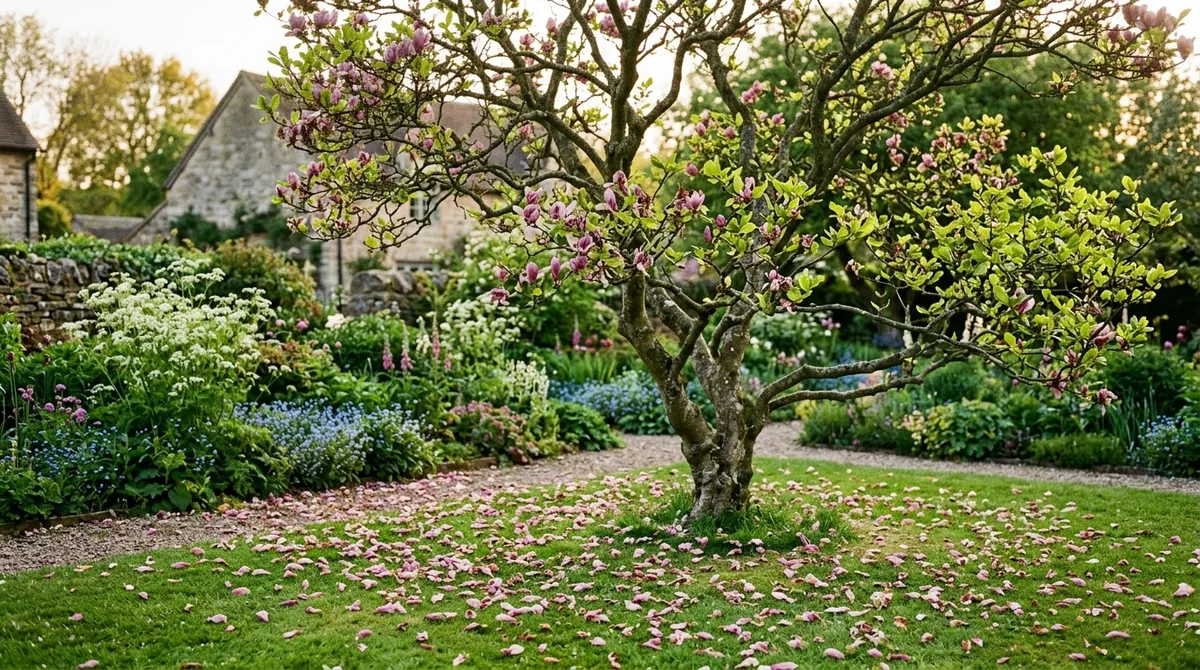
Magnolias hold their late-April or early-May flowering as the high point of the garden year. What you do in the weeks immediately after the petals drop sets the bud count for the spring that follows. Most UK gardeners get the timing wrong, prune too soon, mulch against the trunk, or stop watering as soon as the flowers go over. After 18 years tending four magnolias on heavy Staffordshire clay, the rules below are the ones that move the needle on next year’s display.
This is the companion to our how to grow magnolia UK guide. The growing guide covers siting and planting. This guide covers everything from the moment the last petal hits the lawn through to October.
Why Magnolia Care After Flowering Matters More Than You Think
The flower buds you will see open next April or May are built between mid-July and late August of the previous year. By the time you notice in October that the buds look small, the damage is already done. Every decision you make in the eight weeks after flowering, watering, mulching, feeding, light pruning, pest control, feeds directly into the size and number of those buds.
Magnolia roots sit shallow. Most of the active feeding roots are in the top 250mm of soil. They dry out fast in a dry June or July, especially under a hot brick wall or south-facing fence. A drought-stressed tree shuts down bud formation first and conserves energy for survival. By the time leaves wilt, you have already lost 40-60% of next spring’s flowers.
The other half of the picture is photosynthesis. Healthy green leaves through July, August, and September build the carbohydrates the tree stores in its woody framework. Scale-damaged or mildew-stained leaves cannot do that job. A clean, hydrated, well-mulched tree in August has the energy reserves to produce a full display the following April.
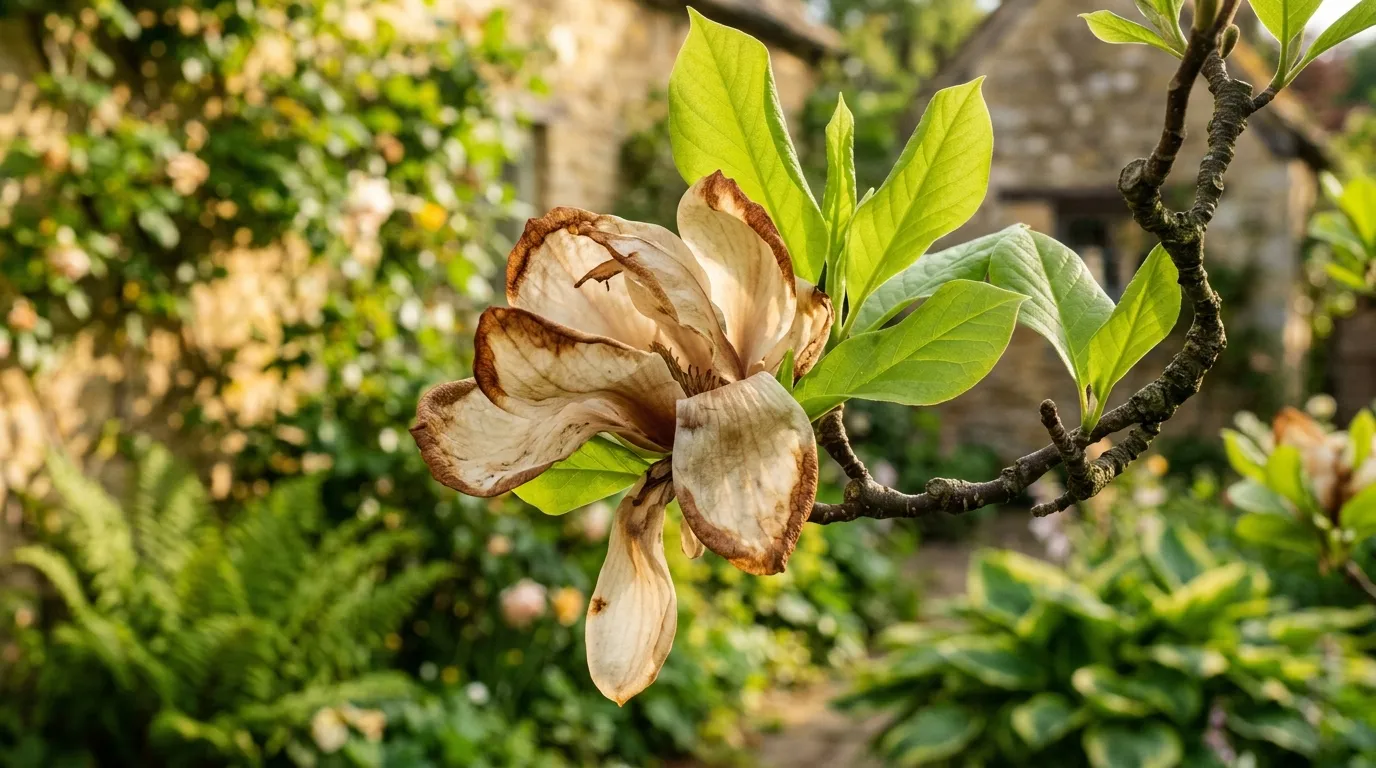 A spent Magnolia x soulangeana bloom in mid-May, still attached to the branch as the leaves open behind. Leave these to drop naturally. Twisting or cutting them off scars the bark and risks die-back.
No. Magnolias are one of the few flowering trees where deadheading does more harm than good.
Magnolia bark is soft and thin. Cuts close to a bud or stem leave wounds that bleed sap and seal slowly. Each cut becomes a potential entry point for coral spot (Nectria cinnabarina) and other fungal die-back. A tree with 200 deadhead wounds in May is a tree showing 200 small brown twig die-backs by June.
Most magnolia petals drop cleanly on their own within 7 to 10 days of opening. If a tepal hangs on, twist it gently between finger and thumb. It will detach at the natural abscission layer without damaging the branch.
Seed pods are not a problem. Many magnolias produce knobbly seed pods through summer that ripen pink and red by September. These divert almost no energy compared to active flower-bud development. Leave them. Birds eat the orange seeds in autumn and they look attractive on a bare winter tree. The exception is a very young magnolia under 3 years old: snap the developing seed pods off in June to push all energy into root establishment.
Mid-July to end of August is the only safe pruning window for UK magnolias. Outside that 8-week period, pruning causes problems.
Spring pruning bleeds heavily. The sap is rising. A cut in April or May can run for weeks and weaken the branch above. Autumn pruning fails to heal. Cuts made in September or October will not callous before the first frosts, leaving the tree open to disease through winter. Winter pruning on deciduous magnolias is technically possible on dormant wood but cuts cannot be assessed for sap response and the risk of frost-cracked wood around fresh wounds is high.
July to August works because the tree is in full leaf, sap pressure has dropped, and cuts callous within 3-4 weeks before any cool nights begin. Keep cuts small, ideally under 25mm diameter. Use sharp bypass secateurs for anything up to 20mm, a pruning saw above that. Cut just outside the branch collar, never flush.
What to prune:
- Crossed branches rubbing against each other
- Dead twigs (snap test, brittle = dead)
- Inward-growing branches blocking airflow in the centre
- A single low side branch if the tree needs raising over a path
What not to prune:
- The leader (top central stem)
- Any branch over 40mm diameter unless absolutely necessary
- More than 10% of the total canopy in any one year
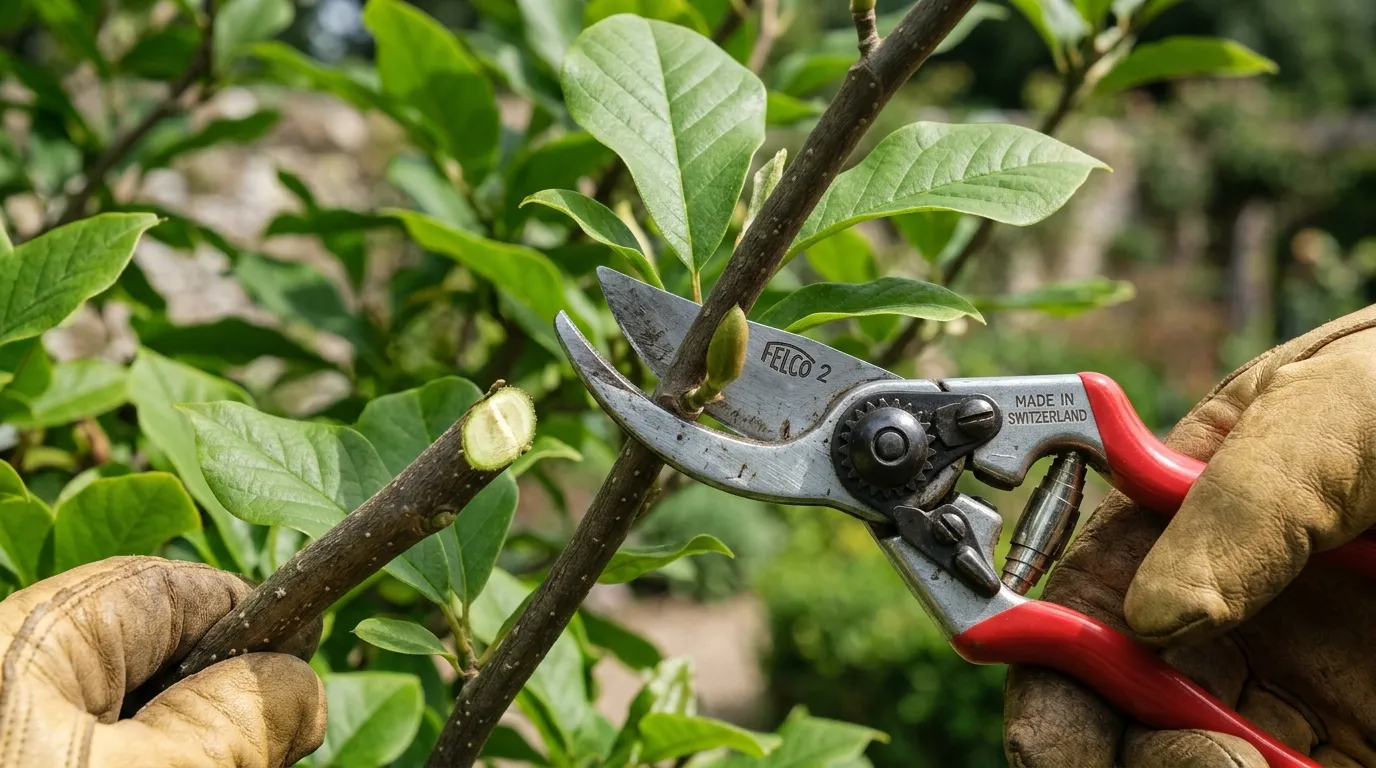 Light July pruning on Magnolia stellata. Cut just outside the branch collar, blade angled away from the bud. Anything over 20mm in diameter needs a pruning saw, not secateurs.
Mulching Magnolias After Flowering UK
Mulch is the single highest-value job in the post-flowering care plan. Done right in late April or early May, it locks in moisture for the dry months ahead and feeds the surface roots slowly.
Use composted bark, leaf mould, or a 50/50 mix. Both materials are slightly acidic, which suits magnolias growing on neutral to slightly acidic soil (pH 5.5 to 6.5 ideal). Composted bark is widely sold as ornamental bark mulch in 60-litre bags from £6-£9. Leaf mould is free if you stockpile autumn leaves for two years.
Avoid mushroom compost: it is too alkaline (often pH 7.5+) and pushes magnolias toward chlorosis. Avoid fresh wood chip from a tree surgeon: it locks up nitrogen as it rots and starves the surface roots.
The application rules:
- Depth: 50mm across the full canopy drip line
- Trunk clearance: 80mm minimum gap of bare soil around the trunk
- Diameter: Mulch out to where the rain falls off the outer branches, typically 1.5-2.5m wide for a mature tree
- Refresh: Top up to 50mm each May. Add a thinner 25mm leaf-mould topdressing in late November
The trunk gap matters. A mulch ring piled against the bark traps moisture, encourages collar rot, and gives slugs and woodlice a route up into the lower bark. Make a doughnut, not a volcano.
Our what is mulch guide covers the science of how organic mulches build soil structure over time. Our woodchip mulch UK guide goes deeper on the nitrogen-lock issue.
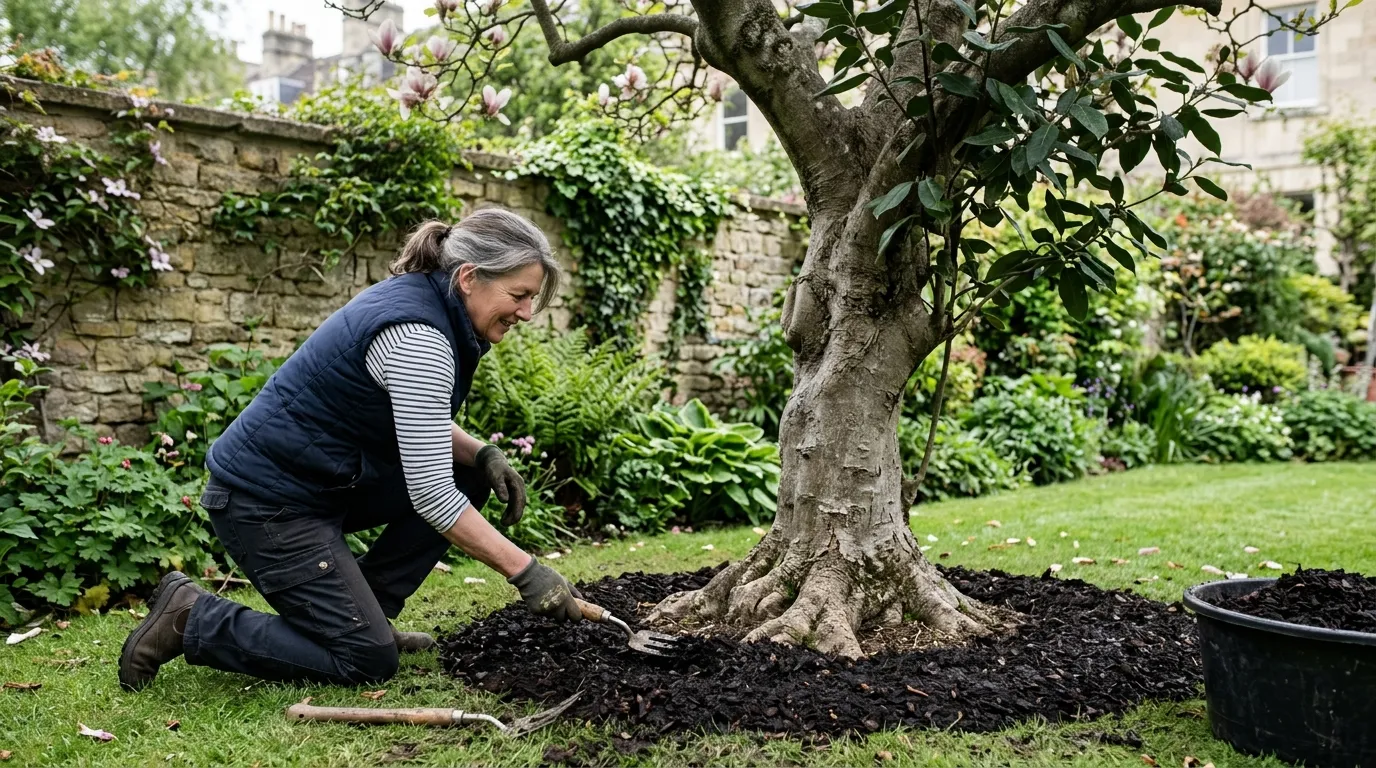 Apply 50mm of composted bark mulch in a ring around the magnolia, keeping the inner edge 80mm clear of the trunk. The doughnut shape prevents collar rot and lets the bark breathe.
Feeding Magnolias After Flowering UK
Magnolias do not need heavy feeding. The wrong feed at the wrong time is worse than no feed at all.
Use a potash-rich, low-nitrogen mix. The aim is to support flower bud formation in July and August, not to push soft leaf growth. A sulphate of potash topdressing at 50g per square metre in late May is the single best feed. Spread it evenly under the canopy and water in. The roots will absorb the potassium over 6-8 weeks, exactly when buds are forming.
Avoid:
- High-nitrogen lawn feed (typically 25-5-5 NPK). Nitrogen runoff into the magnolia root zone causes long whippy shoots and few flowers
- Tomato food (typically 4-3-8 NPK). The phosphorus level is fine but the nitrogen is still too high for an established tree
- Fresh manure. Burns surface roots and floods the soil with nitrogen
Acceptable options if sulphate of potash is unavailable:
- A balanced 5-5-10 NPK shrub feed at 60g per m2
- Wood ash from untreated hardwood at 100g per m2 (only on neutral to acidic soils, never alkaline)
- Comfrey tea diluted 1:15 with rainwater, applied as a soil drench in June
For magnolias on poor sandy soil, add 30g per m2 of bonemeal each October. The slow phosphorus release supports root function through winter.
Watering Magnolias After Flowering to Save Next Year’s Buds
This is the most ignored task in the magnolia year and the highest-impact one. Flower buds for the spring 2027 display will form between roughly 15 July and 30 August 2026. Any drought stress during those 6 weeks cuts bud numbers directly.
Mature trees need 30 litres around the drip line per dry spell. Apply it slowly so water penetrates 200-300mm down rather than running off the surface. A galvanised watering can is fine for small trees. For a tree over 4m tall, lay a leaky hose around the drip line and let it run for 90 minutes once every two weeks during dry weather.
Newly planted magnolias (under 3 years in the ground) need watering every 7 dry days, not 14. Their roots are still establishing and cannot draw from deeper soil reserves.
Water at the drip line, not the trunk. The active feeding roots are at the canopy edge, not against the bole. Watering at the trunk encourages crown rot and does nothing for the roots that actually take up water and nutrients.
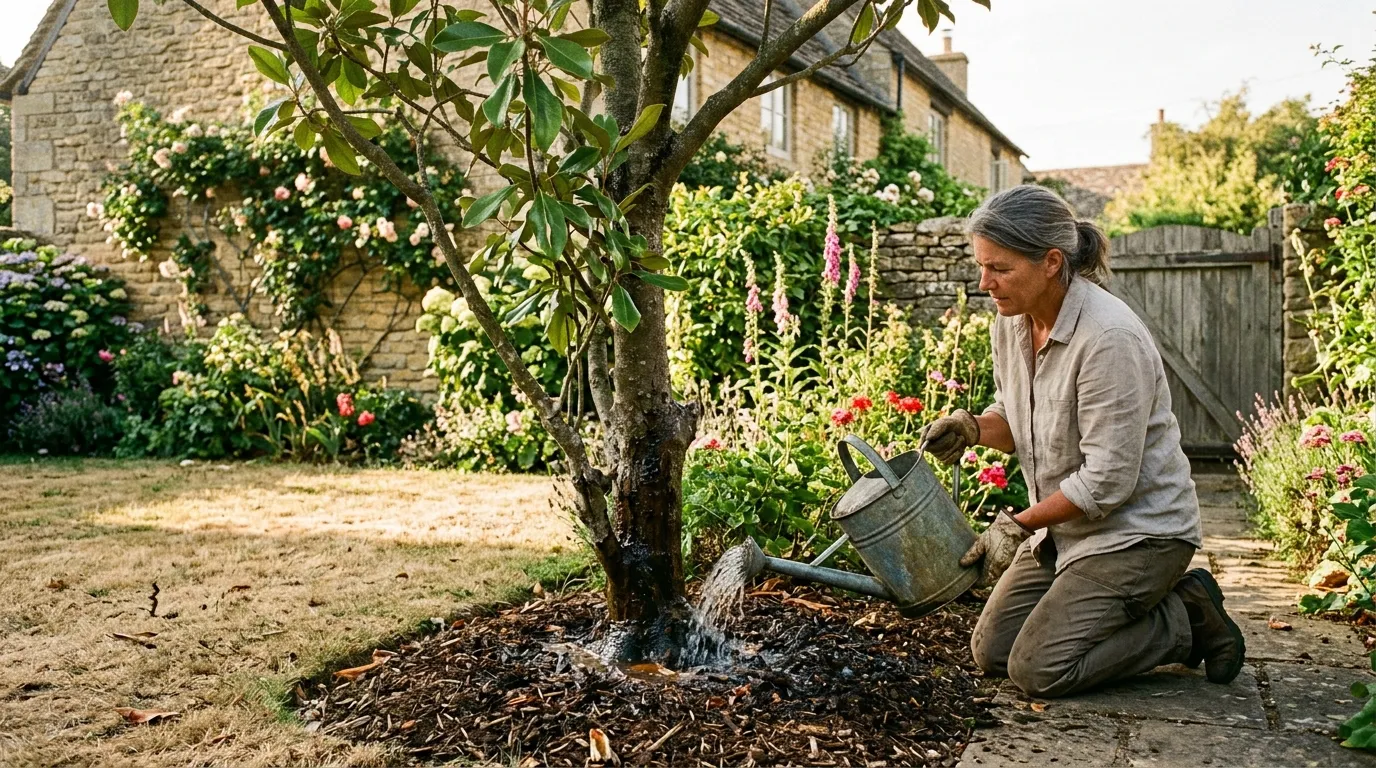 A 30-litre soak at the drip line during a July dry spell. Slow application lets water reach 200-300mm deep where the active feeding roots are. Watering at the trunk does nothing useful.
How Next Year’s Magnolia Flowers Are Made in July and August
Understanding the timing changes how you care for the tree. Magnolia flower buds are not made in spring. They are made the previous summer, while everyone else assumes the tree is just sitting there in leaf.
The lifecycle of a single magnolia flower:
- Late June: Vegetative shoot growth slows. The tree begins reallocating energy from new wood to bud differentiation
- Mid-July to early August: Floral initiation. Cells at the tips of certain short shoots begin organising into a floral primordium. This is the make-or-break window
- Mid-August to late September: Bud expansion and silvering. The bud grows visible, covered in protective silver hairs (technically called pubescence)
- October to February: Dormancy. The bud sits tight and tolerates frost down to -15C
- March to April: Bud break. Tepals expand over 7-14 days as soil temperatures rise above 7C
- Late April to early May: Flowering. The whole show lasts 10-21 days depending on weather
The critical mistake is treating July and August as a quiet period. They are the moment the tree is making the decisions you will see consequences of in spring 2027. Drought, heavy pruning, pest damage, or nutrient stress during this window has direct visible consequences 8-9 months later.
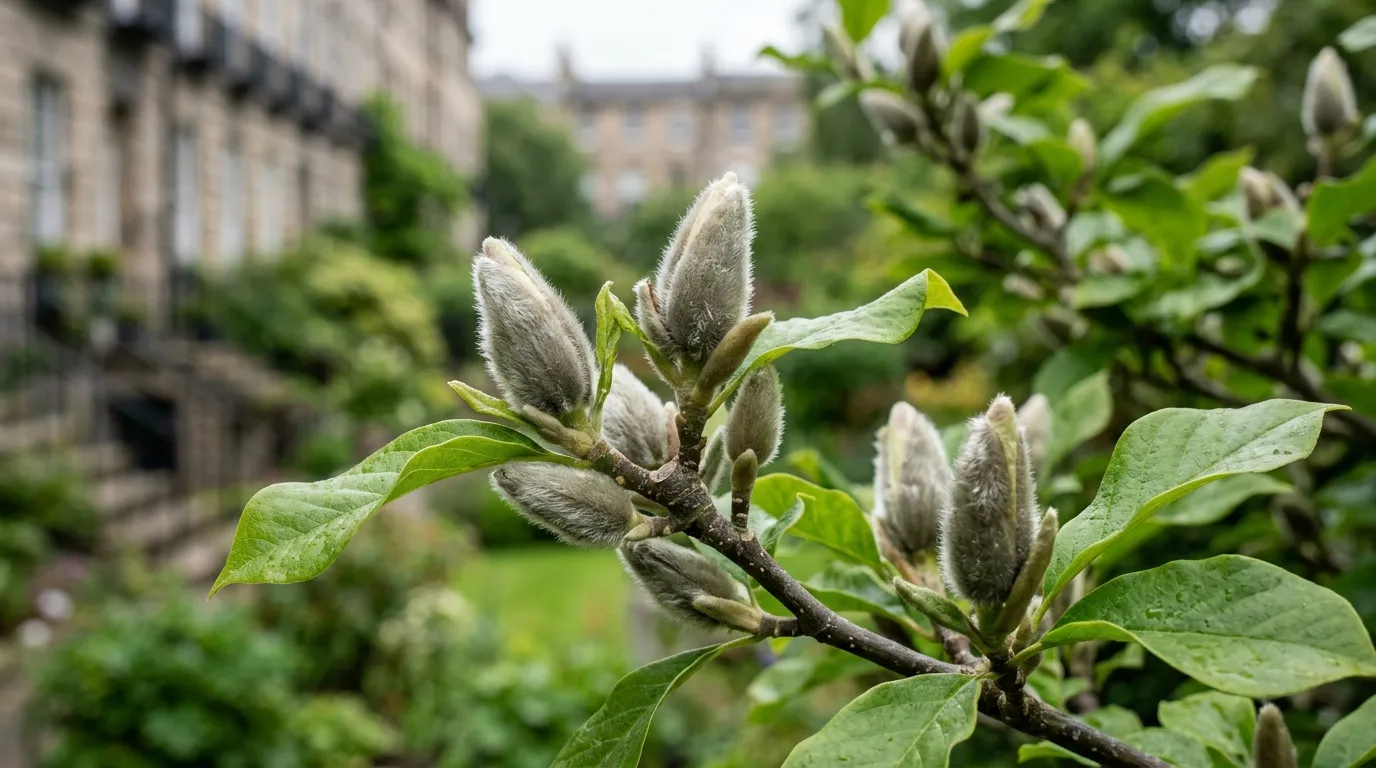 Magnolia flower buds in late August. The silver hairs are protective pubescence. By this stage in the year, bud numbers are set. Care from now on is about protecting what is already there.
Magnolia Variety Comparison: Post-Flowering Care Priority
Different magnolia species have slightly different post-flowering needs. The five most commonly grown in UK gardens are covered below.
| Variety | Post-flowering priority | Pruning month | Mulch type | Feed | Common pest |
|---|---|---|---|---|---|
| Magnolia x soulangeana | Summer watering through dry spells | July to August | Composted bark 50mm | Sulphate of potash 50g/m2 | Magnolia scale |
| Magnolia stellata | Light July tidy, deadwood removal | July | Leaf mould 50mm | Wood ash 100g/m2 | Slugs on low growth |
| Magnolia grandiflora | Leaf wash for sooty mould | August (evergreen) | Composted bark 50mm | Bonemeal 30g/m2 in Oct | Magnolia scale, coral spot |
| Magnolia ‘Susan’ (Little Girl hybrid) | Watering through July-August | July to August | Bark and leaf mould mix | 5-5-10 NPK 60g/m2 | Vine weevil on young plants |
| Magnolia sieboldii | Shade in afternoon, mulch heavy | July only | Leaf mould 75mm | Comfrey tea drench | Honey fungus risk |
Variety-specific notes:
Magnolia x soulangeana is the easiest UK magnolia after flowering. Standard plan: mulch in May, feed once with potash in late May, water through 14-day dry spells, light July prune if needed, scale check in June.
Magnolia stellata is shrubbier and flowers earlier. The early flowering means it has a longer summer for bud development, so it bounces back faster from one bad season. Keep slug bait near the lower branches in May and June.
Magnolia grandiflora is evergreen. The post-flowering window is wider (it flowers June to August) and pruning sits in late August or September instead. Wipe sooty mould off the glossy leaves with a damp cloth in July if scale is present.
Magnolia ‘Susan’ (one of the eight Little Girl hybrids bred by the US National Arboretum) is the smallest UK magnolia and ideal for small gardens. Treat as for soulangeana but with a slightly richer feed because the smaller root volume needs help.
Magnolia sieboldii is the most demanding of the five. It dislikes dry roots and full afternoon sun. Use a thicker 75mm mulch and site away from west-facing walls. Susceptible to honey fungus, so check the pruning shrubs guide for technique before any cuts.
Magnolia Month-by-Month Calendar April to October
| Month | Task |
|---|---|
| Late April | Flowering begins (soulangeana, stellata, Susan). Spray water on buds if hard frost forecast below -3C overnight. |
| Early May | Flowering ends on most varieties. Petals drop naturally. Do not deadhead. |
| Mid May | Apply 50mm bark or leaf-mould mulch across the drip line, 80mm clear of the trunk. |
| Late May | Apply 50g per m2 sulphate of potash. Water in if dry. |
| June | First scale insect check on leaf undersides. Wipe small infestations with damp cloth. Slug watch around stellata. |
| Early July | Light pruning window opens. Crossed branches, dead twigs, inward growth only. |
| Mid July | Bud formation begins. Trigger summer watering if 14 days no rain. Apply 30 litres at drip line. |
| Late July | Continue water trigger. Second scale check. SB Plant Invigorator spray if needed. |
| August | Buds visibly forming, silvery and fuzzy. Continue water trigger. Light pruning still acceptable to end of month. |
| Early September | Pruning window closes. Stop feeding. Reduce watering to twice monthly if dry. |
| Mid September | Final pest check. Sooty mould wipe on grandiflora if needed. |
| October | Apply 30g per m2 bonemeal on sandy soils only. Plant new magnolias if needed (best month). |
Magnolia Pruning Mistakes UK
The pruning errors that cause the most damage to UK magnolias are predictable. Watch for these five.
Mistake 1: Spring pruning
The most common mistake. People look at the tree in April or May and decide to tidy it up while they have the secateurs out. Spring pruning causes heavy sap bleeding, drains the tree of energy at flowering, and rarely heals before summer dry weather stresses the wound. Wait until mid-July.
Mistake 2: Autumn pruning
The second most common. People prune as part of a general autumn tidy-up in September or October. The cuts will not callous before frost, water enters the wound, the wood freezes and cracks, and you have a die-back to deal with by spring. Never prune magnolias after end of August.
Mistake 3: Cutting large branches
A 60mm diameter branch removal leaves a wound that takes 3-5 years to heal on magnolia (compare to 1-2 years on apple). The wound is a route for coral spot and other die-back fungi. Keep all cuts under 25mm where possible. If a major branch genuinely needs removing, do it in stages over 2-3 years, taking 200mm off the tip each July.
Mistake 4: Flush cuts
Cutting flush against the trunk removes the branch collar, the swollen ring of tissue that produces the wood plug to seal the wound. Without the collar, the wound cannot heal. Cut just outside the visible collar swelling, leaving 3-5mm of branch tissue.
Mistake 5: Heavy deadheading
Already covered above. Worth repeating. Soft magnolia bark scars from each cut, sap bleeds, fungal entry follows. Twist spent flowers off by hand, or just leave them to drop.
Watch List: UK Magnolia Pests and Diseases
Three problems cover 90% of UK magnolia issues.
Magnolia scale (Neolecanium cornuparvum and Pulvinaria hydrangeae). The big one. Adult scales are 5-12mm long, brown to grey, oval, found on leaf undersides and young stems. They suck sap and excrete sticky honeydew that drips on leaves below, then turns black with sooty mould. Heavy infestations weaken the tree and cut bud count by 30-50%. Check in June and July when crawler stages are most vulnerable.
Treatment hierarchy:
- Wipe small infestations off with a damp cloth (effective on under 20 visible scales)
- SB Plant Invigorator spray every 7 days for 4 weeks in late June and early July
- Horticultural soap drench in early July
- Avoid systemic insecticides where possible: they kill the natural parasitoid wasps that long-term keep scale in check
Honey fungus (Armillaria mellea). Affects sieboldii and grandiflora most heavily. Black bootlace rhizomorphs visible under the bark at soil level. White mycelium fan-shaped between bark and wood. Usually fatal once established. Prevention is the only real defence: do not plant magnolias in soil where honey fungus is known to exist. Garden Organic’s expert advice library covers organic prevention measures for soil-borne diseases of UK trees.
Coral spot (Nectria cinnabarina). Bright coral-pink pustules on dead twigs. Enters through pruning wounds and frost cracks. Prune affected twigs back to clean wood, dispose of clippings, do not compost. The single best prevention is pruning only in July and August when wounds callous fastest.
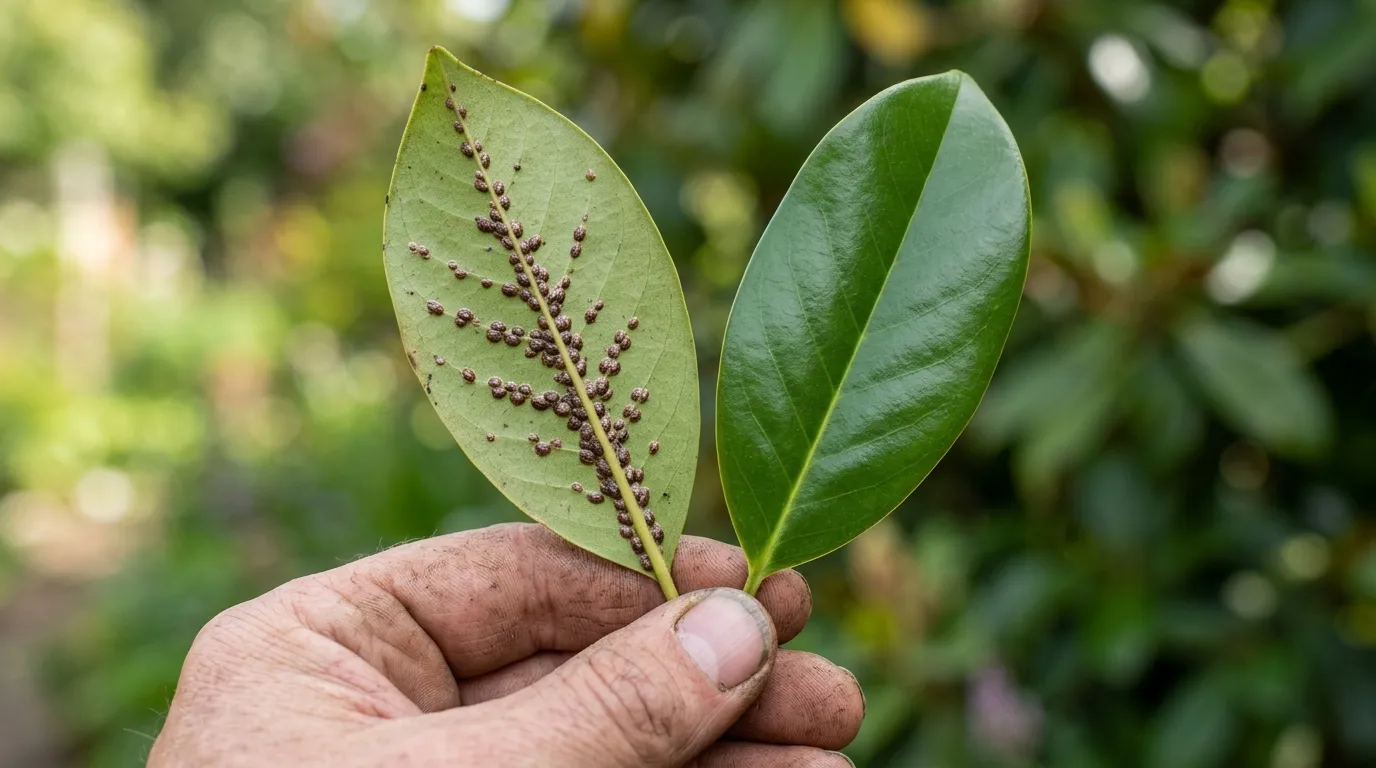 Left: magnolia scale on a leaf underside, the brown oval bumps along the central vein. Right: a healthy clean leaf for comparison. Check in June and July when crawler stages are most vulnerable.
Where to Read More
The Magnolia Society International publishes journals, cultivar descriptions, and species notes covering 1,500+ named magnolias, useful when identifying an unknown garden tree. For wider summer-pruning context, our shrubs to prune in summer guide covers the woody plants that share the July to August window with magnolias. For the spring side of the calendar, our best flowering shrubs guide covers the wider category. The spring pruning guide covers what to prune now and what to leave alone.
Frequently Asked Questions
Should I deadhead my magnolia after flowering?
No, heavy deadheading damages magnolia bark and reduces next year’s flowers. Magnolia wood is soft and scars easily. Most petals drop cleanly on their own within 7-10 days. If a bloom hangs on, twist it off by hand rather than cutting. Leave seed pods to ripen naturally.
When should I prune a magnolia in the UK?
Prune magnolias only between mid-July and end of August. Spring pruning causes heavy sap bleeding. Autumn or winter cuts will not heal before frost and let in disease. Keep cuts small, under 25mm diameter where possible. Use sharp bypass secateurs or a pruning saw on larger branches.
What is the best mulch for a magnolia?
A 50mm layer of composted bark or leaf mould is best for UK magnolias. Keep the mulch ring 80mm clear of the trunk to prevent collar rot. Apply in late April or early May after the soil has warmed. Top up in November with a thinner 25mm layer of leaf mould.
Why did my magnolia not flower this year?
The commonest cause is drought stress the previous summer. Magnolia flower buds for spring 2027 form in July and August 2026. A two-week dry spell during bud formation can cut bud count by 50-70%. Other causes are spring frost on the buds, heavy pruning, and shade from new neighbouring growth.
How do I feed a magnolia after flowering?
Apply 50g per square metre of sulphate of potash in late May, just under the canopy. Avoid high-nitrogen lawn feeds: they push soft leaf growth at the expense of flower buds. A topdressing of well-rotted leaf mould in November adds slow-release nutrients. Magnolias on poor sandy soil also benefit from 30g per m2 of bonemeal in October.
Should I water my magnolia in summer?
Yes, water mature magnolias through any UK dry spell longer than 14 days from June to September. Apply 30 litres around the drip line, not at the trunk. Soak slowly so water reaches the root zone 200-300mm down. Newly planted magnolias under 3 years old need water every 7 dry days.
What are the brown bumps on my magnolia leaves?
Brown oval bumps on leaf undersides are usually magnolia scale, the commonest UK magnolia pest. Adult scale insects are 5-12mm long. Wipe small infestations off with a damp cloth in June. Heavy infestations need an SB Plant Invigorator spray or a horticultural soap drench in early July when crawlers are active.
Now Protect Next Year’s Display
The magnolia year does not end when the petals drop. It restarts. Mulch in May, feed once with potash, water through every 14-day dry spell, and watch for scale in June and July. Light pruning if needed in late July, then leave the tree alone from September onwards. Do this for one full season and the difference in spring bud count is visible.
Now you have the after-flowering care plan, read our how to grow magnolia UK guide for the siting, soil, and planting rules that set a magnolia up for a 100-year life in the same position.
Our team produces practical UK gardening guidance from source research, contributor records and established horticultural practice. Editorial standards are overseen by Matt W.