Quick answer
Nordmann fir is the UK's most popular real Christmas tree because it holds its needles for four weeks or more and has soft, glossy foliage. Fraser fir is slimmer and smells fresher. Norway spruce is cheapest and smells most Christmassy, but drops needles fast, so buy it mid-December. In 2026 Lidl sells cut Nordmann firs from £16.99, while a delivered 6ft Nordmann usually costs about £80-105.
Key points6 at a glance
- Nordmann fir is the safe all-rounder, with soft needles that stay on for four weeks or more
- Fraser and Noble fir also hold their needles well and smell nicer than Nordmann
- Norway spruce has the classic scent and the lowest price, but drops needles within two to three weeks
- Buy a tree about 30cm shorter than your ceiling to leave room for the stand and topper
- Pot-grown trees can be kept and replanted, but "potted" or containerised cut trees rarely survive
- 2026 prices run from about £17 at Lidl to £80-105 for a delivered 6ft Nordmann
In this article11 sections
There are about a dozen types of real Christmas tree on sale in the UK, but most people choose between three. Nordmann fir is the safe bet: soft needles that stay put for weeks. Fraser fir is slimmer and smells fresher. Norway spruce is the cheap, traditional tree with the best scent, but it sheds fast.
This guide compares every type you’re likely to see at a farm, garden centre or supermarket. It covers needles, scent, shape and price. You’ll also find 2026 prices and a simple size rule. Then there’s the difference between cut, pot-grown and “potted” trees, which catches lots of people out. Once you’ve chosen, our real Christmas tree care guide shows how to keep it fresh until January.
Types of real Christmas tree compared
Nordmann fir is the best choice for most homes, with Fraser and Noble fir close behind. Spruces smell lovely and cost less, but drop needles sooner. Pines are less common but long-lasting.
| Tree | Needles stay on | Scent | Needles feel | Price | Good for |
|---|---|---|---|---|---|
| Nordmann fir | Very well | Faint | Soft, glossy | £££ | Most homes, children, heavy decorations |
| Fraser fir | Very well | Fresh, pine | Soft, short | £££ | Narrower rooms, scent with little mess |
| Noble fir | Very well | Fresh | Soft, blunt | £££ | A neat, layered shape with silvery-blue colour |
| Korean fir | Very well | Faint | Soft | ££ | Small pot-grown trees for flats and tables |
| Norway spruce | Poorly | Strong, classic | Short, sharp | £ | Scent and a low price, bought mid-December |
| Blue spruce | Fairly well | Light | Very prickly | ££ | Silver-blue colour, homes with curious pets |
| Serbian spruce | Fairly | Pleasant | Soft, flat | ££ | A slim, elegant shape |
| Lodgepole pine | Well | Strong pine | Long, soft | ££ | Big rooms and high ceilings |
| Scots pine | Well | Strong pine | Long, soft | ££ | A native British tree with a loose, natural shape |
Buying from a local grower or garden centre usually gets you a fresher tree that hasn’t travelled far. Look for the British Christmas Tree Growers Association (BCTGA) label as a sign of a UK-grown tree. Our garden centre directory lists ones near you.
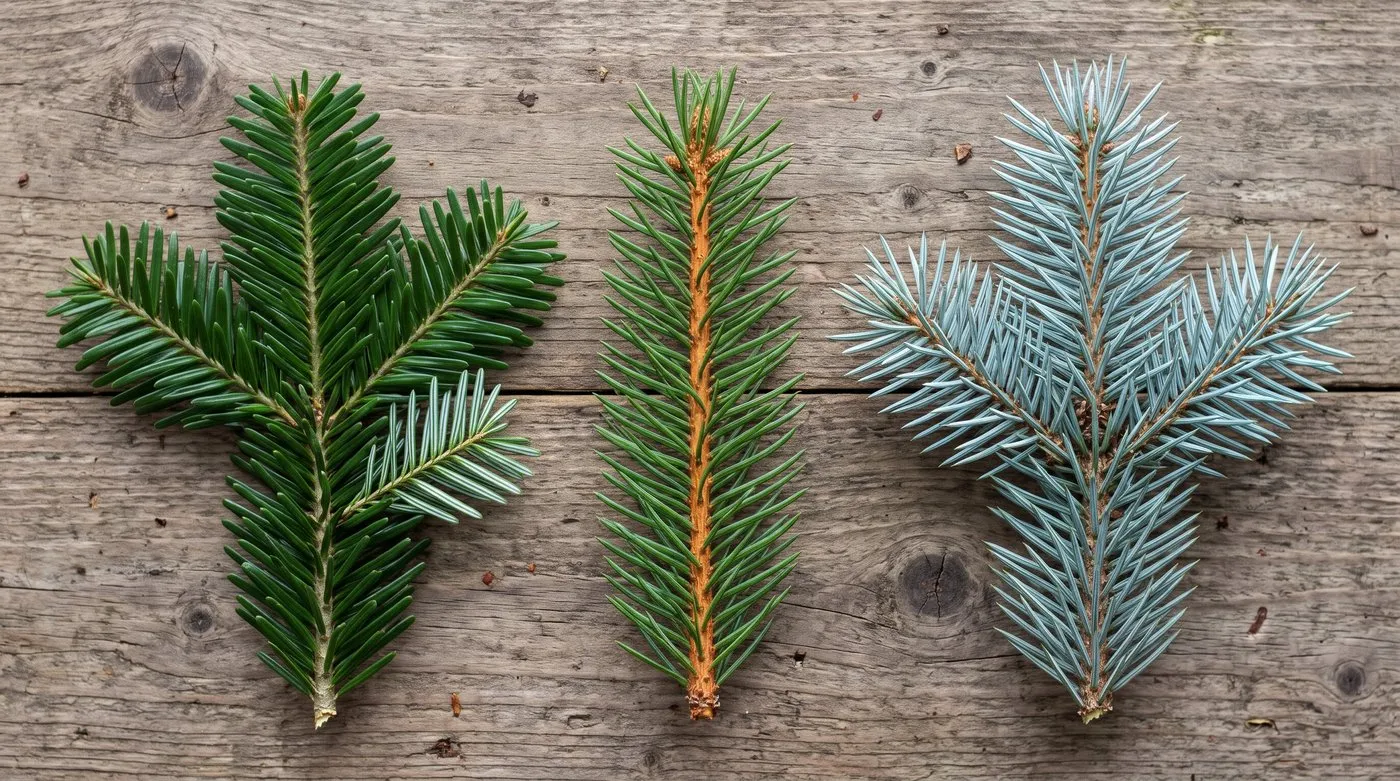
From left: Nordmann fir has flat, glossy needles. Norway spruce has short, sharp ones. Blue spruce is silvery and very prickly.
Nordmann fir: the UK’s favourite Christmas tree
Nordmann fir (Abies nordmanniana) is the UK’s most popular real Christmas tree. It earns that spot by being easy. The soft, glossy dark green needles have a pale stripe underneath. Keep the stand topped up and they’ll stay on for four weeks or more. They’re kind on small hands, too.
Its branches are strong and evenly spaced, so heavy glass baubles hang well without drooping. The shape is a full, even cone, which means it takes up more floor space than a Fraser of the same height.
The only real downside is scent. A Nordmann smells of very little. For that Christmas forest smell, add a few cut sprigs of pine or a Fraser fir wreath. It also costs more than spruce, because it takes longer to grow.
Buy it: from the last weekend of November. A watered Nordmann bought in early December will still look good on Christmas Day.
Fraser fir and Noble fir: good scent, low needle drop
Fraser fir (Abies fraseri) is the tree to pick if you want low mess and a fresh pine smell. Its needles are short, soft and dark blue-green with silvery undersides. It grows as a slimmer cone than Nordmann, so it fits better in a smaller living room or beside a sofa. Its stiff branches hold decorations well.
Noble fir (Abies procera) has a lovely layered shape with upswept, blue-green branches and blunt, soft needles. It holds its needles very well and has a fresh scent. Nobles are less common in the UK and cost more. Still, it’s a beautiful tree if you find one.
Both are good alternatives if you’ve had a Nordmann for years and fancy a change.
Norway spruce: the traditional tree that sheds fastest
Norway spruce (Picea abies) is the classic British Christmas tree and the one with the strongest Christmas smell. It’s usually the cheapest tree on the lot, and it’s the type sent from Norway each year to stand in Trafalgar Square.
The catch is needle drop. In a warm house a Norway spruce starts shedding its short, slightly sharp needles within two to three weeks. To get the best from one:
- Buy it about 10 days before Christmas, not at the start of December
- Saw 2.5cm off the base and stand it in water straight away
- Keep it well away from radiators, fires and sunny windows
- Check the stand water every single day
If you love the scent but hate hoovering, a Norway spruce outside the front door and a Nordmann indoors is a good compromise.
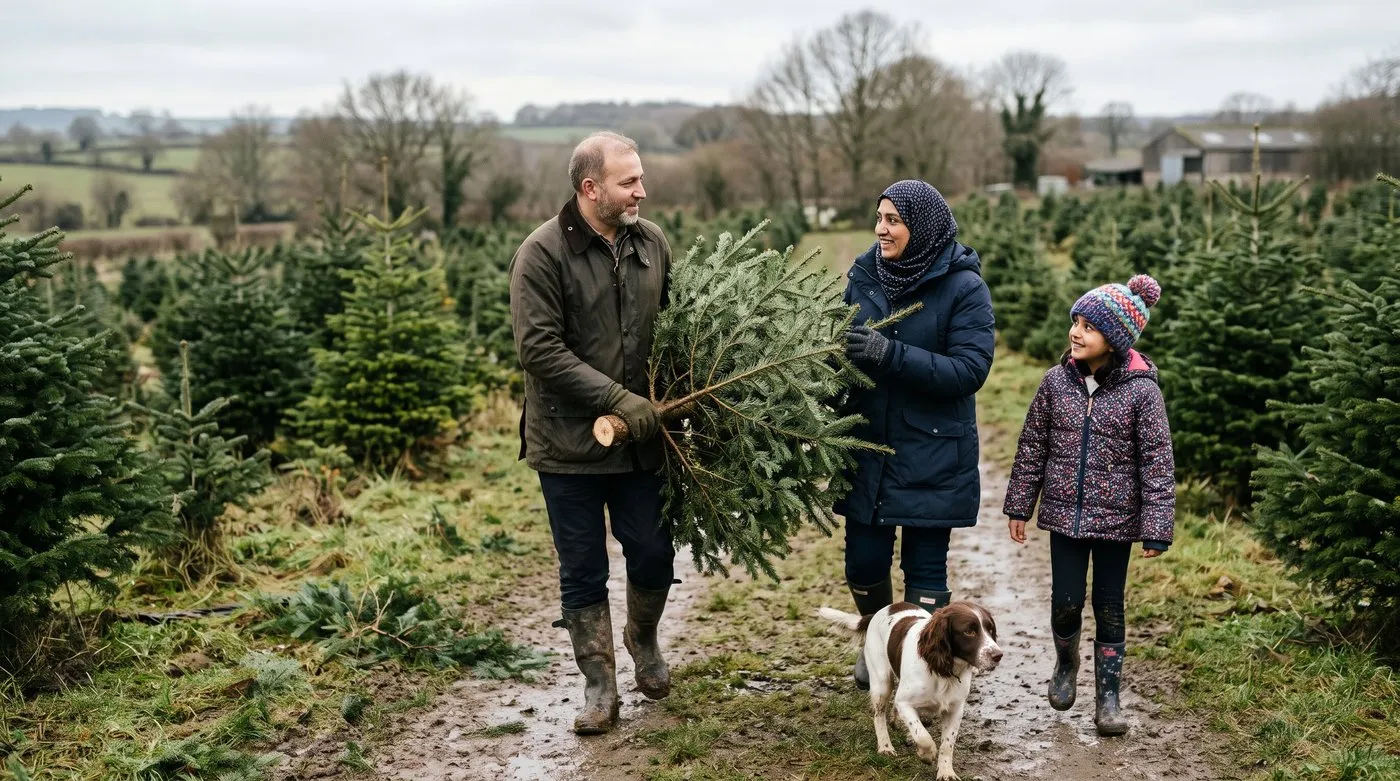
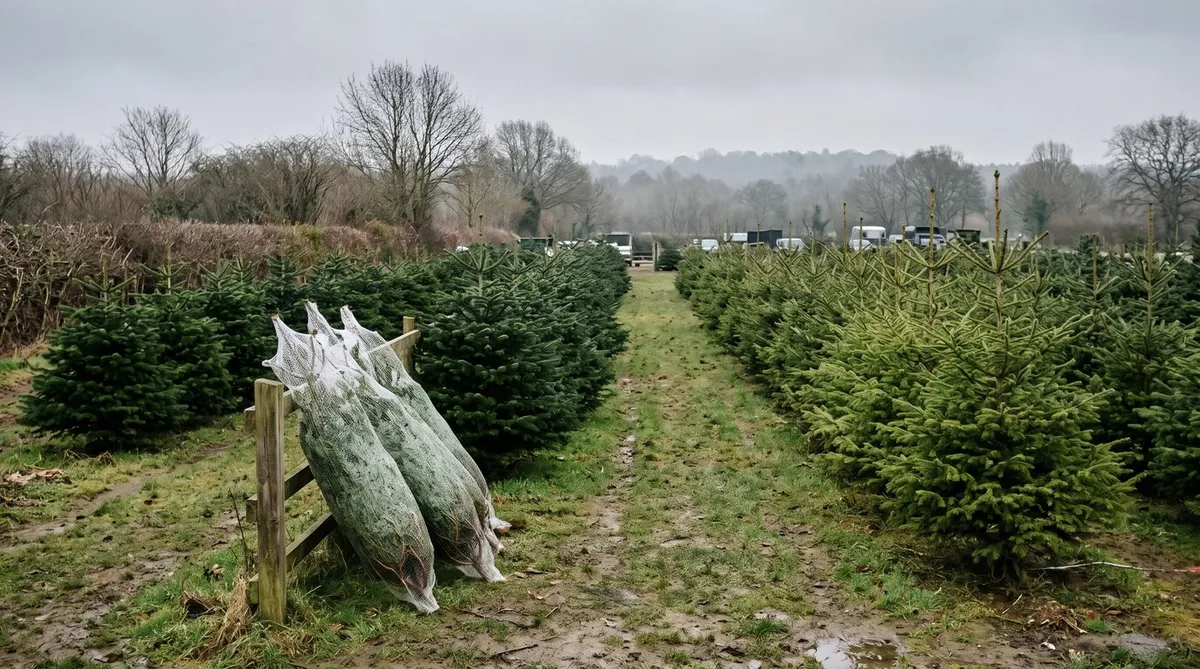
A choose-and-cut farm is the freshest way to buy any type of real tree.
Blue spruce, Korean fir and other trees you’ll see
Blue spruce (Picea pungens) has striking silver-blue needles and stiff branches that hold heavy decorations. The needles are very sharp, so wear gloves when you decorate. Some owners like that it puts cats off climbing it.
Korean fir (Abies koreana) grows slowly and stays small. It’s mostly sold as a neat pot-grown tree for tables, flats and doorsteps. It holds its needles very well.
Serbian spruce (Picea omorika) is a slim, graceful tree with flat, soft needles that have silver undersides. It smells pleasant but doesn’t hold its needles as well as a fir.
Lodgepole pine and Scots pine have long, soft needles, a strong pine scent and an open, natural shape. Pines generally hold their needles well. Lodgepoles suit big rooms and high ceilings. Scots pine is a native British tree, which appeals if you’d like something a bit different.
How much is a real Christmas tree in 2026?
A real Christmas tree costs from about £17 to over £100 in 2026. It depends on the type, the size and where you buy it.
| Where | 2026 example | What to know |
|---|---|---|
| Lidl | Cut Nordmann fir, 150-180cm £16.99, 190-210cm £26.99 | In store from 19 November while stocks last. Grab one early |
| Online growers (delivered) | 6ft cut Nordmann about £80-105 | Delivered to your door. Check the exact height, not “approx 6-7ft” |
| Garden centres and farm shops | Varies by area | Choose the actual tree, often with netting and a fresh cut done for you |
| Choose-and-cut farms | Varies by farm | The freshest tree, and a fun day out |
Norway spruce is cheaper than Nordmann at the same height. Pot-grown trees cost more than cut ones, because they’ve been grown for years in a pot.
There’s no national shortage this year. Some growers lost young trees in the dry summer of 2026, but those are the trees for future Christmases. Prices at most sellers are similar to last year.
What size Christmas tree should I buy?
Choose a tree about 30cm (1ft) shorter than your ceiling. That leaves room for the stand underneath and a star or angel on top. If your topper is tall, allow a little more.
Most UK homes have ceilings of about 2.4m (8ft), so a 6-7ft tree fits well. Older houses with high ceilings can take 8ft or more. Flats and new-builds are sometimes lower, so measure before you go.
Don’t forget width. A full Nordmann is roughly two-thirds as wide as it is tall. So a 6ft tree needs about 1.2m of floor space. A Fraser or Serbian spruce is slimmer if your space is tight.
Before you go, measure:
- Floor to ceiling where the tree will stand
- The width of the space, including room to walk past
- Your doorways and stairs, so you can get it in
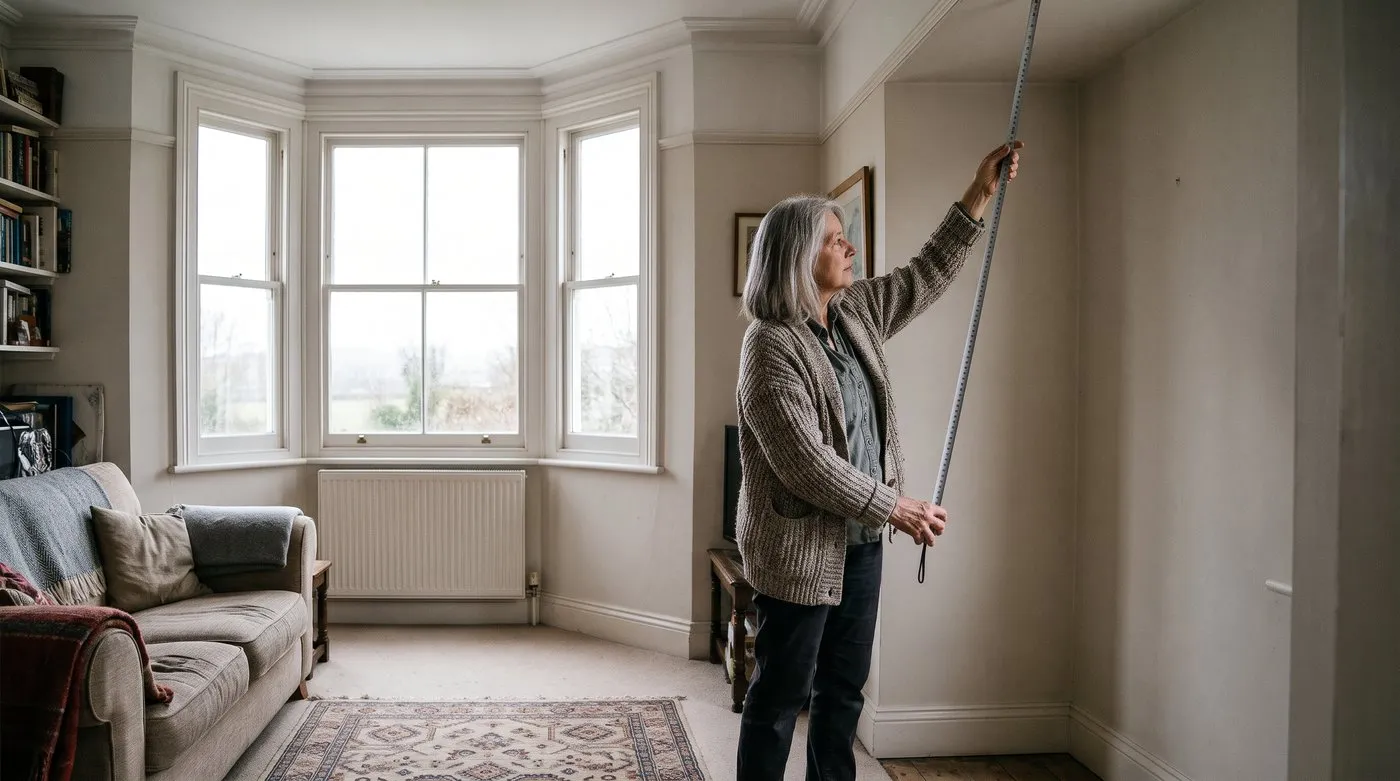
Measure the room first. A tree that looked small outside often looks huge indoors.
Cut, pot-grown or potted: which kind of tree?
These three labels sound alike but mean very different things.
- Cut trees are sawn off at ground level. They’re the cheapest and last about four weeks indoors with daily water. They can’t be replanted.
- Pot-grown trees (also called container-grown) have grown in their pot for years, so their roots are whole. They cost more but can go back outside after Christmas and be reused for a few years.
- Potted or containerised trees were grown in a field, dug up with a small rootball and pushed into a pot. Most lose too many roots to survive, so treat them like a cut tree.
If you want a tree you can keep, ask the seller directly: “Was this grown in this pot?” A pot-grown tree feels firmly rooted and doesn’t wobble when you tug the trunk.
Keep any living tree indoors for no more than about 10-12 days. Bring it in the weekend before Christmas, keep it cool and water it often. Our guide to planting a bare-root tree covers putting it in the ground afterwards.
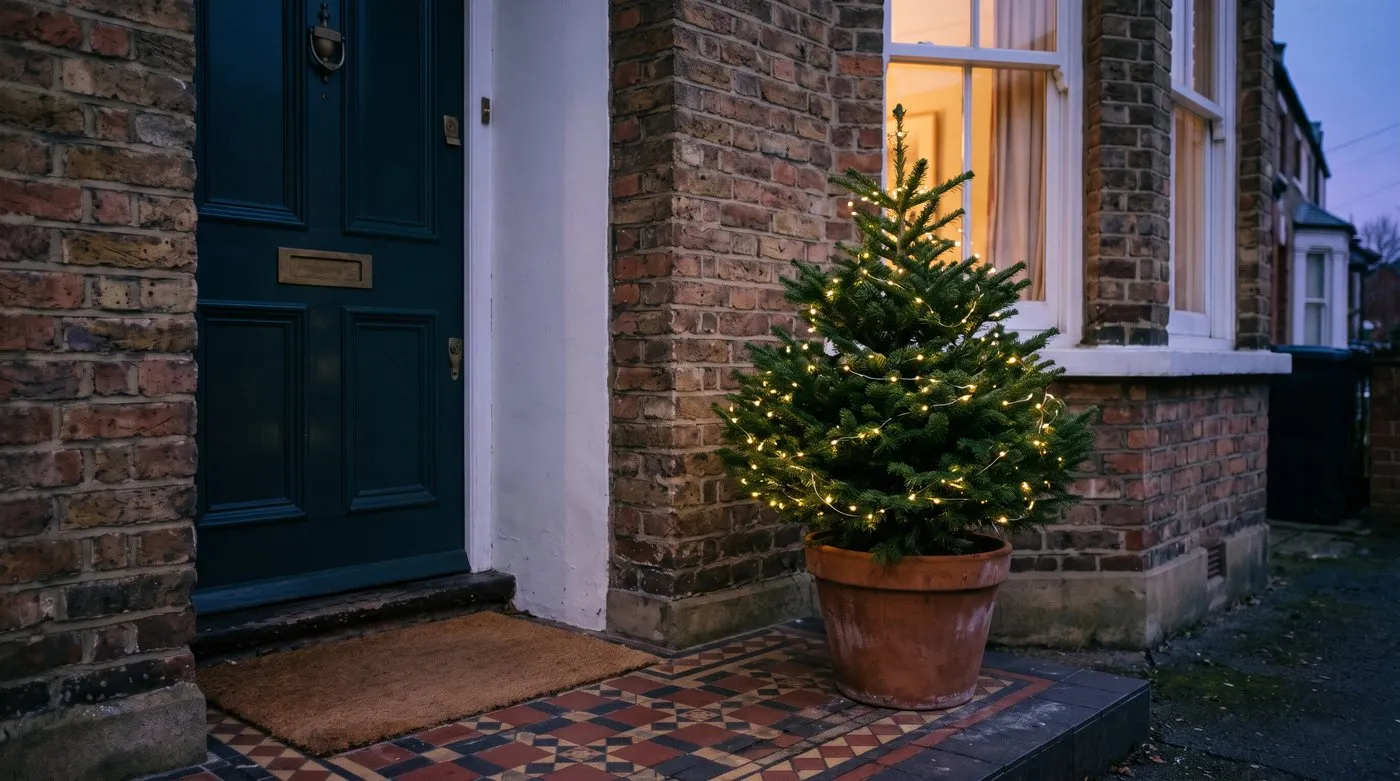
A small pot-grown Korean fir can live outside the front door for years.
How to choose a fresh tree when you buy
A fresh tree lasts weeks longer, so spend two minutes checking before you pay.
- Bend a needle. It should flex, not snap. Brittle needles mean a dry tree.
- Give it a bounce. Lift it a few centimetres and drop it on its base. A few needles falling is normal. A shower is not.
- Check the trunk. Look for about 30cm of clear trunk at the base to fit your stand. Avoid trees with a wooden block nailed to the bottom, as they can’t drink.
- Look at the colour. Needles should be glossy, with no brown or grey patches inside the tree.
Ask for it to be netted. It’s far easier to carry and get through the door. Stand it in its stand first, then cut the net from the bottom up and let the branches drop overnight.
Common mistakes when buying a Christmas tree
Buying a Norway spruce too early. It will look tired by Christmas Day. Wait until mid-December, or choose a fir.
Guessing the height. Trees look smaller outdoors. Measure the ceiling, and check the exact height of a delivered tree.
Thinking “potted” means replantable. Only pot-grown trees usually survive. Ask how it was grown.
Choosing blue spruce for small children. The needles are very sharp. Pick a Nordmann or Fraser instead.
Skipping the fresh cut. Whatever type you buy, saw 2.5cm off the base when you get home. A sealed trunk can’t drink, and that’s what makes any tree drop.
Frequently asked questions
What is the best real Christmas tree in the UK?
Nordmann fir is the best all-rounder for most homes. Its soft, glossy needles stay on for four weeks or more, and its strong branches take heavy decorations. Fraser fir is a good choice if you want more scent in a narrower tree.
Which Christmas tree smells the best?
Norway spruce has the strongest classic Christmas smell. Fraser fir, Noble fir and Scots pine also have a lovely fresh scent. Nordmann fir has very little scent, which suits some people better.
Which Christmas tree doesn’t drop needles?
Nordmann, Fraser, Noble and Korean fir drop the fewest needles. Every real tree sheds a few, but these stay tidy for around four weeks if watered daily. Norway spruce drops needles fastest.
What is the difference between Nordmann and Norway spruce?
Nordmann fir has soft, flat, glossy needles that stay on for weeks. Norway spruce has short, sharp needles, a stronger scent and a lower price. It also starts dropping needles within two to three weeks in a warm house.
How much is a real Christmas tree in 2026?
A real Christmas tree costs from about £17 to over £100 in 2026. Lidl sells cut Nordmann firs at £16.99 and £26.99 while stocks last. A delivered 6ft Nordmann from an online grower usually costs about £80-105.
What size Christmas tree should I get?
Choose a tree about 30cm shorter than your ceiling. That leaves room for the stand and a star or angel on top. Most UK homes have ceilings of about 2.4m (8ft), so a 6-7ft tree fits well.
Can you replant a cut Christmas tree?
No, a cut tree has no roots, so it can’t be replanted. If you want a tree to plant out afterwards, buy a pot-grown tree. Grown in its pot from a seedling, it has a full set of roots.
Now you’ve picked your tree, read our real Christmas tree care guide to keep it fresh until Twelfth Night. In January, our guide on when to take the Christmas tree down covers recycling it, and you’ll find more festive ideas in our plant guides.
Our team produces practical UK gardening guidance from source research, contributor records and established horticultural practice. Editorial standards are overseen by Matt W.