Key takeaways
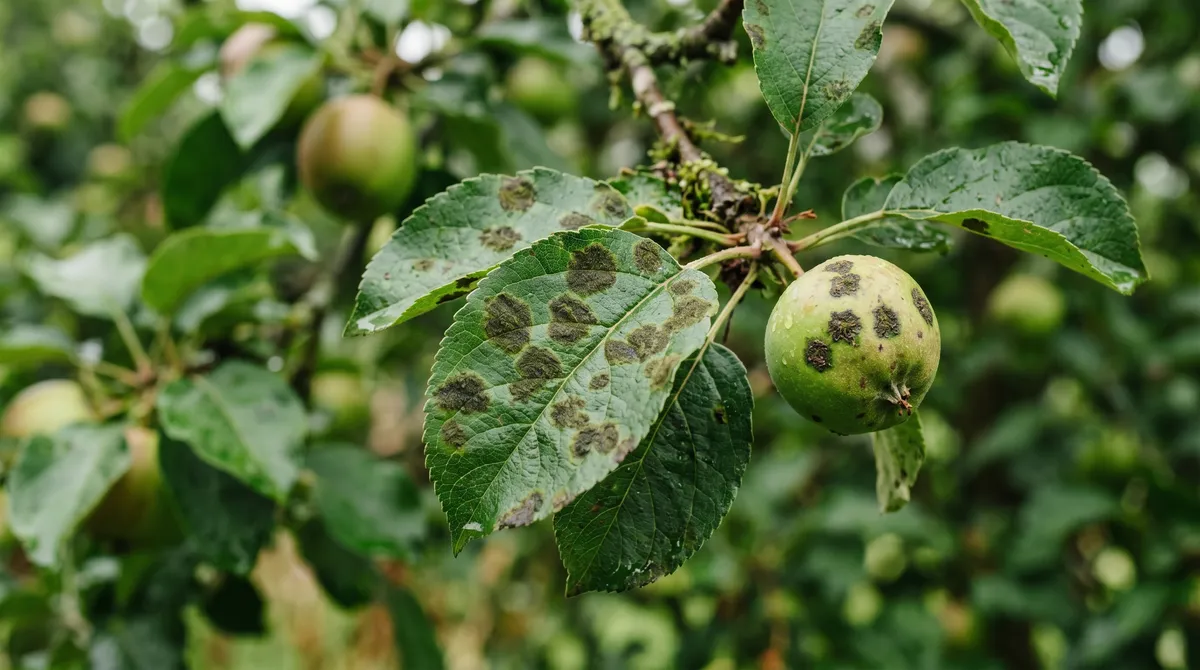
- Olive-green to dark brown spots on leaves with feathery margins
- Matching corky scab spots on fruit, often around the calyx end
- Worst in wet UK springs (March-May)
- Resistant varieties: Discovery, Falstaff, Topaz (apple); Concorde, Beth (pear)
- Rake and remove all fallen leaves in autumn
- Copper or potassium bicarbonate sprays at green-tip and pink bud stages
Apple scab and pear scab are the most common UK fruit tree diseases. Caused by Venturia fungi (V. inaequalis on apples, V. pyrina on pears), the diseases produce dark spots on leaves and corky scab patches on fruit. This guide covers identification, the Venturia lifecycle, resistant variety choices, sanitation and spray timing.
Scab Identification
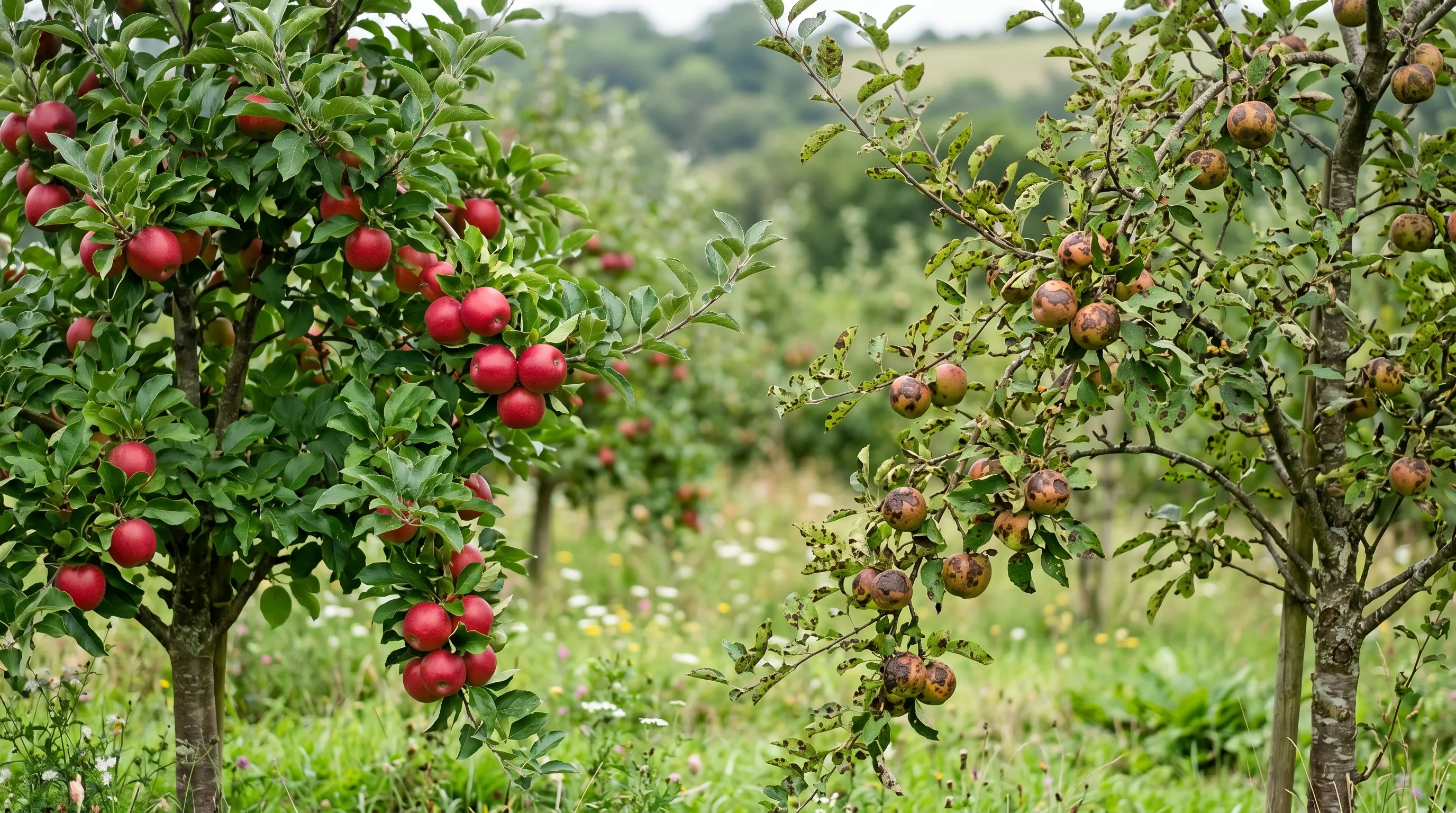
On leaves: olive-green to dark brown circular spots with feathery, indistinct margins, often following leaf veins. Heavily infected leaves yellow and drop early.
On fruit: small dark spots ripening to corky scab patches, often clustered around the calyx (flower end) of the fruit. Severe cases produce cracked or distorted fruit. Fruit remains edible (cut away scab patches) but storage life drops sharply.
On young shoots: raised dark scabs on bark, can develop into bark cankers over 2-3 years. Do not confuse these with apple tree burr knots, which are harmless woody root-like bumps rather than scab lesions.
Pear scab shows the same pattern but spots tend to be smaller and darker. Both diseases follow similar lifecycle and respond to similar control measures.
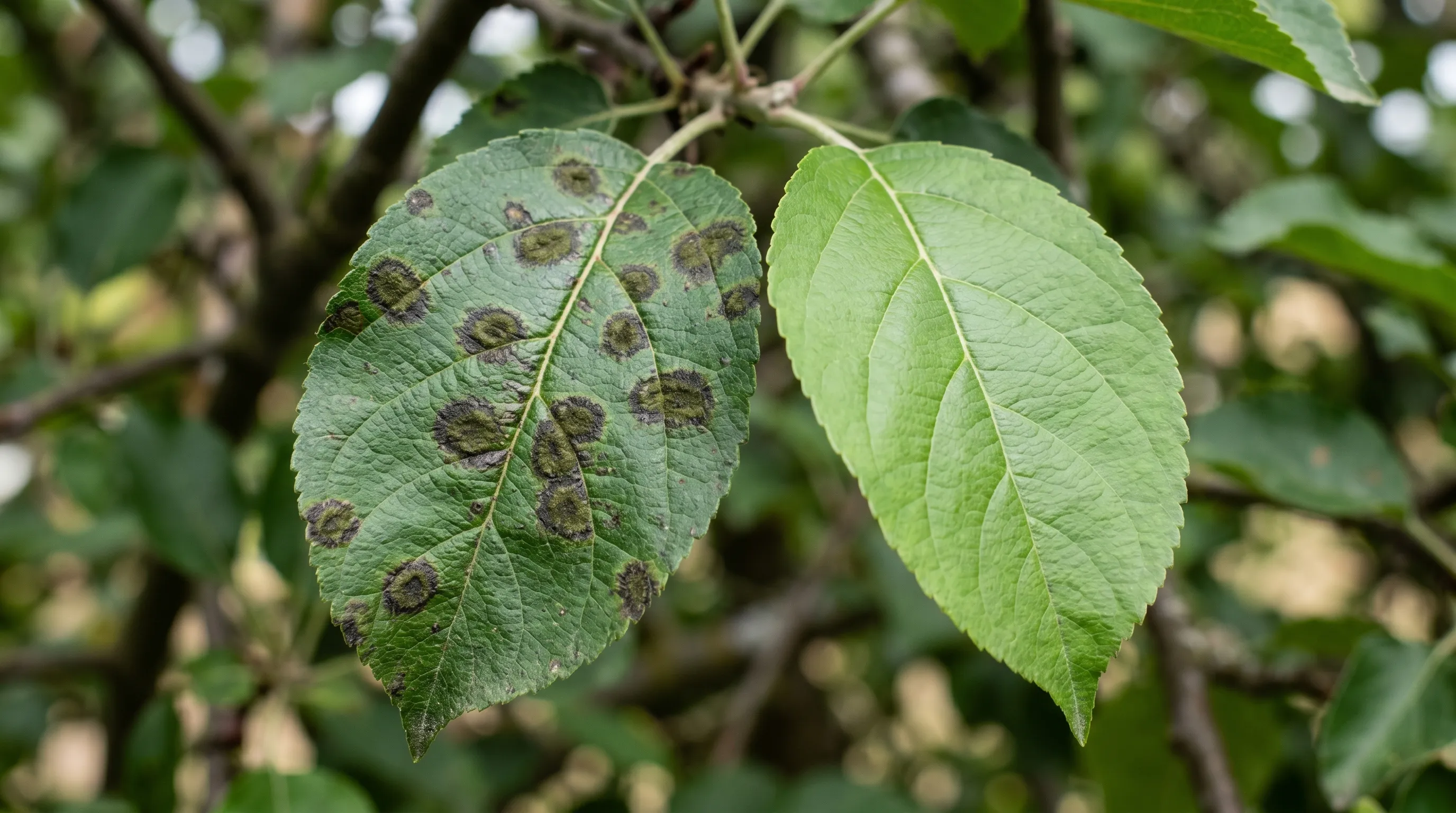 Classic apple scab on a UK Cox leaf. Olive-green lesions with feathery margins follow the leaf veins. Severe infection causes early leaf drop and reduces tree vigour for the following year.
The Venturia Lifecycle
Stage 1 (autumn): Fungus produces sexual fruiting bodies on fallen leaves. These mature through winter.
Stage 2 (early spring): Spring rain triggers spore release from fallen leaves. Spores travel by wind and water splash to new leaves on the tree.
Stage 3 (April-May): Spores germinate on wet leaves. Infection requires 6+ hours of leaf wetness at 6-26C. UK wet springs hit these conditions multiple times per week.
Stage 4 (May-July): Lesions develop. New asexual spores release from the lesions, spreading to other leaves and fruit.
Stage 5 (summer-autumn): Continued cycle until leaf fall. Severe outbreaks defoliate the tree by August.
The critical control point is Stage 2-3: spring spore release. Sanitation reduces Stage 1 inoculum. Sprays at green-tip and pink bud cover Stage 3 infection.
Resistant Varieties: The Easiest Control
| Variety | Scab resistance | Cropping reliability | Notes |
|---|---|---|---|
| Discovery (apple) | Very high | Heavy | Early season, August fruit |
| Falstaff (apple) | Very high | Heavy | Mid-season, October fruit |
| Topaz (apple) | Very high | Reliable | Late season, December store |
| Saturn (apple) | High | Reliable | Crisp eating |
| Scrumptious (apple) | High | Heavy | Early dessert |
| Egremont Russet (apple) | High | Reliable | Russeted skin, traditional |
| Concorde (pear) | High | Reliable | Long season |
| Beth (pear) | High | Reliable | Early pear |
| Cox (apple) | Low | Variable | Classic but scab-prone |
| Bramley (apple) | Low | Heavy | Cooking apple, scab-prone |
| Gala (apple) | Low | Heavy | Modern dessert, scab-prone |
| Worcester (apple) | Very low | Heavy | Old variety, avoid in damp sites |
For the wider UK apple selection, our best apple varieties guide covers UK climate-suited choices.
Sanitation: The Critical Autumn Job
The fungus overwinters on fallen leaves. Removing them breaks the cycle.
October-November routine:
- Rake and collect all fallen leaves under apple and pear trees
- Bag in sealed black plastic for landfill or burn on a hot fire
- Never compost in open heap (spores survive composting)
- Remove any mummified fruit still hanging on the tree
- Prune out canker-affected branches before leaf drop is complete
Alternative for organic gardens: Lay a 25mm mulch of fresh grass clippings under the tree in late October. The clippings smother and accelerate decomposition, reducing spore production by 50-60%.
For the wider autumn orchard maintenance, our autumn jobs guide covers end-of-season tasks.
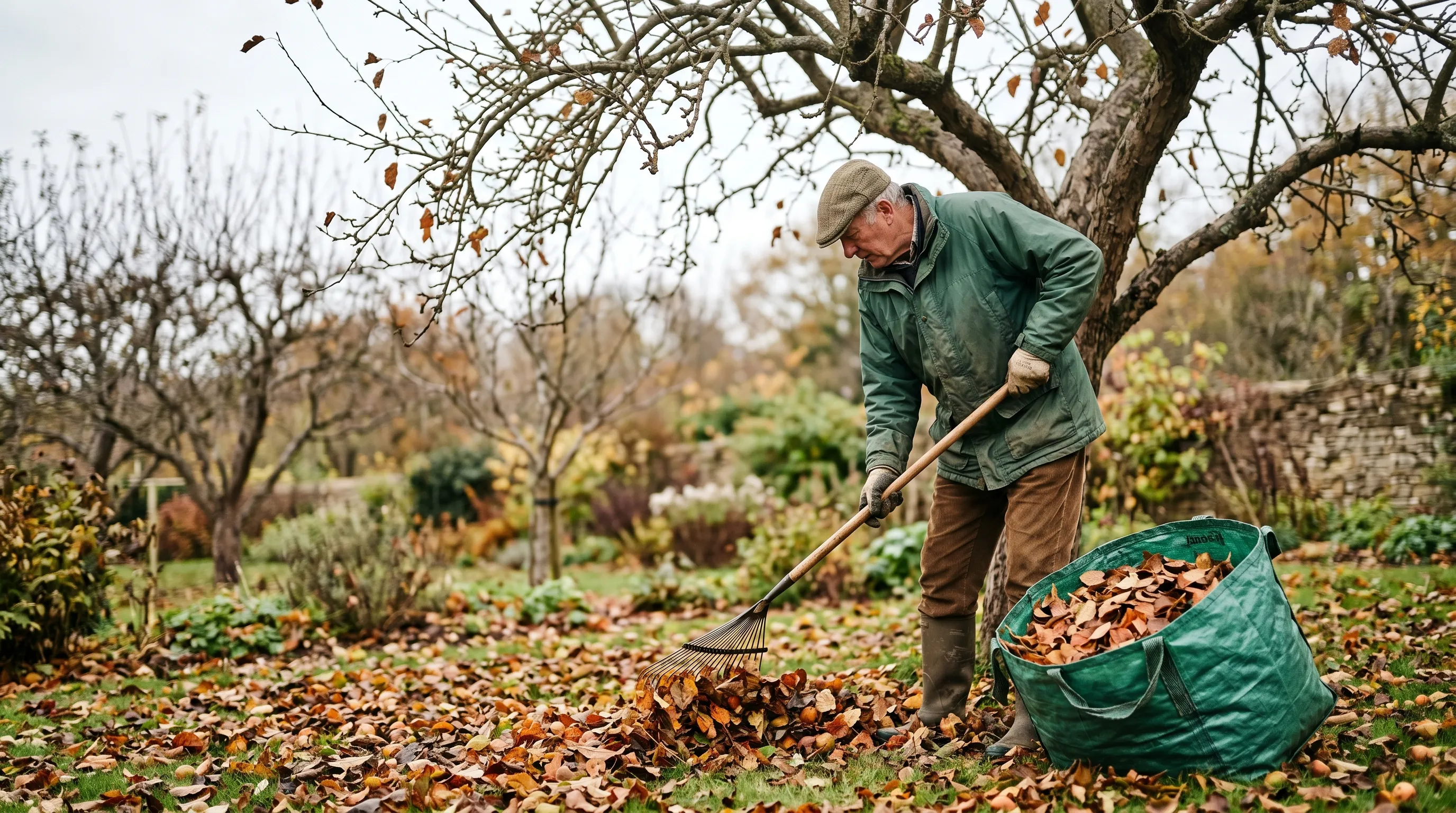 The autumn sanitation routine. Rake and bag all fallen apple and pear leaves before winter. The 60-80% reduction in next year’s spore load is the single most effective non-chemical scab control.
Spring Spray Timing
For susceptible varieties or scab-prone sites, spring sprays provide additional protection.
The three critical spray windows:
| Stage | Timing | Description |
|---|---|---|
| Green-tip | March-April | First green showing at bud tips |
| Pink bud | April-May | Flower buds visible but unopened |
| Petal fall | Mid-May | Flowers dropped, fruitlets forming |
UK products that work:
- Copper-based fungicides (Vitax Bordeaux Mixture): traditional, organic-approved. £8-£15 per pack.
- Potassium bicarbonate (Resolva Mildew & Scab): newer organic option. £6-£12 per pack.
- Sulphur dust: limited but useful for organic gardens. £5-£10 per pack.
Application: mix per pack instructions. Use a knapsack sprayer or pressure sprayer. Spray to coat both leaf surfaces. Apply on dry days with no rain forecast for 24 hours. Avoid spraying when bees are active on flowers.
Pruning for Airflow
Open-canopy pruning reduces leaf wetness duration, the trigger for spore germination.
Winter pruning targets:
- Remove all branches crossing the centre of the tree
- Open the canopy to a vase shape
- Aim for 200-300mm gaps between major branches
- Cut to outward-facing buds
- Remove any cankered wood entirely
Pruned trees dry 2-3 hours faster after rain than dense unpruned trees. Spore germination requires 6+ hours of leaf wetness. The pruning effect drops infection rates by 15-25% without any chemical input.
For the wider apple and pear pruning, our fruit tree training guide covers fan, espalier and cordon shapes.
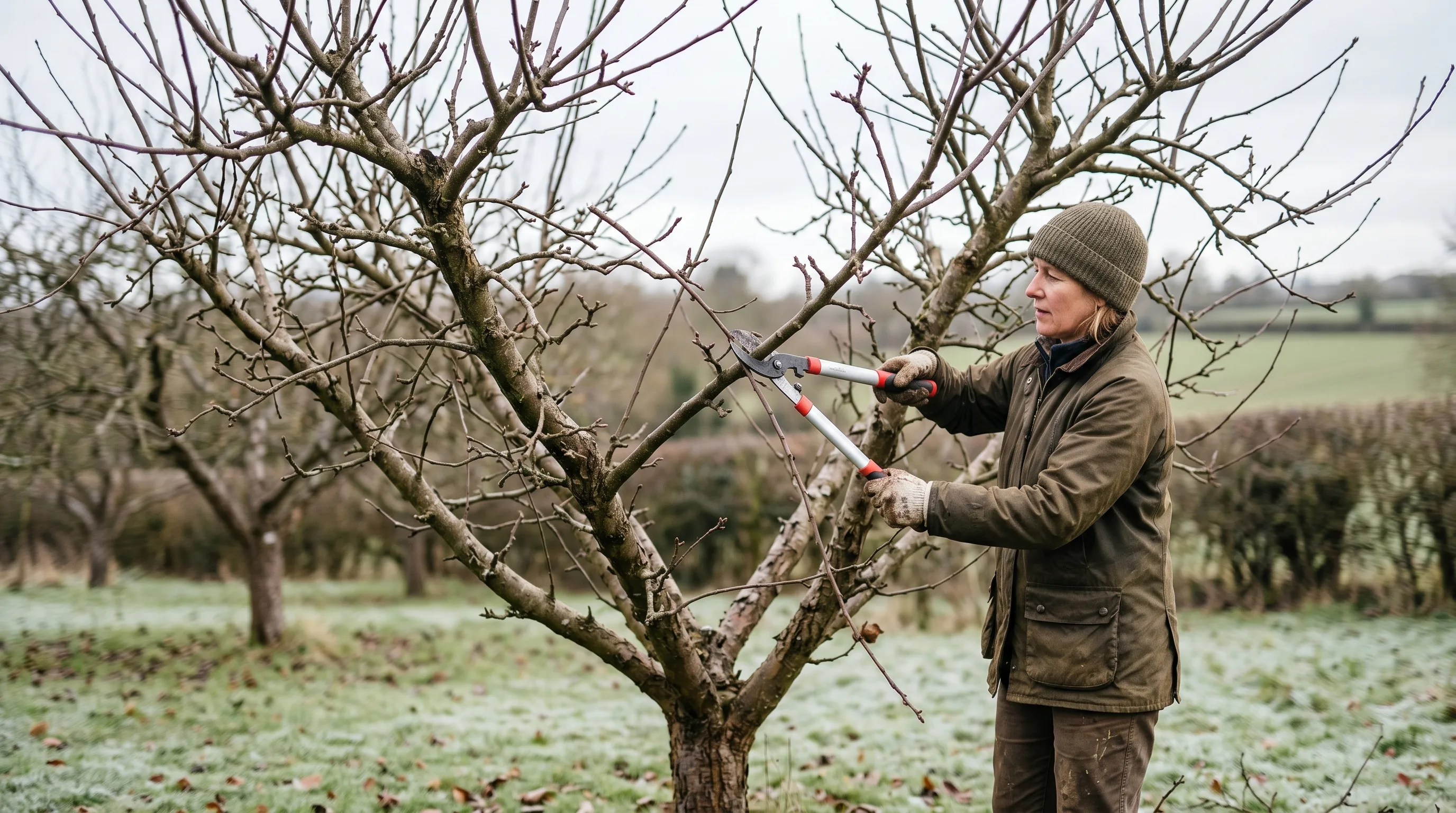 Winter pruning to open the canopy. Removing inward-growing branches and crossing wood reduces leaf wetness duration by 2-3 hours after rain. Scab infection rates drop 15-25% from pruning alone.
Common Mistakes With UK Scab Control
Mistake 1: planting susceptible varieties in wet sites. Cox, Bramley, Gala on damp sheltered ground require annual spray programmes for life. Plant resistant varieties instead.
Mistake 2: leaving fallen leaves on the ground. Each unsanitised leaf releases millions of spores in spring. Always rake in October.
Mistake 3: spraying too late. Sprays after symptoms appear are too late. Spring preventative spraying is the only effective spray strategy.
Mistake 4: using too little product. Diluting sprays beyond pack instructions reduces effectiveness. Mix at full rate.
Mistake 5: spraying in wet weather. Rain within 4 hours of application washes the product away. Wait for a dry window with at least 6-8 hours of drying time.
For the wider UK apple selection, our best apple varieties guide covers UK climate-suited choices. For pear varieties, our pear guide covers scab-resistant pears.
Scab Control Calendar UK Month-by-Month
| Month | Scab control task |
|---|---|
| January | Winter pruning for canopy airflow |
| February | Order any spring fungicide products |
| March | Watch for green-tip stage. First spray for susceptible varieties |
| April | Pink bud spray. Watch weather for wet periods |
| May | Petal fall spray. Stop spraying after fruitlet stage |
| June | Monitor for early lesion appearance |
| July | Continue inspection. Remove obviously infected fruit |
| August | Heavy infection visible if untreated. Plan autumn |
| September | Pre-harvest assessment |
| October | Harvest. Begin fallen leaf rake |
| November | Complete sanitation. Bag and remove all leaves |
| December | Plan next year’s variety additions if replacing trees |
Frequently asked questions
How do I identify apple scab in the UK?
Olive-green to dark brown circular spots on leaves with feathery margins, often along the leaf veins. Matching corky scab spots on developing fruit, frequently around the calyx end. Leaves may yellow and drop early. Symptoms appear from late May through to autumn.
What are the most scab-resistant apple varieties for UK gardens?
Discovery, Falstaff, Topaz, Saturn and Scrumptious are the most reliable scab-resistant UK apple varieties. They show under 5% scab even in wet springs without sprays. Avoid Gala, Cox, Bramley and Worcester for scab-prone sites.
When should I spray for apple scab?
Spray copper or potassium bicarbonate at green-tip stage (March-April, when buds just open) and again at pink bud (April-May, before flowers open). A third spray at petal fall extends protection through May. Stop spraying when fruit reaches walnut size.
Does raking up fallen leaves help with scab?
Yes, significantly. The fungus overwinters on fallen leaves and releases spores the following spring. Raking and removing all fallen leaves in October reduces next year’s spore load by 60-80%. Compost in sealed bags or burn; never leave under the tree.
Can I save a scab-infected apple tree?
Yes. Combine sanitation (remove fallen leaves), pruning for airflow (open the canopy in winter), and a spring spray programme. Susceptible varieties improve to acceptable cropping within 2-3 years. Severely affected trees may benefit from being replaced with resistant varieties.
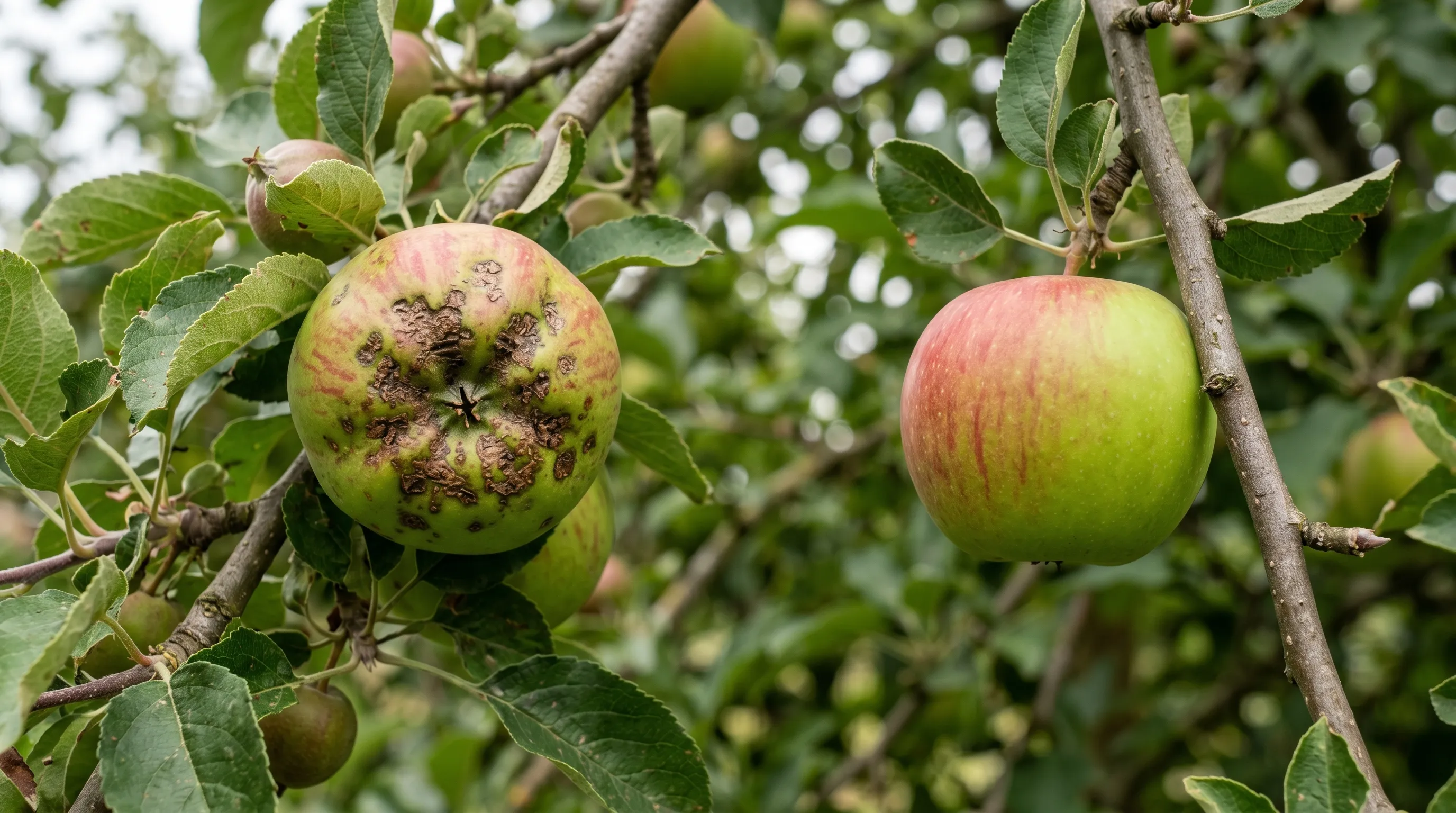 Scab on developing fruit clustered around the calyx end. The fruit remains edible (cut away the corky patches) but storage life drops by 70-80% versus clean fruit.
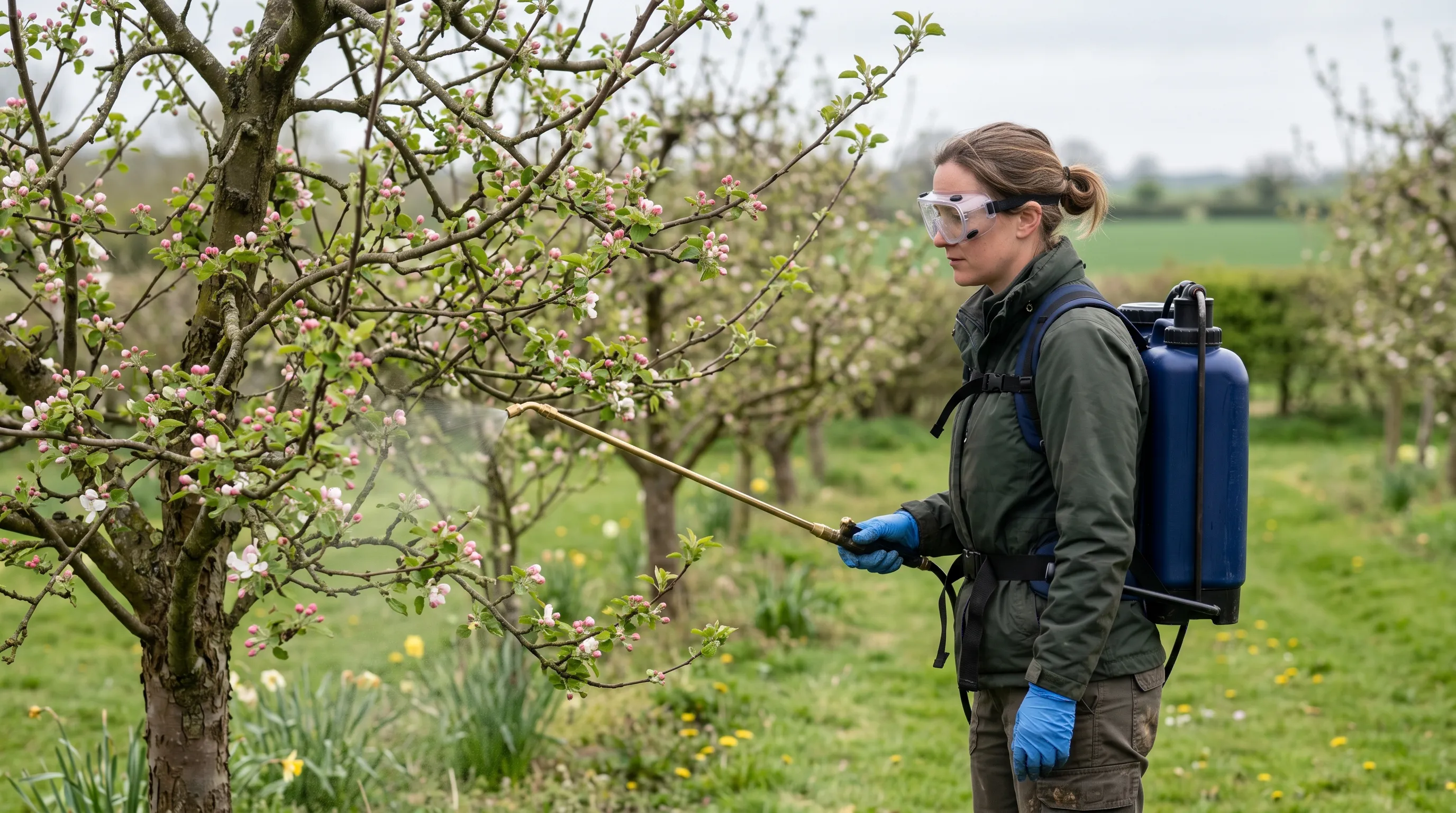 Pink bud copper spray timing on a UK orchard apple. The spray protects opening flowers and emerging leaves from early spore germination. Apply on a dry day with at least 8 hours before forecast rain.
Now plan the wider orchard care
Scab is one of several UK apple and pear diseases. Our canker treatment guide covers the related bark canker disease. For the wider apple varieties, our apple guide covers UK climate-suited choices. The pear varieties guide covers scab-resistant pears alongside flavour and storage picks. And for the broader fruit tree growing approach, our how to grow pear trees guide covers planting, pruning and training principles.
Our team produces practical UK gardening guidance from source research, contributor records and established horticultural practice. Editorial standards are overseen by Matt W.