Key takeaways
- Burr knots are aerial root initials, not a disease, canker or crown gall
- They are genetic and most common on dwarfing rootstocks M9 and M26, and on cultivars like Gala
- Shade, high humidity and warmth of 20-35C make them proliferate
- Most burr knots need no treatment at all; leave healthy ones alone
- They matter because they let in woolly aphid, apple canker and apple clearwing moth, and can weaken branches
- Keep the trunk in sun and air, clear weeds and mulch away from the base, and never bury the graft union
Walk up to a dwarf apple tree in June and you may spot something odd on the lower trunk. Clusters of knobbly, root-like bumps push out through the bark, warty and rough, sometimes ringing the stem just above the graft. The first time you see them it looks like a disease taking hold. Most gardeners reach straight for the secateurs or a bottle of something.
Stop before you cut. These are burr knots, and in the great majority of cases they are harmless. They are not canker, not a gall, not rot. They are the tree trying to grow roots in the wrong place. Understanding what they actually are tells you exactly when to leave them alone and when a burr knot is worth watching.
What are apple burr knots?
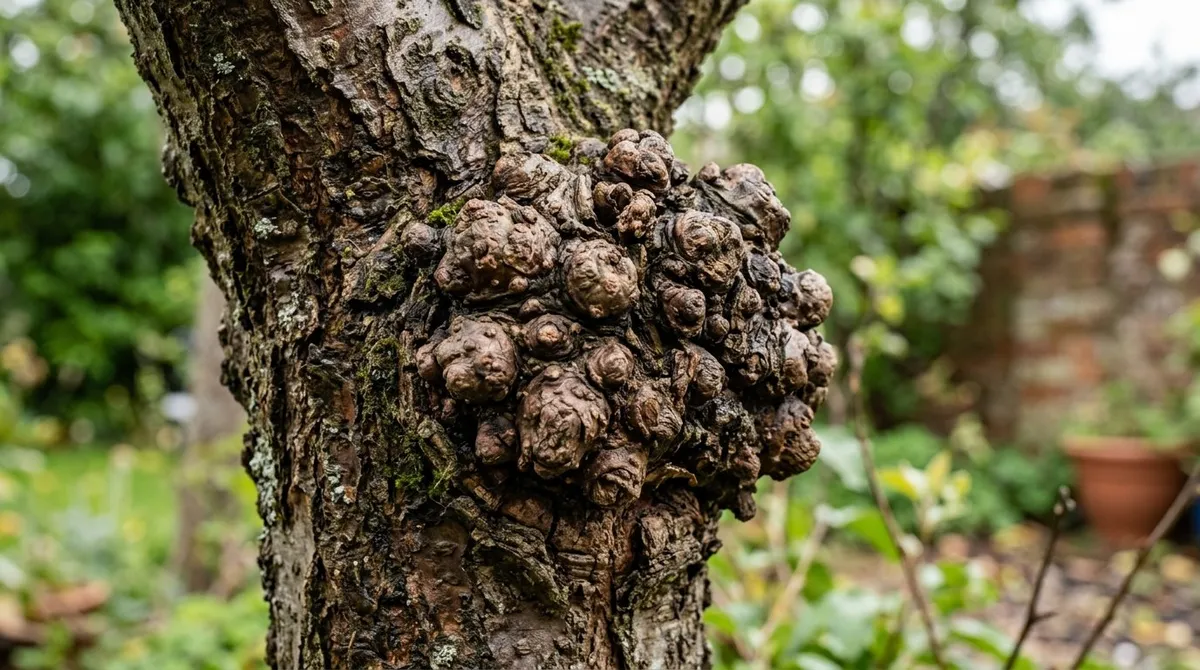
Burr knots are clusters of preformed root initials that erupt on the aerial parts of an apple tree. The tree carries dormant root buds, called adventitious roots, in its bark. On the trunk and branches these normally stay hidden. On some trees they swell and break the surface, forming the tumour-like, knobbly outgrowths we call burr knots. The Royal Horticultural Society describes them as “root-producing structures that develop on the aerial parts of some apple trees” (rhs.org.uk).
Look closely and you can see what they are. Each bump is the blunt tip of a root that has started to form and then stalled, held in the air with nowhere to go. Pot a rooted burr knot up against damp compost and those same initials will push out into real, functioning roots. That is the whole secret of the burr knot: it is root tissue in the wrong place, waiting for moisture.
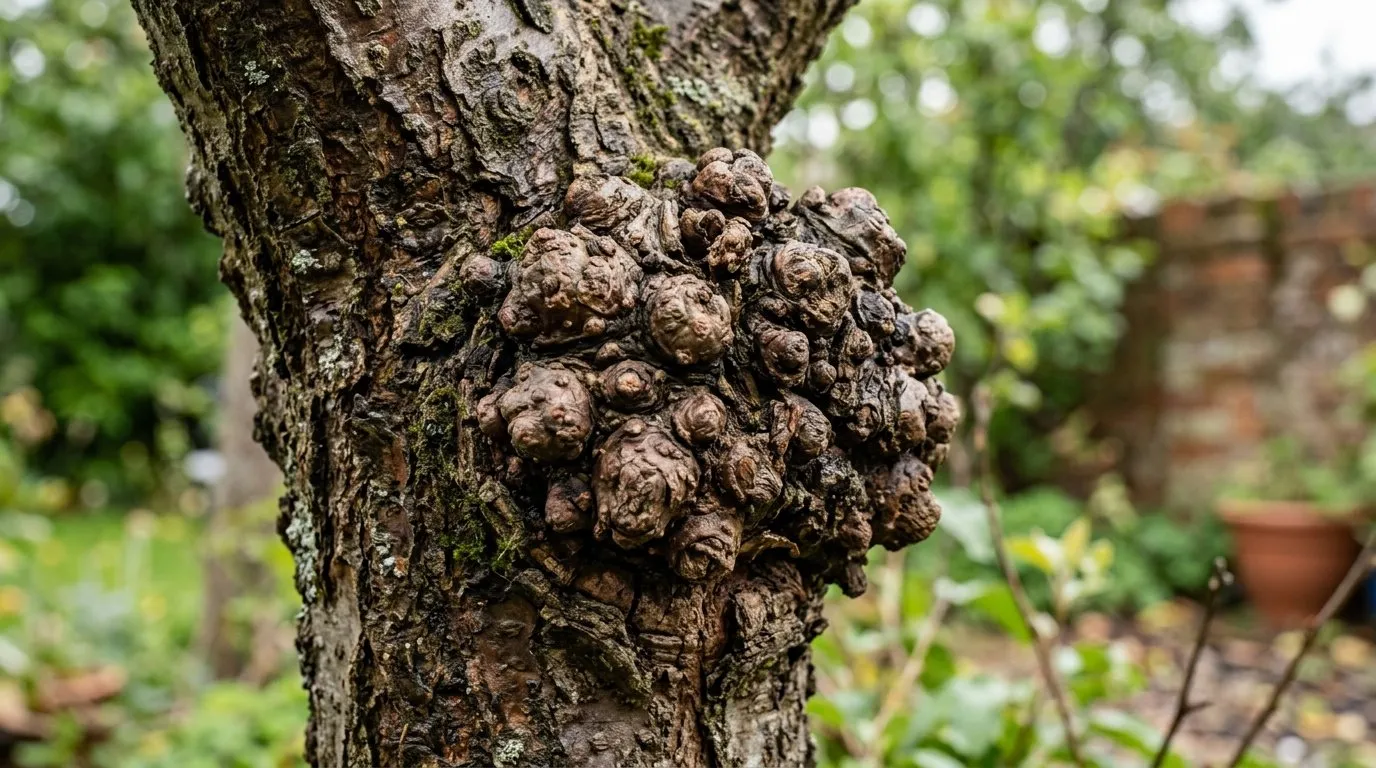 A typical burr knot cluster low on the trunk. Each bump is a stalled root initial, not a disease.
Why do apple trees get burr knots?
Burr knots come down to genetics plus the right conditions. The RHS is clear that they “result from environmental conditions, linked to a genetic predisposition.” Some trees are simply built to make them, and damp shade then brings them out.
The genetic side is all about the rootstock. Nearly every garden apple is two plants grafted together: a named fruiting variety on top, a rootstock below that controls the tree’s size. The dwarfing rootstocks that keep modern garden trees small are the worst offenders for burr knots. M9 and M26, the two most common dwarfing stocks in UK gardens, are strongly predisposed. If your tree is a neat 2-3m bush apple bought in the last twenty years, it is very likely on one of these, and burr knots come with the territory.
Some fruiting cultivars add to it. Gala is notably prone. A handful of old varieties are so keen to make burr knots that they were traditionally propagated from them, including ‘Cornish Aromatic’, ‘Winter Banana’, ‘Lord Burghley’ and one literally named ‘Burr Knot’.
The conditions that trigger them are shade, high humidity and warmth. The RHS lists “shade, high humidity and warmth” as the drivers, with the active temperature band running roughly 20-35C. That is why they cluster on the shaded lower trunk and why they explode on a tree with long grass, weeds or an opaque plastic guard trapping still, damp air around the base. Understanding how rootstocks shape a tree helps here, and our guide to fruit tree rootstocks explains which stock does what.
Are burr knots a disease? The reassurance
No, burr knots are not a disease, and this is the key point to hold onto. Nothing is infecting the tree. No fungus, no bacterium, no virus causes them. They are a growth response written into the tree’s own genes, switched on by damp shade.
This matters because burr knots are easy to mistake for something sinister. They look rough and abnormal, and a worried gardener can talk themselves into canker or a tumour. But a healthy burr knot on a vigorous tree, cropping well and putting on good growth, is doing no harm. You can have a trunk generously studded with knots and a tree that fruits perfectly every year.
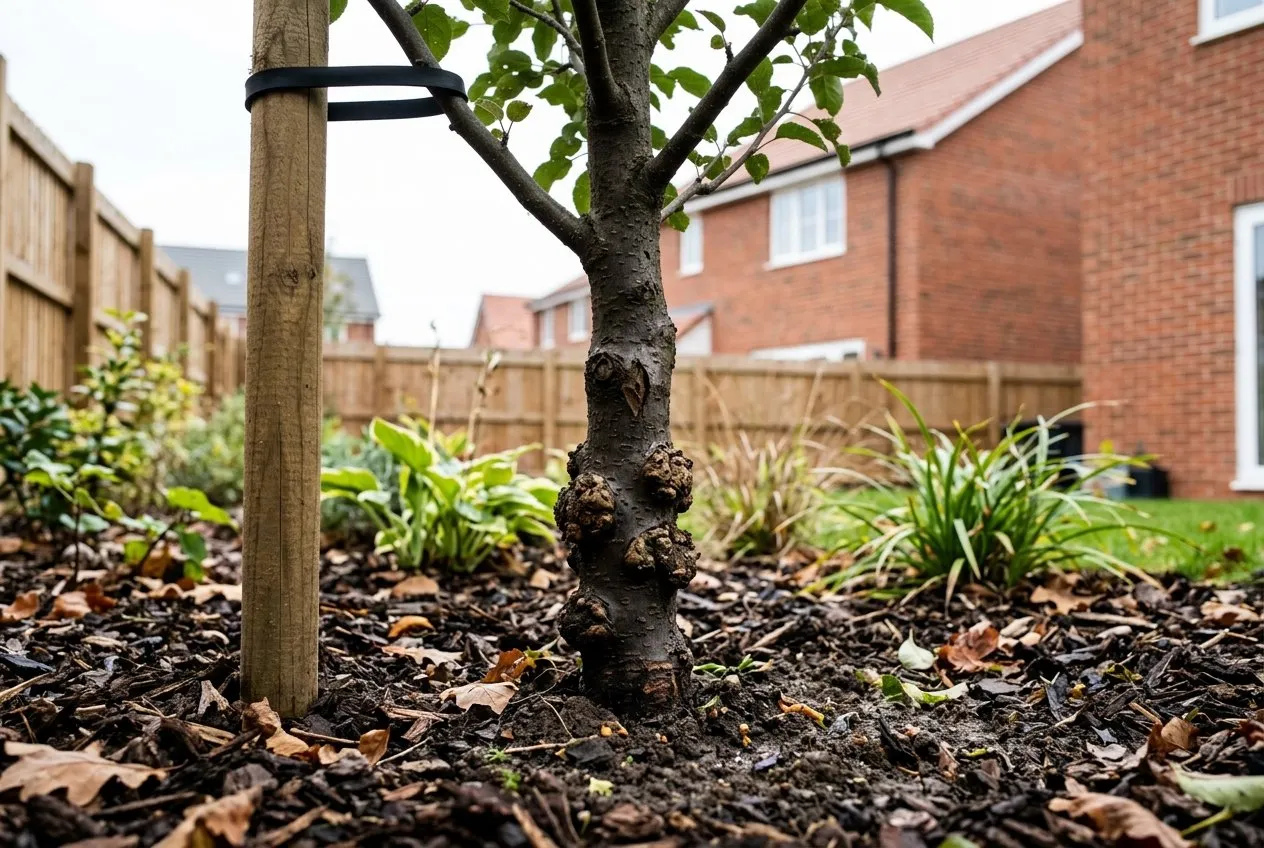 A young tree on M26 rootstock. Dwarfing stocks like this are the most prone to burr knots.
When burr knots do matter: the three real risks
Burr knots become a problem in three specific ways, and all three are about weakness and entry points rather than the knot itself.
The first is structural. Large knots, or several merging into one crusted mass, disrupt the smooth wood beneath. The RHS notes they can “structurally weaken the trunk or branch.” A heavily knotted branch carrying a full crop of apples is more likely to split or snap at the knot than clean wood would be.
The second is woolly aphid. This grey-brown aphid coats itself in white, waxy fluff that looks like cotton wool on the bark. It loves the cracked, sheltered surface of a burr knot, tucking into the crevices to feed and breed. A burr knot gives it a ready-made home. Spotting the fluff early is what counts, and prevention starts with keeping knots dry and open.
The third is disease and boring pests getting in through the broken bark. The uneven, split surface of a burr knot is an open door for apple canker, the fungal disease that sinks and rings branches. It can also admit the apple clearwing moth, whose larvae tunnel under bark around wounds and grafts. Both exploit damage; a burr knot is damage waiting to happen.
Warning: Never gouge or cut a healthy burr knot off in the hope of tidying it. A cut knot is a fresh, wet wound that apple canker colonises readily. You turn a harmless cosmetic feature into a genuine disease site. The RHS specifically warns that cutting out burr knots risks “colonisation by apple canker.”
Burr knot vs crown gall vs canker: how to tell them apart
Correct identification decides whether you relax or act. Three trunk problems get muddled: burr knots, crown gall and canker. They look different once you know the tells, and only one of them is harmless.
Burr knots sit on the trunk and branches above ground. They are clusters of short, blunt, root-like bumps, roughly the colour of the bark, and they stay fairly flush or form a low crusted band. They are genetic and not infectious.
Crown gall is caused by a soil bacterium, Agrobacterium. It appears at or just below soil level, is more wart-like, and protrudes much further from the trunk as a rough, soft-then-woody tumour. If a knobbly lump is right at the ground line and bulging outward, suspect crown gall, not a burr knot.
Apple canker is a fungal disease of the wood. It shows as sunken, cracked, discoloured patches that ring and kill branches, often with concentric rings of shrunken bark. It flows along the branch rather than sitting as a discrete lump. Our guide to canker in fruit trees covers treatment in full.
| Feature | Burr knots | Crown gall | Apple canker |
|---|---|---|---|
| Cause | Genetic root initials | Soil bacterium | Fungus (Neonectria) |
| Position | Trunk and branches, above ground | At or below soil level | Anywhere on woody stems |
| Appearance | Clusters of blunt root-like bumps | Wart-like, protruding tumour | Sunken, cracked, ringed bark |
| Feel | Firm, bark-coloured | Soft then woody, bulging | Dead, flaking, shrunken |
| Harmful? | Usually harmless | Weakens young trees | Kills branches |
| Action | Usually none | Improve drainage, remove badly affected young trees | Cut out to clean wood |
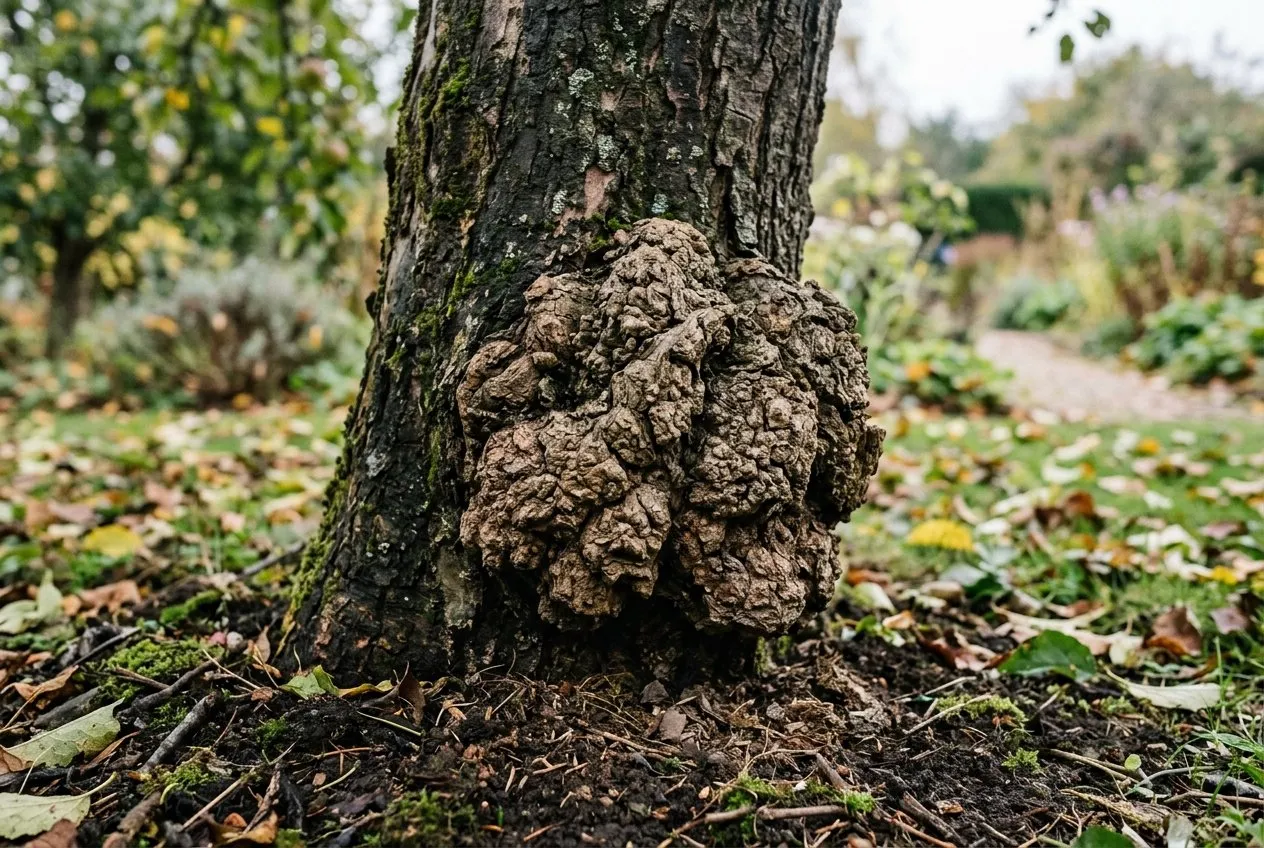 Crown gall sits at soil level and bulges outward, unlike burr knots higher up the trunk.
How to manage burr knots on apple trees
In most cases the correct management is to do nothing to the knot and everything to the conditions around it. There is no chemical treatment; the RHS confirms “there are no chemicals available to gardeners.” Management is cultural, and it all comes down to light and air.
Do not pile mulch against the stem. A mulch ring is good for the roots, but it must stop 10cm short of the trunk. Mulch heaped against the bark holds moisture right where the knots form and can rot the base. Never let the graft union get buried.
Skip opaque tree guards. Solid plastic spiral guards create exactly the dark, humid microclimate that drives burr knots. If you need rabbit protection, use an open mesh guard that lets light and air through. The RHS specifically advises you “avoid the use of tree guards (particularly opaque types).”
Prune only when a knot has done real damage. If large knots have stalled a branch or weakened it badly, remove that branch cleanly, cutting back to healthy wood in dry weather. Do not shave knots off sound wood. For clean technique, see our guide to pruning fruit trees.
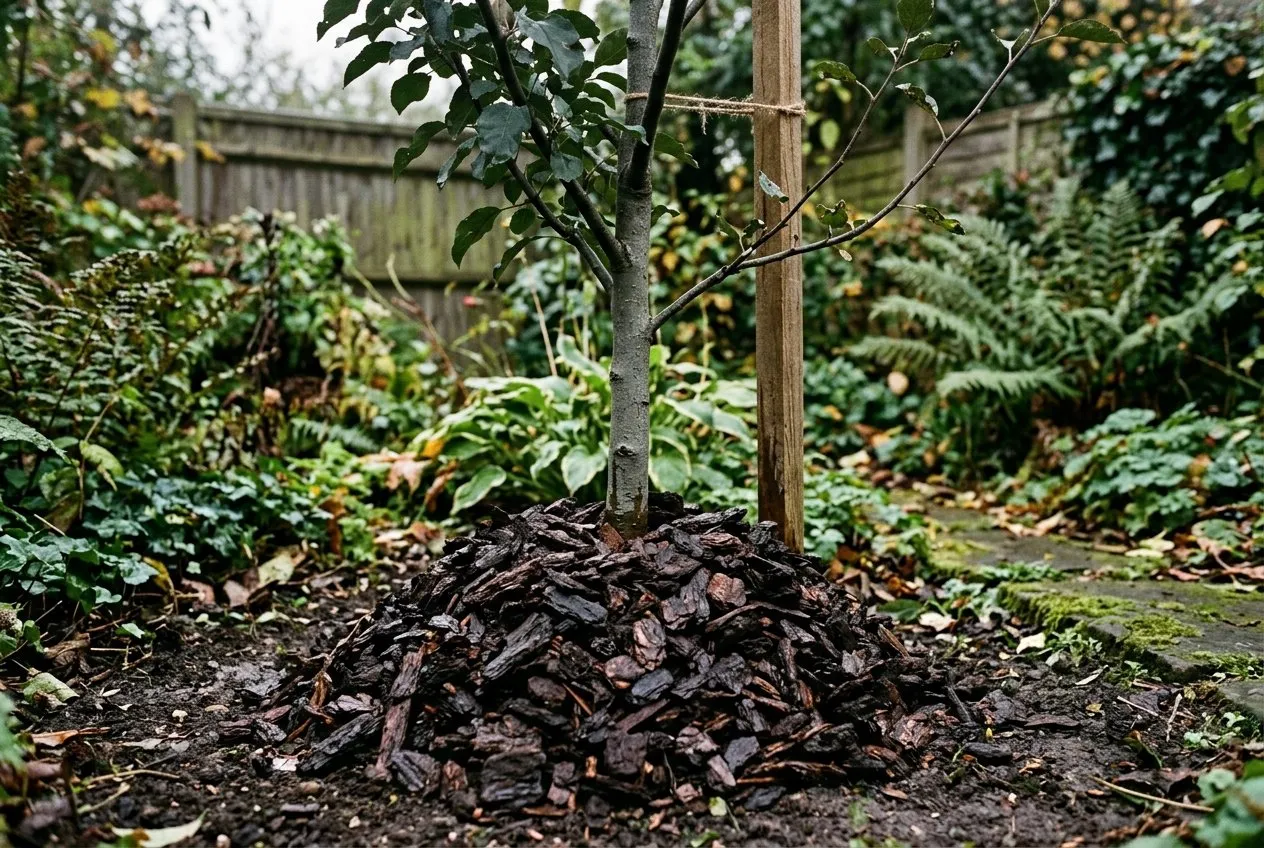 Mulch piled against the trunk traps damp warmth and feeds burr knots. Keep it 10cm clear of the bark.
When to worry: a quick decision table
Use this to judge whether a burr knot needs action or a simple watching brief. The presence of a second problem, not the knot alone, is what usually tips it into action.
| What you see | What it means | What to do |
|---|---|---|
| Small dry knots, tree cropping well | Normal, harmless | Nothing; enjoy the fruit |
| Knots spreading in a shaded, weedy base | Damp conditions driving them | Clear vegetation, open up to sun |
| White cotton-wool fluff on the knots | Woolly aphid colonising | Treat the aphid, dry the trunk |
| Sunken, cracked, ringed bark near a knot | Apple canker has entered | Cut back to clean wood, dry weather |
| Sawdust-like frass or small holes at a knot | Apple clearwing moth larvae | Prune out affected wood, monitor |
| A big knotted branch bending or splitting | Structural weakness | Remove the branch cleanly |
| Knobbly lump right at soil level | Likely crown gall, not a burr knot | Identify carefully; improve drainage |
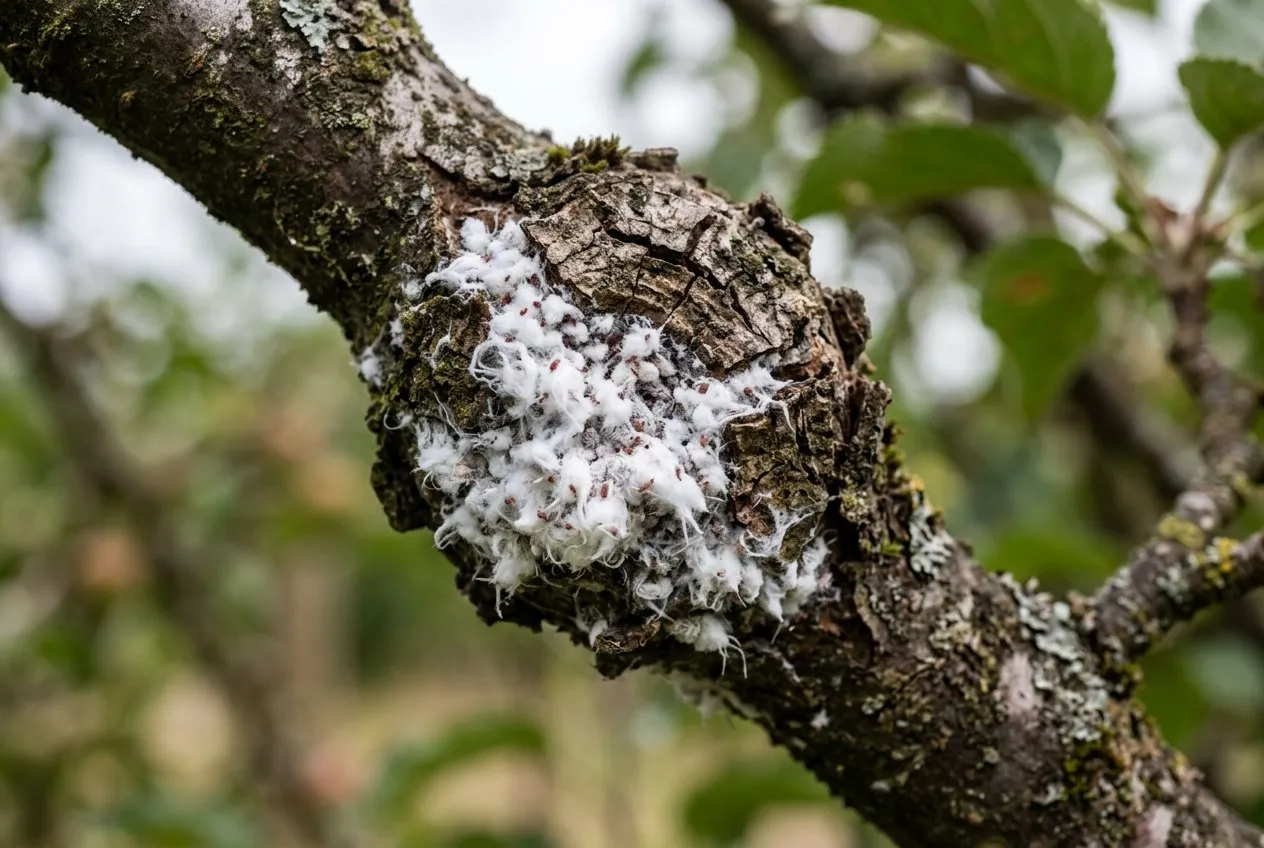 White woolly aphid fluff tucked into a burr knot. This is the sign that turns a harmless knot into a job.
Using burr knots for propagation: the useful side
Here is the part few gardeners realise: burr knots are a free propagation tool. Those stalled root initials will grow into real roots the moment you give them moisture, so a burr knot is a branch that is halfway to being its own tree. This is not a modern trick. West Country and Welsh growers propagated apples this way for centuries, rooting pieces of branch that carried burr knots.
The simplest method is air-layering, done in spring as the sap rises. Pick a healthy young branch with a good burr knot. Wrap the knot in a fistful of damp sphagnum moss, then seal it in a sleeve of clear plastic tied tightly at both ends to hold the moisture in. Keep it shaded. Over the summer the burr knot roots into the moss. By autumn or the following spring you can cut below the rooted section and pot it up as a new tree on its own roots.
You can also take hardwood cuttings of burr-knot wood in winter, treating them like any hardwood cutting but with a far higher strike rate because the roots are already forming. A tree grown this way is on its own roots, not a dwarfing rootstock, so it will grow larger and more vigorously than a grafted bush. Bear that in mind before you fill the garden with them. For grafted trees on chosen rootstocks, our guide to grafting fruit trees is the better route.
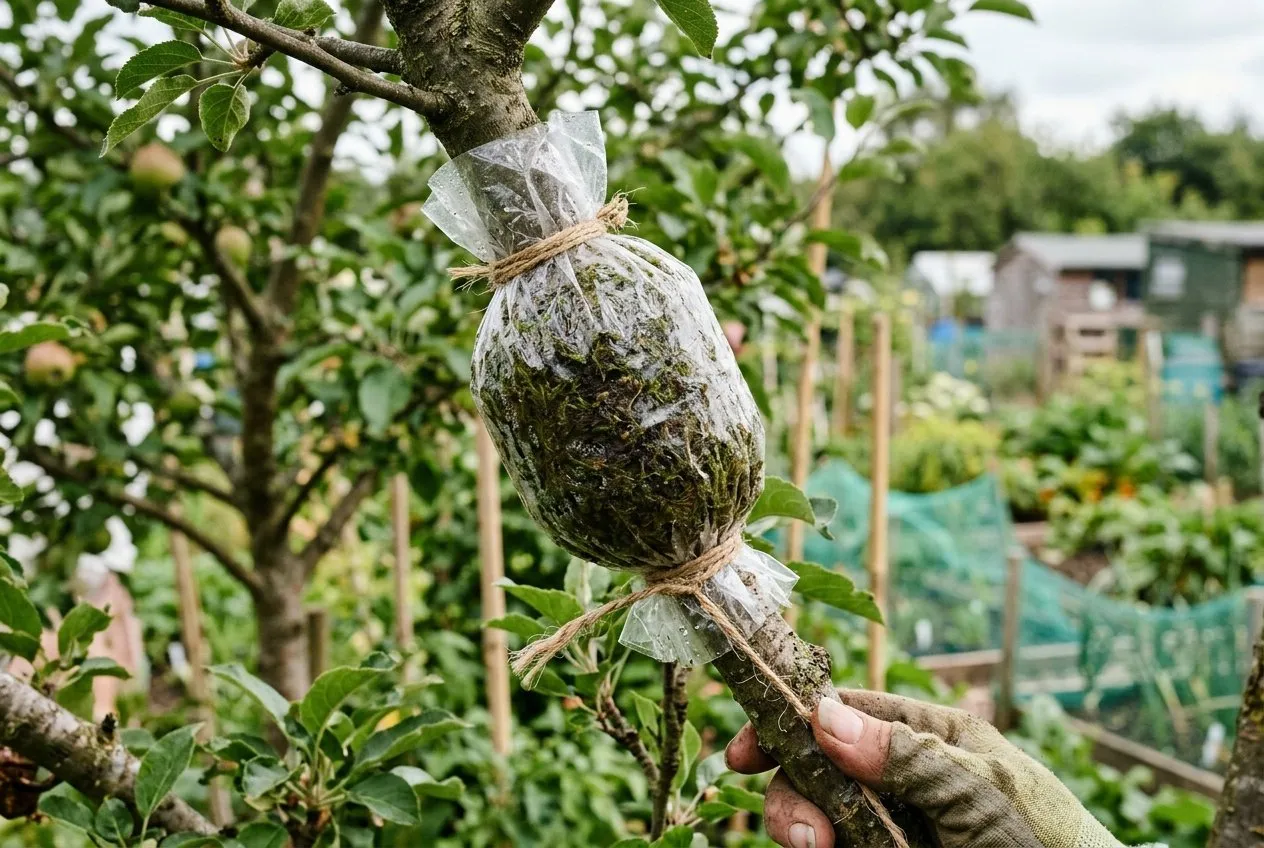 Air-layering a burr knot in spring. The stalled roots grow into the moss and give a new tree by autumn.
Burr knots through the year: a monitoring calendar
Burr knots do not need a treatment schedule, but they do reward a light watching brief through the growing season. This is when problems arrive and when action, if any, pays off.
| Month | What to do |
|---|---|
| January | Check trunks while dormant; note the size and spread of existing knots |
| February | Take hardwood cuttings of burr-knot wood if propagating |
| March | Clear weeds and long grass from the base before growth starts |
| April | Ensure graft union is above soil and mulch is 10cm clear of the trunk |
| May | Start monitoring; woolly aphid first appears as small white tufts |
| June | Check knots closely for white fluff; treat any woolly aphid early |
| July | Peak woolly aphid month; inspect fortnightly, keep the trunk dry and open |
| August | Watch for canker entering damaged knots after summer rain |
| September | Check knotted branches carrying heavy fruit for splitting |
| October | Look for sunken, ringed canker patches as leaves fall |
| November | Prune out any badly weakened or cankered knotted branches in dry weather |
| December | Review the year; plan to open up any shaded, knot-heavy trunks |
Common mistakes with burr knots
Cutting healthy knots off
This is the big one. A burr knot on sound wood is harmless. Cut it and you leave a wet wound that apple canker walks straight into. You have swapped a cosmetic bump for a disease that can kill the branch. Leave healthy knots alone.
Piling mulch against the trunk
A thick mulch mounded against the bark holds moisture and warmth exactly where burr knots and woolly aphid thrive. It can also rot the base and bury the graft. Keep every mulch ring a good 10cm clear of the stem.
Using solid plastic tree guards
Opaque spiral guards create a warm, dark, humid sleeve around the trunk, which is a perfect burr knot factory. If you need protection from rabbits or strimmers, use open mesh that lets in light and air.
Ignoring the woolly aphid, not the knot
Gardeners fret over the knot and miss the white fluff sitting in it. The aphid is the real pest. Check knots from May, and act on any cotton-wool colonies while they are small. Managing the pests that follow matters more than the knot, much as with any apple tree problem.
Panicking and treating it as canker
Reaching for a fungicide or a knife because a knot looks rough wastes effort and can spread real disease. Identify first. A bark-coloured cluster of blunt bumps above ground is a harmless burr knot, not canker.
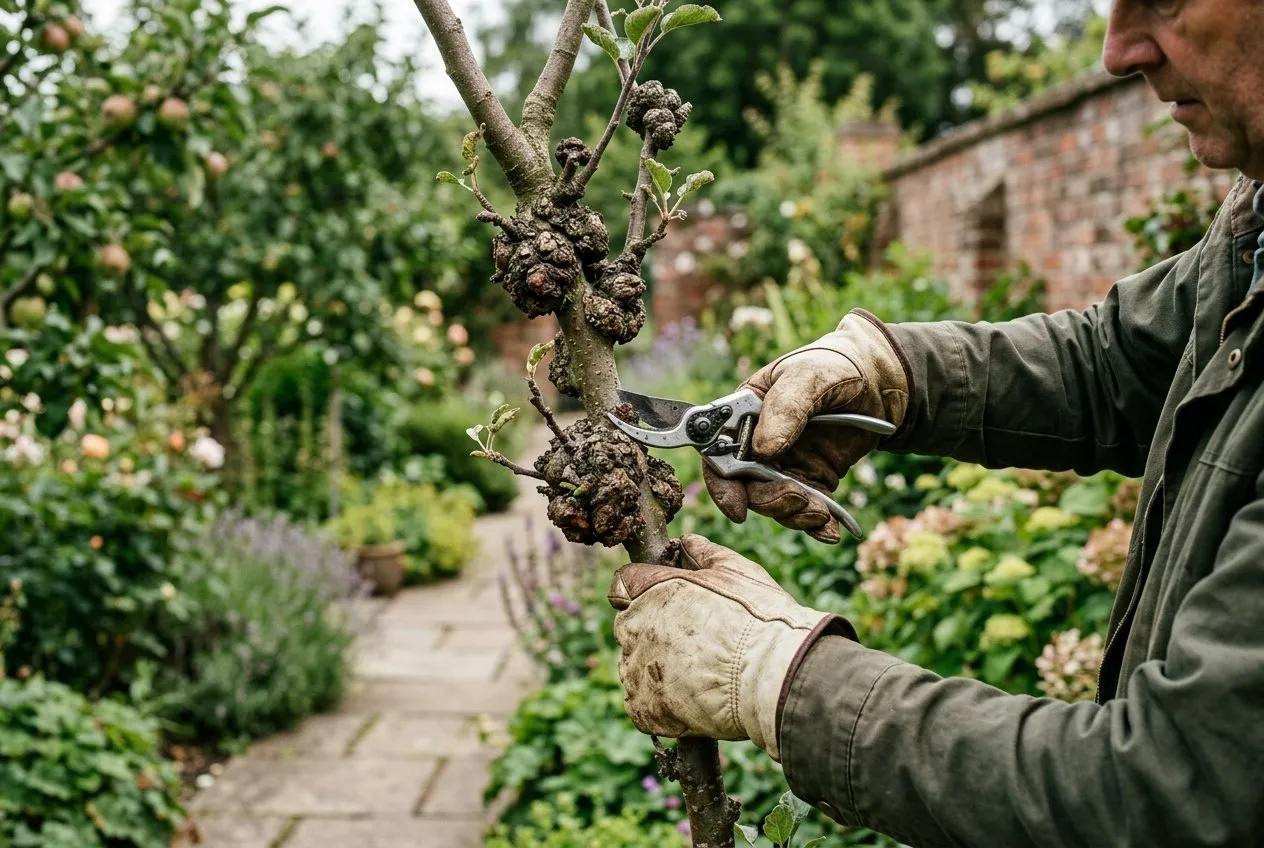 Only prune a knotted branch if the knots have weakened it. Cut back to clean wood in dry weather.
Keeping a knotted tree healthy for the long term
A tree that makes burr knots will always make them; it is written into the rootstock. The goal is not to eliminate the knots but to keep them dry, sunlit and pest-free so they stay the harmless cosmetic feature they usually are.
Give the trunk light and air. An open, sunny, weed-free base is the single best thing you can do. It keeps the knots dry, denies woolly aphid its damp hideout, and lets bark heal fast if it does split. Prune the canopy for an open shape too, so sun and wind reach the lower trunk.
Feed and water the tree well. A vigorous, healthy tree shrugs off the odd aphid colony or minor canker far better than a stressed one. Keep it cropping steadily rather than in exhausting biennial gluts. A well-grown apple with burr knots will outlive you. Panic pruning and damp neglect are what shorten its life, not the knots themselves.
Frequently asked questions
Are apple burr knots a disease?
No, burr knots are not a disease. They are clusters of preformed root initials, or adventitious roots, that erupt on the bark instead of growing underground. They are a natural genetic trait, strongest on dwarfing rootstocks like M9 and M26. Nothing is infecting the tree, and healthy burr knots on a vigorous tree need no treatment at all.
Do burr knots harm the apple tree?
Usually not, but they can cause two problems. Large or merged knots weaken the trunk or branch, which may then snap under a heavy crop. The cracked bark also gives woolly aphid, apple canker and clearwing moth an easy way in. A small, dry, undamaged burr knot on an open, sunny trunk rarely causes any harm.
How do I tell a burr knot from crown gall?
Position and texture separate them. Burr knots appear on the trunk and branches above ground and look like clusters of short, blunt roots. Crown gall sits at or just below soil level, is more wart-like, and protrudes much further from the trunk as a rough, corky tumour. Burr knots are genetic; crown gall is a soil bacterium.
Should I cut burr knots off my apple tree?
No, do not cut healthy burr knots off. Cutting them leaves a fresh wound that apple canker readily colonises, which is far worse than the knot. Only prune out a branch if large knots have stopped it growing or badly weakened it, and always cut back to clean, healthy wood in dry weather.
Why does my apple tree have knobbly lumps on the trunk?
Knobbly clusters low on an apple trunk are almost always burr knots. They form where the tree tries to make roots on its above-ground bark, a trait built into dwarfing rootstocks such as M9 and M26. Shade, damp and warmth make them bigger and more numerous, but they are harmless in themselves.
Can you grow a new apple tree from a burr knot?
Yes, burr knots root readily, which is why they exist. Old West Country cultivars like Cornish Aromatic were propagated this way for centuries. Air-layer a branch by wrapping a burr knot in damp moss and plastic in spring, or take a cutting of burr-knot wood. The pre-formed roots give a much higher strike rate than plain hardwood.
How do I stop burr knots getting worse?
Keep the trunk open, dry and sunlit. Clear weeds, long grass and thick vegetation from the base so air moves freely. Never pile mulch against the trunk or bury the graft union. Avoid opaque tree guards, which trap the warm, humid shade that burr knots love. Good airflow is the single best preventative.
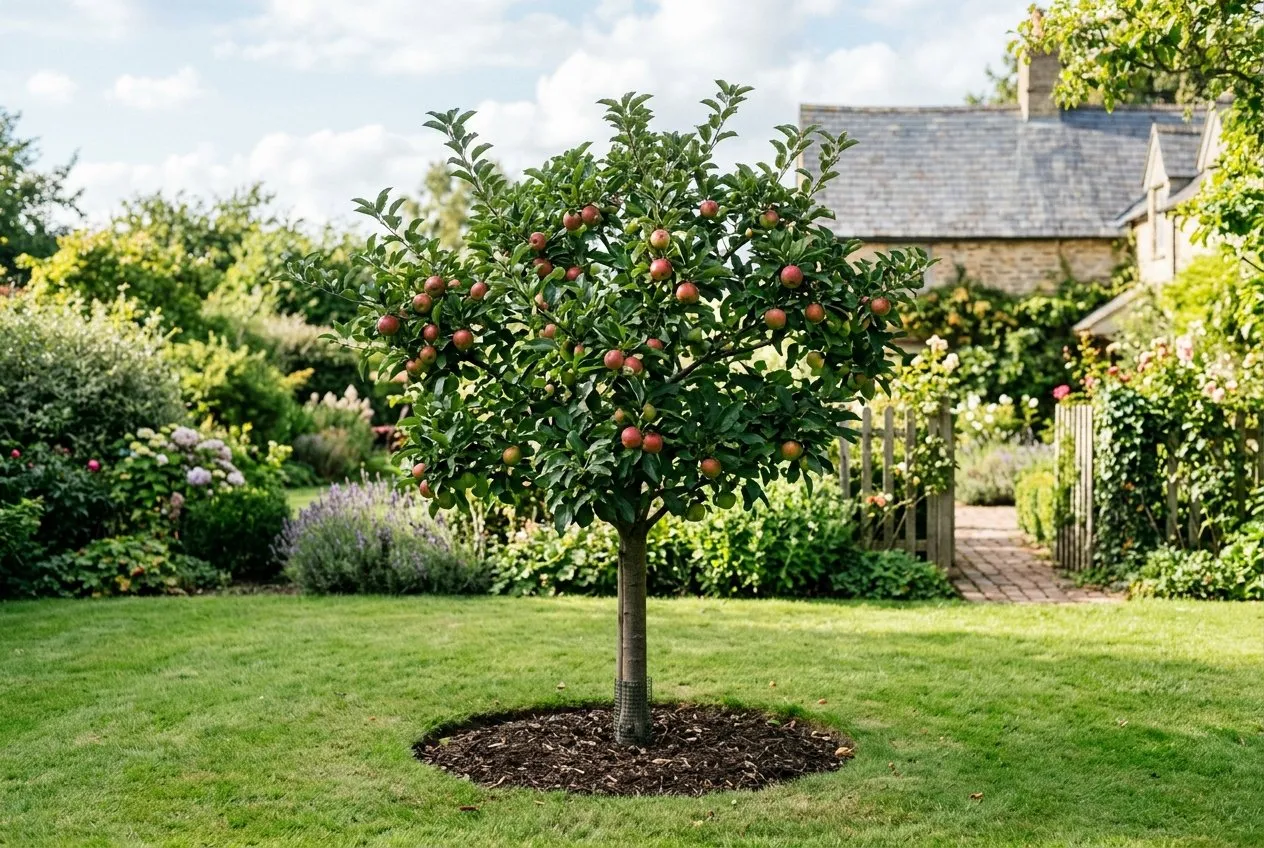 An open, sunny base keeps burr knots dry and harmless. Light and airflow are the whole game.
Now you can tell a harmless burr knot from a real problem, keep the base clear and dry, and if the white fluff does appear, our guide to woolly aphid identification and control takes you through the next step.
Our team produces practical UK gardening guidance from source research, contributor records and established horticultural practice. Editorial standards are overseen by Matt W.