Key takeaways
- AOD shows four signs together: dark weeping trunk bleeds, vertical bark cracks, D-shaped 4mm exit holes and crown thinning
- It mostly hits native oaks over 50 years old in central, south-east and eastern England, Welsh borders and south-east Wales
- The cause is bacterial, chiefly Brenneria goodwinii, working alongside the two-spotted oak beetle Agrilus biguttatus
- Trees can die within four to six years, but some recover when the underlying stress eases; there is no cure or DIY treatment
- Do not move logs or firewood from an affected oak, and clean boots and tools between trees to limit spread
- Photograph the symptoms, report through TreeAlert, and keep the tree unstressed: no root compaction, no drought, mulch but never pile it
Acute oak decline, usually shortened to AOD, is one of the more alarming things you can find on a mature oak. Dark fluid weeps from cracks in the bark and runs down the trunk in tarry streaks. It looks like the tree is bleeding, and in a sense it is.
The condition was first properly described in Britain in the 2000s, and Forest Research has since pinned much of the blame on bacteria working alongside a small beetle. This guide walks a garden or land owner through the four signs that point to AOD, how to tell it from harmless bleeds, and the sensible steps to take if you find it on a tree you look after.
What acute oak decline is and why it matters
Acute oak decline is a bacterial disease of mature oaks that produces weeping stem bleeds and can kill a tree within a few years. It affects Britain’s two native oaks most severely, and it has spread across much of central, south-east and eastern England since it was recognised.
The word “acute” matters. Oaks have declined in waves for over a century, usually slowly. AOD is different because it can move fast, felling a big, apparently healthy tree in four to six years. The visible symptom that gives it away is the stem bleed: a dark, sticky patch of fluid seeping through vertical cracks in the bark, often several down one trunk.
It matters to gardeners and smallholders because oaks are long-lived anchor trees. A single mature oak on a boundary or in a paddock supports hundreds of species and takes 150 years to replace. Spotting AOD early does not give you a cure, but it lets you report the case, avoid spreading it, and manage the tree’s stress so it has the best chance. Oaks are the backbone of our native trees for UK gardens, which is exactly why this disease is watched so closely.
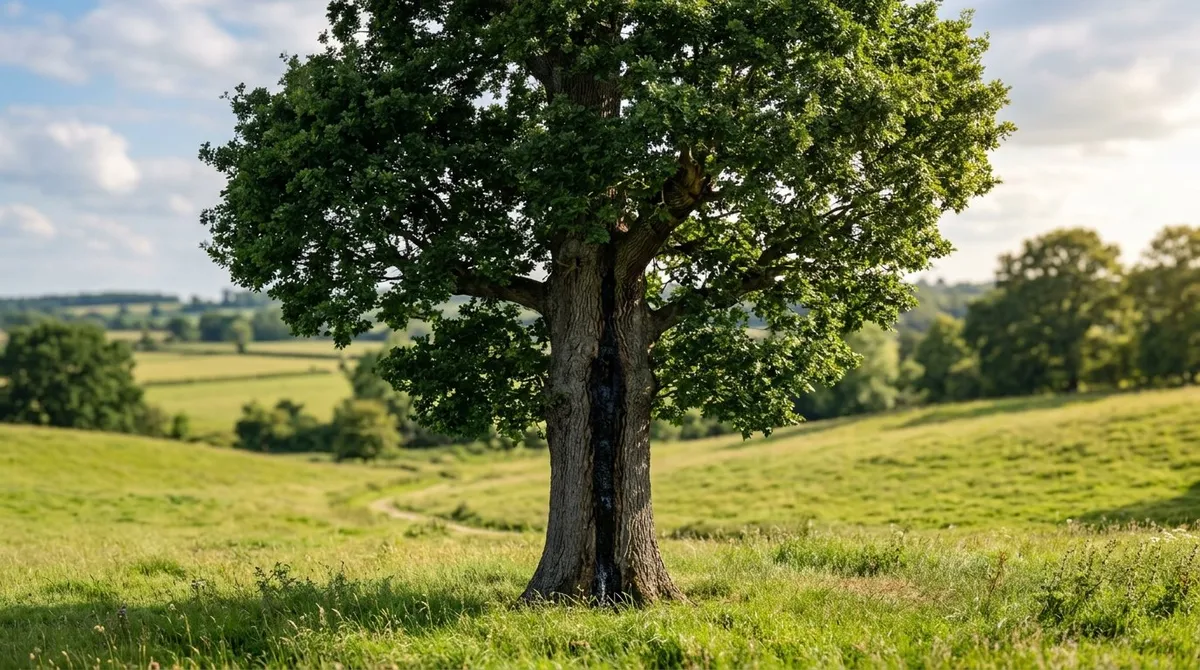
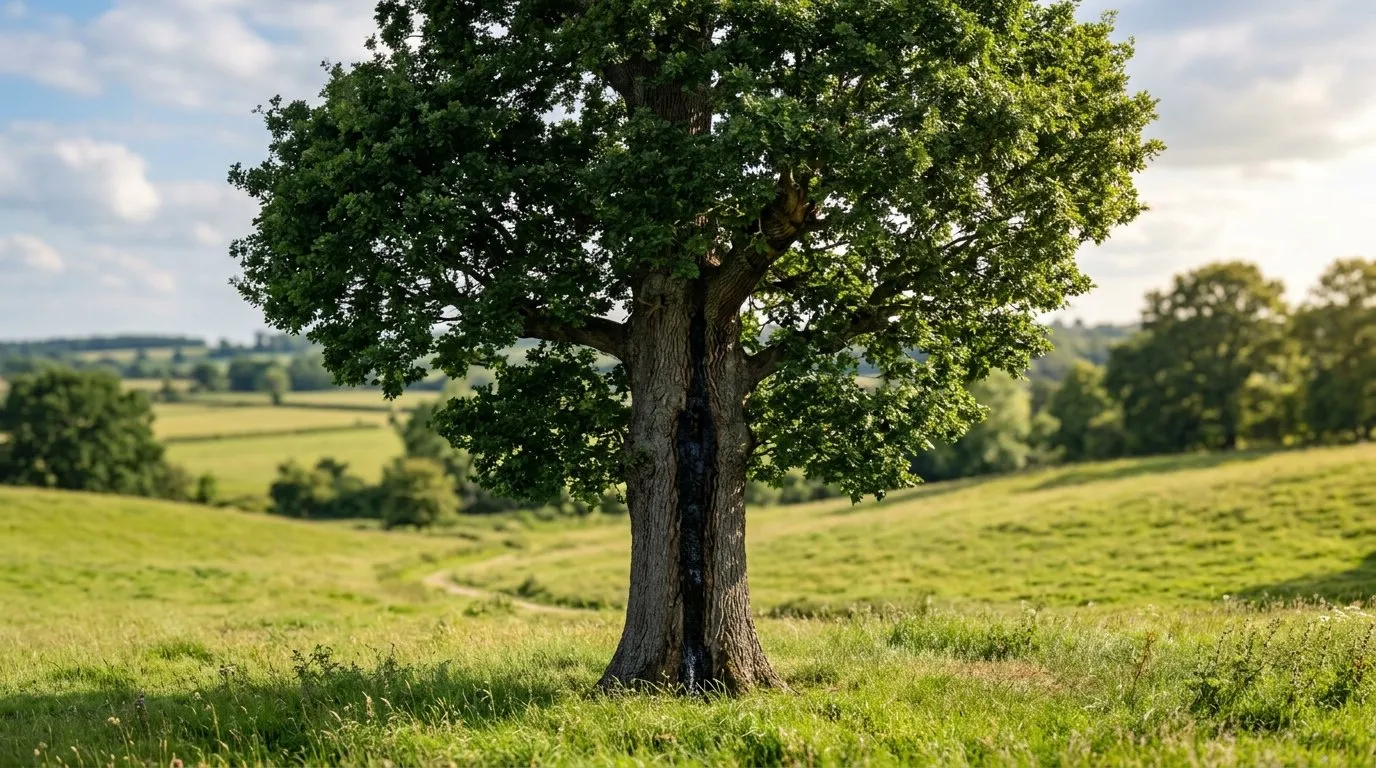 A mature pedunculate oak with a dark stem bleed low on the trunk, the first sign most owners notice.
The four signs of acute oak decline on a mature oak
Look for four signs together: weeping stem bleeds, vertical bark cracks, D-shaped beetle exit holes, and a thinning crown. No single symptom confirms AOD on its own, but the full set is a strong pointer, and Forest Research uses this combination for diagnosis.
The stem bleeds are the headline sign. Dark, reddish-black to almost tar-black fluid oozes from the trunk, usually on the lower two to three metres. It seeps out slowly, dries to a crust, and often reappears after rain. Beneath each bleed, the inner bark has died into a lesion.
The bark cracks run vertically, between the plates of the oak’s ridged bark. The bleeds emerge from these fissures. Peel back nothing yourself, but on close inspection you can see the fluid is coming from splits rather than from a wound or a pruning cut.
The exit holes are made by the two-spotted oak beetle, Agrilus biguttatus. They are a distinctive D-shape, roughly 4mm by 3mm, as if punched with a tiny bevelled chisel. They will not appear on every affected tree, but when you see D-shaped holes alongside bleeds, the case for AOD strengthens a lot. Round holes are made by other, harmless borers.
The crown thinning is the slow-burn sign. Leaves become sparse, the canopy lets more light through, and dead twigs show at the top. Crown thinning alone means little, because drought and old age cause it too, but combined with bleeds it fits the AOD picture.
Gardener’s tip: Photograph any stem bleed the day you find it, with a coin or ruler in shot for scale, then again a month later. A bleed that has spread, multiplied or gained fresh D-shaped holes is telling you the disease is active. One static patch that never changes is far less worrying and may simply be an old, healed wound.
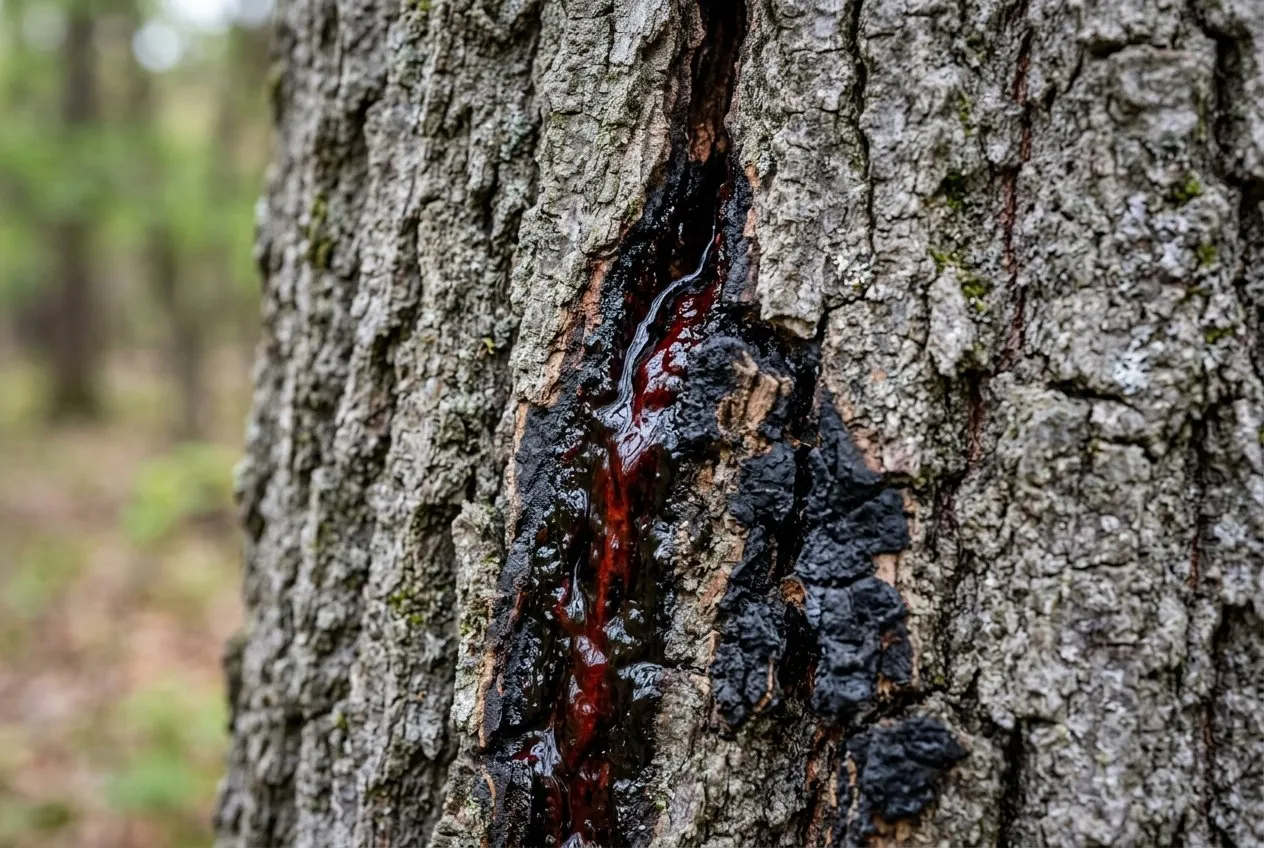 The classic stem bleed: dark fluid seeping from a vertical crack between the bark plates, drying to a black crust.
Which oaks get acute oak decline, and where
AOD mainly affects mature native oaks over 50 years old in the warmer, drier half of Britain. The two most affected species are pedunculate oak (Quercus robur), our commonest lowland oak, and sessile oak (Quercus petraea), more typical of the north and west.
Most confirmed cases sit in central England, the south-east, East Anglia, the Welsh borders and south-east Wales. The disease is largely absent from Scotland and Northern Ireland so far. It seems to favour warm, drought-prone areas, and there is a suspected link with airborne nitrogen pollution, though the science on that is still developing.
Age is a strong factor. The classic victim is a big, established tree of 50 years or more, often well over 100. Younger oaks are affected far less often, although trees with stems only 10 to 12cm across have shown symptoms in a few cases. A handful of non-native oaks, including red oak, Turkey oak and holm oak, can also be affected, so the disease is not limited to our two natives.
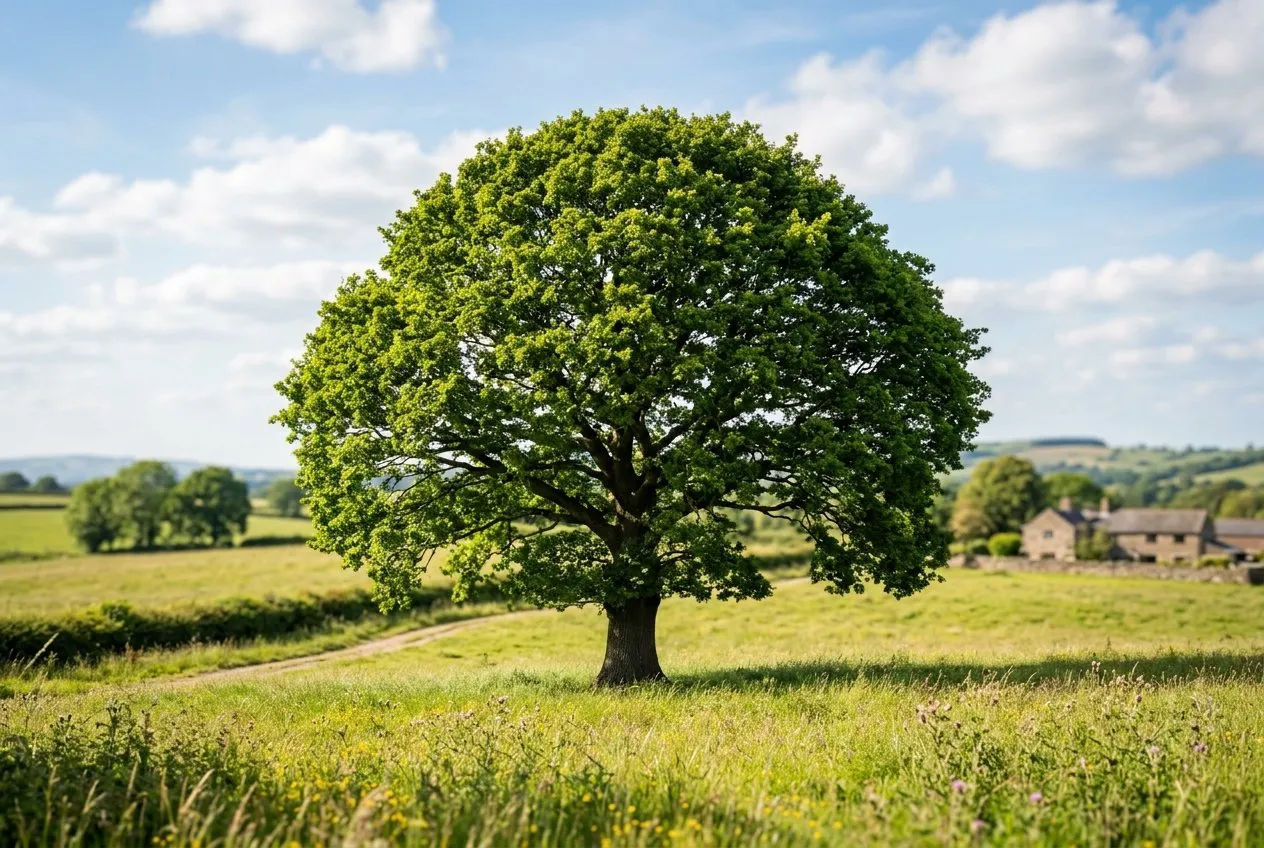 A healthy mature oak has a dense, even crown and clean bark. Knowing what good looks like helps you spot early decline.
What causes the stem bleeds: bacteria and a beetle
The bleeds are caused by bacteria killing the inner bark, with a wood-boring beetle often making things worse. This was a real piece of detective work by Forest Research, because for years the cause was a mystery.
Three bacteria turn up again and again in the lesions: Brenneria goodwinii, Gibbsiella quercinecans and Rahnella victoriana. Brenneria goodwinii is the one most strongly linked to the tissue death. These bacteria produce enzymes that break down the living phloem, the layer just under the bark that moves sugars around the tree. As the phloem dies, fluid leaks out through the cracks, which is the bleed you see.
The beetle is Agrilus biguttatus, the two-spotted oak buprestid, a slim metallic-green insect a centimetre or so long. Its larvae chew winding galleries through the inner bark and outer wood. On a stressed tree these galleries can girdle the trunk, and the beetle may also help move the bacteria between trees. Forest Research found that stem bleeds and fresh D-shaped exit holes strongly tend to appear on the same trees, which is why the beetle is treated as a key player rather than a bystander.
Underlying stress ties it together. Drought, root damage, soil compaction and repeated defoliation weaken an oak’s defences, and a weakened oak is far more open to both the bacteria and the beetle. That is the one part of the puzzle a tree owner can actually influence.
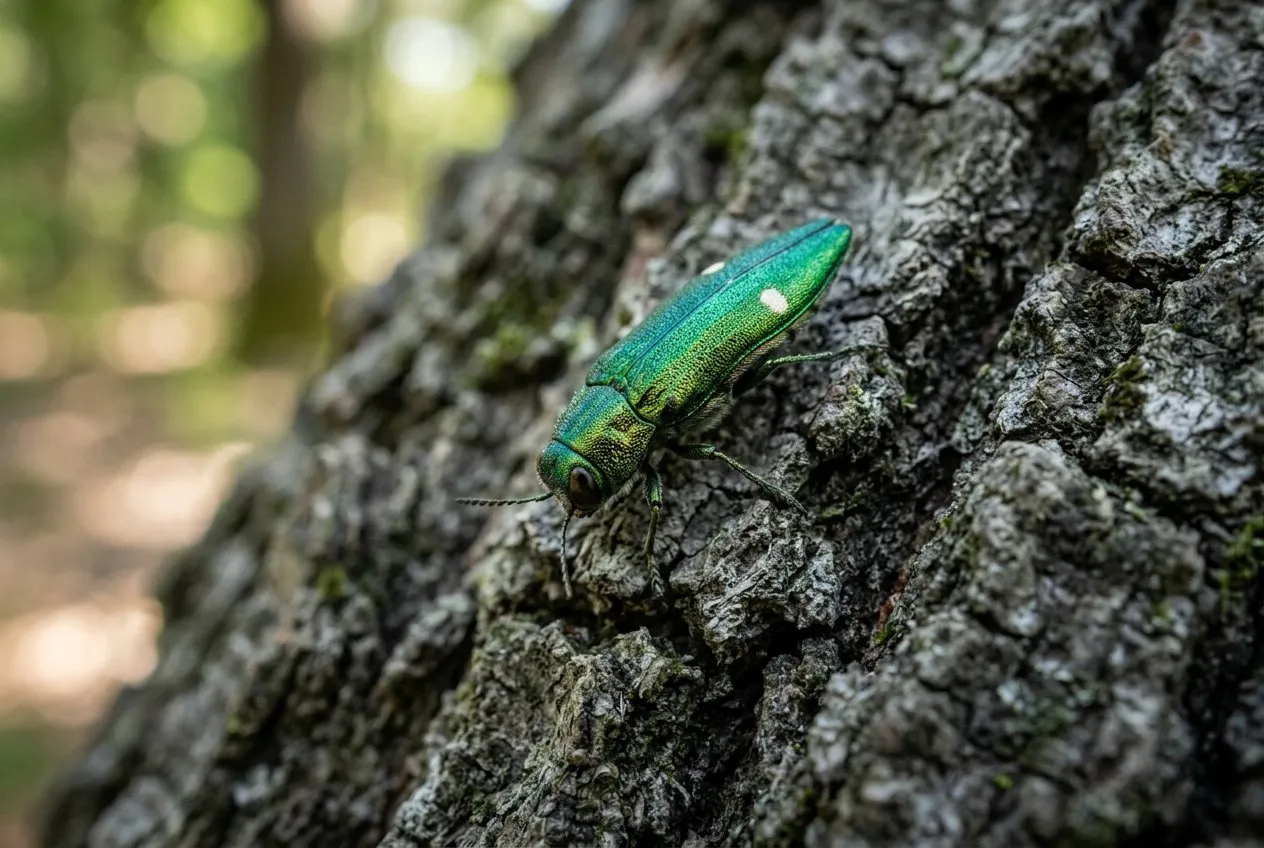 Agrilus biguttatus, the two-spotted oak beetle. Its larvae bore galleries under the bark and may help move the bacteria.
Telling acute oak decline apart from harmless bleeds
Not every oozing oak has AOD. Several harmless or less serious problems produce dark patches or fluid, and it pays to rule them out before you worry. The table below sets the main lookalikes side by side.
The one most often confused with AOD is slime flux, also called bacterial wetwood. This produces a wet, sometimes frothy or foul-smelling ooze, usually from an old wound, branch stub or fork rather than from vertical bark cracks. Slime flux rarely kills the tree. It looks unpleasant but does not carry the same threat, and it is not associated with D-shaped beetle holes.
Squirrel bark stripping, frost cracks and old pruning wounds can all weep sap too, especially in spring. The giveaway with AOD is the combination: dark bleeds from vertical cracks, low on the trunk, often with D-shaped exit holes and crown thinning, on a mature native oak in the affected region.
Acute oak decline versus its lookalikes
| Feature | Acute oak decline | Chronic oak decline | Slime flux (wetwood) |
|---|---|---|---|
| Speed | Fast, 4-6 years to death | Slow, over decades | Chronic, rarely fatal |
| Fluid | Dark, tarry, from vertical bark cracks | Little or no bleeding | Wet, frothy, often smelly |
| Source | Splits between bark plates | Twig dieback, thin crown | Old wounds, forks, branch stubs |
| Beetle holes | D-shaped 4mm holes common | Not associated | Not associated |
| Main driver | Bacteria plus Agrilus beetle | Drought, defoliation, root fungi | Harmless internal bacteria |
| Bacteria | Brenneria goodwinii and others | Not the primary cause | Various, harmless |
If your tree shows dieback and a thinning crown but no bleeding lesions, chronic oak decline is more likely than AOD. Chronic decline is driven by repeated stress: drought years, insect defoliation and root fungi such as honey fungus grinding a tree down over decades. It is worth reading a broader sudden tree death diagnostic guide if you are unsure which pattern you are seeing.
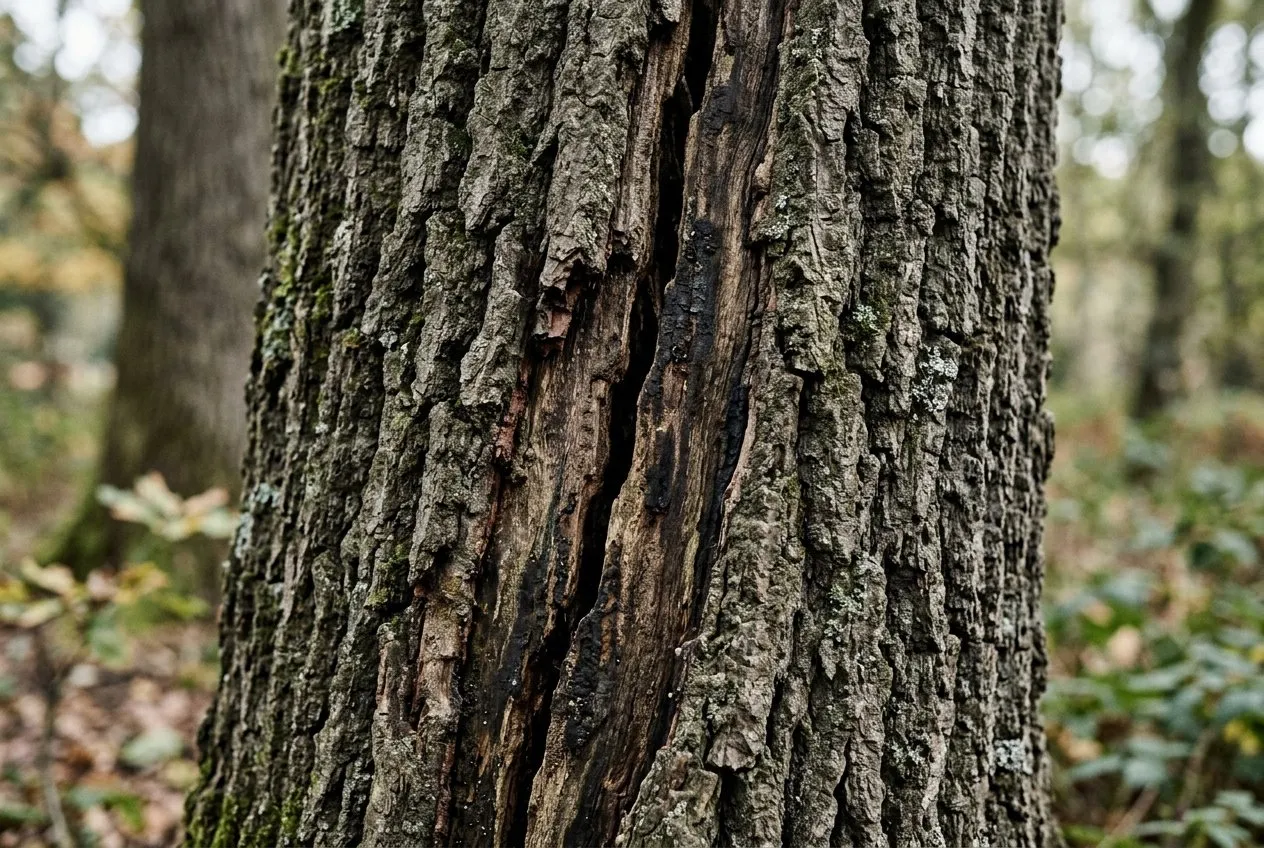 Vertical cracks between the bark plates are where AOD bleeds emerge, unlike slime flux which oozes from old wounds and forks.
How fast does acute oak decline kill a tree?
A severely affected oak can die within four to six years of the first symptoms, but many trees decline more slowly or stabilise. The speed depends on how far the bleeding lesions spread and whether the beetle is active.
The danger point is when lesions merge and encircle the trunk. Because the phloem carries food around the tree, a ring of dead phloem all the way around, called girdling, cuts off that supply and the tree starves. Add beetle galleries doing the same job in the wood, and a big oak can collapse surprisingly quickly for a tree of its age.
Warning: Do not fell an oak the moment you find a bleed. Many affected trees live for years and some recover, and a mature oak is irreplaceable in your lifetime. Get a qualified arboriculturist to judge structural safety before any decision to remove. Panic felling loses a tree that might have held on for decades.
What to do if you find acute oak decline
If you suspect AOD, photograph it, report it through TreeAlert, and tighten your biosecurity. There is no treatment to apply, so your job is to record, report and avoid spreading the problem.
First, photograph the symptoms clearly. Get close-ups of the bleeds and any D-shaped holes, a wider shot of the whole trunk, and a note of the tree’s location or grid reference. Good photos make your report far more useful.
Second, report through TreeAlert, Forest Research’s online reporting tool. AOD is not notifiable, so you are not legally obliged to report, but every logged case helps map the spread. You can submit a report at treealert.forestresearch.gov.uk. Include the photos and location details.
Third, practise biosecurity. The bacteria survive in rainwater and soil, and the beetle can carry them, so:
- Never move logs, branches or firewood from an affected oak to another site. Keep any felled timber where it is.
- Brush soil off your boots and clean your tools before moving from the affected tree to another oak.
- Do not prune the tree unnecessarily, as fresh wounds are entry points and pruning debris can move the problem.
This is the same discipline that slows other tree diseases such as ash dieback, where careless movement of material has spread infection across the country.
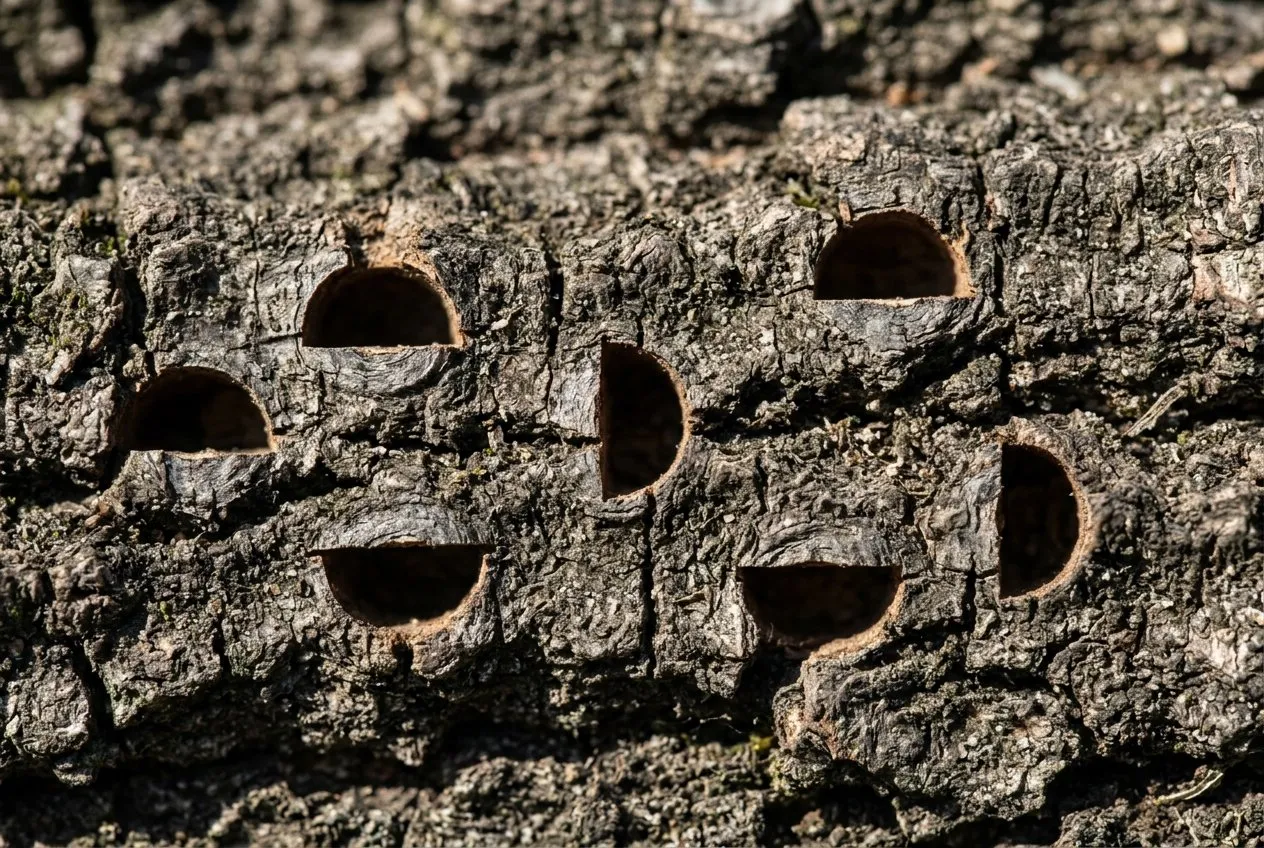 A D-shaped exit hole, roughly 4mm by 3mm, left by Agrilus biguttatus. Round holes come from harmless borers.
Keeping an affected oak unstressed
The single most useful thing you can do is reduce stress on the tree, because a healthy oak resists both the bacteria and the beetle far better. You cannot kill the bacteria, but you can improve the tree’s own defences.
Protect the roots. Most of an oak’s feeding roots sit in the top 60cm of soil and spread well beyond the canopy edge. Avoid compacting that area. Keep vehicles, heavy machinery, hardstanding and building spoil off the root zone. Compaction squeezes air out of the soil and starves the roots, which is a classic trigger for decline.
Prevent drought stress. In a dry summer, a mature oak under attack benefits from a slow, deep soak over the root zone rather than the trunk. Water in the evening, and aim for the outer two-thirds of the canopy spread where the active roots are.
Mulch, but never pile it. A layer of composted bark or leaf mould over the root zone conserves moisture and feeds the soil life slowly. Keep it 5 to 7cm deep and, importantly, hold it well clear of the trunk. Mulch banked against the bark traps moisture and rots the base, adding stress rather than removing it. The same rule applies to any mulching wound entry disease, including canker in fruit trees and silver leaf disease, where damp, buried bark invites trouble.
Do not feed heavily. Rich, high-nitrogen feeds push soft growth and can make a stressed oak more attractive to pests. Improving soil health slowly beats forcing growth.
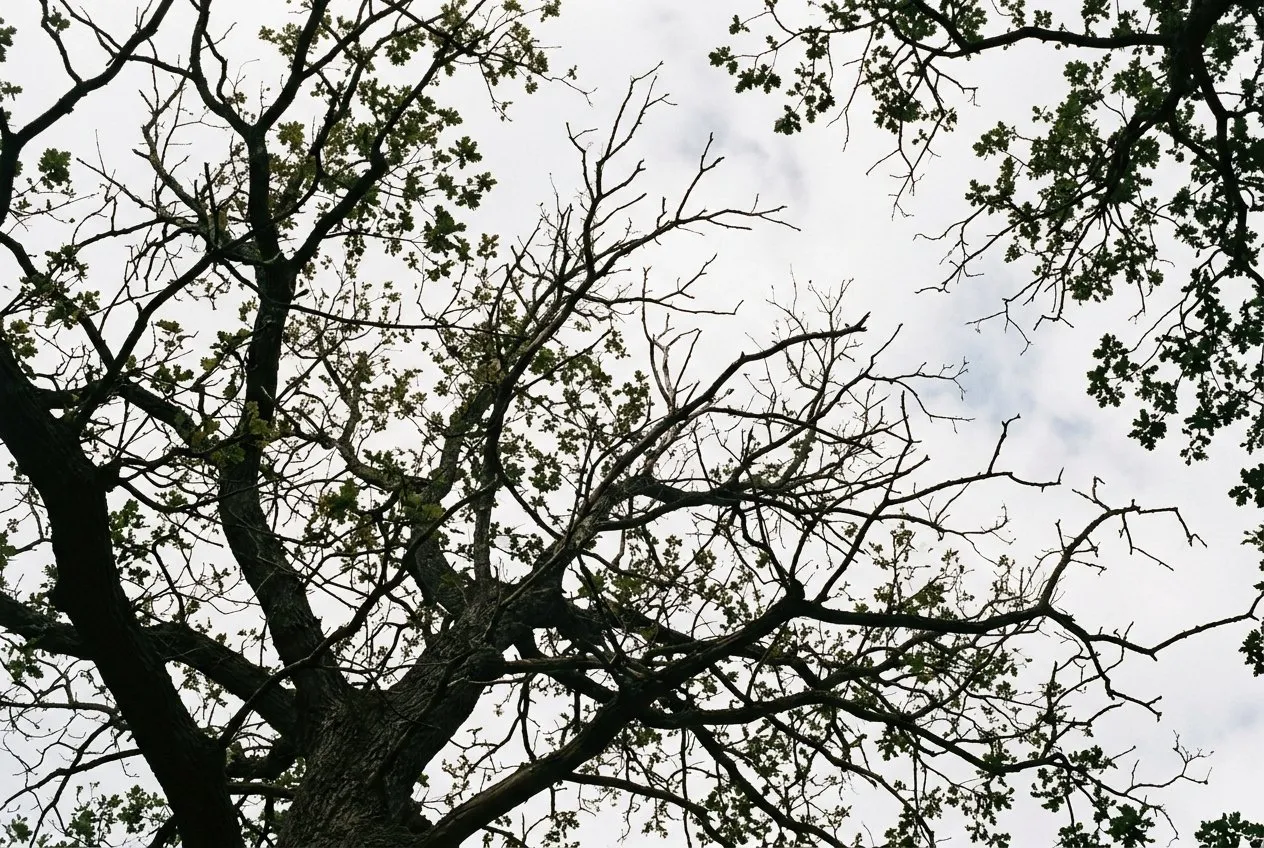 Crown thinning: sparse leaves and dead twigs at the top. On its own it means little, but with bleeds it fits the AOD picture.
A year of monitoring an at-risk oak
| Month | What to check |
|---|---|
| January | Bark visible with leaves gone; note any fresh bleeds on the bare trunk |
| February | Check for water pooling or compaction around the root zone after winter |
| March | Look for new bleeds as sap rises; clear any mulch that has crept to the trunk |
| April | Watch for early leaf flush; a late or patchy flush hints at stress |
| May | Assess canopy filling out; compare density with last year |
| June | Full monitoring set: fixed-spot photos, close-ups, ruler for scale |
| July | Check for adult Agrilus beetle activity and any new D-shaped holes |
| August | In drought, give a slow deep soak over the outer root zone |
| September | Note any early leaf loss beyond normal autumn timing |
| October | Record autumn colour and leaf drop timing against previous years |
| November | Top up mulch over the root zone, kept clear of the trunk |
| December | Review the year’s photos side by side; log any changes |
Common mistakes when dealing with acute oak decline
Most harm comes from overreacting or from spreading the problem, not from the disease being missed. Avoiding these errors matters as much as spotting the symptoms.
Felling too soon
The commonest mistake is felling a mature oak the moment a bleed appears. Many affected trees live on for years and some recover. Unless an arboriculturist judges the tree unsafe, watchful monitoring beats the chainsaw. A felled oak cannot be undone.
Moving the timber
If a tree is felled, moving the logs or firewood to another property carries the bacteria and beetle with them. Keep all timber on site. This one habit does more to slow AOD’s spread than any spray ever could.
Applying wound paints or DIY cures
Sealing bleeds with wound paint traps moisture against dead tissue and can make lesions worse. There is no injection, spray or paint that cures AOD. Money spent on DIY treatments is wasted and may harm the tree.
Piling mulch against the trunk
A well-meant heap of mulch banked up the base of the trunk rots the bark and adds the very stress you are trying to remove. Mulch the root zone, 5 to 7cm deep, and keep a clear gap around the trunk.
Compacting the roots
Parking machinery, stacking building materials or laying hardstanding over the root zone starves the roots of air. On a tree already fighting AOD, compaction can tip it over the edge. Keep the ground under and beyond the canopy soft and undisturbed.
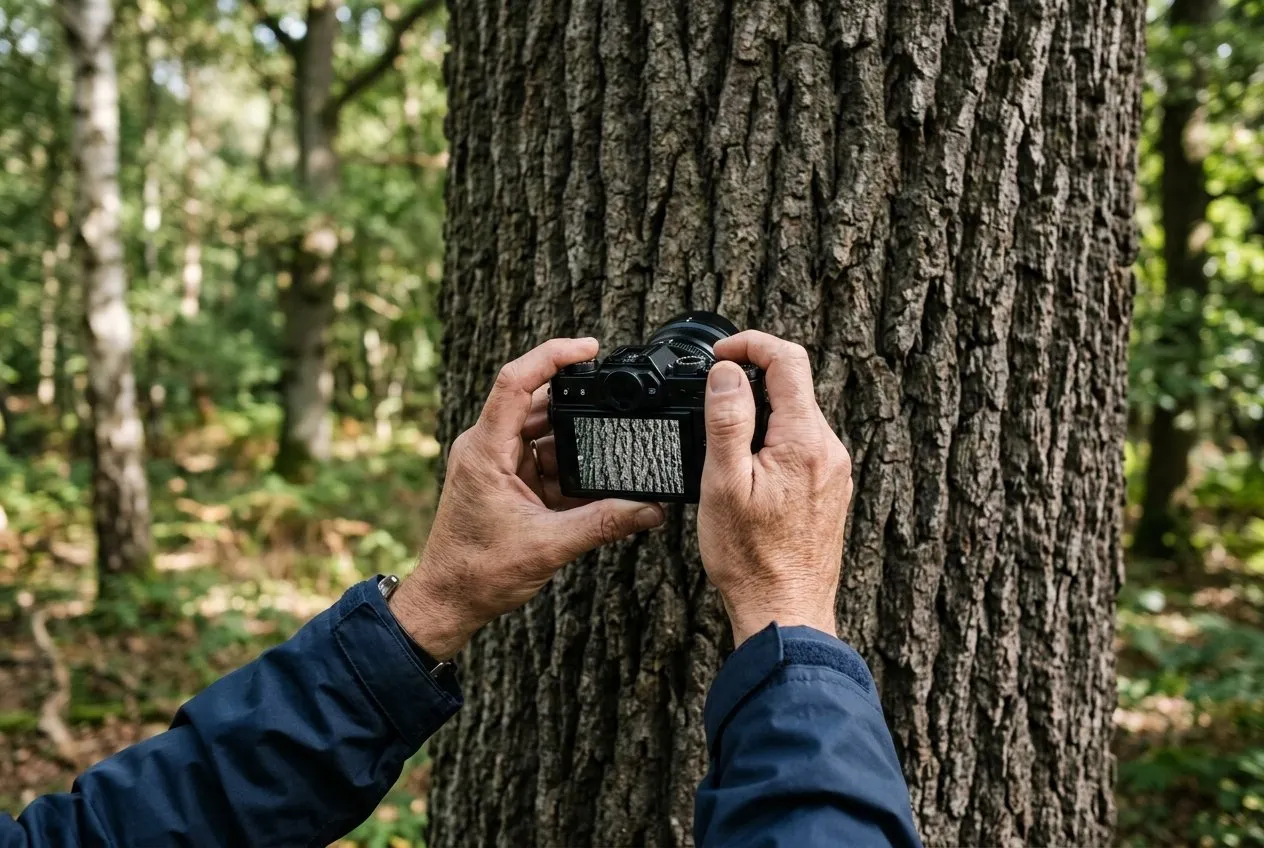 A consistent yearly photo record from fixed spots turns vague impressions into evidence you can compare season on season.
Frequently asked questions
What are the first signs of acute oak decline?
Dark, weeping patches of fluid on the trunk are the classic first sign. The fluid seeps from vertical cracks between the bark plates and dries to a black, tarry crust. Look also for D-shaped exit holes about 4mm across and a thinning crown. AOD usually shows several of these signs together, not just one.
Is acute oak decline notifiable in the UK?
No, acute oak decline is not currently a notifiable disease. You are not legally required to report it, but Forest Research asks people to log suspected cases through TreeAlert. Reports help track where the disease is spreading. Notifiable status can change, so check the Forest Research page before assuming your report is optional.
Can a tree recover from acute oak decline?
Yes, some oaks recover, especially if the underlying stress eases. Stem bleeds can callus over and stop weeping when the tree is no longer drought-stressed or root-damaged. Recovery is not guaranteed, and severe cases where bleeds encircle the trunk are usually fatal. Keeping the tree unstressed gives it the best chance to hold on.
What is the difference between acute and chronic oak decline?
Acute oak decline kills faster and involves stem bleeds and bacteria. It can fell a tree in four to six years and shows the weeping trunk lesions and beetle exit holes. Chronic oak decline is a slower, decades-long process driven by repeated defoliation, drought and root fungi, without the distinctive bleeding lesions or the two-spotted oak beetle.
Do I need to remove an oak with acute oak decline?
Not usually, unless it becomes a safety risk. Many affected oaks live for years and some recover, so felling on sight is rarely justified. Get a qualified arboriculturist to assess structural safety if the tree overhangs a path or building. If you do fell it, keep the timber on site to avoid moving the bacteria and beetle.
Can I catch or spread acute oak decline?
You cannot catch it, but you can help spread it between trees. The bacteria survive in rainwater and soil, and the beetle flies to new oaks. Clean soil off boots and tools between trees, and never move logs or firewood from an affected oak. Good biosecurity is the main thing a tree owner can control.
Is there a treatment or spray for acute oak decline?
No, there is no cure, spray or injection that works. Do not waste money on DIY treatments or wound paints, which can trap moisture and make things worse. The only useful action is to reduce stress on the tree: avoid compacting the roots, prevent drought, and mulch the root zone without piling material against the trunk.
Our team produces practical UK gardening guidance from source research, contributor records and established horticultural practice. Editorial standards are overseen by Matt W.