Key takeaways
- Couch grass spreads by white underground rhizomes, not seed
- Every 25mm rhizome fragment can regrow into a full plant
- Fork-and-sieve in autumn is the only reliable single-season method
- Smother sheet (black plastic or thick cardboard) for 6-12 months
- Three full seasons to clear a heavily infested UK allotment plot
- Glyphosate kills 70-80%; the surviving rhizomes regrow within 8 weeks
Couch grass (Elymus repens, also called twitch or quitch) is the most-feared UK garden weed. It spreads silently by underground white rhizomes that snap into pieces every time a spade hits them. Each 25mm fragment regrows into a new plant. This guide covers the rhizome-removal method that actually works, the smother step that catches what the fork missed, and the three-season plan that clears even severe infestations.
Why Couch Grass Is So Hard to Kill
Couch grass spreads by rhizomes, not seed. A rhizome is a horizontal underground stem that produces new shoots at each node. Couch rhizomes:
- Grow 300-600mm per year through loose UK soil
- Run at 100-250mm depth on clay, 250-400mm on sand
- Produce new plants at every 40-60mm interval along their length
- Regrow from any fragment 25mm or longer with a node intact
- Survive in dried-out form for 6-12 months before withering
- Penetrate gravel paths, brick edging, and concrete cracks
A single mature couch plant produces 3-8m of rhizome in one growing season. A 1m² patch left untreated for two years contains 50-100m of rhizome below ground.
The seed-spread is minor. Couch flowers produce viable seed but the seedlings rarely establish in UK gardens. The rhizome network is the real problem.
| Treatment | Year 1 effect | Year 2 effect | Long-term result |
|---|---|---|---|
| Hand fork (300mm depth) | 70-85% kill | 90-95% kill if re-forked | Cleared in 2-3 seasons |
| Sieve every spadeful | 92-98% kill | 99%+ kill | Cleared in 1-2 seasons |
| Black plastic smother | 60-75% kill | 85-95% kill | Cleared in 2-4 seasons |
| Glyphosate spray alone | 70-80% kill | 60-70% (regrowth) | Never fully cleared |
| Rotavating | -1000% (multiplication) | Catastrophic | Worse than starting |
| Doing nothing | 100% spread | 200% spread | Total plot loss |
Identification: Telling Couch Grass From Other Grasses
UK lawns and beds contain many grass species. Couch is distinct in three ways.
Leaf: flat, dull green, with a slight twist along the length. Width 4-8mm. Leaf undersides slightly hairy. Tip pointed and slightly drooping.
Rhizome: the diagnostic feature. White or pale cream, segmented like a thin underground bamboo, 2-4mm diameter, with a pointed growing tip that can pierce a potato tuber. Pull up any suspect grass and examine the roots. White segmented rhizomes confirm couch.
Spread pattern: couch advances in spreading patches with a clear leading edge, not as scattered tufts. A 1m² patch typically becomes 2m² in one year and 4m² in two years.
The two grasses often confused with couch:
| Grass | Roots | Spread | Notes |
|---|---|---|---|
| Couch (Elymus repens) | White rhizomes 100-400mm deep | Spreading clumps | Worst UK weed |
| Common bent (Agrostis capillaris) | Fine fibrous roots | Lawn-spread by stolons | Tolerable in lawns |
| Yorkshire fog (Holcus lanatus) | Fine fibrous, shallow | Tufts | Easier to clear by hand |
| Annual meadow grass | Fine, shallow | Seed only | One pull clears |
Lift one suspect plant. If white rhizomes break off when you pull, it is couch.
The Fork-and-Sieve Method
The most reliable single-season clearance.
Equipment:
- Pneumatic digging fork (300mm tines, £25-£45)
- Garden sieve or screen on a wheelbarrow (£15-£25)
- Two stout buckets for rhizome collection
- Heavy-duty gardening gloves
- Tarpaulin to collect lifted soil
Method:
- Choose a dry afternoon in October-November after harvest
- Fork the bed in 300x300mm sections, working backwards
- Lift each spadeful of soil onto the sieve over the wheelbarrow
- Shake the sieve gently; rhizomes catch on the mesh
- Pick out every rhizome by hand, including 25mm fragments
- Collect rhizomes in a sealed bucket
- Pour the sifted soil back into the bed
- Continue across the whole bed without breaks
- Burn or bag and bin the collected rhizomes; never compost
A 4m² heavily-infested bed takes 3-4 hours to fork-and-sieve. Two people halve the time. Output: 3-5kg of rhizomes from a typical infestation.
After forking, water the bed and wait 21-28 days. Any missed rhizomes will produce green shoots in this window. Spot-fork these immediately. The 21-day check catches 80-90% of missed rhizomes.
For the wider weed-clearance plan on a UK allotment, our organic weedkillers guide covers the supplementary chemical-free options.
 The fork-and-sieve method in action. Each forkful of soil goes onto a sieve over a wheelbarrow. Rhizomes catch on top while the soil falls through. The single most effective UK couch clearance technique.
Smother Sheets: The Long-Game Approach
For gardeners without time or strength for full forking, smother sheets clear couch in 12-18 months without digging.
Materials that work:
- Black plastic (500-gauge): blocks all light, kills in 9-12 months
- Heavy cardboard (corrugated, multi-layer): kills in 12-18 months
- Old carpet (natural fibre only): kills in 12-18 months
- Bracken layer 150-200mm thick: kills in 12-18 months
Materials that fail:
- Newspaper alone: too thin, couch breaks through in 8-12 weeks
- Grass clippings alone: too thin, couch grows through
- Black weed membrane: couch grows through in 6-12 months
- Polythene under 250 gauge: tears within 3-4 months
Method:
- Cut couch foliage to ground level with shears
- Lay smother material across the entire affected area
- Overlap edges by 200mm minimum
- Weight the edges with bricks, paving slabs, or timber
- Leave undisturbed for 9-12 months minimum
- Lift the smother sheet and fork through the soil
- Any pale white rhizomes underneath are dead
After smothering, fork the cleared bed once to lift any dead rhizome shells (they decompose slowly otherwise). Then plant immediately with a competitive cover crop.
Why Glyphosate Alone Fails
Glyphosate (Roundup, Resolva) is widely recommended for couch but does not provide permanent clearance. The chemistry:
- Glyphosate is absorbed by leaves and translocated to roots
- Kills foliage and surface rhizomes within 14-21 days
- Reaches deeper rhizomes in declining concentration
- Below 200mm depth, less than 30% of the herbicide reaches the rhizome
Glyphosate works as a first-pass tool before forking. Spray the bed in autumn, wait 21 days for foliage to die back, then fork. The dead foliage makes the rhizomes easier to see and pull. Combined approach: glyphosate plus fork-and-sieve typically achieves 95-99% clearance in one season.
For the wider regulatory context on UK garden weedkillers, the HSE pesticide register lists approved products and current restrictions on glyphosate.
The UK regulatory picture is shifting. Glyphosate approval is reviewed every 5-10 years and may face further restrictions. The mechanical fork-and-smother approach is the long-term reliable method regardless of chemical availability.
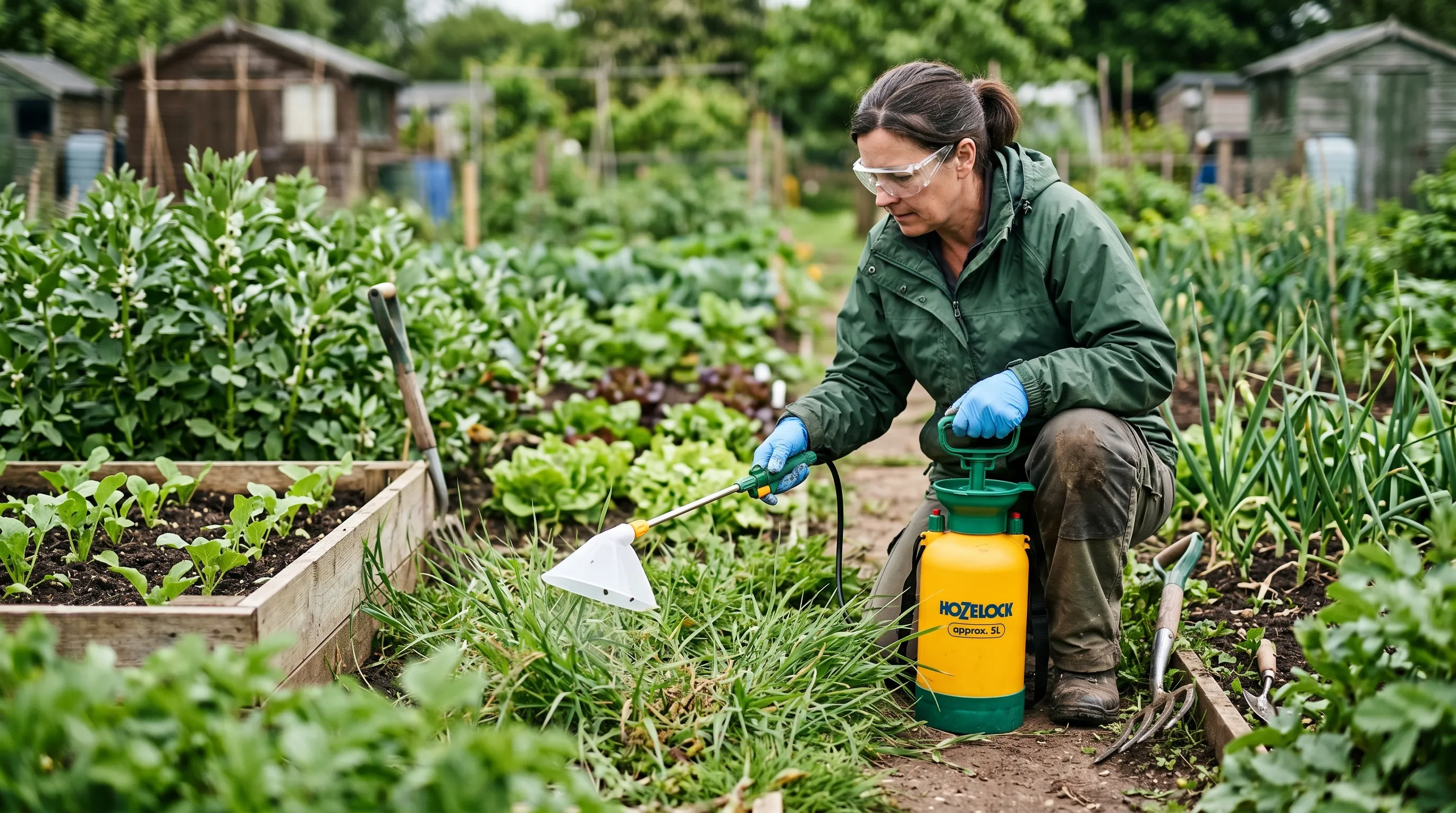 Glyphosate application as a first-pass treatment. Hood guard protects surrounding crops. Even with perfect coverage, deep rhizomes survive and regrow within 12 weeks. Always combine with mechanical clearance.
The 3-Season Clearance Plan
For severe UK couch infestations (couch covering 50%+ of bed area), a full clearance takes three seasons.
Season 1 (Autumn Year 1):
- Mow or strim couch foliage to ground level
- Spray glyphosate on regrowth at 4-leaf stage (if used)
- Wait 21 days for foliage death
- Fork-and-sieve entire bed at 300mm depth
- Plant winter green manure (grazing rye)
- Walk bed weekly for missed regrowth, spot-fork any
Season 2 (Spring Year 2):
- Allow green manure to grow through spring
- Cut and incorporate green manure in May
- Plant a heavily-mulched annual crop (potatoes, pumpkins)
- Watch for couch breakthrough; hand-pull any with full rhizome
- Mulch heavily with cardboard plus grass clippings
Season 2 (Autumn Year 2):
- Re-fork bed at 250-300mm depth, sieving
- Catches the deeper rhizomes that escaped Year 1
- Plant another winter green manure
Season 3 (Year 3):
- Bed is essentially clear
- Plant any vegetable rotation normally
- Watch for boundary re-invasion from neighbouring plots
- Edge with timber 100mm deep to block boundary rhizomes
For the wider organic pest and weed strategy, our organic control guide covers the wider chemical-free approach.
Edge Defence: Stopping Re-Invasion
Couch invades from neighbouring beds, paths, and adjacent allotment plots. Edge defence is essential.
Effective barriers:
- Timber edging set 100mm into soil: stops 90% of edge invasion
- Brick edging on edge mortared base: stops 95% of edge invasion
- Steel or aluminium edging 100mm deep: stops 95% of edge invasion
- Concrete strip 100mm wide x 100mm deep: stops 99% of edge invasion
Ineffective barriers:
- Surface gravel mulch: couch grows through
- Plastic edging set 25mm into soil: rhizomes go under
- Painted brick on the surface: rhizomes grow over
Inspect edges every 4-6 weeks during the growing season. Couch rhizomes appearing at the bed edge mean an invasion is starting. Lift the edge, follow the rhizome back to its source, and remove the parent plant.
For UK allotment holders next to neighbours with couch-infested plots, the realistic plan is constant edge maintenance rather than full plot clearance. A 50mm deep timber barrier with monthly inspection holds the boundary indefinitely.
Common Mistakes With Couch Clearance
Mistake 1: rotavating couch-infested beds. Rotavator blades cut rhizomes into 50-100 fragments per square metre. Each fragment becomes a new plant. The “treatment” multiplies the weed by 10-100x within 8 weeks.
Mistake 2: composting rhizomes. Even dried, dormant rhizomes can regrow when moistened in compost. Bag and bin, or burn. Never compost.
Mistake 3: surface-forking only the top 100mm. Most rhizomes sit at 100-250mm depth. Surface forking misses 60-80% of the network. Use a 300mm fork minimum.
Mistake 4: relying on glyphosate alone. Glyphosate kills 70-80% in the first pass. The remaining 20-30% regrows within 12 weeks. Always combine chemical with mechanical clearance.
Mistake 5: lifting smother sheets too early. Black plastic at 6 months gives 50-60% kill. The same plastic at 12 months gives 85-95% kill. Patience is the key. Mark the lift date on the calendar.
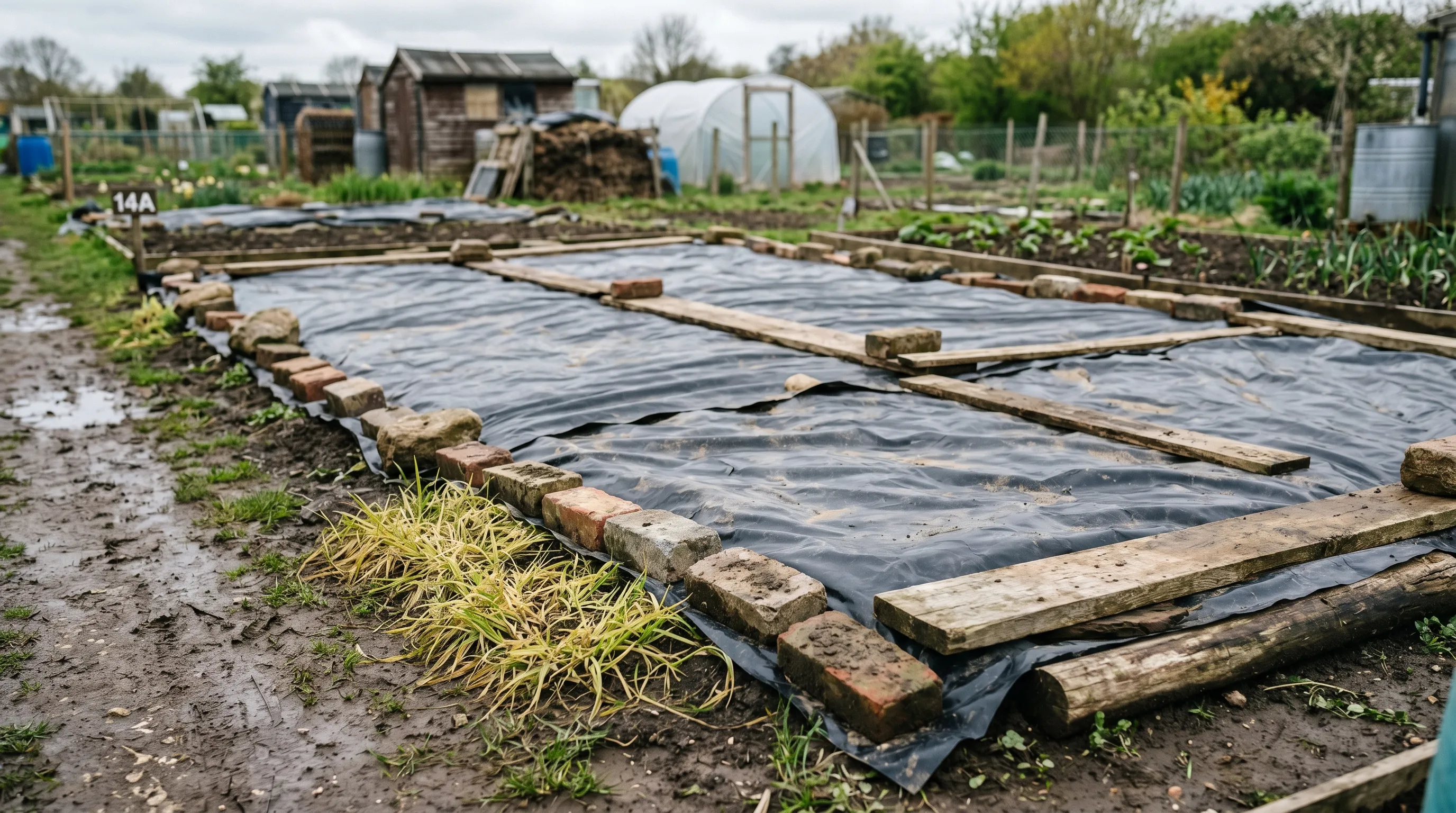 Black 500-gauge plastic smother in place 6 months on. Edges weighted to stop wind lift. Couch underneath has yellowed and is dying back. Leave for 12-18 months for full clearance on heavy infestations.
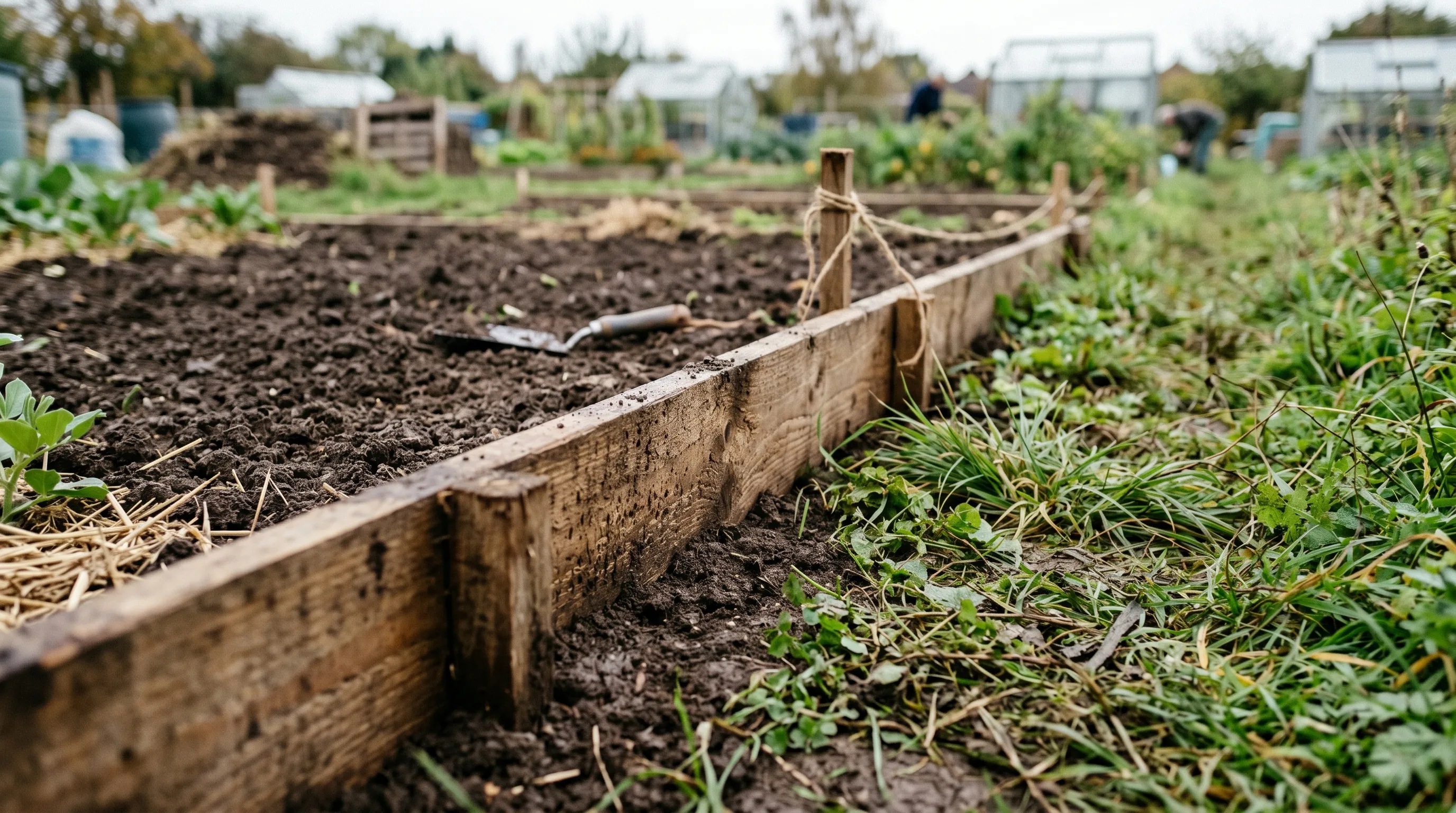 Edge defence after clearance. Timber boards 100mm deep block couch rhizomes from re-invading from neighbouring grass paths. Inspect every 4-6 weeks during the growing season.
For bindweed clearance using a similar fork-and-sieve approach, our bindweed guide covers the related perennial weed with even deeper roots. For the organic weedkiller options, our organic guide covers the chemical-free first-pass alternatives.
Couch Grass Calendar UK Month-by-Month
| Month | Couch clearance task |
|---|---|
| January | Plan beds for spring forking. Check edges |
| February | Order replacement timber edging |
| March | Mark out infested beds. Begin spring smother prep |
| April | Plant green manure on cleared beds |
| May | Monitor for new growth. Spot-fork any breakthroughs |
| June | Walk all edges. Pull boundary rhizomes |
| July | Continue edge inspections. Sharpen forks |
| August | Plan autumn major clearance work |
| September | Strim foliage in target beds. Spray if using glyphosate |
| October | Main fork-and-sieve window. Smother sheets down |
| November | Continue forking. Final smother sheets |
| December | Final edge inspections before winter |
The October-November window is the cornerstone of UK couch clearance. Soil is moist enough to fork easily, foliage is visible but not too dense, and there is time for follow-up checks before winter freezes the soil.
Frequently asked questions
How do I get rid of couch grass in a UK garden?
Fork the bed in autumn lifting every rhizome by hand or sieve. Cover with black plastic or thick cardboard for 6-12 months. Re-fork the following autumn. Repeat for 2-3 seasons on heavy infestations. Never rotavate; the blades multiply the problem.
Does glyphosate kill couch grass permanently?
No. Glyphosate kills the visible foliage and top 50-80% of rhizomes within 2-3 weeks. The deeper rhizomes survive and regrow within 8-12 weeks. Glyphosate works only as a first-pass treatment before forking, not as a single solution.
Can I compost couch grass roots?
Never compost rhizomes. Even fully dried-out couch rhizomes can regrow when moistened in compost. Bag and bin all roots, or burn them. The leaves alone can compost safely after 14 days drying.
How deep do couch grass roots go in UK soil?
Couch rhizomes typically run 100-250mm deep in UK clay and 250-400mm deep in sandy soils. Surface forking misses the deeper rhizomes. Use a 300mm digging fork and lift soil onto a sieve to catch every fragment.
What is the best ground cover after clearing couch grass?
Sow a vigorous green manure like grazing rye or winter tares immediately after clearance. The dense root system prevents any missed couch rhizomes from re-establishing. Follow with a heavy cardboard plus grass mulch the next year for long-term suppression.
Now plan long-term weed defence
Couch grass clearance is one battle. Holding the cleared bed is the long game. Our bindweed removal guide covers the closely related perennial weed. For chemical-free weed control across the rest of the plot, our organic weedkillers guide covers the supporting toolkit. To follow couch clearance with the right cover crop, our green manures and cover crops guide covers grazing rye and winter tares. And for the cardboard plus grass mulch that holds cleared beds long-term, our no-dig mulching guide covers the technique that prevents re-invasion.
Our team produces practical UK gardening guidance from source research, contributor records and established horticultural practice. Editorial standards are overseen by Matt W.