Key takeaways
- Giant hogweed grows up to 5m tall with white flower umbels up to 60cm across and leaves up to 1.5m wide
- The sap contains furanocoumarins that cause severe photodermatitis: burning, blistering and scarring that can flare for years
- If sap touches skin, wash at once with soap and water, cover the area, keep it out of sunlight and seek medical advice
- It is a Schedule 9 plant under the Wildlife and Countryside Act 1981: an offence to plant or cause it to grow in the wild
- Each plant produces up to 50,000 seeds that float downriver and stay viable in soil for up to 15 years
- Never strim, mow or burn giant hogweed: cut the root 10-15cm below the crown or treat with glyphosate, wearing full cover
- Professional removal costs from about £380 plus VAT for a small treatment to £1,900-£2,500 plus VAT for a large infestation
Giant hogweed is the most dangerous plant you are likely to meet on a UK riverbank, and every July it sends people to hospital with burns. It looks like a giant cow parsley or an oversized elderflower, so walkers and children reach out to touch it. That is exactly what you must never do. The sap does not sting or hurt at first. The damage comes hours later, when sunlight turns a smear of clear sap into a line of painful blisters.
This guide covers how to identify giant hogweed with confidence, how to tell it from its harmless lookalikes, what to do if the sap touches your skin, where the law stands, and how to clear it safely. Giant hogweed is beatable. It just demands respect, the right protective kit, and patience across several seasons.
What is giant hogweed and why is it so dangerous?
Giant hogweed (Heracleum mantegazzianum) is a towering invasive weed whose sap causes severe skin burns in sunlight. It arrived in Britain from the Caucasus in the 19th century as an ornamental curiosity for Victorian gardens. It escaped, took to our rivers, and is now a notifiable invasive species across the UK.
The plant is a short-lived perennial, usually flowering in its second or third year, then dying after it sets seed. In that flowering year it is enormous. Mature plants reach 3 to 5m tall, occasionally more, on a thick hollow stem 5-10cm across, green and blotched with purple, covered in coarse white bristles.
The danger sits in the sap. Every part of the plant carries furanocoumarins, chemicals that strip the skin of its natural protection against ultraviolet light. Get sap on your skin, then step into sunlight, and you develop phototoxic photodermatitis: burning, then blistering within 24 to 48 hours, then brown pigmentation and scarring that can last for years. The RHS records that affected skin can flare again on every sunny day long after the first burn heals.
Children are most at risk. The hollow stems look like perfect pea-shooters or telescopes, and the giant leaves make tempting dens. Every summer brings news reports of youngsters badly burned after handling it.
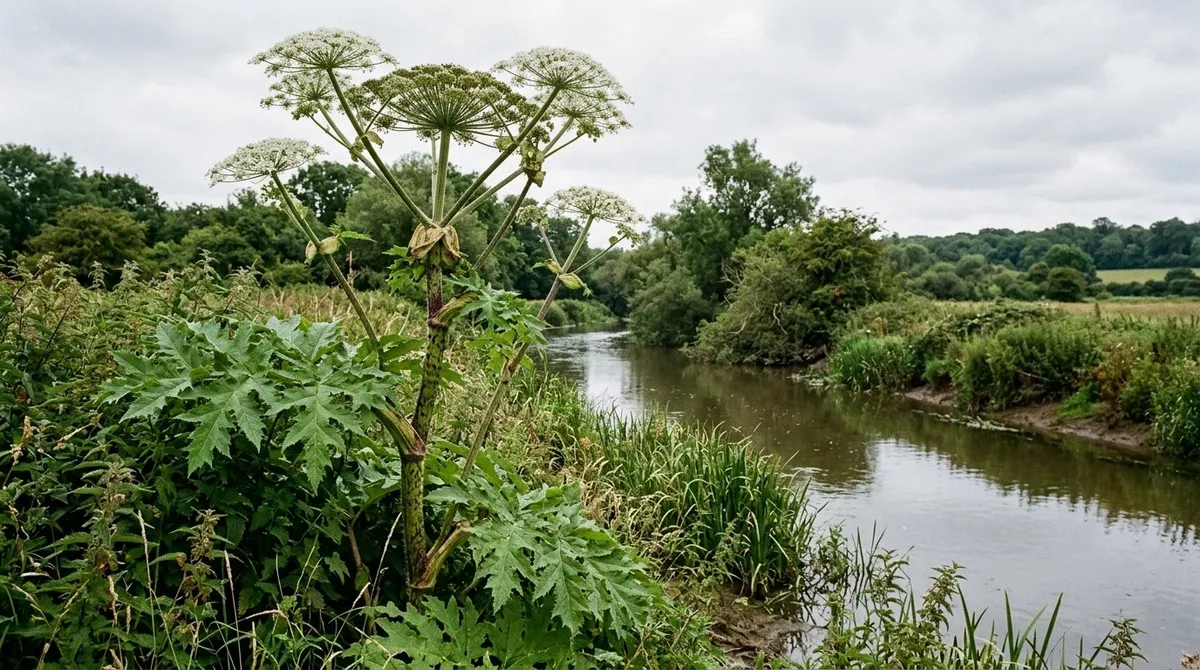
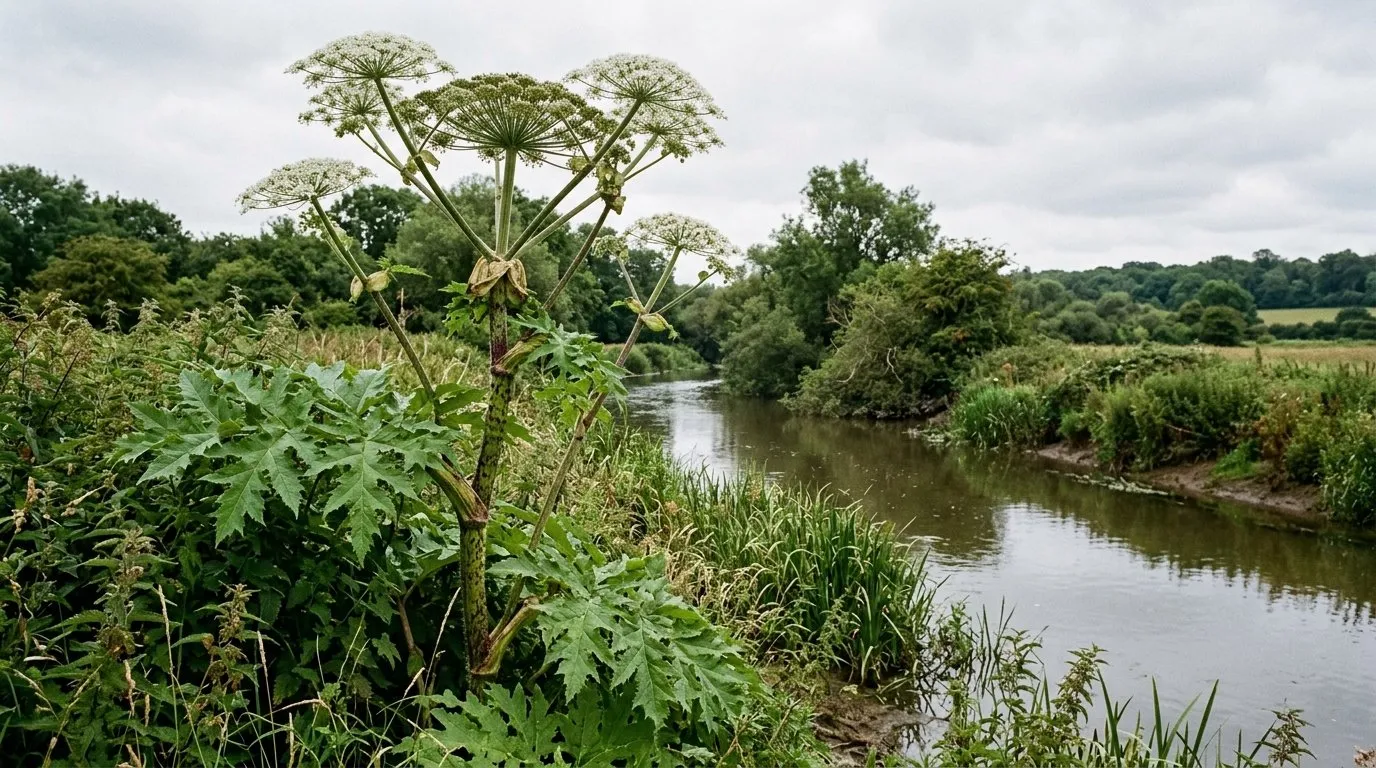 Giant hogweed on a riverbank in full July flower. At 4m tall with 60cm umbels, it dwarfs everything around it. Admire it from a distance and never touch the stems or leaves.
How to identify giant hogweed: the five key features
Giant hogweed identification comes down to five features that, together, no other UK plant shares. Check them from a safe distance, ideally with binoculars or a zoomed photograph, and never handle the plant to confirm.
Height. A flowering plant stands 3 to 5m tall, far above head height. Nothing else in the umbellifer family here comes close.
Stem. The stem is hollow, ridged and 5-10cm thick, bright green with distinct purple-red blotches and studded with stiff white bristles, especially near the base.
Flower heads. Flat-topped white umbels up to 60cm across, like a vast upturned umbrella, appear from June to August. Each carries thousands of tiny white flowers.
Leaves. Deeply cut, jagged and up to 1.5m wide and 3m long, sharply serrated with pointed lobes. They look coarse and almost prehistoric.
Setting. It favours damp ground: riverbanks, ditches, canal towpaths, railway embankments and waste ground. Rarely far from water.
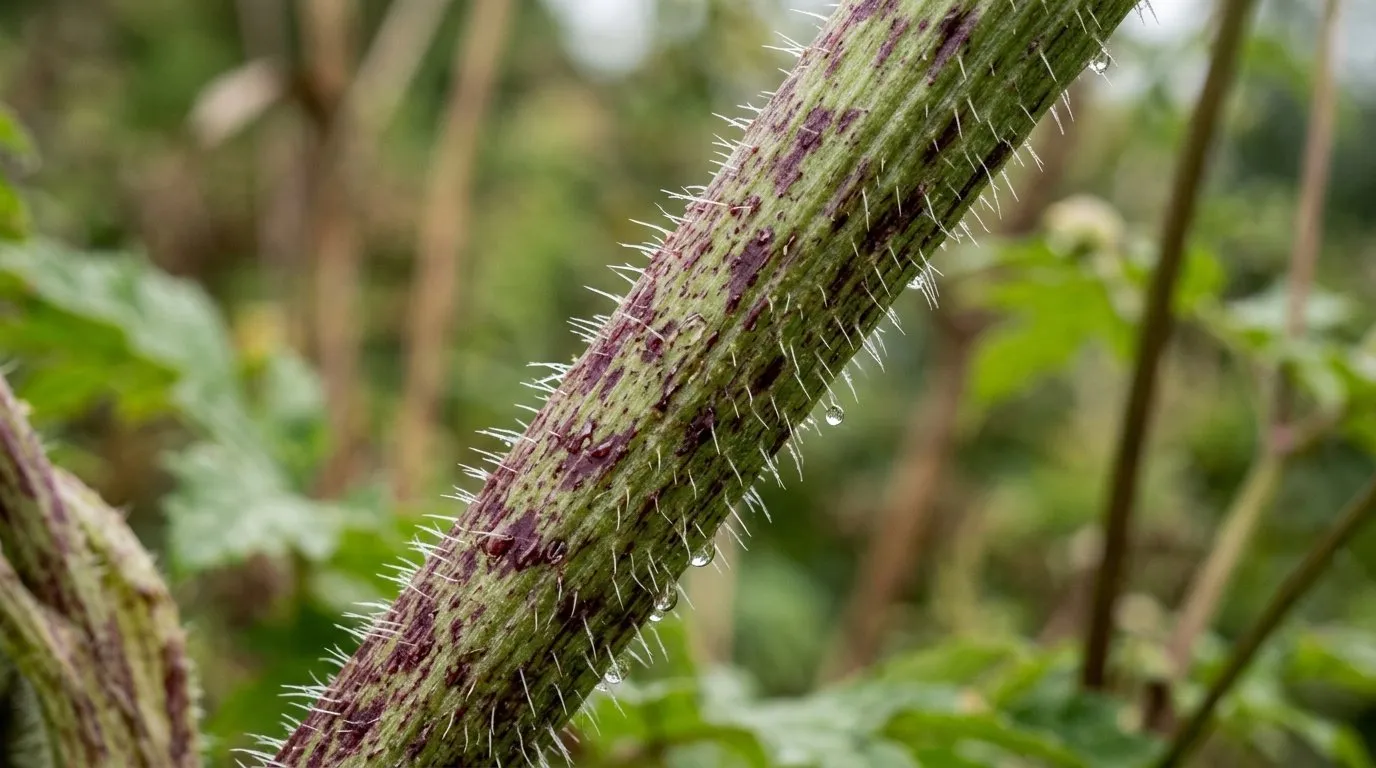 The single most reliable tell for giant hogweed identification: a thick green stem blotched purple and bristled with white hairs. Common hogweed and cow parsley never show this.
Giant hogweed vs cow parsley, common hogweed and elderflower
The confusion is understandable, because four common plants carry the same broad white flowers. The difference is scale and stem. The table below sets the four side by side so you can rule the dangerous one in or out at a glance.
| Feature | Giant hogweed | Common hogweed | Cow parsley | Elderflower |
|---|---|---|---|---|
| Height | 3-5m | Up to 2m | Up to 1m | 3-4m (a shrub or small tree) |
| Stem | Hollow, 5-10cm, green with purple blotches, white bristles | Green or slightly red, ridged, hairy, no strong blotches | Slender green, sometimes purple-tinged, no blotches | Woody, brown, bark-covered, not green |
| Flower head width | Up to 60cm | 20-30cm | 6-10cm | 10-25cm |
| Leaves | Jagged, deeply cut, up to 1.5m wide | Rounded lobes, up to 60cm | Fine, ferny, lacy | Oval leaflets in pairs on a woody twig |
| Flowering | June-August | June-September | April-June | May-July |
| Danger | Severe phototoxic burns | Mild irritant to some skin | Harmless (but has toxic lookalikes) | Harmless, edible flowers |
The quickest field rule: if it is taller than you, with a spotted stem thicker than a broom handle, it is giant hogweed. Cow parsley flowers earlier and stays waist-high. Common hogweed is a mid-summer meadow plant half the height with rounded leaves. Elderflower grows on woody, barked stems, not soft green ones, and its flowers smell sweet. For a fuller comparison of the invasives you may meet, our sibling guide to Japanese knotweed identification covers the other plant every UK gardener should learn to recognise on sight.
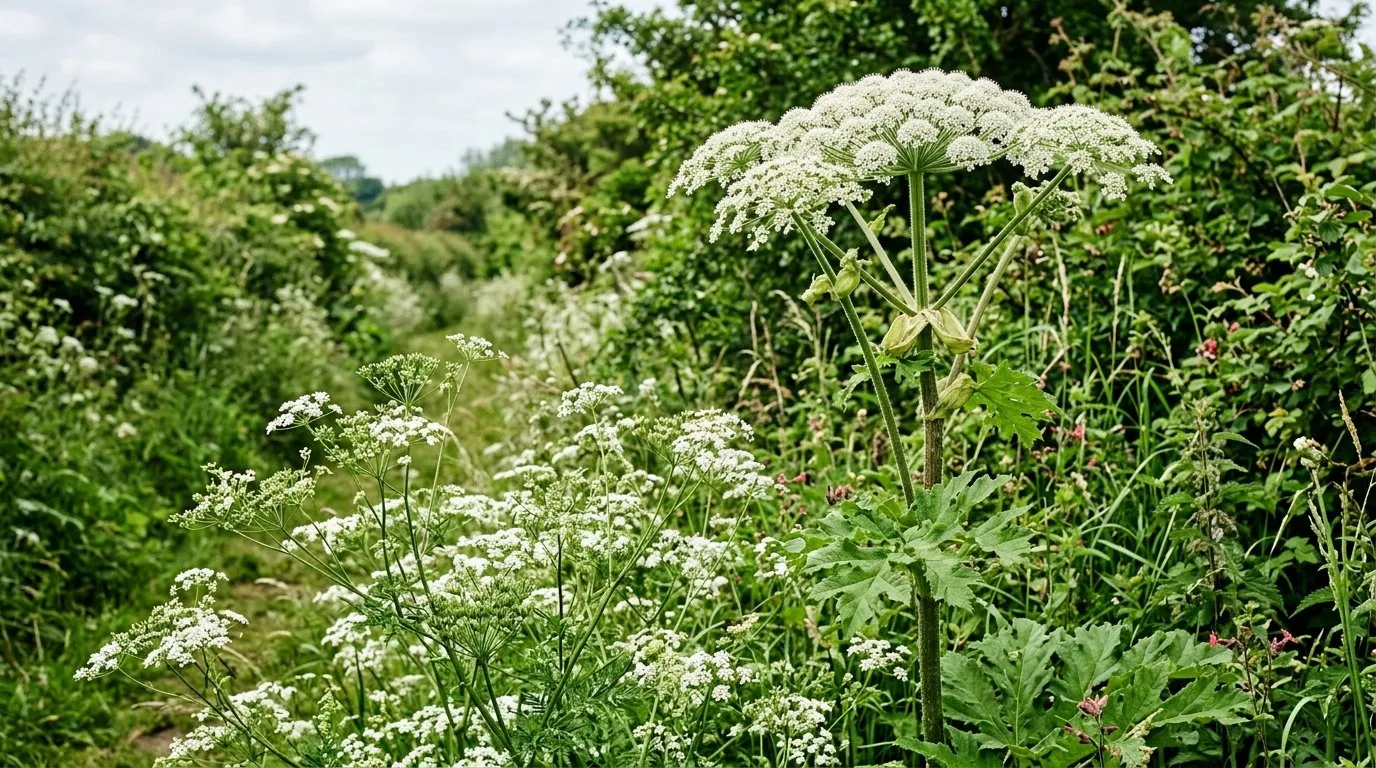 Scale settles it. Lacy cow parsley in front reaches barely a metre; a coarse hogweed behind stands far taller with a much broader umbel and a thicker stem.
What to do if giant hogweed sap burns your skin
Wash the skin immediately with soap and cold water, then keep it out of sunlight. Speed matters, because the furanocoumarins bind to skin within minutes and are activated by ultraviolet light. The faster you wash and cover, the milder the reaction.
Follow these steps if you make contact:
- Wash at once with soap and plenty of cold running water, scrubbing gently to lift the sap.
- Cover the skin and get out of the sun straight away. Keep it shaded for at least 48 hours.
- Do not rub the eyes. If sap reaches your eyes, rinse them with clean water for 10 minutes and seek urgent medical help.
- Watch for blisters over the next one to two days. If they form, do not burst them.
- Get medical advice from a pharmacist, GP or NHS 111 for anything beyond a small patch, and A&E for eye contact or widespread blistering.
Once burned, the skin stays light-sensitive for months, sometimes years. Keep the area covered or use high-factor sun cream outdoors, because bright sun can re-trigger a reaction on healed skin. A GP may prescribe a steroid cream to calm the inflammation.
This is not a plant to underestimate. Unlike the sap of some garden euphorbias, which our guide to plants toxic to dogs touches on for pet safety, giant hogweed reliably burns human skin given sun, and the scars can be permanent.
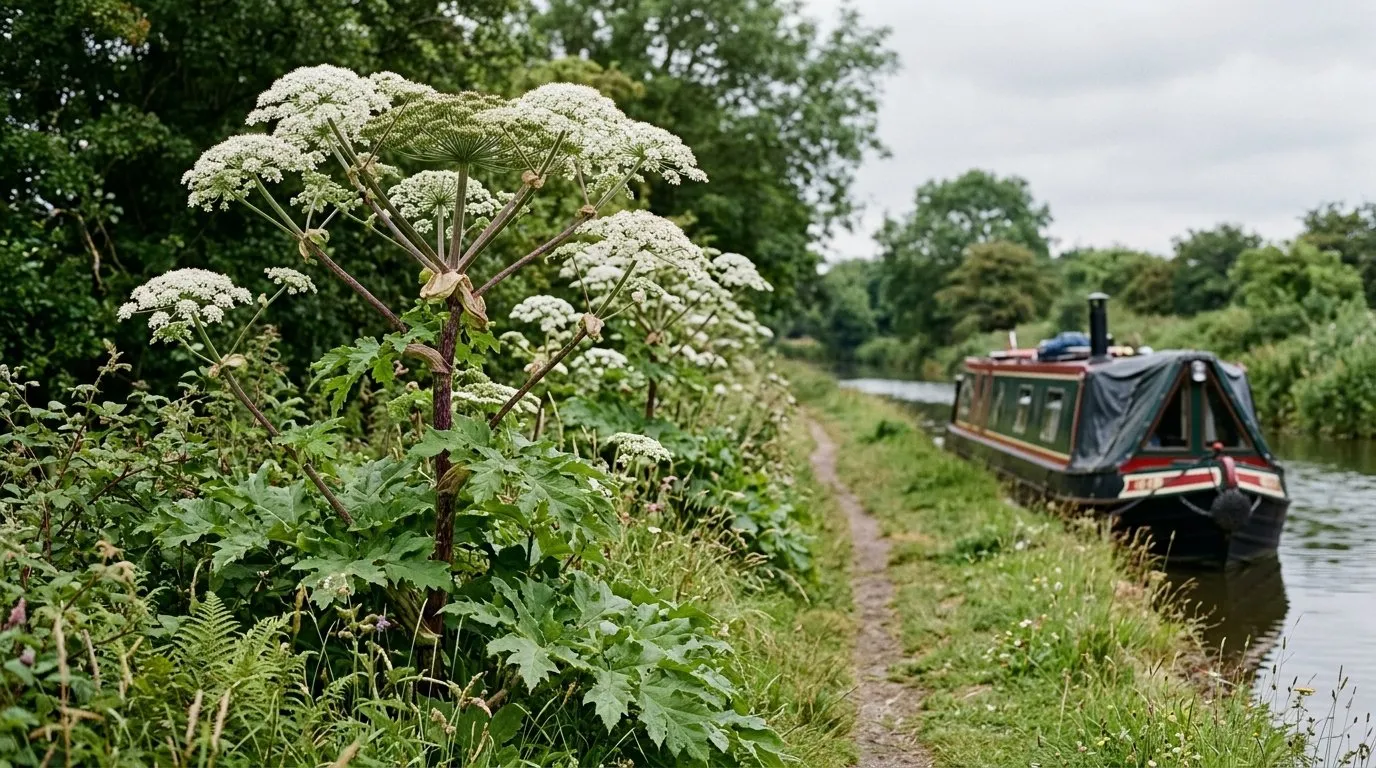 Canal towpaths are prime giant hogweed territory. If you spot it on a public path, report it to the local council or Canal and River Trust rather than tackling it yourself.
Is giant hogweed illegal in the UK?
Having giant hogweed on your land is not itself an offence, but spreading it is. This distinction trips people up, so it is worth stating plainly. Giant hogweed is listed on Schedule 9 of the Wildlife and Countryside Act 1981. Under section 14 of that Act, it is an offence to plant it or otherwise cause it to grow in the wild.
You are not breaking the law simply because it appears on your ground. But you carry two duties. First, you must not allow it to spread onto neighbouring land or into the wild, including by moving contaminated soil. Second, under the Government’s invasive plants guidance, councils can serve a Community Protection Notice under the Anti-social Behaviour, Crime and Policing Act 2014 if you let it become a nuisance, and you could be liable for damage it causes to others.
Cut material and contaminated soil count as controlled waste. You cannot put them in your home compost, the council green bin or household waste. They must go to a licensed landfill site via a registered waste carrier. Burning on site is both dangerous, because heated sap can vapourise, and often restricted.
The practical takeaway: identify it, contain it, control it properly, and keep records. If it sits near a watercourse, tell the Environment Agency or your local council, who coordinate riverbank control.
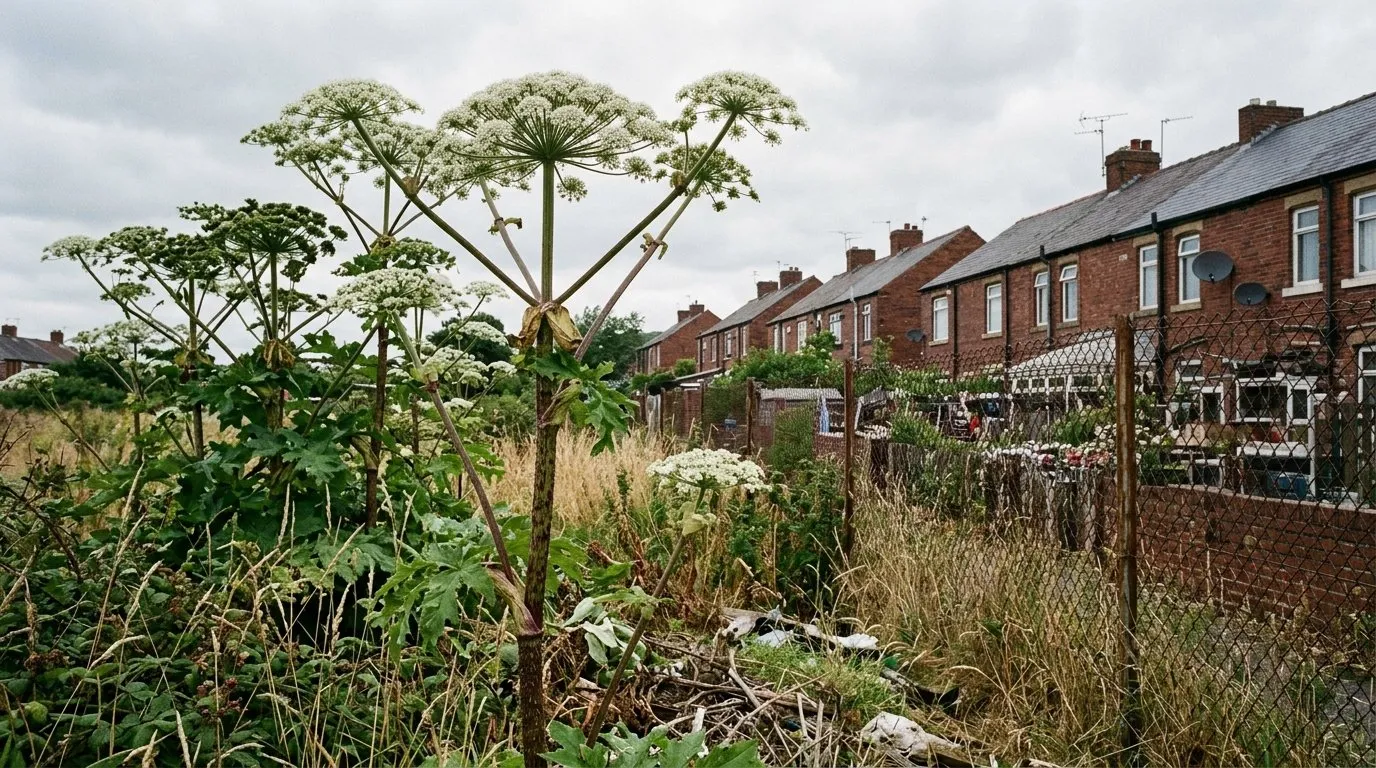 Waste ground behind housing is a common flashpoint, where children can reach the plants. This is exactly the situation a Community Protection Notice is designed to force a landowner to fix.
Giant hogweed removal: how to get rid of it safely
Safe giant hogweed removal means full protective clothing and one of two methods: cutting the root below the crown, or treating the foliage with glyphosate. Never strim, mow or flail it, because that flings sap in every direction and creates an aerosol you can breathe or wear.
Before you start, kit up properly. You need waterproof gloves, a full coverall, wellingtons, safety goggles and ideally a face shield. Work on a dry, still, overcast day, so there is no wind to carry sap and no bright sun to activate any that lands on you. Cover every scrap of skin.
Method 1: root cutting. For a handful of plants, dig down and sever the taproot 10-15cm below the crown with a sharp spade. This kills the plant. Do it before the plant flowers and seeds, ideally in spring. Bag every cut section as controlled waste.
Method 2: glyphosate. For larger stands, a glyphosate-based weedkiller is the standard control, applied as a foliar spray or by stem injection. Timing is everything: treat when the plant is in active growth in spring and early summer, before flowering, on plants around knee to waist height. Our guide to organic weedkillers explains the alternatives, though for an infestation this size glyphosate remains the most effective option, and near water you may need an approved aquatic formulation and a permit.
Whichever method you use, repeat it every year for two to five years. The seed bank keeps germinating, so a single treatment never finishes the job. Check the ground each spring and hoe off seedlings while they are small, exactly as you would tackle a persistent perennial weed like bindweed or horsetail.
If the stand is large, near water, or on a boundary you share, hire a licensed specialist. The burn risk is real and the follow-up is multi-year.
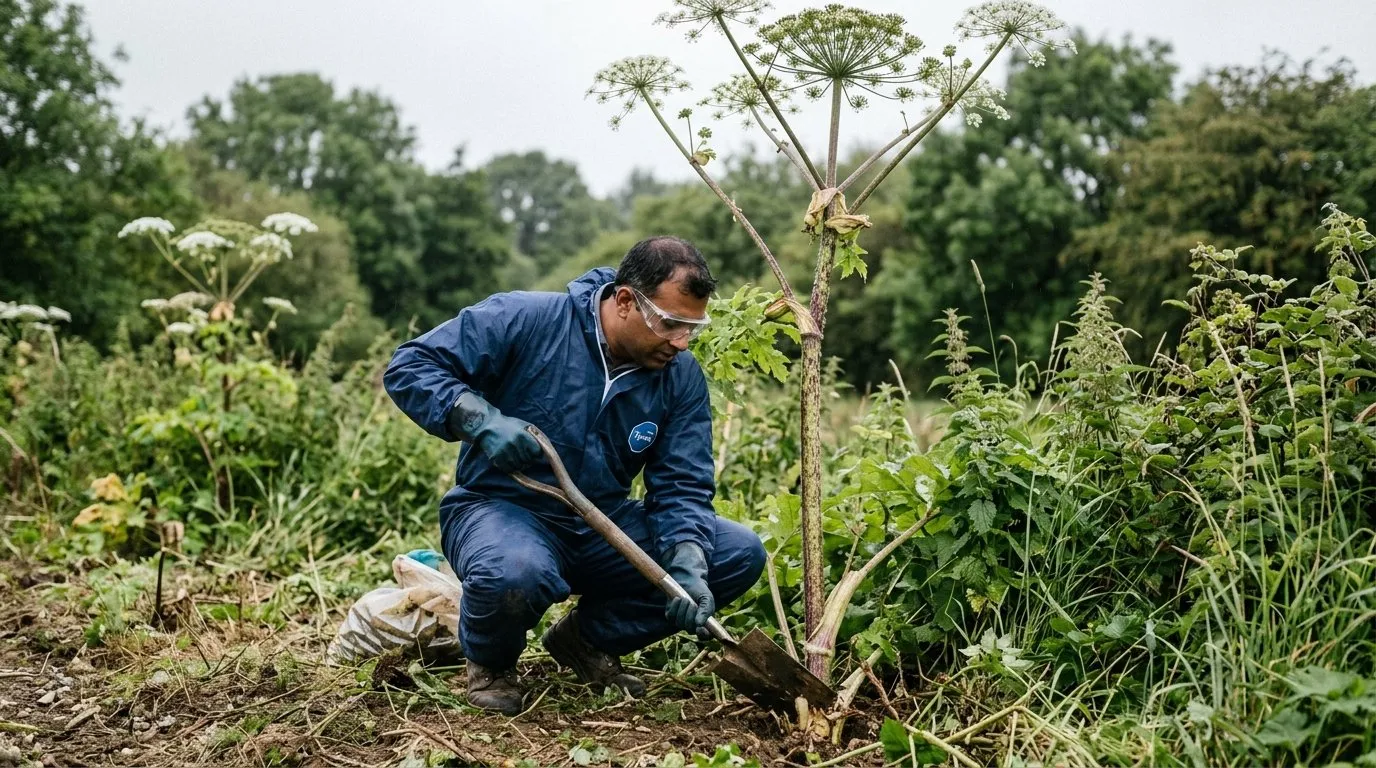 Full cover, calm still day, spade cut below the crown: the only safe way to hand-remove giant hogweed. If in any doubt, a licensed contractor is money well spent.
How much does professional giant hogweed removal cost?
Professional giant hogweed removal costs from about £380 plus VAT for a small treatment to £1,900-£2,500 plus VAT for a large infestation. The price depends on the number of plants, the site access, and how close the stand sits to water.
Most contractors will not quote until they have carried out a site survey, because a few plants on open ground are a very different job from a dense colony along 100m of riverbank. Expect the work to run over two to five years, with an annual herbicide visit each spring until the seed bank is spent. A typical package prices the first treatment, then charges smaller sums for each follow-up.
Here is a realistic guide to what you might pay in 2026:
| Scenario | Typical cost (plus VAT) | Notes |
|---|---|---|
| Single treatment, a few plants | £380-£500 | One spray visit, small domestic site |
| Domestic garden infestation | £1,900-£2,500 | Multi-year plan, several visits |
| Riverbank or watercourse site | £2,500+ | Aquatic herbicide permit and specialist access |
| DIY protective kit only | £40-£80 | Coverall, gloves, goggles, face shield |
Doing it yourself saves the labour cost but not the years of vigilance. Weigh the £40-£80 for protective kit against the risk of a burn and the certainty of repeated visits. For a single roadside plant, careful DIY is reasonable. For anything larger or near water, the professional quote usually earns its keep.
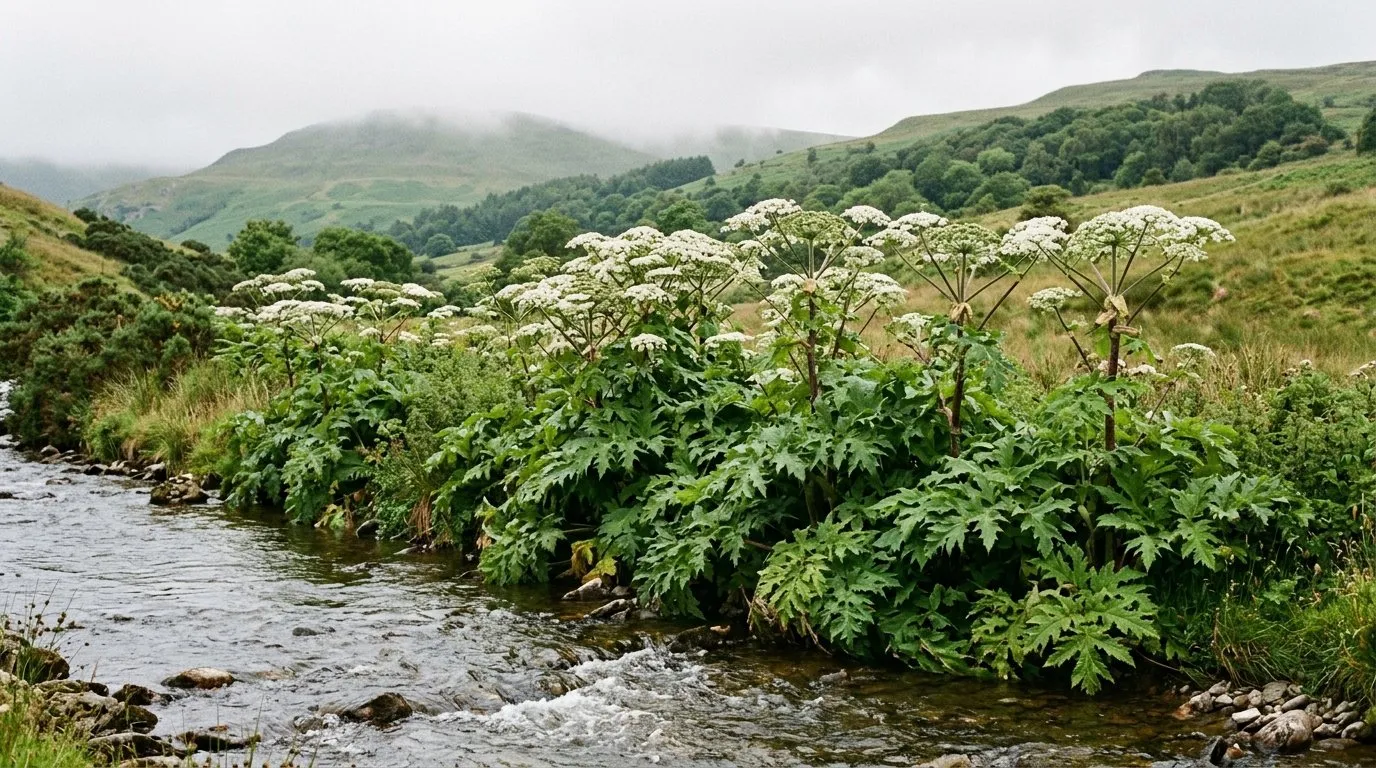 Rural Welsh riverbanks show why control is a regional effort. Seeds float downstream, so a plant left upriver reseeds everyone below it the following spring.
How giant hogweed spreads along rivers
Giant hogweed spreads almost entirely by seed, and water is its highway. A single mature plant produces up to 50,000 seeds, each roughly the size of a lentil. The seeds float, so they wash downstream on winter floods and colonise fresh riverbanks kilometres from the parent plant.
They also hitch a ride on footwear, dog paws, tyres and machinery, which is how the plant jumps from rivers to waste ground, verges and gardens. Once shed, seeds stay viable in the soil for up to 15 years, germinating in flushes each spring. That long-lived seed bank is the reason control takes so many seasons.
This river-borne spread makes giant hogweed a catchment-wide problem rather than a garden one. Clearing your stretch achieves little if plants upstream keep reseeding it. That is why the Environment Agency, rivers trusts and local authorities run coordinated control programmes along infested waterways, working downstream from the source.
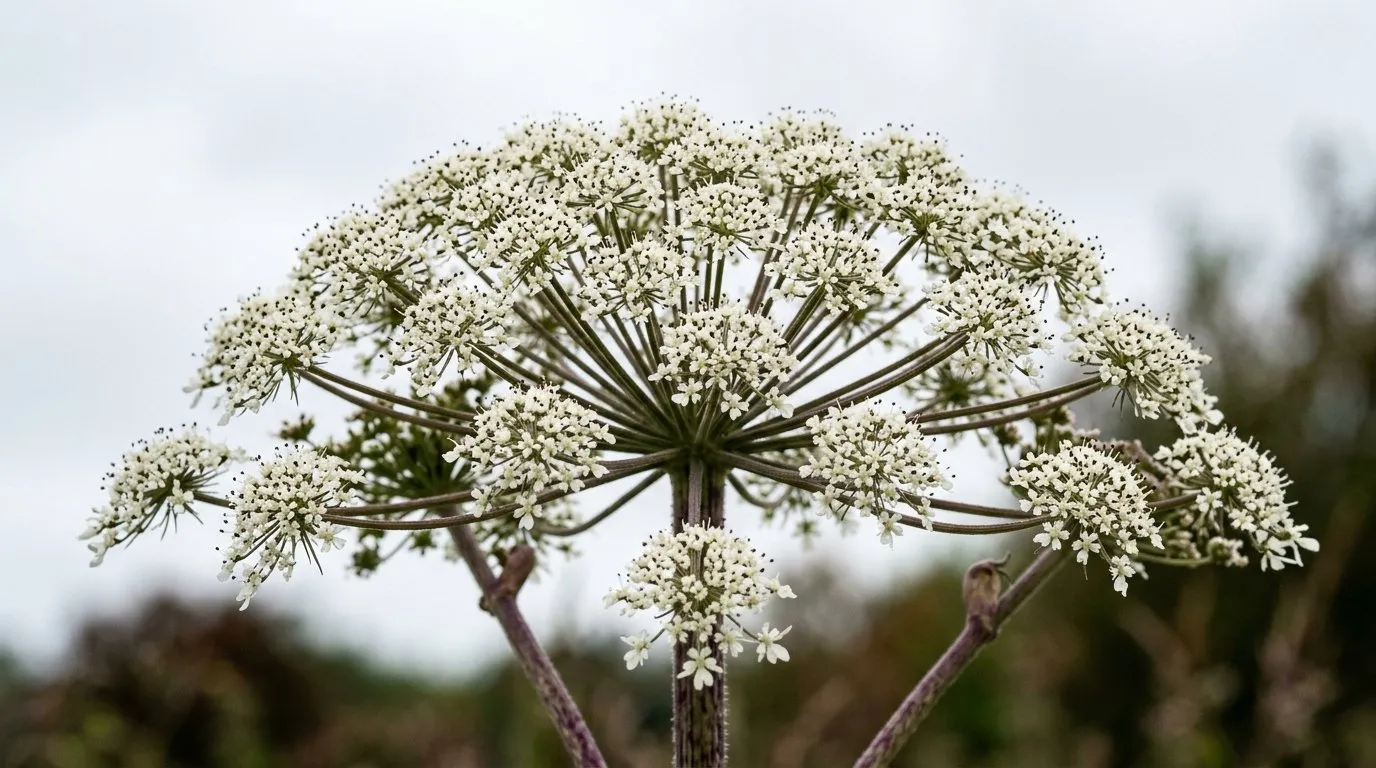 One umbel this size can set thousands of seeds. Cutting the flower heads before they ripen, bagged as controlled waste, stops a plant reseeding the bank below it.
Frequently asked questions
Is giant hogweed poisonous to touch?
Yes, the sap burns skin badly in sunlight. Giant hogweed sap contains furanocoumarins that make skin hypersensitive to ultraviolet light. Contact followed by sun exposure causes painful blisters within 24 to 48 hours, then dark pigmentation and scarring. The affected skin can flare again for years whenever it meets strong sun. Always keep well clear of the plant.
What should I do if giant hogweed sap gets on my skin?
Wash the skin immediately with soap and cold water. Cover the area to block sunlight and get it indoors fast. Do not rub or expose it to sun for at least 48 hours. If blisters appear, if the eyes are affected, or if a large area is involved, seek medical advice or call NHS 111. Keep the skin covered outdoors for weeks afterwards.
How do I tell giant hogweed from cow parsley?
Size and stem are the giveaways. Cow parsley reaches only about 1m with a slender green stem and fine ferny leaves, flowering in May. Giant hogweed towers to 5m, with a thick hollow stem blotched purple and covered in white bristles, and flower heads up to 60cm across. If it is taller than you with a spotted stem, it is not cow parsley.
Is it illegal to have giant hogweed on my land?
No, having it growing is not itself an offence. Under Schedule 9 of the Wildlife and Countryside Act 1981 it is an offence to plant it or cause it to grow in the wild. You must also stop it spreading onto other land, or you risk a Community Protection Notice and liability for any harm it causes. Landowners are responsible for controlling it.
Can I dig giant hogweed out myself?
Yes, but only with full protective clothing and never with a strimmer. Wear waterproof gloves, a coverall, goggles and a face shield on a dry, still, overcast day. Cut the taproot 10-15cm below the crown with a sharp spade. Bag every cut piece as controlled waste. Given the burn risk, most people should hire a licensed contractor instead.
How much does it cost to remove giant hogweed professionally?
Small treatments start at about £380 plus VAT. A larger domestic infestation typically costs £1,900 to £2,500 plus VAT, and most sites need annual herbicide visits for two to five years until the seed bank is exhausted. A site survey sets the exact price. Costs rise near watercourses, where an aquatic herbicide permit may be required.
How does giant hogweed spread so quickly?
One plant sets up to 50,000 seeds that float and drift downstream. The seeds travel on river water, wind, footwear and machinery, then germinate in spring the next year. They stay viable in the soil for up to 15 years. This is why riverbanks and canal towpaths carry the worst infestations, and why control takes several years of follow-up.
Giant hogweed rewards caution above all. Learn its five features, keep children and skin well away, and clear it slowly and safely across several seasons. Report it where it grows in public, and never move soil or cut material that might carry its seed.
Our team produces practical UK gardening guidance from source research, contributor records and established horticultural practice. Editorial standards are overseen by Matt W.