Key takeaways
- Gunnera tinctoria was listed as invasive on 2 August 2017; the ban widened in April 2025
- 2023 RHS DNA research found most UK 'G. manicata' is actually the hybrid Gunnera x cryptica
- It is illegal to sell, plant, swap or allow any large-leaved gunnera to spread into the wild
- You do NOT have to destroy an established plant, but you must stop it spreading
- Deadhead the 1m flower spikes before seed sets, and burn or bin cuttings, never green waste
- Legal big-leaf swaps: Rheum palmatum, Rodgersia, Darmera peltata and Astilboides tabularis
- Removal means cutting the crown, digging or spot-treating with glyphosate, then disposing as controlled waste
Gunnera is now banned in the UK, and if you have a giant rhubarb by your pond you are probably wondering whether you are breaking the law. The short answer is reassuring. You can keep an established plant. What you cannot do is sell it, plant a new one, pass cuttings over the fence, or let it seed into the wild.
Is gunnera illegal in the UK now?
Yes, large-leaved gunnera is illegal to sell, plant or spread in the UK, but you may keep a plant you already own. Two plants are caught by the rules: Gunnera tinctoria, the Chilean giant rhubarb, and Gunnera x cryptica, the hybrid that most garden plants turned out to be.
The law is the Invasive Alien Species (Enforcement and Permitting) Order 2019, which carries across the earlier EU listing into English and Welsh law. Under it, it is a criminal offence to import, sell, grow, breed, transport, swap or release a listed species.
Gunnera tinctoria was first listed on 2 August 2017. For years, gardeners assumed the common garden giant, sold as Gunnera manicata, was in the clear. That changed in April 2025, when the practical effect of the hybrid research pulled almost every garden gunnera into the ban.
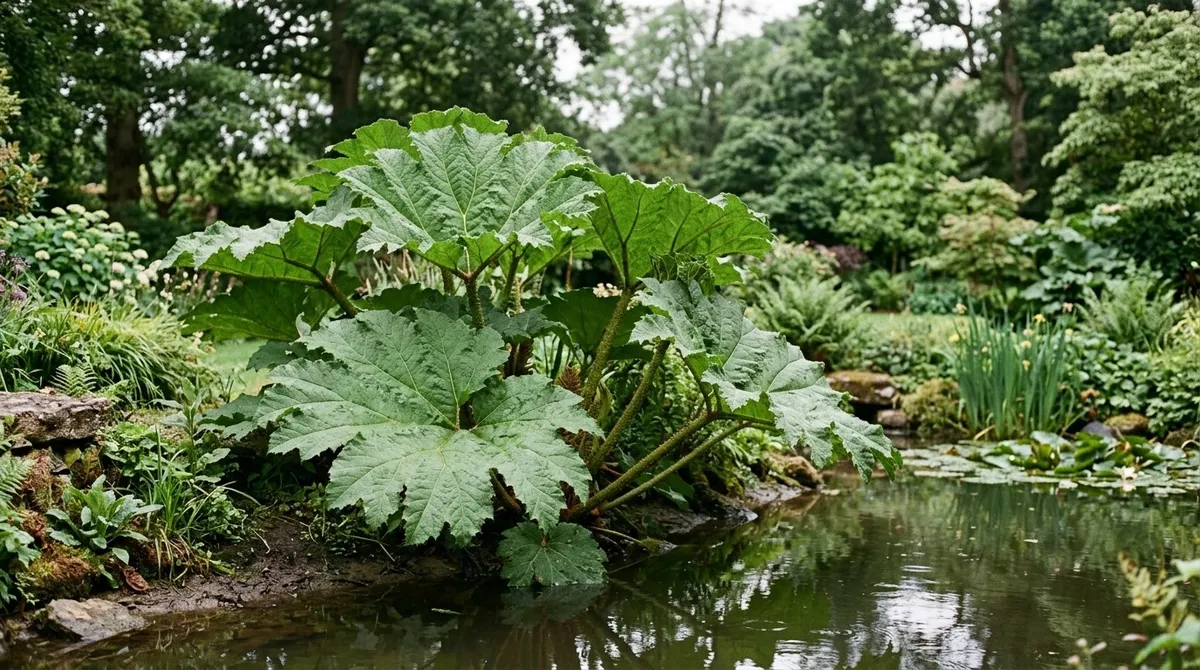
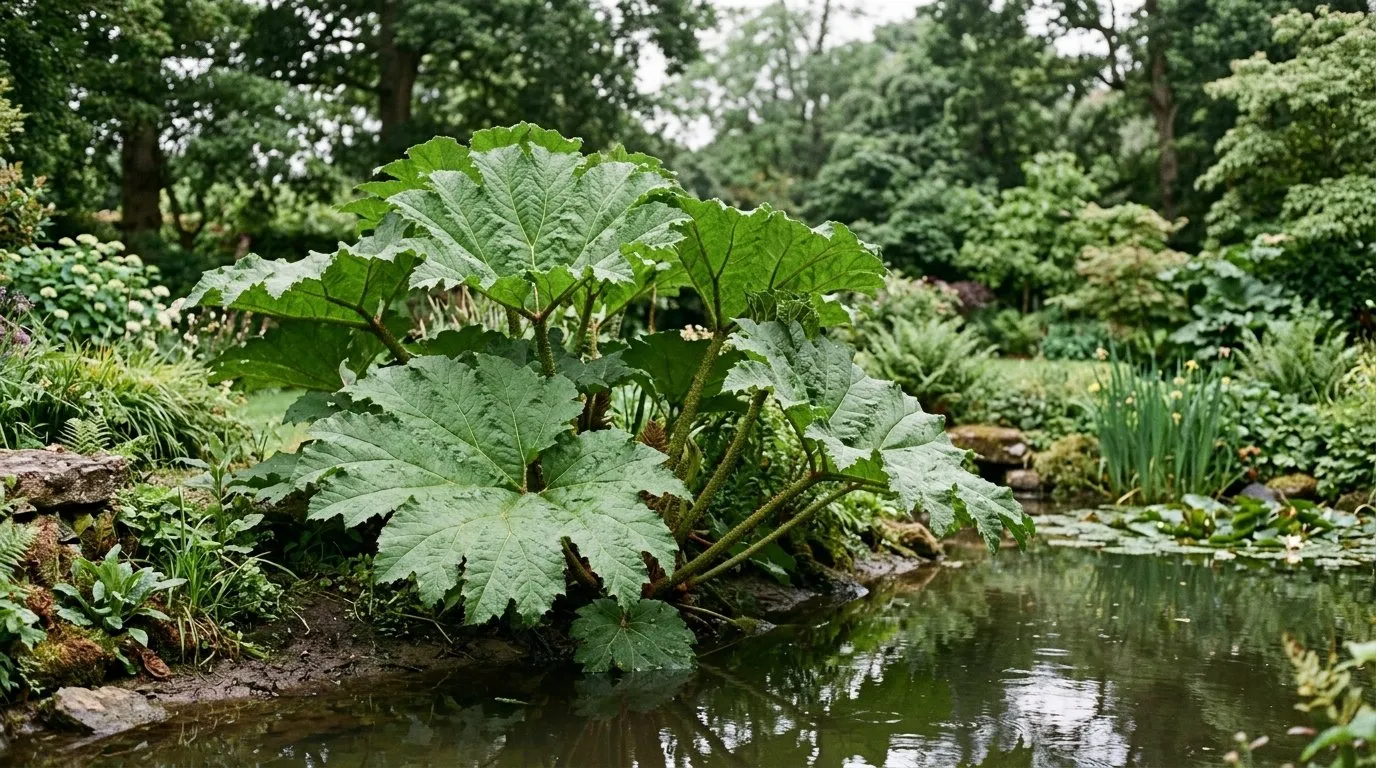 An established gunnera by a rural pond. A plant like this, already growing, is legal to keep. Selling, planting or spreading it is not.
Why was gunnera banned? The Gunnera x cryptica story
Gunnera was banned because it spreads aggressively along rivers and wet ground, smothering native plants and eroding banks. A single plant throws a flower spike up to 1m tall carrying thousands of seeds, and those seeds travel on water.
For decades UK gardens grew two supposed species. Gunnera tinctoria was the smaller, seedier, known troublemaker. Gunnera manicata was the giant everyone prized, with leaves up to 2m across, and it was thought to be a well-behaved Brazilian plant.
Then came the twist. In 2023, RHS research using DNA analysis found that most plants grown in Britain as G. manicata were not that species at all. They were a fertile hybrid, newly named Gunnera x cryptica, a cross involving the invasive G. tinctoria.
This mattered legally. UK invasive species law automatically covers hybrids of a listed plant. Because G. x cryptica descends from banned G. tinctoria, it falls under the same rules. Overnight, the nation’s favourite architectural giant was reclassified.
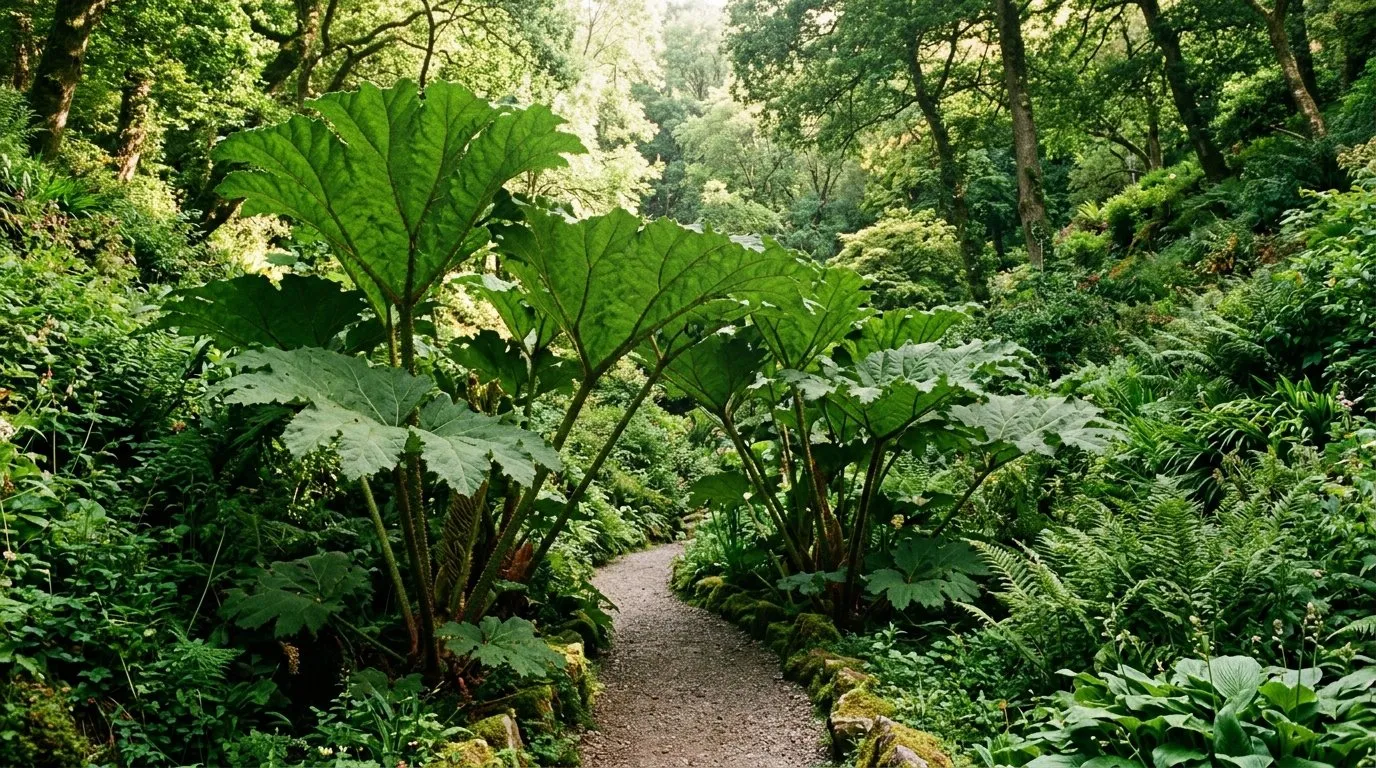 A gunnera at full size in a Cornish valley garden. Plants like this seed freely near water, which is why the ban targets spread.
Gardener’s tip: Do not try to work out which species you have. It takes DNA testing to tell G. x cryptica from true G. manicata, and true manicata is now vanishingly rare in cultivation. Treat any large-leaved gunnera as covered by the ban and you will not go wrong.
Gunnera now joins other listed plants gardeners must manage carefully. Our guide to banned plants in UK gardens covers the wider list, and the approach is similar to tackling Japanese knotweed: know the law, contain the plant, dispose of material properly.
Do I have to dig up my gunnera?
No, you do not have to dig up an established gunnera. Defra guidance states plainly that a listed plant already growing in your garden is not an offence, and there is no order compelling removal.
This is the single most misunderstood part of the ban. The offences are about movement and spread: selling, planting, swapping, transporting, and allowing escape into the wild. None of those describe an old plant sitting quietly by your pond.
So your legal duties as an owner are narrow but real. You must not:
- Sell the plant or any division of it
- Plant a new one or move this one to fresh ground
- Give cuttings, divisions or seed to anyone else
- Allow it to spread into the wild, chiefly by letting seed escape
Meet those, and you can keep enjoying the plant. A mature gunnera at the head of a wildlife pond is a magnificent thing, and there is no benefit to the environment in ripping out a contained specimen that has behaved for twenty years. If you are building or planting around water, our guide to creating a wildlife pond still applies, you simply plant legal giants at the margin.
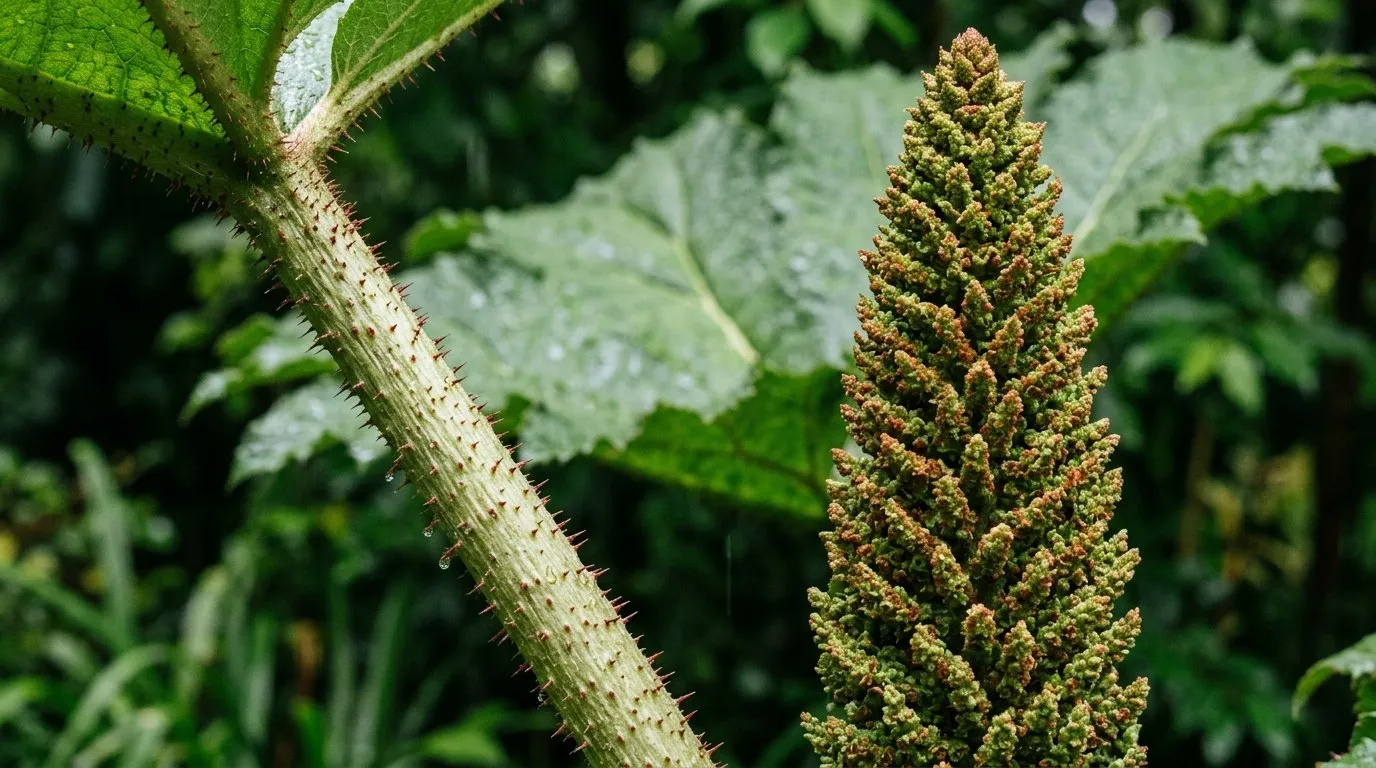 The prickly stem and 1m conical flower spike. Removing the spike before it sets seed is the key legal task for anyone keeping a plant.
How to stop your gunnera spreading
Stopping spread comes down to one job: remove the flower spikes before they set seed. Seed is how gunnera escapes into the wild, so a plant that never seeds cannot break the spread rule.
The flower spike is a strange, conical, green-red structure that pushes up from the crown in late spring and early summer. It reaches about 1m tall and, left alone, ripens thousands of tiny orange seeds by late summer.
Disposal is the part people get wrong. Gunnera seed and material must not enter the ordinary green cycle:
- Do not put spikes, leaves or roots in the council green-waste bin
- Do not home-compost the material
- Do burn it on site where permitted, or
- Do bag it and take it to a household waste centre as controlled waste
The same discipline applies to any leaves you clear in autumn. Bag them and bin or burn them rather than composting. If you garden near a watercourse, this matters even more, because a stray seed head washed downstream is exactly the escape route the law targets.
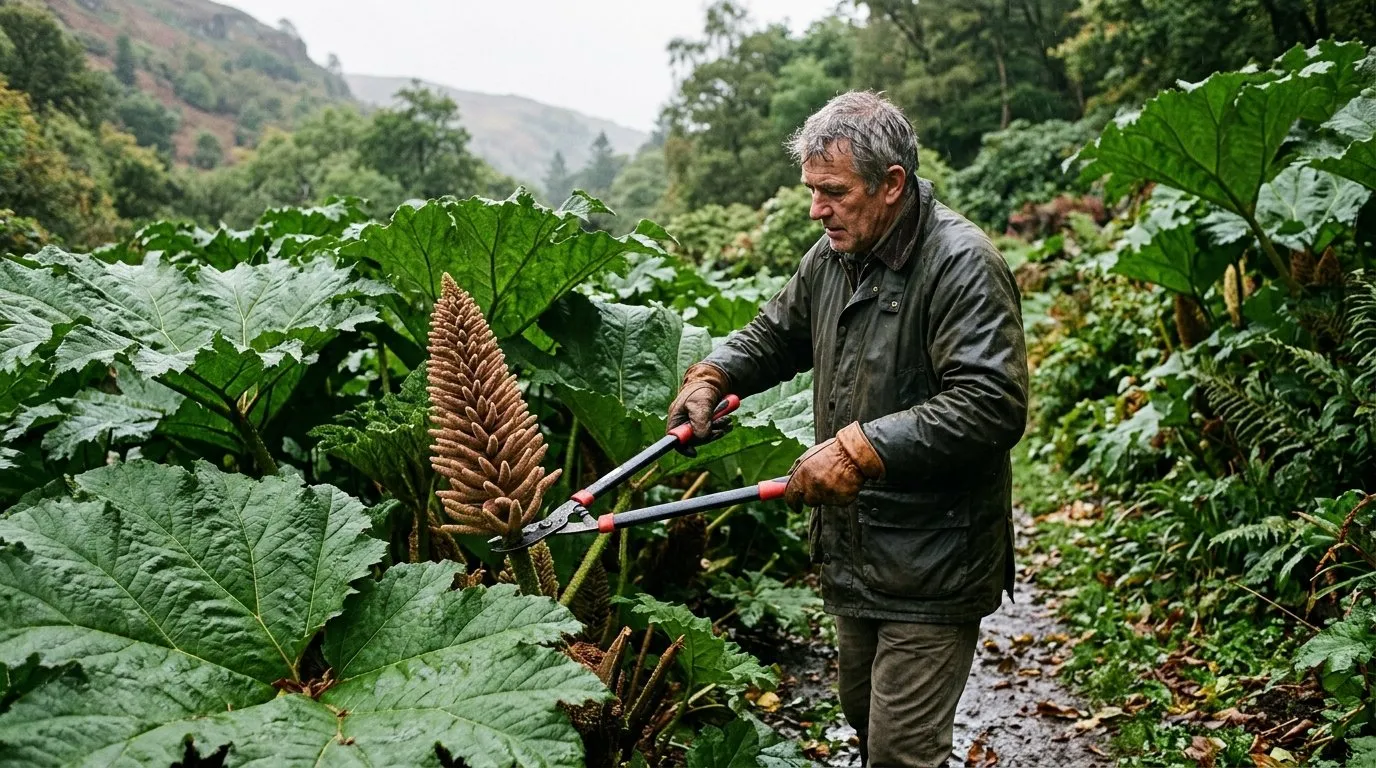 Deadheading the flower spike with loppers and thick gloves. Cut before seed sets, then bag the spike for controlled-waste disposal.
How to remove gunnera if you choose to
If you decide to remove a gunnera, cut the leaves and crown down first, then dig out or spot-treat the crown, and dispose of everything as controlled waste. Removal is a choice, not a legal requirement, but some gardeners want the space back or worry about a plant near open water.
Start by cutting the huge leaves and stems down to the crown. Wear thick gloves and long sleeves, because the stems and leaf undersides carry sharp prickles. A mature plant yields a startling volume of material, easily a builder’s-bag full from one crown.
Then choose your method:
Digging out. The crown is a woody, fibrous mass sitting at or just below the surface. On a small or young plant you can lever it out with a spade and fork in an afternoon. Large crowns are heavy work and may need two people or a mattock.
Spot-treating. For a big established crown, a glyphosate-based weedkiller painted or sprayed onto freshly cut crown tissue in late summer is effective. Expect to repeat it the following season on any regrowth. A 1L bottle of concentrate costs around £12 to £20 and treats several plants.
Disposal. Treat all the material, crown included, as controlled invasive waste. Burn on site where allowed, or take it to a waste centre and tell them what it is. For a very large plant, a skip or grab-hire from £120 to £250 may be simplest. Never fly-tip gunnera or leave it near water.
Once the ground is clear, you have a prime damp, fertile spot. Fill it with one of the legal giants below, or read our guide to plants for wet, boggy soil for the full range.
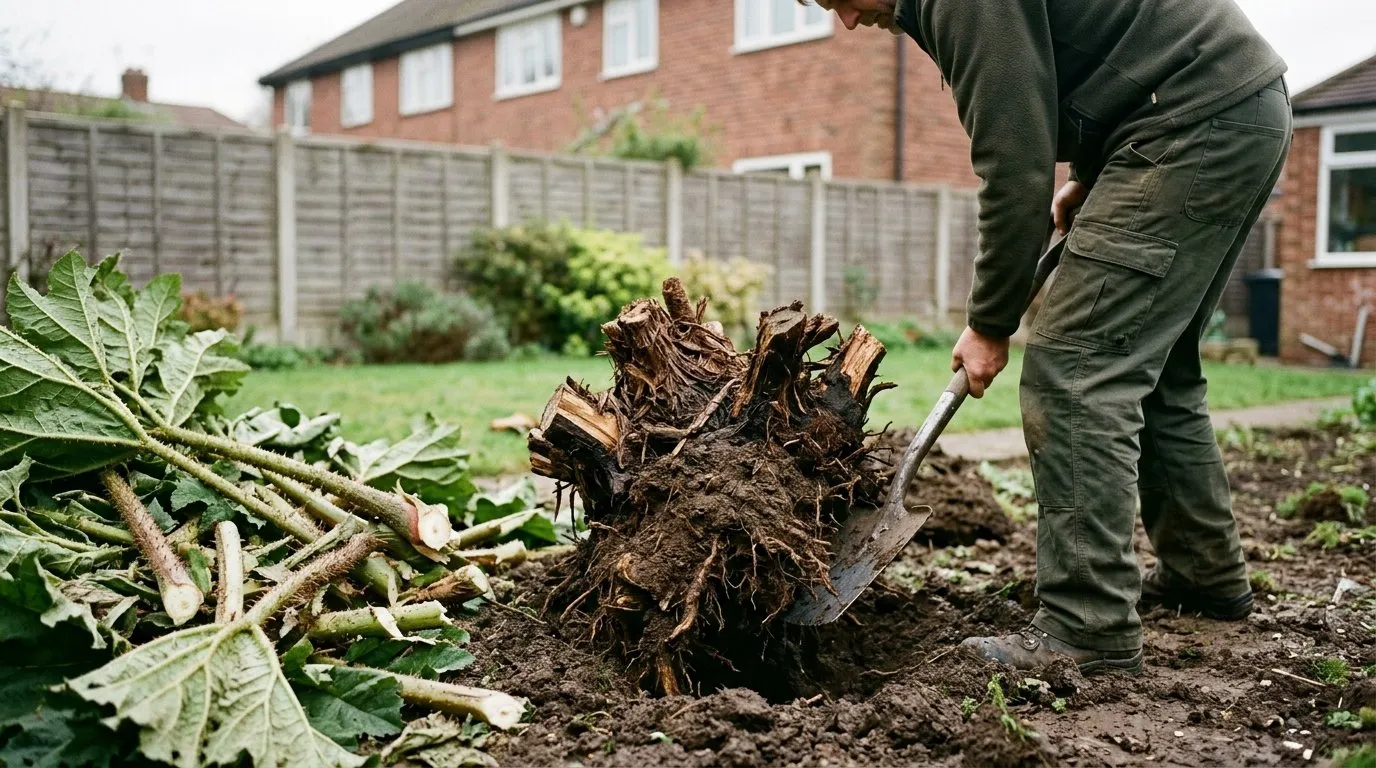 Removing a crown is heavy work and optional. The woody mass sits at the surface and needs a spade, a fork and strong gloves.
Big-leaf alternatives to gunnera you can plant legally
Four hardy perennials give you the dramatic big-leaf look without breaking the law: Rheum palmatum, Rodgersia, Darmera peltata and Astilboides tabularis. All four love the same damp, rich ground gunnera enjoys, and all are legal to buy and plant.
Rheum palmatum, the ornamental rhubarb, is the closest match for sheer scale. Deeply cut palmate leaves reach 90cm across, and the crimson flower plumes tower to 2.5m in June. It is fully hardy, rated RHS H7. The form ‘Atrosanguineum’ has red-flushed young leaves. Expect to pay £12 to £18 for a 2L plant.
Rodgersia carries horse-chestnut-shaped leaves on plants around 1 to 1.2m tall, with frothy cream or pink flower spikes. R. aesculifolia and R. pinnata are the common forms, both hardy to RHS H5 and happy in damp shade. Plants cost £9 to £14.
Darmera peltata, the umbrella plant, is the one for smaller pond edges. Round, rhubarb-like leaves up to 60cm sit on stems to 1.2m, and pink flowers open in spring before the leaves. It spreads by rhizome to stabilise a bank, is hardy to RHS H5, and costs £10 to £15.
Astilboides tabularis is the specialist’s choice: enormous circular leaves up to 90cm wide, each held on a central stem like a parasol. It reaches about 1.2m, prefers damp shade, and is hardy to RHS H6. Plants run £12 to £16.
Gunnera vs four legal big-leaf alternatives
| Plant | Height in flower | Leaf size | Hardiness | Bog tolerance | Typical price |
|---|---|---|---|---|---|
| Gunnera (banned) | 2.5m | Up to 2m across | H5 | Excellent | Not for sale |
| Rheum palmatum | 2.5m | 90cm | H7 | Good | £12-18 |
| Rodgersia | 1.2m | 50cm | H5 | Very good | £9-14 |
| Darmera peltata | 1.2m | 60cm | H5 | Excellent | £10-15 |
| Astilboides tabularis | 1.2m | 90cm | H6 | Good, likes shade | £12-16 |
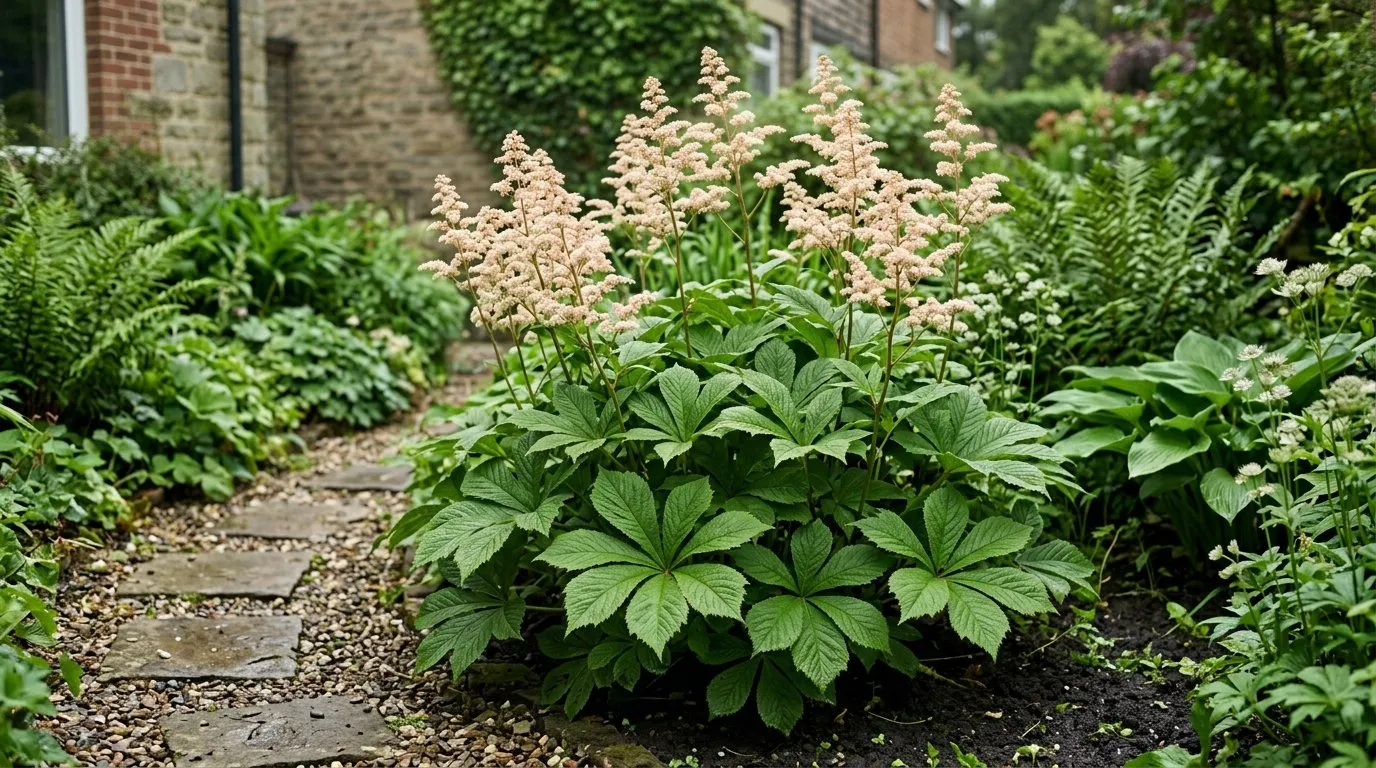 Rodgersia in a suburban damp border. Its horse-chestnut leaves give architectural weight at a legal, garden-friendly scale.
Is gunnera the same as edible rhubarb?
No, gunnera is not the rhubarb you eat, despite the nickname giant rhubarb. Gunnera leaves are ornamental only and are not a food crop. The likeness is in the big, veined leaf shape, nothing more.
Culinary rhubarb is Rheum x hybridum, a compact hardy perennial grown for its edible red stalks. It reaches around 1m, is entirely legal, and its leaves, unlike its stalks, are toxic and never eaten. If it is the crop you want, see our guide to growing rhubarb.
Confusingly, the best ornamental gunnera substitute, Rheum palmatum, is a close cousin of edible rhubarb but is grown for its foliage, not the stalks. So the plant family that gives us the pudding also gives us the finest legal giant leaf. Neither is gunnera.
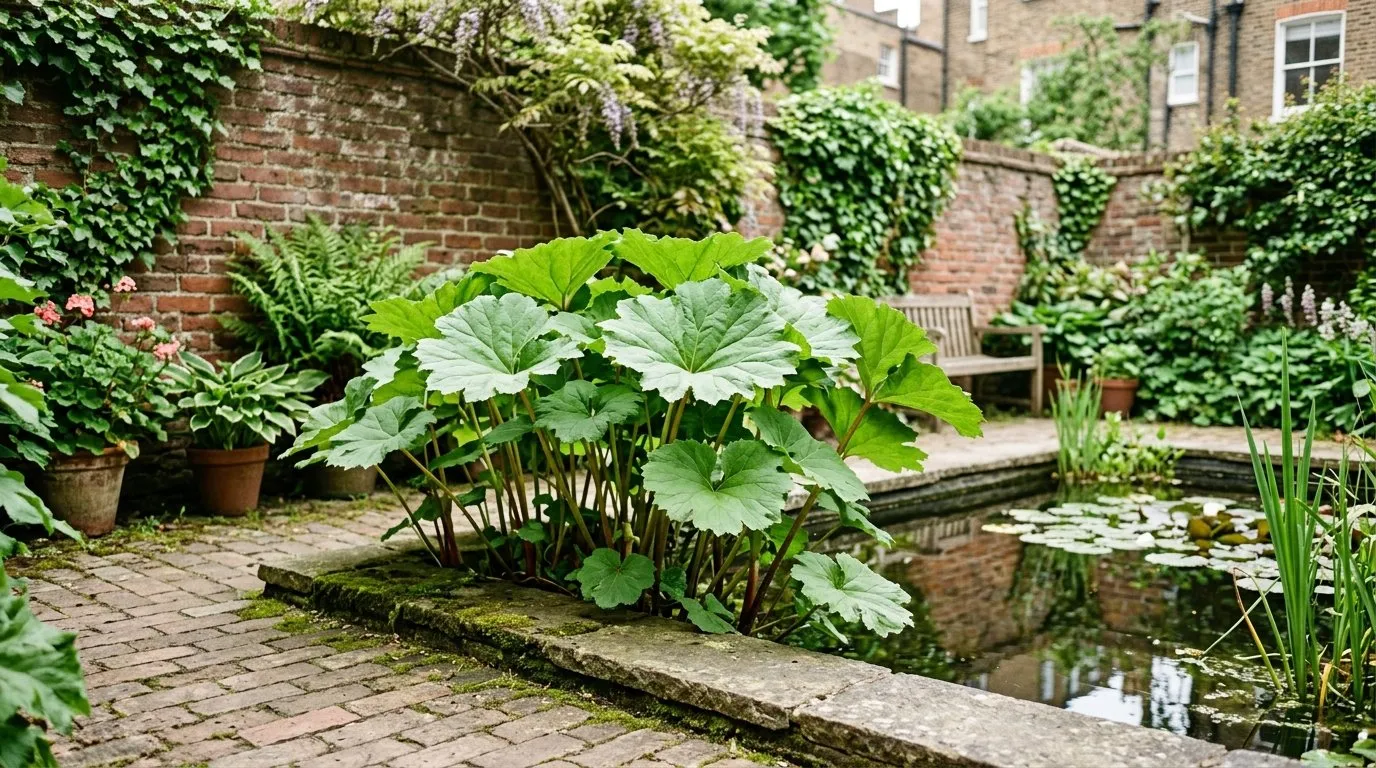 Darmera peltata at a small city-garden pond. Round leaves and a modest 1.2m height suit spaces where gunnera would overwhelm.
Living with the gunnera ban
The gunnera ban sounds dramatic but changes little for most gardeners. Keep your established plant, cut off the flower spikes before they seed, dispose of the material as controlled waste, and never sell, plant or share it. That is the whole obligation.
If you want a fresh big-leaf statement, the four alternatives above deliver the look legally and, in some ways, better. Rheum palmatum matches gunnera for drama, and Darmera or Astilboides suit smaller plots where a true gunnera would swamp everything.
The wider lesson is worth holding onto. Britain’s waterways are fragile, and plants that escape gardens do real harm. Managing gunnera responsibly, like managing knotweed or clearing a pond of invasive oxygenators, is part of gardening with the wild in mind. For more on planting near water, see our guide to best pond plants.
For the official position, read the GOV.UK guidance on invasive non-native plant rules and the RHS gunnera questions answered page. Both confirm the same reassuring point: an established plant is yours to keep, as long as you stop it spreading.
Frequently asked questions
Is gunnera illegal in the UK?
Yes, it is illegal to sell, plant or swap large-leaved gunnera. Both Gunnera tinctoria and the hybrid Gunnera x cryptica are listed invasive species. You cannot buy one, plant a new one, give cuttings to a friend, or let it spread into the wild. An established plant already in your garden is legal to keep.
Do I have to dig up my gunnera?
No, there is no legal duty to remove an established gunnera. Defra guidance is clear that keeping a plant already growing on your land is not an offence. Your only obligations are to stop it spreading and to dispose of any cut material responsibly. Many gardeners simply keep the plant and deadhead the flower spikes each year.
Why was gunnera banned?
Gunnera spreads aggressively along waterways and smothers native plants. Gunnera tinctoria was listed in 2017. In 2023, RHS DNA research showed most plants sold as G. manicata were really a fertile hybrid, Gunnera x cryptica. Because the law covers hybrids of listed species, that discovery pulled nearly all garden gunnera into the ban.
Can I still keep the gunnera I already have?
Yes, you can keep an established gunnera legally. The rules ban selling, planting and spreading, not ownership. You must not propagate it, share divisions, or let seed escape into the wild. In practice that means cutting off the flower spikes before they set seed and binning or burning the material, not composting it.
How do I stop my gunnera spreading?
Cut off the conical flower spikes before they set seed, usually by late summer. The spikes reach about 1m and carry thousands of tiny seeds. Remove them with loppers, bag them, and dispose as controlled waste or burn on site. Never put gunnera material in the green-waste bin or dump it near a stream or pond.
What can I plant instead of gunnera?
Rheum palmatum, Rodgersia, Darmera peltata and Astilboides tabularis give the big-leaf look legally. All are hardy UK perennials that thrive in damp ground beside a pond or bog garden. Rheum palmatum is the closest match for sheer size, reaching 2.5m in flower, while Darmera peltata suits smaller pond edges at around 1.2m.
Is gunnera the same as the rhubarb I eat?
No, gunnera is not edible rhubarb. It is nicknamed giant rhubarb for its huge leaves, but it is a different plant and the leaves are not for eating. Culinary rhubarb, Rheum x hybridum, is a smaller, legal crop grown for its stalks. The two are unrelated beyond a passing resemblance in leaf shape.
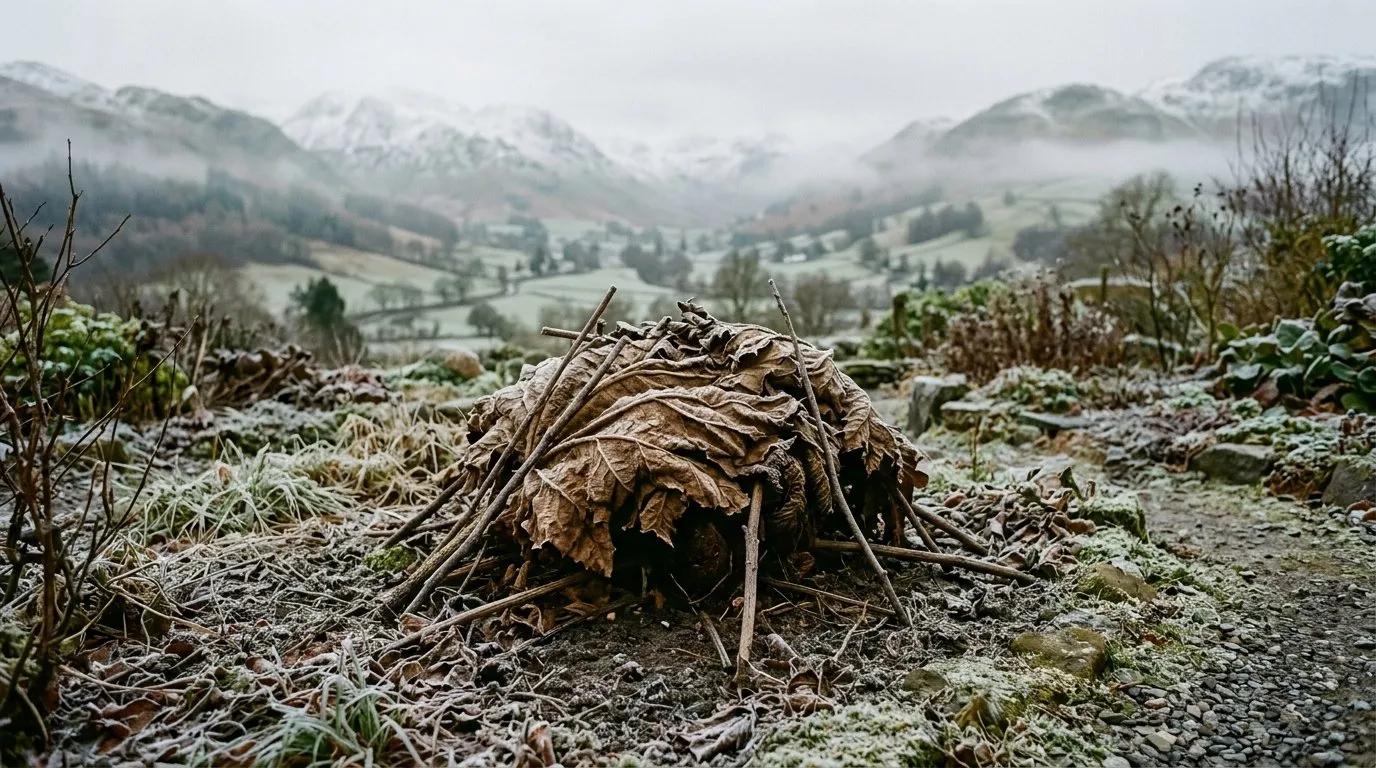 A gunnera crown in winter, old leaves folded over for frost protection. Keeping an established plant is legal, provided you stop it seeding.
Our team produces practical UK gardening guidance from source research, contributor records and established horticultural practice. Editorial standards are overseen by Matt W.