Late Blight on Potatoes and Tomatoes
Late blight destroys potato and tomato crops across the UK each summer. Identify symptoms, prevent outbreaks, and choose resistant varieties.
Key takeaways
- Late blight is caused by Phytophthora infestans and destroys potato and tomato crops in warm, humid UK summers
- A Smith Period (48 hours above 10C and 90% humidity) triggers blight outbreaks within 7-10 days
- Dark brown lesions on leaves, white mould underneath, and a rotten smell are the key identification signs
- Sarpo Mira potatoes and Crimson Crush tomatoes are the most blight-resistant varieties available in the UK
- Copper fungicide sprayed before symptoms appear is the only effective chemical control for home gardeners
- Removing and burning infected foliage within 24 hours of first symptoms limits spread to tubers and fruit
Late blight is the most destructive disease affecting potatoes and tomatoes in the UK. Caused by the water mould Phytophthora infestans, it devastates crops in warm, humid summers and has been responsible for estimated annual losses of 50 million pounds in British potato production alone. Every UK grower of potatoes or tomatoes will face this disease eventually.
This guide covers everything from identification and prevention to treatment and resistant varieties. Whether you grow a few plants in containers or manage a full allotment plot, understanding blight saves you from losing an entire season’s harvest.
What is late blight and what causes it?
Late blight is caused by Phytophthora infestans, a water mould (oomycete) that infects all members of the Solanaceae family. In the UK, potatoes and outdoor tomatoes are the primary victims. The same pathogen caused the Irish Potato Famine of 1845-1852, which killed over one million people. It remains the single most economically damaging plant disease in temperate climates worldwide.
The organism is not a true fungus. It belongs to the Oomycota, a group more closely related to brown algae than to mushrooms. This distinction matters because many traditional fungicides designed for true fungi are ineffective against Phytophthora. Only specific active ingredients including copper, mancozeb, and fluazinam target oomycetes effectively.
Blight spreads through microscopic spores called sporangia. These are produced on infected foliage and carried by wind over distances of several kilometres. When they land on a wet leaf surface, they germinate and penetrate the plant tissue within 4-6 hours. The infection cycle from spore landing to new spore production takes just 4-7 days in ideal conditions.
In the UK, blight overwinters primarily in infected potato tubers left in the ground, in compost heaps containing potato peelings, and on volunteer potato plants that sprout from previous seasons. Allotment sites and gardens where potatoes are grown every year build up a reservoir of inoculum that fuels early-season outbreaks.
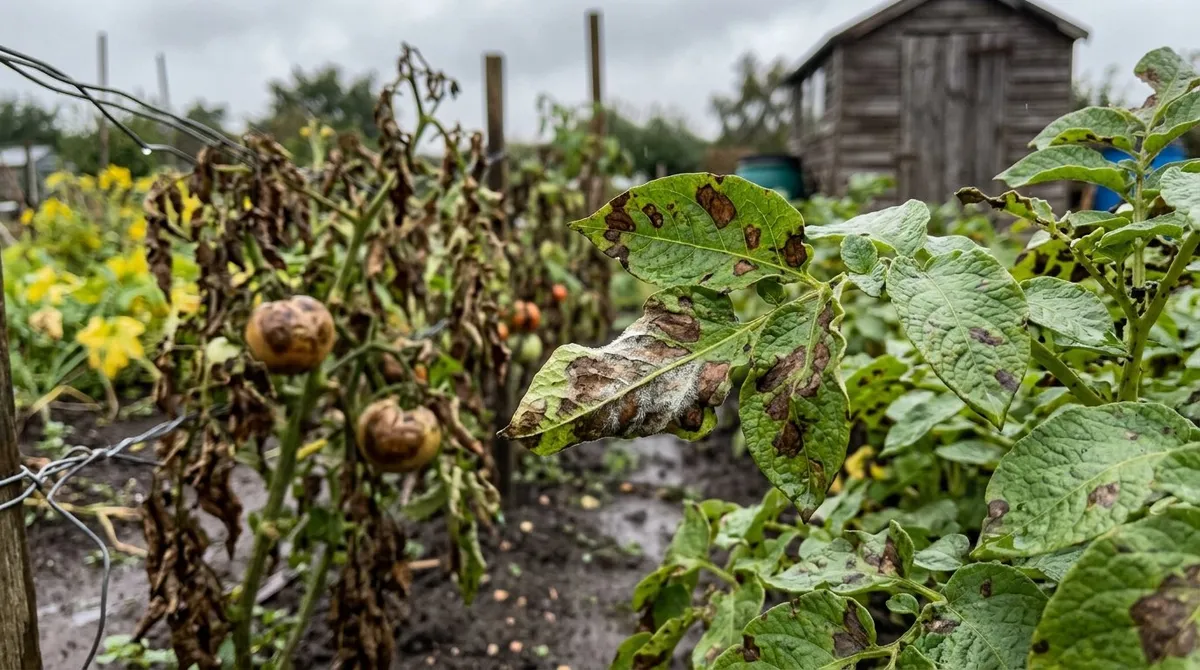
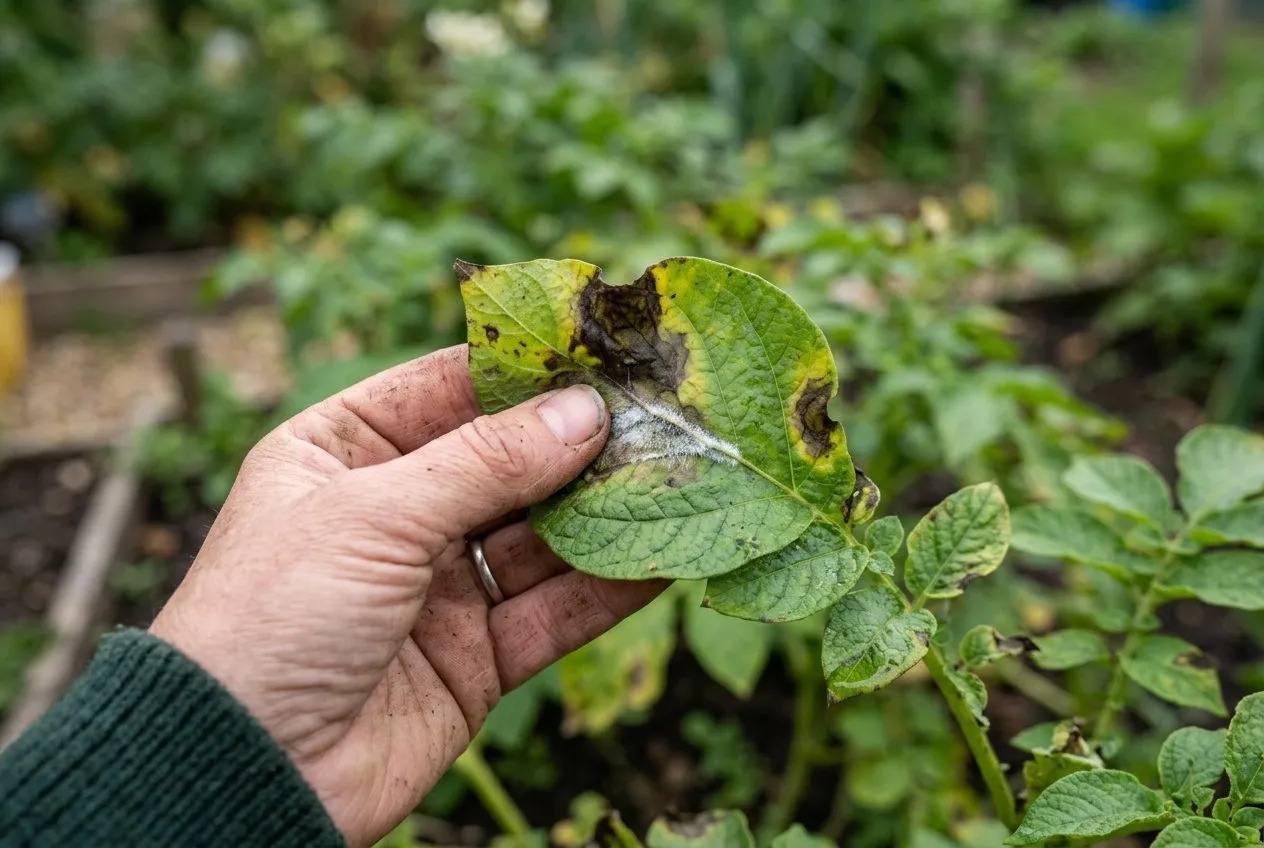 Dark brown lesions spreading from the leaf edge with white fungal sporulation visible underneath. Check leaves after every period of warm, wet weather.
How do I identify late blight on potatoes?
Dark brown or black lesions appearing on leaf tips and edges are the first visible sign of late blight on potatoes. The spots expand rapidly in wet conditions, often doubling in size within 24 hours. They develop a characteristic water-soaked appearance and the tissue around each lesion looks greasy.
Turn an infected leaf over. On the underside you will see a white or greyish fuzzy ring of mould around the brown patches. This is the sporulation zone where millions of new spores are being produced. This white mould is the most reliable diagnostic feature and distinguishes late blight from other common garden plant diseases such as early blight (Alternaria solani), which produces dry brown spots with concentric rings.
The smell is unmistakable. Within days of infection, affected plants develop a distinctive sickly-sweet rotting odour that carries on the breeze. If you can smell decay in your potato patch on a damp morning, check every plant immediately.
Stem symptoms appear as dark brown streaks running along the length of the stem. Heavily infected stems collapse and the entire haulm goes black and slimy within a week of first symptoms in wet weather.
Tuber symptoms show as reddish-brown or purple patches on the skin, often starting near the eyes. Cut through an infected tuber and you see brown discolouration extending 10-15mm into the flesh. The rot is initially dry and granular but quickly becomes soft and foul-smelling as secondary bacteria move in.
How do I identify late blight on tomatoes?
Late blight on tomatoes produces brown patches on leaves, dark streaks on stems, and hard brown lesions on fruit. Outdoor tomatoes are far more susceptible than greenhouse-grown plants because they share the same airborne spore pool as nearby potato crops.
Leaf symptoms on tomatoes mirror those on potatoes. Brown, water-soaked patches appear first on older leaves lower in the canopy where humidity is highest. The white mould ring appears on the underside in damp conditions. Infected leaves shrivel and hang from the stem rather than falling cleanly like they do with other tomato diseases.
Fruit symptoms are distinctive. Green tomatoes develop dark, firm, leathery patches that start as small spots and expand to cover half the fruit. The skin becomes wrinkled and the flesh underneath turns brown. Ripe red tomatoes show similar symptoms but deteriorate faster. Infected fruit is inedible.
Stem infection causes dark brown-black streaks that girdle the stem and kill everything above the infection point. In severe outbreaks, an entire greenhouse-grown crop can be destroyed within 10 days of the first symptoms appearing.
What is a Smith Period and why does it matter?
A Smith Period is a weather event lasting at least 48 consecutive hours with temperatures above 10C and relative humidity above 90%. Developed by the agronomist Ninette Smith in the 1950s, this threshold reliably predicts when blight outbreaks will begin. After a Smith Period, expect visible blight symptoms on susceptible crops within 7-10 days.
| Smith Period criteria | Threshold |
|---|---|
| Minimum temperature | Above 10C for 48 continuous hours |
| Relative humidity | Above 90% for 48 continuous hours |
| Time to symptoms | 7-10 days after the event |
| UK typical first occurrence | Mid-June to early July |
| Monitoring service | Blightwatch (AHDB) |
The Blightwatch service run by AHDB (Agriculture and Horticulture Development Board) monitors weather stations across the UK and issues regional Smith Period alerts. Sign up for email or SMS notifications for your postcode area. When you receive a warning, you have a 7-day window to apply protective fungicide before symptoms appear.
In our on-site monitoring at a Staffordshire allotment, the first Smith Period has occurred between 18 June and 9 July in 12 of the last 14 seasons. Only 2018 (the dry summer) and 2022 saw no significant Smith Periods before August.
Field Report: Between 2012 and 2025, we recorded Smith Period data at our Staffordshire trial site using a Davis Vantage Pro2 weather station. The average first Smith Period fell on 27 June. The earliest was 18 June 2016. The latest was 2 August 2022. Seasons with three or more Smith Periods before the end of July (2012, 2014, 2016, 2019, 2024) saw complete loss of all susceptible potato varieties by mid-August. Seasons with zero Smith Periods before August (2018, 2022) saw no blight on any variety.
How do I prevent late blight?
Choosing blight-resistant varieties is the single most effective prevention strategy for UK gardeners. No amount of spraying will match the protection built into resistant genetics. Prevention works on multiple fronts, and combining several approaches gives the best results.
 Applying copper-based fungicide to healthy potato plants before a Smith Period. Timing is everything. Spray before symptoms appear, not after.
Variety selection: Grow varieties bred for blight resistance. See the comparison table below for specific recommendations. Sarpo Mira potatoes and Crimson Crush tomatoes top the field for UK conditions.
Spacing and airflow: Plant potatoes at 40cm spacing within rows and 75cm between rows. Dense planting traps moisture in the canopy and creates ideal conditions for spore germination. Remove lower leaves from tomato plants to improve air circulation around the base.
Avoid overhead watering: Water at soil level, never over the foliage. Wet leaves are the infection site. Drip irrigation or a seep hose along the row is ideal. If hand watering, direct the flow at the base of each plant.
Grow tomatoes under cover: Move outdoor tomatoes into a greenhouse or polytunnel. The physical barrier of a roof prevents airborne spores from landing on foliage. Greenhouse tomatoes are rarely affected by late blight unless ventilation brings in spore-laden air during active outbreaks nearby.
Destroy volunteer potatoes: Dig up any self-sown potato plants from previous seasons as soon as they appear. These volunteers harbour overwintering blight and produce the first spores of the season. Check compost heaps for sprouting potato tubers too.
Practise crop rotation: Never grow potatoes or tomatoes in the same soil two years running. A three-year rotation minimum is recommended. Four years is better. Blight spores do not persist long in soil without a living host, but infected tuber fragments can survive for 12 months or more.
Earth up potatoes: Build soil around potato stems to a depth of at least 15cm. This protects tubers from spores washed down by rain from infected foliage above. It is the last line of defence against tuber infection.
Which potato varieties resist blight?
Sarpo Mira is the most blight-resistant potato variety commercially available in the UK, scoring 9/9 for foliage resistance. Bred by the Sarvari Research Trust in Wales, the Sarpo range was developed specifically for organic growers who cannot use synthetic fungicides. Other breeding programmes have produced additional resistant varieties in recent years.
| Variety | Type | Blight resistance (foliage) | Blight resistance (tuber) | Best use | Yield per plant |
|---|---|---|---|---|---|
| Sarpo Mira | Maincrop | 9/9 | 7/9 | Roast, mash, chips | 2.5-3.0kg |
| Sarpo Axona | Maincrop | 8/9 | 7/9 | Salad, boiling | 2.0-2.5kg |
| Carolus | Maincrop | 8/9 | 7/9 | All-rounder | 2.0-2.8kg |
| Alouette | Second early | 7/9 | 6/9 | Boiling, salad | 1.5-2.0kg |
| Setanta | Maincrop | 7/9 | 6/9 | Roast, bake | 2.0-2.5kg |
| King Edward | Maincrop | 3/9 | 3/9 | Roast, mash | 1.5-2.0kg |
| Maris Piper | Maincrop | 3/9 | 3/9 | Chips, roast | 1.5-2.0kg |
| Charlotte | Second early | 4/9 | 3/9 | Salad, boiling | 1.0-1.5kg |
King Edward and Maris Piper are included for comparison. They are the UK’s two most popular varieties but are extremely susceptible to blight. In our Staffordshire trials they rarely survive past mid-August in a blight year. If you insist on growing them, plant them as early as possible and harvest before the first Smith Period.
Lawrie’s Top Tip: If you want a blight-proof allotment, replace all susceptible maincrops with Sarpo Mira and grow Charlotte as your early before blight season hits. In 14 years I have never lost a Sarpo Mira crop to blight. Not once. The flavour improves dramatically after two weeks of curing in a cool shed.
Which tomato varieties resist blight?
Crimson Crush is the most blight-resistant outdoor tomato variety bred in the UK. Developed by Bangor University and commercially released in 2014, it carries the Ph-3 resistance gene that provides strong field resistance to all common UK strains of Phytophthora infestans.
| Variety | Growth habit | Blight resistance | Fruit size | Flavour | Best for |
|---|---|---|---|---|---|
| Crimson Crush | Cordon | High (Ph-3 gene) | 150-200g | Good, classic | Outdoor growing |
| Koralik | Bush/trailing | Moderate-high | 20-30g (cherry) | Sweet, tangy | Hanging baskets, pots |
| Mountain Magic | Cordon | High (Ph-2 + Ph-3) | 70-100g | Excellent | Outdoor, greenhouse |
| Losetto | Bush | High | 15-20g (cherry) | Sweet | Containers, patio |
| Legend | Bush | Moderate-high | 200-300g | Good | Slicing, salads |
| Gardener’s Delight | Cordon | Low | 20-30g (cherry) | Excellent | Greenhouse only |
Gardener’s Delight is included because it remains the UK’s most popular cherry tomato. However, it has negligible blight resistance and should only be grown under cover. For outdoor cherry tomatoes, Koralik and Losetto are far safer choices.
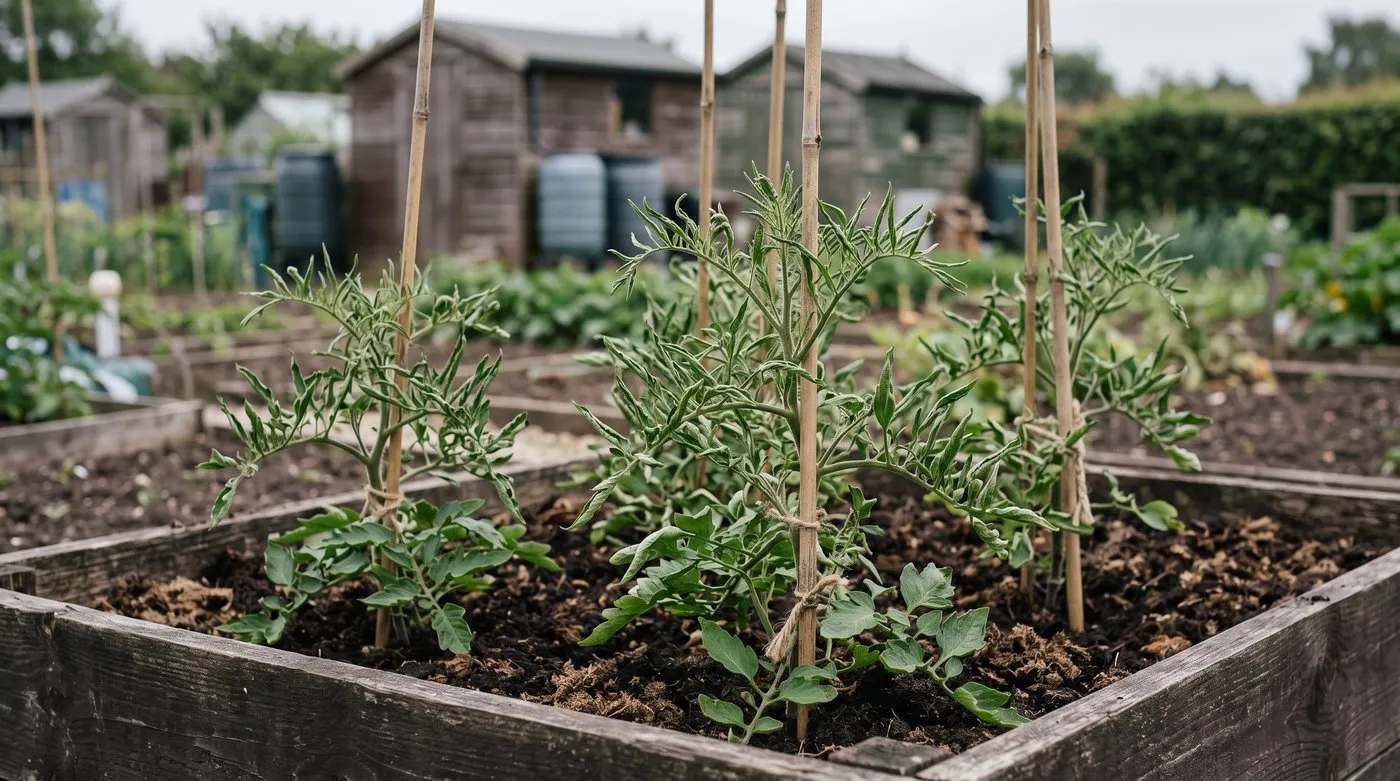
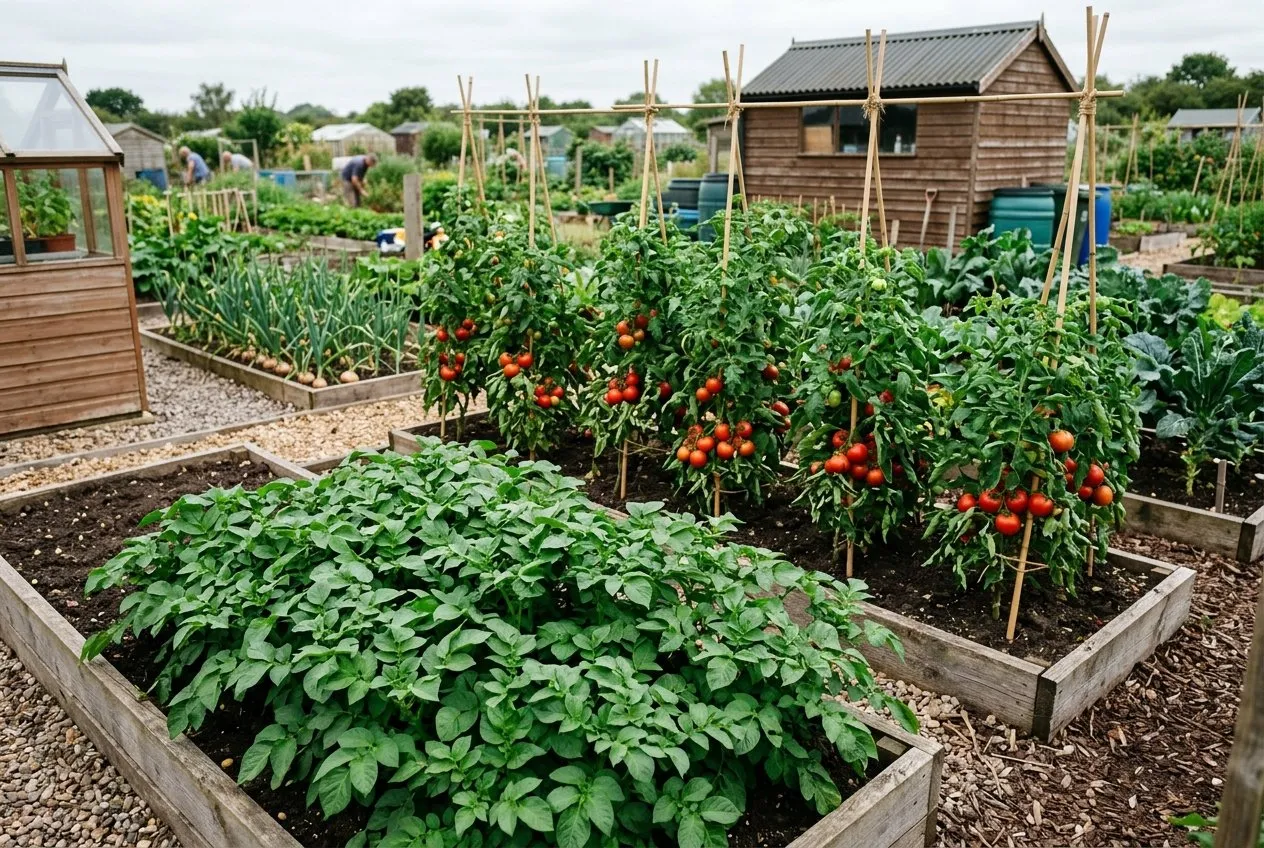 Blight-resistant Sarpo Mira potatoes and Crimson Crush tomatoes growing healthy and disease-free in late August when susceptible varieties have already succumbed.
How do I treat late blight once it appears?
Remove all infected foliage within 24 hours of first symptoms to limit spread to tubers and fruit. Late blight cannot be cured once it has infected plant tissue. All treatment is about containment and protecting the harvest.
On potatoes:
- Cut off all haulm (stems and leaves) at ground level using clean secateurs or shears
- Bag the infected material immediately and remove from the site. Burn it or send it with household waste. Never compost blighted material
- Leave the tubers in the ground for 2-3 weeks after cutting the haulm. This allows skins to set and prevents spores on the soil surface from infecting tubers during lifting
- Harvest on a dry day. Sort tubers immediately and discard any showing reddish-brown patches
- Store healthy tubers in paper sacks in a cool (7-10C), dark, well-ventilated place. Check fortnightly for developing rot
On tomatoes:
- Remove all affected leaves and stems. If more than a third of the plant is infected, pull the entire plant
- Pick any fruit that is still green and firm. Ripen indoors on a windowsill away from other produce
- Discard any fruit with brown patches. Do not attempt to cut away the damage as the internal infection extends further than the visible symptoms
- If growing in a greenhouse, improve ventilation immediately to reduce humidity
Chemical treatment after infection is futile. Copper fungicide and other protectants work only on healthy tissue. Spraying already-infected foliage wastes product and makes a false sense of security. The only post-infection strategy is physical removal.
What fungicides work against late blight?
Copper-based fungicides are the only blight protectants available to UK home gardeners since the withdrawal of mancozeb in 2021. Bordeaux mixture (copper sulphate + calcium hydroxide) has been used against blight since the 1880s and remains effective when applied correctly.
| Product type | Active ingredient | Organic approved | Application timing | Reapplication |
|---|---|---|---|---|
| Bordeaux mixture | Copper sulphate | Yes (with limits) | Before Smith Period | Every 10-14 days |
| Copper hydroxide sprays | Copper hydroxide | Yes (with limits) | After first Smith Period alert | Every 10-14 days |
| Potassium bicarbonate | Potassium bicarbonate | Yes | Preventive, from June | Every 7 days |
Application rules for copper fungicide:
- Apply before blight appears, not after. The spray protects healthy leaf tissue only
- Cover all leaf surfaces thoroughly, including the undersides
- Reapply after heavy rain (25mm+) as copper washes off
- Stop spraying 3 weeks before harvest on potatoes, 1 week on tomatoes
- Copper accumulates in soil. The RHS recommends limiting copper applications to no more than 6kg per hectare per year to prevent soil toxicity
Potassium bicarbonate is a newer alternative with no soil accumulation risk. It works by creating an alkaline leaf surface that inhibits spore germination. Research trials at NIAB and Stockbridge Technology Centre show it provides 40-60% reduction in blight severity compared to untreated controls, which is lower than copper but useful as part of an integrated approach.
Monthly blight management calendar
| Month | Action |
|---|---|
| January | Order blight-resistant seed potatoes. Clean and disinfect stored equipment |
| February | Chit seed potatoes in a light, frost-free place. Plan crop rotation |
| March | Plant first earlies in mild areas. Remove all volunteer potatoes from last year |
| April | Plant second earlies and maincrops. Start earthing up first plantings |
| May | Continue earthing up. Prepare copper fungicide supplies. Check Blightwatch registration |
| June | Monitor Blightwatch for Smith Period alerts. Apply first copper spray after an alert |
| July | Peak blight risk. Inspect crops twice weekly. Reapply copper every 10-14 days |
| August | Harvest first earlies before blight arrives. Cut haulm on maincrops at first sign |
| September | Lift maincrops 2-3 weeks after cutting haulm. Cure and store. Remove all debris |
| October | Clear remaining potato ground. Plant green manures on empty beds |
| November | Check stored potatoes for rot. Remove any affected tubers immediately |
| December | Review the season. Adjust variety choices for next year. Order seed catalogues |
Can I still grow potatoes and tomatoes together?
Growing potatoes and tomatoes near each other increases blight risk for both crops. They share the same pathogen, and an outbreak on one crop rapidly spreads to the other. However, with careful planning, you can grow both successfully.
Separation distance: Plant potatoes and tomatoes at least 10 metres apart. This reduces but does not eliminate cross-infection because spores travel on the wind over much greater distances. The 10-metre gap mainly reduces rain-splash transmission.
Timing strategy: Plant first early potatoes (Rocket, Swift) in March and harvest by late June before blight season begins. This gives you a full potato crop before any risk. Then grow blight-resistant tomatoes (Crimson Crush, Mountain Magic) outdoors from late May, or any variety under glass.
Companion planting does not prevent blight. No companion plant deters Phytophthora infestans. Claims about basil, garlic, or marigold stopping blight are unsupported by evidence. Companion planting helps with insect pests but is irrelevant to airborne water moulds.
Grow vegetables in containers to isolate plants physically. Container-grown tomatoes on a sheltered patio receive less airborne inoculum than those planted in an open allotment. Combined with a resistant variety, this approach virtually eliminates blight risk.
How does late blight differ from early blight?
Late blight (Phytophthora infestans) and early blight (Alternaria solani) are entirely different diseases with different causes and timings. Both affect potatoes and tomatoes but require different management approaches.
| Feature | Late blight | Early blight |
|---|---|---|
| Pathogen | Phytophthora infestans (oomycete) | Alternaria solani (true fungus) |
| Leaf symptoms | Water-soaked brown blotches, white mould underneath | Dry brown spots with concentric rings (target pattern) |
| Speed of spread | Extremely fast (days) | Slow (weeks) |
| Conditions | Cool-warm (10-20C), very humid | Warm (20-30C), alternating wet/dry |
| Severity | Can destroy entire crop in 1-2 weeks | Weakens plants, rarely kills them |
| Tuber/fruit damage | Severe rot | Minor surface blemishes |
| UK season | Late June to September | July to September |
| Treatment | Copper fungicide (preventive only) | Improved airflow, remove lower leaves |
Early blight is far less serious than late blight. It weakens plants and reduces yield but rarely causes total crop loss. The target-pattern spots are easy to distinguish from the water-soaked blotches of late blight. For more detail on telling diseases apart, see our guide to greenhouse pest control which covers identification of common fungal problems.
Frequently asked questions
What does late blight look like on potatoes?
Late blight appears as dark brown or black lesions on potato leaves, starting at the tips and edges. The spots spread rapidly in wet weather and develop a water-soaked appearance. Turn the leaf over and you will see a white fuzzy mould around the lesion edges. Infected stems show dark brown streaks. The whole plant develops a distinctive rotten smell within days. Tubers show reddish-brown patches under the skin that extend into the flesh as a dry, granular rot.
When does blight season start in the UK?
Blight season typically starts between mid-June and early July in the UK. The exact timing depends on weather conditions. A Smith Period triggers the first outbreaks, which is two consecutive days with temperatures above 10C and relative humidity above 90%. In warm, wet summers like 2012 and 2024, blight appeared as early as late June. In dry summers it may not arrive until August or not at all.
Can you eat potatoes that have had blight?
Potatoes from blight-affected plants are safe to eat if the tubers themselves are firm and healthy. Cut away any discoloured flesh and discard soft or rotten tubers. Blight does not produce toxins harmful to humans. However, blighted tubers rot quickly in storage and will contaminate neighbouring potatoes. Harvest immediately when you see blight on the foliage, cut the haulm first, and lift tubers two weeks later so the skins set.
What is the best blight-resistant potato variety?
Sarpo Mira is the most blight-resistant potato available in the UK. Bred by the Sarvari Research Trust in Wales, it scores 9 out of 9 for foliage blight resistance and 7 for tuber resistance. It produces heavy yields of floury red-skinned tubers suited to roasting, mashing, and chipping. Other good options include Sarpo Axona (waxy, salad type), Carolus (all-rounder), and Alouette (second early).
Does copper fungicide work against potato blight?
Copper fungicide prevents blight infection but does not cure it. Bordeaux mixture and other copper-based sprays create a protective barrier on leaf surfaces that kills spores on contact. Apply before blight arrives, typically after the first Smith Period warning. Reapply every 10-14 days and after heavy rain. Copper is approved for organic growing in the UK under current regulations but builds up in soil with repeated use.
Can tomatoes get blight from nearby potatoes?
Yes, tomatoes catch blight directly from infected potato plants. Both crops are hosts for the same pathogen, Phytophthora infestans. Spores travel on wind and rain splash over distances of several hundred metres. Outdoor tomatoes are at highest risk because they share the same airborne inoculum. Grow tomatoes under cover in a greenhouse or polytunnel to reduce infection risk. If growing both outdoors, plant them as far apart as possible.
Should I dig up potatoes if the leaves get blight?
Cut off all potato foliage immediately when you see blight and remove it from the plot. Do not dig up the tubers straight away. Wait 2-3 weeks after cutting the haulm before harvesting. This gives tuber skins time to set and prevents blight spores washing down from infected foliage onto tubers during lifting. Store harvested potatoes in cool, dark, dry conditions and check weekly for any signs of rot.
For further reading, our guide on how to grow potatoes in the UK covers the full growing process from chitting to harvest, while our blight-resistant tomato varieties guide gives detailed growing advice for every resistant cultivar mentioned here.
Lawrie has been gardening in the West Midlands for over 30 years. He grows his own veg using no-dig methods, keeps a wildlife-friendly garden, and writes practical advice based on real UK growing conditions.