Key takeaways
- Lesser celandine (Ficaria verna) flowers February to May, then dies back completely by early June
- Flowers carry 8 to 12 narrow glossy petals; leaves are heart-shaped, glossy and often mottled
- It spreads by finger-like root tubers and, in some subspecies, tiny bulbils in the leaf axils
- Never rotavate or hoe: chopping the tubers multiplies the plant across the bed
- Thick light-excluding mulch cleared 97% of a Staffordshire patch over two seasons
- An early nectar source for queen bumblebees; many gardeners tolerate it since it vanishes by June
Lesser celandine divides gardeners like few other plants. To one person it is a cheerful native wildflower, the first sheet of glossy yellow on a damp February bank. To another it is a weed, colonising a lawn or border and refusing to leave. Both views are right. Lesser celandine (Ficaria verna) is a genuine British wild plant and, in the wrong spot, a genuine nuisance.
Is lesser celandine a wildflower or a weed?
Lesser celandine is both, and the difference is entirely about place. It is a native UK spring wildflower in the buttercup family, Ranunculaceae, once classed as Ranunculus ficaria and now named Ficaria verna. On a woodland floor, a stream bank or a hedge bottom it is a welcome sign that spring has started.
The trouble begins when it moves into cultivated ground. In a lawn it forms glossy patches that resist mowing. In a border it carpets bare soil between perennials and competes with young plants for that first month of the season. On damp clay in shade it can spread to cover several square metres within a few years.
Here is the point most weed guides miss: it is a spring ephemeral. By early June the whole plant dies back and disappears underground until the following February. So for eight months of the year it is not there at all. That single fact changes how you should respond to it. For a wider view of what turns up in turf, our lawn weed identification guide covers the other spring colonisers you may be seeing alongside it.
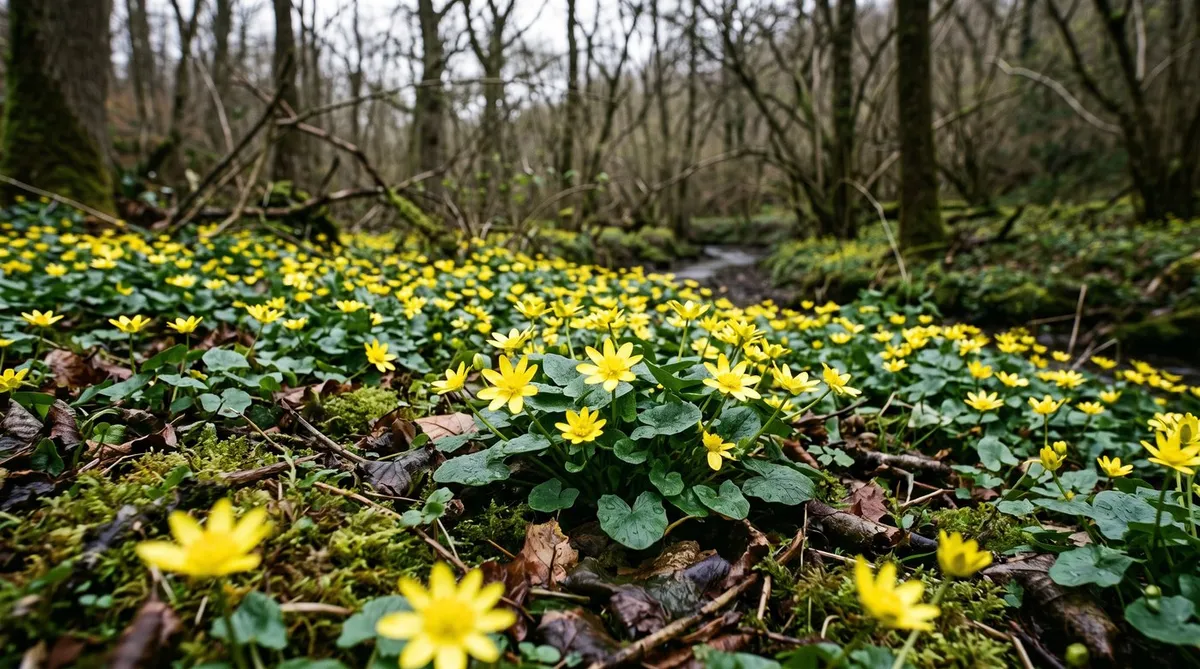
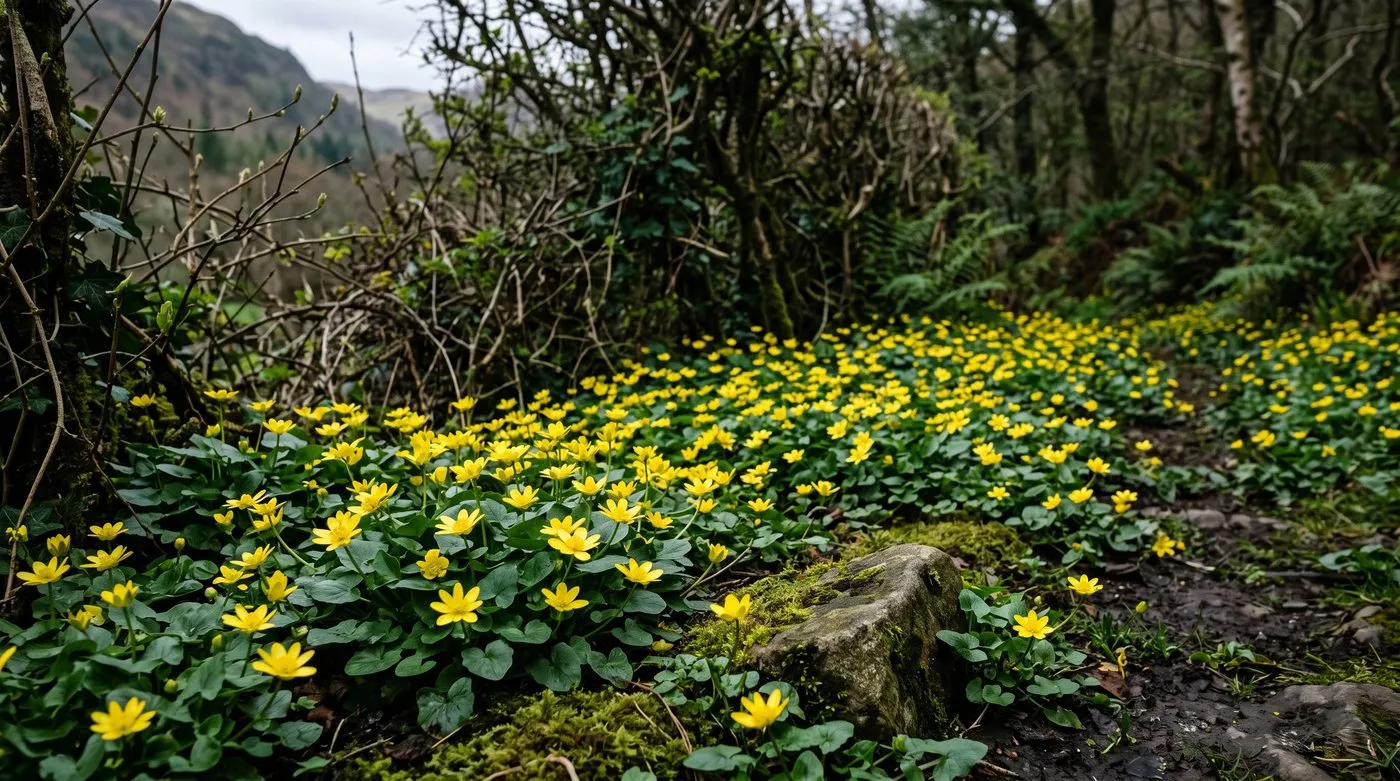 Lesser celandine carpeting a damp woodland edge in a Welsh valley garden. In this setting it is a prized native wildflower, not a weed.
How to identify lesser celandine
Correct identification matters, because two common plants get confused with lesser celandine and each needs a different response. Get the name wrong and you can waste a season treating the wrong thing.
Lesser celandine has glossy, bright yellow, star-shaped flowers, each with 8 to 12 narrow petals. The petals shine as if varnished. Flowers are 2 to 3cm across and open only in sun, closing in dull weather and at night. The leaves are heart or kidney-shaped, dark green, glossy, and often marked with pale or bronze mottling. The plant is low and mat-forming, reaching only 5 to 25cm tall.
The two lookalikes are very different plants. Greater celandine (Chelidonium majus) is in the poppy family, not the buttercup family, and its broken stems bleed bright orange sap. Its flowers have only four petals. Creeping buttercup (Ranunculus repens) has five rounded petals, hairy three-lobed leaves, and spreads by creeping runners rather than tubers.
Identification comparison table
| Feature | Lesser celandine | Greater celandine | Creeping buttercup |
|---|---|---|---|
| Family | Buttercup (Ranunculaceae) | Poppy (Papaveraceae) | Buttercup (Ranunculaceae) |
| Flower | 8-12 glossy petals, star shape | 4 dull-yellow petals | 5 rounded glossy petals |
| Leaf | Heart-shaped, glossy, mottled | Lobed, soft, grey-green | 3-lobed, hairy, toothed |
| Season | Feb to May, then gone | May to August | May to September |
| Sap | Clear | Bright orange | Clear |
| Spreads by | Tubers and bulbils | Seed | Creeping runners |
The clearest field test is the sap. Snap a leaf stalk: clear sap points to lesser celandine or buttercup, orange sap confirms greater celandine. After that, count the petals. Eight or more narrow, shiny petals means lesser celandine every time.
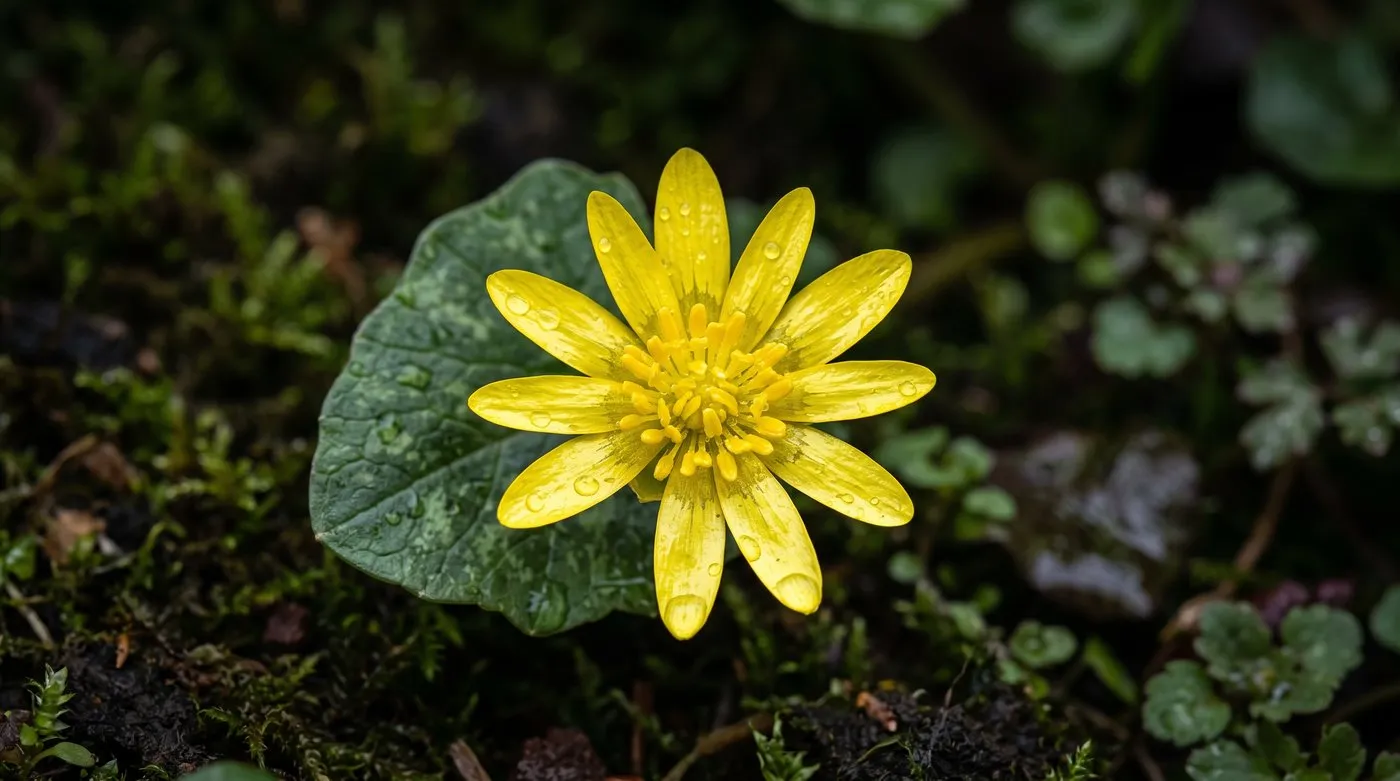 The glossy, star-shaped flower with 8 to 12 varnished petals is the surest identification feature. Creeping buttercup has only five rounded petals.
Why it vanishes by June: the spring ephemeral life cycle
Understanding the life cycle is the key to both enjoying and controlling this plant. Lesser celandine is a spring ephemeral, a plant that races through its whole above-ground life in about four months, then retreats underground for the rest of the year.
The cycle runs in clear stages. Leaves push up when the soil warms to around 6 to 8C, usually in mid-February on our Staffordshire clay. Flowering follows through March and April, peaking when air temperature climbs past 10C and the sun is out. Through May the foliage yellows and collapses. By early June the plant has gone completely. Across seven seasons of records here, die-back dates fell between 28 May and 11 June.
While the leaves are green, the plant pumps sugars down into root tubers for storage. This is the critical detail most people miss. When the top growth dies in June, gardeners assume the plant is dead and stop trying to control it. It is not dead. It is dormant, fully charged, and will return next February from those tubers. Any control that leaves the tubers intact simply resets the clock.
Gardener’s tip: Do your identification and any hand-digging in March and April, while the plant is in leaf and easy to see. Once June arrives it is invisible, and you will spend the summer forgetting exactly where the patch was. Mark problem patches with a cane before they die back.
How lesser celandine spreads: tubers and bulbils
Every one of those tubers can grow a new plant. That is why rotavating and hoeing make the problem far worse. A rotavator chops the tuber cluster into dozens of fragments and scatters them across the bed. Each fragment is a fresh plant in waiting. What looked like one patch becomes ten.
The second trick belongs to certain subspecies, mainly Ficaria verna subsp. verna and subsp. bulbilifer. These produce tiny bulbils in the leaf axils, small bulb-like growths that drop to the ground and root. When you pull a plant of these subspecies, the bulbils shower off into the soil. This is why a tug-and-go approach so often leaves a thicker patch behind.
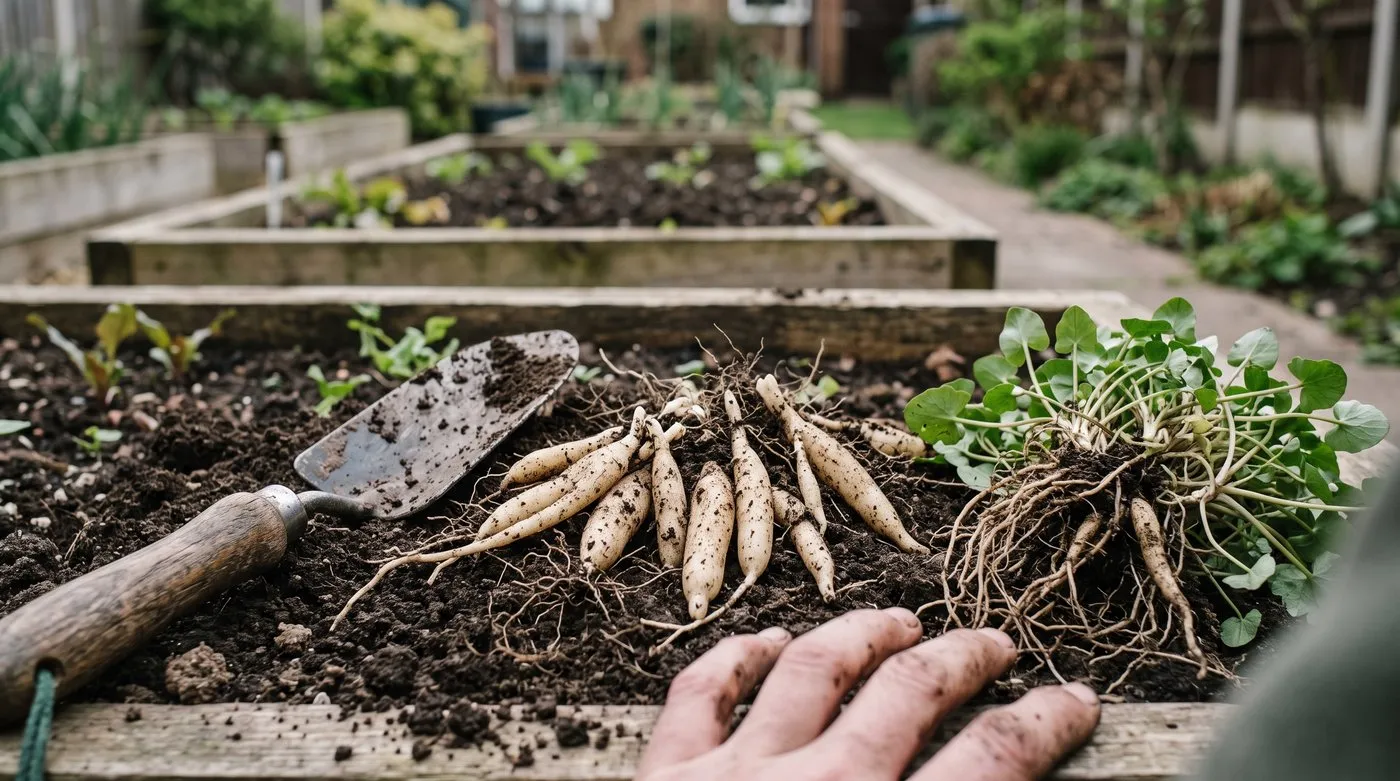 The finger-like root tubers are how lesser celandine spreads. A rotavator chops these into fragments and scatters new plants across the whole bed.
What lesser celandine does for bees and pollinators
Before you reach for a spade, weigh what this plant gives back. Lesser celandine is one of the earliest nectar and pollen sources in the UK garden year. Its open, shallow, sun-tracking flowers appear from February, weeks before most border plants have stirred.
That timing is what makes it valuable. Queen bumblebees emerging from hibernation in late winter need fuel fast, and there is little else in flower. The open daisy-like shape suits them and other early insects, including solitary bees and hoverflies. The Bumblebee Conservation Trust stresses how much emerging queens depend on late-winter and early-spring forage to found their nests.
Lesser celandine is also a proper woodland-floor native, part of the same spring community as wood anemone and wild primrose. The Woodland Trust lists it as a genuine ancient-woodland indicator in some settings. For all these reasons, plenty of gardeners choose to leave it in wilder corners. If you want to know which early bees it is feeding, our UK bumblebee species guide helps you tell the queens apart.
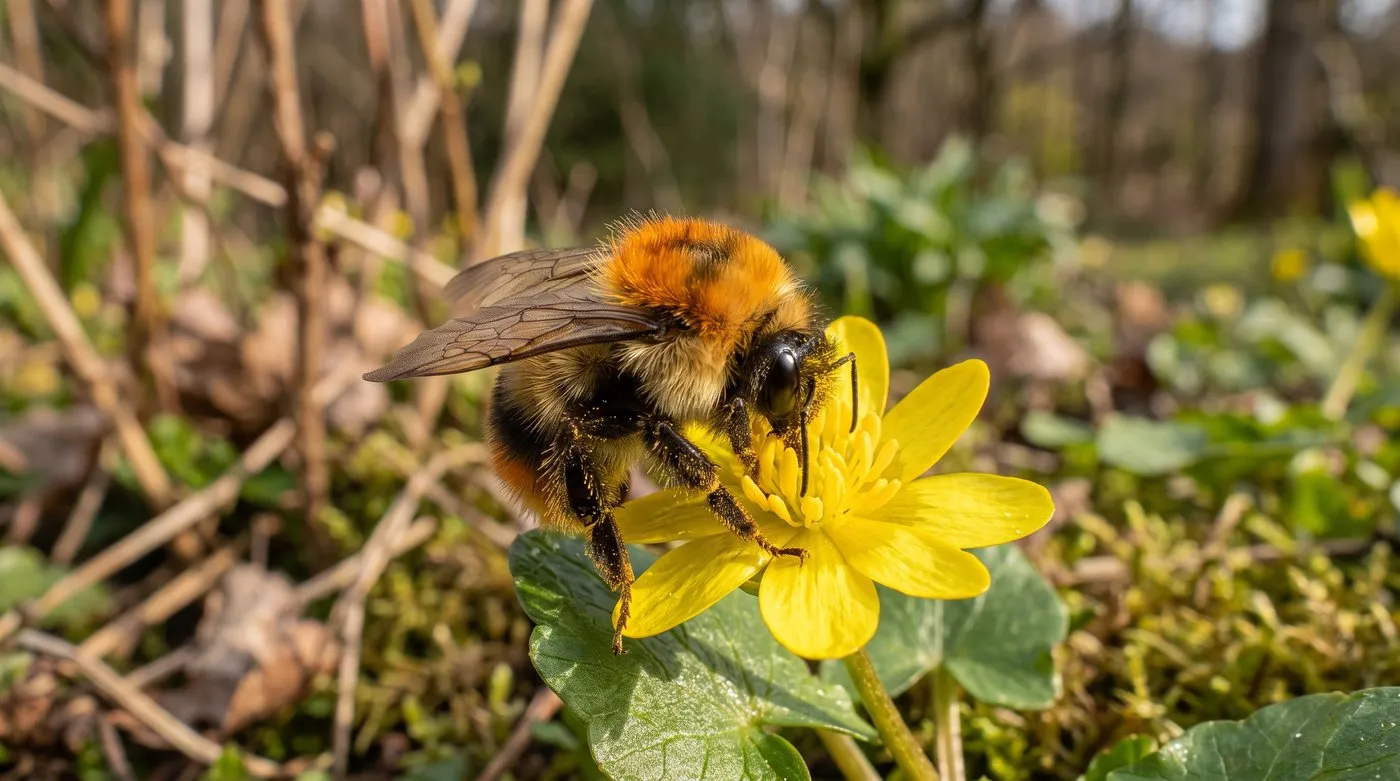 A queen bumblebee working lesser celandine in a Scottish garden in March. In late winter this is one of very few open nectar sources available.
How to control lesser celandine effectively
Control methods ranked by effectiveness
| Method | Effectiveness | Role | Notes |
|---|---|---|---|
| Thick light-excluding mulch (cardboard + 8cm bark) | ~97% over 2 seasons | Primary | Best on borders and bare ground |
| Hand-digging the whole tuber cluster, soil sieved | ~70% first pass; 3 springs to clear | Primary for small patches | Must remove every fragment |
| Tolerate and let it die back | 100% seasonal disappearance | Do-nothing default | Gone by June anyway |
| Lawn selective weedkiller | Marginal | Supplementary | Poor uptake on waxy leaves |
| Glyphosate | ~40% | Weak, last resort | Short window before die-back |
| Rotavating or hoeing | Negative, spreads it | Never do this | Chops tubers into new plants |
For the mulch route, lay it in autumn while the plant is dormant, so the tubers meet darkness the moment they try to grow in February. Our cardboard and grass-clippings mulch method sets out the layering that smothers persistent weeds without weedkiller. In a lawn the plant is harder to isolate, and the same principles that clear other stubborn turf invaders apply; our guide to clearing moss and weeds from lawns covers the wider turf approach.
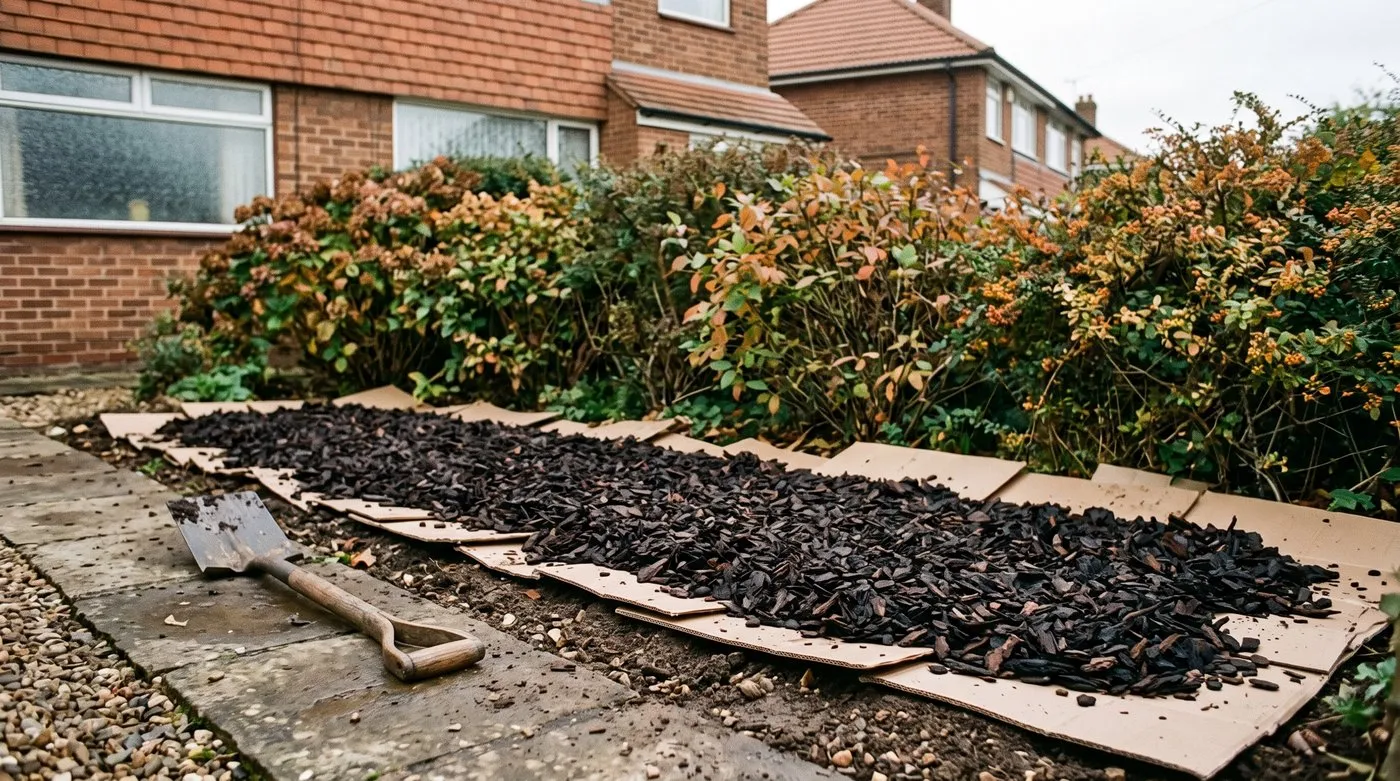 Overlapping cardboard topped with 8cm of bark chip, laid in autumn over a known celandine patch. Two seasons of darkness exhausts the tubers.
Should you just leave it? The case for tolerance
For many gardeners the sensible answer is to do nothing. Lesser celandine causes almost no lasting harm in a border, because it has finished and gone by the time your main planting fills out. It occupies bare spring soil that would otherwise sit empty, then hands the space straight back in June.
The tolerance case is strongest in damp, shaded, semi-wild areas: under hedges, along a north fence, at the back of a border, or in a mini-meadow. In those spots the early flowers earn their keep as bee forage and the plant never competes with anything you value. A no-mow spring lawn is one place where letting it flower fits the wider aim rather than fighting it.
Tolerance is a poor choice in only a few situations. A fine ornamental lawn, a newly planted alpine bed, or a nursery of small treasures will all suffer if celandine smothers them in that first month. There, control is worth the effort. Everywhere else, the plant that disappears by itself is rarely worth a battle.
Month-by-month calendar for lesser celandine
Timing every job to the plant’s life cycle is what makes control efficient. This calendar shows what lesser celandine does through the UK year and when to act.
| Month | What the plant does | What to do |
|---|---|---|
| January | Dormant underground | Plan; keep autumn mulch topped up over known patches |
| February | Leaves emerge as soil hits 6-8C | First shoots; dig small patches now while soil is moist |
| March | Flowering begins | Flowers open in sun; hand-dig on moist soil, sieve out tubers |
| April | Peak flowering, key bee forage | Best window to dig or smother; or leave it for pollinators |
| May | Flowering ends, foliage yellows | Last chance to dig before the plant hides for the year |
| June | Dies back completely | Plant vanishes; mark patches with canes for autumn |
| July | Fully dormant | Nothing visible; nothing to do |
| August | Dormant, tubers resting | Clear other weeds off bare patches ready for mulch |
| September | Dormant, tubers building strength | Good time to lay cardboard mulch over problem areas |
| October | Dormant | Finish mulching; overlap all cardboard edges |
| November | Dormant | Check mulch has not blown or thinned |
| December | Dormant | Plan next spring’s approach for any missed patches |
The single best window for the mulch method is September to October. Lay it then and the tubers meet darkness the instant they wake in February, so they burn through their reserves with no light to rebuild them.
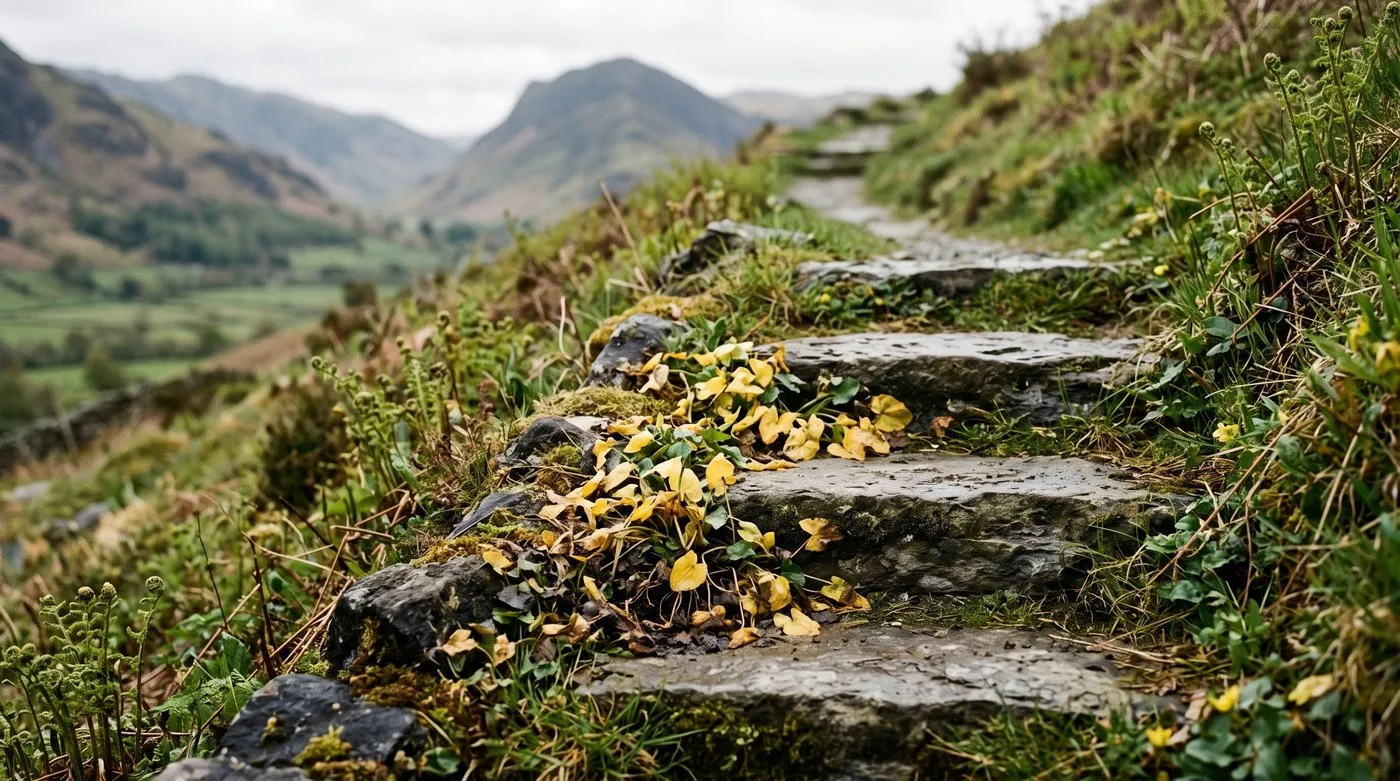 Late May in a Lake District garden: the foliage yellows and collapses. Within two weeks the plant will vanish underground until February.
Common mistakes when dealing with lesser celandine
Ornamental lesser celandine: the celandine you plant on purpose
Not all lesser celandine is unwanted. Plant breeders have selected some striking forms that gardeners grow deliberately, chiefly for their foliage. The best known is ‘Brazen Hussy’, a chocolate-bronze-leaved selection with glossy yellow flowers, spotted in a Suffolk wood and introduced by the gardener Christopher Lloyd. Others include ‘Coppernob’, with dark coppery leaves, and various double-flowered forms that look like tiny yellow or cream rosettes.
The lesson is that context decides everything, even within one species. The same plant is a treasured foliage feature in a raised bed and a weed in a wet lawn 20 metres away.
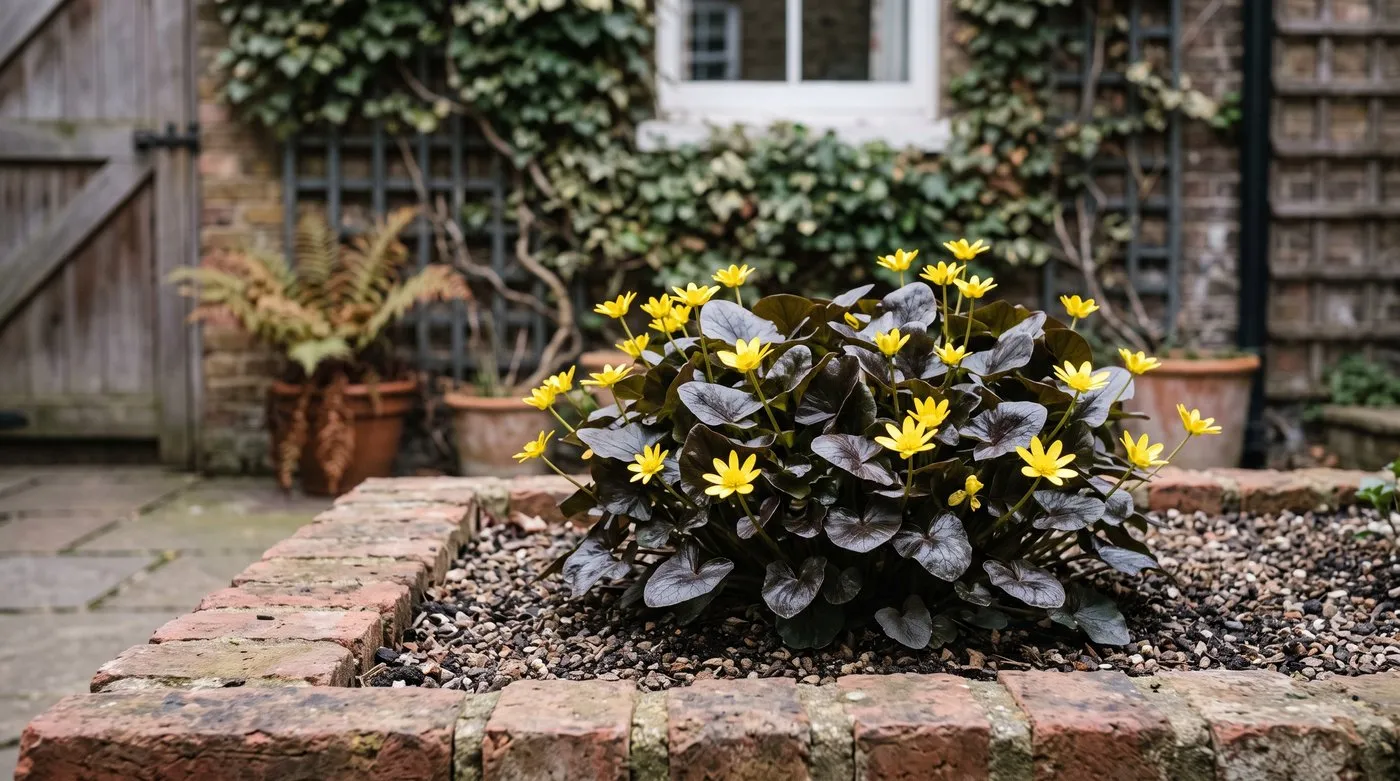 The cultivar ‘Brazen Hussy’, grown deliberately for its chocolate-bronze foliage. On a dry raised bed it stays as a tidy clump rather than spreading.
Is lesser celandine edible or poisonous?
Lesser celandine is mildly toxic when raw, and this is worth taking seriously. Like other members of the buttercup family, it contains protoanemonin, a compound that irritates the mouth, throat and gut. Eating the raw leaves or flowers can cause a burning sensation and stomach upset.
The plant does have a foraging history, but only with care. Traditionally the young spring leaves were gathered before flowering and eaten only after thorough cooking, because heat breaks protoanemonin down into a harmless form. The old country name “pilewort” reflects a historic medicinal use, not a food use. This is a plant for looking at, not for casual nibbling.
Warning: Never eat lesser celandine raw. It contains protoanemonin, which irritates the mouth and digestive system. Keep curious children and pets away from the foliage, and do not treat it as a wild salad leaf. Any traditional use involved thorough cooking, which most modern foragers are not equipped to judge safely.
Frequently asked questions
Is lesser celandine a weed?
It depends on where it grows. Lesser celandine is a native UK wildflower, welcome in wild corners but a nuisance in lawns and borders. It dies back by June, so many gardeners tolerate it rather than fight it every spring.
How do I get rid of lesser celandine?
Why does my lesser celandine disappear in summer?
It is a spring ephemeral that dies back underground. Lesser celandine finishes flowering by May and vanishes by early June, storing energy in root tubers. It is dormant, not dead, and returns the following February.
Is lesser celandine the same as greater celandine?
No, they are unrelated plants. Greater celandine (Chelidonium majus) is in the poppy family with bright orange sap and four petals. Lesser celandine is a buttercup relative with clear sap and 8 to 12 petals.
Is lesser celandine poisonous?
Yes, it is mildly toxic raw. Lesser celandine contains protoanemonin, which irritates the mouth and gut. Historically it was eaten only after thorough cooking, which breaks the toxin down. Never eat it raw.
Does lesser celandine help bees?
Yes, it is a valuable early nectar source. The open yellow flowers feed emerging queen bumblebees and other pollinators from February, when little else is out. This is why many gardeners leave it in wilder areas.
Will glyphosate kill lesser celandine?
Our team produces practical UK gardening guidance from source research, contributor records and established horticultural practice. Editorial standards are overseen by Matt W.