Key takeaways
- Crown rot accounts for roughly 8 in 10 rhubarb deaths on wet UK soils, and drainage is the only permanent fix
- Set crown buds no more than 25mm below the surface: deeper planting is the single commonest trigger for rot
- Phytophthora attacks saturated soil below 18C, while Erwinia soft rot spreads fastest at 20-25C
- Rhubarb is genuinely susceptible to honey fungus, which travels 1m or more a year through soil
- Thin stalks almost always mean a congested crown needing division, not a disease or a feeding problem
- Rhubarb leaves hold 0.5-1.0% oxalic acid by weight and must never be eaten, whatever the season
Most rhubarb never gets ill. When it does, the problem is nearly always the same one: the crown is rotting, and it is rotting because it sits in wet soil. Rhubarb problems fall into three groups that need completely different responses. There are the true diseases, led by crown rot and honey fungus. There are the pests, which in a UK garden amount to slugs and very little else. Then there is the biggest group of all, the disorders that look alarming but are not disease: bolting, thin stalks and green stems.
This guide is about telling those three apart before you act. For planting, forcing, harvesting and dividing, our guide to how to grow rhubarb in the UK covers the ground. What follows is what to do when an established crown starts to fail.
Where to look first when a rhubarb plant fails
Start at the base, not the leaves. Almost every serious rhubarb problem announces itself within 50mm of soil level, and almost every harmless one does not.
Grip a failing stalk and pull gently. If it comes away from a soft, brown, wet base, you are looking at crown rot. If the stalk is firm at the base but the whole plant looks pale and stunted, the trouble is either root damage below or a virus above. Leaves marked with spots while the crown stays firm point to a fungal leaf disease, which is nearly always cosmetic. Chewed buds in March mean slugs. A thick central spike topped with creamy flowers is bolting, which is not a disease at all.
| What you see | Most likely cause | How serious |
|---|---|---|
| Stalks collapse at the base, tissue brown and soft | Crown rot (Phytophthora or Erwinia) | Fatal without drainage work |
| White fungal sheets under the crown skin, mushroom smell | Honey fungus (Armillaria) | Fatal, and it spreads |
| Round spots 2-5mm with pale centres on leaves | Ramularia leaf spot | Cosmetic |
| Angular pale patches, grey felt on the leaf underside | Downy mildew | Cosmetic in most years |
| Yellow mottling, ring marks, plant weaker each year | Virus | Incurable, dig out |
| Grazed or holed buds in February to April | Slugs and snails | Annoying, not fatal |
| Thick central spike with cream flowers | Bolting (a disorder) | Harmless, cut it out |
| Thin stalks under 15mm across | Congested crown (a disorder) | Fixed by dividing |
Crown rot, the disease that kills established rhubarb
Crown rot is the one that matters. Two different organisms cause it, and they behave differently enough that it helps to know which you have.
Phytophthora is a water mould, not a true fungus, and that distinction is the whole story. It swims. Its zoospores need free water in the soil to move, and they travel only 20-40mm through wet soil towards the chemical signals leaking from root tips. In dry or free-draining soil they never arrive. In saturated clay they arrive easily. Phytophthora cryptogea and P. cactorum are the species usually behind rotten rhubarb, and both work best in cold wet soil below 18C. That means winter and early spring, not summer.
Erwinia, now classified as Pectobacterium, is a bacterium and the second act. It moves into tissue that Phytophthora or a spade has already damaged. It produces enzymes that dissolve the pectin holding cell walls together, which turns firm crown tissue into brown slime. It works fastest at 20-25C. The sour, unmistakable smell of a rotting crown is Erwinia, not Phytophthora.
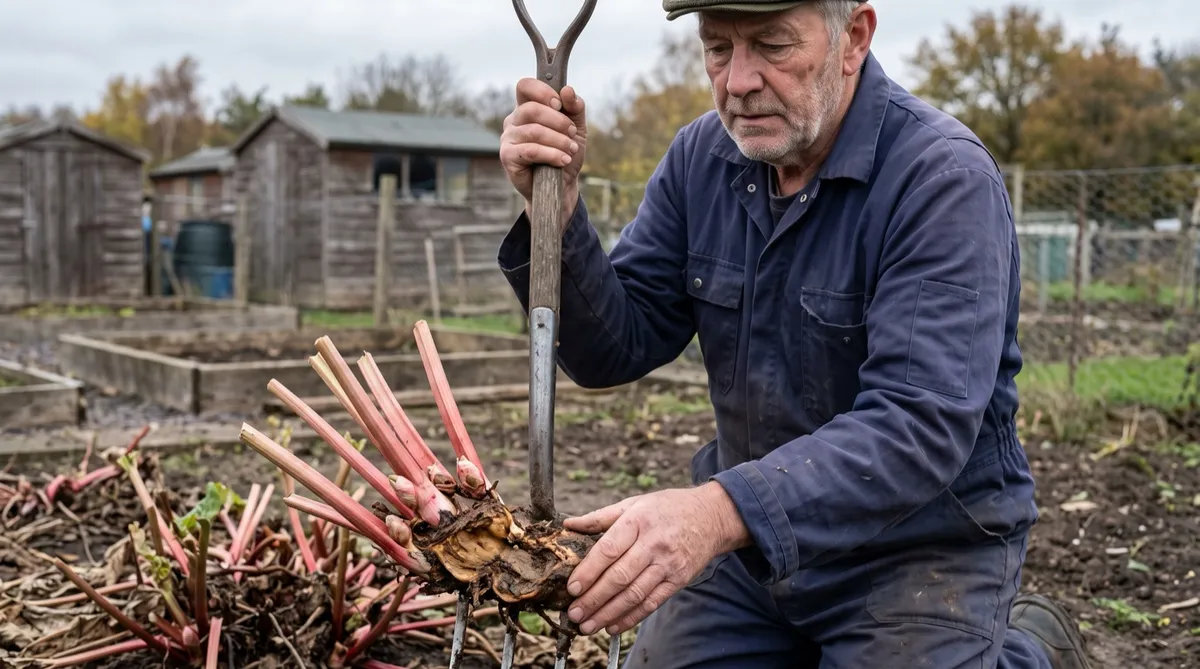
To confirm either, cut into the crown with a clean knife. Healthy rhubarb crown tissue is firm, dense and cream to pale pink. Rotten tissue is brown, wet and gives under a thumbnail.
Gardener’s tip: Dip the blade in boiling water between plants when you are testing several crowns. Erwinia travels perfectly well on a knife. Cutting into a healthy crown with a blade you just pulled out of a rotten one is a reliable way to start the disease you went out to look for.
How crown rot takes hold, stage by stage
Understanding the sequence matters because it tells you when to act, and the answer is months earlier than most people think.
- Day 0, the soil saturates. Heavy rain fills the pore spaces between soil particles. On clay this water has nowhere to go. Oxygen in the root zone falls below roughly 10%.
- Days 1-3, the roots stop breathing. Rhubarb roots cannot respire without oxygen. Fine root tips die and leak sugars and amino acids into the water around them.
- Days 3-10, infection. Phytophthora zoospores swim up that chemical trail and encyst on the dying roots and the base of the buds. Soil at 10-18C is ideal for them. Any wound left by a spade, a slug or a cut stalk stump doubles the entry points.
- Days 10-21, the rot spreads. Infected tissue browns and softens. Once temperatures climb past 20C, Erwinia colonises the damaged tissue and the collapse accelerates.
- Weeks 3-6, the plant gives up. Stalks fall outwards from the base. Leaves yellow. The crown is now a brown mass.
The critical mistake follows directly from that timeline. A gardener sees the crown collapse in May, blames the wet fortnight in May, and replaces the crown in the same hole in November. But the infection that killed it started in the waterlogged soil of the previous January. By May the plant was already lost. Rhubarb crown rot is a winter drainage problem that becomes visible in spring. Nothing you do in May will change the outcome. Everything you do in November will.
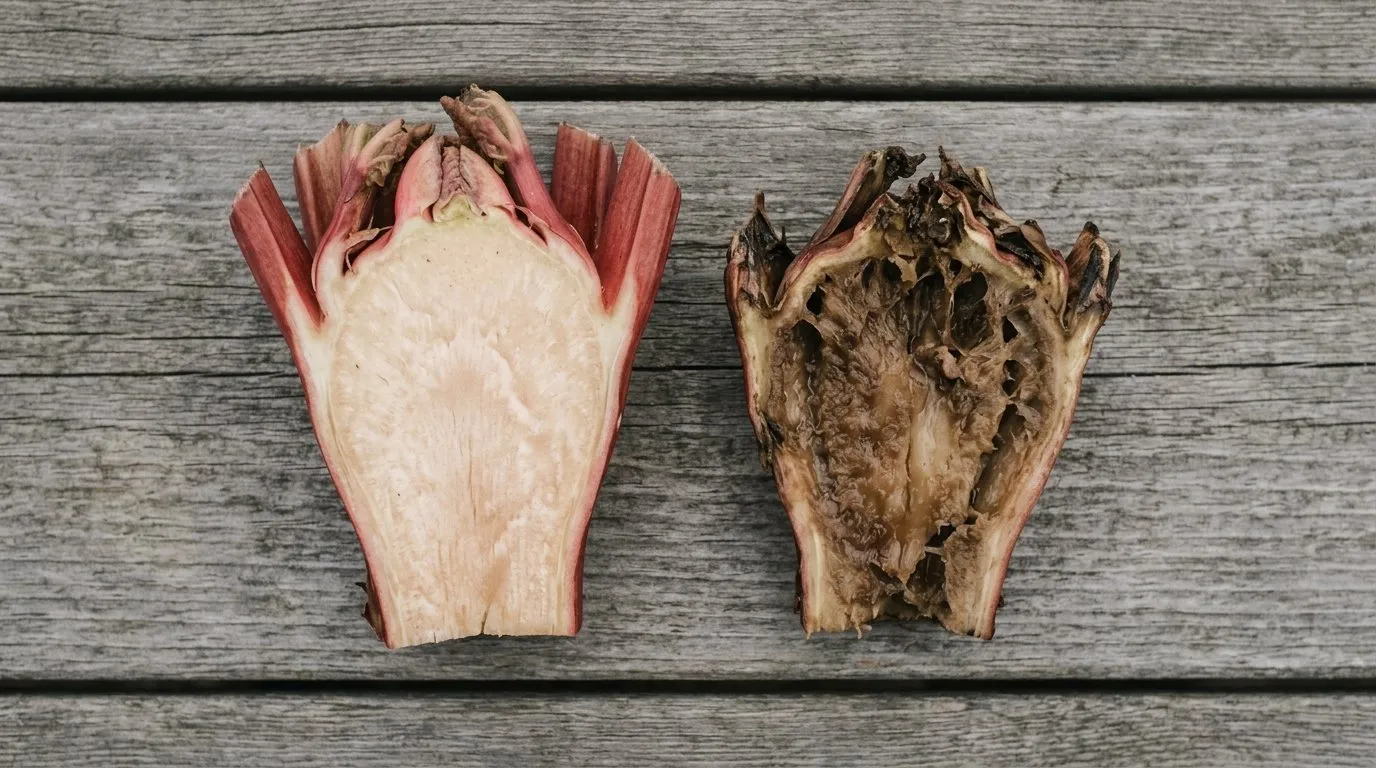 The knife test settles it. Healthy crown tissue on the left is firm and cream coloured. Rotten tissue on the right is brown, wet and soft under a thumbnail.
Why crown rot keeps coming back to the same spot
Here is the part that generic advice misses. The pathogen is not the cause. Phytophthora is already present in most UK garden soils, sitting harmlessly as resting oospores. It is not something your rhubarb caught. It is something that was always there, waiting for conditions.
Two things decide whether those conditions arrive: how long the soil stays saturated, and how deep the buds sit. A crown planted level with heavy clay creates a shallow bowl. Rain collects in it, the buds sit in standing water for weeks, and the pathogen gets everything it needs. A crown planted 50mm down, which people do because it feels more secure, makes that bowl deeper.
This root cause gets missed for two reasons. First, gardeners treat rot as a disease to be cured, so they buy a new crown and plant it in the same hole, and it rots too. Second, the standard advice to use “rich, well-drained soil” is too vague to act on. Nobody knows what depth of grit that means.
The permanent prevention is physical, cheap and takes twenty minutes:
- Build a mound 200mm high and 600mm across where the crown will sit, rather than digging a hole.
- Mix the mound 50:50 with 20mm washed grit, not sharp sand, which blocks rather than opens clay.
- Set the buds 20mm proud of the surrounding soil, so water drains away from them in every direction.
- Keep mulch 50mm clear of the buds. Manure heaped over a crown holds water exactly where you do not want it.
- Never replant rhubarb in a spot where a crown has rotted. Phytophthora oospores survive 3-4 years in soil.
That last figure is worth keeping in perspective. Three to four years feels long, but it is nothing next to allium white rot, whose resting bodies sit in soil for 15 to 20 years. Rhubarb ground recovers. You simply have to move the plant for a few seasons. If your whole plot drains badly rather than one corner, our soil drainage and structure guide covers the wider fix.
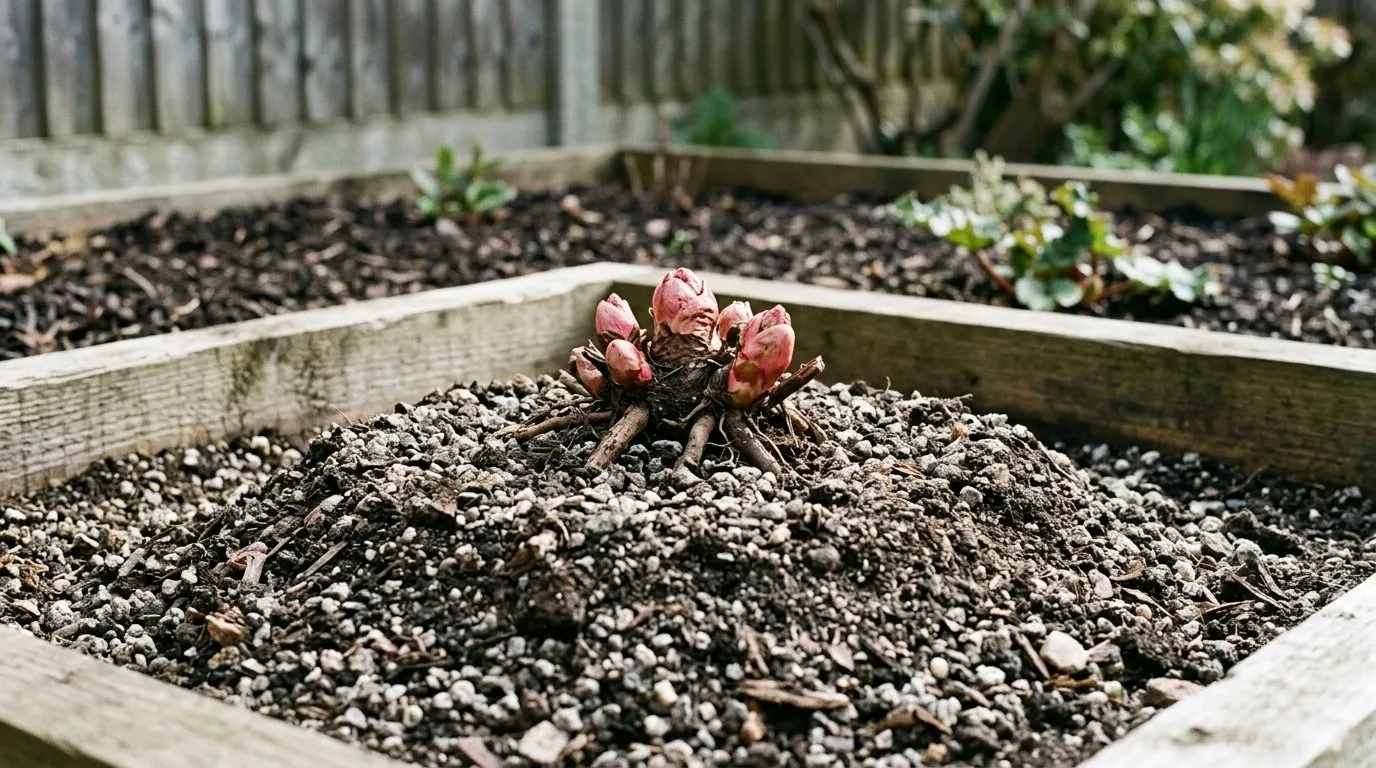 The whole prevention in one picture: a 200mm mound of soil and grit, with the buds sitting 20mm proud so water runs away from them rather than into them.
Honey fungus in a rhubarb bed
Rhubarb’s susceptibility to honey fungus surprises people, because rhubarb is not a woody plant. It is real, and Armillaria mellea will take a crown as readily as it takes an apple tree.
The symptoms differ from crown rot in one useful way. Peel back the skin at the base of the crown and look for white sheets of fungal growth that smell strongly of mushroom. That smell is diagnostic. Crown rot smells sour; honey fungus smells like a mushroom counter. In the soil around the plant you may find black bootlace strands called rhizomorphs, roughly 1-3mm thick. Honey-coloured toadstools appear in clumps in autumn, though often nowhere near the plant they killed.
Honey fungus advances through soil at 1m or more a year along those rhizomorphs. That is why it takes plants in a line across a plot, and why treating a single crown achieves nothing.
There is no chemical control available to gardeners. Dig the crown out with every root fragment you can find. Do not compost it. A physical barrier of butyl rubber sunk 45cm deep and left 25mm proud of the surface stops rhizomorphs crossing into clean ground. Our guide to dealing with honey fungus covers barriers and resistant replacements in detail, and the RHS honey fungus profile lists the species most at risk.
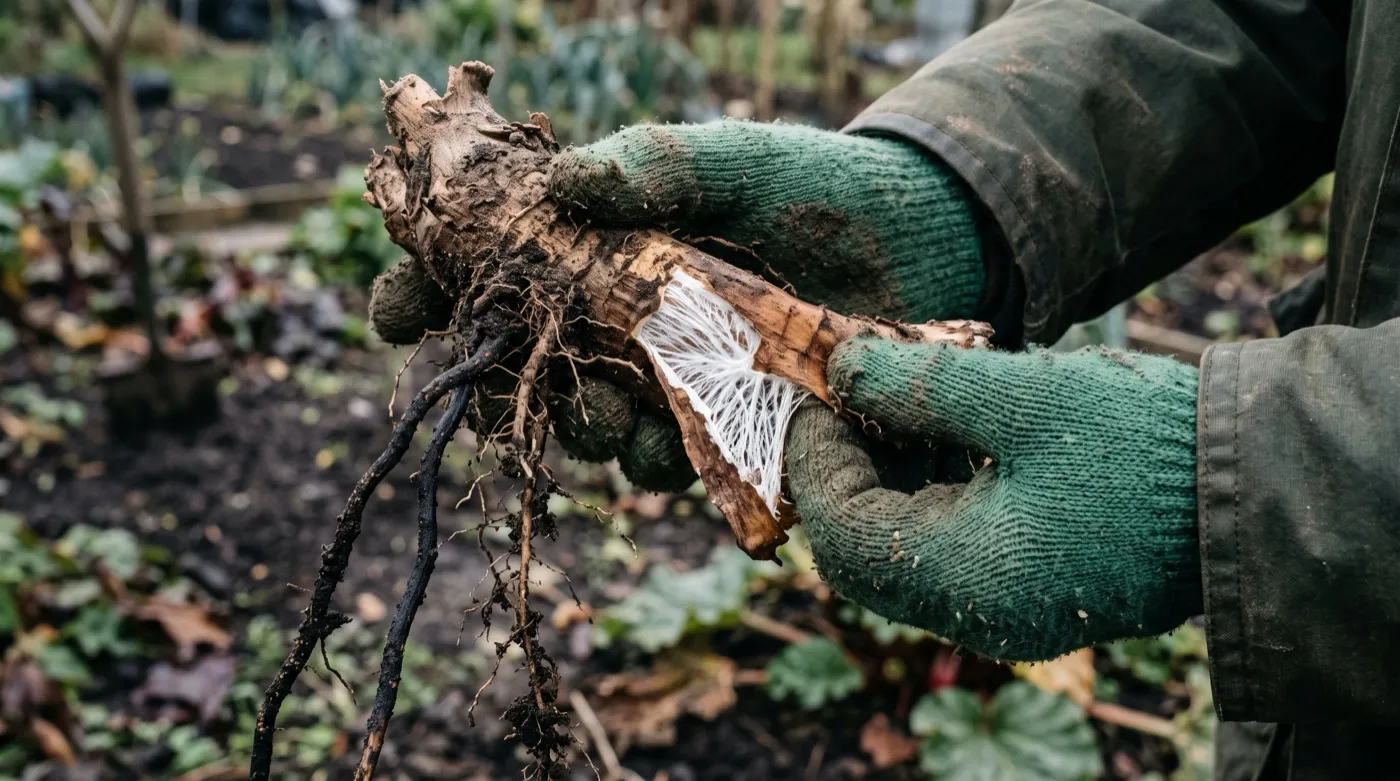 Honey fungus gives itself away by smell and by these black bootlace rhizomorphs. They travel a metre a year through soil, which is why one dead crown rarely stays one.
Leaf spot and downy mildew on rhubarb leaves
Marked leaves alarm people far more than they should. Both common rhubarb leaf diseases are cosmetic in most seasons, and both are worth identifying purely so you can stop worrying about them.
Ramularia leaf spot (Ramularia rhei) makes circular spots 2-5mm across with dark red or purple margins and pale centres. As the spots age those centres dry out and drop through, leaving a shot-hole effect. It appears after wet spells, favours 15-20C, and needs leaves to stay wet for around 6 hours to infect.
Downy mildew (Peronospora jaapiana) is less common and looks different. It makes angular pale patches bounded by the leaf veins, with a grey-purple felt on the underside in humid weather. Angular means downy mildew; round means Ramularia.
Neither one kills a crown, and neither makes the stalks unsafe. A plant can carry heavy leaf spot and still crop normally, because the disease arrives late in the season once the leaves have already done their work. Do not spray for either.
What does help is air movement and hygiene. Space crowns 90cm apart, water at soil level rather than over the leaves, remove only the worst-marked leaves during the season, and clear all dead foliage in October so spores do not overwinter in the crown. Badly spotted leaves are still safe to compost, since the spores need living tissue.
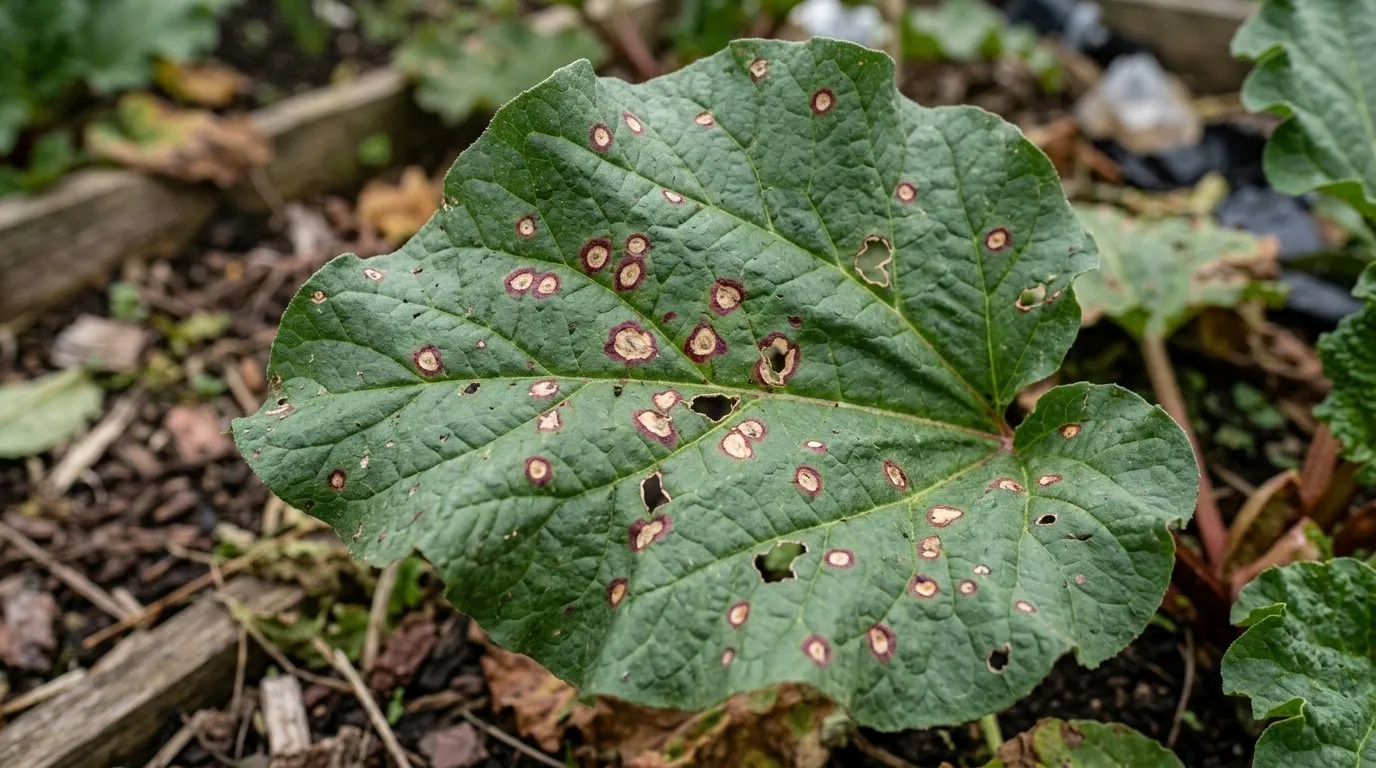 Ramularia leaf spot: round spots 2-5mm across with red margins and pale centres that eventually drop out. Cosmetic, and not worth spraying.
Mosaic, stunting and the viruses you cannot cure
If a crown gets weaker every year despite feeding, dividing and perfect drainage, suspect a virus. This is the quiet cause behind a great many tired rhubarb plants that get blamed on soil.
Several viruses infect UK rhubarb, including arabis mosaic virus, turnip mosaic virus and cherry leaf roll virus. The symptoms overlap: yellow mottling or mosaic patterning across the leaf, pale ring marks, puckered or distorted leaf blades, and a plant that shrinks year on year. Stalks stay thin no matter what you feed it. Decline typically runs over 2-3 years rather than arriving suddenly, which is exactly why people miss it.
Two things spread these viruses. Soil-dwelling nematodes of the genus Xiphinema carry arabis mosaic virus from root to root. Far more often, gardeners spread it themselves by taking divisions from an infected crown and planting them around the plot, or giving them to neighbours.
There is no cure. No spray, feed or soil treatment touches a virus once it is in the plant. Dig the crown out and burn or bin it. Then apply the rule that prevents the next one: never take divisions from a plant that is mottled, puckered or declining, however tempting a free plant is. Buy certified bare-root stock from a reputable supplier instead. The Garden Organic advice pages are a sound starting point for organic soil management once a bed has been cleared.
Slugs, snails and the pests that actually matter in the UK
The pest list for UK rhubarb is short. Slugs, and then nothing much.
Now the honest part. Search rhubarb pests online and you will find rhubarb curculio (Lixus concavus) described in detail. It is a North American weevil. It is not established in the UK, and you will not find it on your plot. The same goes for most of the crown borer advice in circulation, which is written for American growers. UK gardeners spend real time hunting a pest that is not here, then miss the slugs that are.
Aphids occasionally colonise flower spikes, and vine weevil grubs can trouble container-grown crowns. Neither is common enough to plan around. Browse the wider garden problems section if the symptoms on your plot do not match anything here.
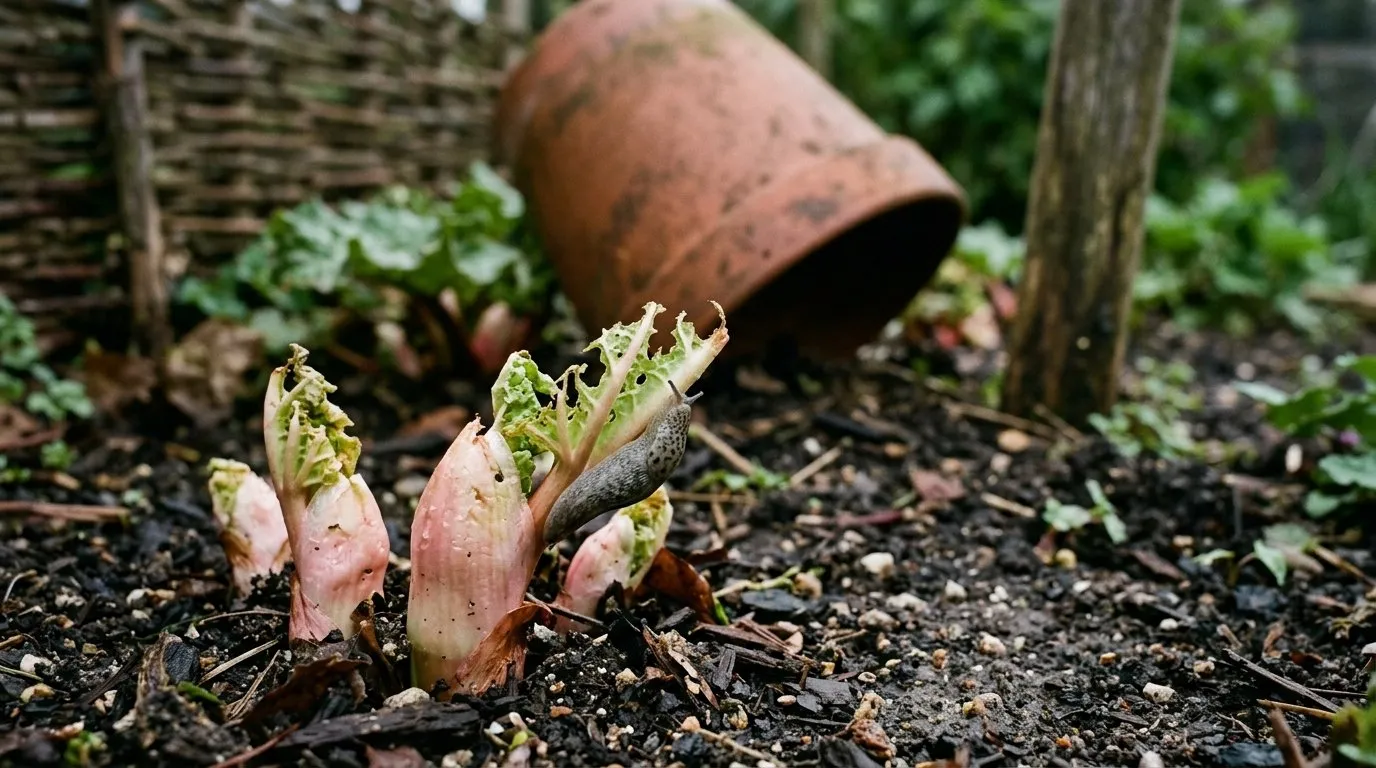 Emerging buds under a forcer are the most vulnerable rhubarb of the year. Dark, humid and warm suits slugs better than it suits you.
Bolting, thin stalks and the problems that are not diseases
Most of what gets reported as rhubarb disease is not disease. These three account for the bulk of it.
Why rhubarb sends up a flower spike
Bolting is a thick central spike topped with a cluster of creamy flowers. It is the plant switching from growth to reproduction, and it is triggered by age, heat or stress. Crowns over five years old bolt far more readily than young ones. A hot dry June brings it on. Variety matters too: Victoria bolts noticeably more than Timperley Early.
Cut the spike out at the base as low as you can reach, as soon as you see it. Left standing, it takes energy that would otherwise go into stalks. Bolting does not make the stalks poisonous or inedible, which is the usual worry. A crown that bolts every year is telling you it is due for division.
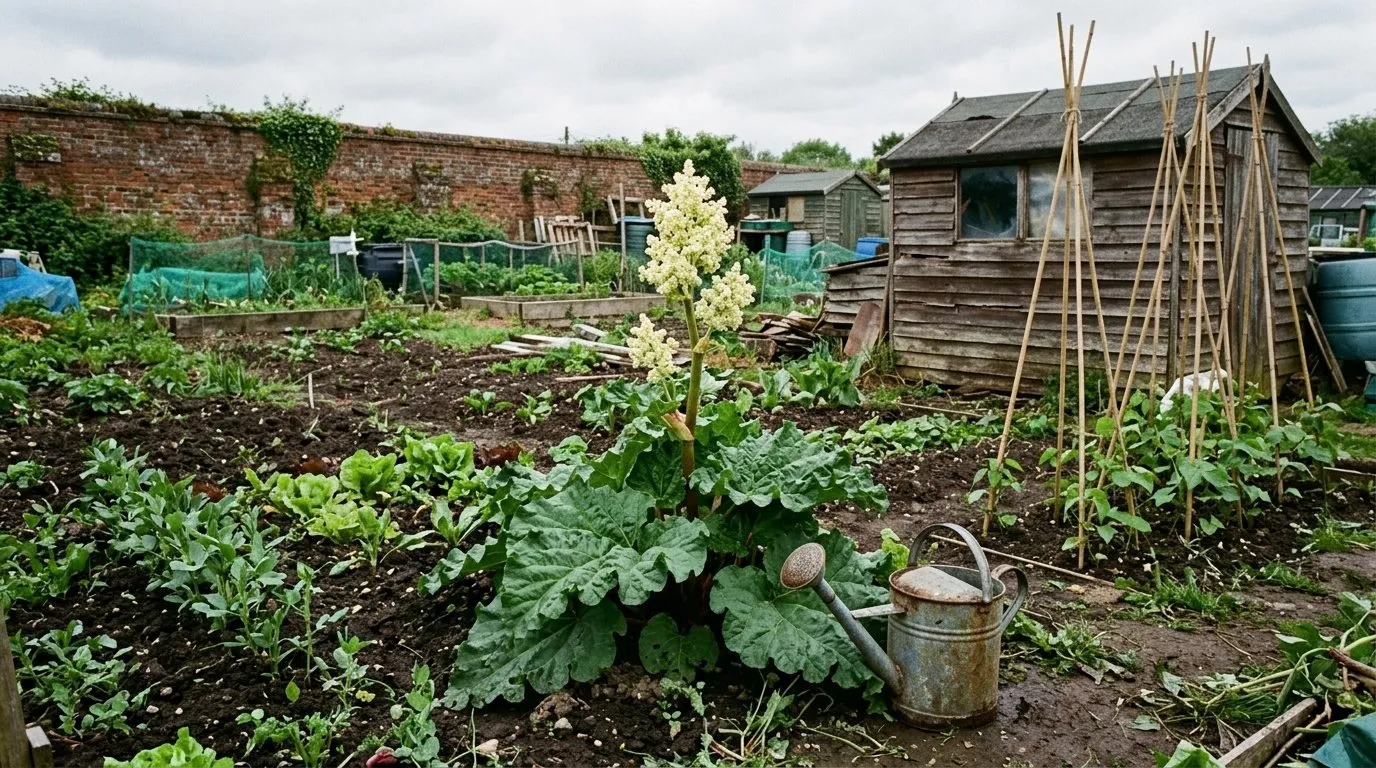 A bolting rhubarb crown. Cut the spike out at the base as low as you can reach. It is a sign of age or heat stress, not disease.
Thin, spindly stalks
Stalks under 15mm across on a mature plant mean one of two things, and neither is a disease. Either the crown is congested, or you harvested too hard last year.
The other cause is over-harvesting. Picking past the end of June strips the leaf area that recharges the roots for next spring. The stalks you take in July are borrowed from the following April.
Red or green: what stalk colour actually tells you
Stalk colour is genetic. It is not ripeness, and this misconception causes more wasted worry than any actual pathogen.
Rhubarb does not ripen. There is no stage at which a stalk turns from unready to ready. Colour comes from anthocyanin pigments determined by the variety, and to a small degree by temperature. Victoria produces green stalks flushed red at the base and will do so in perfect health for thirty years. Raspberry Red carries colour the whole way up. A green stalk from a green variety is not unripe, not unsafe, and not necessarily sharper once cooked.
If you want red stalks, the only reliable route is to plant a red variety. Waiting for a green one to turn is waiting for something that will never happen.
Warning: Rhubarb leaves contain 0.5-1.0% oxalic acid by weight and must never be eaten, by people or animals, at any point in the year. Cut them off at harvest and compost them, where the acid breaks down safely. The stalks carry only trace amounts and are safe. Frost-damaged stalks are a separate question. The common claim that frost drives oxalic acid down from the leaves into the stalks is not supported by evidence, and repeating it obscures the real reason to discard them: frost bursts the cells, and the tissue is already rotting. Judge a frosted stalk by texture. Limp or mushy goes on the compost heap. Firm is fine. If hard frosts are forecast after growth has started, our guide to protecting plants from frost covers the fleece timings.
 Rhubarb leaves stay poisonous all year, to dogs as well as people. Clear cut leaves into a barrow rather than leaving them on the path.
Rhubarb problem controls ranked by effectiveness
Not all of these are equal, and treating them as equal is why people spray leaves while the crown drowns. The table is ordered by what each method actually delivers.
| Method | Role | Effectiveness | What it cannot do |
|---|---|---|---|
| Raised 200mm grit mound at planting | Primary prevention | 1 crown lost in 11 over 10 years, against 3 in 3 planted flat | Cannot save a crown already rotting; no effect on honey fungus or virus |
| Planting depth, buds 20mm proud | Primary prevention | Removes the commonest single trigger for rot | Cannot compensate for a site that floods for weeks |
| Dividing every 5-6 years | Maintenance | Restored mean stalk diameter from 12mm to 24mm in 2 years | Cannot fix virus decline, and spreads virus if the crown is infected |
| Digging out and destroying infected crowns | Primary, once disease is present | The only real control for honey fungus and virus | Cannot save the plant; soil stays infested 3-4 years after Phytophthora |
| Slug control on emerging buds | Supplementary | Cut grazing from 12 buds in 20 to 3 in 20 under forcers | No effect on any disease |
| Autumn clearance of dead foliage | Maintenance | Cuts leaf spot carryover into spring | Cannot touch soil-borne crown rot |
| Cutting out flower spikes | Maintenance | Returns energy to stalk production the same season | Cannot fix the age or stress causing the bolting |
| Fungicide sprays | Not recommended | No amateur product is approved for rhubarb crown rot in the UK | Cannot reach a pathogen that lives below ground |
The gold standard is the first row, and it is not close. A raised grit mound with the buds set proud prevents the disease that causes most rhubarb deaths, permanently, for about £3 a plant. Everything below it is either maintenance or damage limitation. No spray on that list treats crown rot, because nothing sprayed on a leaf reaches a water mould swimming around the roots.
Month-by-month rhubarb problem calendar
| Month | What to watch for |
|---|---|
| January | Check under forcers weekly. Slugs graze blanched buds in the dark and warmth. |
| February | Lift and inspect any crown that failed last year. Rebuild the bed as a mound before replanting. |
| March | Emerging buds are at their most vulnerable to slugs. Check at dusk. |
| April | Watch for stalks collapsing at the base. Cut into a suspect crown to confirm rot. |
| May | Peak collapse month for infections that started in winter. Remove failed crowns whole. |
| June | Stop harvesting by the end of the month. Over-picking now causes next year’s thin stalks. |
| July | Flower spikes appear on older crowns in hot spells. Cut them out at the base. |
| August | Ramularia leaf spot shows after a wet fortnight. Cosmetic. Remove only the worst leaves. |
| September | Downy mildew appears in humid weather. Improve air flow rather than reaching for a spray. |
| October | Clear dead foliage to cut leaf spot carryover. Bin visibly diseased leaves. |
| November | The month that decides next year. Divide congested crowns, raise beds, add grit. |
| December | Check that no crown sits in standing water after heavy rain. Mark any that do. |
Common mistakes that kill rhubarb crowns
The short version on rhubarb problems
Rhubarb is one of the toughest plants in a UK garden, and it stays that way for a decade if you get one thing right at the start. Nearly everything that kills it comes back to water sitting around the crown in winter. The pathogens are already in your soil. The weather is not under your control. The height of the crown is.
Everything else on this page is smaller than it looks. Leaf spot and downy mildew are cosmetic. Slugs are a nuisance for six weeks a year. Bolting and thin stalks are the plant asking to be divided. Viruses are real and incurable, but rare if you buy clean stock and never propagate from a struggling plant. Honey fungus is the only other genuine killer, and it announces itself with a smell you cannot mistake.
Now you know what is actually killing rhubarb crowns, read our guide to improving clay soil for the drainage work that stops the problem returning.
Frequently asked questions
Why is my rhubarb rotting at the base?
Crown rot, caused by wet soil or a crown planted too deep. Phytophthora and Erwinia both enter the crown where water sits around the buds. Cut into the crown with a knife: healthy tissue is firm and cream coloured, rotten tissue is brown, soft and often smells sour. Fix the drainage before you replant anything.
Can rhubarb recover from crown rot?
Sometimes, if under half the crown is affected and you fix the drainage. Lift the crown in late autumn, cut away every trace of soft brown tissue with a clean knife, and replant the firm sections on a raised mound. Expect no harvest for two years. If the rot has reached the centre, dig it out and start again elsewhere.
Why is my rhubarb green instead of red?
Stalk colour is genetic, not a sign of ripeness. Rhubarb does not ripen. Victoria produces green stalks flushed red at the base and always will, while Raspberry Red carries colour through the whole stalk. A green stalk is not unripe, not unsafe and not less sweet once cooked. Choose a red variety if you want red stalks.
Why are my rhubarb stalks thin and spindly?
Usually a congested crown that needs dividing, or too much harvesting last year. After about six years the centre of a crown goes woody and stalk diameter drops sharply. Lift and divide it in November. Thin stalks can also follow a season where picking ran past June, which robs the roots of stored energy.
Should I cut the flower stalk off my rhubarb?
Yes, cut it out at the base as soon as it appears. A flower spike diverts energy from stalk production. Bolting is not a disease and does not make the stalks unsafe. It signals an older crown, a hot dry spell, or a variety like Victoria that bolts readily. Frequent bolting means the crown is due for division.
Is rhubarb safe to eat after a frost?
Discard any stalk that has gone limp or mushy; firm undamaged stalks are fine. The popular claim that frost drives oxalic acid from the leaves down into the stalks is not supported by evidence. The real reason to bin frosted stalks is simpler: the cells have burst and the tissue is already rotting. Judge by texture, not folklore.
Does rhubarb get honey fungus?
Yes, rhubarb is genuinely susceptible to honey fungus. Look for white sheets of fungal growth under the skin at the crown base, smelling strongly of mushroom, and black bootlace strands in the surrounding soil. There is no chemical control. Dig out the crown with as much root as possible and do not replant rhubarb in that spot.
Our team produces practical UK gardening guidance from source research, contributor records and established horticultural practice. Editorial standards are overseen by Matt W.