Key takeaways
- Russian vine grows 3 to 5m in a single year and can reach 12m
- It is not Japanese knotweed: heart-shaped leaves and woody stems, not hollow bamboo canes
- Foamy white to pink flower sprays appear from July to October
- Prune hard in late winter, back to a 1 to 2m framework, to keep it in bounds
- Cut-stump glyphosate in August or September gives the highest kill rate
- Dig out the whole crown; the plant regrows from stem and root fragments
Russian vine is the fastest climber most UK gardeners will ever meet. Also called mile-a-minute, Russian vine (Fallopia baldschuanica) can smother a fence, shed or tree in a couple of summers. It grows 3 to 5m in a single year and reaches 12m in time. That speed makes it either a useful screen or a serious problem, depending on where it lands. This guide covers all three jobs honestly: growing it on purpose to hide an eyesore, pruning it hard to keep it in check, and killing it off for good. It also settles the question that worries people most. No, Russian vine is not Japanese knotweed, and we will show you exactly how to tell them apart.
What Russian vine is and where it came from
Russian vine is a vigorous, woody, deciduous climber in the knotweed family, Polygonaceae. Its botanical name is Fallopia baldschuanica. You may also see it sold under the older names Bilderdykia baldschuanica or Polygonum baldschuanicum. All three point to the same plant. It comes from the mountains of Central Asia, not Russia, despite the common name.
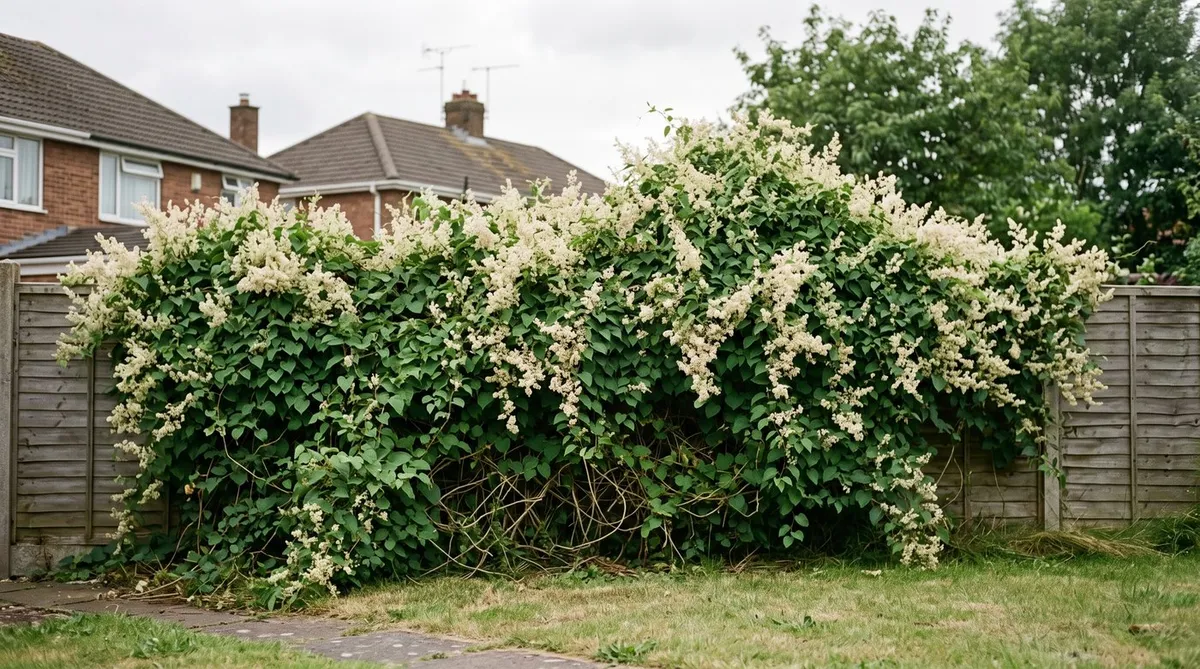
The plant climbs by twining. Thin, wiry stems wrap around any support and thicken into woody rope over the years. Older stems at the base can reach 5cm across. In late summer it throws out sprays of tiny cream to white flowers, sometimes flushed pink, held in loose foamy panicles. These cover the plant from July to October and give it a soft, frothy look that many people rather like.
A mature Russian vine is a big animal. Left unchecked it makes a mound of growth 10 to 12m across and just as tall, heavy enough to pull down a weak fence. That mass is the root of every problem people have with it.
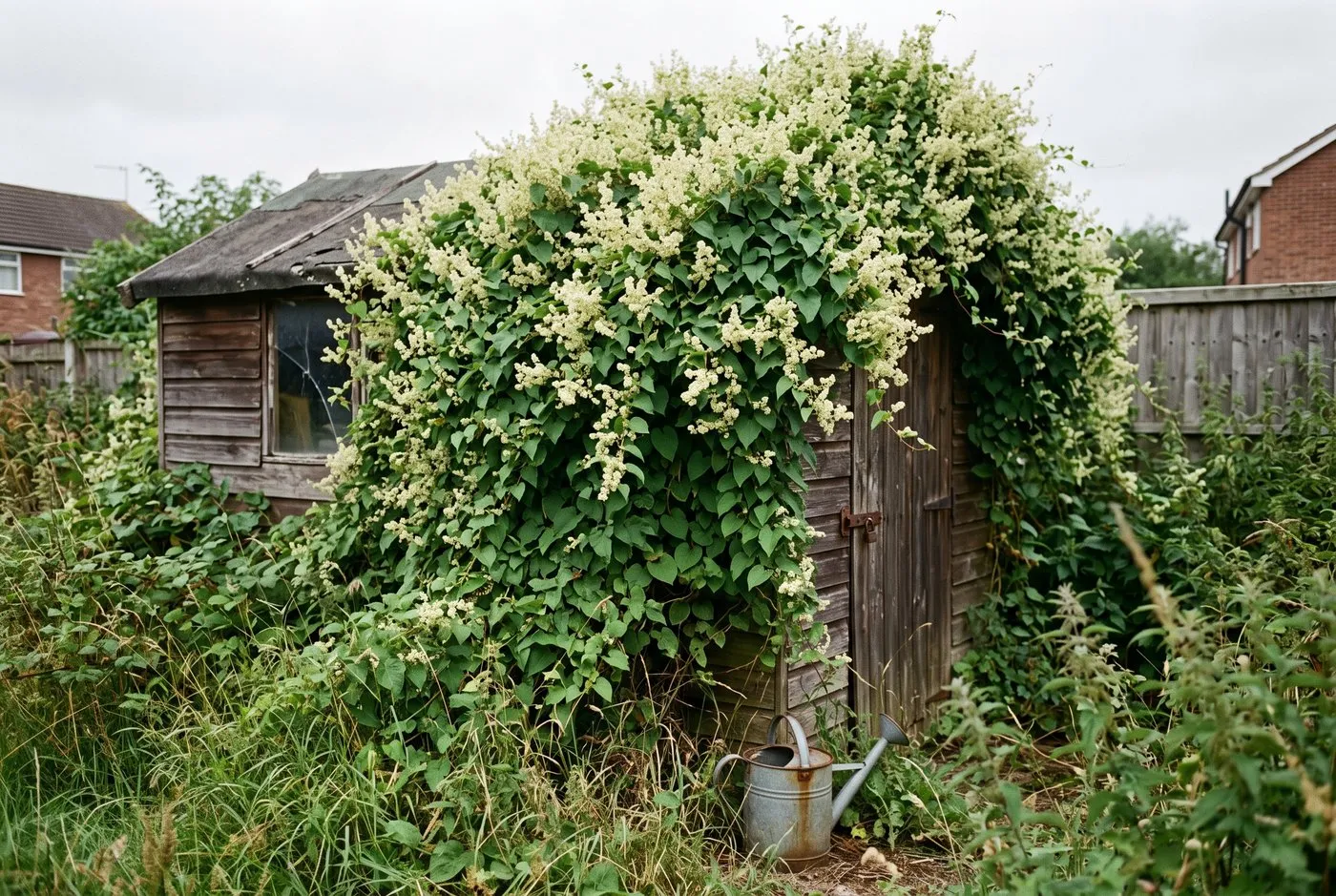 An unchecked Russian vine engulfs an old shed in a neglected corner. Two summers of free growth are enough to bury a structure this size.
Russian vine or Japanese knotweed: how to tell them apart
Russian vine is regularly confused with Japanese knotweed, and the panic that follows is usually needless. They are different plants with very different legal duties. Getting the identification right before you act saves money and worry.
The quickest test is the stem. Russian vine has woody, twining stems that wrap around supports and climb. Japanese knotweed has hollow, bamboo-like canes that stand upright in dense clumps. The leaves differ too. Russian vine leaves are heart-shaped with a pointed tip, 4 to 10cm long. Knotweed leaves are shovel or shield-shaped with a flat base, 10 to 14cm long, arranged in a zig-zag up the cane.
| Feature | Russian vine | Japanese knotweed |
|---|---|---|
| Stems | Woody, twining, wraps around supports | Hollow, bamboo-like canes, upright |
| Leaves | Heart-shaped, 4-10cm, pointed tip | Shovel or shield-shaped, flat base, 10-14cm |
| Flowers | Foamy sprays, cream-white to pink, Jul-Oct | Creamy-white tassels, upright, Aug-Sep |
| Growth habit | Climbs and smothers | Forms dense upright thickets |
| Legal status | Not scheduled; must not spread off-site | Controlled waste, strict legal duties |
If your plant is climbing and twining, it is Russian vine. For the full set of knotweed markers, including the red-speckled canes and the rhizome, read our Japanese knotweed identification guide and compare side by side before you dig.
How fast Russian vine grows: the mile-a-minute lifecycle
Understanding the growth cycle explains why Russian vine defeats so many gardeners. It is a summer-growing perennial climber that dies back a little in winter but never truly stops. The energy is stored in a woody crown and deep roots, ready to fire out again each spring.
The season runs in four clear stages:
- Spring surge (March to May). Buds break along last year’s stems as soil warms past 8C. Growth is slow at first, then accelerates once nights stay above 10C.
- Summer sprint (June to August). This is the mile-a-minute phase. Stems extend 20 to 40cm a week in warm, wet spells. A single plant can add over a metre in a month.
- Flowering and seeding (July to October). Foamy flower sprays open across the whole plant. In a hot summer some seed sets, though most UK spread is by stem and root, not seed.
- Winter dormancy (November to February). Top growth slows and old leaves drop. The crown and roots stay alive underground, holding the energy for next spring’s surge.
The critical mistake most people make is cutting Russian vine down in spring or early summer and assuming that is the end of it. It is not. A growing-season cut removes leaves but leaves the crown full of stored sugars. The plant simply resprouts, often faster and bushier than before. To beat the crown you must either starve it by repeated cutting over years, or treat it when it is moving sugars down to the roots in late summer.
Using Russian vine as fast screening
Grown on purpose, Russian vine has one real use: hiding a large, ugly structure fast. If you have a breeze-block wall, an old shed or a chain-link boundary you want gone from view, few plants cover it quicker. It earns its keep only where speed beats everything else.
Give it a sturdy support. A galvanised wire framework, a strong trellis bolted to a wall, or a heavy-duty pergola all work. Avoid feather-edge fence panels, which the weight will eventually push over. Plant it in spring in any reasonable soil, water it through the first summer, and stand back. Expect useful cover in two seasons and full cover in three.
Site it well away from gutters, roof tiles, young trees and shared boundaries. Once it reaches the top of its support, prune the leading growth every summer to stop it heading where you do not want it. For most gardens there are calmer options. Our guide to fast-growing climbers for fences and walls lists plants that give quick cover without the yearly fight. Choose Russian vine only when you have the room and the muscle to keep it in check.
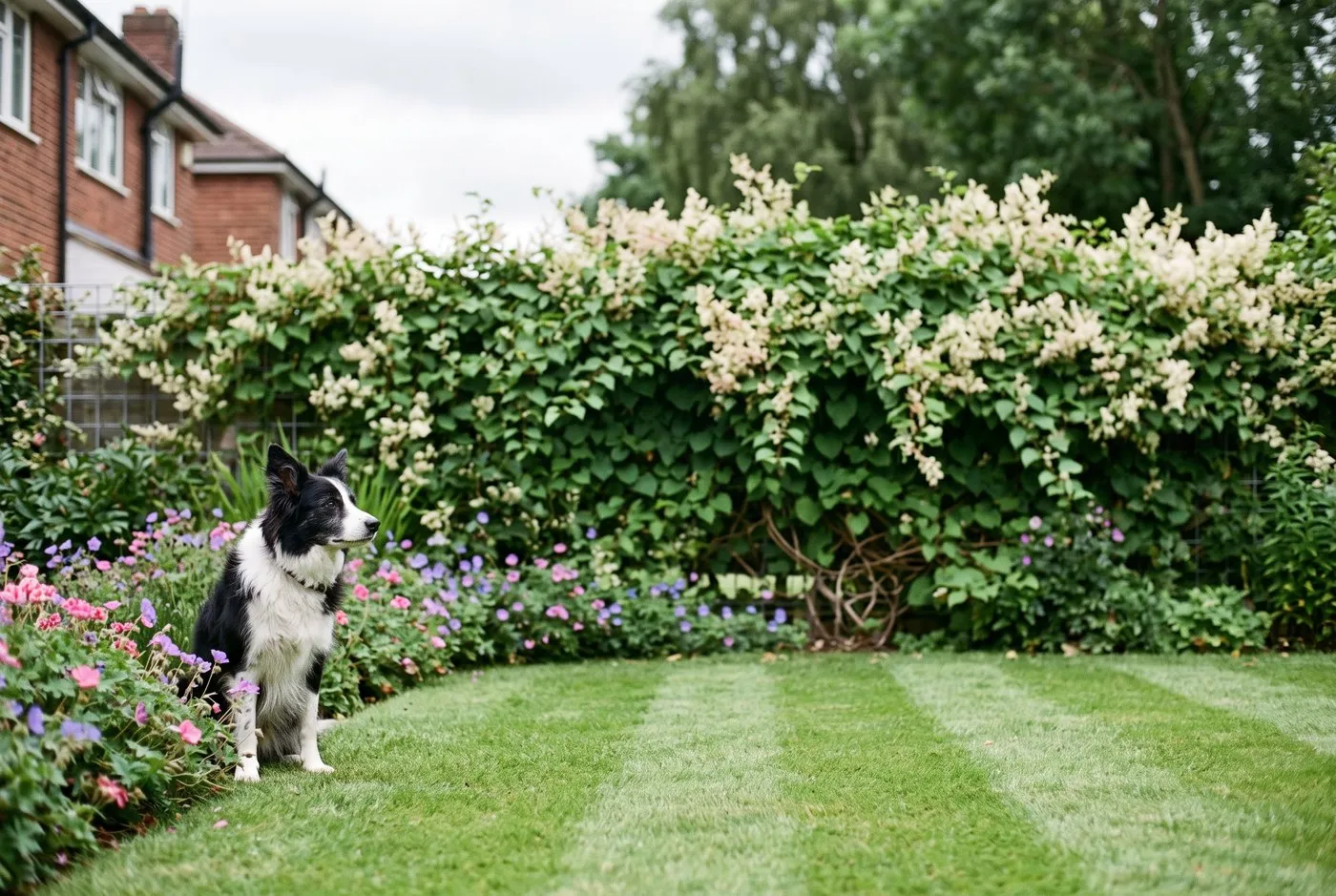 Used deliberately, Russian vine screens a plain boundary fence within two or three seasons. Site it well away from the house and give it a strong support.
How to control Russian vine with hard pruning
Keeping Russian vine is a commitment to hard, regular pruning. The plant flowers on new growth, so you can cut it back savagely each year without losing the summer show. Skip a year and it will be over the fence and into the neighbour’s garden.
Prune hard in late winter, from February to early March, before growth starts. Cut the whole plant back to a framework of strong stems 1 to 2m long. Take out dead, crossing and weak growth completely. A pruning saw handles the thick basal stems, while sharp loppers deal with the rest. Wear gloves, as the wiry stems cut into bare hands.
Through summer, give it a second, lighter tidy. Trim any growth reaching into trees, gutters or a neighbour’s plot as soon as you see it. This is where most people fall behind, because the growth is so fast in June and July. Treat this as an annual job, not an occasional one. If that sounds like more than you want, the plant is in the wrong place, and removal is the better answer. Russian vine sits firmly among the garden thugs that take over UK plots for exactly this reason.
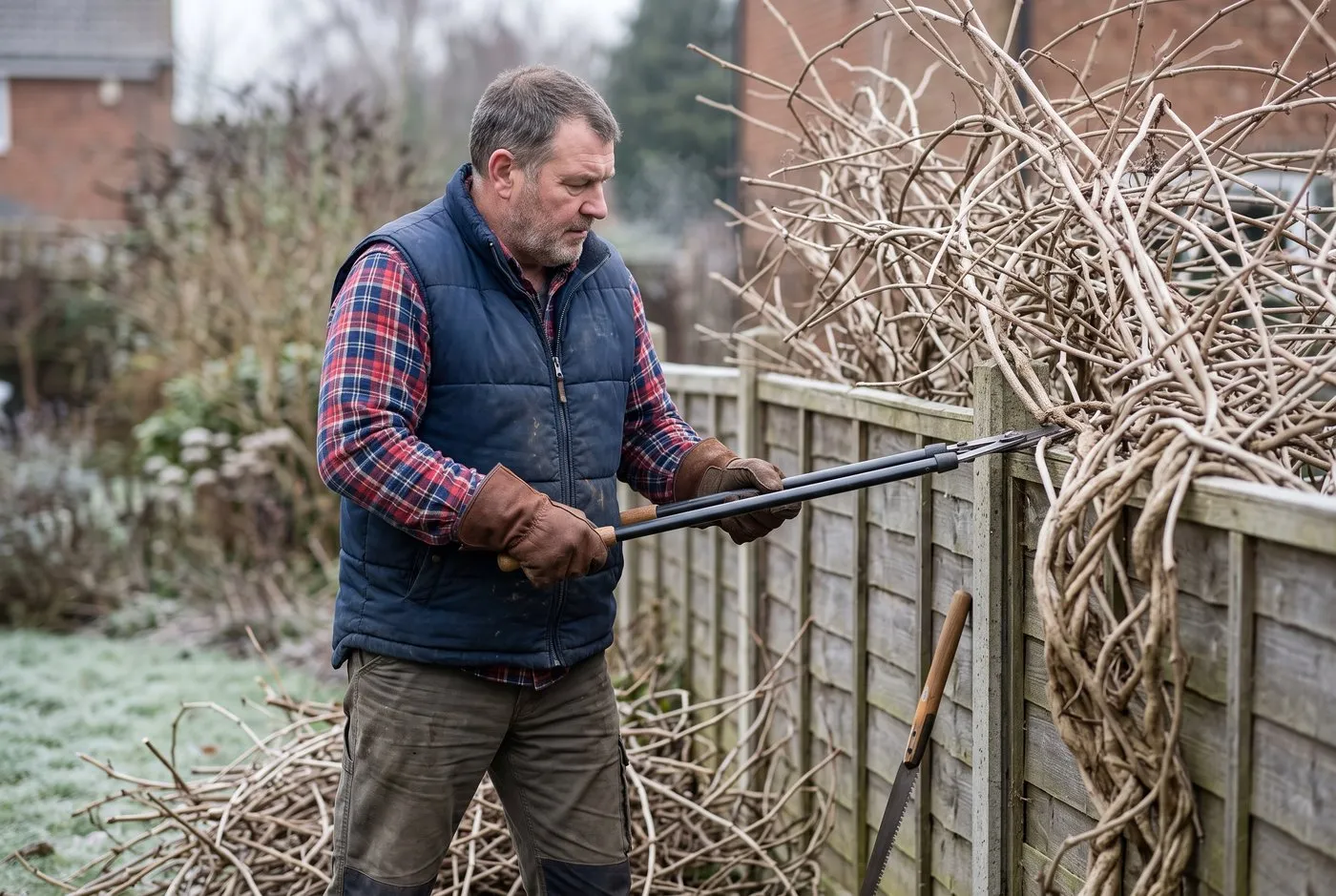 Hard late-winter pruning keeps Russian vine in bounds. Cut back to a framework of stems 1 to 2m long, using a saw on the thick basal wood.
Getting rid of Russian vine for good
The order of work is simple. Cut the bulk of the top growth away first so you can see what you are dealing with. Then attack the crown, because the crown is what regrows. How you attack it depends on the size of the plant and whether you will use chemicals.
| Method | Effectiveness | Reliability | Best use / role |
|---|---|---|---|
| Cut-stump glyphosate, late summer | 80-90% kill per treatment | High, if timed right | Primary kill on established plants |
| Full crown excavation | 90%+ if all crown removed | High, but hard labour | Primary kill on small to medium plants |
| Repeat cutting to the ground | 40-60% over 2-3 years | Moderate, needs persistence | Chemical-free slow starve |
| Foliar glyphosate on regrowth | 60-75% per season | Moderate, weather-dependent | Follow-up on resprouts |
| Smothering with membrane | 30-50% | Low on vigorous crowns | Supplementary only |
The gold-standard approach on an established plant is a cut-stump glyphosate treatment in late summer, followed by digging out the dead crown the next year. Cutting alone almost never works, because the crown holds too much stored energy. Digging alone works on small plants but is brutal labour on a big one, and any fragment left behind resprouts. If you would rather avoid glyphosate entirely, repeat cutting and crown excavation are your route, backed by patience. Our guide to organic weedkillers in the UK covers the contact treatments that scorch regrowth, though none kill a woody crown outright.
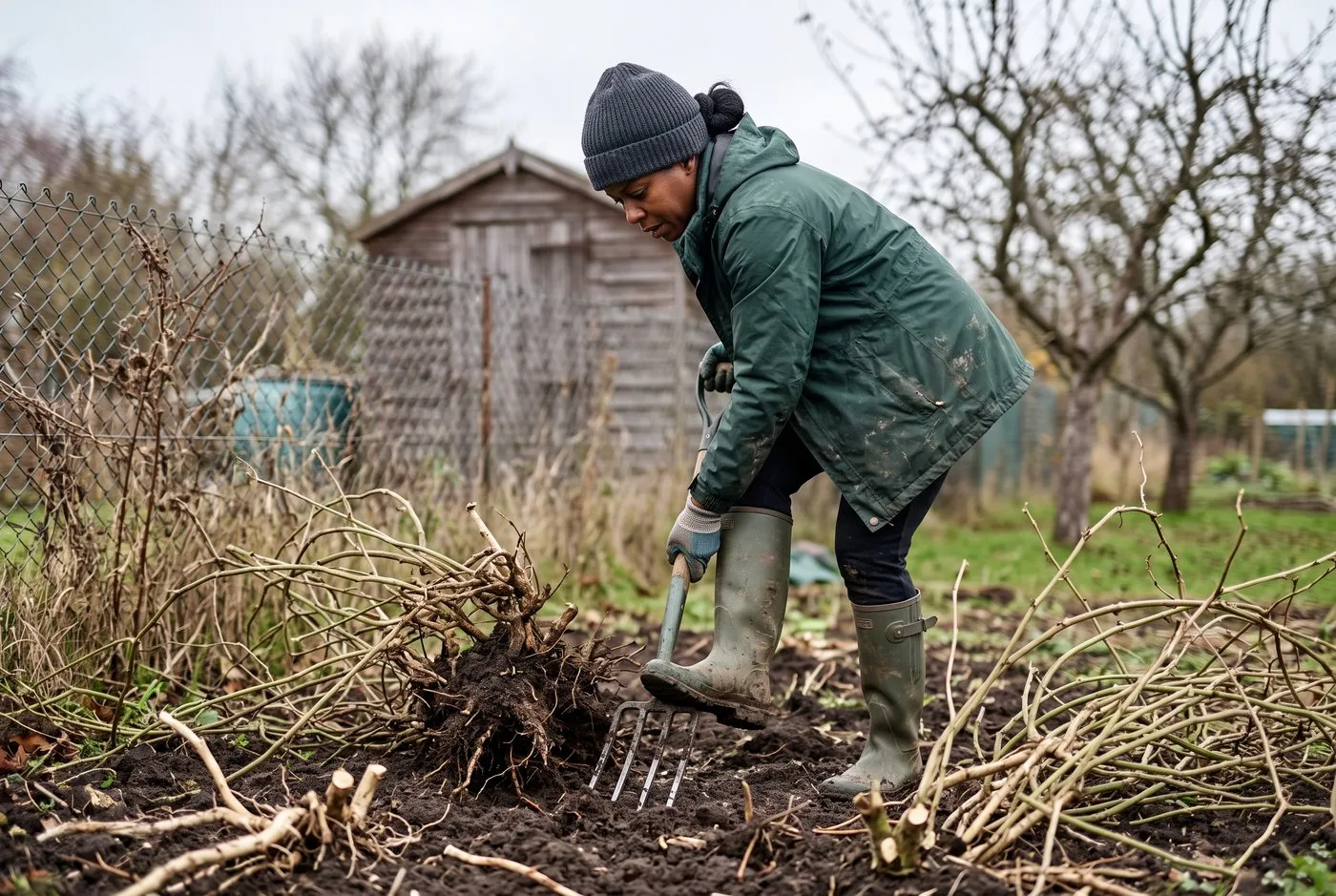 Excavating the crown kills Russian vine outright on small to medium plants. Follow the main roots down and lift every woody fragment you can reach.
Cut-stump treatment step by step
Cut-stump treatment is the most reliable kill for a large Russian vine. Timing is everything, so do not rush it in spring.
- Wait for late summer, August or September, when the plant is moving sugars down to the roots.
- Cut each main stem low, no more than 5cm above the crown, with a clean saw cut.
- Within 30 seconds, paint undiluted glyphosate gel across the whole cut surface, especially the outer ring where the living tissue sits.
- Leave the crown in place over winter so the chemical can travel down into the roots.
- The following autumn, dig out the dead crown and check for any live regrowth.
Treat every cut stem, not just the biggest. A single missed stem keeps the whole crown alive.
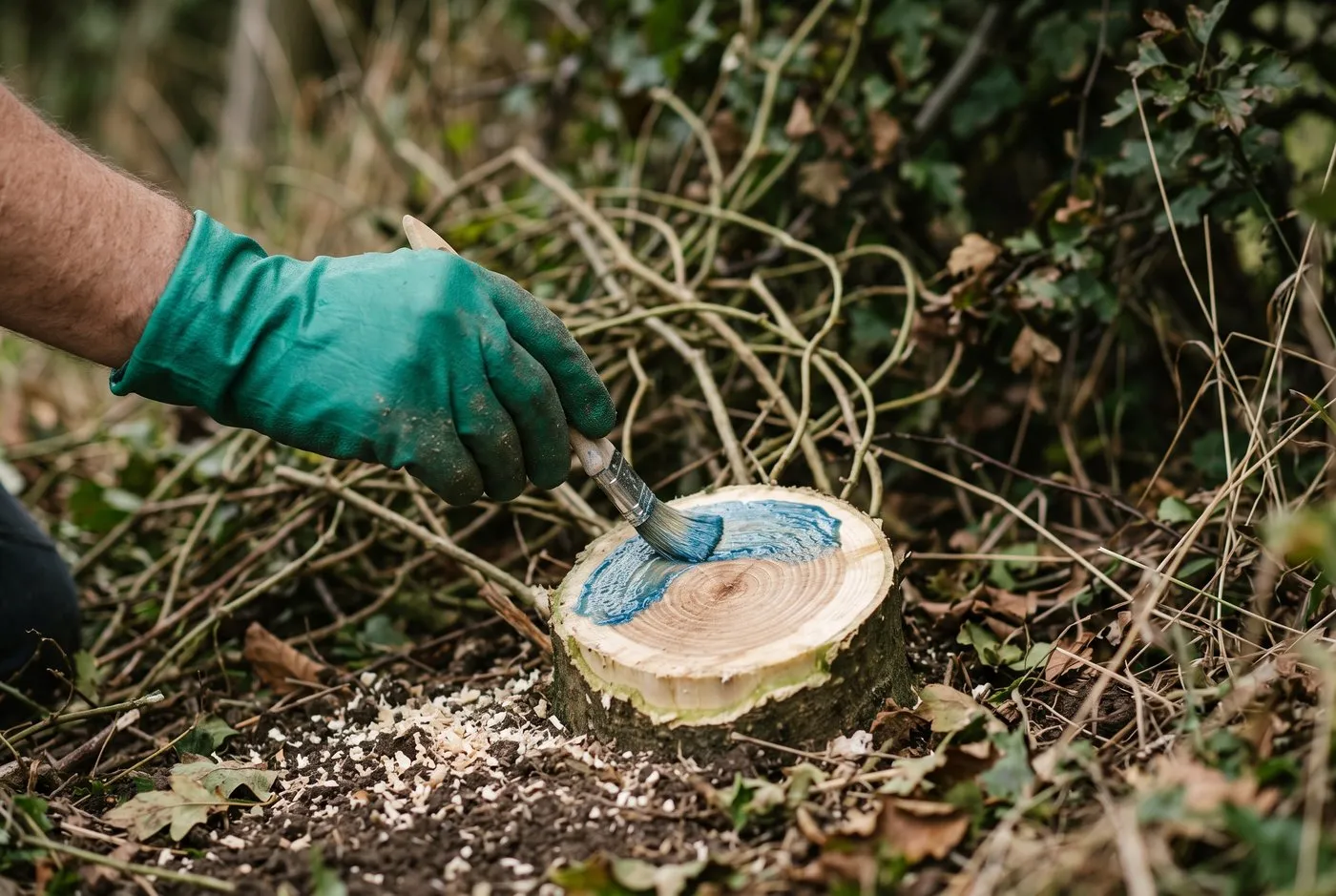 The cut-stump method: saw the stem low, then paint gel across the fresh cut within 30 seconds. The plant carries the chemical down to the roots.
Digging out the crown
On small to medium plants, excavation kills Russian vine outright and needs no chemicals. Cut the top growth back to knee height first. Then dig a trench around the crown with a strong fork, loosening the soil 30 to 40cm down. Lever the whole woody crown out, following the main roots and lifting every piece you can reach.
Sieve the loosened soil for root fragments before you backfill. On our sandy loam a medium crown took about 90 minutes to lift cleanly. On heavy clay it is harder and slower going. The effort is worth it, because a crown left in the ground is a Russian vine that comes straight back.
Why Russian vine keeps coming back
The reason Russian vine keeps returning is almost always the crown. People treat the symptom, the wild top growth, and ignore the cause, the woody root mass storing years of energy underground. Cut the top off and the crown simply pushes new shoots, drawing on stored sugars.
The crown of an established plant is a dense, woody knuckle at soil level, often 20 to 40cm across. Below it, thick roots run deep and wide. Even a thumb-sized fragment of crown or root left in the soil can grow into a new plant. That is why quick fixes fail.
Permanent prevention comes down to removing or killing the crown, then staying alert:
- On small plants, dig the whole crown out, following the roots and lifting every woody piece.
- On large plants, kill the crown first with a late-summer cut-stump treatment, then excavate the dead mass the next year.
- After clearing, check the ground every few weeks through the following summer, and pull or spot-treat any resprout while it is small.
This is the same fragment-chasing discipline that beats bindweed and brambles, where a single piece left behind restarts the whole problem. Sieving the soil around an old crown is dull work, but it is what makes the difference between a kill and a two-year battle.
 Regrowth from an untreated cut stump, six weeks after cutting. The crown holds enough energy to resprout hard, which is why the crown must be killed or removed.
The gel format is what makes this method safe to use near other plants. A spray drifts, but a gel stays exactly where you paint it. For UK guidance on identifying and managing invasive climbers, the RHS advice on Russian vine backs the same late-summer approach. Gardeners who prefer to stay chemical-free will find the no-dig and mulching principles at Garden Organic useful for the slow-starve route.
Month-by-month Russian vine calendar
| Month | Task |
|---|---|
| January | Plan the year. Order glyphosate gel and check loppers and a pruning saw are sharp. |
| February | Prune hard for control. Cut the plant back to a 1 to 2m framework before growth starts. |
| March | Buds break. Finish any winter pruning now. Clear and bag last year’s fallen stems. |
| April | Growth speeds up. Watch for resprouts on cleared ground and pull them while small. |
| May | Tie in wanted screening growth. Spot-treat unwanted resprouts with foliar glyphosate. |
| June | The sprint begins. Trim screening plants to shape. Keep growth off gutters and tiles. |
| July | Flowering starts. Cut back any growth heading into trees or a neighbour’s garden. |
| August | Prime cut-stump month. Cut unwanted crowns low and treat within 30 seconds with gel. |
| September | Continue cut-stump treatment while sap still runs down. Foliar-spray leafy regrowth. |
| October | Flowering fades. Mark where treated crowns sit so you can dig them out next year. |
| November | Top growth dies back. Excavate dead crowns from last summer’s treatments. |
| December | Dormant season. Bag or burn cut stems. Never compost live material. |
Common mistakes when tackling Russian vine
- Cutting in spring and walking away. Growing-season cuts just trigger bushier regrowth from the crown. Cut hard in late winter to control the plant, and treat the crown in late summer to kill it.
- Planting it near the house or small fences. Russian vine belongs on big, sturdy structures. On a standard 1.8m panel fence it becomes a yearly wrestle and can push the panels over.
- Getting the weedkiller timing wrong. Glyphosate works best when the plant moves sugars to the roots in late summer. Spring and early summer applications kill the top but often spare the crown.
- Composting live stems. Russian vine stems can root where they touch damp ground. Bag and bin them, or burn them, rather than composting live material.
- Confusing it with Japanese knotweed and panicking. They are different plants with different legal duties. Identify the plant first, then act on the right advice.
Warning: Check the plant is Russian vine and not Japanese knotweed before you dig or move any soil. Japanese knotweed carries legal duties under the Wildlife and Countryside Act 1981 and the Environmental Protection Act 1990, and spreading it can bring prosecution. If in any doubt, identify it properly before touching it.
Frequently asked questions
Is Russian vine the same as Japanese knotweed?
No, Russian vine is not Japanese knotweed. Russian vine is a woody twining climber with heart-shaped leaves. Japanese knotweed grows as hollow, bamboo-like canes with shovel-shaped leaves. Russian vine is not covered by the same legislation, but you must still stop it spreading onto neighbouring land.
How fast does Russian vine grow?
Russian vine grows 3 to 5m in one season and reaches 12m in time. In a warm summer a single plant can add over a metre of stem in a month. This speed earned it the name mile-a-minute. Hard annual pruning is the only way to keep it in bounds.
Will glyphosate kill Russian vine?
Yes, glyphosate kills Russian vine, but timing matters. Apply it in late summer as a cut-stump treatment, painting the fresh cut within 30 seconds. Spraying leafy regrowth in autumn also works. Expect to repeat the treatment once, as the crown often survives a single hit.
How do I get rid of Russian vine permanently?
Cut the top growth, then dig out the entire woody crown and main roots. Any fragment left behind can resprout. On large plants, cut-stump treat with glyphosate in late summer first, then dig out the dead crown the following year. Two seasons of persistence is usually needed.
When should I prune Russian vine?
Prune Russian vine hard in late winter, from February to early March. Cut the whole plant back to a framework of stems 1 to 2m long. It flowers on new growth, so hard pruning does not lose you flowers. Add a lighter summer tidy if it outgrows its space.
Should I grow Russian vine at all?
Only grow Russian vine to hide a large, ugly structure fast. It covers an eyesore in two to three seasons. Give it a sturdy support, well away from gutters, trees and neighbours. On a small fence it becomes a yearly battle you rarely win.
Is Russian vine poisonous to dogs or children?
Russian vine is not considered poisonous to dogs, cats or children. It carries no serious toxicity warning in UK guidance. The main risk is the sheer weight of growth pulling down fences and trellis. Keep pets off cut stems treated with weedkiller until the gel is dry.
Our team produces practical UK gardening guidance from source research, contributor records and established horticultural practice. Editorial standards are overseen by Matt W.