Key takeaways
- Feng shui uses five elements and a nine-square bagua grid mapped from your back door across the plot
- Curved paths slow chi and feel calmer; a straight path from gate to door creates a fast rushing line
- Place still or moving water near the front or entrance, never directly behind your main seat
- Aim for roughly 60 percent planting to 40 percent hard surfacing for yin and yang balance
- Round off or screen sharp corners and fence ends that point at a seat to soften poison arrows
- Dead plants, broken pots and clutter stall energy, so 20 minutes of tidying resets a small garden
Feng shui garden design arranges an outdoor space so energy moves gently and the five elements stay in balance. The practice is centuries old, but feng shui garden design translates surprisingly well to a UK plot when you treat it as a practical layout tool rather than mysticism. It guides where paths curve, where water sits, how much planting balances hard surfacing, and where a focal point belongs.
This guide applies the system specifically to British gardens. It covers the five elements with hardy UK plants and native materials for each, the bagua energy map laid over a real plot, why curved paths beat straight ones, front garden flow, colour placement, water rules, yin and yang balance, focal points, and the decluttering that keeps energy moving. Every example is grounded in UK climate, plants and house types.
The five elements and UK plants for each
Feng shui works with five elements: wood, fire, earth, metal and water. A balanced garden contains all five, expressed through planting, colour and materials. In a UK garden you do not need imported features. Native plants and ordinary building materials cover every element.
Wood is growth and upward energy. It shows in tall plants, green colours and timber. Use silver birch (Betula pendula), bamboo such as Fargesia murielae, climbing hydrangea up a fence, and oak or larch sleepers. Wood is the easiest element to overdo in a leafy British garden.
Fire is warmth and activity, shown in reds, oranges, pointed leaves and light. Crocosmia ‘Lucifer’, red hot poker (Kniphofia), Japanese maple in autumn, and a fire pit or solar lantern all carry fire. Place it at the rear centre of the plot.
Earth is stability, in yellows, browns, low mounds and clay. Terracotta pots, lavender (Lavandula angustifolia ‘Hidcote’), sedum and a flat stone seat anchor a garden. Earth suits the centre and the corners.
Metal is clarity and precision, in whites, greys, rounded shapes and stone. White roses, silver-leaved artemisia, pale gravel, steel planters and a round bird bath all read as metal.
Water is flow and reflection, in blacks, deep blues and curving forms. A still bowl, a bubbling rock or a small pond carries it. Black ophiopogon grass and dark iris reinforce the water element near a real water feature.
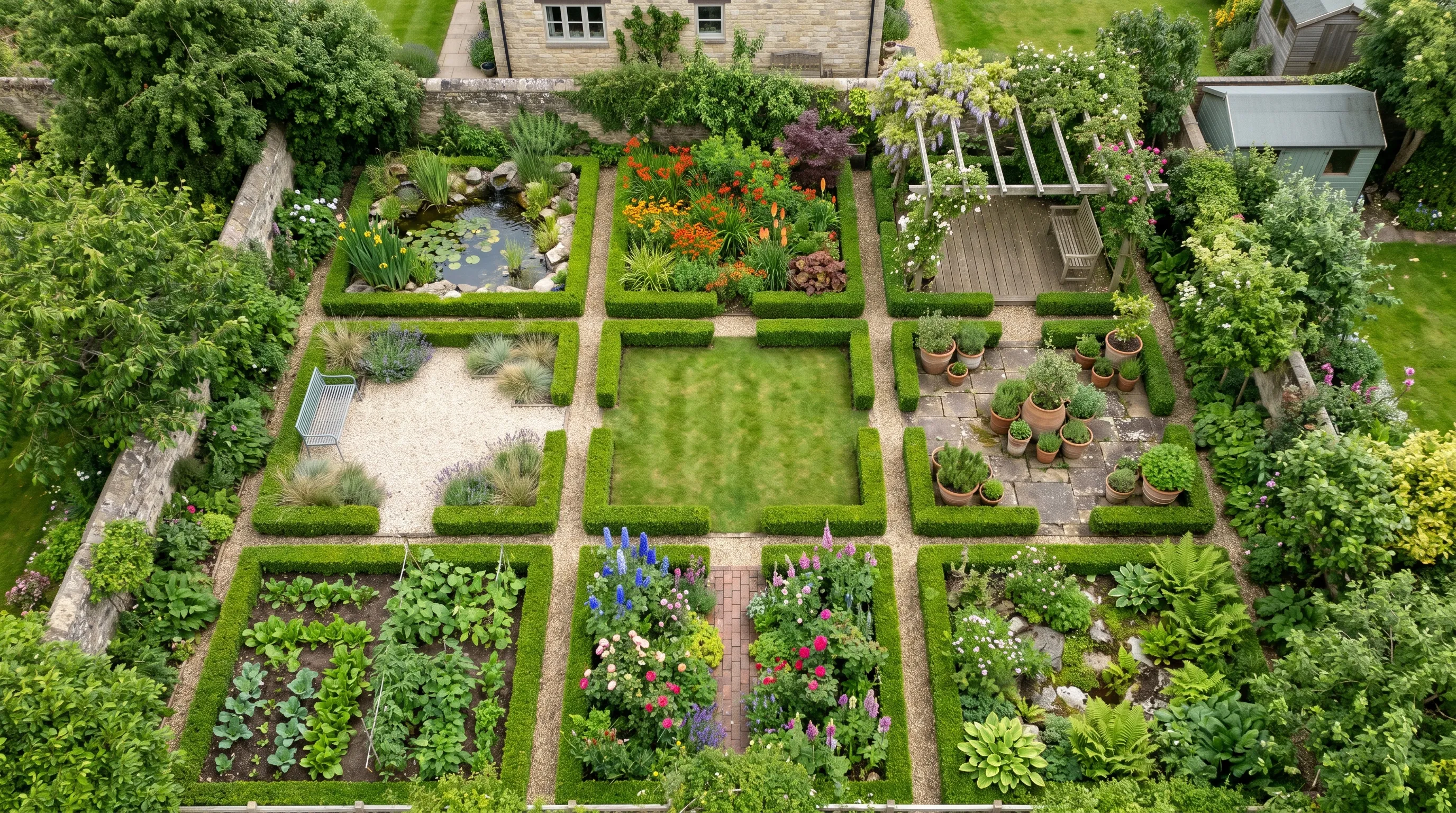 The bagua works as a nine-square grid laid over the plot. Each square carries its own element, colour and planting, here separated by low box hedging.
How to read the bagua energy map across a garden
The bagua is a nine-square grid you lay over the garden plan. Each square maps to a life area, a compass direction and an element. You orient it from the back door, which feng shui treats as the mouth of energy for the rear garden. Stand at the door looking out, then divide the plot into a three by three grid.
The three squares nearest you are the career zone (centre, water element), with knowledge to your left and helpful people to your right. The middle row holds family (left, wood), the health centre (earth), and children and creativity (right, metal). The far row, the back of the garden, holds wealth (far left, wood and purple tones), fame (far centre, fire and reds), and relationships (far right, earth and pinks).
Why chi flows better along curved paths than straight lines
Chi is the term for energy or flow, and how it moves decides how a garden feels. The core rule is simple. Energy should wander, not rush. A straight path from gate to door, or from door to back fence, creates a fast channelling line. Feng shui calls a hard straight line aimed at a door or seat a poison arrow. It hurries people through and the garden never gets used. The same thinking shapes Chinese garden design, where winding paths and framed views slow the visitor down.
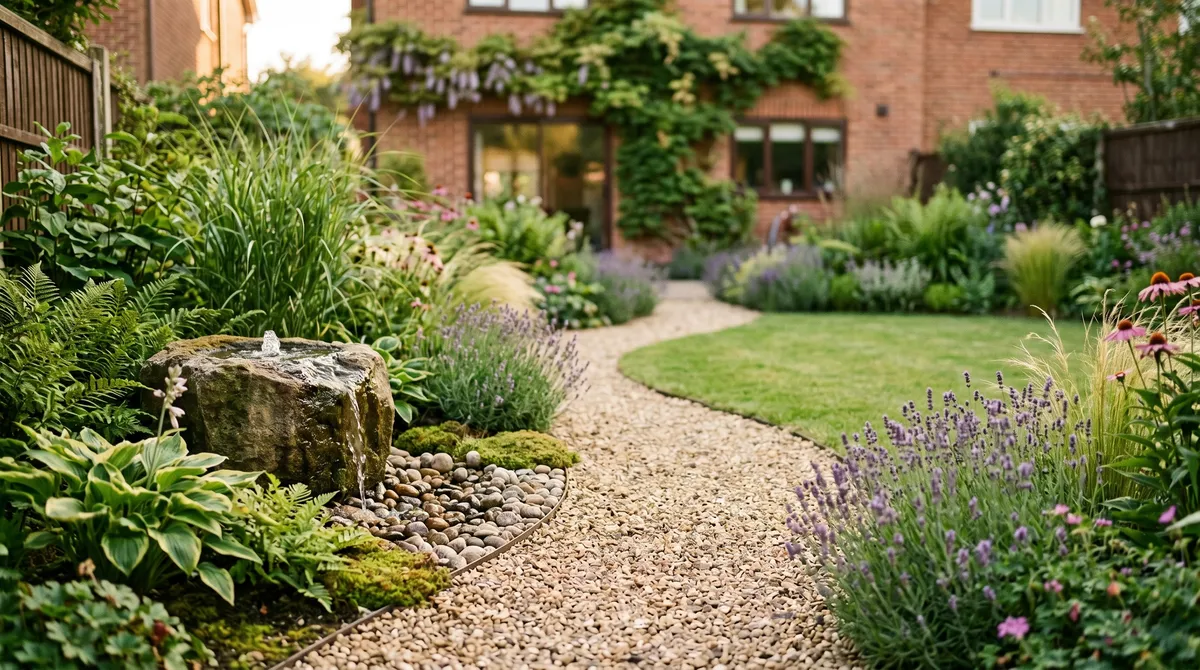
A curved path slows everything down. A gentle meander of around 600 to 900mm width invites a pause. It hides part of the garden behind each bend, so the space reveals itself gradually and feels larger. This is the single most effective change you can make. A buff self-binding gravel or a brick path laid in a soft S curve transforms a thoroughfare into somewhere to linger.
Front garden feng shui and the mouth of chi
The front door is the mouth of chi, the main point where energy enters the home and garden. A welcoming, well-kept front approach matters more in feng shui than almost anything at the back. The door should be clearly visible from the street, well lit, and reached by a path that does not run dead straight at it.
Start with the approach. If a path runs straight from the pavement to a Victorian terrace door, soften it. Add a curve, or break the line with a pair of pots, clipped bay or box balls either side of the door. This slows the rushing energy and frames the entrance. A clean, freshly painted door in a strong colour, deep blue or green for many UK homes, signals a cared-for entrance.
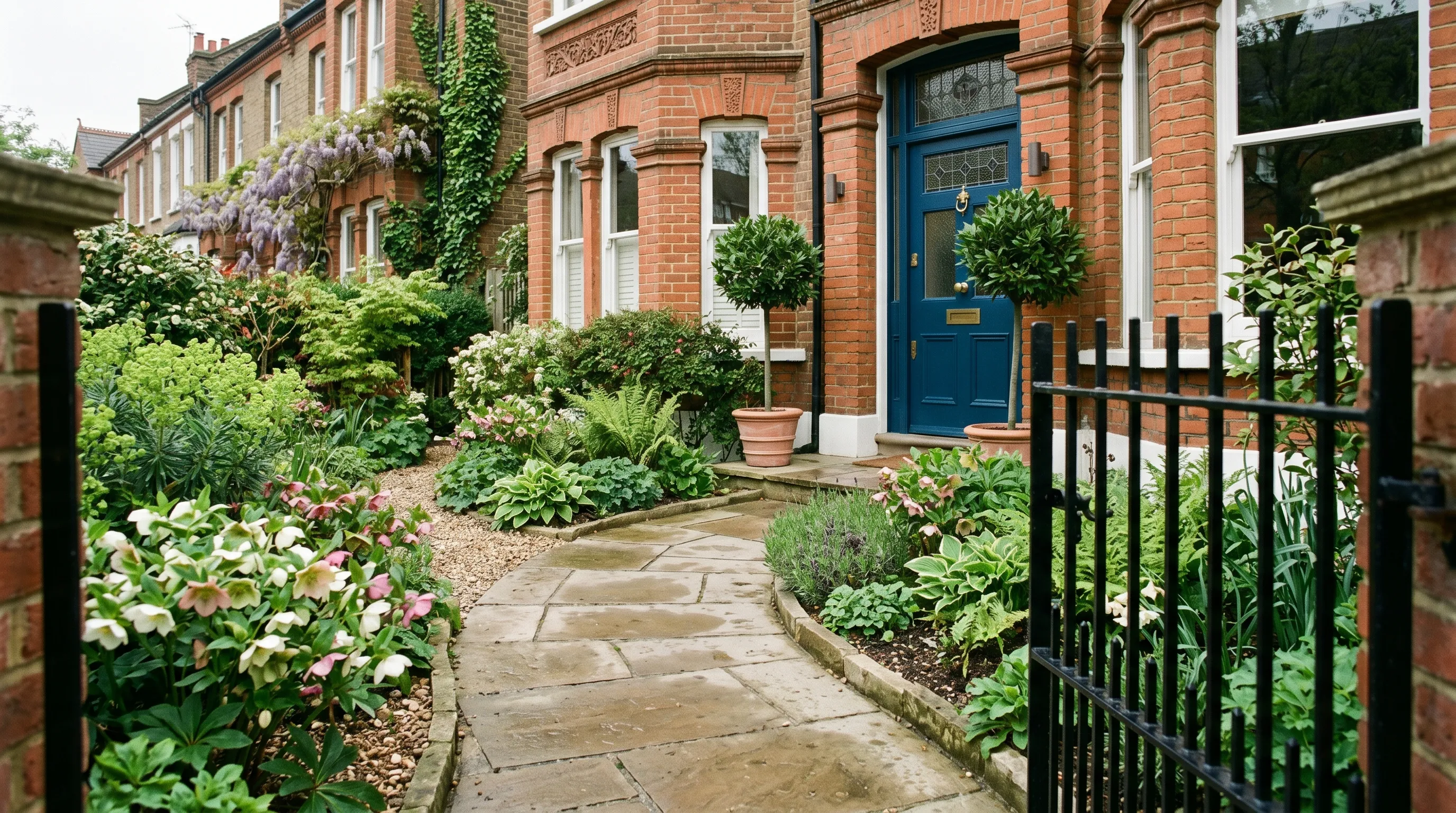 The front door is the mouth of chi. A curving approach, clipped bay either side and a freshly painted door make the entrance feel cared for.
Best feng shui colours and where to use them
Each element carries colours, and you place them by bagua zone. Used well, colour is the quickest way to balance a garden without rebuilding it. You match the colour to the zone and the element it belongs to.
Greens and soft blues are wood, and they suit the family zone on the left and the wealth corner at the far left. They are also the safe default across most of a British garden. Reds and oranges are fire, placed at the far centre fame zone. Crocosmia ‘Lucifer’, dahlia ‘Bishop of Llandaff’ and red pelargoniums concentrate fire energy where it belongs.
Yellows and browns are earth, for the centre and the relationship corner at the far right, where soft pinks also sit. Achillea ‘Terracotta’ and rudbeckia cover this. Whites and greys are metal, for the right-hand children and helpful-people zones. White roses, silver santolina and pale gravel read as metal. Blacks and deep blues are water, kept near actual water or the front career zone.
Water feature placement and when water is wrong
Water in feng shui means wealth and flow, but placement decides whether it helps. Moving water near the front garden or in the wealth zone, the far left of the rear plot, is considered fortunate. Still water reflects the sky and doubles light, which suits a calm centre.
The clearest rule is about your main seat. Never place water directly behind where you sit. Feng shui calls a solid backing behind a seat the command position. You want a wall, fence or hedge at your back, giving a sense of support and a clear view out. Water behind the seat removes that solid backing and feels unsettling. Put the bench against the hedge and the water in front of it, in view.
Gardener’s tip: Set any new water feature 1.5 to 2 metres from your back door so you hear it the moment you step outside. Sound arriving before you have even sat down is what makes water feel calming rather than decorative.
Balancing yin and yang in planting and hard surfacing
Yin and yang is the balance of opposites: soft and hard, shaded and sunny, still and active. A garden that is all paving feels harsh and yang. A garden that is all dense planting feels heavy and yin. The aim is a working balance between the two.
A practical UK target is roughly 60 percent soft planting to 40 percent hard surfacing. Soft, yin elements are lawn, borders, ferns, hostas and moving grasses. Hard, yang elements are paving, gravel, walls, decking and large still features. Most new-build gardens lean too far into yang, with a large patio and thin borders. Adding deeper planting beds rebalances them.
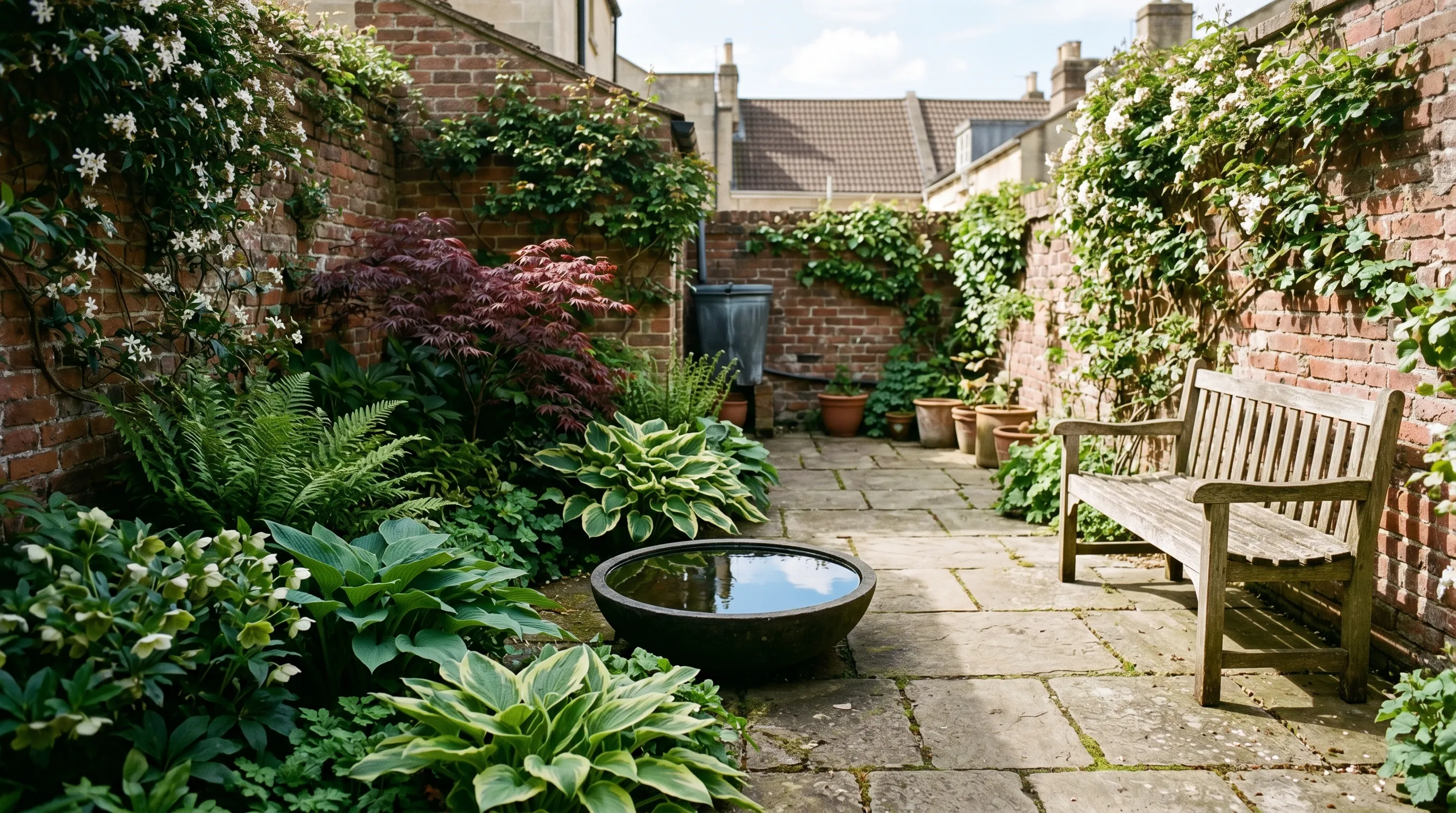 Yin and yang in a city courtyard: soft shaded planting on one side, an open sunlit terrace on the other, with a still water bowl linking them.
Focal points, statuary and garden ornaments
A focal point gives energy somewhere to settle. Without one, the eye wanders and the garden feels unresolved. A focal point sits at the end of a sightline, the turn of a path or the centre of a view from the house. It can be a specimen tree, a large pot, a bench, a water feature or a statue.
Statuary carries meaning in feng shui. A calm seated figure, a pair of stone spheres or a smooth round form suits a place for rest and reflection. Sharp, aggressive or jagged ornaments work against the calm a feng shui garden aims for. Scale matters too. One well-placed piece reads as a focal point. A scatter of small ornaments reads as clutter and stalls the eye.
For garden ornaments and statues, choose materials that suit the zone: pale stone and metal forms for the metal zones on the right, weathered bronze or terracotta for the earth corners. Place a single strong piece where the path turns or the border ends, framed by planting so it is revealed rather than dumped on a lawn.
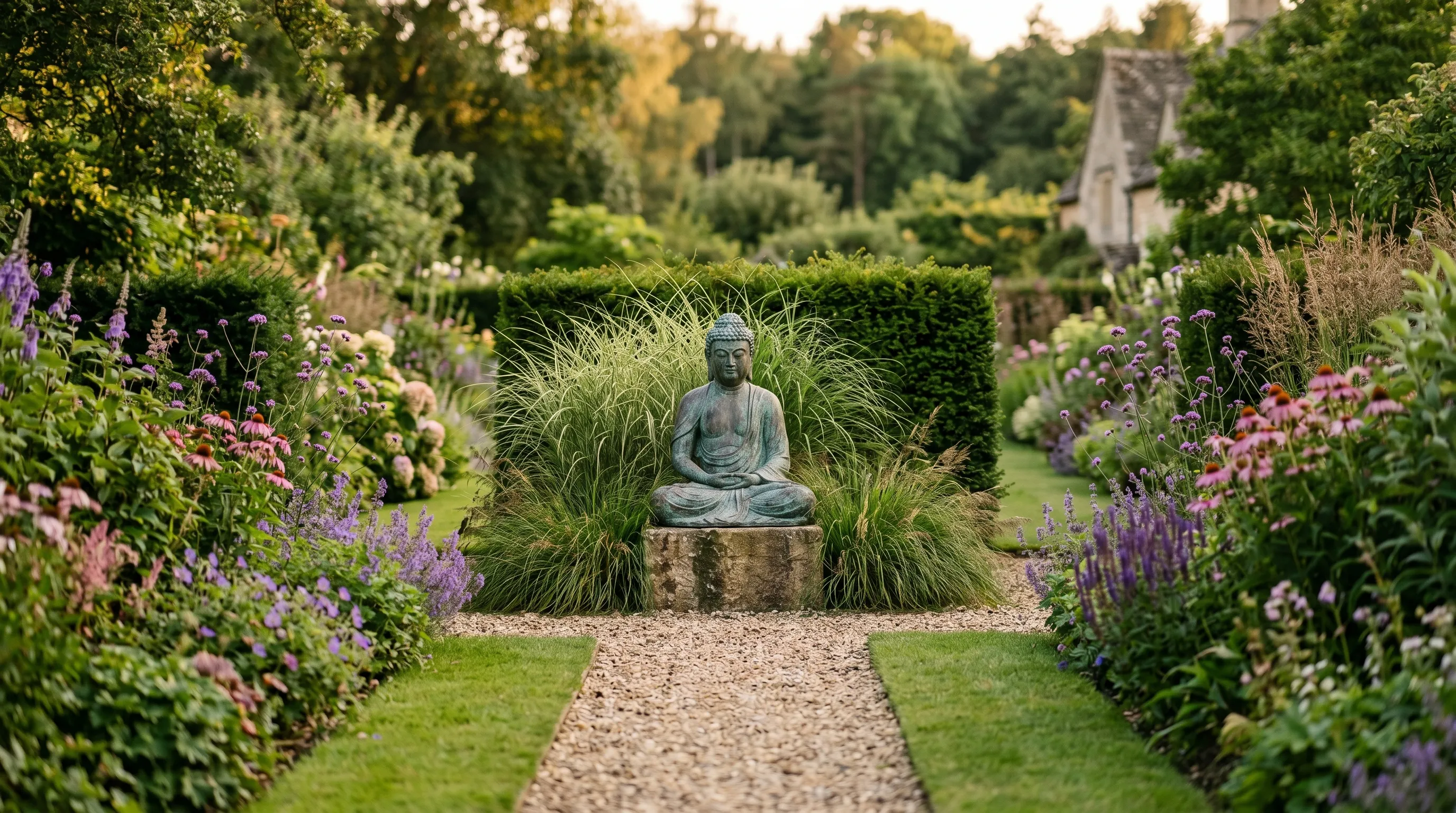 A single calm focal point at the end of a border, framed by grasses and clipped yew, gives the eye somewhere to rest.
Decluttering and maintenance as energy management
Clutter stalls energy, and dead growth holds it back. This is the part of feng shui that needs no belief at all. A garden full of broken pots, snapped canes, dead plants and a jammed gate feels stuck because it is. Clearing it changes the feel within an hour.
Dead and dying plants are the priority. A border full of collapsed perennials or a pot of dead lavender drains the energy of its whole zone. Cut back, compost the waste, and the area lifts. Broken tools, split bags of compost and a tangle of hose are the same. They are stuck energy in physical form. Keep maintenance tools tidy and the shed, often in the wealth corner, in order.
Twenty minutes of focused tidying resets a small garden. Pull weeds from the path joints, sweep the patio, deadhead, and bin anything broken. Keeping paths clear matters most, because they are the channels energy moves along. A path half blocked by an overgrown shrub chokes the flow. Regular light upkeep beats an occasional heavy blitz.
How to apply feng shui to a UK garden step by step
You do not need to rebuild anything to start. Work through these steps in order, and each one shifts the feel of the space.
- Map the bagua. Stand at your back door, look out, and divide the garden into a three by three grid. Note which zone holds your seat, shed, compost and any dead corner.
- Curve any straight path. Reroute a rushing straight line into a gentle S. Even repositioning stepping stones to wander breaks the poison arrow.
- Fix your seat. Move the main bench so a wall, fence or hedge sits behind it. That is the command position, with a clear view out.
- Place water correctly. Set still or moving water near the front, the entrance or the wealth corner, and never directly behind the seat.
- Balance the elements. Check all five appear: green planting (wood), a red or orange plant (fire), terracotta or stone (earth), pale gravel or white flowers (metal), a water bowl (water).
- Soften sharp corners. Screen or round off fence ends, sharp wall corners and shed edges that point at a seat. A pot, a shrub or a curved bed deflects the line.
- Add one focal point. Place a single statue, specimen tree or large pot where a sightline ends or a path turns.
- Declutter. Clear dead plants, broken pots and blocked paths. This is the fastest single improvement.
Element, direction and material reference table
This table pulls the system together. Use it to match plants, colours and materials to each element and bagua zone in a UK garden.
| Element | Bagua zone / direction | Colours | UK materials | UK plants |
|---|---|---|---|---|
| Wood | Family and wealth, left side | Green, blue, purple | Oak sleepers, larch trellis, living willow | Silver birch, Fargesia bamboo, climbing hydrangea |
| Fire | Fame, far centre | Red, orange | Fire pit, solar lantern, red brick | Crocosmia ‘Lucifer’, Kniphofia, dahlia ‘Bishop of Llandaff’ |
| Earth | Centre and corners | Yellow, brown, terracotta | Terracotta pots, sandstone, clay | Lavender ‘Hidcote’, sedum, achillea ‘Terracotta’ |
| Metal | Children and helpful people, right | White, grey, silver | Pale gravel, steel planters, slate | White rose, santolina, silver artemisia |
| Water | Career, front centre | Black, deep blue | Still bowl, pebble pool, dark glaze | Black ophiopogon, dark iris, water lily |
Common feng shui garden mistakes to avoid
A handful of errors come up again and again in UK gardens. Each one works against the calm, useful space feng shui aims for.
A straight path rushing at the door. This is the classic poison arrow. A path running dead straight from gate to front door, or door to back fence, channels energy too fast and the garden goes unused. Curve it, or break the line with planting and pots.
Clutter and dead plants. Broken pots, snapped canes, a jammed gate and collapsed perennials all stall energy. They are the easiest fault to fix and the one people put off longest. Twenty minutes of clearing resets a small plot.
Sharp corners pointing at a seat. A fence end, a shed corner or a hard wall edge aimed at where you sit creates a poison arrow on a small scale. Round it off, screen it with a shrub, or set a pot in front to deflect the line.
Water behind the main seat. Water belongs in front of or beside a seat, never behind it. A seat needs solid backing, the command position. Water there removes that support and feels unsettling. Turn the bench so a hedge or wall sits at your back.
All paving and no planting. A garden that is mostly hard surfacing feels harsh and unbalanced. Aim for roughly 60 percent planting to 40 percent hard, deepening thin borders and breaking up large patios with pots and beds.
A feng shui garden is not about belief. It is a practical way to arrange a UK plot so it feels calm and gets used. Curve the paths, balance the planting against the paving, place water with care, give the eye a focal point, and keep the whole thing tidy. Apply two or three of these and you will notice the difference in how long you sit outside.
Frequently asked questions
What is feng shui garden design?
Feng shui garden design arranges a garden so energy flows gently and elements stay balanced. It maps the plot into nine zones called the bagua, then assigns each a direction, element, colour and material. The aim is a calm, useful space. In a UK garden it works best as a practical design tool, guiding path shape, water placement, planting ratios and focal points rather than as mysticism.
Where should water go in a feng shui garden?
Place water near the front garden or the entrance, never behind your main seat. Moving water by the front door or in the wealth zone, the rear left of the plot seen from the back door, is considered fortunate. The rule to avoid is water directly behind where you sit. Feng shui calls a solid wall or hedge behind a seat the command position, and water there undermines that backing.
Why are curved paths better in feng shui?
Curved paths slow energy and make a garden feel calmer. A straight path from gate to door creates a fast rushing line, sometimes called a poison arrow, that hurries people through. A gently meandering path of about 600 to 900mm width invites people to pause and notice planting. It also reveals the garden gradually rather than all at once, which feels more restful and larger.
What colours are used in feng shui garden design?
Each element has its colours: green and blue for wood, red and orange for fire, yellow and brown for earth, white and grey for metal, black and deep blue for water. You match colours to the relevant bagua zone. Reds and oranges suit the fame zone at the rear centre. Whites and silvers suit the metal zones on the right. Soft greens work almost anywhere as the wood element.
How do I start applying feng shui to my garden?
Stand at your back door and divide the garden into a nine-square grid. That grid is the bagua, and each square maps to a life area, direction and element. Note where paths, seats, water and clutter sit. Then make three changes: curve any straight rushing path, move water away from behind your seat, and clear dead plants and broken pots. Small adjustments shift the feel quickly.
The Royal Horticultural Society has further guidance on garden layout and structure that complements this element-led approach.
Our team produces practical UK gardening guidance from source research, contributor records and established horticultural practice. Editorial standards are overseen by Matt W.