Key takeaways
- A garden rill runs 15 to 45cm wide and 5 to 15cm deep, far shallower than a pond
- Set a gentle 1:100 fall for moving water, or keep it dead level for a still mirror channel
- A recirculating pump of 1,500 to 3,000 litres an hour keeps water use and bills low
- Rendered concrete costs £120 to £250 per linear metre DIY, £300 to £600 installed
- The idea dates to Moorish gardens and the Alhambra, revived by Lutyens at Hestercombe
- At 5 to 15cm deep a rill is safer than a pond, but still supervise young children
A water rill is a narrow channel of moving water, usually straight, shallow and formal. As a piece of garden design a rill does something a pond cannot. It draws the eye along a line and pulls you through the space. The sound of water travels, the surface catches the sky, and the whole garden feels calmer for it. Rills also sit at just 5 to 15cm deep, which makes them far safer around children than an open pond.
What a garden rill is, and where the idea comes from
A garden rill is a shallow, usually formal water channel, cut in stone, concrete, brick or metal. It differs from a pond, which is a still body of water, and from a stream, which is informal and naturalistic. A rill is a controlled line. That line can move water gently downhill or hold it dead level as a mirror.
The idea is old. Rills began in Moorish and Islamic gardens, where thin channels carried cool water through courtyards in a hot climate. The Alhambra and the Generalife at Granada still run rills that are 700 years old. Water was scarce there, so it was used sparingly and shown off deliberately.
The design reached British gardens through the Arts and Crafts movement. Edwin Lutyens and Gertrude Jekyll built a famous rill at Hestercombe in Somerset around 1904. Their version paired stone channels with soft planting. That pairing of hard geometry and loose planting is still the template, and it sits well beside other water feature ideas for UK gardens.
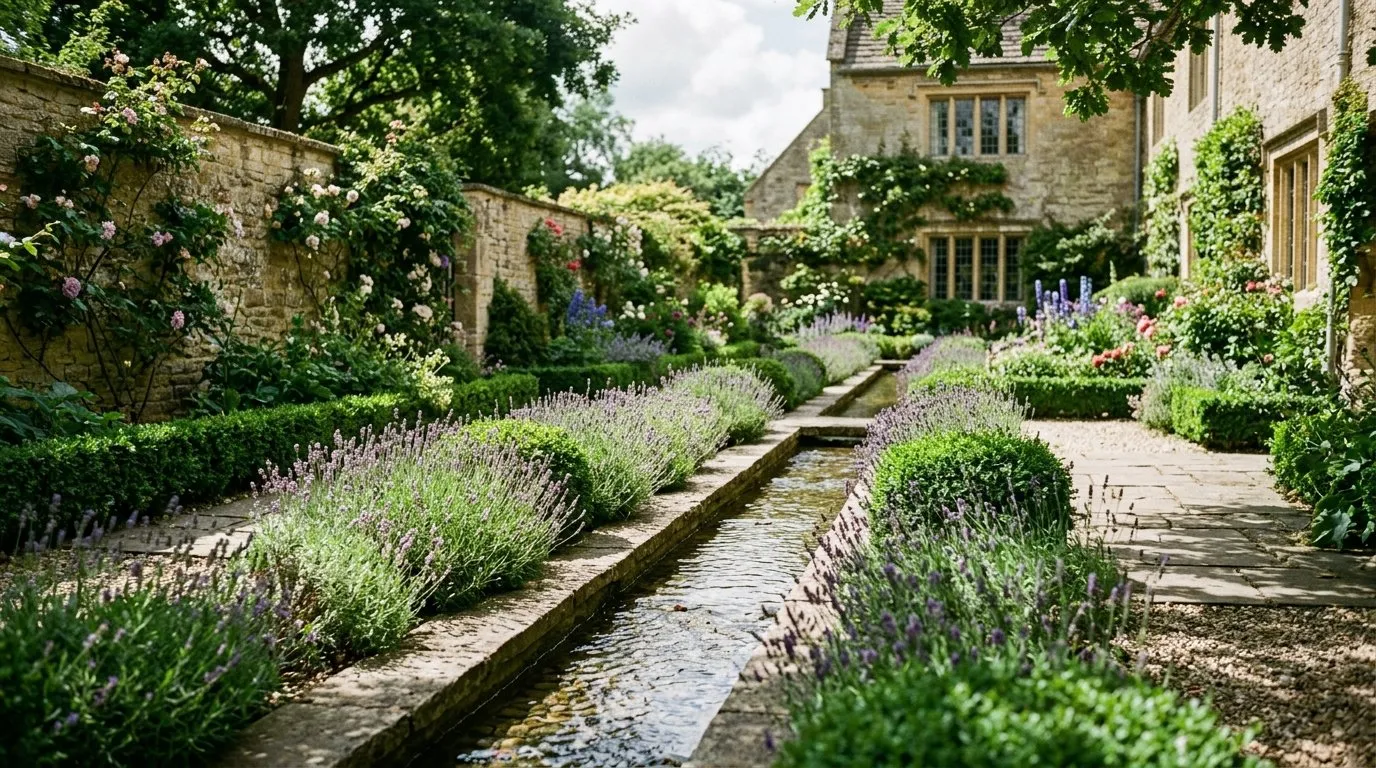 A sawn-stone rill in an Arts and Crafts style courtyard. The formal channel with soft edge planting is the Lutyens and Jekyll template.
Rill dimensions and the gentle fall that makes it work
Get the proportions right and a rill reads as deliberate rather than accidental. Three numbers matter: width, depth and fall.
Width is usually 15 to 45cm. Anything under 15cm looks like a gutter. Anything over 45cm starts to read as a canal and needs a much bigger pump. For a domestic garden, 20 to 30cm is the sweet spot.
Depth sits at 5 to 15cm. The shallow water is the whole character of a rill. It stays bright, reflective and safe. Ours runs at 8cm, which holds enough water to look full without wasting volume.
Fall is the gradient the channel drops along its run. A 1:100 fall means a 10mm drop for every metre. That is enough for the water to move with a soft trickle you can hear. Steeper than 1:100 and the water jumps, splashes and loses volume over the sides. Many formal rills are built perfectly level instead, then pumped, so the surface stays still. On a sloping site, step the rill in short level runs with small drops between, the same thinking behind garden steps and retaining walls.
Gardener’s tip: Set the rill so the still surface reflects something worth looking at. Line it up with the sky, a tree or a doorway. On a dead-level rill the reflection does as much work as the water itself, and it costs nothing to plan.
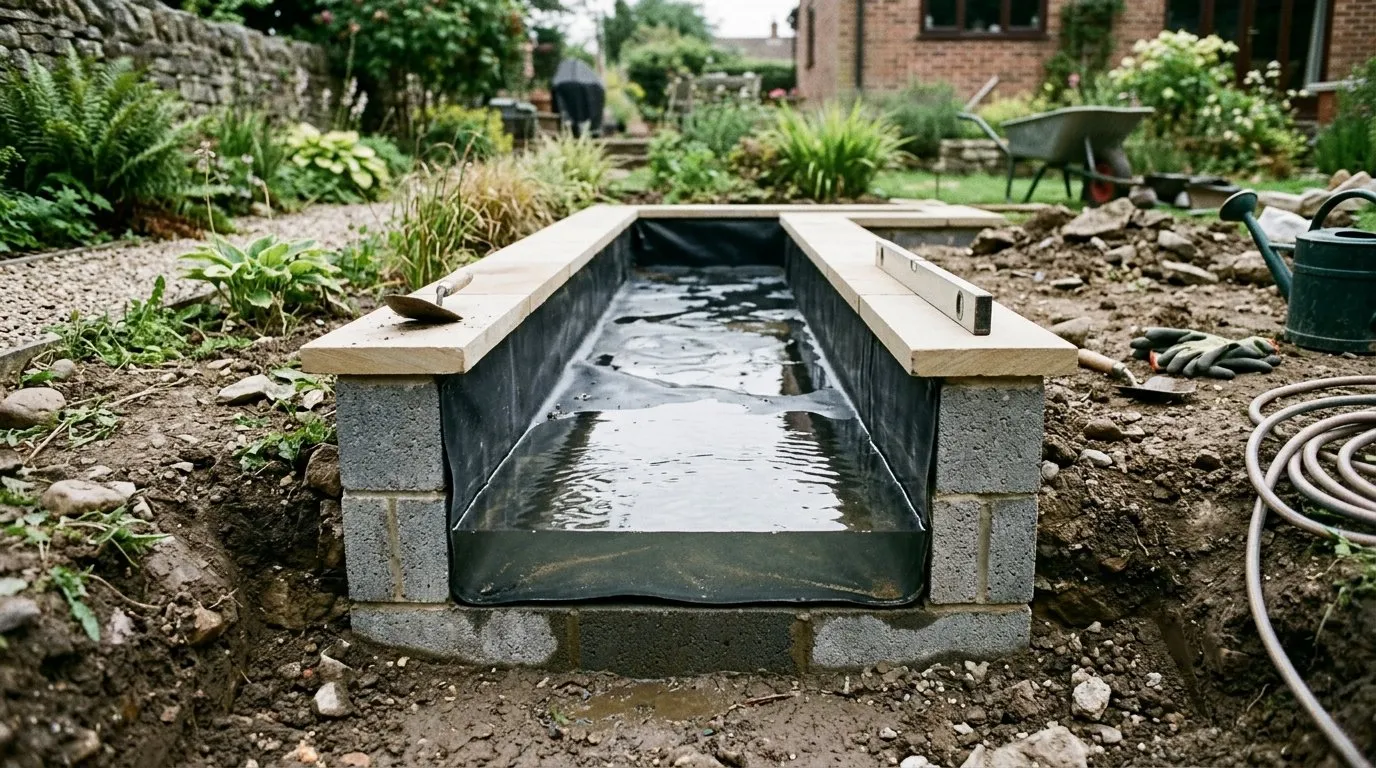 A cross-section of a blockwork rill lined with butyl. Note the shallow 8cm water depth and the crisp level edges that give the channel its line.
How the water actually moves, and why it uses so little
This is the part most people misjudge. A rill looks like it needs a lot of water. It does not. A garden rill recirculates the same water in a closed loop, so it barely touches the mains supply.
The system has four parts. A hidden reservoir, usually a buried tank of 80 to 150 litres, holds the water. A submersible pump lifts that water up to the top of the rill, into a header pool or spout. The water then travels the length of the channel by gravity or the gentle fall. At the bottom it drops back through a grille into the reservoir, and the cycle repeats.
Because it is a loop, the only real loss is evaporation. Ours loses about 8 litres a week in high summer, and almost nothing in winter. That is why a rill running all day still costs pennies. A rain-fed top-up covers the loss entirely in a normal British summer.
The pump size sets the character. For a 6m rill 30cm wide, a 2,000 litre-per-hour pump gives a calm flow. Longer or wider channels need 3,000 litres an hour or more. Too small and the water sits stagnant. Too large and it splashes and empties the reservoir. Even a small moving-water feature adds value for insects, and organisations like the Freshwater Habitats Trust show how much even tiny clean water bodies matter in a garden.
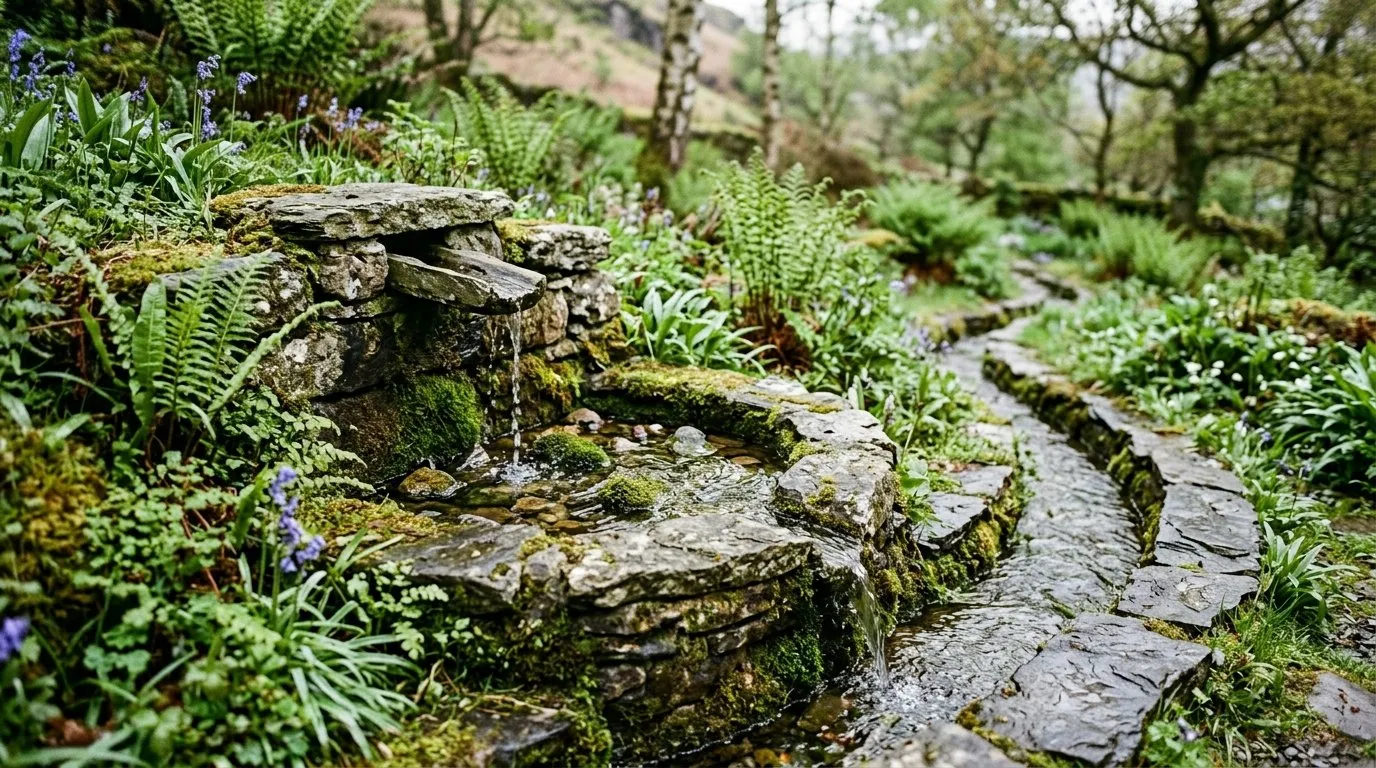 The header pool and spout at the top of the rill. The pump lifts water here, and the fall carries it back down to a hidden reservoir.
Rill materials compared: concrete, stone, brick and steel
Material decides the cost, the look and how long the rill lasts. The channel can be built in solid masonry and rendered, lined with butyl over blockwork, or dropped in as a preformed unit. Steel gives a sharp modern edge.
Rendered concrete blockwork is the workhorse for a formal, contemporary rill. Natural stone suits period gardens. Corten and stainless steel suit minimalist plots. The table below ranks the common options by cost and use.
| Material | Cost per linear metre | Durability | Style | Best for |
|---|---|---|---|---|
| Preformed liner in blockwork | £60-£150 | 10-15 years | Utility, hidden by edging | Budget and quick DIY builds |
| Rendered concrete blockwork | £120-£250 | 20+ years | Crisp, contemporary | Modern formal gardens |
| Engineering brick | £150-£300 | 40+ years | Traditional, warm-toned | Cottage and courtyard gardens |
| Natural sawn stone | £250-£500 | 50+ years | Timeless, weathers well | Period and Arts and Crafts gardens |
| Corten steel | £300-£600 | 25+ years | Rust-orange, sculptural | Contemporary and sloping gardens |
| Stainless steel | £400-£800 | 30+ years | Bright, reflective | Minimalist urban gardens |
The most durable option is natural stone, which outlives everyone who builds it. The best value for a modern garden is rendered blockwork lined with butyl. Steel is the fastest to install because units arrive ready-made, though the price climbs quickly. A butyl liner over blockwork also underpins many natural swimming ponds, so the waterproofing method is proven at much larger scale.
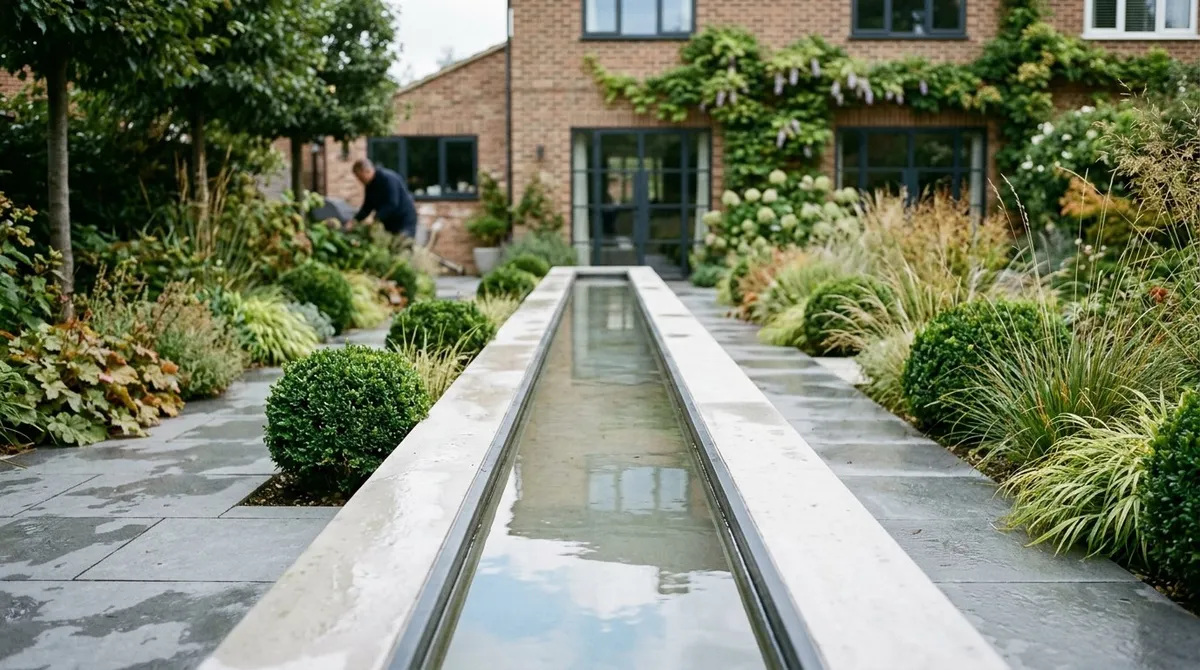
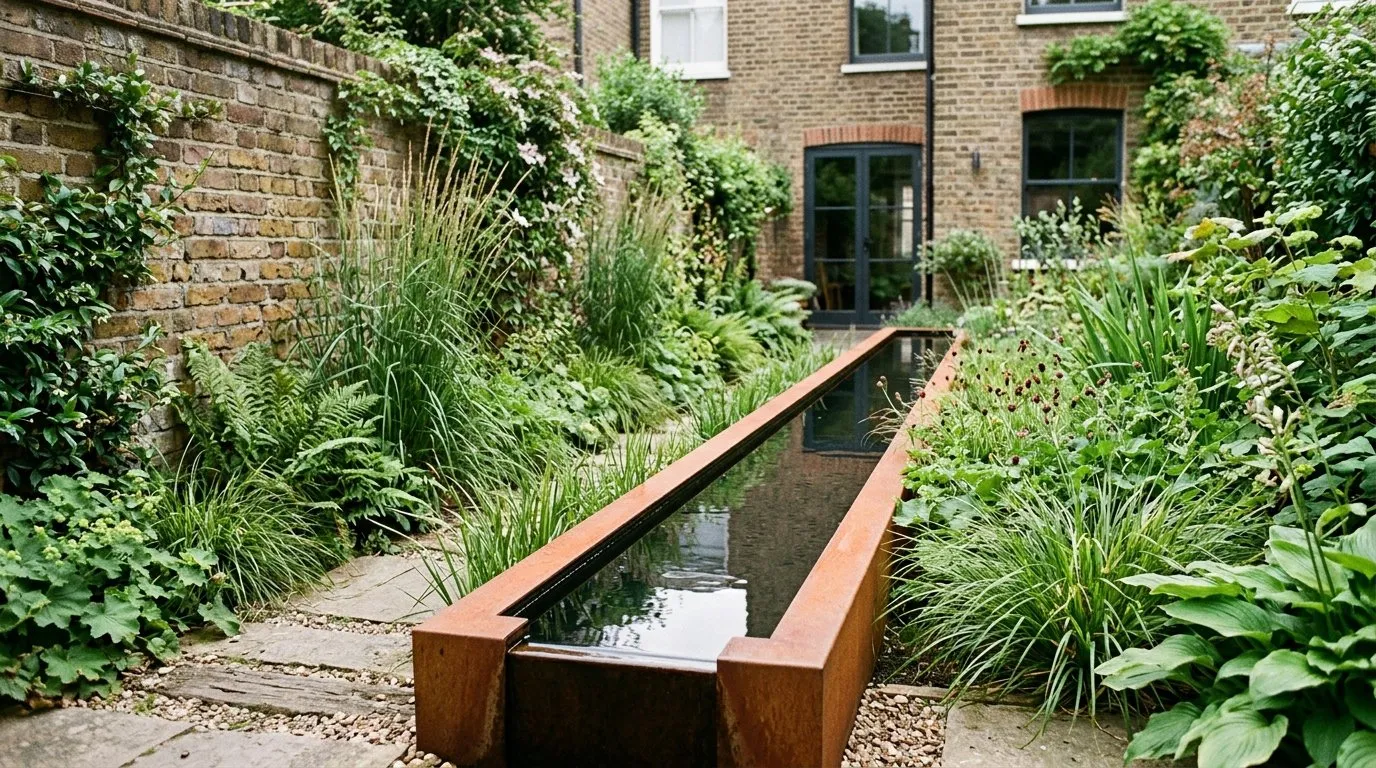 A corten steel rill in a small London garden. The rusted finish and sharp edges suit a minimalist, contemporary planting scheme.
How to build a garden rill step by step
A DIY blockwork rill is a long weekend job for a competent builder. Work in this order and the fall looks after itself.
1. Set out and level. Mark the line with string and pegs. Decide now whether the rill runs level or on a 1:100 fall. Use a laser level or a long spirit level on a straightedge to fix your datum. This is where accuracy pays off.
2. Dig and lay the base. Excavate 150 to 200mm below the channel floor. Lay and compact a 100mm concrete or hardcore base, checked level or to your fall.
3. Build the sides. Lay two courses of concrete block or brick to form the channel walls, 15 to 45cm apart. Keep them plumb and parallel.
4. Line it. Render the inside with a waterproof sand-and-cement mix, or drape a butyl liner over the blockwork and dress it into the base. Butyl is more forgiving of small movement than render.
5. Fit the reservoir, pump and pipework. Bury the reservoir at the low end. Set the pump inside it and run flexible pipe up to the header pool. Hide the pipe in the wall cavity or under the edging.
6. Fill, balance and edge. Fill the rill, run the pump, and watch the water find its level. Adjust the fall or the pump flow until it moves cleanly. Then cap the edges with coping stone or paving.
The waterproofing and base-prep logic is the same as how to build a garden pond, where a firm, level base and a sound liner do most of the work.
Warning: Any outdoor pump must run through an RCD-protected socket, wired by a qualified electrician. Water and mains electricity are a lethal mix. Keep young children supervised near the rill and fit a grille over any header pool deeper than 15cm.
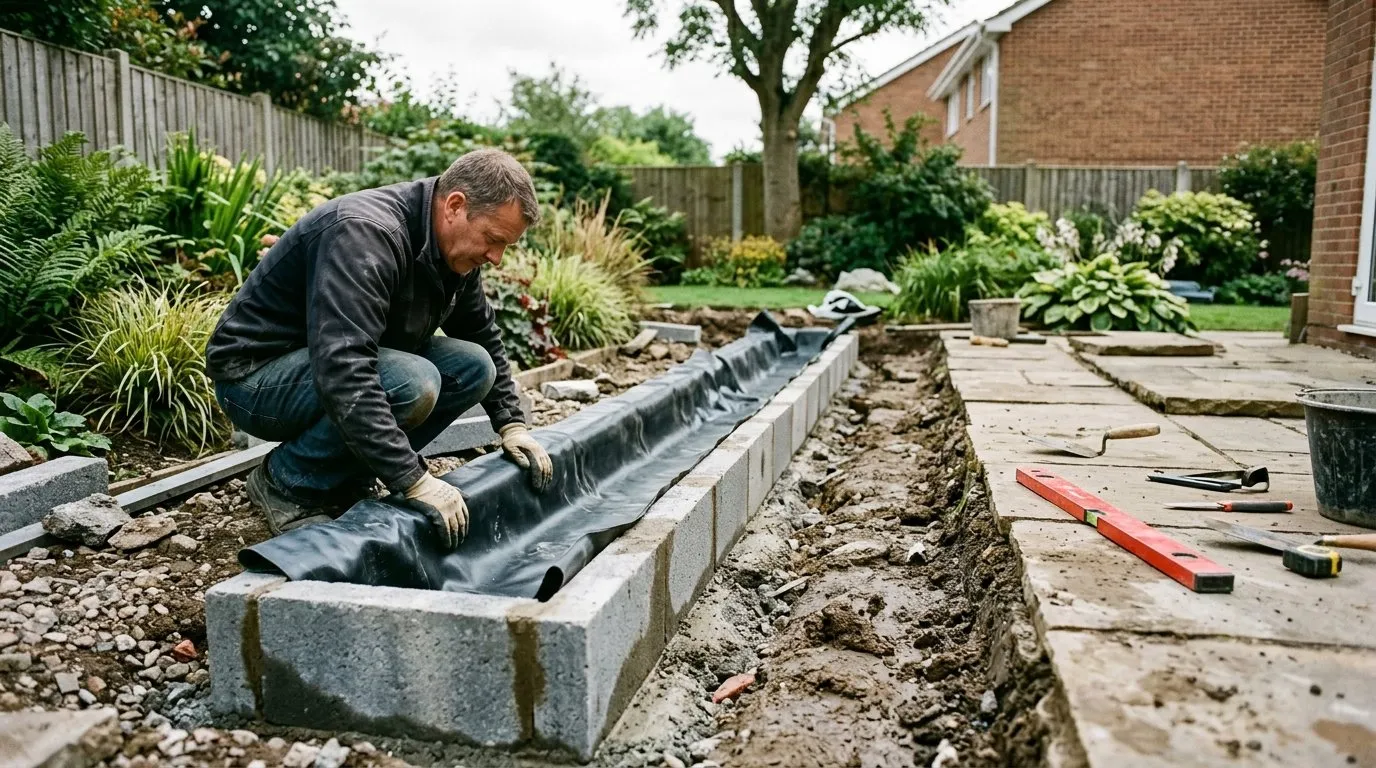 Blockwork sides lined with butyl mid-build. A firm level base and a sound liner are what keep a rill watertight for decades.
Planting a rill for reflection, sound and calm
The planting around a rill should soften the hard line, never fight it. A rill is architecture. The plants are the frame.
Plant the edges, not the moving water. Flowing shallow water gives roots nothing to hold, so true marginals belong in a still header pool in baskets, not in the channel. Along a formal rill, clipped box (Buxus sempervirens), lavender (Lavandula angustifolia) and low mounds of Stipa tenuissima grass give a clean, repeating rhythm. Erigeron karvinskianus spilling over stone coping breaks the edge beautifully.
For a still header pool, true marginals earn their place. Water mint (Mentha aquatica), water forget-me-not (Myosotis scorpioides), Iris laevigata and Carex elata ‘Aurea’ all sit happily in 5 to 15cm of standing water. They also draw pollinators and give the pool a little wildlife value. The Wildlife Trusts gardening advice rates even small garden water as a genuine gain for insects and birds.
At dusk, lighting turns a rill into the main event. Low-voltage submerged LED spots washing along the channel, or a single uplight on the spout, doubles the water in reflection. A rill sits neatly alongside other small-space water ideas like container ponds for small gardens.
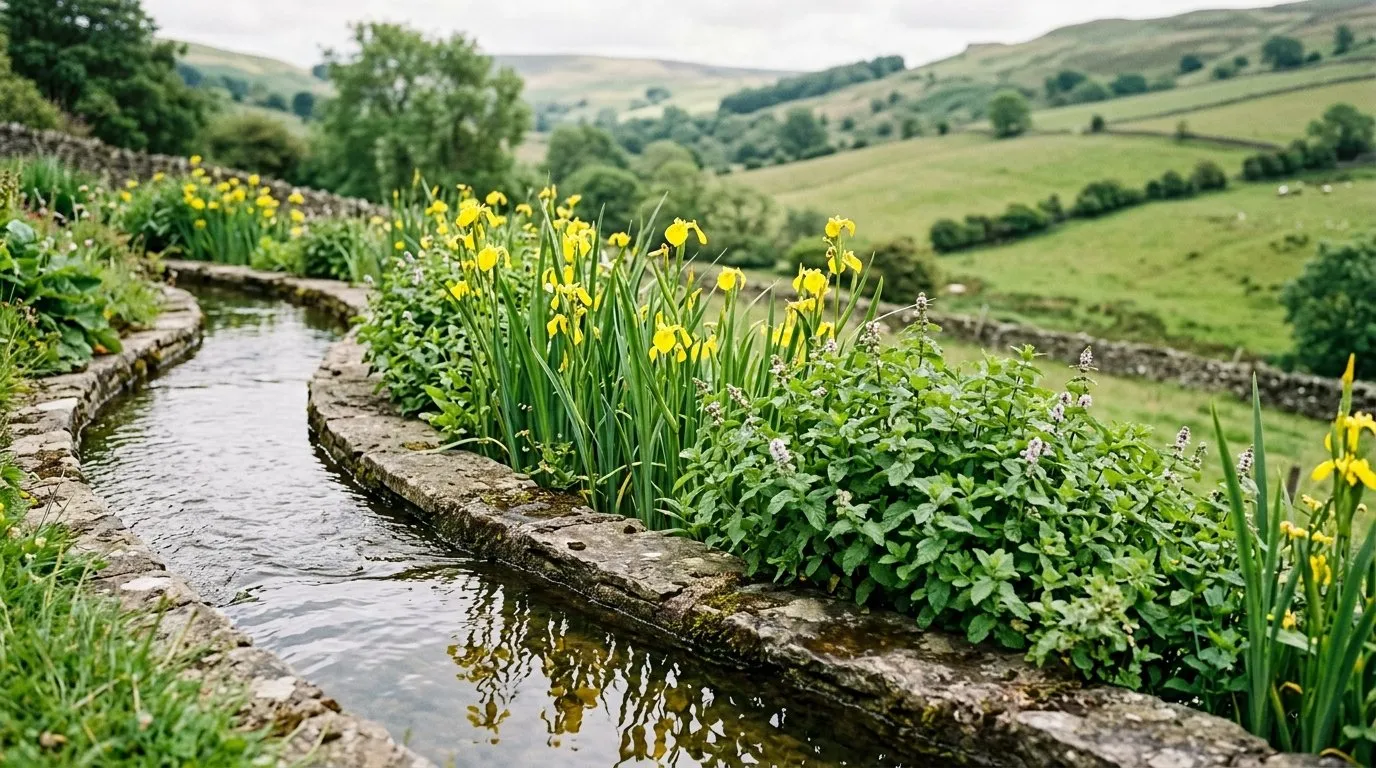 Iris and water mint softening the edge of a rill. Plant the sides and any still header pool, not the moving channel itself.
Month-by-month UK rill maintenance calendar
| Month | Task |
|---|---|
| January | Check for ice. Run a small pump or drain down to stop frost cracking render. Clear leaves. |
| February | Inspect render and liner for frost damage. Patch any hairline cracks before spring. |
| March | Clean the pump filter. Restart the system if drained. Top up the reservoir. |
| April | Full clean and refill. Check the flow and fall. Begin edge and header-pool planting. |
| May | Watch for green algae as the water warms. Add oxygenating and marginal plants to the pool. |
| June | Top up weekly for evaporation. Trim edge plants back off the coping. |
| July | Peak evaporation. Check the reservoir level every few days in a heatwave. Remove blanketweed. |
| August | Keep water topped up from a butt. Deadhead marginals. Skim off string algae. |
| September | Net the rill to catch the first fallen leaves. Reduce any feeding. |
| October | Last full clean before winter. Leave the leaf net in place. Check the pump. |
| November | Drain down or fit an ice preventer. Lift tender marginal plants from the pool. |
| December | Run minimally or leave drained. Check for freeze. Clear any debris off the surface. |
Common mistakes that spoil a garden rill
Keeping a rill safe around children and pets
A rill is one of the safest ways to bring water into a family garden. At 5 to 15cm deep it carries far less drowning risk than a 45cm-plus pond. The shallow, visible water is easy to see and easy to step across.
That does not mean no risk. Any standing water is a hazard for a toddler, so supervision still matters. Keep the header pool shallow, or cover it with a rigid grille just below the surface. A grille lets planting grow through while removing the deep pocket. Route the pump cable safely and always through an RCD-protected socket.
For households wanting water with the least risk of all, a level rill with no deep pool beats an open pond every time. If you do want more depth elsewhere, a proper pond with gently shelving sides and a safety grille is the safer route than a deep-sided tank.
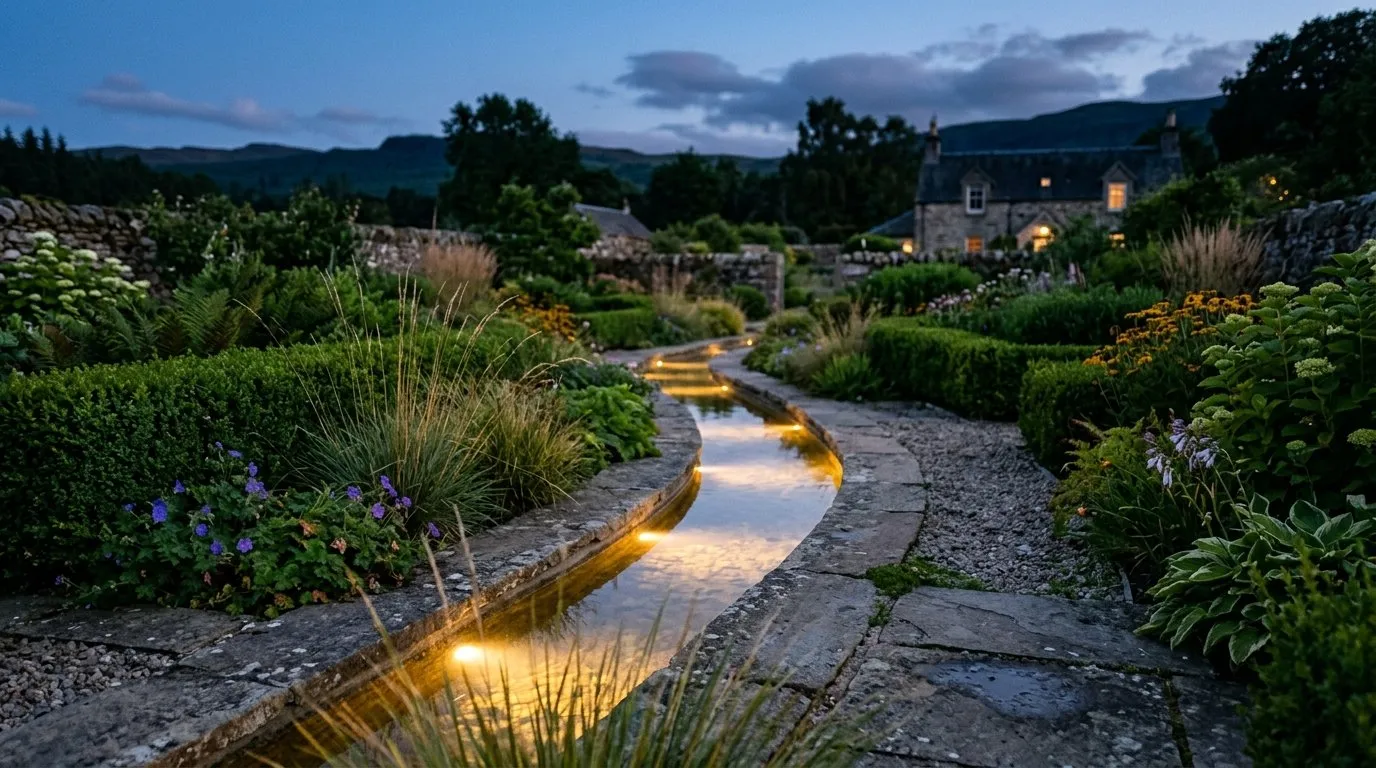 The same rill at dusk with low-voltage submerged lights. The still surface doubles the light and turns the channel into the focus of the evening garden.
Bringing it all together
A garden rill rewards precision more than effort. Fix a true level or a 1:100 fall, line the channel properly, size the reservoir and pump to the run, and plant only the edges. Do that and you get a calm, reflective line of water that runs for years on a few minutes of care a week, at almost no cost in water.
Frequently asked questions
What is a garden rill?
A rill is a narrow, shallow water channel, usually straight and formal. It carries a thin band of moving or still water along a line through the garden. Rills sit 15 to 45cm wide and 5 to 15cm deep, and the water is recirculated by a hidden pump so it never runs to waste.
How deep should a garden rill be?
A garden rill is usually 5 to 15cm deep, no more. The shallow depth is the point: it reflects the sky, catches light and keeps the design crisp. It also makes a rill much safer around children than an open pond. Depth beyond 15cm reads as a channel or canal, not a rill.
What fall does a water rill need?
A gentle 1:100 fall is enough to move water visibly and audibly. That means a 10mm drop for every metre of run. Steeper falls splash and throw water over the edges. Many formal rills are built dead level instead and pumped, so the surface stays still and mirror-flat.
How much does a garden rill cost to build?
A DIY rendered rill costs £120 to £250 per linear metre in materials. A professionally installed stone or steel rill runs £300 to £600 per metre and more. A simple 6m DIY rill, pump and reservoir included, comes in around £700 to £1,200. Natural stone and stainless steel sit at the top of the range.
Does a water rill use a lot of water?
No, a rill recirculates the same water through a hidden pump. The pump lifts water from a buried reservoir to the top, and gravity or the fall returns it. The only real loss is evaporation, roughly 5 to 15 litres a week in summer. Top up from a water butt to cut mains use to almost nothing.
Are garden rills safe for children?
Yes, at 5 to 15cm deep a rill is safer than a pond. The shallow water lowers the drowning risk sharply compared with a 45cm-plus pond. Still supervise young children near any water. A pump must run through an RCD-protected socket, and grilles can cover any deeper header pool.
What plants suit a garden rill edge?
Marginal plants like Iris, Carex and Mentha suit rill edges. Clipped box, lavender and Stipa grasses soften a formal channel. Plant along the sides rather than in a moving rill, since the shallow flowing water gives roots nothing to hold. A still header pool can take true marginals in planting baskets.
Our team produces practical UK gardening guidance from source research, contributor records and established horticultural practice. Editorial standards are overseen by Matt W.