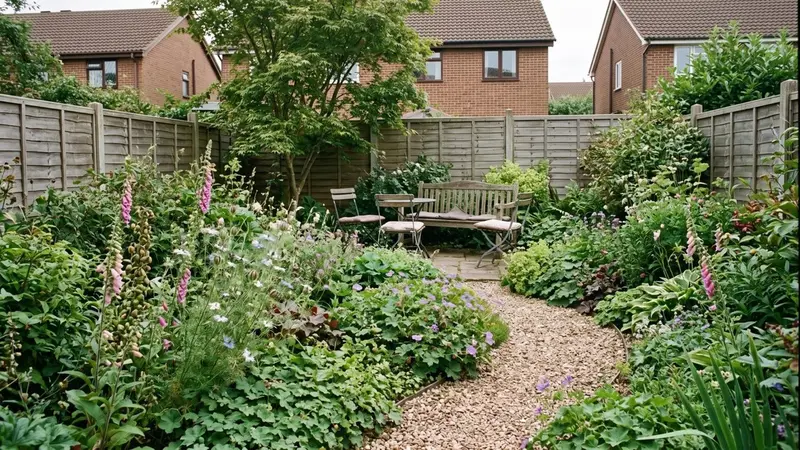
Key takeaways
- A saturated living wall weighs 30 to 50kg per square metre, so fixings must reach masonry, not render
- Plant at 40 to 50 plugs per square metre for full cover within one growing season
- Drip irrigation on a timer is the single biggest factor: 9 in 10 failures are watering, not plants
- Evergreen ferns, heuchera and bergenia keep a shaded UK wall green through winter
- DIY felt-pocket systems cost £60 to £120 per square metre, installed systems £150 to £600
- Face a wall north or east to cut summer scorch and halve irrigation demand
A living wall turns a bare fence, shed or house front into a sheet of green. Done well it holds 40 to 50 plants per square metre, cools the wall behind it, and gives pollinators a vertical feeding strip in a small garden. Done badly it browns off within a single summer and drips dirty water down the brickwork. The difference is rarely the plants. It is almost always the water.
This guide draws on four winters of running three green wall systems side by side on a north-facing wall in Staffordshire. It covers the three main system types, the plants that actually last on a UK wall, the irrigation setup that keeps them alive, and the build sequence from membrane to top-up. The order matters. Get the structure and water right, then the planting looks after itself.
What a living wall actually is (and why most fail)
A living wall is a vertical growing system where plants root in pockets, trays or troughs fixed to a structure, not in the ground. It differs from a green facade, where climbers like ivy root at the base and cover the wall over years. A living wall is instant and dense from day one, but it depends on irrigation because the plants have no soil reservoir to draw on.
Three failures account for most dead walls. The first is irrigation drift, where the top row dries while the bottom stays wet. The second is weight failure, where fixings pull out of render because nobody counted the saturated load. The third is wrong plants, usually deep-rooted or fast woody species that strangle the pockets within a season.
Our first tray unit lost 40 percent of its plants in one winter, and none of it was plant choice. It was a single drip line trying to feed a 1.8m-tall wall from the top. Fix the water and the weight, and a UK living wall runs for years.
Living wall systems compared: pockets, trays and troughs
Three system types dominate UK gardens. Each suits a different budget and skill level.
Felt-pocket panels are stitched fabric sheets with rows of planting pockets. They are the cheapest DIY option at around £60 to £90 per square metre, light when dry, and easy to cut to size. The downside is water spread. Felt wicks unevenly, so pockets need individual drippers.
Modular trays are rigid plastic or metal cassettes, usually 50cm by 50cm, that clip onto rails. Each tray holds compost and 9 to 16 plants. They cost £150 to £400 per square metre and give the most even root zone, but they are heavier and need a stronger frame.
Trough systems stack horizontal planters up a wall. They are the most forgiving for beginners because each trough holds a decent compost volume, but coverage looks more banded than a true green sheet.
| System | Cost per m² | Weight (saturated) | Plants per m² | Best for | Weak point |
|---|---|---|---|---|---|
| Felt-pocket panel | £60-£120 | 30-40 kg | 40-50 | DIY, light walls, tight budgets | Uneven wicking, needs a dripper per pocket |
| Modular tray | £150-£400 | 40-50 kg | 36-64 | Even growth, long-term display | Heavy, needs a strong batten frame |
| Trough/planter stack | £80-£200 | 35-45 kg | 20-35 | Beginners, balconies, edibles | Banded look, lower density |
| Pre-grown modular | £300-£600 | 45-50 kg | 50+ | Instant full cover, commercial | Highest cost, needs a fitter |
For a first wall on a house or shed, felt pockets give the best value. For a display you want dense and even for a decade, a modular tray system earns its extra cost.
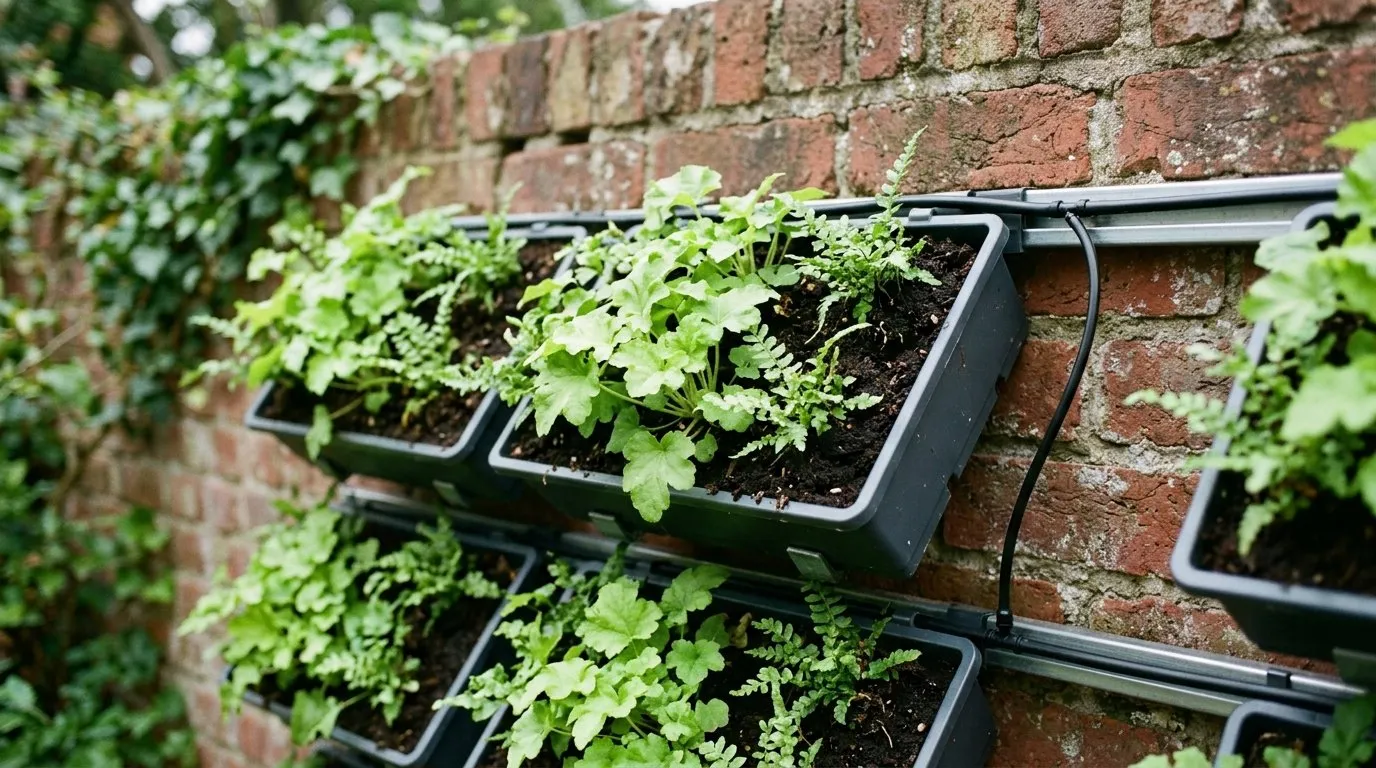 A modular tray system: 50cm cassettes clip to rails, each holding compost and 9 to 16 plugs. The rigid root zone holds water more evenly than felt.
The best plants for a UK living wall
Plant choice follows one rule: shallow, fibrous roots that cope with a confined, free-draining root zone. Deep tap-rooted and fast woody plants fail. Aspect decides the rest.
For a shaded, north or east-facing wall, build the backbone from evergreens that keep the wall green through winter:
- Hardy ferns such as Dryopteris affinis, Polystichum setiferum and Asplenium scolopendrium. Tough, evergreen, and happy in low light.
- Heuchera in wine, lime and amber tones for year-round leaf colour.
- Bergenia and Tiarella for solid ground-cover foliage and spring flower.
- Ajuga, Vinca minor and Lamium as trailing fillers that spill over pocket edges.
For a sunny south or west-facing wall, switch to drought-tolerant, sun-loving plants:
- Thyme, sedum and sempervivum for heat and dry spells.
- Erigeron karvinskianus, the Mexican fleabane, for months of daisy flower.
- Dwarf grasses like Carex oshimensis ‘Evergold’ and Festuca glauca for movement.
- Compact herbs such as chives, marjoram and creeping savory for an edible wall.
 A shaded, north-facing wall carried by evergreen ferns, heuchera and bergenia. An evergreen backbone is what keeps a living wall green in a UK winter.
Irrigation: the make-or-break of a green wall
This is the root cause of almost every failed living wall. Plants in pockets have no soil to fall back on, so water has to arrive little and often, evenly, top to bottom. Hand watering cannot do this. The top row dries out within hours while gravity leaves the bottom soaked.
The working setup is drip irrigation on a timer, fed from a reservoir and pump:
- A 60-litre reservoir at the base holds water and any liquid feed.
- A 45W submersible pump lifts water to a header pipe along the top.
- Drip lines run down the face, with a dripper at every pocket or tray.
- A battery or mains timer runs short, frequent cycles.
Set the timer to 2 to 4 cycles a day in summer, each 2 to 5 minutes, and 1 cycle a day in winter. Split tall walls into two zones so the top gets its own feed. Add a second dripper to every top-row pocket, because that row loses water fastest. This one change took our tray unit from 60 percent survival to 94 percent.
Feed through the reservoir at half the normal strength, roughly a balanced liquid feed at 1ml per litre every second week in the growing season. Flush the system with plain water once a month to stop salts building up in the pockets. Our rainwater harvesting guide applies here too: a rain-fed reservoir cuts mains use sharply.
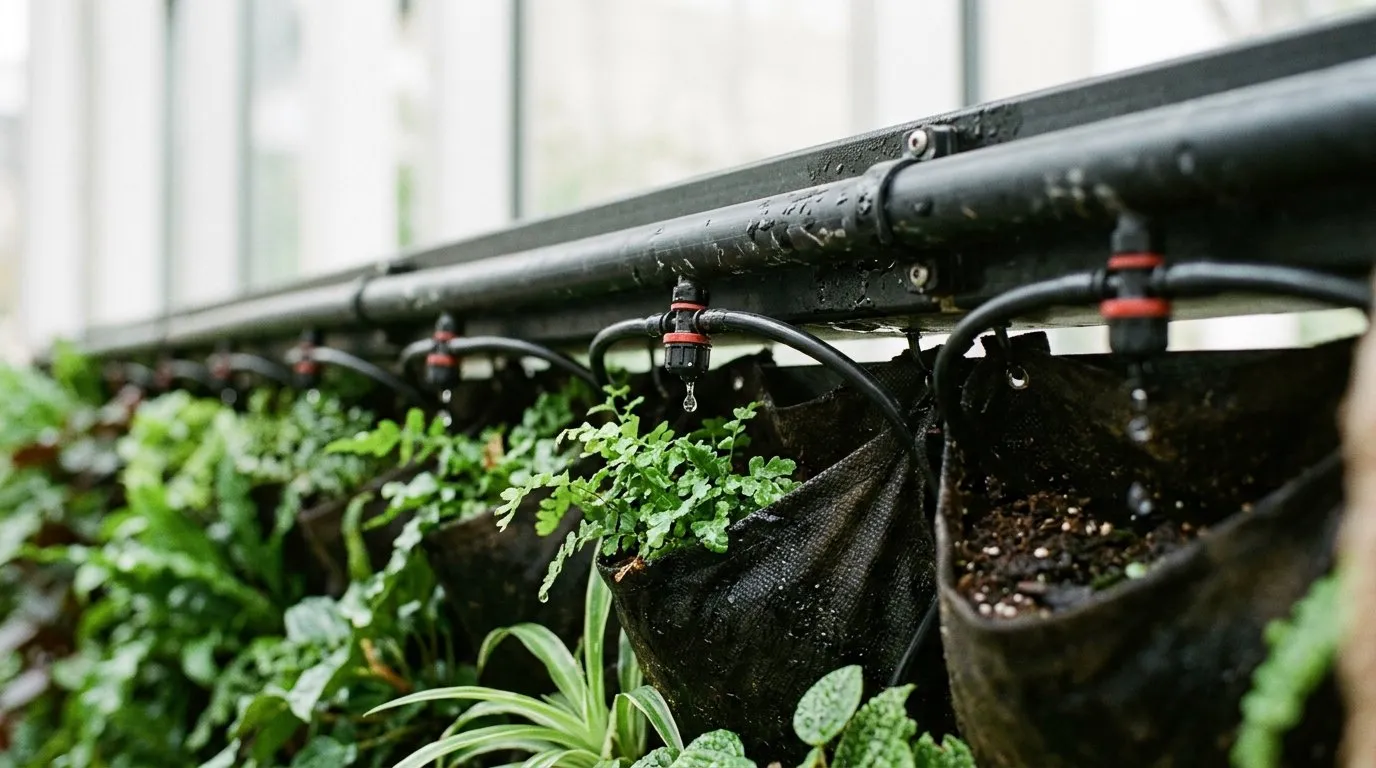 The header pipe and drippers along the top of the wall. Even water delivery from this top line is what keeps the whole wall alive.
How to build a living wall step by step
A DIY felt-pocket or tray wall is a weekend job for a competent home improver. Work in this order.
1. Check the wall and the weight. A saturated wall weighs 30 to 50kg per square metre. A 2m by 2m wall can top 180kg watered. Fixings must reach masonry, using resin anchors or long frame bolts. Never rely on render, plasterboard or a single timber panel.
2. Fit a waterproof membrane. Staple a pond liner or dedicated root-barrier membrane to the wall to keep moisture off the brick. This is what stops a living wall damaging the structure behind it.
3. Batten out for airflow. Screw treated 25 to 40mm battens over the membrane. This ventilation gap dries the wall face and prevents trapped damp.
4. Mount the system. Fix felt panels or tray rails to the battens, level and plumb. Add the drip header pipe along the top and run lines down.
5. Plant from the bottom up. Knock plugs from their pots, tease the roots, and firm into peat-free compost in each pocket or tray. Work bottom to top so you do not knock out lower plants.
6. Water in and check flow. Run the pump and watch every dripper. Blocked drippers are the commonest early fault. Adjust the timer and walk away.
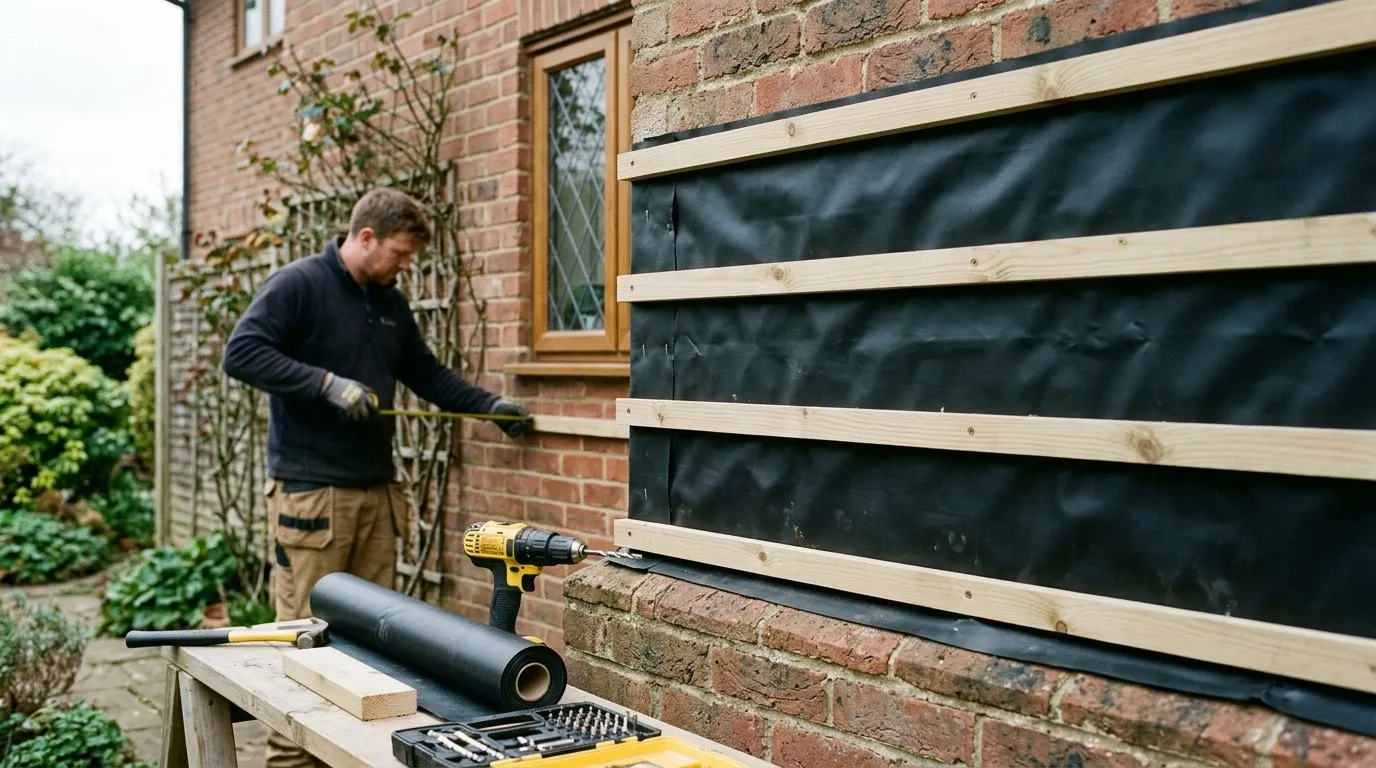 Membrane first, then a batten frame for airflow. This layer is what protects the wall behind and gives the system something solid to hang on.
Planting is the quick part once the frame is up. Knock each plug out, loosen the root ball, and firm it into peat-free compost so the crown sits level with the pocket lip. Work along each row before moving up. A 2m by 1.8m wall takes around 160 plugs at 45 per square metre, so buy in trays of 20 and keep five or six spares of each core species for the first-winter gaps.
 Firming a heuchera plug into a felt pocket. Plant bottom to top, crown level with the lip, at 40 to 50 plugs per square metre.
Month-by-month living wall care calendar
| Month | Task |
|---|---|
| January | Check drippers are not frozen. Lag the pump. Clear leaves from tray tops. |
| February | Cut back tired heuchera and fern fronds before new growth. Test the timer battery. |
| March | Resume feeding at half strength. Replace any plugs lost over winter. Increase to 2 cycles a day. |
| April | Peak planting month. Add trailing fillers. Watch for slug damage on soft new growth. |
| May | Move to 3 cycles a day as temperatures climb. Flush the system to clear winter salts. |
| June | Trim spreading plants off pocket edges. Deadhead erigeron and thyme for repeat flower. |
| July | Peak demand: up to 4 cycles a day. Check the reservoir daily in heatwaves. |
| August | Keep water topped up. Shear back leggy growth. Take cuttings of heuchera for spares. |
| September | Reduce to 2 cycles. Plant autumn gaps while the wall still has warmth to root. |
| October | Clear fallen leaves off the wall face. Last feed of the year. Check fixings before winter. |
| November | Drop to 1 cycle a day. Insulate exposed pipework. Remove frost-tender fillers if used. |
| December | Minimal watering. Watch for frozen lines. Enjoy the evergreen structure doing its job. |
Common mistakes that kill living walls
- One drip line for a tall wall. Gravity beats a single top feed. Split walls over 1.5m into two irrigation zones with their own header. This is the number one killer.
- Fixing to render. Render cannot hold a saturated wall. Anchors must bite masonry. Ignore this and the whole panel pulls away in the first wet winter.
- No waterproof membrane. Skipping the membrane traps damp against the brick and lets the wall spoil. It is a cheap layer that protects an expensive structure.
- Deep-rooted or fast plants. Shrubs, bamboo and vigorous perennials outgrow the pockets in a season and shade out everything else. Stick to shallow, fibrous-rooted species.
- Hand watering to save money. It never works for long. The top row dies first. Budget for a pump, reservoir and timer from the start, not after the first casualties.
Warning: Never hang a living wall system on render, plasterboard or a fence panel without checking what is behind it. A 2m by 2m wall holds over 180kg of water. Frame fixings must reach solid masonry with resin anchors or through-bolts.
Wildlife and a living green wall
A living wall is a vertical habitat. On a small plot with no room for a border, it gives pollinators a feeding strip and small birds a foraging surface. Flowering fillers do the heavy lifting.
Plant erigeron, thyme, marjoram and sedum into a sunny wall and it hums with bees from May to September. Bumblebees and solitary bees work the small flowers in numbers, and the dense foliage shelters spiders and beetles that feed wrens and dunnocks. The Wildlife Trusts gardening advice rates vertical planting as a genuine gain for urban wildlife where ground space is tight.
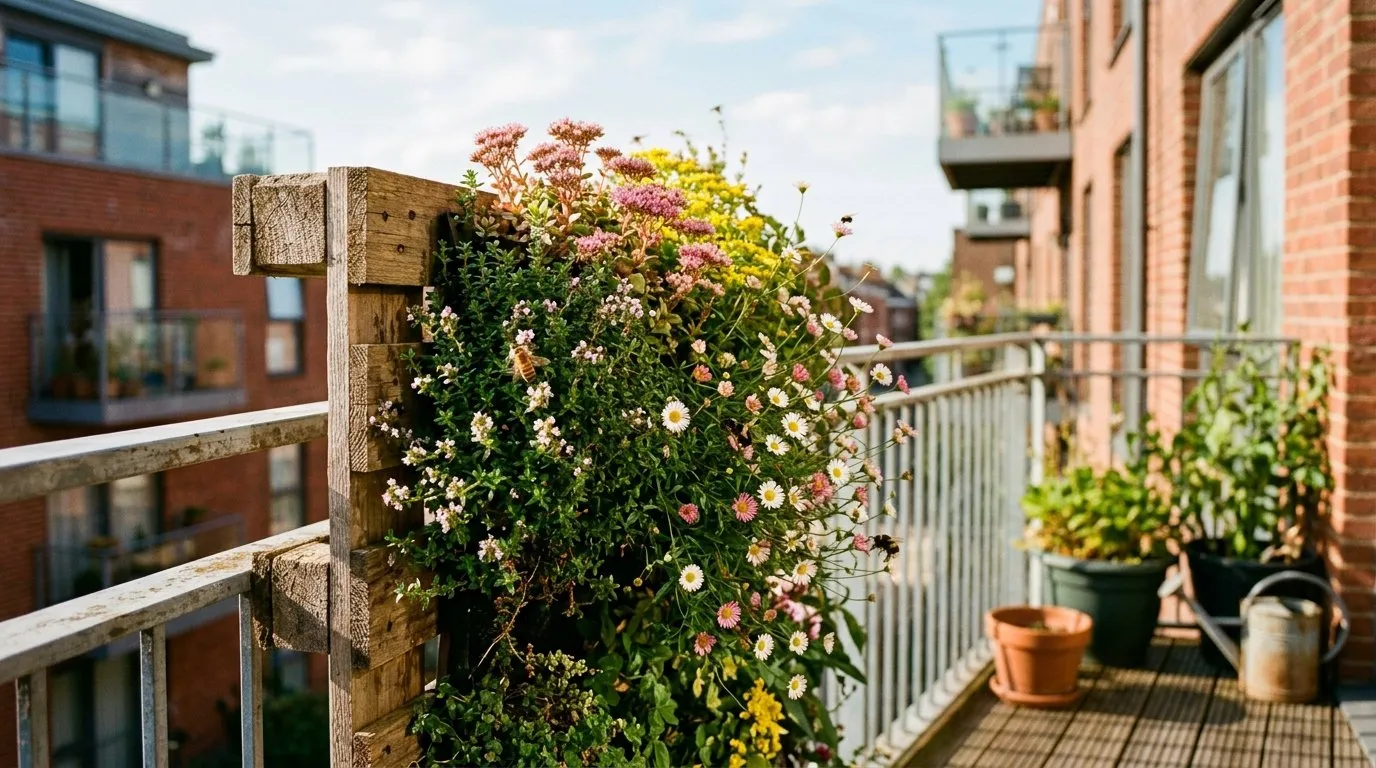 A sunny courtyard wall on a city balcony, planted for pollinators with thyme, sedum and erigeron. Vertical habitat where there is no ground to spare.
Bringing it all together
A living wall is not hard to keep alive once you accept the truth about it: the water system matters more than the plants. Fix the load back to masonry, fit a membrane, split the irrigation into zones, and plant an evergreen backbone for winter. Do that and a UK green wall runs for years on a few minutes of care a week.
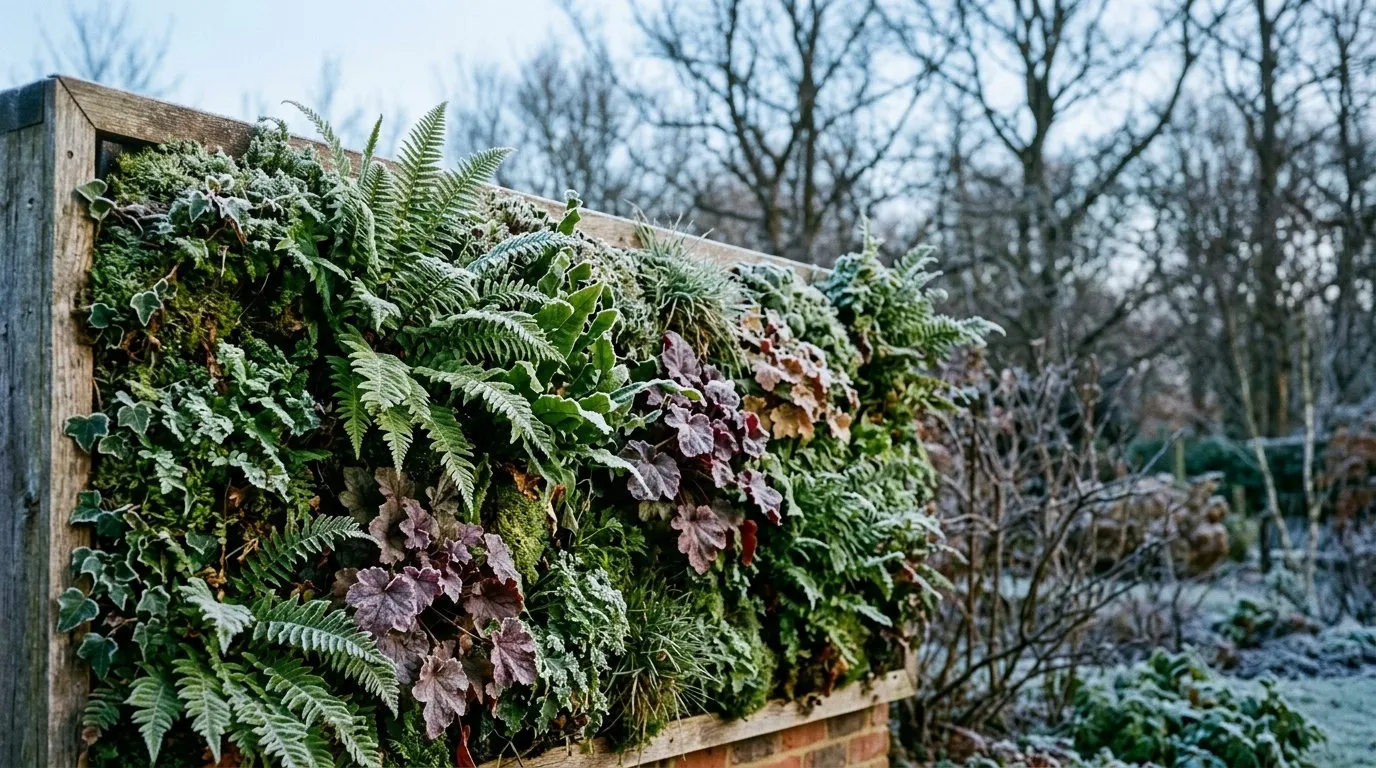 The same wall in December frost. An evergreen backbone of ferns and heuchera is what carries a living wall through a UK winter.
Frequently asked questions
How much does a living wall cost in the UK?
A DIY felt-pocket wall costs £60 to £120 per square metre. Professionally installed modular systems run £150 to £600 per square metre, plus irrigation. A small 2m by 1m DIY wall costs around £250 in materials and plants. Ongoing costs are water, feed and replacement plugs, roughly £20 to £40 per square metre a year.
Do living walls damage the wall behind them?
Not if you fit a waterproof membrane and a ventilation gap. The membrane keeps moisture off the brick, and a 20 to 40mm batten gap lets air circulate. Fixed straight onto bare render with no membrane, constant damp will eventually spoil the surface. Always mount the frame on treated battens, not flush to the wall.
What plants are best for a living wall in the UK?
Evergreen ferns, heuchera, bergenia and tiarella work best on shaded UK walls. For sun, use thyme, sedum, erigeron and dwarf grasses like Carex. Choose plants with shallow, fibrous roots that tolerate confined compost. Avoid deep-rooted or fast, woody plants, which outgrow the pockets within a year.
How do you water a living wall?
Use drip irrigation on a timer, fed from a reservoir and pump. Run 2 to 4 short cycles a day in summer, 1 in winter. Hand watering almost always fails because the top row dries out first. A 60-litre reservoir with a 45W pump serves around 4 square metres of wall reliably.
Can a living wall survive a UK winter?
Yes, if the plants are hardy and the irrigation cannot freeze. Use evergreen, fully hardy species and lag the pump and pipework. Drain or insulate exposed lines below freezing. Ferns, heuchera and bergenia shrug off UK frosts. The main winter risk is a frozen dripper starving the wall, not the cold itself.
How much does a living wall weigh?
A saturated living wall weighs 30 to 50kg per square metre. That means a 2m by 2m wall can weigh over 180kg when fully watered. Fixings must reach the masonry behind any render, using resin anchors or long frame fixings. Never hang a green wall on render, plasterboard or a single-skin timber panel alone.
How often do you need to replace living wall plants?
Expect to replace 5 to 15 percent of plugs each year. Gaps appear where drippers block or plants outgrow their pocket. Keep a few spare plugs of your core species. A well-run wall holds 85 to 95 percent of its planting year on year, with most losses in the first winter after planting.
Our team produces practical UK gardening guidance from source research, contributor records and established horticultural practice. Editorial standards are overseen by Matt W.