Key takeaways
- A 50% permeable windbreak beats a solid wall: solid barriers create downwind turbulence
- A shelter belt protects ground for about 10 times its height downwind
- Plant the windbreak first, then design garden rooms in its shelter
- Salt spray drops sharply 10 to 15m inland behind the first filter of planting
- Use gravel, grit and raised beds for drainage on free-draining sandy coastal soil
- Anchor exposed plots with low, wind-cheating structure, not tall solid screens
Designing a coastal garden is an exercise in managing wind and salt before anything else. The view is the prize, but the same gap that frames the sea funnels gales straight at your borders. Get the windbreak wrong and nothing you plant survives. Get the shelter and zoning right and a coastal plot becomes one of the most rewarding gardens in Britain, with early-warming soil and a long growing season.
Sun-loving Australian natives suit these conditions, including the kangaroo paw, or Anigozanthos.
After advising on exposed plots in Pembrokeshire and Norfolk, the order of work is always the same. Read the exposure first. Filter the wind, never block it. Build the garden in the shelter you create. This guide covers the structure and layout, not a plant list. For the planting, our existing coastal plant guide does that job in full.
How to Read Your Coastal Exposure First
Before you draw a single bed, work out exactly what the site throws at you. Exposure is not one thing. It is the combination of wind direction, wind speed, salt load and the lie of the land. On most British coasts the prevailing wind is from the south-west, but a north-east coast like Norfolk takes its worst hits off the cold North Sea.
Stand on the plot in a blow and watch where the wind accelerates. It speeds up through gaps, over the brow of a slope and round the corners of the house. These are the funnels you must tame first. Note where existing shrubs lean: that bend records years of prevailing wind for you.
Salt matters as much as speed. Within about 400m of open sea, salt-laden spray coats foliage in onshore gales. A plot facing the Atlantic on the west coast of Scotland or Ireland takes a heavier salt load than a sheltered estuary garden the same distance inland. Map your worst corner, your prevailing wind line and your salt-blasted front edge before you design anything.
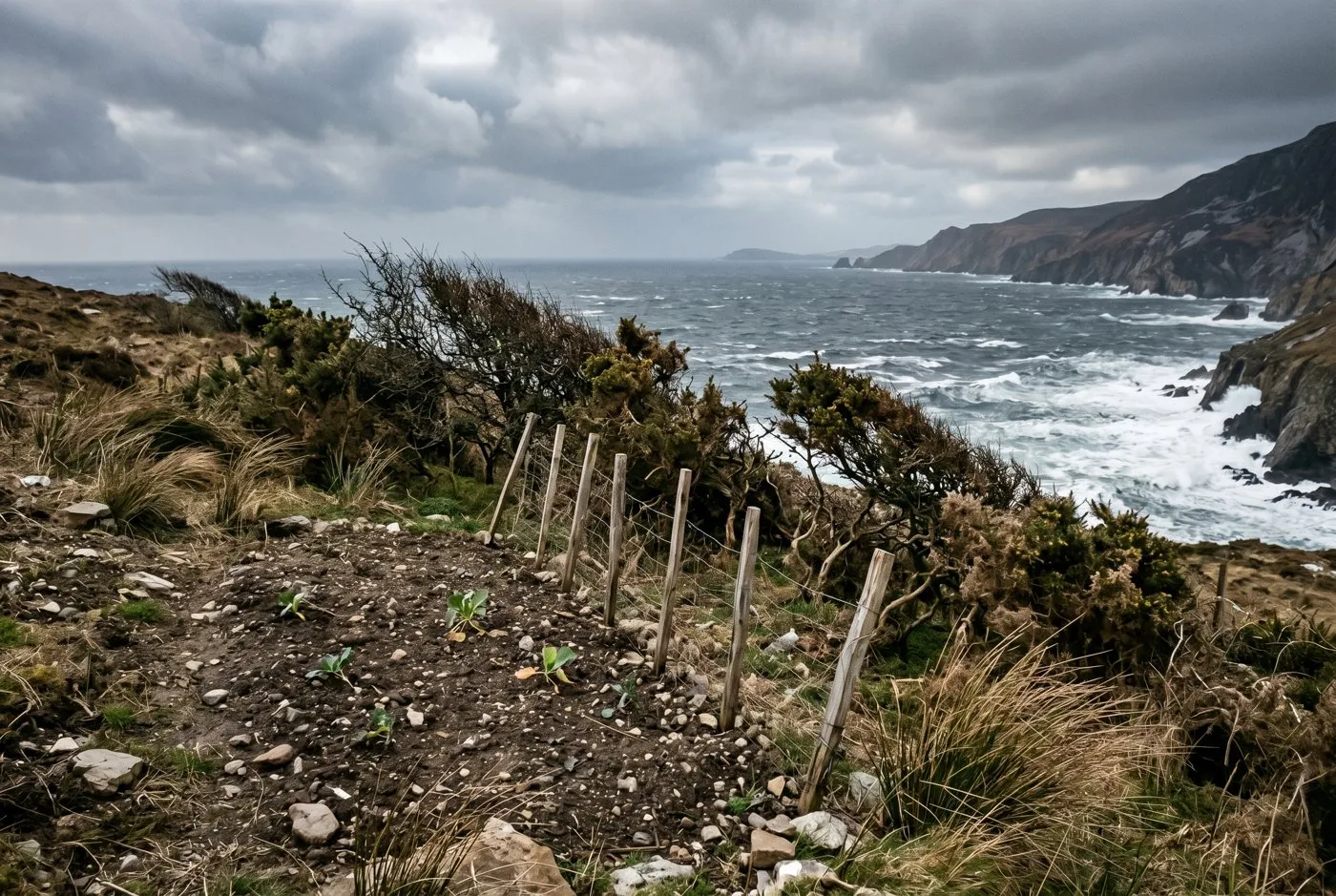 An exposed Atlantic-facing plot before any shelter goes in. The leaning, salt-burnt shrubs record the prevailing wind line. Reading this exposure is the first design job, before a single bed is drawn.
Why a 50% Permeable Windbreak Beats a Solid Wall
The single most important rule in coastal design is counter-intuitive. A solid wall is the worst windbreak you can build. Wind cannot pass through it, so it piles up and accelerates over the top, then crashes down on the sheltered side as violent turbulence. That downdraught lands roughly 2 to 5 times the barrier height downwind, exactly where you wanted calm planting.
A permeable barrier works with the wind instead. A hedge or slatted fence at about 50% permeability lets half the air filter through at reduced speed. This bleeds the energy out of the gust and stops the rolling eddy forming behind it. The filtered air slows the faster air above, and you get a long, calm pocket rather than a churning one.
The reach is the payoff. A solid wall shelters useful ground for only about 2 times its height before the turbulence bites. A 50% permeable windbreak shelters ground for roughly 10 times its height downwind, with the calmest zone between 3 and 7 times the height. A 2m permeable hedge therefore quiets the wind across 15 to 20m of garden. That is the difference between sheltering a path and sheltering a whole garden.
Warning: Never run a solid close-board fence or a high masonry wall along the windward boundary of an exposed coastal garden. It looks like protection but creates a turbulent dead zone a few metres inside it, where plants snap at the base. Make the seaward boundary permeable.
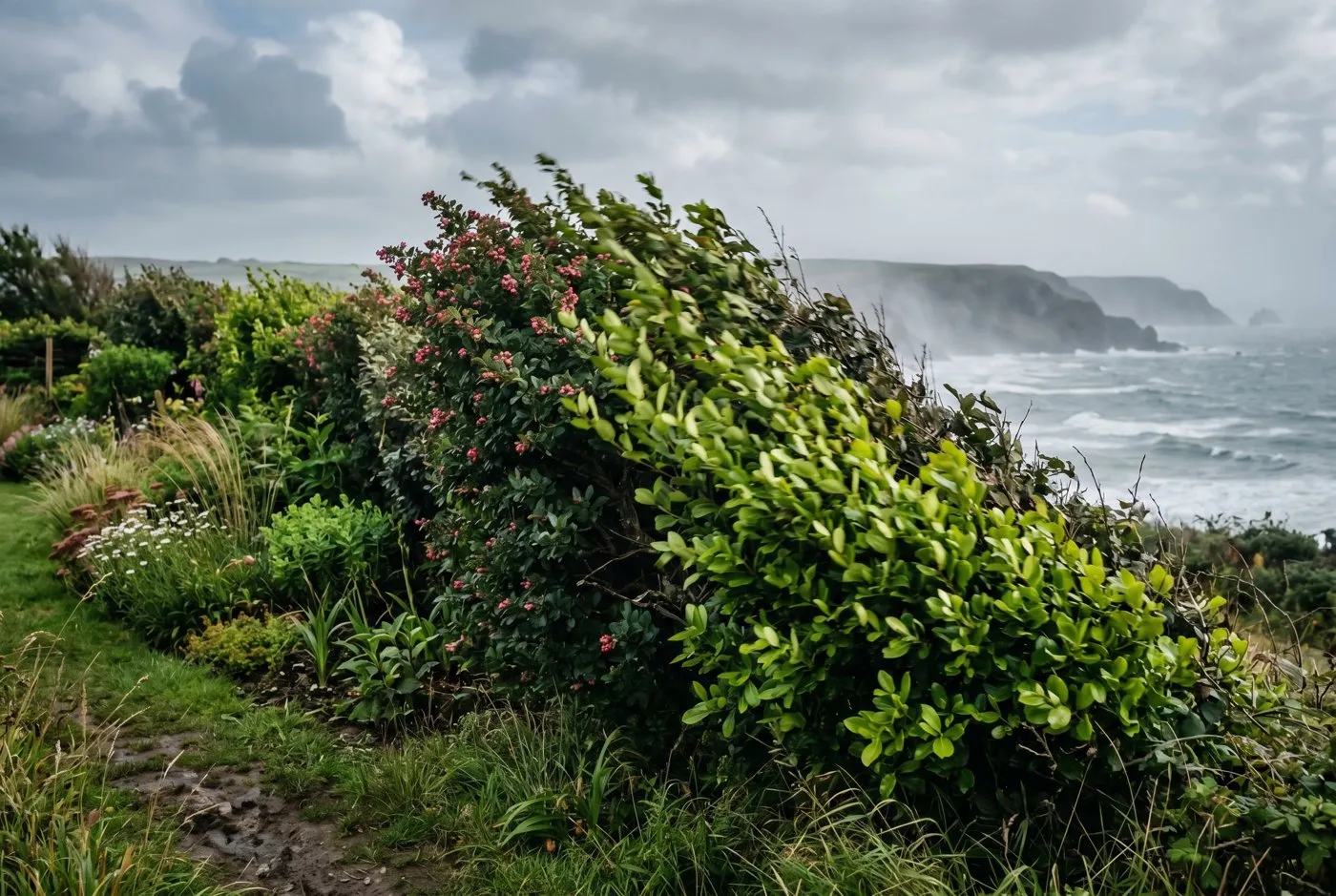 A permeable escallonia and griselinia shelter belt filtering an onshore wind on a Pembrokeshire boundary. The foliage bleeds energy from the gust, leaving a long calm pocket in its lee rather than crashing turbulence.
Choosing Between Hedges, Shelter Belts and Slatted Fences
Not all windbreaks are equal. Rank them by how they filter, how much salt they shrug off and how tall they grow. A living shelter belt is the gold standard on an exposed plot because it self-repairs and improves every year. A slatted fence is the fast fix that buys time while the hedge establishes.
| Boundary type | Permeability | Practical height | Salt tolerance | Role and best for |
|---|---|---|---|---|
| Escallonia or griselinia hedge | ~50% | 1.5 to 3m | Very high | Gold standard living filter for the front line |
| Mixed shelter belt (sycamore, hawthorn, tamarisk) | ~50 to 60% | 3 to 8m | High | Large exposed plots, farm-scale shelter |
| Slatted timber fence (40mm gaps) | ~50% | 1.8 to 2m | High (treated) | Instant shelter while a hedge grows in |
| Woven willow or hazel hurdle | ~40 to 60% | 1.2 to 1.8m | Moderate | Internal divisions and short-term screening |
| Solid masonry wall or close-board fence | 0% | Any | High (material) | Avoid on windward edge; use only as a sun-trap backstop in the lee |
The mistake is treating the solid wall as the safe default because it is the most permanent. It is the worst performer for wind. Reserve solid structure for the sheltered heart of the garden, where a south-facing wall becomes a sun trap once the shelter belt outside has done its job.
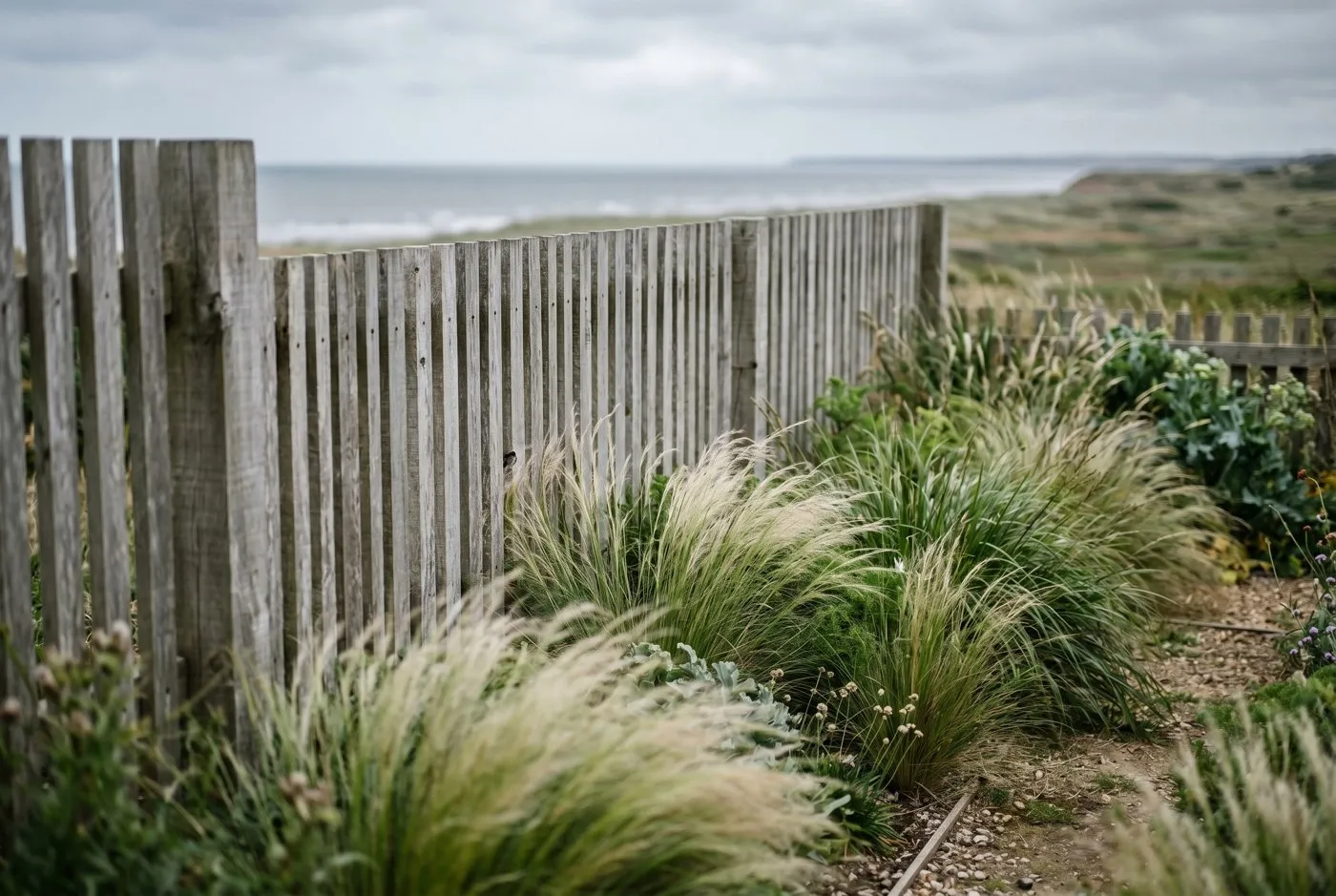 A slatted fence with 40mm gaps on a Norfolk plot, giving roughly 50% permeability. This is the instant-shelter fix while an escallonia hedge grows up behind it to take over the job within three or four years.
Building a Layered Hedging Windbreak
A single hedge helps, but a layered windbreak of staggered heights does far more. Wind hits a wall of equal height and lifts cleanly over it. Hit it with graduated tiers and it loses energy at every step, like water over a series of weirs. This is the principle behind every working farm shelter belt.
Build it in three tiers from the sea inwards. Plant a low, tough front row of tamarisk, hebe or sea buckthorn at 1 to 1.5m to take the first salt hit. Behind that, a mid tier of escallonia or griselinia at 2 to 3m. At the back, a taller tier of hawthorn, sycamore or pine where you have room, reaching 4m or more. On a larger plot, that back tier can grow into a sheltering pocket woodland of native trees that doubles the windbreak as wildlife habitat. Each tier shelters the next so it can grow taller than it could alone.
Spacing matters. Set hedging plants 45 to 60cm apart in the row for a dense filter, and stagger the rows 1 to 1.5m apart. Plant small, at 30 to 45cm, rather than large. Small whips root fast and take the wind, where a tall pot-grown specimen rocks loose and dies. Stake low and firm, and shelter the new tier with temporary windbreak mesh for the first two winters.
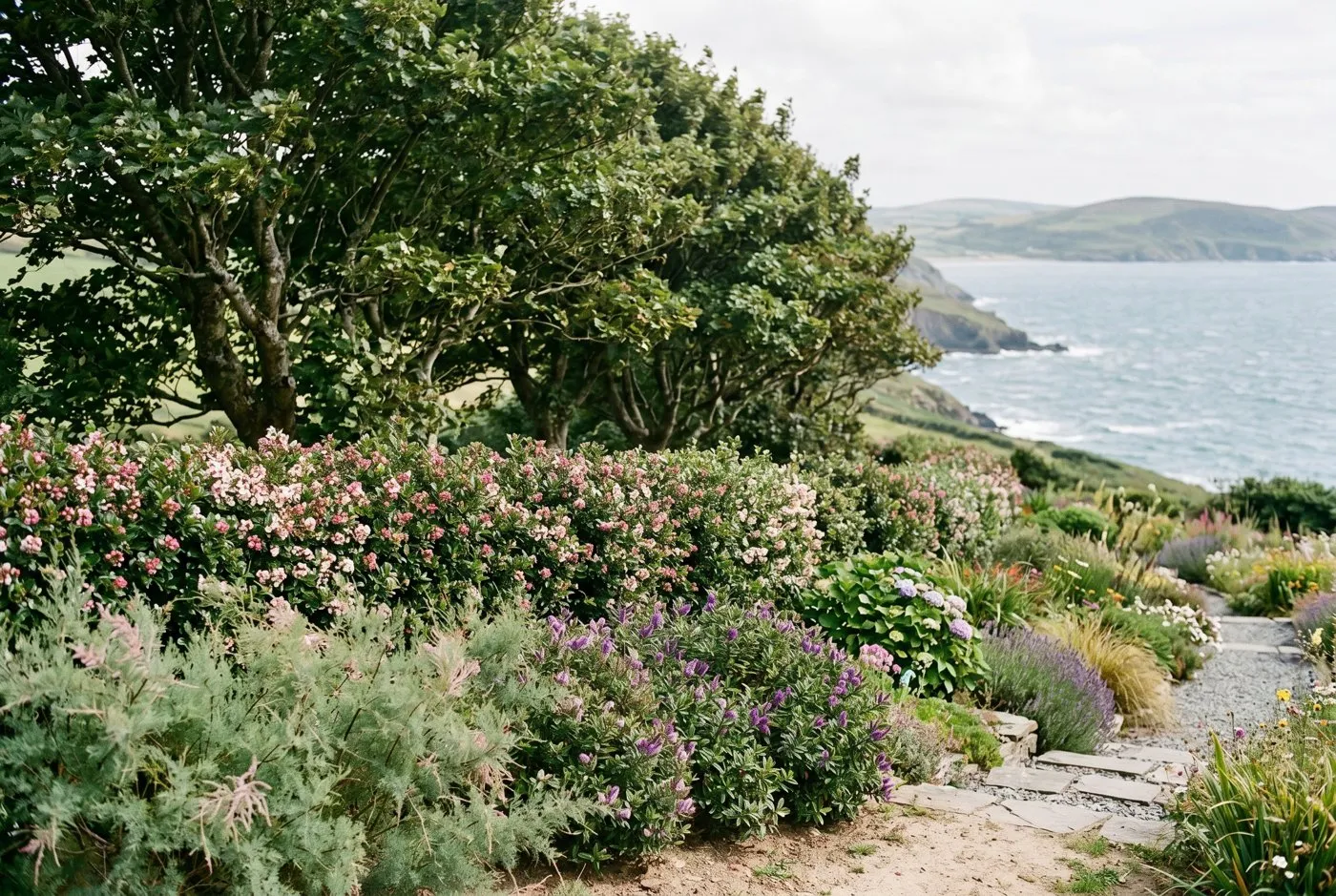 A three-tier layered windbreak on the Welsh coast. Low tamarisk and hebe at the front, escallonia in the middle, sycamore behind. Each tier shelters the next, bleeding wind energy step by step like a series of weirs.
How Far Salt Spray Travels and Designing Salt Zones
Salt does its damage on a gradient, and good design works with that gradient. In an onshore gale, salt-laden spray burns soft new growth on the front line within hours. But salt drops out of the air fast once something filters it. Behind the first dense barrier, the salt load falls sharply across the first 10 to 15m.
Design the garden in salt zones that match this drop-off. The front line, the seaward 5m, is the sacrifice zone. Plant only the toughest salt-shruggers here: griselinia, escallonia, sea buckthorn, tamarisk. These take the hit so everything behind them does not. Do not waste tender or precious plants on the front edge.
The middle ground, roughly 10 to 25m back, is the working garden where most planting and structure sits. Salt is much reduced here, and the wind is filtered, so this is where borders, lawns and seating belong. The far end, in the deepest shelter, is your showcase zone: the spot for the tender Mediterranean and exotic planting that a sheltered coastal microclimate makes possible, from agapanthus to echium and even tree ferns on a mild south-west coast.
Gardener’s tip: After a winter gale, hose salt off precious evergreens with fresh water within a day or two. Salt sits on the leaf and keeps drawing moisture out long after the storm passes. A quick rinse on the second-line planting saves a lot of brown foliage by spring.
Creating Microclimates and Sheltered Garden Rooms
 A sunken seating room dropped 45cm below grade and ringed with a low wall and clipped hedge on the west coast of Scotland. Wind skims over the dip, making it the one spot to sit out comfortably in a stiff onshore breeze.
Gravel, Shingle and Hardscape for Coastal Drainage
Coastal hardscape should look as though the beach crept up the garden, and it should drain like one too. Gravel and shingle are the natural material of the coast and the practical answer to fast-draining ground. A gravel garden needs no irrigation, suits the self-seeders that thrive by the sea, and never waterlogs in winter storms.
Lay gravel 5 to 7cm deep over a permeable membrane, or straight onto improved sandy soil if you want plants to self-seed into it. Sea holly, red valerian, sea kale and ornamental grasses colonise gravel happily and shrug off salt and wind. Our guide to growing sea holly (eryngium) covers raising it from seed and dividing established clumps. The look is loose and naturalistic, the opposite of a manicured lawn that struggles on a windy coast anyway.
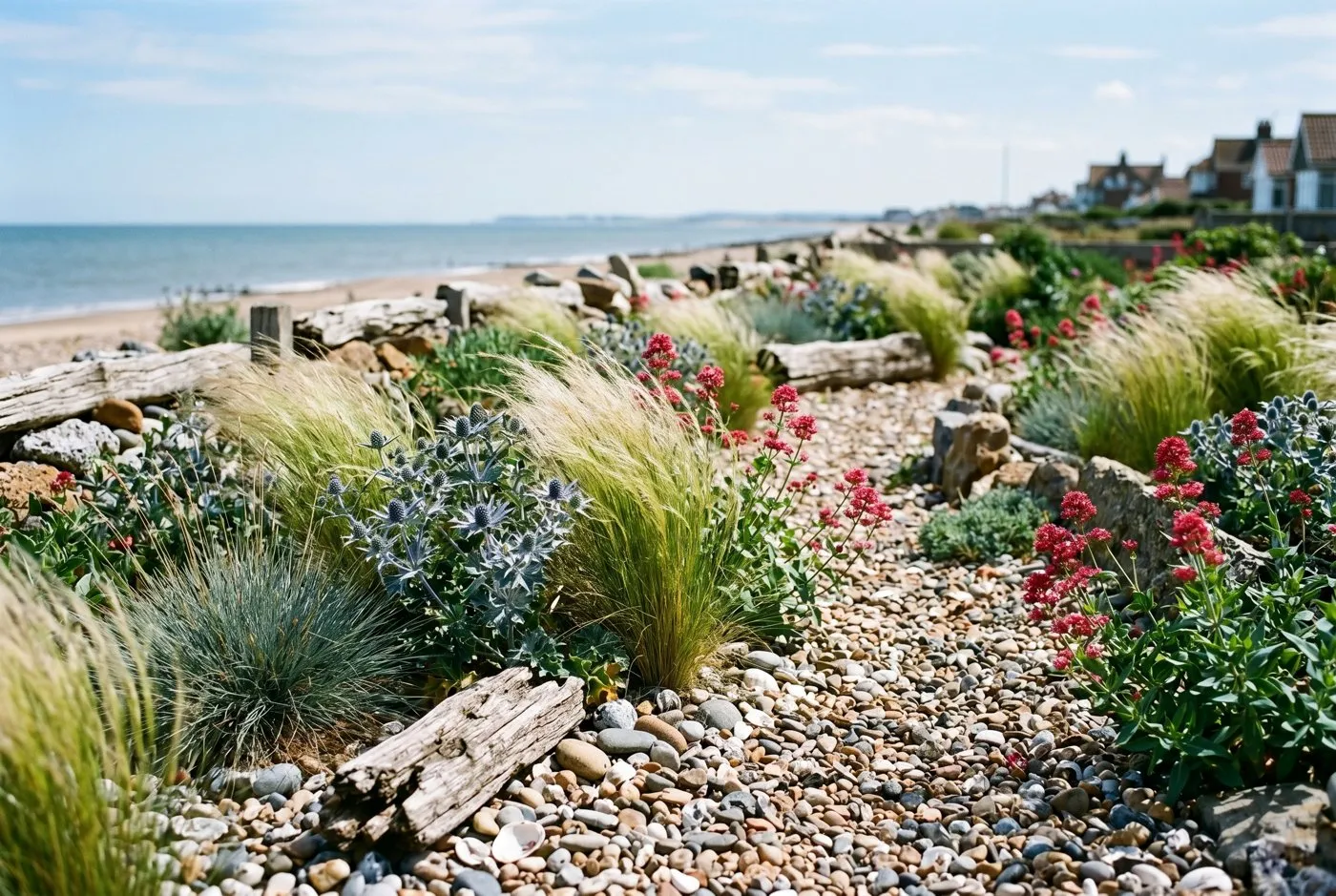 A gravel coastal garden on the Suffolk shingle. Stipa and festuca grasses, sea holly and red valerian self-seed between the pebbles. Gravel never waterlogs in winter storms and needs no irrigation through summer.
Raised Beds and Drainage on Sandy Coastal Soil
Most coastal gardens sit on free-draining sandy soil. It warms early in spring, which is a real bonus, but it loses water and nutrients almost as fast as you add them. The design answer is to build soil up rather than fight to retain it across the whole plot.
Raised beds concentrate good soil where you need it. Fill them with a mix of topsoil, garden compost and well-rotted seaweed, and they hold moisture far better than the surrounding sand. Raised beds also lift tender roots clear of any salt-laden run-off and make a windy plot easier to work. On a sloping coastal site, terraced raised beds double as wind-cheating structure.
Improve the open ground with bulk organic matter. Dig in 5 to 10cm of garden compost, leaf mould or seaweed each year. Seaweed is the classic coastal soil improver, free off many beaches, and it adds trace minerals as it rots. For the full method on lightening and feeding sand, our guide to improving sandy soil covers organic matter rates and timing.
Common Mistakes in Coastal Garden Design
The same errors wreck coastal gardens again and again. Each one comes from treating a seaside plot like an inland one. Avoid these and you are most of the way to a garden that thrives.
- Building a solid wall or fence on the windward edge. It throws wind over the top to crash down as turbulence a few metres in. Make the seaward boundary 50% permeable instead.
- Planting before the shelter is up. Borders put in before the windbreak establishes get burnt and battered. Plant the windbreak first, give it two seasons, then design the garden in its lee.
- Ignoring drainage on sandy soil. Treating fast-draining sand like loam leaves plants thirsty and starved. Build raised beds, mulch heavily and dig in seaweed or compost yearly.
- Using tall, tender or top-heavy plants on the front line. Precious specimens on the seaward edge get salt-burnt and snapped. Save them for the sheltered showcase zone at the back.
- Choosing one tall hedge instead of layered tiers. A single wall of equal height lifts wind cleanly over it. Stagger the heights so each tier bleeds energy from the gust.
Frequently asked questions
How do I protect a garden from sea wind?
Filter the wind with a permeable barrier, never block it. A 50% permeable hedge or slatted fence shelters ground for roughly 10 times its height. A solid wall forces wind over the top to crash down as turbulence a few metres in. Plant a shelter belt on the seaward boundary first, then design the garden in its lee.
What is the best windbreak for a coastal garden?
A living hedge of escallonia, griselinia or tamarisk is the gold standard. These salt-tolerant shrubs filter wind to about 50% permeability and self-repair after storms. A slatted timber fence with 40mm gaps works while a hedge establishes. Avoid solid walls and close-board fence, which create damaging downwind turbulence.
How far inland does salt spray reach in a coastal garden?
Salt spray drops sharply 10 to 15m behind the first filter of planting. On the front line, salt-laden wind burns soft growth within hours of a storm. A tough outer hedge of griselinia or escallonia takes the hit, so plants 10m back see a fraction of the salt load. Distance and a sacrificial first row do most of the work.
What soil do coastal gardens have and how do I improve it?
Most coastal gardens sit on free-draining sandy soil that loses water and nutrients fast. Dig in 5 to 10cm of garden compost or seaweed each year to hold moisture. Use raised beds and gravel mulch where drainage runs too fast. Sandy soil warms early, so it suits Mediterranean and silver-leaved planting well.
Can you have a sheltered seating area in an exposed coastal garden?
Yes, by building an enclosed room in the lee of the windbreak. Sink a paved circle 30 to 60cm below grade and ring it with a low wall and clipped hedge. The dip and the enclosure together cut wind chill enough to sit out. Site it behind the shelter belt, not on the seaward edge.
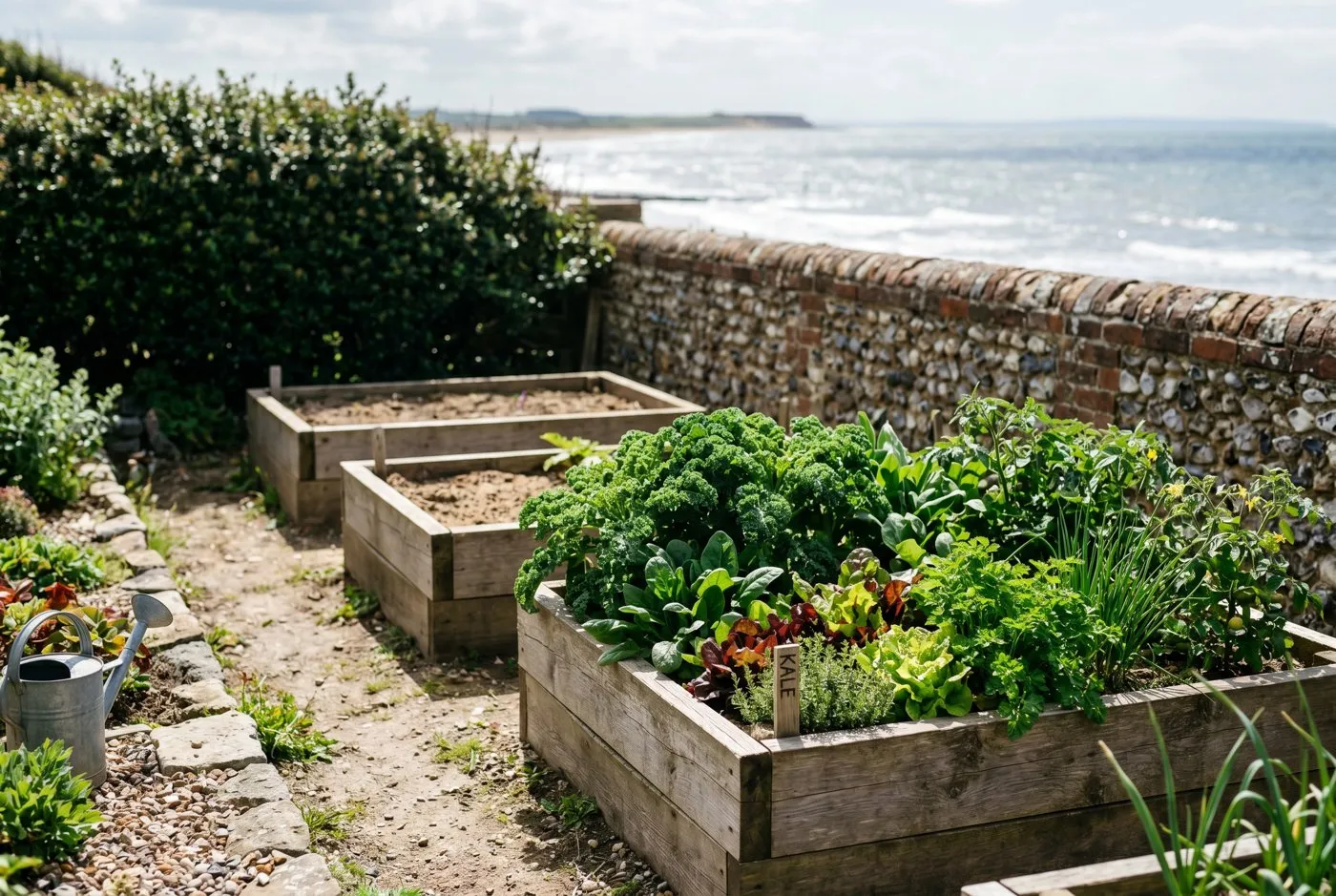 Timber raised beds in the lee of a hedge on a Norfolk plot. Filled with topsoil, compost and rotted seaweed, they hold moisture where the surrounding sand cannot, and lift roots clear of salt-laden run-off.
Plan the planting that fills your shelter
Our team produces practical UK gardening guidance from source research, contributor records and established horticultural practice. Editorial standards are overseen by Matt W.