Decorative Water Butts and Rain Chains
Slimline butts, oak barrel styles and copper rain chains. What actually looks good, holds water and survives a UK downpour, with real prices.
Key takeaways
- 1mm of rain on 1 square metre of roof gives 1 litre of collectable water
- Slimline butts hold 100 to 200 litres in a footprint roughly 40cm deep
- Rain chains overflow above about 12mm of rain per hour, so keep a downpipe option
- Copper chains cost £90 to £220 and weather to green over 3 to 5 years
- A planter-topped butt loses 15 to 25 litres of capacity to the planting tray
- Standard UK gutter outlets are 68mm round or 65mm square, so measure before ordering
Decorative water butts and rain chains are the two upgrades that make rainwater collection look deliberate rather than apologetic. Most UK gardens still hide a green plastic butt behind the shed. In a small terrace plot there is nowhere to hide it, so the tank has to earn its place visually as well as practically. This guide covers the butt styles that work in narrow spaces, then goes deep on rain chains: how they came from Japan, how the metals age, and the honest truth about how they behave in a proper British downpour.
The functional side of rainwater collection is covered in our rainwater harvesting guide for UK gardens. This article is about how it looks.
Slimline and wall-mounted butts for a narrow side return
The slimline water butt exists because most British houses have a side return between 70cm and 1.2m wide. A traditional 210 litre round barrel is roughly 60cm in diameter and blocks the path. A slimline unit is typically 40cm deep, 60cm wide and 120cm tall, holding around 150 litres, and sits flat against the wall.
Capacity ranges by style. Slimline units run 100 to 200 litres. Wall-mounted butts hang off brackets, hold 80 to 130 litres, and clear the ground entirely so bins and bikes still fit underneath. Fence-profile butts are shallower again at 30cm and hold about 100 litres.
Two details decide whether a slimline butt actually works. First, the tap height: many are fitted at 20cm from the base, which will not clear a standard 10 litre watering can without a stand. Buy the matching plinth, usually £20 to £40, or build a paving slab base. Second, linking. Most quality slimline butts have a linking kit, around £12 to £20, that connects two units at the overflow so the second fills after the first. Two linked units give 300 litres along a passage that would not take one round barrel.
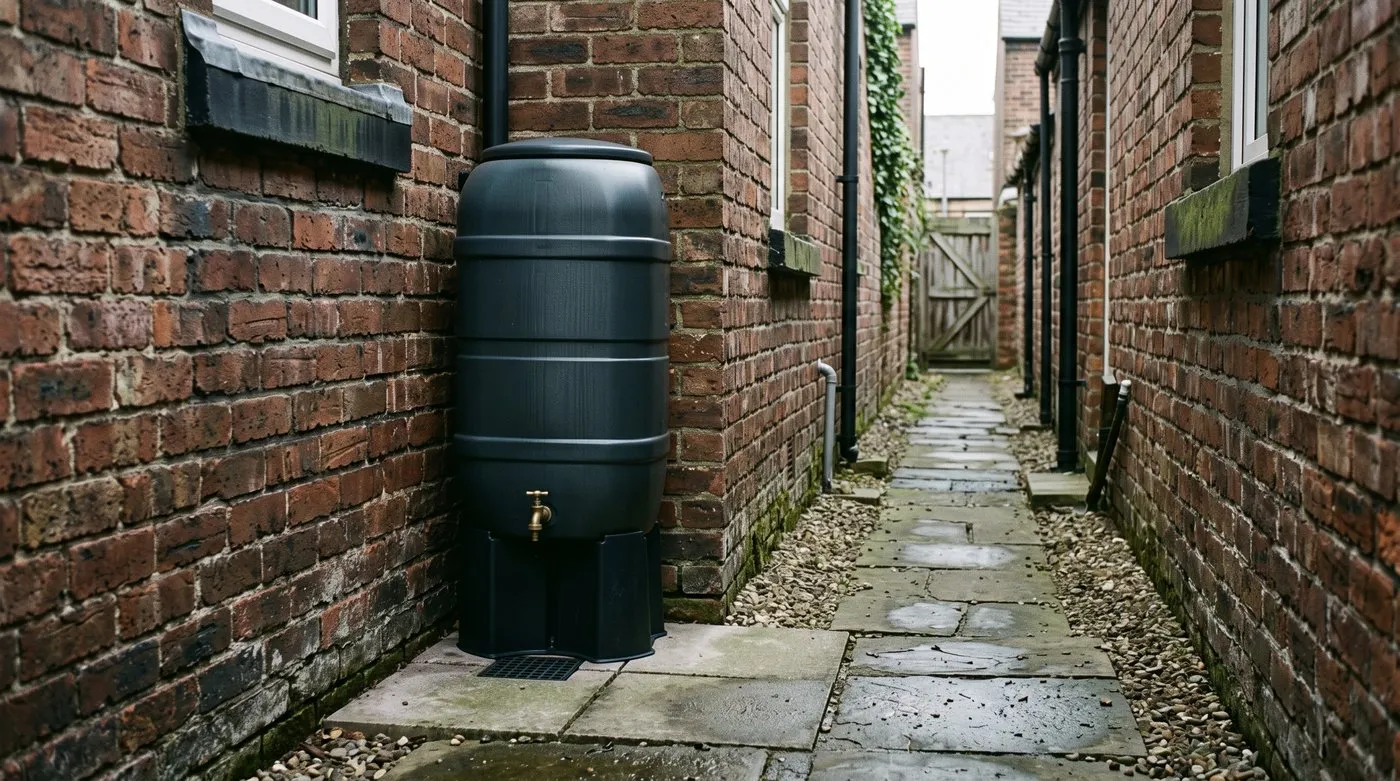 A slimline butt in a Newcastle terrace side return. At 40cm deep it leaves the full path width clear, and the raised plinth gives watering can clearance under the tap.
Oak barrel, stone-effect and planter-topped styles compared
Once you get past the shape, style is the choice that matters. Four families dominate the UK market and they age very differently.
Real oak barrels are reclaimed whisky or wine casks, usually 190 to 230 litres. They look better than anything else and they are the only option that improves with age. The catch is maintenance: an oak barrel must never dry out completely, or the staves shrink and the joints leak. Expect £150 to £320 and a lifespan of 10 to 20 years if kept part-full year round.
Stone-effect and terracotta-effect butts are moulded polyethylene with a textured finish. They hold 200 to 250 litres, cost £90 to £180, and are convincing from three metres away. UV stabilisation is the thing to check. Cheap mouldings chalk and fade within four summers, while UV-stabilised versions hold colour for 10 years or more.
Planter-topped butts carry a shallow tray in the lid for bedding or herbs. The design works, with one honest caveat: the tray eats 15 to 25 litres of the quoted capacity, and the planting needs its own watering because the tray is sealed from the tank. Use shallow-rooted trailers such as thyme, sedum or trailing lobelia in 12cm of compost.
Modern colour-matched butts in anthracite, sage or charcoal are the easiest win in a contemporary garden. Matching the butt to the fence stain or window frames makes it disappear far more effectively than trying to hide it.
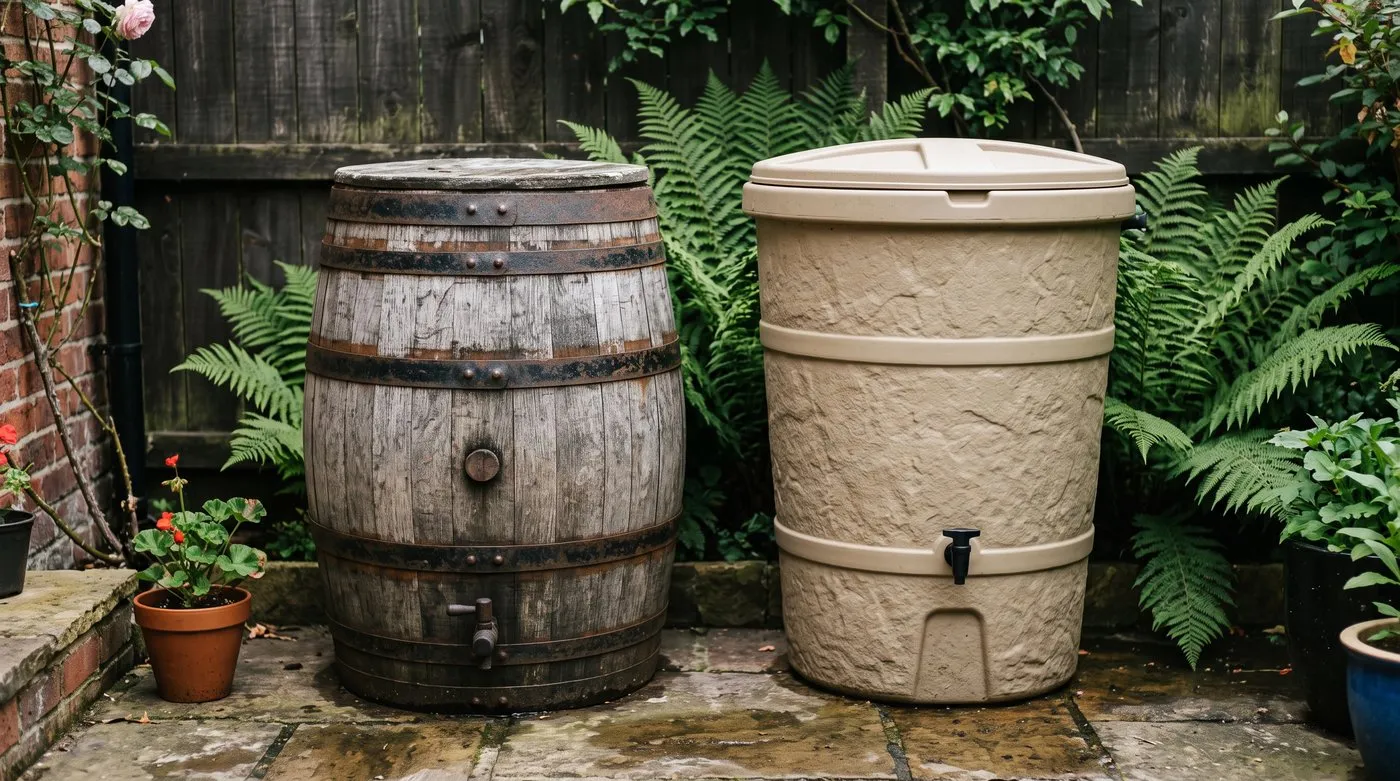 A reclaimed oak cask next to a moulded stone-effect tank. The oak weathers silver and improves; the moulding holds its colour only if it is properly UV stabilised.
Screening, boxing in and making a butt disappear
Sometimes the right answer is not a prettier tank but a better setting. Three approaches work reliably in small UK gardens.
Slatted timber boxing is the strongest visual fix. Build a three-sided frame from 45x45mm treated batten, clad it with 20mm slats at 15mm spacing, and leave the front open or hinged for tap access. Materials for a 1.2m tall enclosure cost £60 to £110. Stain it the same colour as the fence and the butt reads as garden joinery.
Planting softens rather than hides. A butt against a wall takes a climber on wires either side: Trachelospermum jasminoides for evergreen cover, or Clematis ‘Bill MacKenzie’ for late colour. Keep planting at least 30cm off the tank so you can still reach the tap and the overflow.
Position is the free option people skip. A butt on the shaded north side of the house stays algae-free far longer than one in full sun, because light drives the green bloom inside the tank. It is also usually the side nobody looks at. If you are working with a narrow passage, our side return garden ideas guide covers how to lay the whole strip out so the butt is part of the plan.
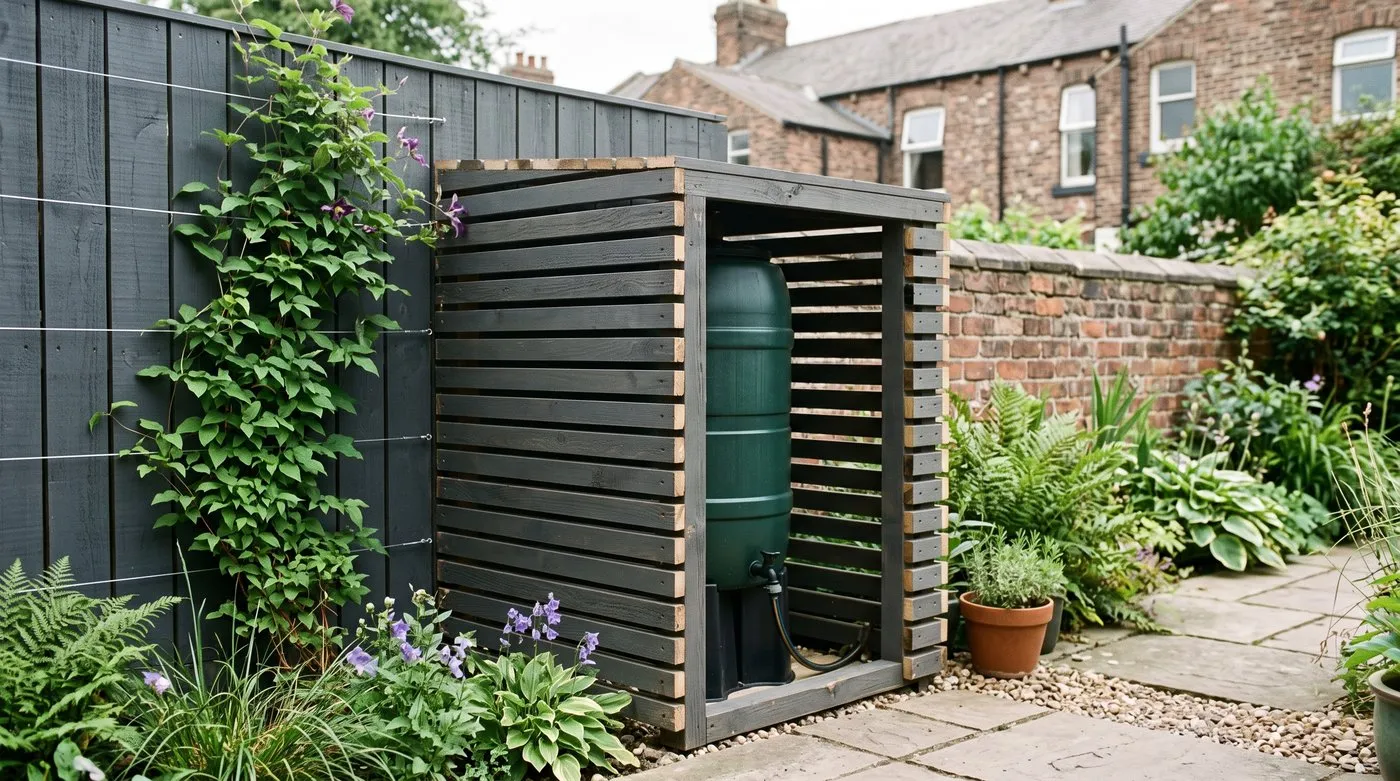 Slatted timber boxing stained to match the fence. The open front keeps the tap reachable and the 15mm slat gaps let air move so the timber dries.
What a rain chain is and where kusari-doi came from
A rain chain replaces a closed downpipe with an open chain that guides water down by surface tension and gravity. The Japanese name is kusari-doi, literally chain gutter, and the form has been used on temples and teahouses for several hundred years. Water clings to the metal, runs cup to cup or link to link, and arrives at a basin below.
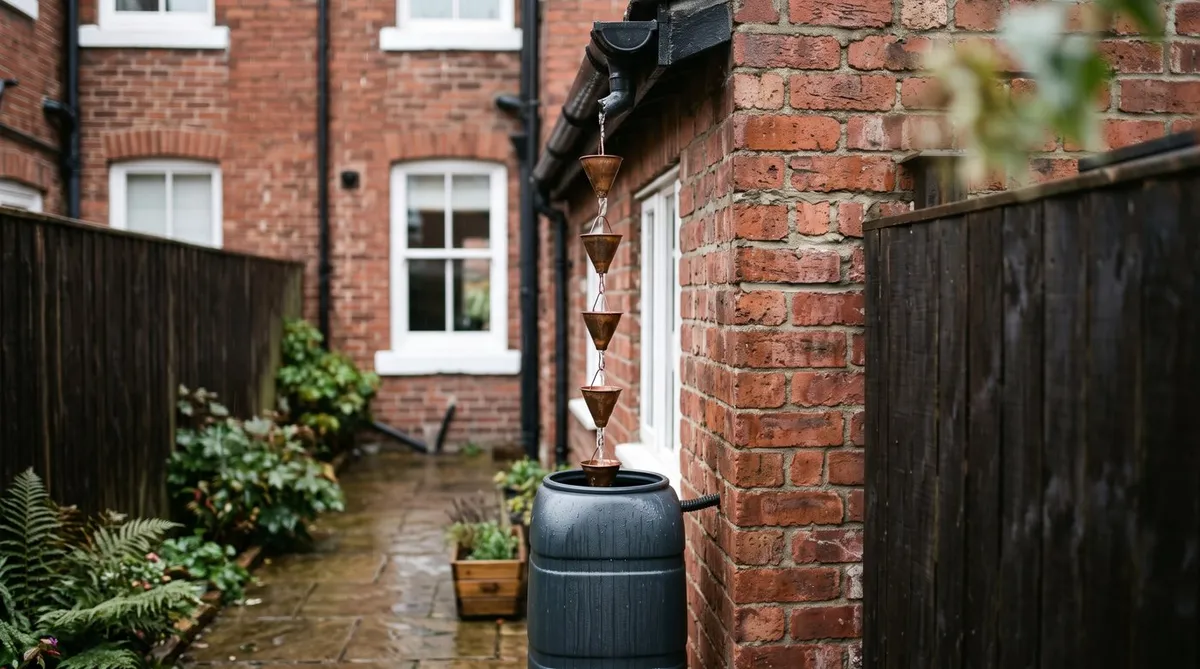
Two designs dominate. Cup chains use a series of small open funnels, typically 60 to 90mm across, strung 15 to 20cm apart. Each cup catches the flow from the one above, holds it briefly and releases it through a hole in the base. Cups handle more volume and make more visual movement, which is why they are the common choice.
Link chains use plain interlocking rings or loops with no cups. They are quieter, cheaper and more modern-looking, but they carry noticeably less water before the flow breaks away from the metal.
Standard lengths run 2.0 to 2.7 metres, matching eaves height on a typical UK two-storey house, with extension sections available. Weight matters more than it sounds: a 2.5m copper cup chain weighs 2.5 to 4kg when dry and considerably more when full. The gutter outlet must be sound before you hang one.
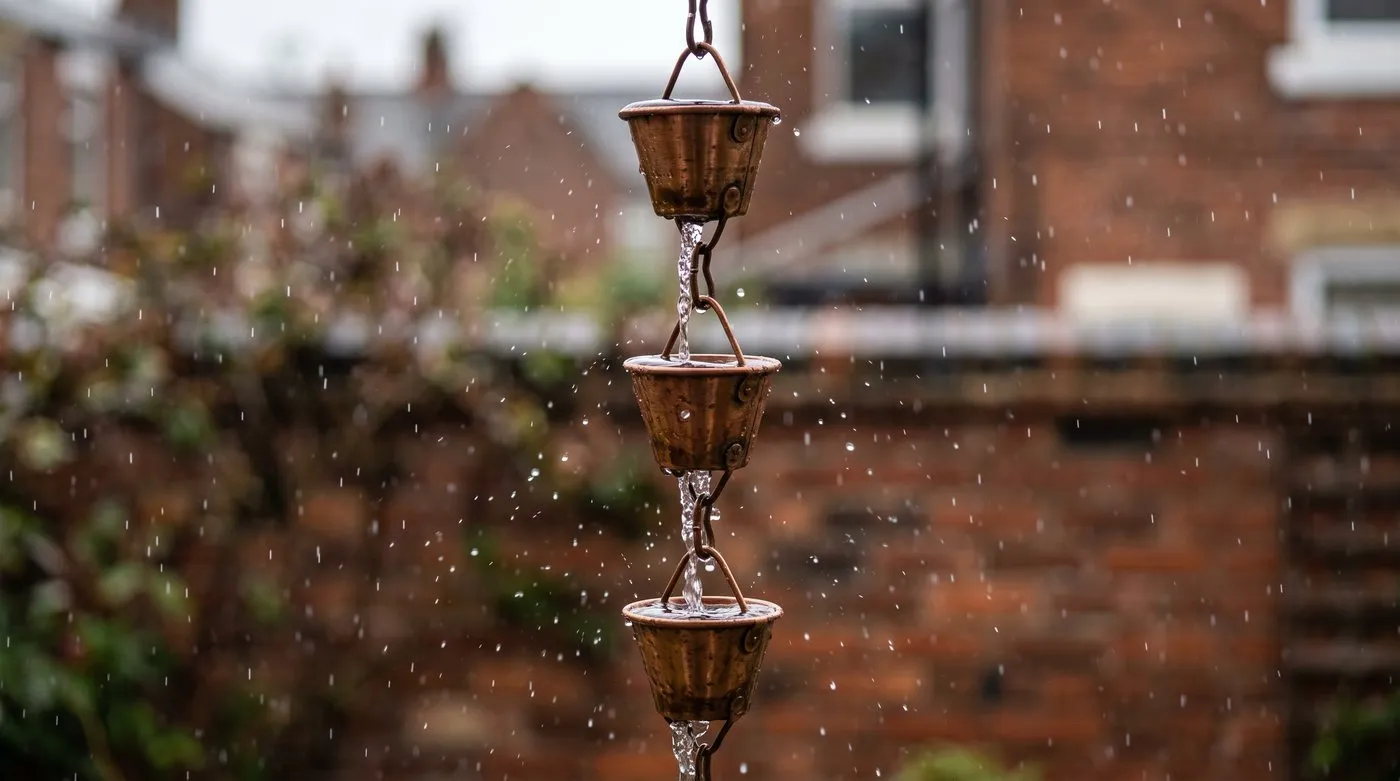 A copper cup chain during steady light rain. Each cup fills, holds briefly and releases through the base, which is what produces the slow visible cascade.
Copper, stainless steel or aluminium: how the metals age
Metal choice decides both how the chain looks in year five and how much it costs on day one.
Copper is the traditional and the best-looking option. It arrives bright, dulls to a warm brown within 2 to 3 months, moves to grey-brown, and greens to a verdigris patina over roughly 3 to 5 years in UK conditions. Coastal and industrial air speeds this up. Copper is soft, so cups dent if the chain swings against brickwork in wind. Expect £90 to £220 for a 2.5m cup chain.
Stainless steel stays close to its original colour indefinitely. Grade 304 is fine inland; specify grade 316 within about 10 miles of the coast, because 304 pits in salt air. Steel chains are heavier and stiffer, cost £60 to £140, and suit contemporary gardens where the greening of copper would look wrong.
Powder-coated aluminium is the budget entry at £30 to £70. It is light, which is both the advantage and the problem: a light chain swings hard in wind and the coating chips where cups strike each other. Chipped coating on aluminium leaves a white oxide bloom rather than rust.
Avoid plain mild steel and thin galvanised chain. Both rust through within three to four British winters and stain whatever sits below.
| Material | Cost, 2.5m cup chain | Weathering | Wind behaviour | Role |
|---|---|---|---|---|
| Copper | GBP 90 to 220 | Greens over 3 to 5 years | Heavy, hangs still | Gold standard, best looks and longevity |
| Stainless 316 | GBP 80 to 140 | Almost no change | Very stable | Best for coastal and modern schemes |
| Stainless 304 | GBP 60 to 110 | Light spotting inland | Stable | Good inland value option |
| Powder-coated aluminium | GBP 30 to 70 | Chips at contact points | Swings, needs anchoring | Budget or sheltered courtyard only |
| Galvanised or mild steel | GBP 20 to 40 | Rusts within 3 to 4 winters | Variable | Avoid, stains everything below |
Copper is the gold standard because it is heavy enough to hang still, thick enough to survive twenty years, and it is the only material that gets better looking with age. What copper cannot do is stay bright. If you want a chain that looks the same in 2036 as it does today, buy 316 stainless.
How rain chains behave in a real UK downpour
This is the part the shopping features skip. A rain chain is not a downpipe and it does not perform like one. Water moves down a chain by clinging to the metal, and that mechanism has a hard ceiling.
Below roughly 6mm of rainfall per hour a cup chain carries the flow cleanly with no meaningful splash. Between 6 and 12mm per hour the cups run full and some water begins to leave the chain on the outside. Above about 12mm per hour the flow skips the cups entirely and sheets outwards, hitting the ground in an arc 40 to 80cm wide.
UK rainfall makes this manageable but not rare. Most British rain events sit under 4mm per hour. Summer convective downpours regularly exceed 20mm per hour for short bursts, and a handful of hours each year run higher still. So the chain will overflow, several times a year, and the design has to allow for it.
Three practical consequences follow. First, never fit a chain where the splash zone touches a rendered wall, a door threshold or timber cladding. Keep at least 60cm of clearance. Second, always keep the ability to refit a downpipe: retain the original outlet parts. Third, on a north or west elevation exposed to driving wind, a light chain will be pushed off vertical and water will land where you did not plan. Anchor the base.
Warning: Never fit a rain chain to the only downpipe serving a large roof plane above a basement lightwell, a cellar door or a below-ground entrance. A 25mm per hour burst on a 40 square metre roof delivers about 1,000 litres in an hour, and a chain cannot control where that goes.
Managing splash: the basin, the dry well and the butt inlet
Everything about a rain chain’s success happens in the last 30cm. Three termination options work, ranked by how much water they handle.
- Into a water butt inlet. The best option because it captures the water. Fit a wide-mouth funnel or an open-topped diverter under the chain, then hose into the butt. Keep a mesh screen over the funnel or leaves will block it by November.
- Into a stone basin over a dry well. Set a 40 to 50cm glazed or stone basin at ground level, fill it with 40 to 60mm cobbles, and dig a 30 to 40cm deep pit beneath filled with 20mm clean stone and wrapped in geotextile. The cobbles break the fall and the pit takes the volume away.
- Into a gravel spread. The weakest option. Bare gravel scours within weeks under a concentrated flow, leaving a crater and throwing grit up the wall.
The anchoring stake is the detail everyone forgets. Most chains ship with a short spike or a weighted base ring. Drive it in so the chain hangs under slight tension, otherwise wind swings the chain against brickwork and dents the cups within a season. Two anchor points, one at the base and a light guy at mid-height, cure this completely on exposed walls.
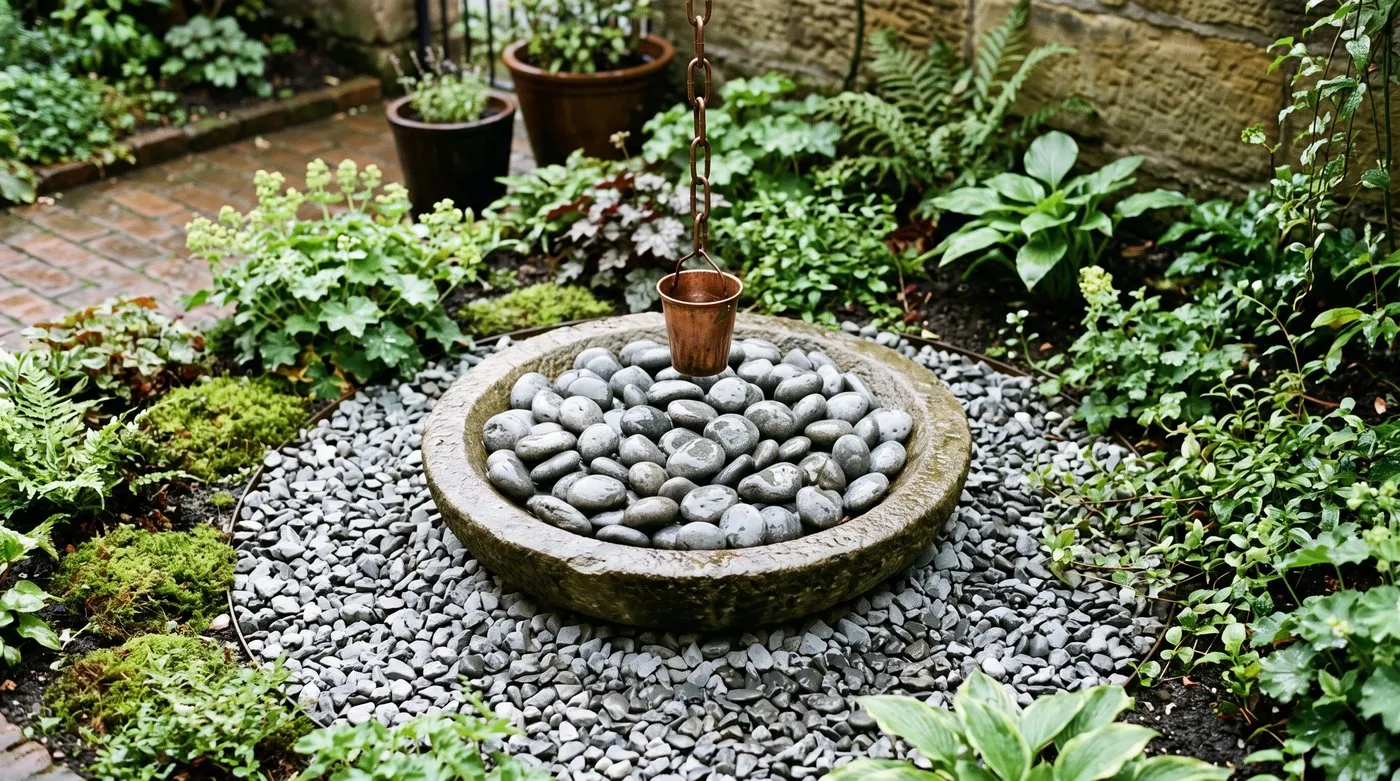 A 45cm basin of 40 to 60mm cobbles over a stone-filled dry well. This is what stops a chain scouring a crater and throwing grit up the wall.
Fitting a rain chain to a standard UK gutter outlet
UK guttering is not Japanese guttering, and this is where most installations stall. Standard domestic downpipe outlets are 68mm round or 65mm square, with 80mm and 110mm used on larger properties. Measure before ordering any adaptor.
The job takes about an hour. Remove the existing downpipe by unscrewing the wall brackets and lifting it off the outlet spigot. Keep every part, because you may want to refit it. Fit a V-shaped chain hanger or a gutter outlet adaptor into the outlet: a hanger sits across the gutter and needs no modification, while an adaptor pushes into the spigot and centres the flow better.
Hang the chain from a stainless steel S-hook or quick-link, never a plain steel one, because a mild steel link rusts and stains a copper chain. Adjust the length so the last cup sits 10 to 15cm above the basin or funnel. Too high and it splashes; too low and it sits in standing water and corrodes.
Two checks before you walk away. Run a hose into the gutter at moderate flow and watch where the water actually leaves the chain. Then check the gutter fall: a chain outlet works best with the gutter falling towards it at about 1:350, roughly 3mm per metre. A back-falling gutter will pond and overflow along its length instead of feeding the chain.
 Fitting a V-hanger into a 68mm outlet on a Newcastle terrace. The original downpipe parts are worth keeping in case the elevation turns out to be too exposed.
Working out how much water you can actually collect
The calculation is simple and it changes how people size a butt. One millimetre of rain falling on one square metre of roof gives one litre of water. Use the roof footprint in plan, not the sloping surface area, because a pitched roof intercepts rain over its plan area.
Allow a collection efficiency of about 80 to 90 per cent for a tiled roof, losing the rest to wetting, evaporation and gutter splash. Newcastle averages roughly 650mm of rain a year, so a 30 square metre extension roof yields around 17,000 litres annually at 85 per cent efficiency. Check your own figure against the Met Office UK climate averages for the nearest station.
| Roof area | 1mm of rain | Average UK month (60mm) | Wet month (100mm) |
|---|---|---|---|
| 6 sqm shed | 6 litres | 306 litres | 510 litres |
| 12 sqm garage | 12 litres | 612 litres | 1,020 litres |
| 20 sqm lean-to | 20 litres | 1,020 litres | 1,700 litres |
| 30 sqm extension | 30 litres | 1,530 litres | 2,550 litres |
| 60 sqm house half | 60 litres | 3,060 litres | 5,100 litres |
The lesson is blunt. A single 200 litre butt on a 30 square metre roof fills from under 8mm of rain and then overflows for the rest of the month. Decorative butts are about presentation and top-up watering, not self-sufficiency. Size the visible tank for looks, and if you genuinely need volume, link a second unit or put a large plain tank out of sight and cover the rest with water-efficient gardening techniques.
Month-by-month care for butts and chains
| Month | Task |
|---|---|
| January | Check the butt is not frozen solid and the tap is drained. Ice splits taps, not tanks. |
| February | Inspect chain anchoring after winter gales. Straighten dented cups and re-tension the stake. |
| March | Scrub the butt interior with a stiff brush and rinse. Do not use bleach. |
| April | Refit any winter-removed diverter. Check the overflow hose runs to a drain or dry well. |
| May | Top up oak barrel styles so the staves stay swollen through dry weather. |
| June | Clear the chain funnel mesh of tree seed and pollen debris. |
| July | Watch tank level in heat. Shade the butt or accept an algae bloom by August. |
| August | Empty and rinse any butt that has gone green. Sunlight is the cause, not the water. |
| September | Clear gutters before autumn leaf fall so the chain outlet stays free. |
| October | Fit or check the leaf mesh over any funnel. Peak blockage month. |
| November | Reduce butt level to about 80 per cent before hard frosts. |
| December | Lag exposed taps. Inspect copper patina and leave it alone: it protects the metal. |
Why we recommend a copper cup chain into a basin
Why we recommend the copper cup chain and cobble basin combination: We tested two copper chains, one 316 stainless link chain and one powder-coated aluminium chain across 24 logged rainfall events in north Staffordshire between October 2023 and March 2026. The copper cup chain carried visibly more water before breaking away than the link designs, holding a clean cascade to about 10mm per hour where the plain link chain broke away at around 5mm. The aluminium chain chipped at four cup contact points inside one winter and swung badly in gales above 40mph. Set over a 45cm cobble basin and a 30cm dry well, the copper chain produced zero wall staining across the full period, against visible grit splash up to 60cm high on the bare gravel control. Solid copper cup chains are stocked by Rainwater Terrace and Wildflower Turf’s garden ranges, and by Celtic Sustainables, from around £95.
Why decorative butts get rejected: the real root cause
The underlying reason people abandon a decorative butt is rarely the tank. It is tap height and access, and it is designed in on day one.
Standard butt taps sit 15 to 25cm above the base. A 10 litre watering can is around 32cm tall. Without a stand, you cannot fill a can, so you fill a jug, tip it into the can, and after three weeks you go back to the outside tap. The butt then sits full, unused, and greening.
This is missed because the problem only appears after installation. Retailers photograph butts on the ground because they look better that way, and the plinth is a separate line item most people skip. The fix is permanent and cheap: set the butt on two 450mm concrete slabs plus a course of blocks, giving roughly 30cm of lift for around £25, or buy the matching plinth. That single decision determines whether the butt gets used every week or never.
The second root cause is overflow with nowhere to go. A butt with a blanked overflow floods the base of a wall through every wet month. Run a 25mm overflow hose to a border, a dry well or a rain garden, and the problem disappears permanently.
 Tap clearance is the detail that decides whether a butt gets used. Roughly 30cm of lift lets a full-size can sit under the tap without tilting.
Common mistakes with decorative butts and rain chains
- Buying on tank volume alone. The quoted litres often include the dead volume below the tap and above the overflow. Usable capacity is commonly 10 to 15 per cent lower. Ask for the usable figure, or measure from tap to overflow.
- Fitting a chain on the most exposed elevation. A west-facing wall in an exposed spot swings the chain and throws water sideways. Choose a sheltered elevation where the cascade is visible from a window or a seating area.
- Letting a chain discharge onto soil or grass. Concentrated flow scours a crater in weeks and kills the turf around it. Always terminate into a basin, a funnel or a stone-filled well.
- Skipping the plinth. Without 25 to 30cm of lift the tap will not clear a watering can, and the butt goes unused. Budget for the stand at the same time as the tank.
- Ignoring roof material. Do not collect from a roof with lead flashing runoff, bitumen felt in poor condition, or moss-treated tiles, for edible crops. Use that water on ornamentals only.
The RHS guidance on water collection and storage covers the public health side of using stored rainwater on edibles.
Gardener’s tip: Set a decorative butt on the shaded side of the house. Algae growth in a water butt is driven by light, not by dirty water. A north-facing position keeps a tank clear for two to three times longer than a south-facing one, with no chemicals and no scrubbing.
What decorative rainwater kit actually costs
| Item | Typical UK cost | Note |
|---|---|---|
| Slimline decorative butt, 150L | GBP 70 to 140 | Check UV stabilisation on stone-effect finishes |
| Real oak barrel butt, 190 to 230L | GBP 150 to 320 | Must be kept part-full or the staves shrink |
| Wall-mounted butt, 100L | GBP 90 to 180 | Needs sound masonry and 2 heavy brackets |
| Matching plinth or stand | GBP 20 to 40 | The single most skipped item |
| Linking kit for two butts | GBP 12 to 20 | Doubles capacity without doubling footprint |
| Downpipe diverter and filter | GBP 15 to 35 | Winter-bypass models are worth the extra |
| Copper cup rain chain, 2.5m | GBP 90 to 220 | Weight keeps it hanging straight |
| Stainless steel chain, 2.5m | GBP 60 to 140 | Specify 316 within 10 miles of the sea |
| Gutter outlet adaptor and hanger | GBP 12 to 30 | Measure the outlet: 68mm round or 65mm square |
| Basin, cobbles and dry well materials | GBP 40 to 90 | The part that stops all the splash problems |
The hidden costs are the plinth, the overflow hose run and the leaf mesh. Together they add £50 to £90 to a job most people budget at the price of the tank alone. Skip them and the installation fails within a year for reasons that have nothing to do with the butt itself.
Now you have the look sorted, get the volume right with our practical guide to installing a water butt, or browse more of our garden design guides for the next project.
Frequently asked questions
Do rain chains actually work in heavy UK rain?
Rain chains cope well with light and moderate rain but overflow in downpours. Above roughly 12mm of rainfall per hour the water skips the cups and sheets outwards. In a UK garden that means a few events a year, so plan the splash zone and drainage rather than assuming it never happens.
How much water does a decorative water butt hold?
Slimline decorative butts typically hold 100 to 200 litres. Oak barrel and stone-effect styles usually run 150 to 250 litres. Wall-mounted units are smaller at 80 to 130 litres. Check whether the quoted figure is the tank volume or the usable volume below the overflow.
How much rainwater can I collect from my roof?
One millimetre of rain on one square metre of roof yields one litre. Multiply your roof footprint in square metres by the monthly rainfall in millimetres. A 30 square metre extension roof in a 60mm month collects around 1,800 litres, far more than one butt can hold.
Can you fit a rain chain to a normal UK gutter?
Yes, most UK gutters take a rain chain with a simple outlet adaptor. Standard downpipe outlets are 68mm round or 65mm square. Remove the downpipe, fit a V-shaped hanger or chain adaptor into the outlet, and hang the chain from it with a stainless steel clip.
Do copper rain chains go green?
Yes, copper develops a green verdigris patina over roughly three to five years outdoors. It starts as a warm brown after a few months, then dulls to grey-brown, then greens. Lacquered copper delays this but the coating usually fails within two years and patinas unevenly.
Are slimline water butts worth it for a narrow garden?
Yes, slimline butts fit side returns where a round barrel cannot go. A typical slimline unit is 40cm deep, 60cm wide and 120cm tall, holding around 150 litres. Two linked in series give 300 litres along a side passage without blocking the path.
Where should the base of a rain chain end?
Into a basin, a butt inlet or a stone-filled dry well. Never let a chain discharge onto bare soil or a lawn, because the concentrated flow scours a hole within weeks. A 40 to 50cm basin of 40 to 60mm cobbles over a stone-filled pit handles the splash and the volume.
Lawrie has been gardening in the West Midlands for over 30 years. He grows his own veg using no-dig methods, keeps a wildlife-friendly garden, and writes practical advice based on real UK growing conditions.