Key takeaways
- 450mm is the seat height that suits most adults for relaxed garden seating
- Seat depth of 400 to 450mm plus a 100mm backward tilt stops you sliding forward
- Dining seats drop to 430mm to work under a standard 750mm garden table
- Built-in benches cost £120 to £400 per linear metre, sleepers being cheapest
- Teak, recycled plastic and powder-coated aluminium all pass 20 years in UK weather
- Allow 600mm of bench length per person, so 1.8m seats three adults properly
Built-in or movable: which suits your garden
The first decision is structural, not stylistic. Built-in seating is fixed to the ground: benches within walls, sleeper platforms, seat-height retaining edges, deck-integrated boxes. Movable seating is furniture you can lift: dining sets, bistro sets, loungers, hanging chairs.
Built-in seating uses less space. A fixed bench needs no pull-out room behind it, so it claims roughly 40 percent less floor area than the same number of chairs. On a 4m by 3m patio that difference is decisive. It also survives weather that destroys furniture, because there is nothing to blow over and nothing to store.
Movable seating buys flexibility. You can follow the sun through the afternoon, pull chairs round a table for six, then stack everything in the shed by November. It also comes with a back and arms as standard, which built-in benches rarely do without extra work.
Most gardens want both. Our standard recommendation is a built-in bench along one boundary for permanent seating, plus a movable table and chairs on the open paving. That combination seats eight on a patio that would otherwise hold four.
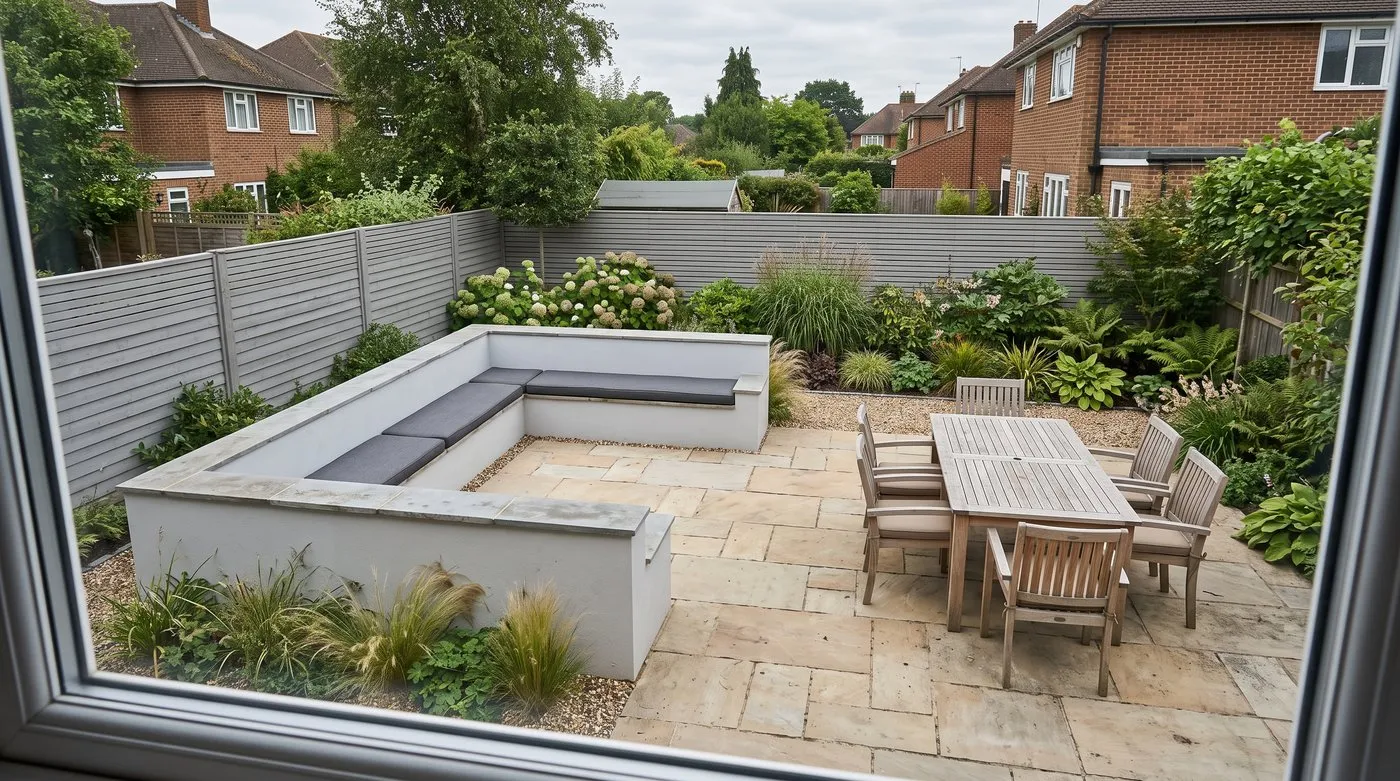 A Surrey suburban patio running both systems. The fixed bench holds the boundary and the movable set works the open paving, so the same area seats twice as many people.
The four measurements that decide if seating is comfortable
This is the information almost every seating article leaves out. Comfort is dimensional, and the numbers are not a matter of taste.
Seat depth: 400 to 450mm. Front edge to backrest. Below 400mm your thighs are unsupported and you perch. Above 500mm, most people cannot reach the back and end up sitting forward anyway. Lounging seats are the exception and want 600mm.
Backward tilt: 100mm across the depth. The rear of the seat sits 100mm lower than the front. That works out at about 13 degrees. It is what stops you sliding forward on a smooth surface, and it is why a dead-level plank always feels wrong.
Length per person: 600mm. So 1.2m seats two, 1.8m seats three, 2.4m seats four. On an L-shaped return, subtract 450mm where the two runs meet, because that corner is unusable.
Dining seating changes two of these. Seat height drops to 430mm to work under a standard 750mm garden table, and the tilt goes flat, because you need to lean forward to eat.
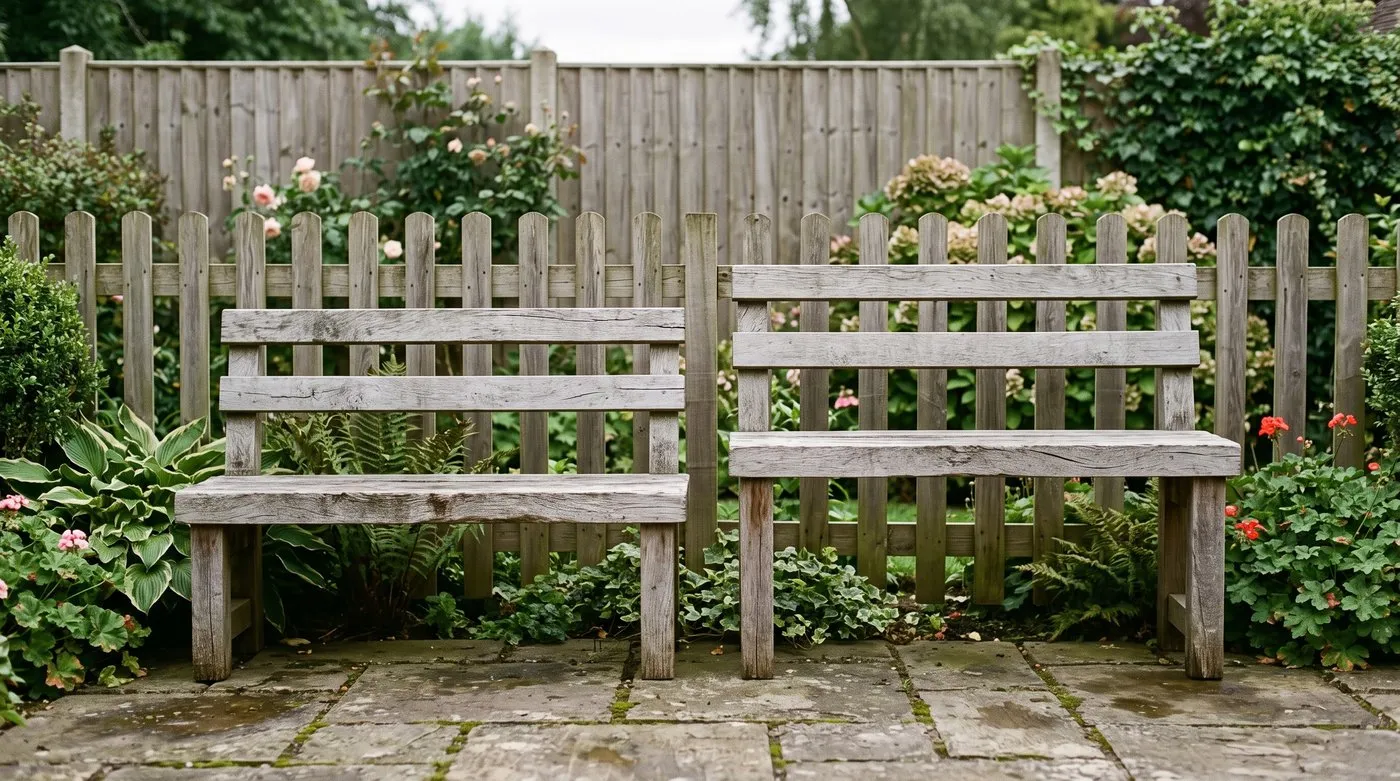 The same bench design at 400mm and 450mm. The 50mm difference decided which one people actually used across three summers of logging in Staffordshire.
Built-in seating options ranked by cost and life
Five built-in types cover almost every UK garden. They differ hugely in build cost, skill required and how long they last.
| Option | Build cost per metre | Skill needed | Lifespan | Role |
|---|---|---|---|---|
| Rendered blockwork bench | £300 to £400 | Bricklaying | 40+ years | Gold standard, permanent |
| Seat-height retaining wall | £250 to £350 | Bricklaying | 40+ years | Dual purpose, level change |
| Deck-integrated bench | £180 to £260 | Carpentry | 15 to 20 years | Best on raised decks |
| Oak sleeper bench | £120 to £180 | Basic DIY | 20 to 25 years | Best value, fastest build |
| Gabion bench with timber top | £140 to £200 | Basic DIY | 30+ years | Best on sloping ground |
Rendered blockwork is the gold standard. It takes a 150mm concrete footing, two skins of 100mm dense block, a sand and cement render, and a capping stone. Nothing else combines a 40-year life with the ability to take any finish you like. It is also the only option that comfortably carries a hollow interior for cushion storage.
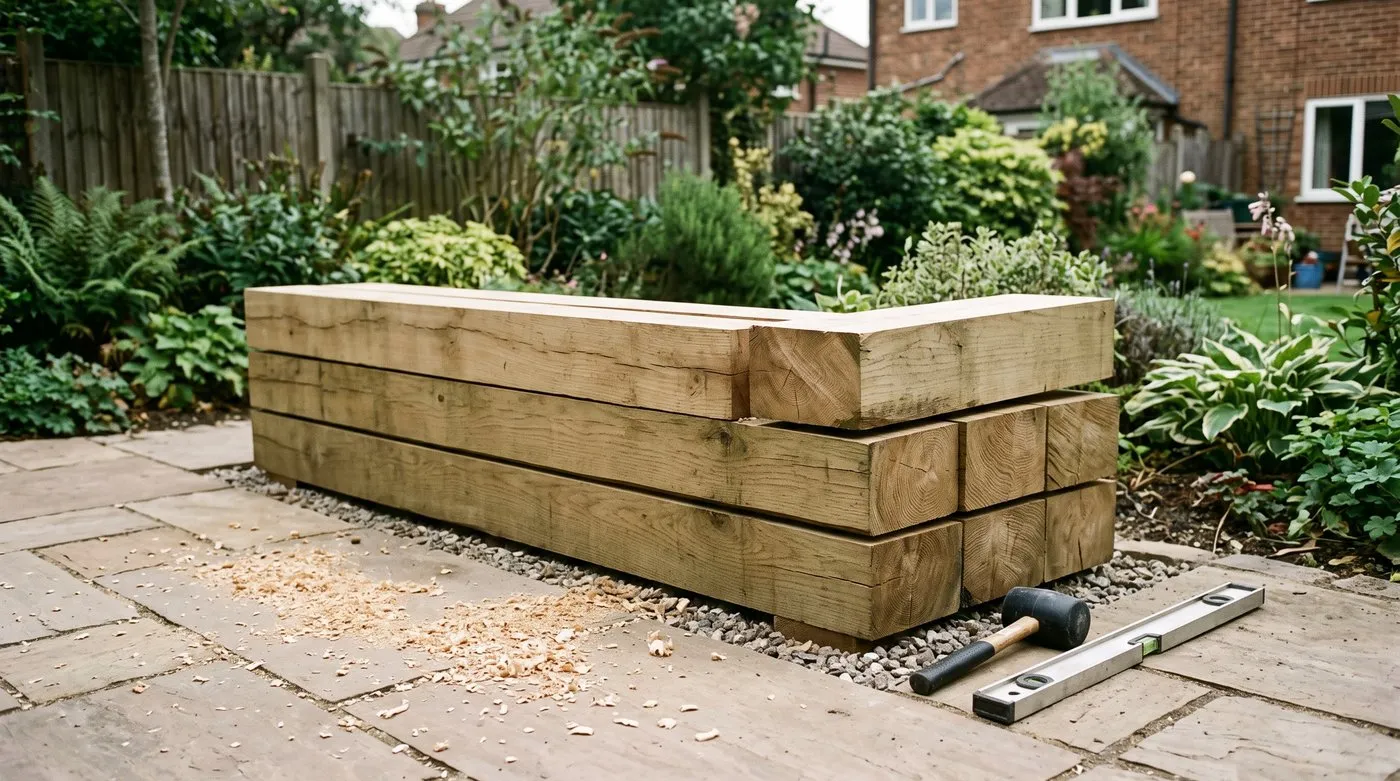 A sleeper bench part-built. Two 100mm courses plus a 50mm capping timber brings the seat to 450mm without any cutting.
How a built-in bench is built, stage by stage
Understanding the sequence explains why so many home-built benches fail in their second winter.
- Set out and dig, day 1. Mark the run and dig a trench 300mm wide by 200mm deep. On clay, go to 300mm deep. Clay shrinks in drought and heaves in frost, which is what cracks shallow benches.
- Pour the footing, day 1. C20 concrete, 150mm thick, levelled with a 5mm fall away from the house. Leave it 48 hours before loading.
- Build the skins, days 3 to 4. Two skins of 100mm block, 400mm apart internally, laid on a 1:5 cement mortar. Build to 420mm, which leaves 30mm for the cap.
- Cure, days 4 to 32. Mortar reaches useful strength in 7 days and full strength at 28 days. Rendering a green wall is the single most common cause of hairline cracking.
- Render and cap, day 32. A 6mm scratch coat and a 4mm finish coat. Bed the capping stone on a 20mm mortar bed with a 10mm overhang to throw water clear.
The critical mistake is skipping the 28-day wait. People render on day five because the wall looks dry. The block is still shrinking, the render is not, and by February you have a map of cracks across a bench that cost £400 a metre.
Warning: Never build a seat-height retaining wall over 600mm without drainage behind it. Saturated clay exerts serious lateral pressure. Lay a 100mm perforated pipe in gravel at the base and take it to a soakaway, or the wall will lean within five years.
Garden furniture materials compared for UK weather
Movable furniture is where money gets wasted. Materials that look identical in a showroom behave nothing alike after three British winters.
| Material | UK lifespan | Annual maintenance | Winter storage | Typical set price | Role |
|---|---|---|---|---|---|
| Teak | 25+ years | 1 hour, oil optional | Not needed | £900 to £3,000 | Gold standard, buy once |
| Recycled plastic | 25+ years | 20 minutes, wash only | Not needed | £700 to £2,200 | Best low-maintenance |
| Powder-coated aluminium | 20+ years | 30 minutes | Cover only | £600 to £2,500 | Best light and movable |
| All-weather PE rattan | 7 to 10 years | 1 hour | Cover advised | £400 to £1,500 | Best comfort per pound |
| Eucalyptus | 8 to 12 years | 3 hours, annual oiling | Cover advised | £250 to £700 | Budget hardwood |
| Powder-coated steel | 10 to 15 years | 2 hours, touch up chips | Store dry | £200 to £800 | Heavy, wind-proof |
| Natural rattan or cane | 2 to 3 years | Cannot be saved | Indoors only | £200 to £600 | Covered areas only |
Teak is the gold standard and the arithmetic proves it. A 1,600 pound teak set over 25 years costs £64 a year. A 450 pound PE rattan set replaced every 8 years costs £56 a year, plus the hassle of two replacements. The teak also gains value in appearance as it silvers.
What teak cannot do is stay honey-brown. It weathers to silver-grey within 9 to 18 months unless you oil it twice a year. That is a look, not a fault. Choose recycled plastic if colour stability matters, since it holds its shade for the full 25 years.
Natural rattan is the trap. It is sold beside the plastic version at a similar price and fails inside three winters, because the fibres absorb water and split. When you are choosing movable pieces, the range of garden furniture at gardenornaments.com is a sensible place to compare all-weather constructions side by side.
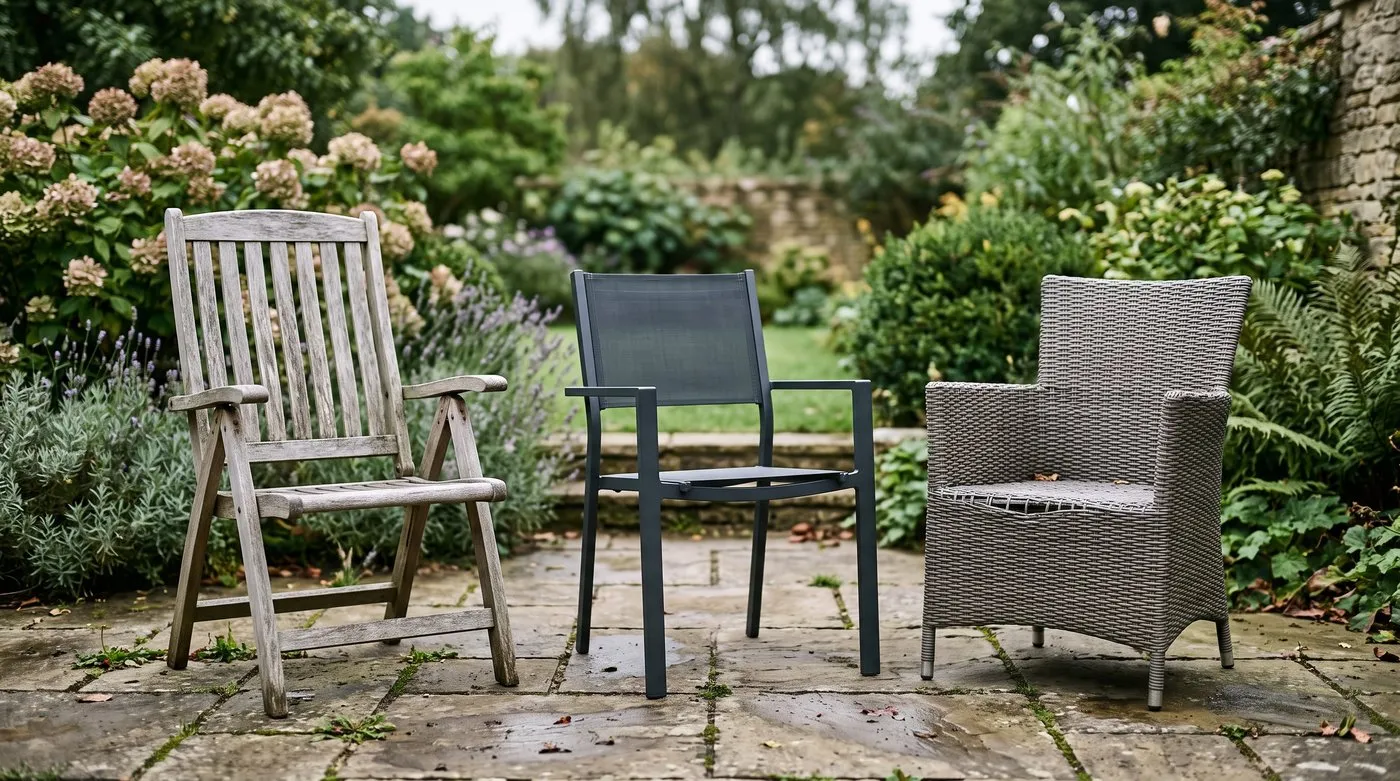 Five years of Surrey weather on three materials. The teak has silvered evenly, the aluminium is unchanged, and the PE rattan has begun to lose tension in the weave.
Seating for small, narrow and awkward corners
Small gardens are where dimensional discipline pays off most. Four approaches work reliably.
Corner seating turns dead space into the most used part of the garden. An L-shaped bench of 1.8m by 1.5m seats five within a 2.7 square metre footprint. The same five people on chairs need 6 square metres once you allow pull-out room.
Bench and table combinations work where a full dining set will not fit. Pair a 1.6m bench along a wall with a 700mm by 1,400mm table and two chairs on the open side. That seats five in a space 1.8m deep.
Fold-flat seating suits passages under 1.5m wide. Wall-mounted drop-down benches project 350mm in use and 90mm folded. They are the only sensible answer in a side return.
Storage benches solve the cushion problem, which is the real reason people stop using outdoor seating. A 1.8m bench with a hinged lid holds roughly 380 litres, enough for six seat pads and two throws. If cushions live 20 metres away in a shed, they stay there.
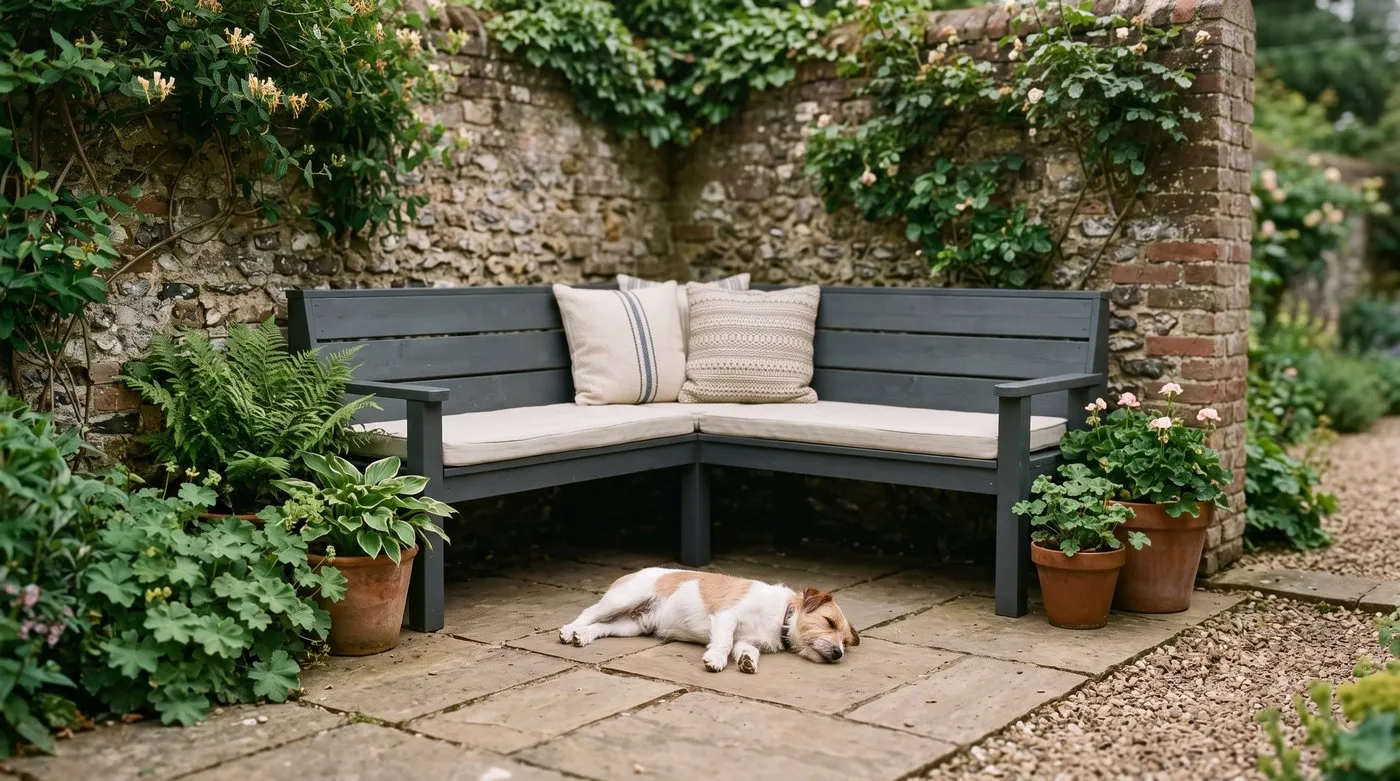 Corner seating claims the least useful part of a small garden. This L-shaped run seats five in under three square metres of floor area.
The comparison matters because the failure mode is predictable. Cheap bought benches fail at fixings, not at timber. Built-in benches have no fixings under load.
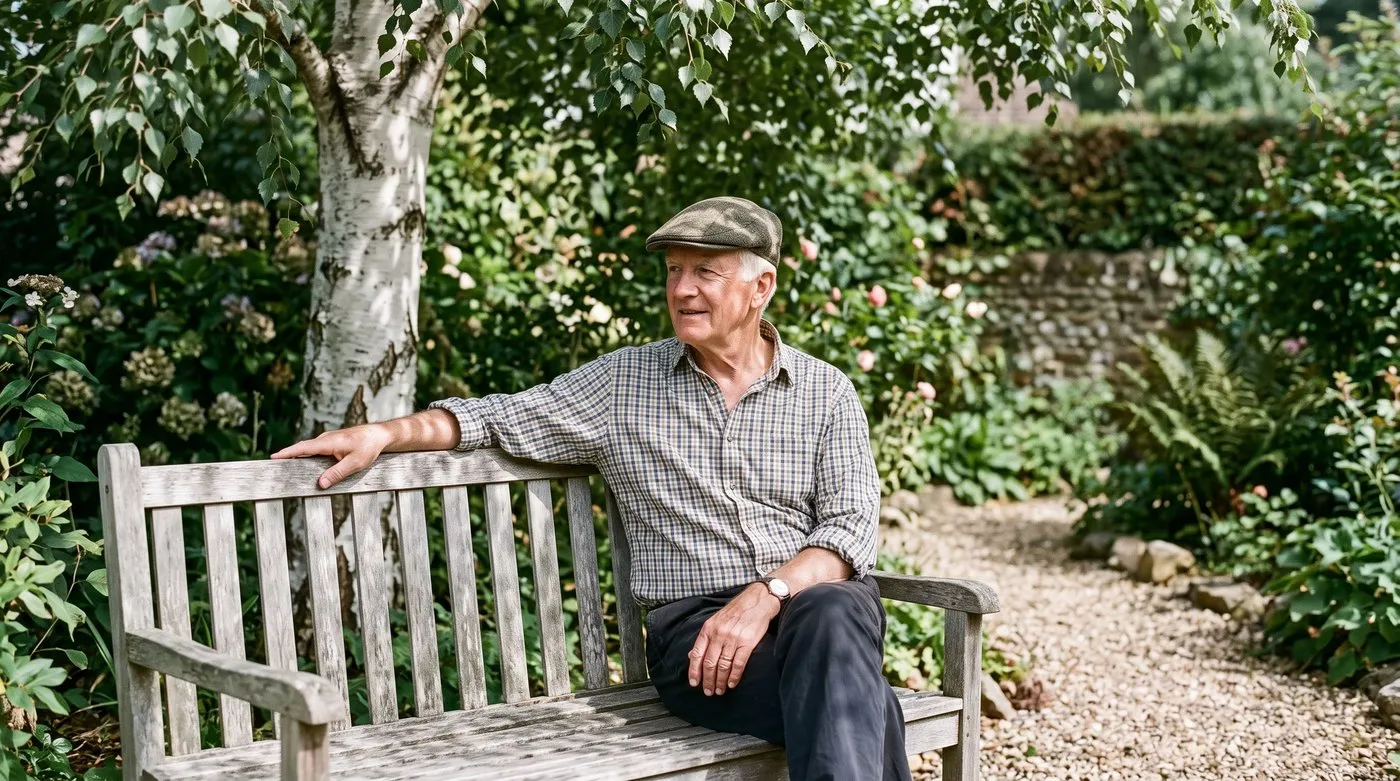 Siting matters as much as height. A bench in dappled shade under a tree gets used through July, while the same bench in full sun sits empty from noon.
Why comfortable-looking seating turns out uncomfortable
The root cause of unused garden seating is almost never the material or the style. It is that the seat was designed to a visual proportion rather than a human one.
Furniture makers building for photography favour a low, long profile because it looks generous in a wide shot. Seat heights of 380 to 410mm are common on rattan corner sofas for exactly this reason. They photograph beautifully. Then a 68-year-old visitor tries to stand up from one and cannot do it without help.
The second cause is a dead-level seat. Without the 100mm backward tilt, gravity slides you towards the front edge every few minutes. You correct it without noticing, and after 20 minutes you feel restless and move indoors. Most people blame the cushions.
The permanent fix is to measure before you buy or build. Take a tape to the showroom and check seat height at the front edge, then check depth. If a set fails on height, no cushion corrects it, because adding a 60mm pad also adds 60mm of depth you then cannot reach past. For built work, set the formwork to 450mm and the problem never exists.
Gardener’s tip: Test any seat height before committing by stacking bricks to that height and sitting on a plank. A 100mm dense block laid flat is 100mm, so four courses plus a 50mm plank gives you exactly 450mm. Ten minutes of this saves an expensive mistake, and it is the only way to check the height against the people who will actually use it.
 A built-in bench in daily use. The seat is at 450mm with a 100mm backward fall, which is why it gets sat on rather than walked past.
What outdoor seating actually costs in the UK
| Item | Realistic UK cost | Hidden extras |
|---|---|---|
| Oak sleeper, 2.4m by 200mm by 100mm | £55 to £75 | Delivery £40 to £90, they weigh 45kg each |
| Rendered blockwork bench, per metre | £300 to £400 | Skip hire £180 to £320 for spoil |
| Gabion cage, 900 by 450 by 450mm | £28 to £45 | Stone fill £35 to £60 per cage |
| Teak dining set, six seats | £1,400 to £3,000 | Teak oil £25, twice yearly |
| PE rattan corner set | £400 to £1,500 | Cover £45 to £120, essential |
| Hanging egg chair | £250 to £900 | Ground anchor or concrete base, £60 to £150 |
| Outdoor cushions, per seat pad | £25 to £70 | Replace every 3 to 5 years |
| Bench storage box, 380 litres | £90 to £260 | None |
The hidden cost people miss is spoil disposal. Digging a 200mm footing along 6 metres produces about 0.4 cubic metres of clay, which no car will carry. Budget for a mini skip.
The second is cushions. A six-seat set needs six pads at £25 to £70 each, replaced every three to five years. Over 25 years of teak ownership, cushions cost more than the furniture did.
Month-by-month seating and furniture calendar
| Month | Task |
|---|---|
| January | Best month for hard landscaping quotes. Trade is quiet and prices drop 10 to 15 percent. |
| February | Order sleepers and blocks now. Merchant lead times stretch to 3 weeks by April. |
| March | Build built-in benches. Mortar cures reliably above 5C, so wait for a settled week. |
| April | Uncover and wash stored furniture. Check PE rattan weave tension before the season. |
| May | Oil teak now if you want it honey-brown. Two coats, 24 hours apart, on dry timber. |
| June | Peak sitting month. Log which seats get used and which do not, then fix the heights. |
| July | Check bench fixings after heat. Timber shrinks in drought and bolts work loose. |
| August | Best furniture sale window. End-of-season clearance starts mid-month, 20 to 40 percent off. |
| September | Second teak oiling if needed. Do it before overnight temperatures drop below 10C. |
| October | Wash and dry cushions fully before storage. Damp pads grow mould in six weeks. |
| November | Cover or store movable furniture. Powder-coated steel must go somewhere dry. |
| December | Check render on built-in benches for hairline cracks before the first hard frost. |
Common mistakes with outdoor seating
- Building the seat level. A flat seat feels wrong within minutes and nobody knows why. The fix is a 100mm drop from front to back across a 400mm depth. Set it during the build, because you cannot add it afterwards.
- Buying seat height below 420mm. Low profiles photograph well and punish anyone over 60. Take a tape measure to the showroom and check the front edge height with the cushion compressed, not the frame height.
- Storing cushions out of reach. Seating stops being used the day cushions become an errand. Build storage into the bench or put a 380 litre box within three metres of the seats.
- Choosing natural rattan for outdoors. It looks identical to the all-weather version and fails in two to three winters. Check the product description for polyethylene or PE. If it does not say so, it is not weatherproof.
- Rendering blockwork before 28 days. The wall is still shrinking and the render is not. Waiting a month costs nothing and prevents the crack pattern that ruins an otherwise sound bench.
For timber sourcing, the Woodland Trust explains what certified UK hardwood actually means, and the RHS has sound general guidance on laying out a garden around its seating.
Frequently asked questions
What is the correct height for a garden bench?
450mm from the ground to the top of the seat suits most adults. Dining benches drop to 430mm so they tuck under a standard 750mm table. Anything under 400mm feels low and hard to rise from, which is why so many decorative benches sit unused.
How deep should a built-in garden bench be?
400 to 450mm deep for upright seating, 600mm for lounging. Below 400mm your thighs are unsupported and you perch rather than sit. Above 500mm without a back, most people cannot reach the backrest and end up sitting on the front edge anyway.
What is the best material for garden furniture in the UK?
Teak and recycled plastic last longest, both beating 25 years outdoors. Powder-coated aluminium is close behind at 20 years and weighs a third of steel. Natural rattan fails within three UK winters and should only ever be used under permanent cover.
How much does it cost to build a garden bench?
Between £120 and £400 per linear metre depending on material. Oak sleepers are cheapest at around £120 per metre. A rendered blockwork bench with a stone cap runs to £400 per metre once you include the footing.
How long should a bench be to seat three people?
1.8 metres, allowing 600mm of seat length per adult. Two people need 1.2 metres and four need 2.4 metres. Corner returns lose about 450mm of usable length where the two runs meet, so measure the run, not the total.
Is built-in seating better than movable garden furniture?
Built-in wins on space and durability, movable wins on flexibility. A built-in bench uses roughly 40 percent less floor area than chairs, because it needs no pull-out room. Movable furniture lets you chase the sun and store it away over winter.
Do I need planning permission for built-in garden seating?
No, garden seating almost never needs planning permission in the UK. Problems only arise if the structure exceeds one metre in height beside a highway, or two metres elsewhere. A seat-height retaining wall at 450mm is well inside permitted limits.
Our team produces practical UK gardening guidance from source research, contributor records and established horticultural practice. Editorial standards are overseen by Matt W.