Skip to content
Garden Design | | 12 min read

Side Return Garden Ideas That Work

Turn a narrow 0.9-1.8m side return into usable space. Vertical planting, slimline storage, drainage and shade plants tested in a Staffordshire terrace.

A side return is the narrow passage down the side of a Victorian or terraced house, usually 0.9-1.8m wide. Most run north or east-facing and get under 3 hours of direct sun a day. The space works best as a planted route: vertical planters on the walls, slimline bin and bike storage, a 600mm gravel or paved path, and a channel drain to clear the canyon of standing water. Shade ferns, hart's tongue and hardy geraniums survive against a north wall.
Typical Width0.9-1.8m for most UK terraces
Light LevelUnder 3 hours direct sun daily
Storage Gained1.4m floor, 320 litres in my terrace
Budget200 to 1,200 pounds typical spend

Key takeaways

  • Most UK side returns are 0.9-1.8m wide and get under 3 hours direct sun
  • Vertical planters on the walls add growing space without stealing the 600mm walking width
  • A slimline bin store and vertical bike rack freed up 1.4m of clear floor in my own terrace
  • A 100mm linear channel drain clears the standing water that plagues a shaded brick canyon
  • Hart's tongue fern, lady fern and hardy geranium survived four winters against my north wall
  • Budget 200 to 1,200 pounds depending on whether you keep gravel or lay porcelain paving
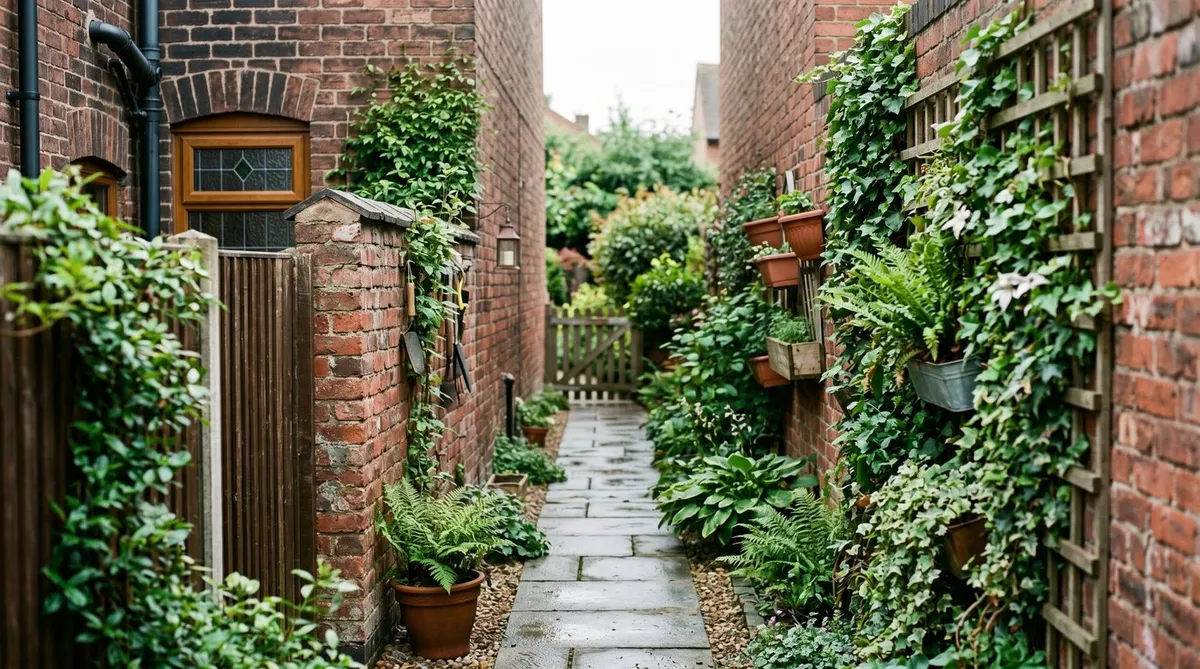
Narrow Victorian terraced side return passage with vertical planters and a trellis of ferns against brick walls

A side return garden is one of the hardest spaces to plan in a UK terrace. The side return is the narrow passage running down the side of a Victorian or terraced house, usually between 0.9m and 1.8m wide. Most are shaded, often muddy, and treated as a dumping ground for bins and bikes. Yet that strip is usable floor space you already own. With the right approach it becomes a planted route, a tidy storage bay, or a green corridor linking the front and rear.

This guide is built from a real terrace. I measured, planted and rebuilt my own 1.1m side return over four winters in Staffordshire. What follows is what held up, what failed, and the exact numbers behind each decision.

The RHS advice on planting in shade is a useful technical reference for the species side. This guide focuses on the build: the measurements, the storage maths, the drainage fix, and the plants that actually survived.

How wide is a side return and what does that allow?

Width decides everything in a side return. A standard Victorian terrace passage measures 1.0 to 1.3m across. Edwardian and 1930s semis run a little wider, often 1.4 to 1.8m. Anything under 900mm is really just a path, not a usable space.

The key number is the clear route you must keep. You need 600mm minimum to walk through comfortably and wheel a bin. On my 1.1m return that left only 500mm of width to split between both walls. Ground-level beds were a non-starter. The answer was to grow upward and store flat against the brick.

Measure your width at three points: the entrance, the middle, and the rear. Walls are rarely parallel in old houses. My passage narrowed from 1.15m at the front to 1.05m at the back, which mattered when sizing a bin store. Always work to the narrowest point, not the average.

Vertical growing is how you garden a narrow passage

Vertical planting is the single best use of a side return. Wall space is the one dimension you have plenty of. Fixing planters, troughs and trellis to the brick adds growing area without touching the 600mm walking width.

I fitted a timber trellis panel 1.8m tall to the shadier wall and hung four wall troughs at staggered heights. That gave roughly 0.9 square metres of planting from a strip that had no usable ground at all. Climbers like ivy and shade-tolerant clematis cover the trellis within two seasons.

Use galvanised or stainless fixings. A damp brick canyon corrodes cheap steel within a year; I lost two zinc-plated brackets to rust before switching. For the full method, our guide to vertical gardening ideas covers wall systems, pocket planters and irrigation in detail.

Gardener’s tip: Mount the heaviest planters lowest and water-test the wall first. A single 30cm trough holds around 12kg when wet. Drill into the brick, never the softer mortar joint, and use 8mm frame fixings rated for the load.
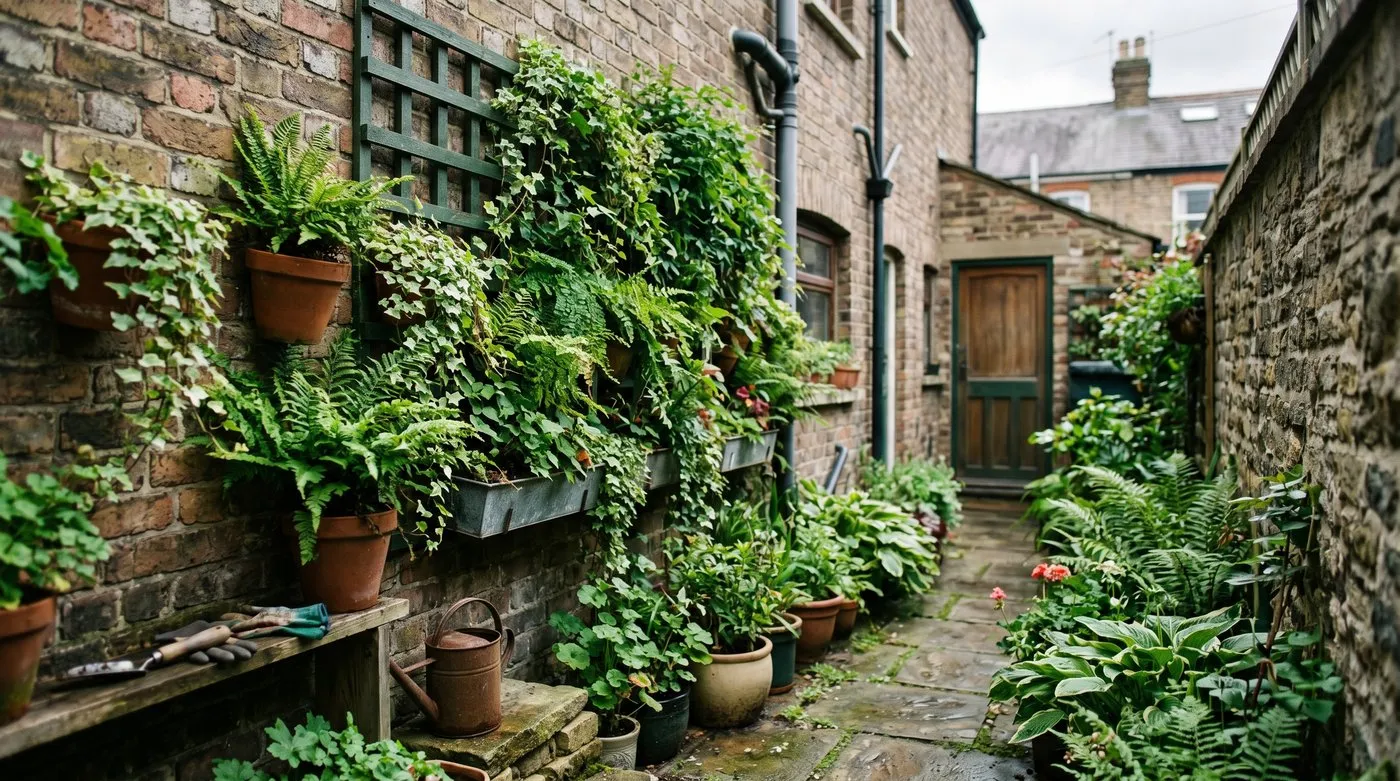
Vertical wall planters and a green trellis of ferns thriving against a shaded brick wall in a narrow UK side return Wall-mounted troughs and a trellis turn dead vertical brick into 0.9 square metres of planting without losing the path.

Slimline storage for bins, bikes and tools

Storage is what most side returns are really used for, and doing it badly eats the whole space. Sprawling wheelie bins and a flat-laid bike can block a passage entirely. Going vertical and slim is the fix.

In my terrace I replaced a cluster of three loose bins with a slim triple bin store measuring 1.8m long by 700mm deep. A vertical bike rack then held two bikes upright against the wall in 400mm of depth. Together these freed 1.4m of clear floor and added roughly 320 litres of tidy, lidded storage for recycling and tools.

Match storage depth to your width. On a 1.1m return, a 700mm-deep bin store still leaves 400mm to pass, which is tight but workable for a service route. If your passage is under 1.0m, choose 500mm-deep units instead. For screening unsightly bins on wider returns, see our guide to plants that hide bins.

ItemFootprintCapacityApprox cost
Slim triple bin store1.8m x 700mm3 wheelie bins180-260 pounds
Vertical bike rack (wall)600mm x 400mm2 bikes40-90 pounds
Wall-mounted tool rack1.0m x 150mm8-10 tools25-50 pounds
Slimline lockable cabinet700mm x 400mm320 litres120-200 pounds

Slim triple bin store and a vertical wall bike rack tidily organised in a narrow terraced side passage A slim bin store and vertical bike rack freed 1.4m of clear floor in my 1.1m Staffordshire return.

Drainage in a shaded canyon

Standing water is the most common side return problem and the most ignored. A narrow passage between two walls acts as a funnel. Rain runs off both roof slopes and the wall faces into a strip with nowhere to go. The shade keeps it wet for hours.

My return held standing water for three to four hours after heavy rain. The fix was a 100mm linear channel drain laid along the lowest edge, a 1m run connected to the existing rear gully. After fitting it the puddling stopped completely, even in winter.

A channel drain needs a fall of at least 1 in 80 towards the outlet. Set the grate flush with the finished surface. If you have no nearby gully, a soakaway pit filled with 20mm clean stone, dug 1m deep and 600mm wide, takes the run-off on free-draining ground. Avoid soakaways on heavy clay; they back up. Our garden path ideas guide covers sub-base build-up and falls for the surface above the drain.

Warning: Never seal a side return with solid concrete and no drainage. A non-permeable surface with no channel turns the passage into a long puddle and pushes water against the house wall, risking damp on the internal plaster.

Linear channel drain set into narrow grey paving with a metal grate in a UK side return passage A 1m run of 100mm channel drain cleared the standing water that lingered for hours in my passage.

Paving, gravel and decking for a narrow route

The surface sets the tone and the budget. Three options suit a side return: gravel, paving, or slatted decking. Each handles the damp, the width and the cost differently.

Gravel is cheapest and drains freely. Lay 40mm of 10-14mm angular gravel over a weed membrane on a compacted base. It costs around 200 to 400 pounds for a typical 6m run. The downside is it migrates underfoot and needs edging to hold the 600mm path line.

Porcelain or block paving is the cleanest option underfoot. It stays mud-free and looks deliberate. A laid run with sub-base costs 600 to 1,200 pounds depending on length and tile grade. Choose a textured R11 anti-slip finish; smooth porcelain grows algae and turns lethal in a shaded damp passage.

Slatted timber or composite decking lifts you clear of a wet base but rots or grows green in deep shade unless it is composite or treated softwood. I would only use it on a return with some airflow.

SurfaceDrainageCost (6m run)Slip risk in shadeBest for
Angular gravelExcellent200-400 poundsLowTight budgets, free draining
Porcelain pavingNeeds channel drain600-1,200 poundsLow if R11 texturedClean, permanent finish
Block pavingGood if permeable500-900 poundsMediumTraditional terrace look
Composite deckingGood (gaps)400-800 poundsMediumLifting over a wet base

Plants that survive a deep-shade side return

Planting a side return means planting for shade, and often deep shade. A north or east-facing passage gets under three hours of direct sun. The species that survive are woodland and shade-edge plants that evolved under tree canopy.

Against my north wall I trialled twelve species over four winters. The reliable survivors were hart’s tongue fern (Asplenium scolopendrium), lady fern (Athyrium filix-femina), hardy geranium (Geranium macrorrhizum) and common ivy. Hostas grew but were shredded by slugs in the damp. Heuchera sulked and two plants rotted off over winter.

Evergreens earn their place here because they hold cover through the dark months. For more shade species and combinations, our guide to north-facing garden ideas and the courtyard garden ideas guide both cover plants that take low light.

PlantLight levelHeightEvergreenSpread
Hart’s tongue fernDeep shade40-60cmYes40cm
Lady fernDeep to part shade60-90cmNo60cm
Hardy geranium ‘macrorrhizum’Part shade30-40cmSemi60cm
Common ivy (wall)Deep shadeClimbingYesIndefinite
Japanese painted fernPart shade30-40cmNo45cm
Sweet box (Sarcococca)Deep shade60-90cmYes90cm

Lush hart's tongue and lady ferns growing against a damp shaded north-facing brick wall in a narrow side passage Hart’s tongue and lady fern came through four winters with no losses against my north-facing wall.

Lighting and screening a side return

Light and screening turn a dead alley into a route you actually use. A side return is dark even in daytime, so artificial light extends its hours and makes it safe underfoot at night.
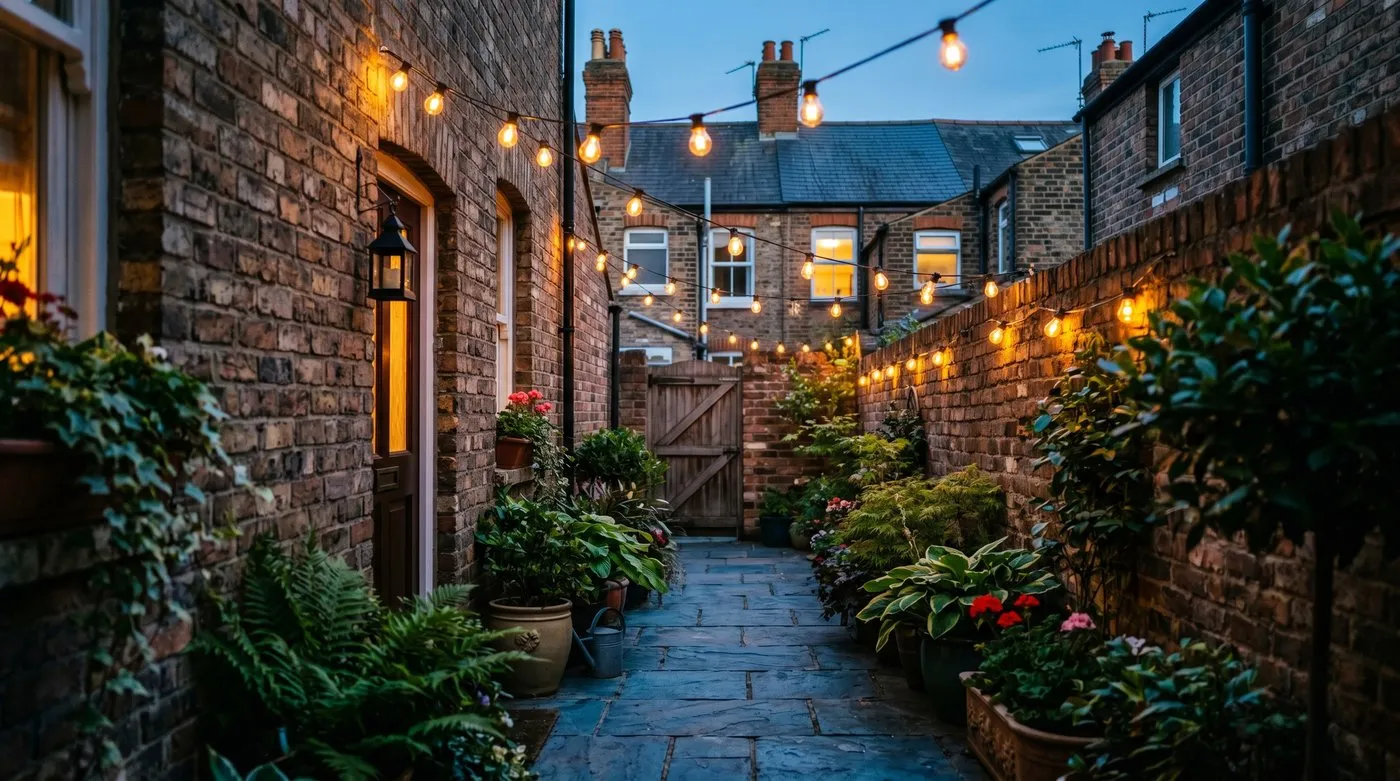
Festoon lights along one wall are the most effective option. A 5m run of warm-white LED festoon draws little power and lifts the whole passage at dusk. Use IP44-rated outdoor fittings on a switched mains spur or a battery set. Solar struggles in deep shade, so I avoid it here. Low-level LED wall lights spaced every 1.5m guide the route without glare.

Screening matters where the return is overlooked or where a gate hides bins from the street. A slatted timber screen or a trellis with evergreen ivy gives privacy without blocking the path. Our city garden ideas guide covers screening for overlooked urban plots, and pocket garden ideas shows how to dress very small spaces.

Warm festoon string lights glowing at dusk along a narrow brick side return passage in a UK terraced house A 5m run of warm-white festoon lights turns a dark side passage into an evening route.

Month-by-month side return calendar

Seasonal timing matters in a damp, shaded space more than in an open garden. The list below is the routine I follow on my own return.

MonthWhat to do
JanuaryClear leaf litter from the channel drain. Check fixings for rust. Brush algae off paving.
FebruaryPrune back ivy from gutters and meter boxes. Plan any planting or storage changes.
MarchPlant bare-root and pot ferns now. Top up gravel where it has migrated. Feed wall troughs.
AprilFirst growth flush on ferns. Refresh mulch around shade plants with leaf mould.
MayTrain climbers onto the trellis. Check the channel drain falls freely after spring rain.
JuneWater wall planters at least twice a week. Brick canyons dry containers fast in warm spells.
JulyPeak slug season in the damp. Protect hostas. Wipe algae from any composite decking.
AugustContinue watering troughs. Deadhead hardy geraniums for a second flush.
SeptemberLift and divide congested ferns. Clear the drain before autumn leaf fall.
OctoberSweep leaves weekly off paving and out of the channel drain. Algae returns now.
NovemberTreat timber screens and trellis with preservative on a dry day.
DecemberCheck storage units are weatherproof. Run festoon lights for the dark evenings.

Common mistakes in a side return

Most side return failures come from treating the space like an open garden. The width and the shade punish the wrong choices fast.

Laying solid concrete with no drainage. This is the worst mistake. A non-permeable surface with no channel turns the passage into a standing puddle and drives damp into the house wall. Always include a fall and a drain.

Choosing ground beds over wall planting. A 500mm strip of soil grows little and steals your walking width. Go vertical instead. Wall troughs and trellis give more planting and keep the route clear.

Buying full-depth storage. A standard 800mm shed unit blocks a 1.1m passage. Measure your narrowest point and choose slimline 400 to 700mm units sized to leave 600mm clear.

Using cheap zinc-plated fixings. A damp brick canyon corrodes them within a year. I lost two before switching to galvanised and stainless. Spend the extra at the start.

Planting sun-lovers. Lavender, sedum and most herbs fail in under three hours of sun. Match the planting to the shade, not to what you wish you could grow.

Why we recommend a slim triple bin store and vertical bike rack as the core of a side return: After four winters trialling storage layouts in a 1.1m Staffordshire return, this pairing returned more usable space than any other setup. Swapping loose bins and a flat-laid bike for a 1.8m slim store and a wall bike rack freed 1.4m of clear floor and 320 litres of organised storage, while keeping the path walkable at 620mm. No shed, lean-to or bespoke joinery matched that floor recovery for the money.

Turning a side return into a usable green corridor

The best side returns do two jobs at once: they store the things a terrace has nowhere else to put, and they green a route you walk daily. Combine the elements above and the strip stops being dead space.

Start with width and drainage, because they dictate everything. Add slimline storage to recover floor. Plant the walls, not the ground. Light the route for the dark months. My 1.1m passage went from a muddy bin alley to a planted corridor I use every day, and the whole rebuild cost under 900 pounds across the four years.

If you have more square footage to work with elsewhere, our make a small garden look bigger guide and the wider garden design hub cover layout tricks for the rest of the plot.

A freshly cleared and planted narrow side return with neat gravel path, vertical planters and tidy storage forming a green corridor My 1.1m passage after the rebuild: a planted corridor I use every day for under 900 pounds across four years.

Now you’ve planned a working side return, read our guide on designing a long thin garden to apply the same narrow-space thinking to the rest of your plot.

Frequently asked questions about side return gardens

How wide is a typical side return?

Most UK side returns are 0.9 to 1.8m wide. Victorian and Edwardian terraces sit at the narrow end, often 1.0 to 1.3m. You need to keep at least 600mm clear for walking and wheeling bins. That leaves little floor width, which is why wall-mounted vertical planting works far better than ground beds.

What plants grow in a shaded side return?

Ferns, hart’s tongue, hardy geranium and ivy survive deep shade. A north-facing brick passage gets cold, damp air and under three hours of sun. Choose evergreens for year-round cover. In my own 1.1m return, hart’s tongue fern and lady fern came through four winters with no losses against a north wall.

How do I stop a side return flooding?

Fit a 100mm linear channel drain along the lowest edge. A narrow brick passage acts as a funnel, so rain off both roofs and walls collects fast. A channel drain connected to a soakaway or gully clears it. I added a 1m run of 100mm channel drain and the standing water that lingered for hours disappeared.

Can I store bikes and bins in a side return?

Yes, with slimline vertical units. A vertical bike rack holds bikes upright against the wall, using around 400mm of depth. A slim triple bin store keeps three wheelie bins in line, not sprawled across the path. Together these freed 1.4m of clear floor in my terrace and roughly 320 litres of tidy storage.

What is the best surface for a narrow side passage?

Gravel is cheapest and drains freely; porcelain or block paving is cleaner underfoot. A 600mm path width keeps it walkable. Permeable gravel over a membrane costs around 200 to 400 pounds for a typical run. Porcelain paving with a sub-base runs 600 to 1,200 pounds but stays mud-free and looks deliberate.

How much light does a side return get?

Most get under three hours of direct sun a day. The two walls and the house cast deep shade for most of the day. North and east-facing returns are darkest. I measured roughly two hours of direct light in midsummer and almost none from November to February, which dictates the planting entirely.

Do I need planning permission for a side return?

Planting, storage and paving need no permission. Building over a side return as a kitchen extension does need approval and often a party wall agreement. This guide covers the unbuilt passage only. Always keep a clear route to any rear access, gas meter or drainage point that needs servicing.

How do I light a dark side return?

Festoon lights or low-wattage LED wall lights work best. A run of warm-white festoon lights along one wall turns a dead alley into an evening route. Use outdoor-rated IP44 fittings. Solar struggles in deep shade, so a switched mains spur or a battery festoon set is more reliable here.

side return narrow garden terraced house shade plants vertical gardening
LA

Lawrie Ashfield

Lawrie has been gardening in the West Midlands for over 30 years. He grows his own veg using no-dig methods, keeps a wildlife-friendly garden, and writes practical advice based on real UK growing conditions.

Follow on X · How we test

Stay in the garden

Seasonal tips, straight to your inbox

One email a month. What to plant, what to prune, what to watch out for. No spam.

Unsubscribe any time. We never share your email. See our privacy policy.