Key takeaways
- One method builds three projects: a retaining or boundary wall, a garden seat, and a raised bed
- Fill stone must be larger than the mesh: angular 100 to 200mm at about 1.5 tonnes per cubic metre
- Walls under 1m need no concrete footing, just 100 to 150mm of compacted MOT Type 1 sub-base
- Retaining walls over 1m need a footing, geotextile backing, and Building Control advice
- Bracing wires tied front to back every 250mm of height stop the cage bulging under load
- Budget 90 to 150 pounds per linear metre for a 1m high by 0.5m deep DIY gabion wall
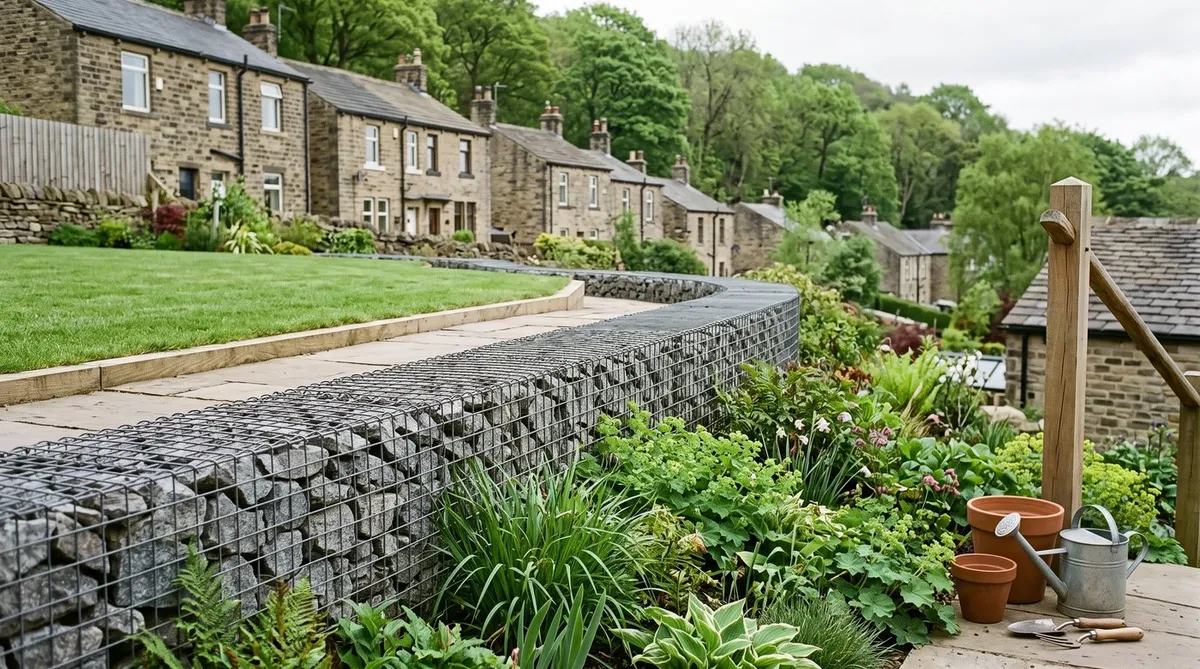
A garden gabion is a wire cage packed with stone, and it is one of the most useful structures you can build in a British garden. The same garden gabion method builds three different things: a retaining or boundary wall, a solid garden seat, and a raised bed. You learn one set of skills and get years of use from them. Gabions suit our climate because they drain freely, need no mortar, and shrug off frost that cracks brick and rendered blockwork.
What a garden gabion is and where it earns its place
A gabion is a rectangular cage of steel mesh, filled with hard stone and closed with a wired-down lid. The word comes from the Italian gabbione, meaning big cage. Engineers have used them for river banks and motorway cuttings for decades. In the garden they give you a structure that is quick, mortar-free, and forgiving of ground movement.
The appeal is honest. There is no cement mixing, no waiting for footings to cure, and no bricklaying skill needed. A 1m by 0.5m by 0.5m cage is the workhorse size, and you build up and along from there. Because the cage flexes, a gabion tolerates minor settlement that would crack a rigid wall. That makes it ideal on a slope or over made-up ground.
Choosing baskets: welded mesh, woven and wire coatings compared
Not all gabion baskets perform the same, and the choice drives both looks and lifespan. The two mesh types are welded and woven. Welded mesh is a rigid grid of wires spot-welded at each crossing, giving crisp, architectural lines. Woven mesh is a flexible double-twisted hexagonal net that bends with ground movement and suits tall retaining work.
Wire coating decides how long the cage lasts. Galvanised wire is zinc-coated and lasts 20 to 30 years. Galfan is a zinc-aluminium alloy that corrodes far slower, reaching 40 to 60 years for a small price premium. PVC-coated wire adds a plastic skin over galvanised steel, which resists salt air and suits seaside gardens. The table below ranks the common options by how reliably they hold up in a UK garden.
| Basket and coating | Wire and mesh | Best use (role) | Lifespan | Reliability |
|---|---|---|---|---|
| Welded, galfan-coated | 4mm, 75mm aperture | Architectural walls, seats, beds | 40-60 years | 1st, most reliable |
| Welded, PVC over galvanised | 4mm | Coastal and decorative features | 40-50 years | 2nd |
| Welded, galvanised | 4mm, 75mm aperture | Budget low walls | 20-30 years | 3rd |
| Woven hexagonal, galfan | 2.7-3.4mm | Tall retaining, moving ground | 40-60 years | 4th, best for movement |
| Woven hexagonal, galvanised | 2.7mm | Cheap large retaining runs | 15-25 years | 5th |
For most garden projects the gold-standard pick is welded galfan mesh. It gives the clean face people want from a seat or a boundary wall, and the galfan coating means you build it once. Woven mesh only wins where the ground will keep moving or the wall is tall, because it flexes without splitting. What welded mesh cannot do is absorb large settlement, so on unstable slopes over 1m, switch to woven.
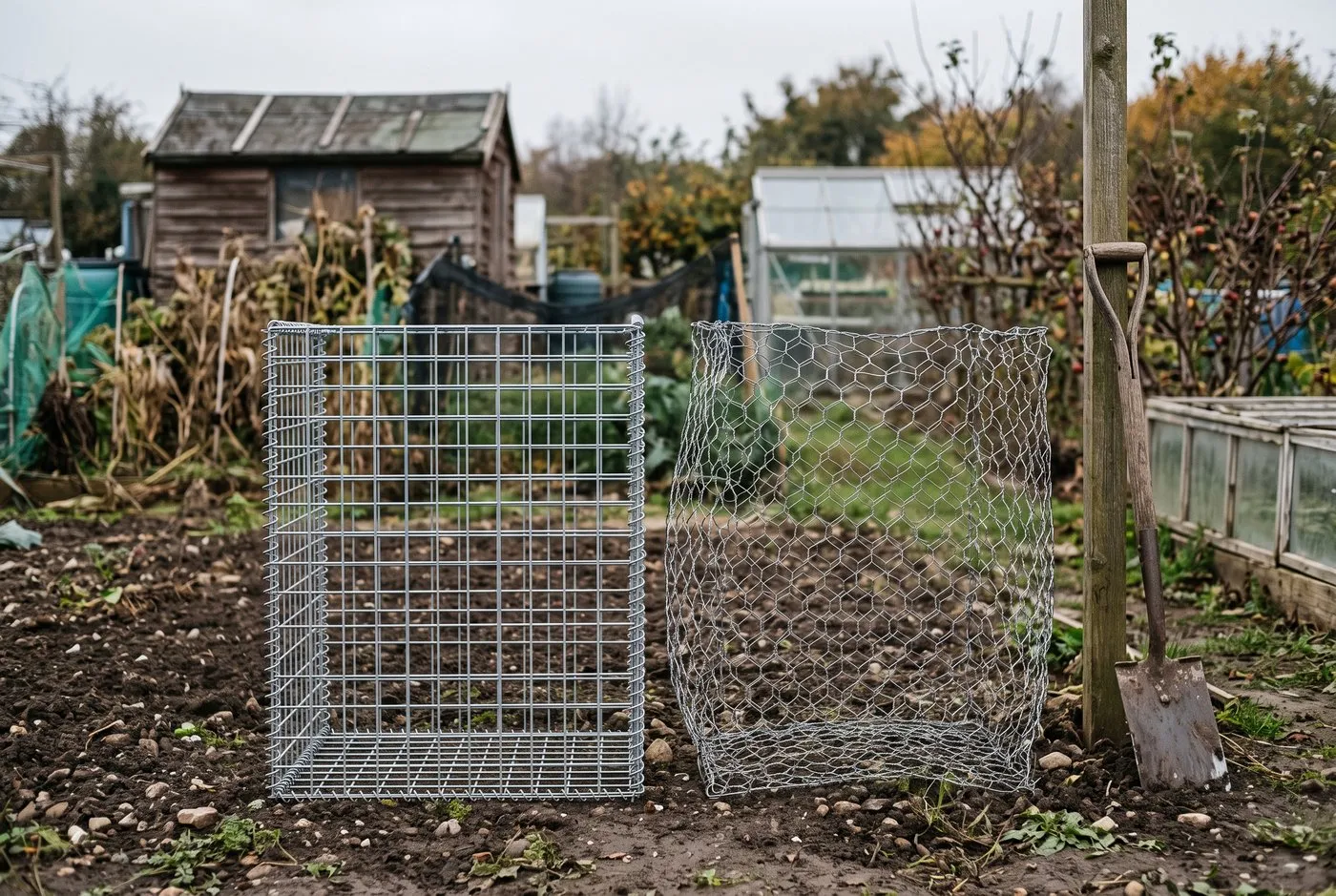 Welded mesh, left, gives crisp architectural lines for seats and walls. Woven hexagonal mesh, right, flexes with ground movement and suits tall retaining runs.
How much fill stone you need and what it costs
Fill stone is the biggest cost and the part people underestimate. As a planning figure, one cubic metre takes about 1.5 tonnes of angular stone. A standard 1m by 1m by 0.5m cage holds 0.5 cubic metres, so around 0.75 tonnes. Order 5 to 10 percent extra for waste and for the flat pieces you set aside for the visible face.
The stone must be larger than the mesh aperture so it cannot fall through. For 75mm welded mesh, use stone of at least 90mm, and 100 to 200mm is the usual range. Use angular rock, never rounded cobbles. Angular pieces lock together and hold a flat face, while rounded stone rolls and pushes the mesh out. Granite, limestone and gritstone all work, and the colour is your choice.
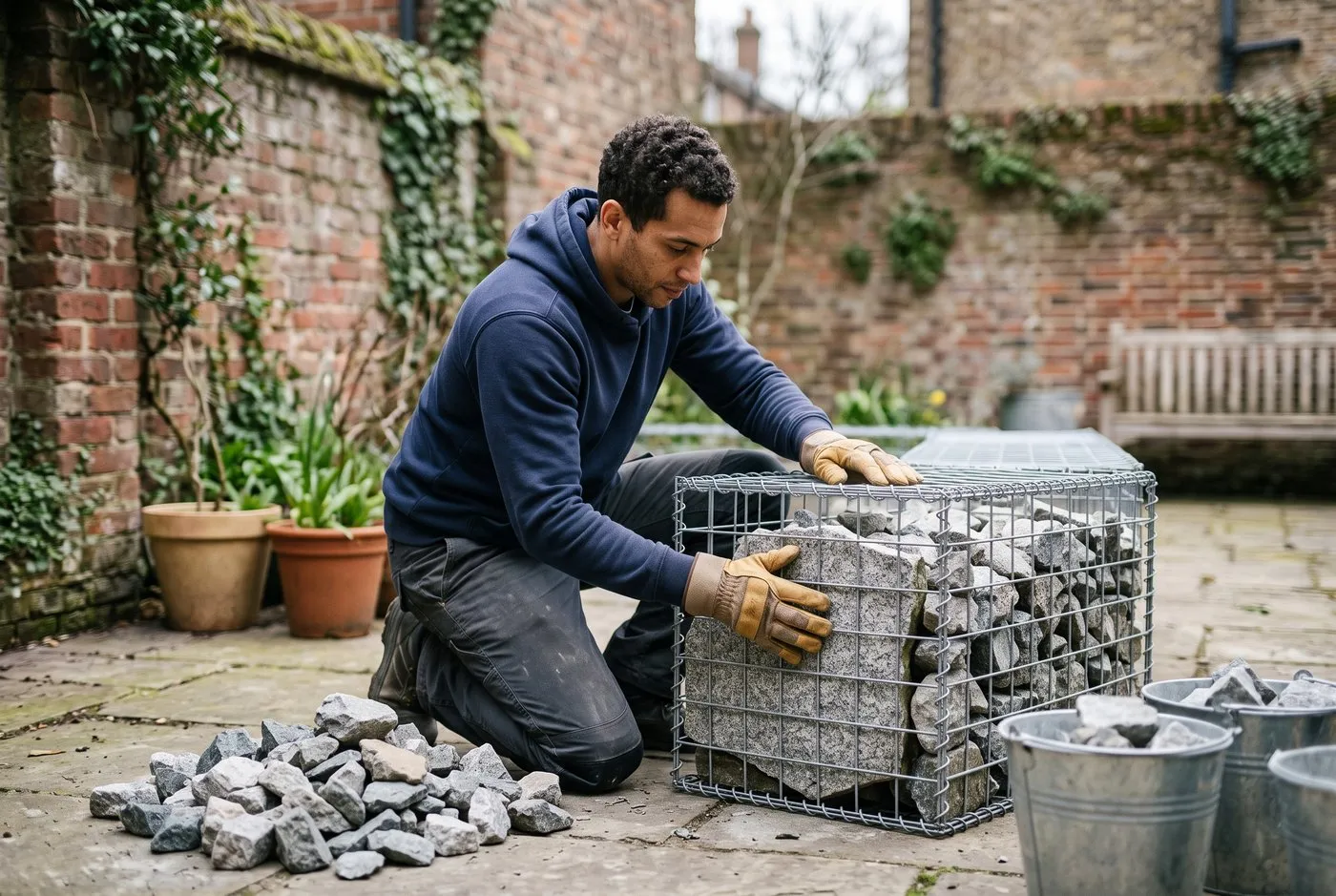 Angular 100 to 200mm granite locks together and holds a flat face. The best flat pieces are hand-packed on the visible faces; cheaper hardcore fills the hidden core.
How a gabion carries load without bulging
Understanding how a gabion holds itself up makes every build decision obvious. A filled cage works as a gravity structure: its own dead weight resists the push of soil or a leaning load. A packed 1m cube weighs roughly 1.5 tonnes, and that mass is what stops it sliding or tipping. The wire does not carry the load. It simply keeps the stone in shape.
The build works through four stages, each with a critical point:
- Base contact (day one). The cage transfers its weight to the sub-base. If the base is soft or uneven, the cage tilts. Compact 100 to 150mm of MOT Type 1 first.
- Initial settlement (first weeks). Stone shuffles down into its tightest packing, dropping 10 to 30mm at the top. Overfill the lid so it stays proud.
- Face loading (ongoing). The weight of stone presses outward on the two long faces. Without ties, the faces bow apart and the middle bulges.
- Long-term stability (years). A braced, well-packed cage locks solid and stops moving. Ours has held flat since 2021.
The critical mistake most people make is missing stage three. They build the cage, fill it, and never fit the bracing wires that tie the front face to the back. Six months later the face has bellied out 30 to 50mm. Bracing wires every 250mm of height fix this for the cost of a few pounds. For the ground side of the equation, our soil drainage and structure guide explains why a wet, unstable base undoes even a well-built cage.
Building the base: the one method behind all three projects
Every gabion project starts the same way, and getting the base right matters more than anything above it. Strip the topsoil down to firm subsoil, then lay and compact 100 to 150mm of MOT Type 1 in two layers with a hired plate compactor. Check it flat with a spirit level and a straightedge. A cage on a soft or sloping base tilts and never recovers.
Assemble each cage on the flat. Fold the mesh panels up and join the edges with helical spirals, C-rings at 100 to 150mm spacing, or continuous lacing wire. Keep every corner square with a set square, because a skewed cage shows every gap on the finished face. Stand the cages on the base, butt them tight, and wire adjoining cages together along all touching edges.
Now fit the bracing wires: galvanised ties running front to back across the cage every 250mm of height, roughly three per cubic metre. Fill in 150mm layers. Hand-pack the outer 100 to 150mm of each visible face with flat, angular stone laid tight, and tip cheaper hardcore into the hidden middle. Close the lid, wire it down all round, and overfill so the lid compresses the top. This base method is close to laying any hard surface; our patio-laying guide covers the same sub-base and compaction discipline in more depth.
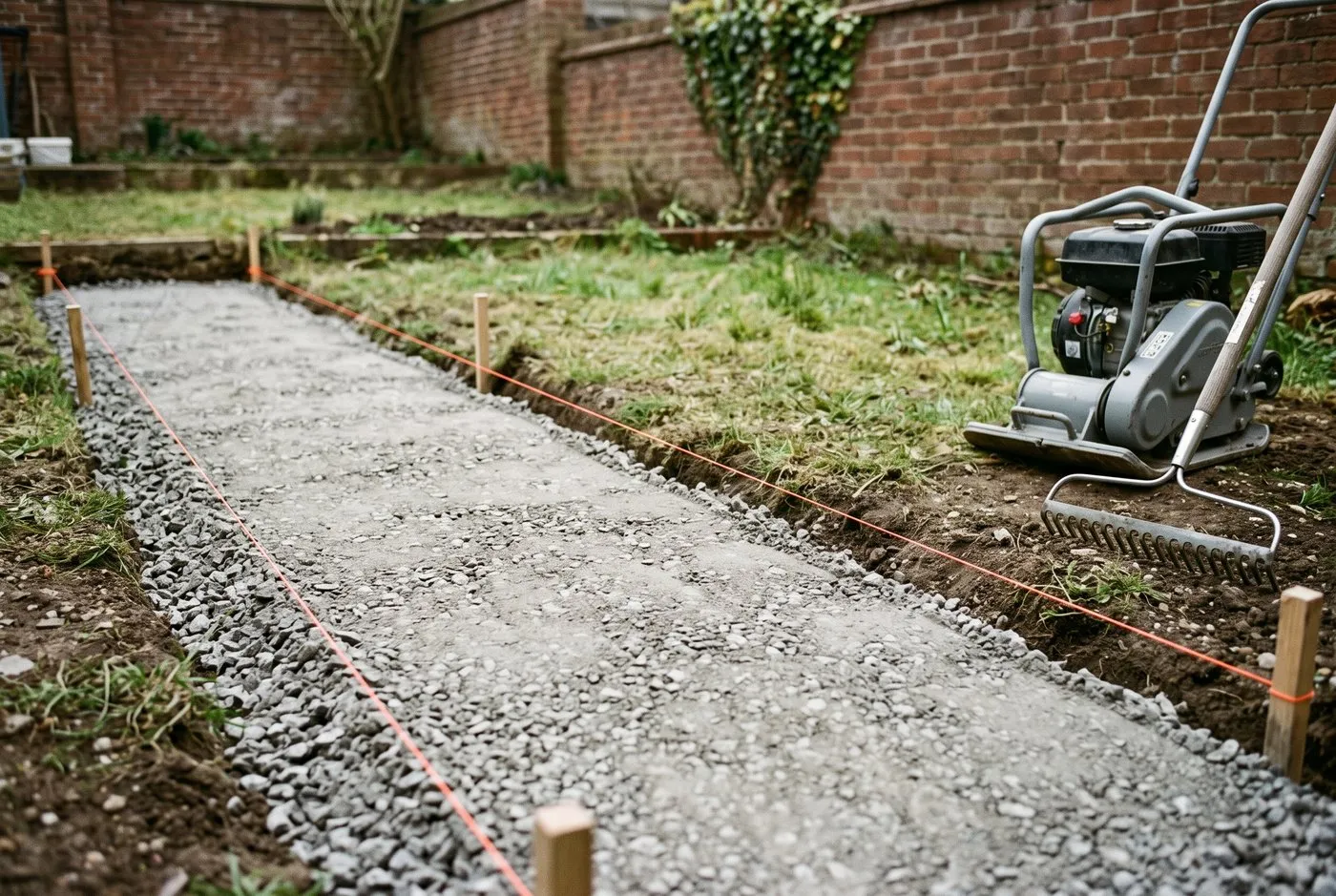 The whole cage sits on this. A flat, compacted 100 to 150mm sub-base, set to a string line, stops the finished gabion tilting or settling unevenly.
Building a gabion retaining or boundary wall
A gabion wall is the most common project, and the safest one to get wrong. For a boundary or low freestanding wall under 1m, build straight onto the compacted sub-base with no concrete footing. Stack courses of 0.5m or 1m cages, wiring each course to the one below. A single 0.5m-deep base gives a stable freestanding wall up to about 1m tall.
Warning: Any retaining wall over 1m high needs Building Regulations approval and structural advice before you build. A collapsing retaining wall can injure people and damage neighbouring property. Boundary walls over 2m, or over 1m next to a road, also need planning permission. Check with your local Building Control before ordering stone.
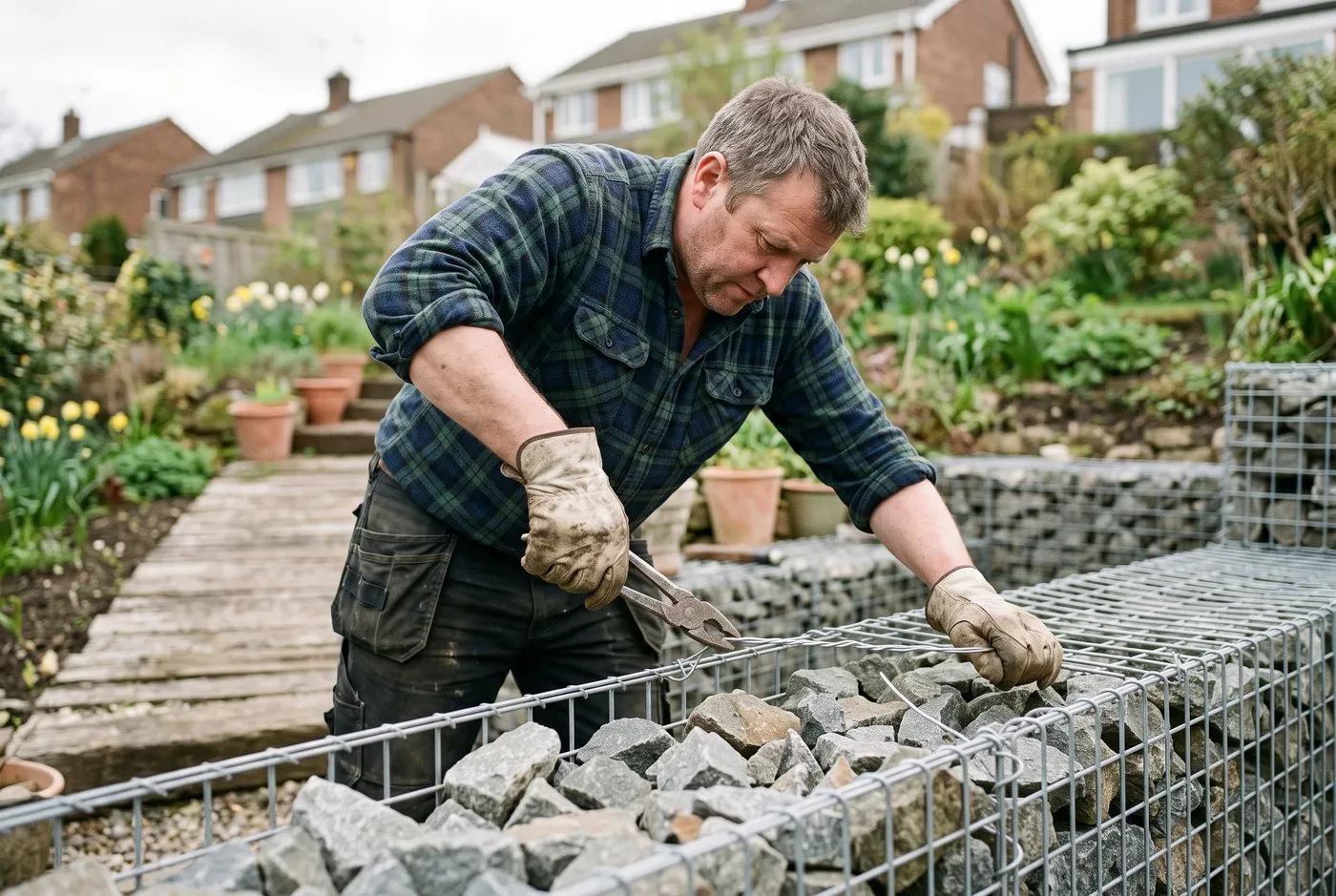 Bracing wires tied front to back every 250mm of height stop the two faces bowing apart. This is the step that keeps a retaining wall flat for decades.
Building a gabion garden seat
A gabion makes a permanent, no-maintenance garden seat, and it is the quickest of the three projects. Build the base to 450mm high, the comfortable seat height once a cushion sits on top. Keep the depth around 400 to 450mm so it sits like a bench. A 1.2m-long seat uses roughly one tonne of stone and seats two adults.
For the top, bolt a treated timber frame to the mesh with coach screws and fixing plates, then fix boards across it. Three lengths of 45mm-thick decking board or a single oak sleeper cut to fit both work well. Leave a 5mm gap between boards so rain drains through. Set the timber to overhang the stone by 20 to 30mm on each side for a clean edge and to keep drips off the face.
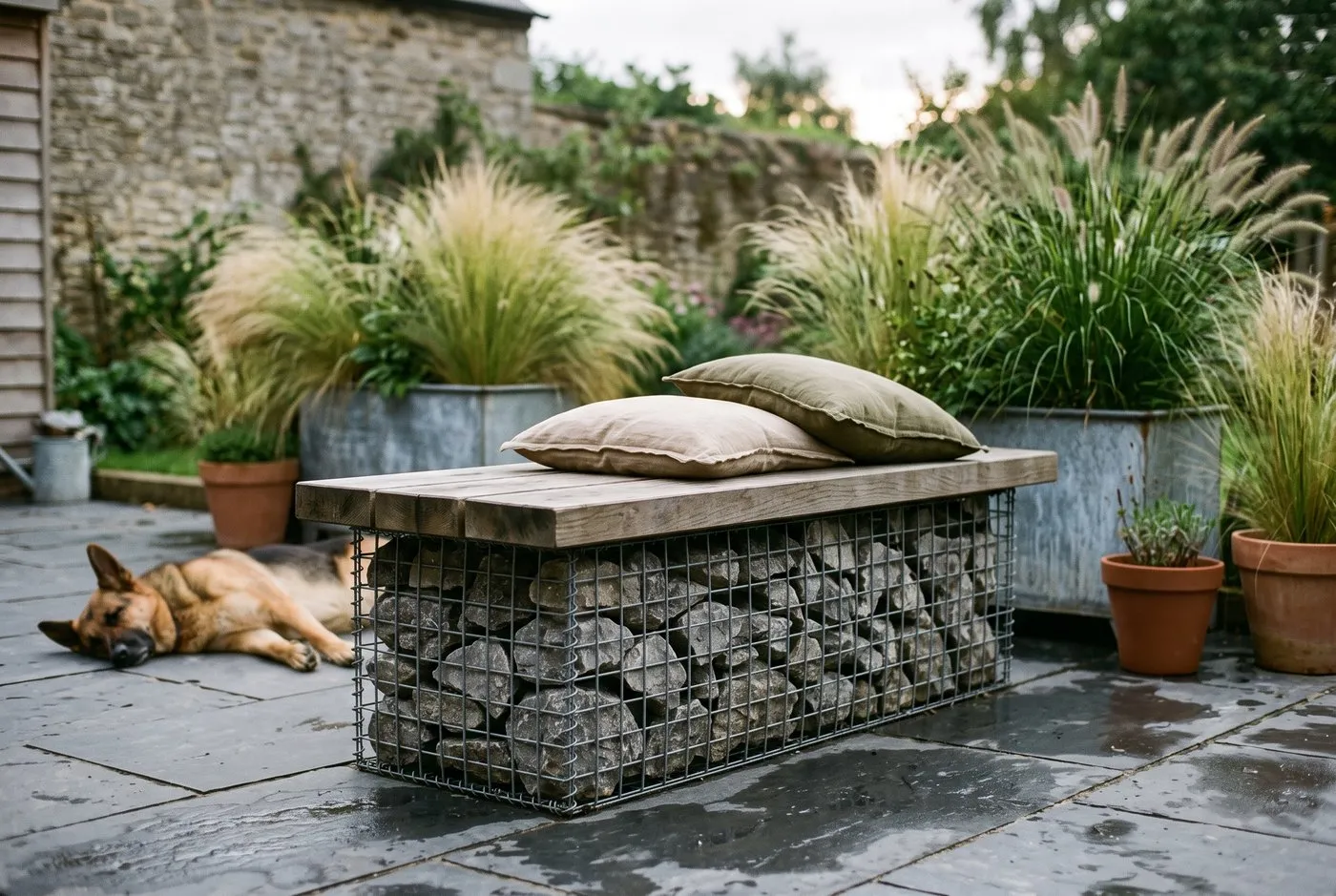 A 450mm gabion base with a treated timber top makes a permanent bench. The stone needs no maintenance and the timber overhangs 20 to 30mm for a clean edge.
Building a gabion raised bed
A gabion raised bed gives you a sturdy, free-draining growing space with a decorative stone edge. Build a perimeter of cages to your chosen height, commonly 600mm for comfortable working without bending. Wire the corners tight, because the soil inside pushes outward once filled and watered.
The key detail is the inner liner. Line the inside face of the cages with a woven geotextile membrane so soil does not wash out between the stones. Use a permeable membrane, never solid plastic, or the bed will waterlog. For a deep bed, fill the bottom third with hardcore or coarse rubble for drainage, then top with 300mm or more of quality topsoil and compost for roots.
This suits vegetables, herbs and deep-rooted perennials. The free drainage helps on heavy clay, though a raised bed dries faster in summer, so plan to water more in July and August. For layout, spacing and soil mixes, our raised bed gardening guide for beginners covers what to grow and how to fill it economically.
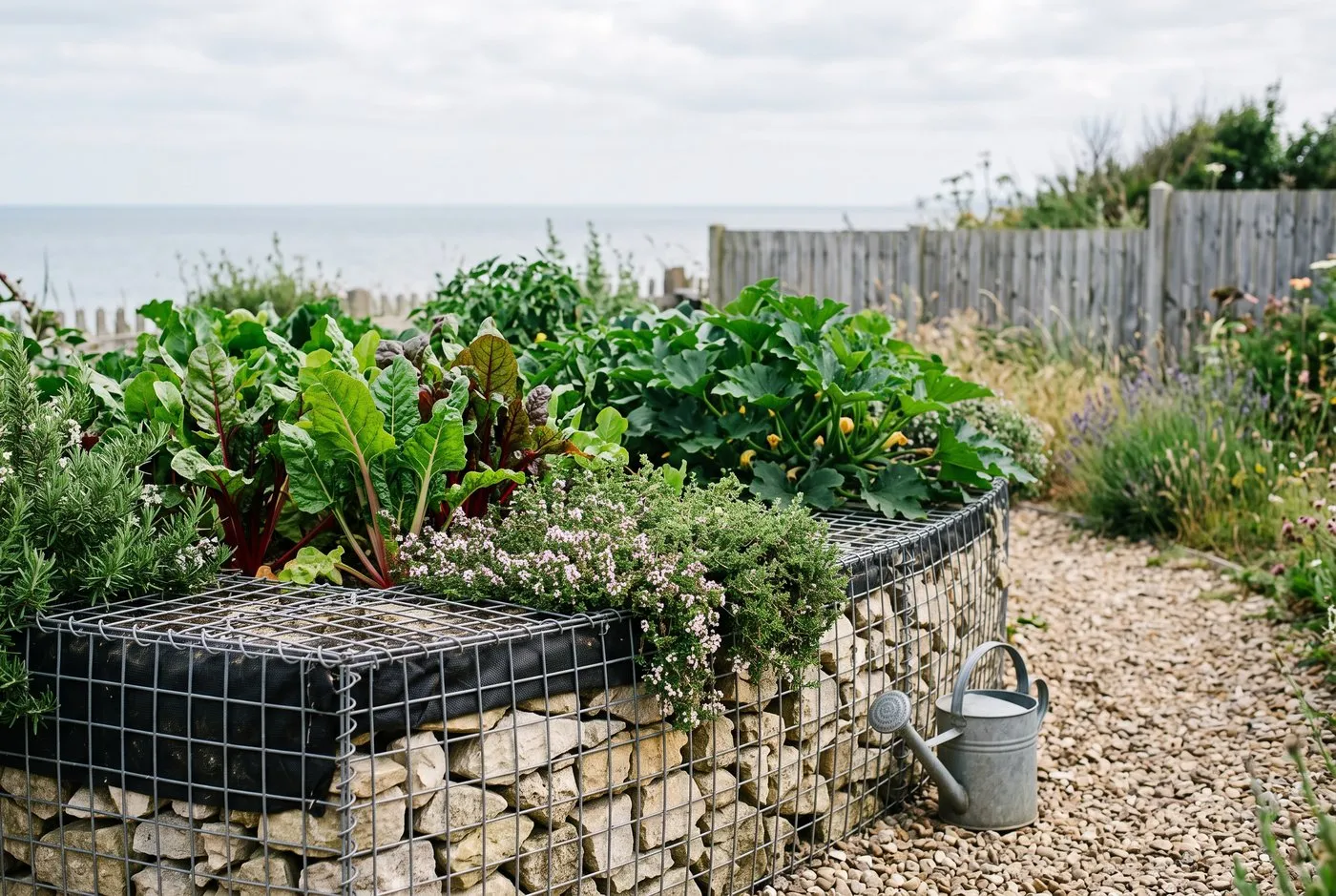 A 600mm gabion raised bed drains freely and never needs re-treating. A woven geotextile liner stops soil washing out between the stones.
Why gabion faces bulge and how to stop it for good
Bulging is the one failure that ruins the look of a gabion, and the root cause is almost always the same: missing internal bracing. As stone settles under its own weight, it pushes the two mesh faces apart. Without ties holding front to back, the middle of the cage bellies out 30 to 50mm within the first winter. People blame the mesh or the stone, but the mesh is fine. It was never braced.
The permanent fix is designed in, not bolted on later. Fit galvanised bracing wires front to back every 250mm of height, roughly three per cubic metre, as you fill. These internal ties take the outward load and keep both faces flat. Retro-fitting braces to a filled, bulged cage is far harder, so do it during the build.
Two other habits stop bulging. First, keep the cage square during assembly, because a racked cage loads unevenly. Second, hand-pack the face with flat angular stone laid tight, rather than tipping loose rounded cobbles that roll and press outward. Get the bracing, the squareness and the face-packing right, and the wall holds its line for its full life.
Gardener’s tip: Run a taut string line along the finished face and check it each spring for the first two years. Any bulge shows up as a gap or a touch against the string within days of forming. On our 2021 wall the string has stayed flat against the face for five years, which tells me the bracing did its job.
Planting pockets and lighting to finish a gabion
A finished gabion does not have to be bare stone. Planting pockets soften the face and turn a wall into a living feature. Leave a gap in the face stone, line it with a scrap of geotextile to hold soil, and fill with gritty compost. Plant drought-tolerant alpines that thrive in sharp drainage: sempervivums, sedums, thyme, Erigeron karvinskianus and aubrieta all root happily in a pocket. Our guide to growing aubrieta for walls covers the tumbling spring colour that suits a gabion face.
For lighting, tuck low-voltage LED strip or spike lights into the stone during the build. Use IP65-rated fittings run off a 12V transformer, and thread the cable through the hidden core before you close the lid. Uplighting a gabion wall at dusk throws texture across the stone and doubles the feature after dark. Keep the transformer under cover and use armoured cable to any buried run.
Plant pockets also feed wildlife. The open, free-draining flowers of sedum and Erigeron draw hoverflies and solitary bees from June onwards. The RHS advice on planting in walls and crevices confirms which alpines cope with the thin, sharp root run a pocket provides. A stone wall also gives basking spots and shelter for insects and small reptiles.
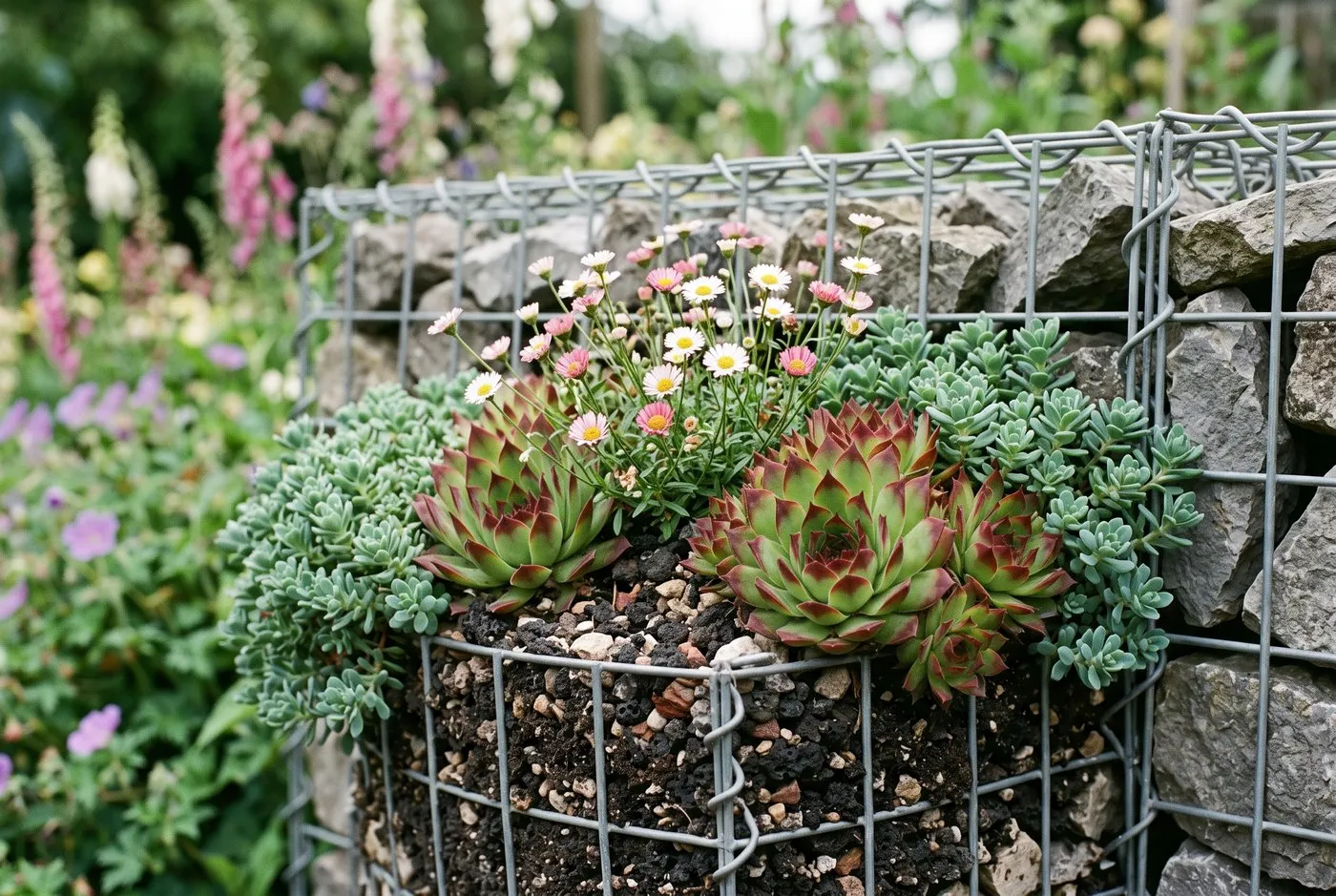 Planting pockets soften a gabion face. Sempervivums, sedums and Erigeron root in gritty compost behind a scrap of geotextile and feed pollinators from June.
Month-by-month gabion build calendar
| Month | Task |
|---|---|
| January | Ground often frozen or waterlogged. Plan the run, measure up, and price baskets and stone. |
| February | Order gabion baskets and fill stone for spring delivery. Book a plate compactor hire. |
| March | Soil workable again. Strip topsoil and dig out the base line on drier days. |
| April | Lay and compact the MOT Type 1 sub-base. Assemble cages under cover if wet. |
| May | Prime building month. Set cages, fit bracing wires, and start filling in dry weather. |
| June | Complete filling and lidding. Add planting pockets while alpines establish fast in warmth. |
| July | Build seats and raised beds now. Fill new raised beds and plant up before high summer. |
| August | Check first settlement on any May build. Top up stone under lids that have dropped. |
| September | Good second window for walls as ground stays warm and workable. Plant pocket alpines. |
| October | Finish outdoor builds before wet sets in. Fit lighting and bed cable runs now. |
| November | Check faces against a string line for bulge before winter. Re-tension any loose ties. |
| December | Avoid building on frozen or saturated ground. Inspect finished walls after heavy rain. |
The welded grid is what gives a garden gabion its crisp, architectural face. That clean line is why a welded galfan cage suits a seat or a boundary wall far better than the softer look of woven mesh. For a purely retaining job on moving ground it is worth switching to woven galfan for the flex, but for everything else, welded galfan is the default we reach for.
Common mistakes when building a garden gabion
- Skipping the bracing wires. The cage looks fine when filled, then the face bulges 40mm over one winter. It happens because settling stone pushes the faces apart with nothing tying them together. Fit galvanised braces front to back every 250mm of height as you fill.
- Using stone smaller than the mesh. Fill that fits through the 75mm mesh trickles out and leaves gaps. It happens when people buy by price, not size. Always use angular stone at least 90mm across, and larger for the face.
- Building tall retaining walls without advice. A retaining wall over 1m can fail catastrophically if it is under-designed. It happens when a garden feature quietly becomes a structural one. Get Building Control advice and a proper footing on anything over 1m holding soil.
- Ignoring the sub-base. A cage set on soft ground tilts and never comes back. It happens when people rush past the boring groundwork. Compact 100 to 150mm of MOT Type 1 and level it before a single cage goes down.
- Tipping stone in loose instead of packing the face. A tipped face looks gappy and bulges. It happens because packing by hand is slow. Set aside the flat angular pieces and hand-pack the outer 150mm of every visible face.
Frequently asked questions
Do gabion walls need a foundation?
No, walls under 1m need only a compacted sub-base, not concrete. Lay and compact 100 to 150mm of MOT Type 1 hardcore on firm subsoil and level it. The cages flex slightly and settle with the ground, so a rigid footing is not required. Walls over 1m, or any wall holding back soil, do need a proper footing and structural advice.
How much stone do you need to fill a gabion?
Around 1.5 tonnes of stone fills one cubic metre. A standard 1m by 1m by 0.5m cage holds 0.5 cubic metres, so about 0.75 tonnes. Order 5 to 10 percent extra for waste and face packing. Angular stone bulks slightly more loosely than rounded gravel, so 1.5 tonnes per cubic metre is a safe planning figure across granite, limestone and gritstone.
What size stone goes in a garden gabion?
Use angular stone 100 to 200mm across, always larger than the mesh aperture. A 75mm mesh needs stone of at least 90mm so it cannot fall through. Angular rock locks together and holds the face; rounded cobbles roll and bulge. Granite, limestone, gritstone and recycled concrete all work. Keep the best flat pieces for the visible faces.
How long do gabion baskets last?
Galfan-coated welded baskets last 40 to 60 years in a UK garden. Plain galvanised baskets last 20 to 30 years, and PVC-coated wire suits coastal salt air. The stone lasts indefinitely, so lifespan comes down to the wire coating. Galfan, a zinc-aluminium alloy, corrodes far slower than plain zinc and costs only a little more.
Can you make a garden seat from a gabion?
Yes, a 450mm-high gabion base with a timber top makes a solid bench. Build two cage piers or one long run to 450mm, the comfortable seat height. Bolt a treated timber frame to the mesh and fix boards across it. A 1.2m bench uses roughly one tonne of stone and seats two adults with no maintenance.
Do gabions need planning permission?
Not usually under 1m, but taller boundary walls can need permission. A boundary wall over 1m next to a road, or over 2m elsewhere, needs planning permission. A freestanding gabion feature or low bed inside your garden normally does not. A retaining wall over 1m needs Building Regulations approval regardless of position. Check the Planning Portal guidance on fences and walls for your case.
How do you stop a gabion bulging?
Fit galvanised bracing wires front to back every 250mm of height. These internal ties stop the two mesh faces bowing apart as the stone settles under its own weight. Hand-packing the face stone tight, keeping the cage square, and using angular rock rather than rounded cobbles all help. Bulging is almost always missing bracing wires.
Our team produces practical UK gardening guidance from source research, contributor records and established horticultural practice. Editorial standards are overseen by Matt W.