Key takeaways
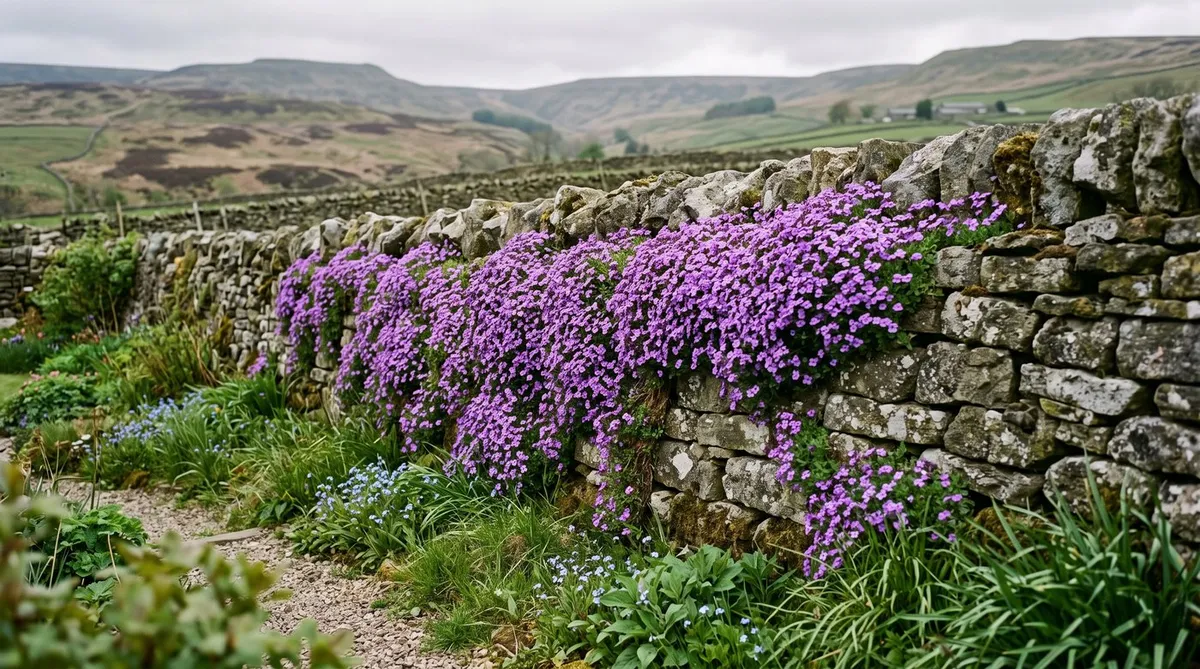
- Aubrieta flowers in April and May, sheeting walls with purple, mauve, pink or blue four-petalled blooms
- It grows just 5 to 15cm tall but spreads 30 to 60cm, forming a dense evergreen mat
- Needs full sun, sharp drainage and neutral to alkaline soil; it rots in wet heavy clay
- Shear the whole plant back by about half straight after flowering or it goes woody and bald in the middle
- Hardy to about -15C (RHS H5) and drought tolerant once its roots are down
- 'Doctor Mules' survived 8 winters on our Staffordshire wall while 9 of 12 clay-border plants rotted in one wet winter
Learning how to grow aubrieta gives you the biggest spring colour hit for the least effort. Aubrieta, also spelled aubretia and often sold as rock cress, is a low evergreen mat that sheets a wall or rockery in purple. The four-petalled flowers arrive in April and May, exactly when the garden needs waking up. Once its roots are into grit, the plant asks for almost nothing but one hard haircut a year.
This guide draws on nine years of growing aubrieta on a built dry-stone wall in north Staffordshire. It covers where the plant thrives, why it rots in clay, and the one care job that decides whether it stays dense or turns bald. Get the drainage and the timing of that cut right, and a single plant covers half a metre of wall.
The mat-forming rock cress that sheets a wall in April
Aubrieta is a low, spreading evergreen perennial in the cabbage family, Brassicaceae. That makes it a relative of wallflowers, alyssum and true cress, which explains its four-petalled flowers and its love of a lime-rich wall. Most garden plants trace back to Aubrieta deltoidea and its many hybrids.
The plant forms a tight mat of small, grey-green, slightly hairy leaves. It reaches just 5 to 15cm tall but spreads 30 to 60cm wide within a few years. In April and May it disappears under a sheet of flowers. Each bloom is small, around 1.5cm across, with four petals in purple, mauve, violet, pink, red or blue.
Where aubrieta grows best: walls, rockeries and gravel
Aubrieta wants the dry, sunny, gritty spots that defeat most border plants. It thrives on dry-stone walls, rockeries, gravel beds, sunny banks and the edges of raised beds, where it can spill over stone. The classic sight is a mat foaming down a wall face or tumbling over steps.
Two things matter above all: full sun and sharp drainage. Give it six or more hours of direct sun a day. A south or west-facing wall is ideal. In shade the plant stretches, flowers thinly and rarely covers itself. Deep shade is one of the commonest causes of a poor, patchy display.
The soil should be neutral to alkaline, ideally pH 6.5 to 7.5, and it must drain fast. Aubrieta evolved on limestone and chalk, so it loves the free lime a mortared wall leaks. If your ground is chalky you already have the perfect home for it. For more plants that share those conditions, our guide to the best plants for chalky and alkaline soil covers partners that thrive on lime.
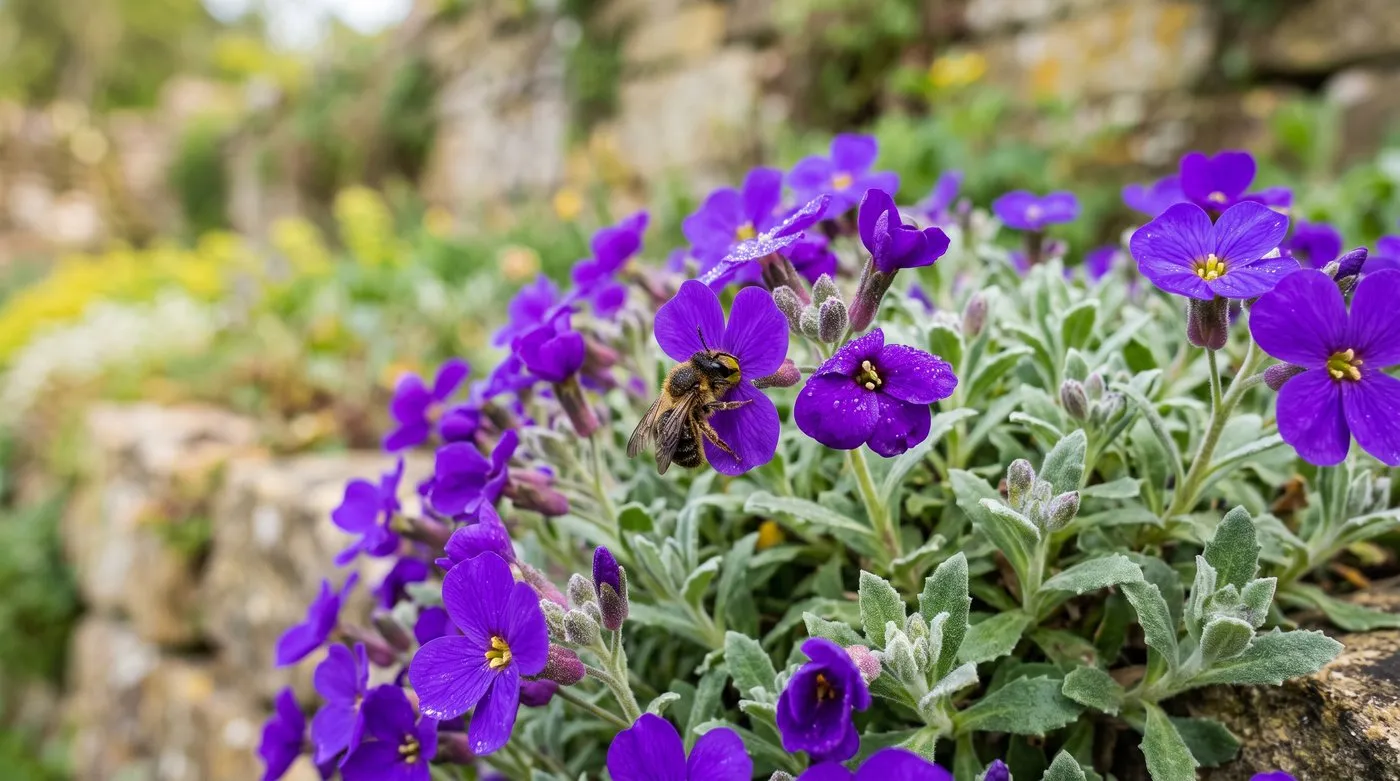 Each flower has four petals, the signature of the cabbage family. A solitary bee works the fresh blooms on a warm April morning.
Why aubrieta rots in heavy clay
The single biggest killer of aubrieta in UK gardens is wet, heavy soil in winter. This is the root cause behind most losses, and it is often blamed wrongly on cold. Aubrieta is hardy to about -15C, so frost rarely kills it. Standing moisture around the crown does.
The science is simple. Clay holds water against the fleshy crown and roots. In cold, wet conditions the tissue cannot breathe, fungal rots move in, and the plant collapses from the base. Grit and stone let water drain away in minutes, so the crown stays dry even after heavy rain.
Warning: Never plant aubrieta into a low, wet spot or unimproved clay. It will look fine all summer, then rot at the collar over its first wet winter. If your garden is clay, build up, not down: a raised bed, a wall pocket or a deep gravel bed are the only reliable homes for it.
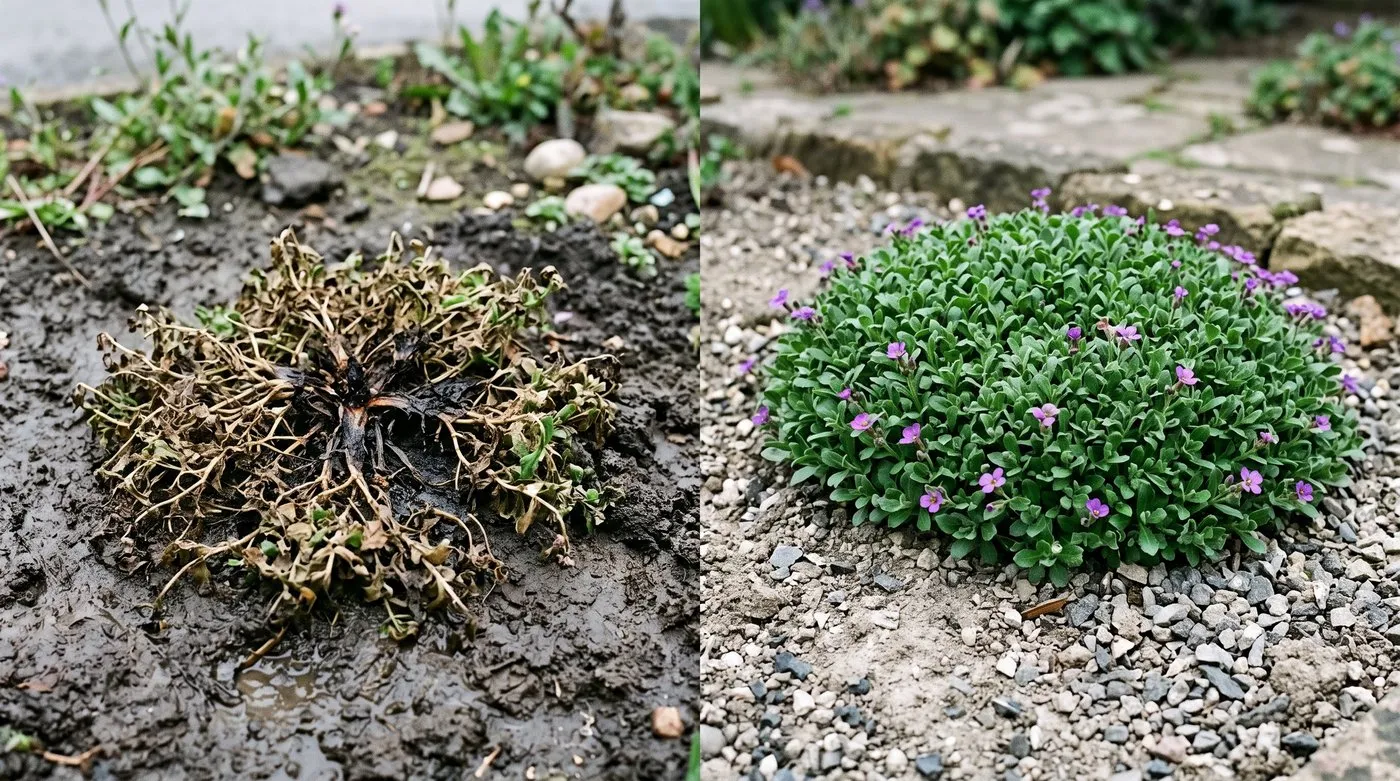 Left, an aubrieta rotted at the collar after a wet winter on clay. Right, a healthy mat on the same garden’s gritty wall. Drainage, not cold, is the killer.
Planting into a wall pocket or gravel bed
Plant aubrieta in spring or early autumn, when the soil is warm but not baked. Spring planting lets the roots settle before summer; autumn planting suits milder, drier gardens. Buy young plants in 9cm pots for about £4 to £7, or plug plants more cheaply in trays.
For a dry-stone wall, tuck plants into pockets as you build, or push young plants into existing gaps and firm gritty compost around the roots. Angle the crown slightly outward so water runs off it. Space plants 30 to 45cm apart along the wall. They knit together within two seasons.
For a rockery or gravel bed, dig in plenty of grit first, then plant so the crown sits proud of the surface. Top-dress with a 50mm layer of grit or gravel right up to the collar. This keeps the base dry and stops soil splashing onto the foliage. Water new plants every few days through their first summer, then leave them to it.
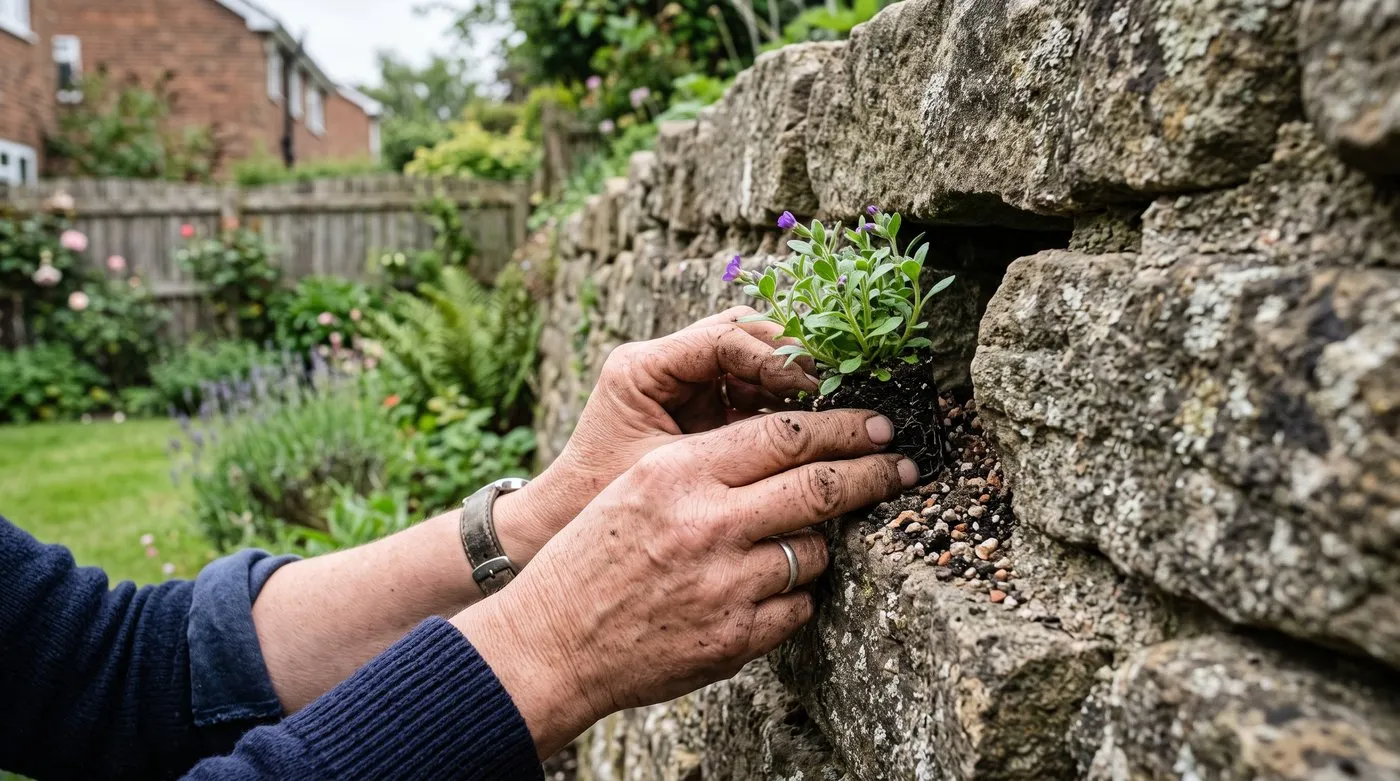 Firming a young plant into a gritty wall pocket. Angle the crown outward so rain runs off it rather than pooling around the base.
Growing aubrieta from seed and softwood cuttings
Aubrieta is easy and cheap to raise yourself, which matters if you want to sheet a long wall. There are three routes: seed, softwood cuttings and division. Seed is the cheapest; cuttings hold a named colour exactly.
From seed, sow in spring, March to May, or in early autumn. Scatter seed thinly on the surface of gritty, free-draining compost and barely cover it, no more than 2 to 3mm. Germination takes two to three weeks at around 18 to 20C. Seed-raised plants vary in shade, which is fine for a mixed wall but not for matching a colour. The ‘Cascade’ and ‘Axcent’ seed series give reliable, uniform colours from seed.
From softwood cuttings, take 5cm shoots in early summer, just after flowering when you shear the plant. Strip the lower leaves, dip in hormone powder, and push into gritty compost. Keep them shaded and just moist. Roots form in three to four weeks. This is the way to bulk up a favourite like the double ‘Bressingham Pink’.
By division, lift an older clump in early autumn and pull it into rooted sections. This also rejuvenates a plant that has gone woody. Aubrieta self-seeds gently too, dropping the odd seedling into wall cracks and gravel, so a colony slowly renews itself without any help.
Cutting back after flowering: the one job that matters
If you do only one thing for your aubrieta, do this. Shear the whole plant back by about half straight after flowering, in late May or early June. This is the difference between a plant that stays a solid mat for a decade and one that turns into a woody ring with a bald hole in three years.
Left uncut, aubrieta keeps growing outward from spent stems. The centre ages, goes woody, loses its leaves, and dies back, so you get a doughnut of foliage around an empty middle. Cutting hard forces fresh growth from low down and keeps the whole mat dense and leafy.
Use shears, not scissors, and take the plant down by 40 to 50 percent all over. Do not be timid. A hard cut looks brutal for a fortnight, then the plant flushes back tighter than before. In many years the shear also triggers a light second flush of flowers in September.
Gardener’s tip: Time the cut by the flowers, not the calendar. Shear within two weeks of the last main flower, while the plant still has energy to regrow. If you wait until midsummer, the plant hardens off and the regrowth is thin. Feed nothing: a hungry, lean plant stays tight, and a fed one flops.
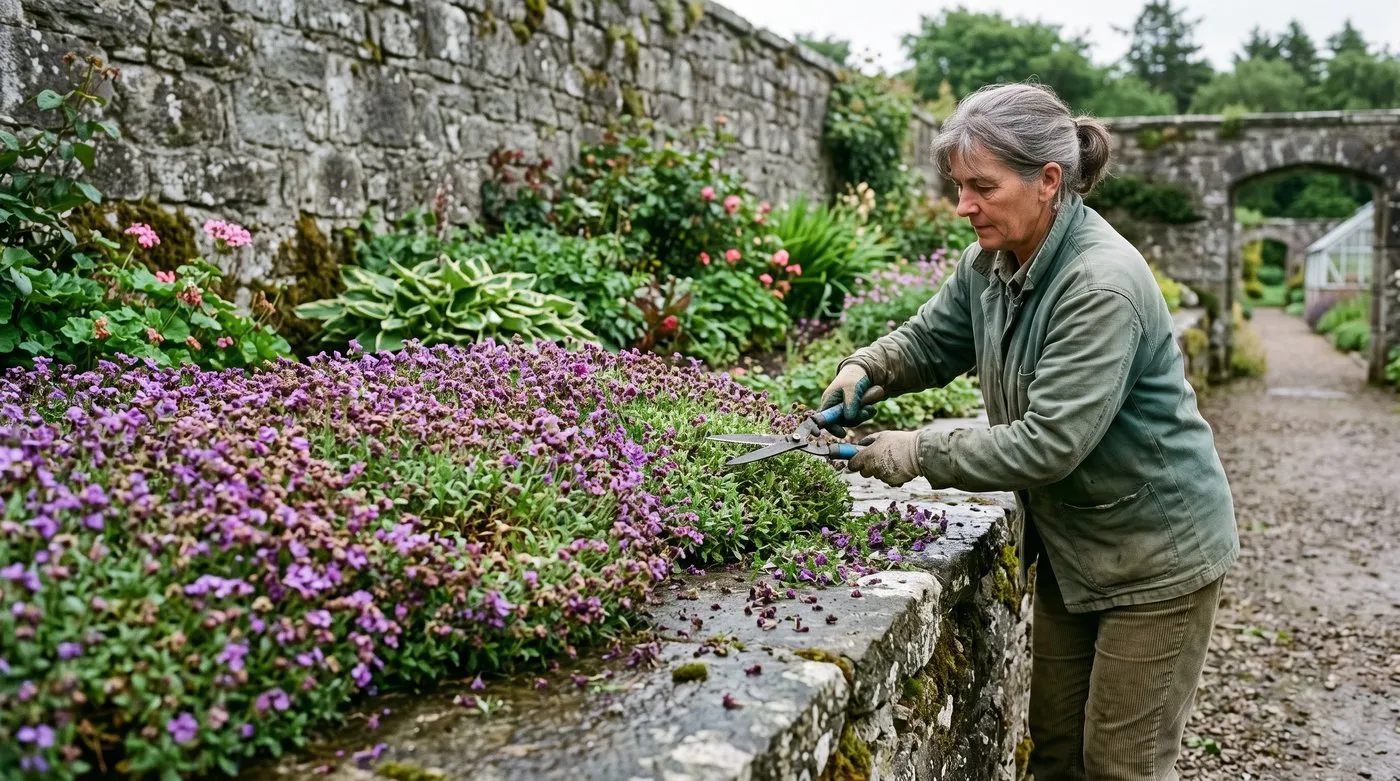 The one job that matters: shearing the mat back by half in late May. It looks brutal for a fortnight, then the plant regrows tighter than before.
Aubrieta cultivars compared by colour and vigour
The classic spring rockery trio
Aubrieta looks best in company, and there is a traditional planting that has earned its place. The spring rockery trio pairs aubrieta with two other easy alpines that flower at the same time and want the same dry, sunny wall. The colours read like a flag across the stone.
The three are aubrieta in purple, Aurinia saxatilis, the gold alyssum, and Arabis, in white. Set together on a wall or rockery, they cover it in purple, gold and white through April and May. All three are mat-formers, all three want full sun and sharp drainage, and all three get the same hard shear after flowering. That shared care makes them simple to grow as a group.
Space the three so they meet but do not fight, roughly 40cm apart. Aubrieta and Arabis stay lowest; the gold alyssum builds a slightly taller cushion behind. For a wall that carries this trio and then keeps going, underplant with later self-seeders. Our roundup of easy self-seeding plants for UK gardens lists partners that fill the gaps once the spring alpines finish.
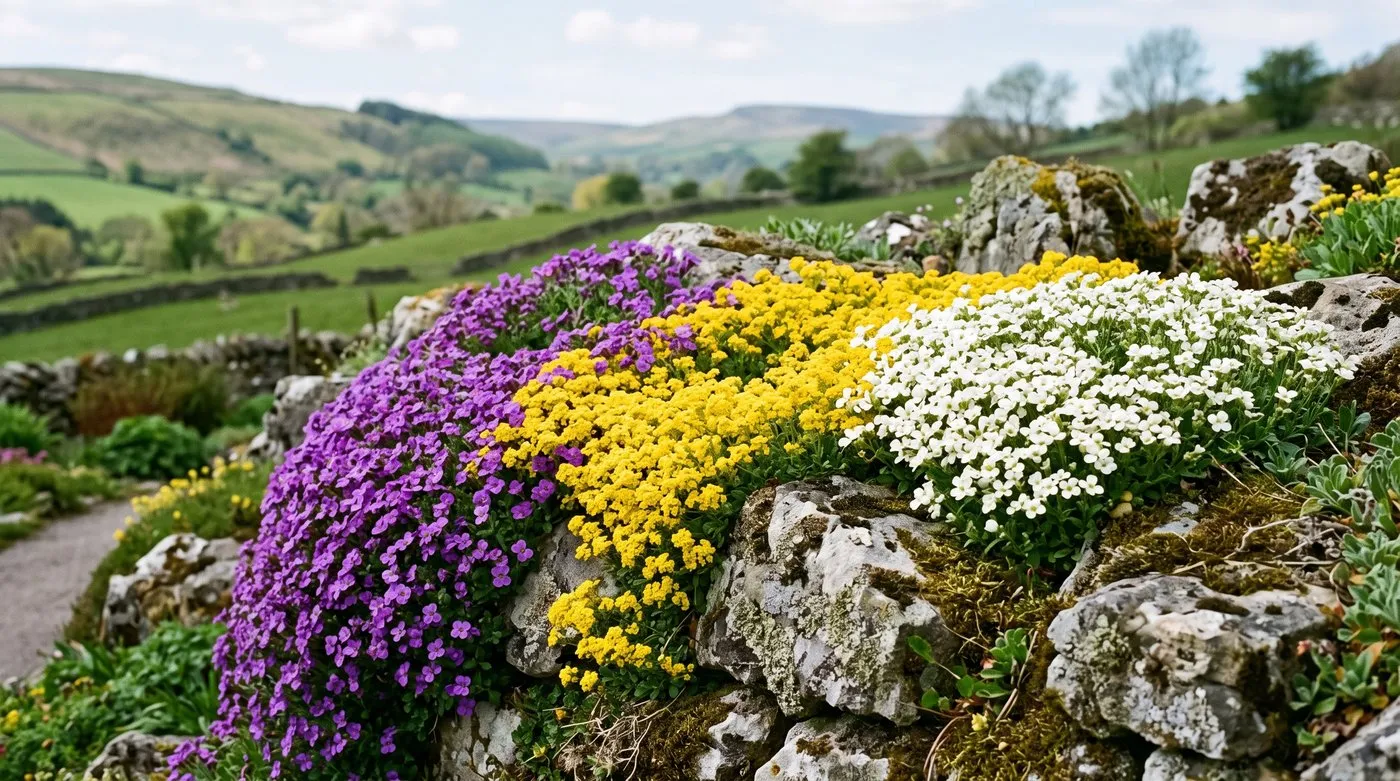 The classic spring trio: purple aubrieta, gold Aurinia saxatilis and white Arabis. All three want the same sun, grit and post-flowering shear.
Feeding early bees and butterflies
Aubrieta earns its keep beyond looks. It flowers in April and May, early in the season when few plants are open and hungry pollinators are short of food. The flat, open, four-petalled flowers are easy to feed from, so a mat in bloom is busy from mid-morning.
Month-by-month aubrieta care through the UK year
| Month | Task |
|---|---|
| January | Leave the plant alone. Check that no wet leaves are sitting on the crown; brush them off. |
| February | Order plug plants or seed. Top up grit around the crown if winter rain has washed it away. |
| March | Sow seed on the surface under cover. First flower buds show on established plants. |
| April | Main flowering begins. Water any new spring plantings until their roots take. |
| May | Peak bloom, then flowering fades. Shear the whole plant back by half straight after. |
| June | Take 5cm softwood cuttings from the shearings. New growth flushes from the cut mat. |
| July | Water new cuttings and young plants. Established mats need nothing; they are drought tolerant. |
| August | Little to do. Keep grit topped up and the crown clear of debris. |
| September | A light second flush may open after the June cut. Divide old woody clumps now. |
| October | Plant new pot-grown aubrieta while the soil is still warm. Clear fallen leaves off mats. |
| November | Stop watering. Make sure drainage is clear so winter rain runs off, not into the crown. |
| December | Leave evergreen mats standing. Do no cutting now; save all hard pruning for after flowering. |
Common mistakes when growing aubrieta
- Not shearing after flowering. This is the number one error. Skip the hard cut and the plant grows woody, dies out in the centre, and turns into a bald ring within three years. Shear the whole mat back by half in late May, every year, without fail.
- Planting in wet, heavy clay. Aubrieta rots at the collar over a wet winter on clay. Do not plant it low or in unimproved clay. Lift it into a raised bed, a wall or a deep gravel bed with plenty of grit.
- Growing it in shade. In under six hours of sun the plant stretches, flowers thinly and never covers itself. A shaded wall is the commonest cause of a sparse, disappointing display. Give it a south or west aspect.
- Feeding it too richly. Rich soil or a general feed makes aubrieta grow soft, leafy and floppy, with fewer flowers and worse winter survival. Grow it hungry and lean in grit. It flowers best when it is slightly starved.
- Mulching with bark or compost. A soft mulch traps moisture against the crown and smothers self-sown seedlings. Use grit or gravel around the base only, never bark or rich compost.
Aubrieta rewards a light touch and the right position. Get the drainage and the annual shear right, and it will carry a wall for a decade with almost no other input. It is one of the toughest, cheapest ways to fill a dry, sunny wall with spring colour.
 Aubrieta cascading over stone steps in a coastal Cornish garden. On sharp drainage it spills and softens hard edges for years.
Now you can sheet a wall with spring purple, read our guide to drought-tolerant plants for UK gardens for the next step in a low-water, low-effort planting scheme. For more wall and gravel colour, browse the full plants section or pair aubrieta with the self-seeding Mexican fleabane in our Erigeron growing guide.
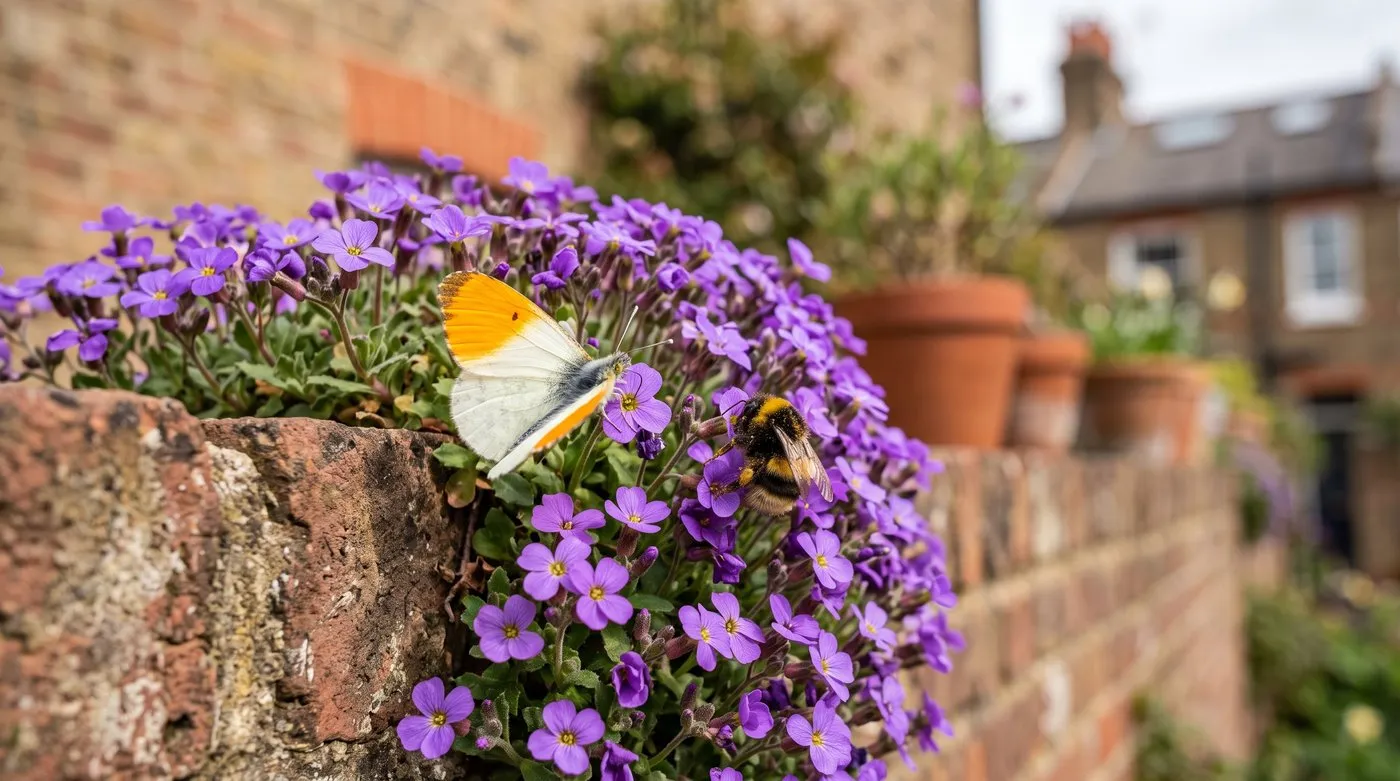 Early nectar in action: aubrieta feeds queen bumblebees and just-woken butterflies in April, weeks before most borders open.
Frequently asked questions
How do you grow aubrieta in the UK?
Plant it in full sun with sharp drainage and neutral to alkaline soil. Set it in a dry-stone wall, rockery, gravel bed or raised edge, never in wet clay. Water new plants through their first summer. Shear the whole plant back by half straight after flowering to keep it dense.
When does aubrieta flower in the UK?
Aubrieta flowers in April and May, through mid spring. The main flush lasts about four to six weeks. In a warm, sheltered spot the first flowers can open in late March. A light second flush sometimes appears in autumn after a hard post-flowering trim.
Should you cut back aubrieta after flowering?
Yes, shear the whole plant back by about half once flowering finishes. This is the single most important job. It stops the plant going woody and bare in the centre, forces fresh dense growth, and often triggers a small autumn flush. Use shears and cut hard in late May.
Why is my aubrieta leggy and bare in the middle?
It was not sheared back hard after flowering. Unpruned aubrieta grows outward and dies off in the centre, leaving a woody ring with a hole. Cut the whole plant back by half every year straight after the flowers fade to keep the mat solid.
Does aubrieta grow in clay soil?
No, aubrieta rots in wet heavy clay. It needs sharp drainage and open, gritty soil. On clay, grow it in a raised bed, a wall or a gravel bed with plenty of grit added, so water drains away from the crown fast.
Is aubrieta the same as aubretia or rock cress?
Yes, aubretia and rock cress are common names for aubrieta. Aubrieta is the correct botanical spelling and aubretia is the common misspelling. Rock cress reflects its home in walls and rockeries and its place in the cabbage family alongside true cresses.
Does aubrieta come back every year?
Yes, aubrieta is an evergreen perennial that lives for years. A well-drained, regularly sheared plant stays productive for six to ten years. It also self-seeds gently into wall cracks and gravel, so a patch renews itself even as older plants slowly tire.
Our team produces practical UK gardening guidance from source research, contributor records and established horticultural practice. Editorial standards are overseen by Matt W.