Key takeaways
- An all-herb border is visually bare for about 15 weeks, from mid-December to late March
- Aim for 30 to 40% evergreen planting so the border keeps a designed shape in January
- Box blight and box tree moth have made Buxus a poor bet: Ilex crenata clips to the same 25-40cm profile
- Layer from 2m bronze fennel at the back down to 5cm creeping thyme at the front edge
- A south-facing brick wall holds the border base 2-4C warmer overnight, which keeps rosemary and myrtle alive
A herb border is a design problem before it is a growing problem. Most herb advice treats the plants as a crop and stops at sun, soil and spacing. That advice is sound, and it lives elsewhere on this site. This piece is about the other half: what a herb border looks like, how it holds together as a composition, and why yours probably falls apart in December.
The hard truth comes first. An all-herb border is bare ground for roughly 15 weeks a year. Fennel, lovage, chives, tarragon and oregano all disappear. With nothing evergreen holding the shape, you spend the whole winter looking at wet soil. Every herb border in Britain that works has solved that same problem, and almost all of them borrow the solution from the walled kitchen gardens and physic gardens that got there several centuries earlier.
Why an all-herb border falls apart in December
The herb border has a structural flaw built into its plant list. Culinary herbs skew heavily herbaceous: they die back to the root each autumn and rebuild each spring. Fennel, lovage, angelica, chives, tarragon, sorrel, oregano and mint all do it. You can plant fifteen species and have every one of them gone by Christmas.
This is invisible when you plan. Nobody designs a herb border in February. They design it in June, when everything is up, and the plant list is chosen at peak leaf.
The distinction that matters is structure versus infill. Structure is what holds the shape when nothing is growing: clipped evergreens, hard edges, gravel, paths, walls. Infill is everything that comes and goes. Herbs are almost all infill. A border made entirely of infill has no skeleton, so when the soft growth goes, nothing is left standing.
Fix the skeleton and the same herbs suddenly work. That is the entire argument of this guide.
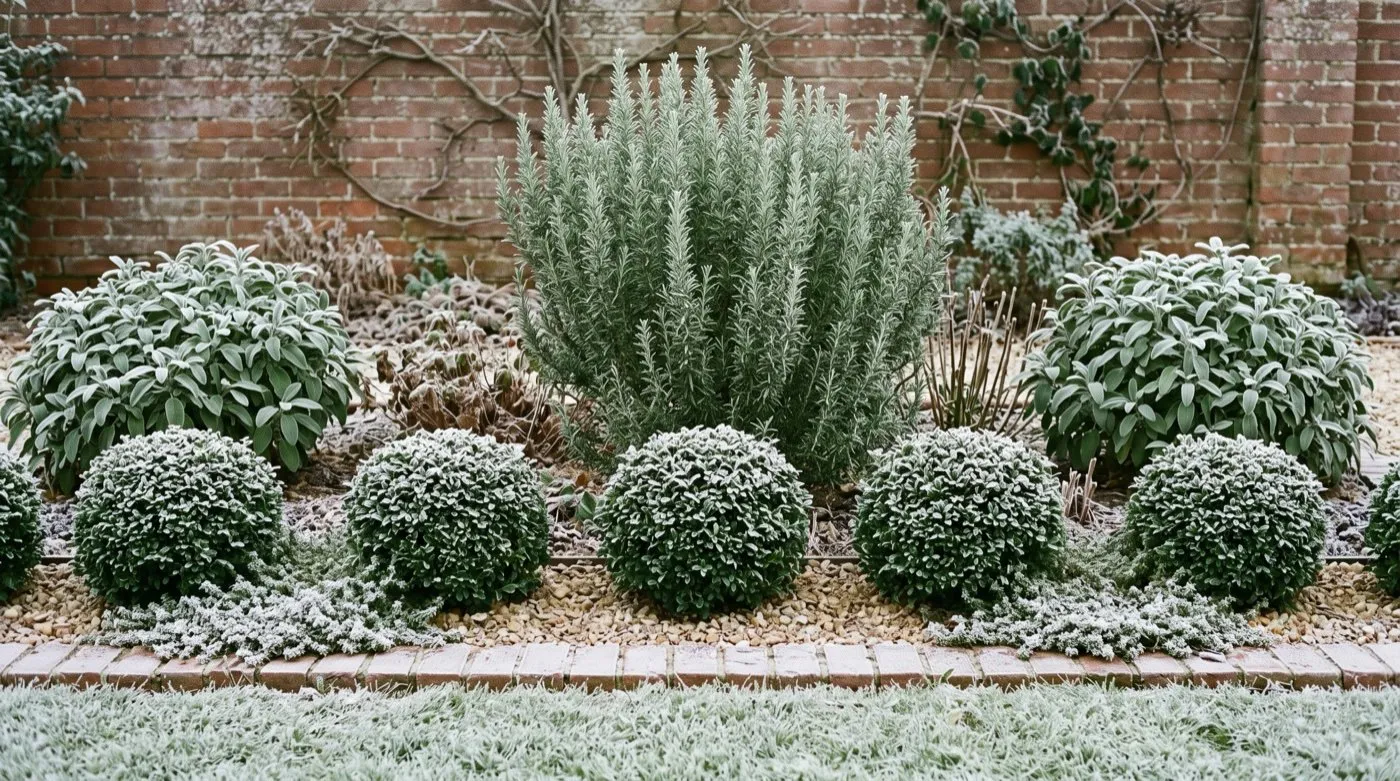 Mid-January, and only the skeleton is left: clipped Ilex crenata, rosemary, sage and thyme under frost. Every soft herb here has gone. Take the evergreens out and this is 15 weeks of bare clay.
Stealing the geometry of the walled kitchen garden
The walled kitchen garden and the physic garden solved this a long time ago, and the solution is worth taking wholesale.
Both traditions grew plants that were seasonal, scruffy and functional. Both still looked deliberate in midwinter. They managed it through geometry rather than planting: rectangular beds, straight paths, clipped edges, a central axis, and a repeated low hedge that read as a drawn line whether or not anything was growing inside it. Strip out every plant and the design remained legible on the ground.
Physic gardens went further. Because they arranged plants by use or family, they needed hard divisions between beds that stayed readable all year. The clipped edge was not decoration. It was the filing system. The Chelsea Physic Garden, founded in 1673 and still laid out on ordered beds, is the clearest surviving British example of the idea.
You can lift this at any scale. The suburban version is not a walled acre with a dipping pond. It is one border with:
- A straight, hard front edge that holds a line in January.
- Repeated clipped shapes at even spacing along it.
- A path material that reads as a surface, not a gap.
- Symmetry or rhythm, so the eye sees a plan rather than a collection.
Evergreen bones: the 30 to 40 per cent rule
Here is the number to design against: 30 to 40% of the planting should be evergreen.
Below about 30% the border looks patchy in winter, like a failed planting rather than a designed one. Above roughly 40% it starts to read as a shrub border with herbs squeezed in, and loses the loose, aromatic quality that makes a herb border worth having in the first place. Between those two figures it holds a shape without going stiff.
Count by visual mass in winter, not by plant numbers. Nine clipped Ilex crenata at 30cm are worth more structurally than twenty chive clumps, because in January the chives are not there at all. The honest way to work it out is to sketch the border twice: once in July with everything, once in January with only the evergreens. If the January sketch has nothing in it, the plan has failed.
Spread the evergreens evenly. A clump of them at one end and nothing at the other gives you half a border in winter. The traditional answer is repetition at fixed intervals, which is why old gardens repeat the same clipped shape every 1.5m or so rather than grouping.
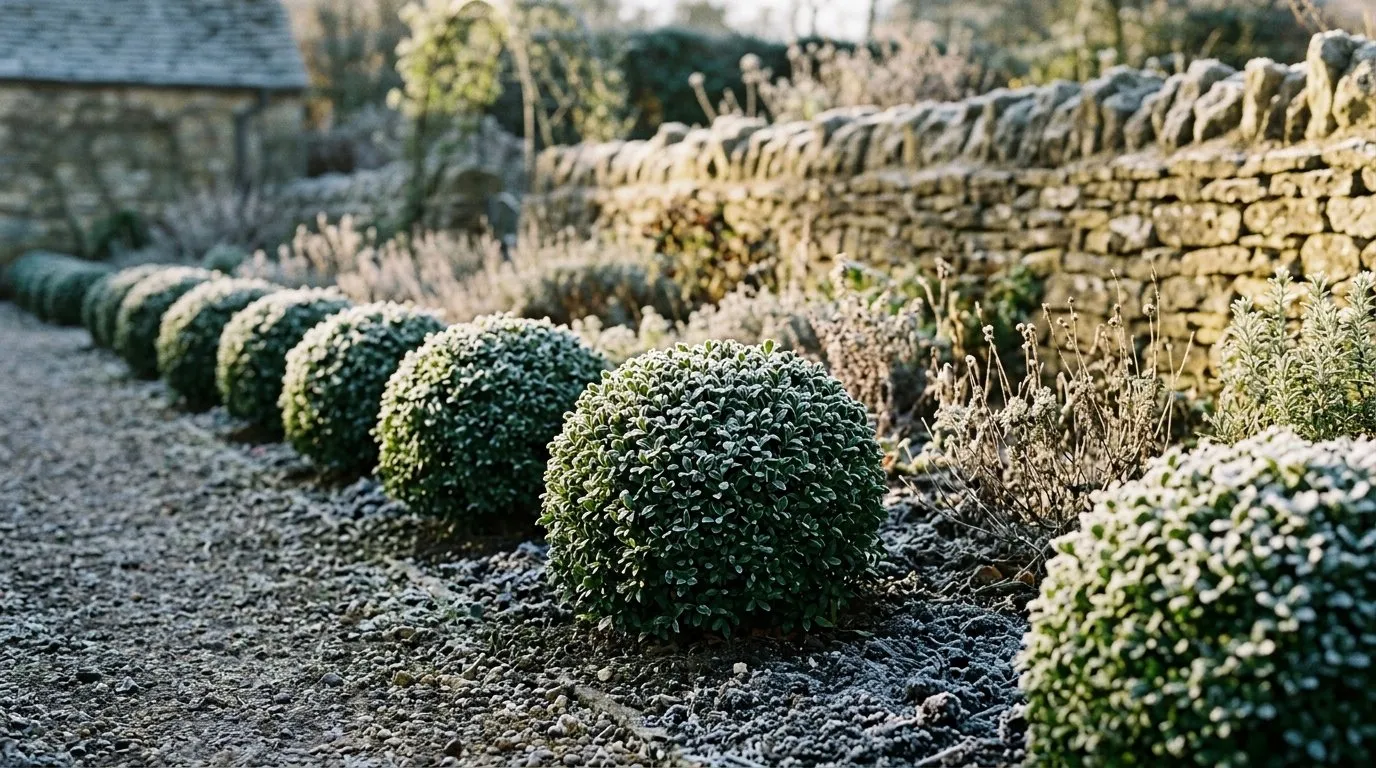 Clipped Ilex crenata at 30cm, repeated along the front. In July it is a quiet green line. In January it is the only reason the border still reads as a design.
Life after box: what to clip instead
For four hundred years the answer to this was box (Buxus sempervirens). It is no longer a sensible bet.
Two problems arrived together. Box blight, caused by the fungi Calonectria pseudonaviculata and C. henricotiae, strips foliage and leaves bare black stems, and it thrives in exactly the still, humid, densely clipped conditions a low hedge creates. Then the box tree moth (Cydalima perspectalis) arrived, spread across southern and central England from around 2011, and its caterpillars can strip a mature hedge in a fortnight. The RHS guidance on box blight sets out how hard it is to eradicate once established.
Three other options earn a place in a herb border specifically:
- Teucrium fruticans, shrubby germander. Silver-grey evergreen, clips to 60-90cm, and it belongs to the Mediterranean palette rather than fighting it. Cut hard by about -10C but reshoots.
- Dwarf yew (Taxus baccata), for a darker, heavier line. Hates sitting wet, so it needs a ridge on clay.
- Clipped bay (Laurus nobilis), as a full stop rather than a line. It is a herb, so it is not a compromise at all.
Because this is a herb border, not a parterre, keep the list short and repeat it. For the full ranked comparison of box replacements, see our guide to box hedge alternatives after blight.
Ranking the structure plants by what survives January
Ilex crenata is the gold standard here, and the reason is narrow: it is the only plant on the list that holds a clipped architectural line through a British winter without disease risk, without cutting back, and without a ridge of grit to survive clay. Bay and Teucrium are excellent but do a different job: accent and anchor, not line. Everything from rosemary down is a bonus rather than a skeleton, because none of it can be relied on to look deliberate in February.
Height layering from fennel down to thyme
A herb border fails visually when everything sits between 30cm and 60cm, which is where most culinary herbs naturally land. Deliberate height layering is what stops it reading as a flat green mat.
The back tier, 1.5 to 2.5m, is where herb borders get their architecture, and it is almost free because two of the best plants are common herbs. Bronze fennel (Foeniculum vulgare ‘Purpureum’) reaches 1.8 to 2.5m and is see-through: a haze of bronze thread you look past rather than at. Angelica archangelica hits 1.8 to 2m with sculptural green umbels the size of a dinner plate, then dies after seeding, which makes it a punctuation mark rather than a fixture.
The middle tier, 50cm to 1.2m, carries the mass: rosemary, sage, Teucrium, lovage, hyssop, oregano. This is where most of the actual cooking happens, and where repetition matters most.
The front tier, 5 to 40cm, is the finish: clipped Ilex crenata, santolina, chives, winter savory, and creeping thyme spilling over the edge.
Two rules make the layering work. First, do not build a staircase. Pull one tall plant forward every few metres so the tiers interlock. Second, use the see-through plants deliberately. Bronze fennel at the front, with the border visible through it, is one of the best effects available in a British garden and it costs the price of one plant. For growing detail on the back-tier workhorse, see our guide to growing fennel as a herb.
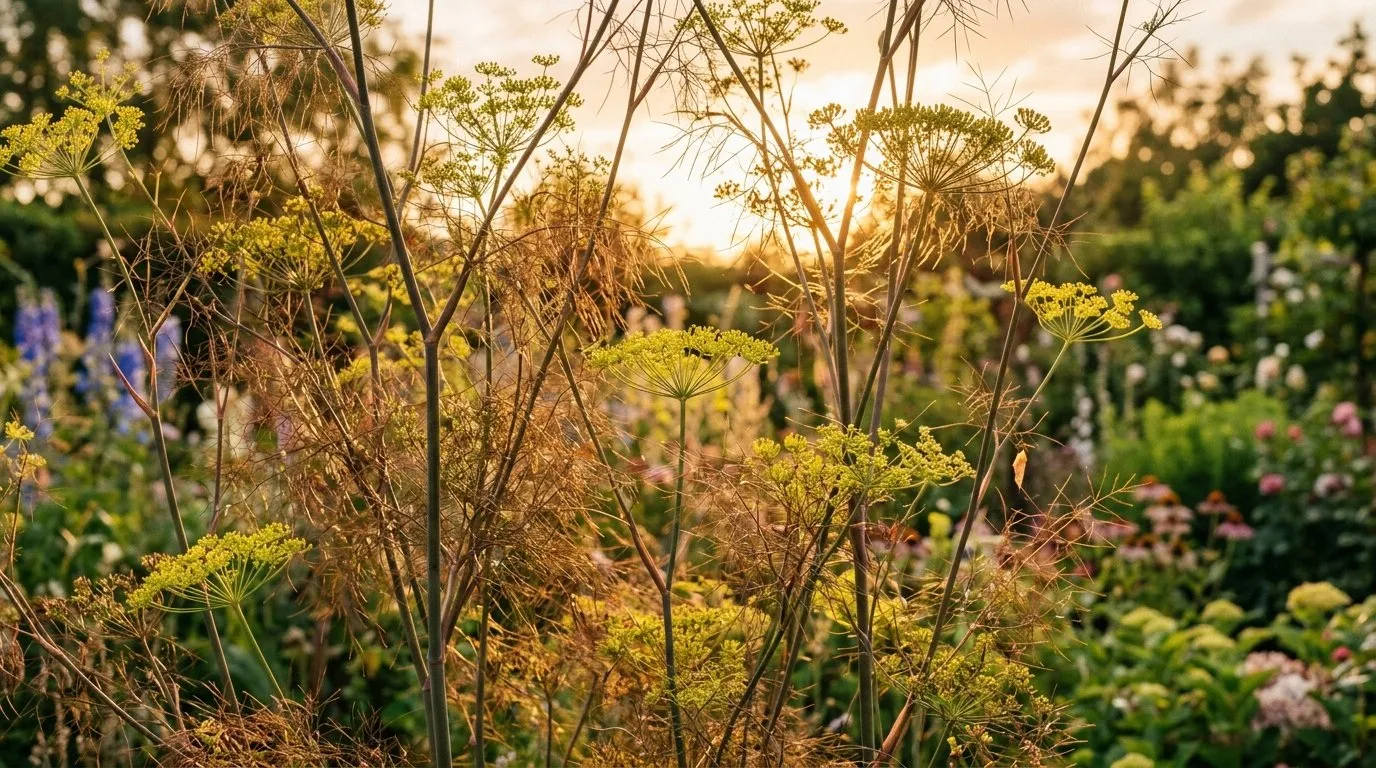 Bronze fennel at 2m. It screens without blocking, and late sun through the umbels is the effect that makes the back of a herb border worth designing.
The silver palette against warm brick
Herb borders have a colour advantage almost no other planting gets for free: a huge proportion of culinary herbs are silver, grey or blue-green.
That is not decorative. It is anatomy. Mediterranean plants carry fine hairs and waxy coatings to cut water loss under strong sun, and those surfaces scatter light, which reads to us as silver. Lavender, santolina, artemisia, rue, sage, thyme, curry plant and Teucrium all share it.
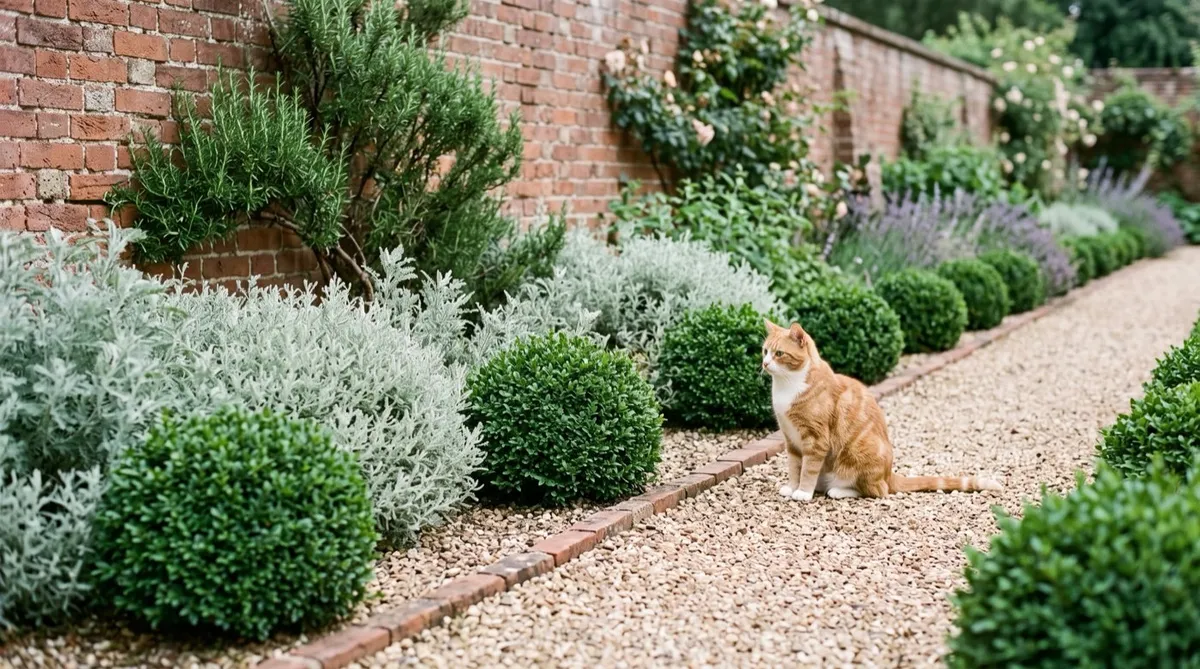
Put that palette against warm red brick and it does something specific. Silver and grey are cool and recessive; brick is warm and advancing. The contrast is direct without being loud, and unlike a flower colour it is there every day of the year, including the fortnight in February when nothing is in bloom.
The trick is to break the grey before it turns to fog. A border of nothing but silver goes flat and slightly dead in overcast light, which Britain has rather a lot of. Two interruptions fix it:
- Dark green mass: clipped Ilex crenata, bay, rosemary.
- One gold or purple: oregano ‘Aureum’ for gold, sage ‘Purpurascens’ for dusty purple.
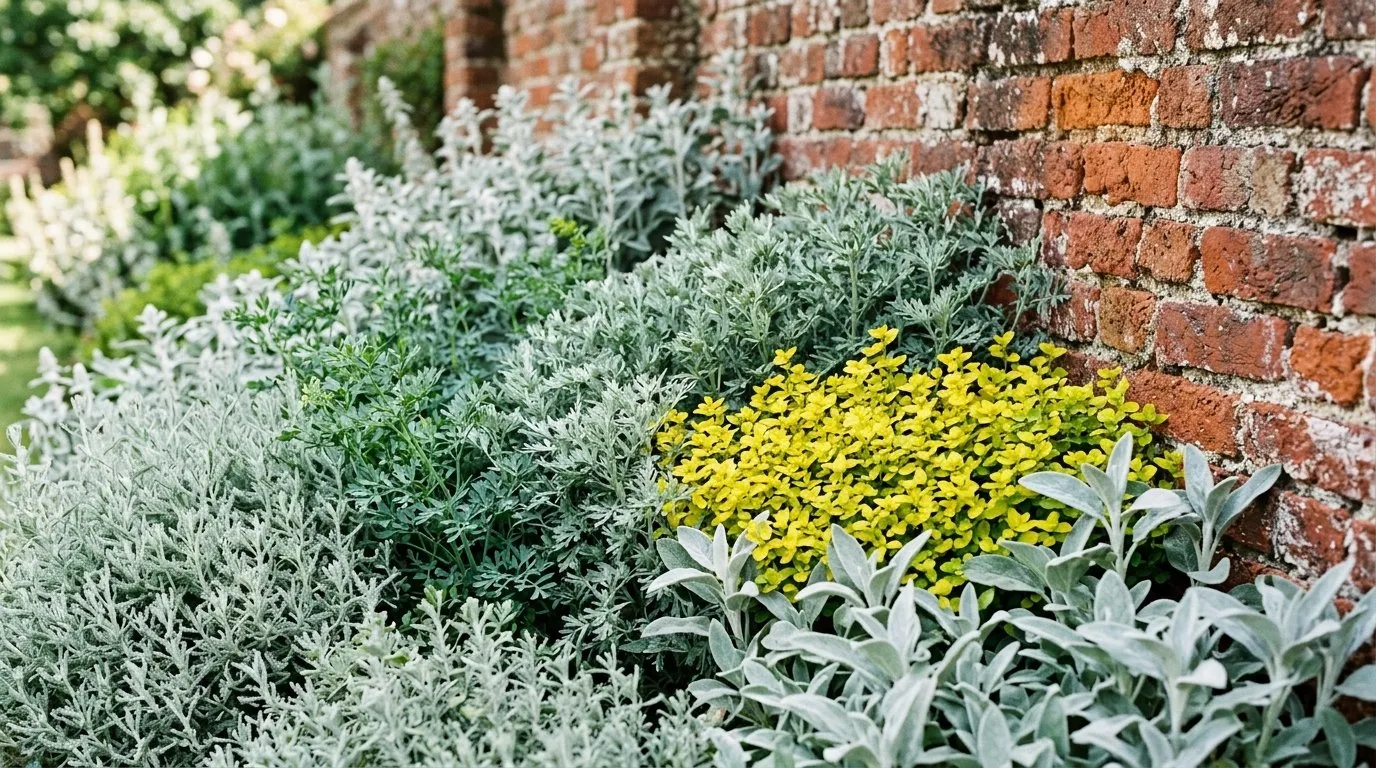 Silver herb foliage against warm brick. The contrast works every day of the year, which is more than any flower in the border manages.
Using a south-facing wall’s stored heat
A south-facing brick wall is the single most valuable thing a herb border can be planted against, and most people waste it.
Brick is thermal mass. It absorbs solar energy all day and releases it slowly overnight. The effect at the wall base is around 2 to 4C warmer than open ground on a still night, and it also keeps the soil drier by shedding rain. For Mediterranean herbs, both halves matter. Winter wet kills far more rosemary in Britain than winter cold does.
That margin decides what you can keep. At the foot of a warm wall, rosemary, myrtle, bay and French tarragon get through winters that would kill them 3m out in the open border. It is the difference between replacing plants every few years and having a permanent structure.
Use the wall properly:
- Put the borderline evergreens tight to it, within about 500mm. That is where the heat is.
- Keep the soft annuals out in the open border. Basil and coriander gain nothing from a warm wall and will only bolt faster.
- Watch the rain shadow. The strip within 400mm of a wall stays bone dry even in a wet British summer, so anything there needs watering in year one.
- Do not train anything vigorous across it. A climber over the brick shades the wall and cancels the thermal effect you are trying to use.
The east-facing and north-facing walls are not wasted, they are just a different list: mint, chervil, sweet cicely, parsley and lovage are perfectly happy in half a day of sun.
Repetition and rhythm in a herb border
This is where most home herb borders come apart, and it has nothing to do with plants.
The instinct is to collect: one rosemary, one sage, one thyme, one hyssop, one fennel, one of everything you might cook with. That produces a plant collection, not a border. The eye finds no pattern, so it reads the whole thing as clutter, however healthy the plants are.
Repetition is the cure. Take three or four plants and repeat each of them at least three times along the run, at regular intervals. On a 6m border that might be:
- Ilex crenata every 1.5m, so five domes.
- Santolina in three groups of two.
- Chives in five clumps, evenly spaced.
- Bronze fennel three times, pulled forward once.
Everything else, all the one-offs you actually want for the kitchen, goes into the gaps between. The repeated plants carry the design; the singletons hide inside it. This is precisely how a walled garden reads as ordered while containing dozens of species.
The second half is interval. Regular spacing reads as designed; random spacing reads as accident. Old gardens are almost obsessive about this, and it is the reason a physic garden bed of mixed medicinal plants still looks composed rather than weedy.
If you take one thing from this section: buy fewer species and more of each. Three rosemary at £8 beats six different herbs at £8 every time, visually.
A planting plan for a 1.2m by 6m herb border
Count the evergreen column and you get 8 of 15 species, which lands the winter mass at just under 40%. That is the number doing the work.
Gravel mulch as drainage and design device
Gravel does two unrelated jobs in a herb border and both of them matter.
The design job is surface. Gravel gives an unbroken, quiet, neutral floor that reads as deliberate ground rather than exposed soil. That is exactly what the border needs in January, when the plants are gone and the ground is most of what you can see. Bare earth reads as neglect; gravel reads as a design decision.
Specifics that matter:
- Angular, not rounded. Angular grit locks together and stays put. Pea shingle rolls onto the path and migrates for years.
- 6 to 10mm grade for a fine finish, 10 to 20mm for a coarser one. Both work; mixing them does not.
- Match the wall. Buff limestone against red brick, grey slate against grey stone. Gravel is a large flat colour and it will fight the wall if you let it.
- Do not use membrane. It stops herbs self-seeding, which is one of the great pleasures of this kind of border, and thyme rooting into gravel is exactly what you want at the edge.
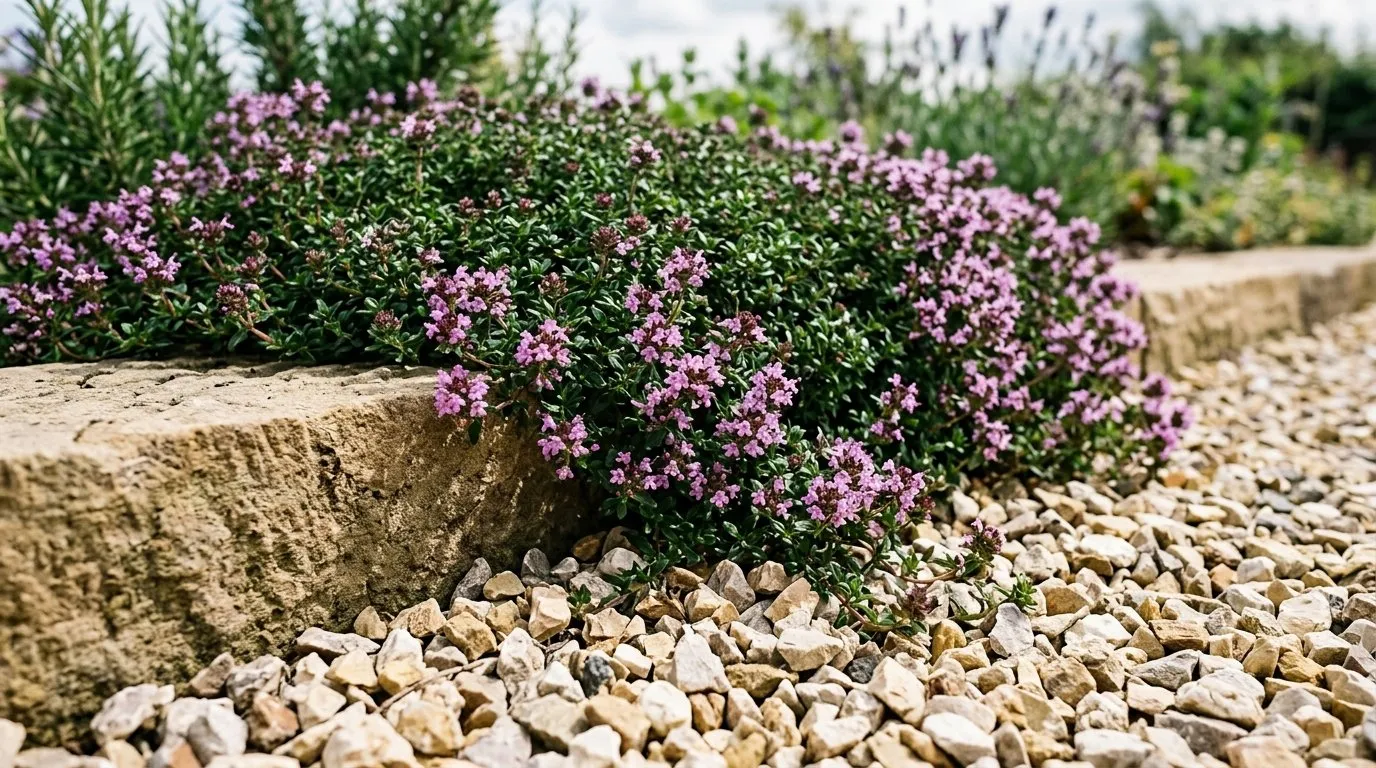 Thyme rooting into angular gravel at the border edge. The gravel drains the crowns, holds the design line in winter, and lets the thyme spread into it.
Paths, edging and the hard geometry
The hard edges are what survive winter, so they carry more design weight than anything you plant.
Edging is the drawn line of the border. On a herb border it must be crisp, because the planting above it is soft and aromatic and inclined to flop. The options that hold up:
- Brick on edge, laid to match the wall. The traditional kitchen garden answer, and still the best against red brick.
- Sawn stone setts, for a cleaner, more modern line.
- Steel edging, 3 to 5mm, for an almost invisible edge that stops gravel migrating.
- Clipped Ilex crenata, as a green edge instead of a hard one.
Paths need to be a surface, not a gap. A 600mm path is enough to walk; 900mm lets two people pass and lets you crouch to pick without standing in the border. If you take one dimension from the walled garden tradition, take the generous path. Old kitchen gardens ran paths at 1.2m or more because the path was a working space.
The geometry itself should be simple and straight. Herbs are soft, sprawling and irregular; the framework has to be the opposite or the whole thing reads as chaos. Curves fight the planting. The reason four centuries of kitchen gardens use rectangles is not lack of imagination. It is that a straight line is the only thing legible under a metre of collapsing fennel in August.
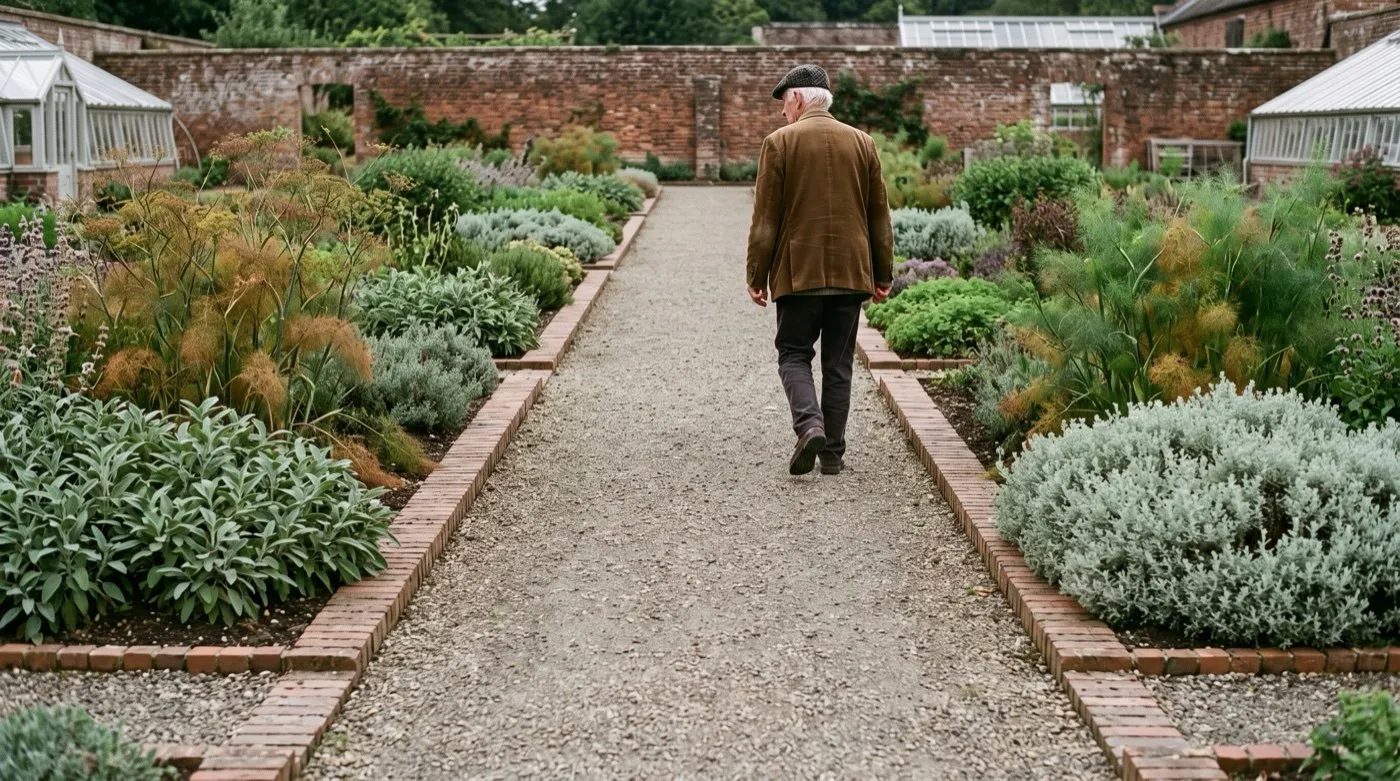 The framework doing the work: a straight brick-on-edge line and a generous path. At 900mm two people pass without standing in the border.
The seasonal cycle of a herb border, stage by stage
Understanding the die-back sequence is what lets you design for it rather than be surprised by it every year.
- Stage 1, September, air 12-15C. Soft herbs stop making new growth. Oregano and marjoram start to yellow at the base. The border is still full but has stopped improving.
- Stage 2, October, first air frost near -1C. Fennel, lovage and angelica collapse within 7 to 10 days of the first real frost. This is the fastest change of the year, and the border loses its whole back tier in a fortnight.
- Stage 3, November, 5-8C. Chives die back completely. Tarragon retreats to the root. Oregano goes to bare stems. Sage and rosemary hold but stop growing.
- Stage 4, December to February, 0-5C. Only evergreens are visible. This is the 15-week window, and the border is now entirely whatever structure you built.
- Stage 5, March, soil 6-8C. Chives and fennel push through. It takes a further 3 to 4 weeks to read as anything other than bare soil with green dots in it.
- Stage 6, May, soil above 10C. The border reads as full again. Total round trip: about 28 weeks from collapse to recovery.
The critical mistake is in stage 4, and it is a diagnosis error. People assume winter losses are cold damage and respond with fleece. On clay, they are almost always wet damage. A rosemary sitting in saturated soil at 3C rots at the collar and dies. The same plant on a 100mm ridge of grit, at the same temperature, lives. Fleece over a wet crown makes it worse by holding moisture against the stem.
| Month | Soil / air | What the border looks like | Job |
|---|---|---|---|
| January | 0-5C | Evergreen structure only | Look at it honestly. Photograph the gaps |
| February | 2-6C | Structure only; first bulbs | Order Ilex crenata; plan additions |
| March | 6-8C | Green dots appearing | Prune sage and santolina; clip nothing yet |
| April | 8-11C | Filling; back tier climbing | Clip Ilex crenata first cut; top up gravel |
| May | 10-14C | Reads as full | Plant new Mediterranean herbs now |
| June | 13-17C | Peak foliage; chives over | Clip santolina after flowering |
| July | 15-20C | Peak; fennel at full height | Second clip on Ilex crenata; harvest hard |
| August | 15-20C | Fennel and angelica dominant | Take rosemary cuttings; deadhead hyssop |
| September | 12-15C | Softening; oregano yellowing | Final light clip. Do not cut rosemary now |
| October | 8-12C | Back tier collapses in 7-10 days | Cut fennel and lovage down; lift ridges |
| November | 5-8C | Bare except evergreens | Gravel top-up. Do not prune Mediterranean herbs |
| December | 2-6C | Structure only | Nothing. The design is now doing the work |
Root cause: herb borders are planned in July
The underlying cause of nearly every disappointing herb border is a scheduling accident.
The design decision is made at peak leaf. People visit gardens in June, buy plants at a nursery in July, and plan a border when every herb on the bench is full, aromatic and in flower. The plant list that comes out of that moment is a July plant list. It has no reason to contain a single evergreen, because in July nothing needs one.
The permanent prevention is a scheduling fix, not a planting one:
Do that and the border works for 52 weeks instead of 37. Same herbs. Same soil. Different order of decisions.
Common mistakes in herb border design
- Planting entirely soft herbs. The commonest failure by a distance. A border with no evergreen mass is bare clay from mid-December to late March. Fix the 30 to 40% before you fix anything else.
- One of everything. Collecting produces clutter. Repeat three or four plants at regular intervals and hide the singletons between them. Fewer species, more of each.
- Blaming cold for winter losses. On clay it is almost always wet. Rosemary rots at the collar at 3C in saturated soil. A 100mm grit ridge saves more plants than any fleece.
- Replanting box. Blight and box tree moth are now endemic across much of England. Ilex crenata gives the same 25-40cm clipped line without the disease risk.
- Making the border too narrow. Under 1.2m you cannot layer three tiers, so the back row falls forward into the front and the whole structure flattens out.
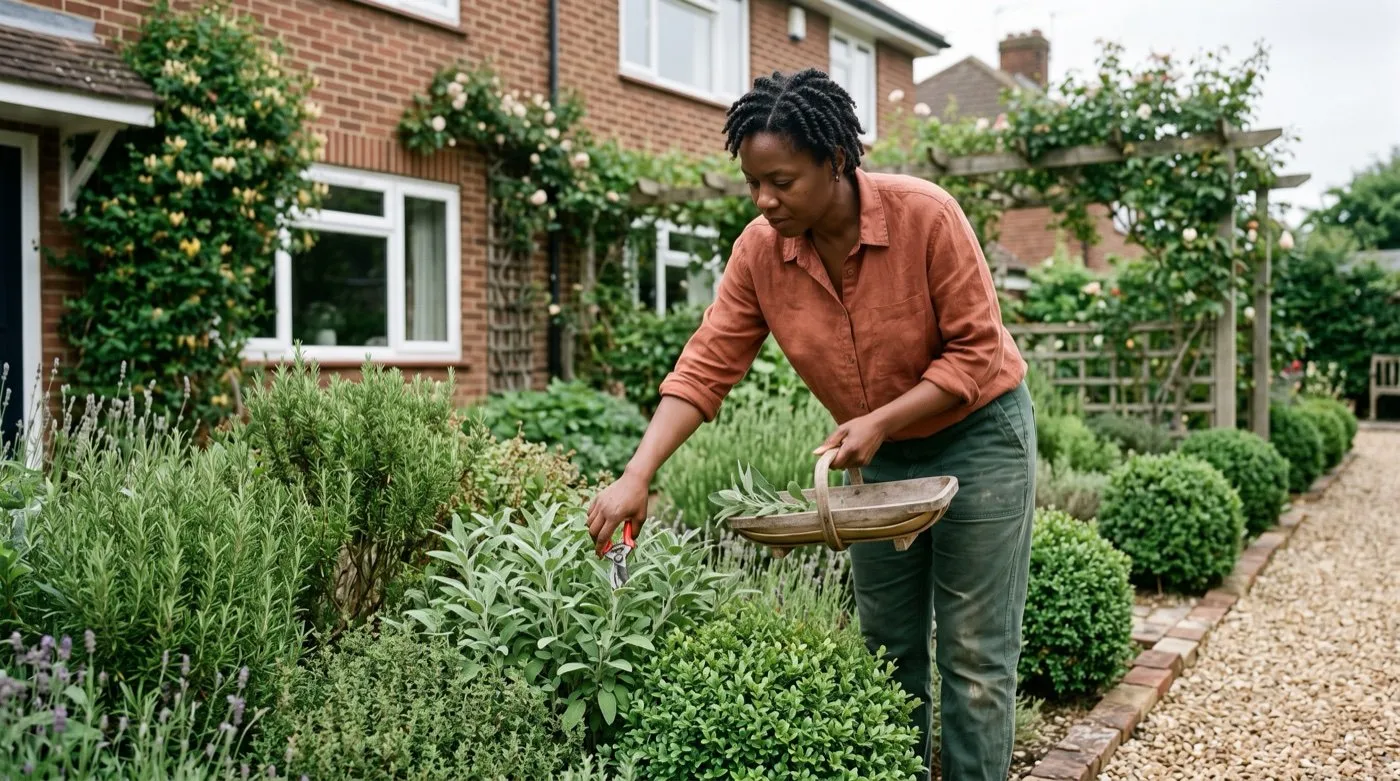 The walled garden geometry stolen at suburban scale: a straight edge, repeated clipped domes and a generous path in an ordinary back garden. Built to be cut from, not just looked at.
Designing a herb border that earns its keep in winter
The argument of this whole guide reduces to one sentence: a herb border is 60% infill and needs 40% skeleton, and the skeleton has to be bought deliberately because no herb list will ever suggest it to you.
Everything else follows. The walled garden geometry, the repeated clipped domes, the gravel floor, the hard edge, the silver against brick: all of it exists to give the border something to be in January when the fennel is a memory. Get that right and the soft planting becomes the easy, pleasurable, changeable part. Get it wrong and you rebuild the same disappointing rectangle every spring.
Frequently asked questions
Why does my herb border look dead in winter?
Most culinary herbs are herbaceous and die back completely once soil drops below 5C. Fennel, lovage, chives, tarragon and oregano all retreat to the root. If nothing evergreen is planted with them, the border becomes bare soil for about 15 weeks. The fix is structure, not different herbs.
Which herbs stay evergreen through a UK winter?
Rosemary, sage, thyme, hyssop, winter savory and bay hold their leaf year-round. Bay and rosemary give height, sage and santolina give mass, thyme and winter savory hold the front edge. Hyssop is semi-evergreen and drops leaf in a hard winter. Together these are the bones of a border that works in January.
What can I use instead of box for herb border edging?
Ilex crenata is the closest match and clips to the same 25-40cm profile. It has the small dark leaf and dense habit of box without the blight or the box tree caterpillar. It is slower, taking about three years to knit into a solid line. Dwarf yew and Teucrium fruticans also work.
How tall should the back of a herb border be?
Bronze fennel and angelica reach 1.8 to 2.5m and make the back-of-border architecture. Both are see-through, so they screen without blocking. Plant them where late summer sun comes through the umbels. Clipped bay at 1.5 to 2m gives the evergreen full stop at each end.
Do herbs really need gravel mulch in a UK border?
On clay, yes. Gravel keeps crowns dry and stops winter rot. Mediterranean herbs are killed by wet far more often than by cold. A 50mm gravel layer over 20mm grit sheds water off the crown and reflects heat back into the plant. It also reads as a deliberate design surface.
Can a herb border work in a shady garden?
Partly. Mint, chervil, lovage, parsley and sweet cicely tolerate shade and stay usable. Mediterranean herbs will not: rosemary, thyme, sage and lavender need six hours of direct sun. A shaded herb border is a different plant list and a greener, softer look, without the silver palette.
How wide does a herb border need to be?
At least 1.2m. Below that you cannot fit three height tiers without the back row falling forward. A 1.2m depth takes 2m fennel at the back, a 60-90cm middle tier and a 20-30cm front edge. Anything narrower works better as a single repeated row of clipped evergreens.
Our team produces practical UK gardening guidance from source research, contributor records and established horticultural practice. Editorial standards are overseen by Matt W.