Key takeaways
- A solid brick wall stores heat and holds its base 2-4C warmer than open ground on still nights
- That heat store lifts effective hardiness by about half a zone, enough to ripen peaches and figs
- South walls suit peaches, figs and grapes; cool north walls suit ferns and morello cherry
- Fan-training fits stone fruit, espaliers fit apples and pears, cordons pack 8-10 trees into 6m
- The rain-shadow strip at a wall base stays 40-60 percent drier, so plant 45cm out and water in
- Most failures come from the wrong plant on the wrong aspect, not from poor soil
A walled garden is the warmest, most sheltered growing space most UK gardeners will ever have. The walls do real physical work: solid brick or stone soaks up the sun all day, then radiates that stored heat back through the night. That single effect, the wall microclimate, is why the old kitchen gardens of country estates could ripen peaches, figs and grapes in a climate that should not allow them.
You do not need an estate to use the same physics. This guide explains how walls store heat, how to read each aspect, what to grow where, and how to train fruit flat against brick. It also covers laying out the space, fixing the dry rain-shadow strip at the wall base, real costs, and the mistakes that waste a season.
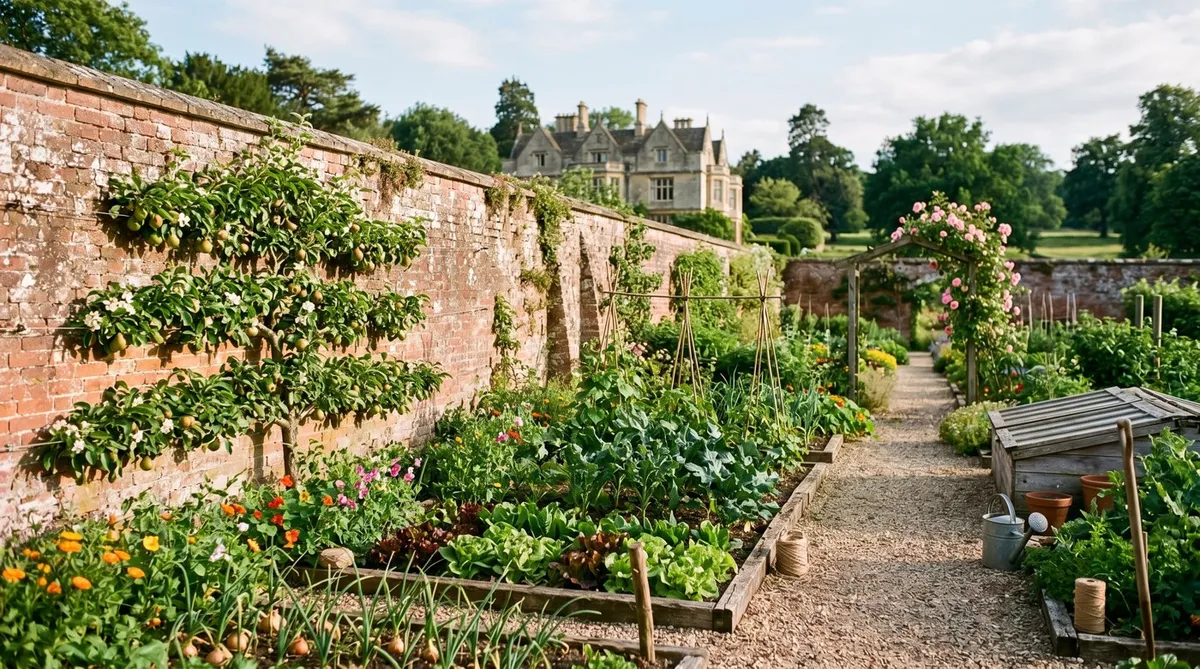
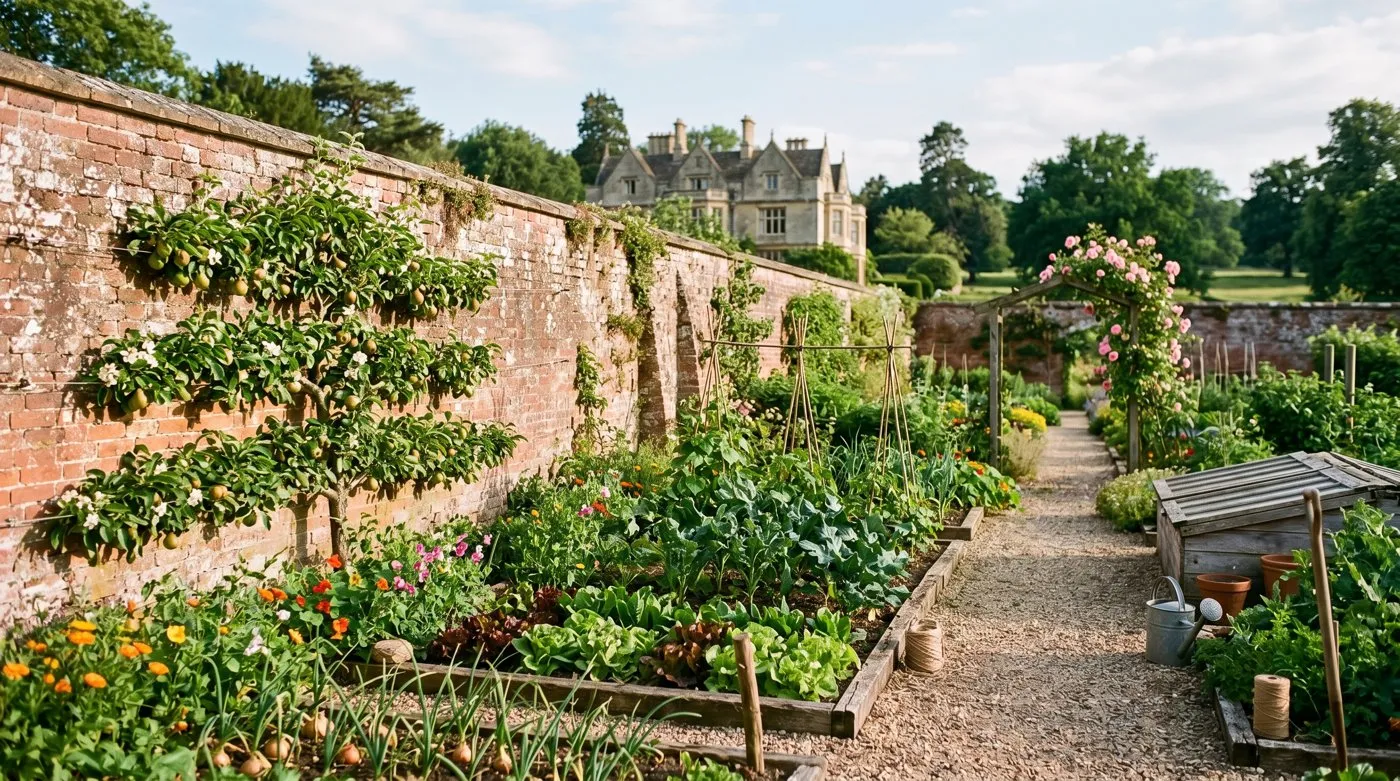 A traditional brick walled garden in high summer. The warm boundary walls do the work that makes tender fruit possible.
Why walled gardens work: the thermal mass effect
A solid wall is a battery for heat. Brick and stone have high thermal mass, meaning they absorb a large amount of energy slowly during the day and release it slowly at night. A standard one-brick wall, around 215mm thick, can hold daytime warmth for six to eight hours after sunset. That released heat keeps the air against the wall measurably warmer than the open garden.
Walls also break the wind. A solid barrier cuts wind speed for a distance of up to ten times its height downwind. Less wind means less chill, less physical damage, and slower moisture loss. Combine heat storage with shelter and you get the classic sun-trap effect: a pocket of garden that warms early in spring and holds that warmth into autumn. Understanding your own plot starts with sun mapping your garden across a full day.
A short history of the kitchen walled garden
The British walled kitchen garden reached its peak in the eighteenth and nineteenth centuries. Estates built high brick enclosures, often two to four metres tall, to feed the household year round. The walls were never just boundaries. They were growing infrastructure.
Gardeners angled and even heated the walls. Some were built hollow, with flues carrying smoke from furnaces behind the brick to push warmth into the masonry on frosty nights. South walls held the prized peaches and apricots. North walls grew morello cherries and stored cool-loving crops. Glasshouses and lean-to vineries leaned against the warmest faces to extend the season further.
How each wall aspect changes what you can grow
Aspect is the single biggest factor in a walled garden. The same wall, facing a different direction, becomes a different climate. Read the aspect first, then choose plants to match. Getting this wrong is the most common and most expensive error in walled planting.
A south-facing wall receives sun from mid-morning until evening and stores the most heat. It is the spot for anything that needs a long, hot season: peaches, nectarines, apricots, figs, grapes and tender wall shrubs. A west-facing wall warms later in the day and holds evening sun, making it a strong all-rounder for plums, pears, late apples and many climbers.
An east-facing wall catches gentle morning sun then falls into afternoon shade. Avoid early-flowering plants here, because morning sun on frosted buds causes rapid thawing and damage. A north-facing wall stays cool and shaded but is also the most frost-stable. It is no dead zone. Morello cherry, ferns, hostas and shade climbers all do well there.
| Wall aspect | Microclimate effect | Best plants to grow |
|---|---|---|
| South | Warmest, stores 2-4C of overnight heat, longest sun | Peach, nectarine, apricot, fig, grape, Ceanothus, Fremontodendron |
| West | Warms in afternoon, holds evening heat, sheltered | Pear, plum, late apple, climbing rose, honeysuckle, jasmine |
| East | Gentle morning sun, cool afternoons, frost risk on buds | Early apple, gooseberry, redcurrant, clematis, pyracantha |
| North | Coolest, shaded, frost-stable, rarely bakes | Morello cherry, climbing hydrangea, fern, hosta, ivy |
Training fruit flat against a warm wall
Wall-trained fruit is the heart of a productive walled garden. Training a tree flat against brick does two things. It presses the plant into the warmest air in the garden, and it makes every fruit easy to reach, net and pick. Three core methods cover almost every fruit, ranked here by where each earns its place.
Fan-training suits stone fruit: peach, nectarine, apricot, fig and morello cherry. These crop on younger wood, so the radiating branches of a fan keep producing fresh fruiting growth. Espaliers, with horizontal tiers off a central stem, suit apples and pears on dwarfing rootstocks. Cordons are single stems planted at a 45-degree angle, and they pack the most varieties into the least space. A 6m run holds 8-10 cordons against 2-3 fans.
| Training method | Best fruit | Spacing per plant | Yield potential | Effort to maintain | Role |
|---|---|---|---|---|---|
| Fan | Peach, fig, morello cherry, apricot | 3.5-4.5m | High per tree | High, regular tying and pruning | Primary for stone fruit |
| Espalier | Apple, pear | 3-4.5m | High, long-lived | Medium, two prunes a year | Primary for pip fruit |
| Cordon | Apple, pear, gooseberry, redcurrant | 60-75cm | Moderate per plant | Medium, summer pruning | Maximum variety in small space |
| Step-over | Dwarf apple, pear | 1-1.5m | Low, edging only | Low | Bed edging and paths |
Start with the right plant for the method. Our guides to training fruit trees as espaliers and fan-training a fruit tree walk through the first three formative years step by step.
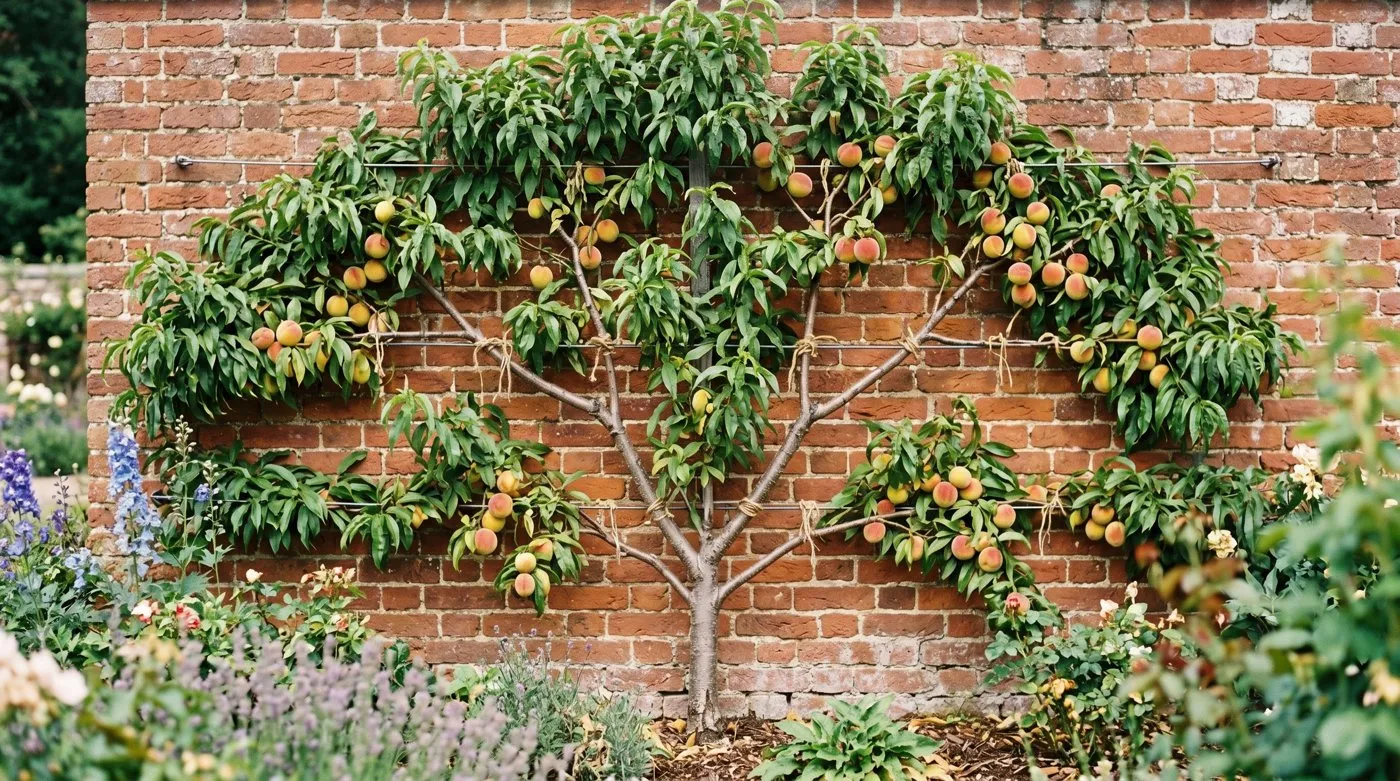 A fan-trained peach pressed flat against warm brick. The wall ripens fruit that rarely succeeds in the open in the UK.
South wall: peaches, figs and grapes
A south wall is wasted on anything hardy. Save it for the plants that genuinely need the heat. Peaches and nectarines flower early and crop on the previous year’s growth, so a sheltered fan against warm brick protects the blossom and ripens the fruit. Grow a peach-leaf-curl-resistant variety like ‘Avalon Pride’ and keep rain off the leaves until June.
Figs crop best with their roots restricted, which a wall border does naturally. ‘Brown Turkey’ is the reliable UK choice. Grapes ripen far better trained on wires against a south wall than freestanding. For the full method see growing fig trees, growing grape vines, and the specific routine for growing peach trees in a UK garden.
North wall: morello cherry and shade climbers
A north wall is the most underused asset in most gardens. It stays cool, never bakes, and rarely suffers the frantic freeze-thaw that wrecks buds on east walls. Morello cherry is the classic crop here. It is a sour cherry that fruits well in shade and makes excellent jam and pies.
For cover, climbing hydrangea (Hydrangea anomala petiolaris) clings to brick without support and lights up shade with white summer flowers. Ferns, hostas and ivy fill the border below. A north wall planted well looks lush and stays calm all year.
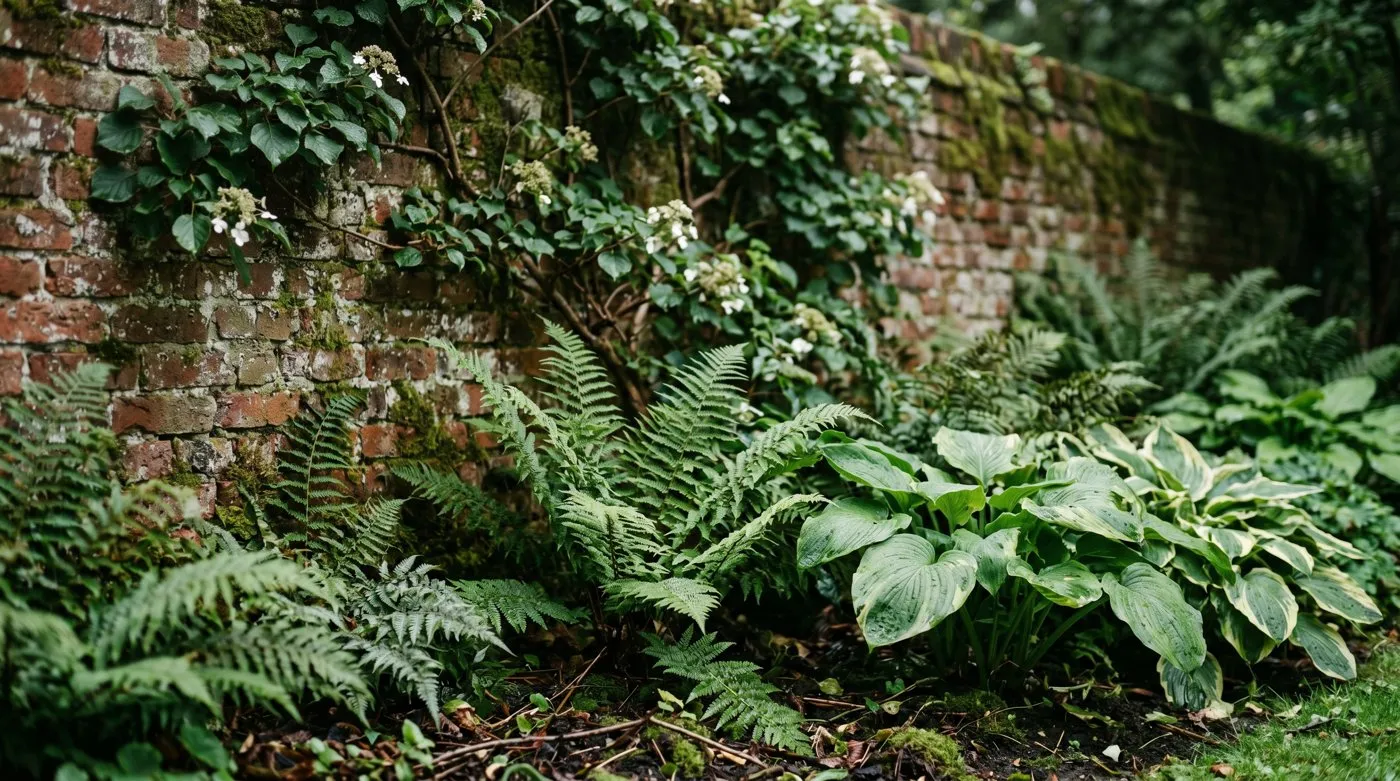 A north wall is not a problem to solve. Ferns, hostas and climbing hydrangea turn the shade into a feature.
Climbers and wall shrubs for every face
Not every wall plant is fruit. Climbers and wall shrubs clothe the masonry, soften hard lines and add scent and flower. Match the plant to the aspect and the support it needs. Self-clinging climbers grip brick directly. Twiners and scramblers need wires or trellis fixed 5cm off the wall for air flow.
For sunny west and south faces, climbing roses, honeysuckle, jasmine and the tender wall shrub Ceanothus all thrive. On cooler walls, climbing hydrangea, ivy and Parthenocissus carry the load. If you have a bare new fence or wall to cover quickly, our list of fast-growing climbers for fences and walls covers the quickest options and their fixing needs.
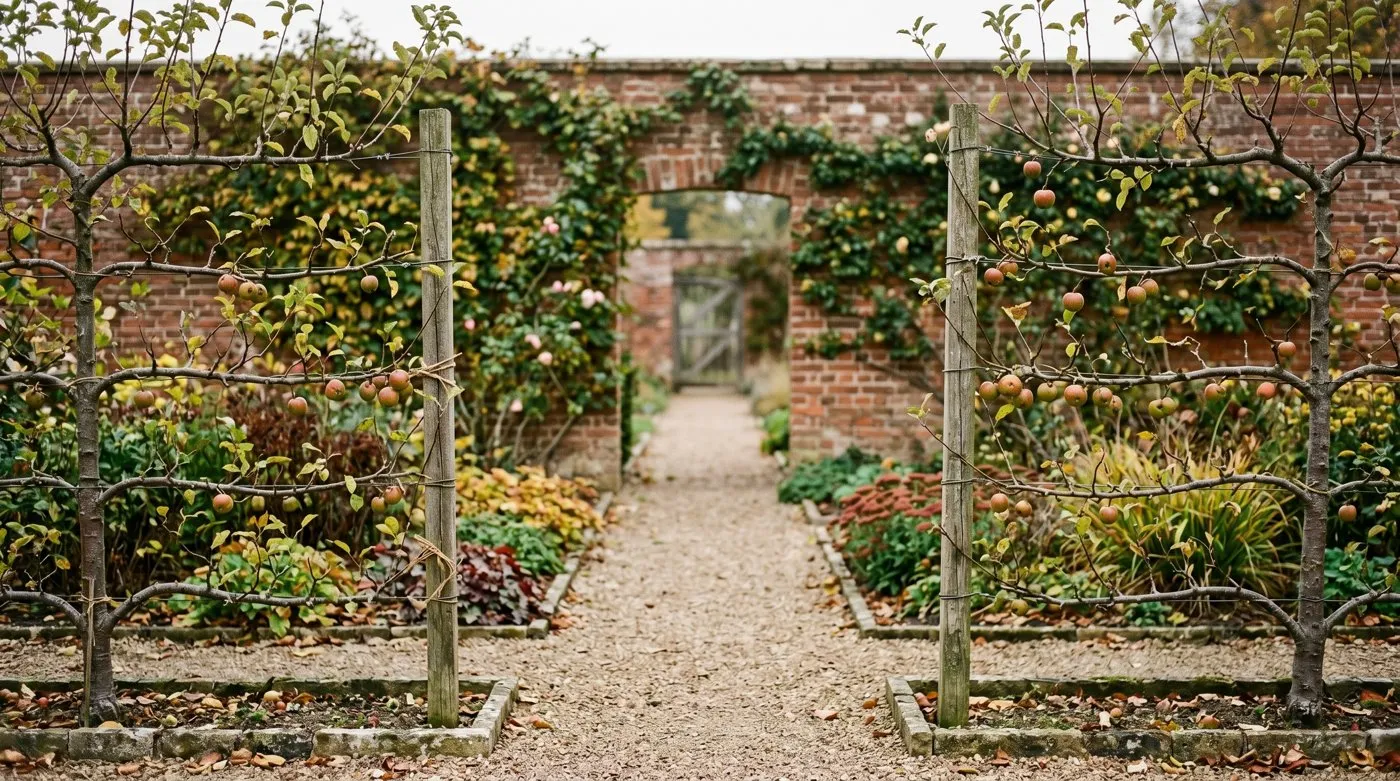 Espaliered apples lining a path. Horizontal tiers turn a boundary into a productive, ornamental edge.
Laying out the walled garden
A walled garden invites formal design because the walls already give you straight lines and symmetry. Work with that. Most successful layouts run paths in a simple grid or cross, with a central feature at the meeting point: a dipping well, a sundial, a clipped box, or a fruit tree on a tall standard.
Divide the space into four or more beds. Edge them with raised beds or low step-over apple cordons for a productive border that stays neat. Keep at least one path 1.2m wide so a wheelbarrow passes easily. Reserve the warmest south-facing wall for fruit and the cool north wall for shade planting and storage.
Build in a seating sun-trap against a south or west wall, where the stored heat makes the spot usable from early spring to late autumn. Use doorways and gates to frame views, a trick the old gardens used to borrow the wider countryside into the design. A single well-placed opening turns a wall into a picture frame.
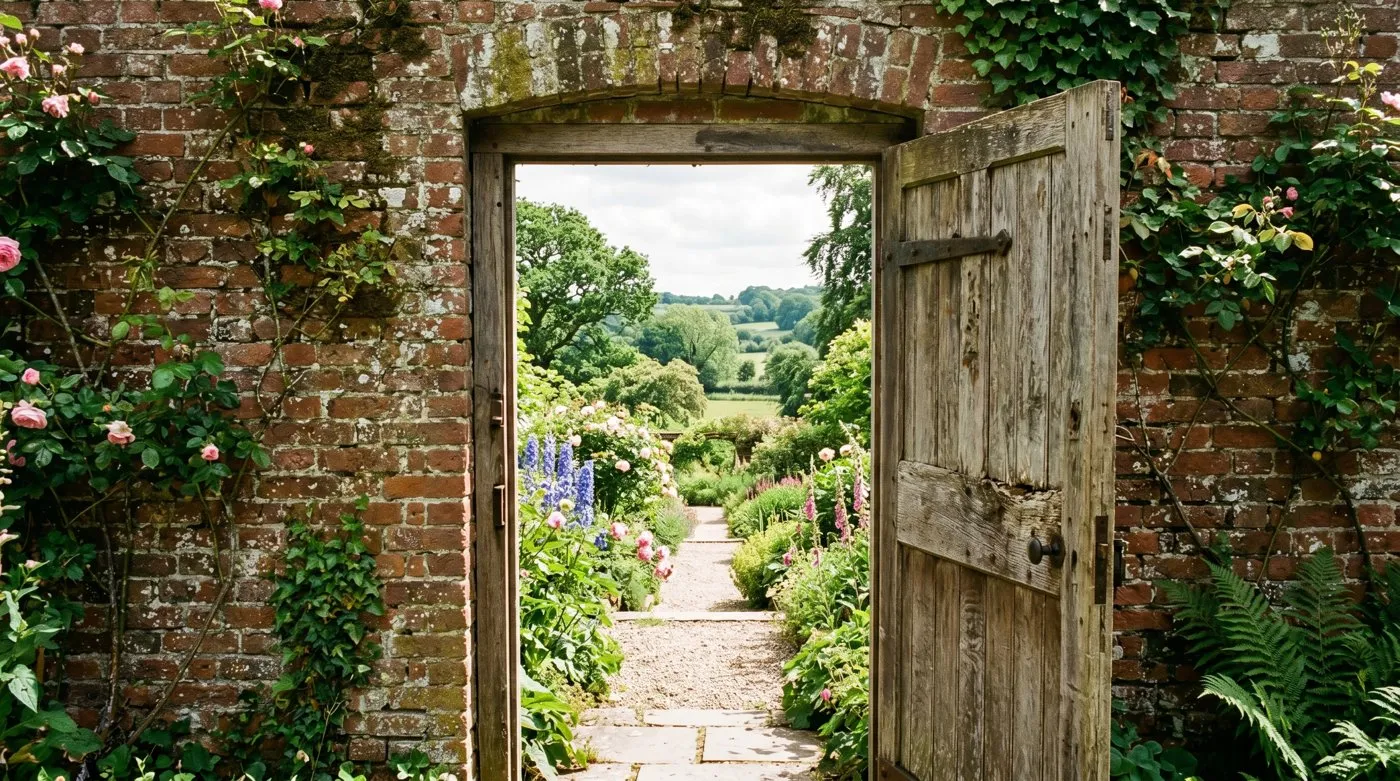 A doorway frames a borrowed view. Openings turn a solid wall into a deliberate sightline.
Building privacy, shelter and a sun-trap
The enclosure itself delivers privacy, but the quality of shelter depends on the wall. A solid wall does not simply block wind. Air spills over the top and can curl down into a damaging eddy close to the base. A wall with a small amount of permeability, or a wall paired with a hedge, gives smoother, calmer shelter across a wider area.
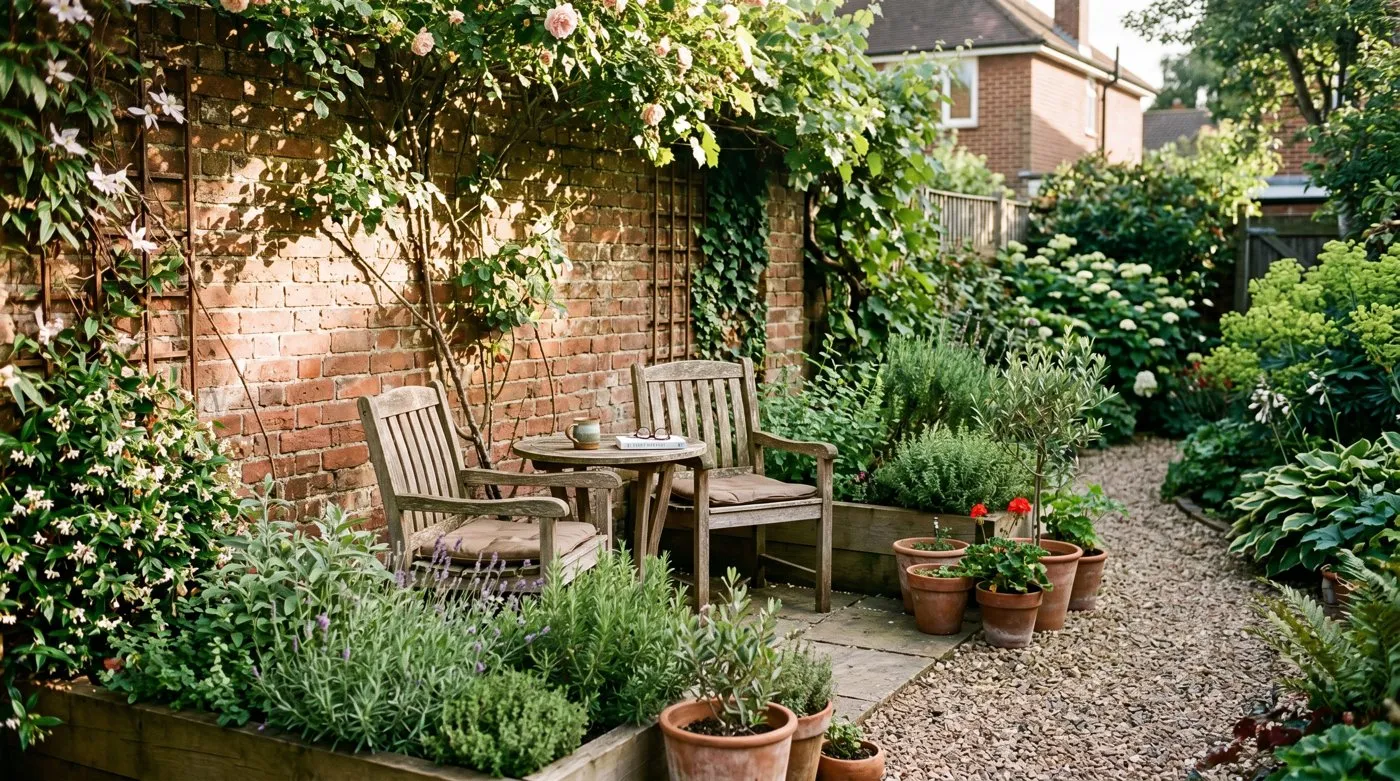 A south-facing corner traps sun and blocks wind from two sides. It warms weeks before the open garden.
Creating a walled feel without an old wall
Few of us inherit a Georgian kitchen garden. The good news is you can build the same effect. A new brick wall gives the full heat store and shelter, at a price. A rendered blockwork wall is cheaper and stores almost as much heat, since the dense concrete blocks behind the render have high thermal mass.
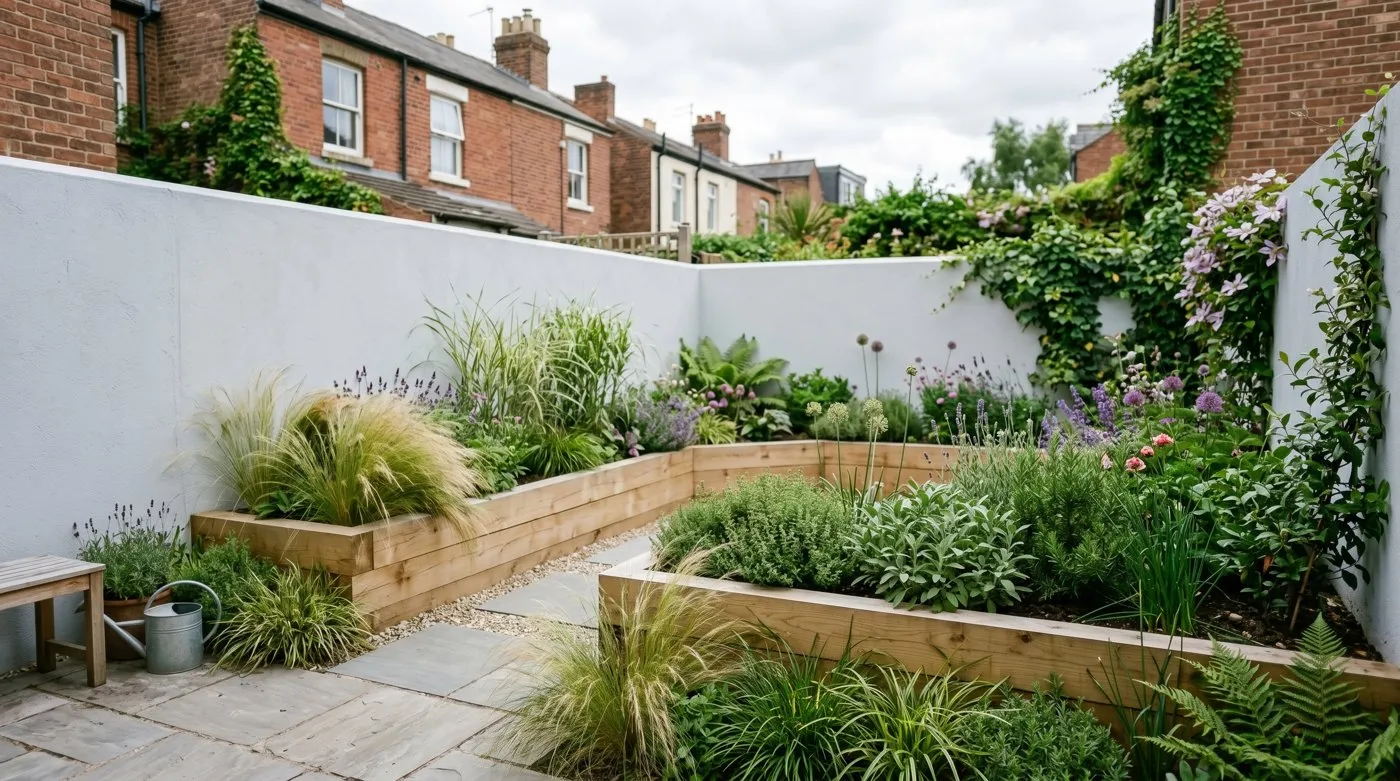 A modern take. A rendered blockwork wall stores nearly as much heat as old brick at a lower cost.
Solving the rain-shadow and drainage problem
The biggest hidden trap in walled planting sits right at the wall base. The wall casts a rain shadow, intercepting rain driven by the prevailing wind. The strip of soil within 30-45cm of a wall stays 40-60 percent drier than open ground, even after heavy rain. Plant straight against the brick and the plant dies of drought while the rest of the garden is soaked.
The fix is simple but non-negotiable. Plant 45cm out from the wall and lean the stems back towards it. Dig in plenty of compost or well-rotted manure to hold moisture in that dry zone. Mulch the base 7-10cm deep, keeping the mulch off the stem. Water every new wall plant weekly through its first two summers; tender wall fruit needs this most.
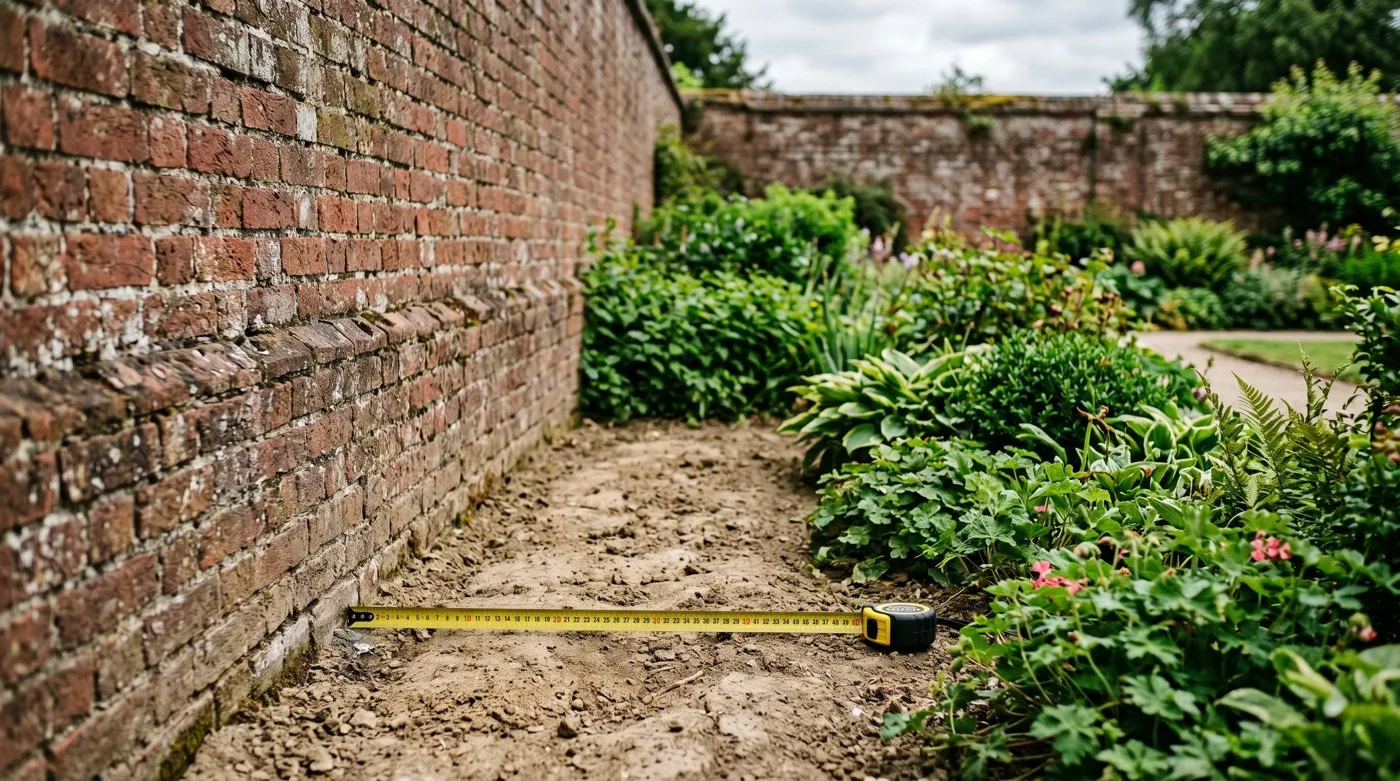 The rain-shadow strip at a wall base stays 40-60 percent drier than open ground. Plant out from it, not against it.
What a walled garden costs to build
Walls are the expensive part of this style. In 2026, a new brick wall costs roughly 150-350 pounds per square metre built, depending on brick choice, height and labour. Reclaimed brick for a traditional look pushes the top of that range. A two-metre wall along a 10m boundary is a serious project, often 6,000-12,000 pounds with foundations.
A rendered blockwork wall is cheaper at around 120-220 pounds per square metre and stores almost as much heat. Gabion walls start near 90 pounds per square metre and go up fast on a level base. Budget separately for foundations, coping stones to shed water off the top, and any wires or trellis for training.
The hidden costs are foundations and drainage. A wall over 1m tall needs a proper concrete footing below frost depth, typically 450-600mm deep. Skimp on the footing and the wall cracks within a few winters. Set the fruit-training wires and vine eyes before you plant, not after.
Gardener’s tip: Fit galvanised vine eyes and 2.5mm wire to your walls before any planting. Space wires 30cm apart for fans and 45cm apart for espalier tiers, holding the wire 5cm off the brick. Retro-fitting wires around an established tree is slow, awkward work, and you will damage growth doing it.
A month-by-month walled garden calendar
Timing turns a walled garden from pretty to productive. The warm microclimate shifts some jobs earlier than the open garden, so work to the wall, not the calendar on the wall.
| Month | Job |
|---|---|
| January | Prune apples and pears on espaliers and cordons while dormant. Check wall ties and wires. |
| February | Plant bare-root fan and espalier trees 45cm out from the wall. Spray peaches against leaf curl. |
| March | Tie in new growth. Mulch wall borders 7-10cm deep. Hand-pollinate early peach blossom. |
| April | Watch for late frost on south and east walls. Fleece blossom on cold nights. |
| May | Tie in and pinch out fig and peach side shoots. Start weekly watering of new wall plants. |
| June | Thin peaches and apples to one fruit per cluster. Summer-prune the first cordon growth. |
| July | Summer-prune trained apples and pears. Net ripening cherries and figs against birds. |
| August | Harvest peaches, early figs and plums. Keep watering through dry spells. |
| September | Pick late apples, pears and grapes. Cut out fruited fig wood. |
| October | Plant new bare-root fruit. Clear fallen leaves to reduce disease over winter. |
| November | Wrap tender fig and wall-shrub roots with fleece or straw on cold walls. |
| December | Winter-prune apples and pears. Plan next season’s training and new wires. |
For frost-prone springs against early-flowering walls, our guide to protecting plants from frost covers fleecing blossom and timing.
Root cause: most walled gardens fail on aspect, not soil
When a walled planting fails, gardeners almost always blame the soil. The real cause is usually wrong plant, wrong aspect. A peach on a cold east wall loses its blossom to freeze-thaw every spring and never crops, no matter how good the soil. The plant is not weak. It is simply in the wrong place against the wrong wall.
The fix is permanent and free. Map the aspect of every wall across a full day before buying a single plant. Note where the sun lands at 9am, noon and 5pm, and where frost lingers longest in the morning. Match heat-lovers to south and west, shade-tolerant plants to north, and frost-stable late-flowerers to east. Get the aspect right and ordinary soil grows extraordinary fruit. Get it wrong and the best soil in the country will not save the plant.
Common mistakes in walled garden design
A handful of errors account for most walled-garden disappointments. Avoid these and the space rewards you for decades.
Planting tight against the wall
The rain shadow kills more wall plants than cold ever will. Planting against the brick puts roots in the driest 30-45cm strip in the garden. Plant 45cm out, lean stems back, and water through the first two summers.
Putting the wrong plant on the wrong aspect
A peach on a north wall will not ripen. A fern on a baking south wall will scorch. Aspect decides survival before soil or feeding ever matter. Read each wall first, then choose plants to suit it.
Ignoring drainage at the wall footing
Old wall footings dam underground water. The base goes soggy in winter and dry in summer, the worst of both. Improve soil deeply, add grit on clay, and raise the planting line slightly on wet ground.
Over-formalising and cluttering the space
The enclosure tempts people to fill every inch. Too many beds, ornaments and features make a small walled garden feel cramped and fussy. Keep the layout simple, the paths generous, and let the walls and a single central feature carry the design.
Related reading: A sheltered warm wall suits tender shrubs, see our guide to growing abutilon against a wall.
Frequently asked questions
Does a walled garden really make plants hardier?
Yes, by roughly half a hardiness zone. Solid masonry absorbs daytime sun and releases it slowly overnight. On a still, clear frost night the base of a south-facing brick wall sits 2-4C warmer than open ground, enough to protect tender wall fruit and shrubs that fail a few metres away.
What can I grow against a south-facing wall in the UK?
Peaches, nectarines, figs, grapes and apricots. The warm brick ripens fruit that struggles in the open. South walls also suit tender wall shrubs like Ceanothus, Fremontodendron and trained pyracantha. Use the heat for anything that needs a long, warm season to crop or flower well.
What grows on a cold north-facing wall?
Morello cherry, ferns, hostas and shade climbers. A north wall stays cool and shaded but rarely bakes. Morello cherry crops well there, and climbing hydrangea, ivy and Parthenocissus thrive. Treat it as a calm, frost-stable spot rather than a poor one.
How do I deal with the dry strip at the base of a wall?
Plant 45cm out from the wall and lean stems back. The wall casts a rain shadow, leaving the base 40-60 percent drier than open soil. Dig in compost, plant away from the footing, mulch deeply, and water new wall plants weekly through their first two summers.
Can I create a walled feel without an old brick wall?
Yes, with new walls, rendered block, or gabions. A rendered blockwork wall stores almost as much heat as old brick. Gabion cages, close-board fencing with a brick plinth, or a clipped yew hedge all give shelter and enclosure, though only solid masonry gives the full night-time heat store.
What is the best fruit-training method for a wall?
Fans for stone fruit, espaliers for apples and pears. Fan-training suits peaches, figs and morello cherry because they fruit on younger wood. Espaliers suit pip fruit on dwarfing rootstocks. Cordons planted at 45-degree angles pack the most varieties into a short run.
How much does building a garden wall cost in the UK?
Roughly 150-350 pounds per square metre for a new brick wall in 2026. A rendered blockwork wall costs less, around 120-220 pounds per square metre. Gabion walls start near 90 pounds per square metre. Add foundations, coping and VAT. Reclaimed brick costs more but suits a traditional look.
Which way should the warmest part of a walled garden face?
South, for the longest and strongest sun. A south-facing wall receives sun from mid-morning to evening and stores the most heat. West walls warm later and hold evening sun. East walls catch gentle morning sun. North walls stay cool and shaded all year.
For deeper guidance on the science behind enclosed beds, the Royal Horticultural Society and the conservation charity Garden Organic both publish useful background on wall fruit and microclimates.
Now you understand how walls store heat and shelter tender fruit, put that warm brick to work with our guide to growing apple trees as fans and espaliers.
Our team produces practical UK gardening guidance from source research, contributor records and established horticultural practice. Editorial standards are overseen by Matt W.