Key takeaways
- Knot gardens peaked in England between 1560 and 1620, designed to be viewed from above
- A 3m square open knot needs roughly 100 dwarf hedging plants and costs £350-750 to plant
- Box blight (mid-1990s) and box tree moth (2007) rule box out of most new knots
- Ilex crenata, Euonymus 'Jean Hugues', teucrium, lavender and santolina are the safe ribbon plants
- Set the pattern out with a 1m string grid and dry sand poured from a bottle
- Clip two or three times a year: first cut early June, last cut by mid-September
A knot garden condenses four centuries of English garden history into a few square metres of clipped evergreen pattern. The Elizabethans laid them out below their windows, ribbons of green weaving over and under one another like embroidery. Then box blight arrived in the 1990s and the whole tradition looked finished.
What is a knot garden and where did it come from?
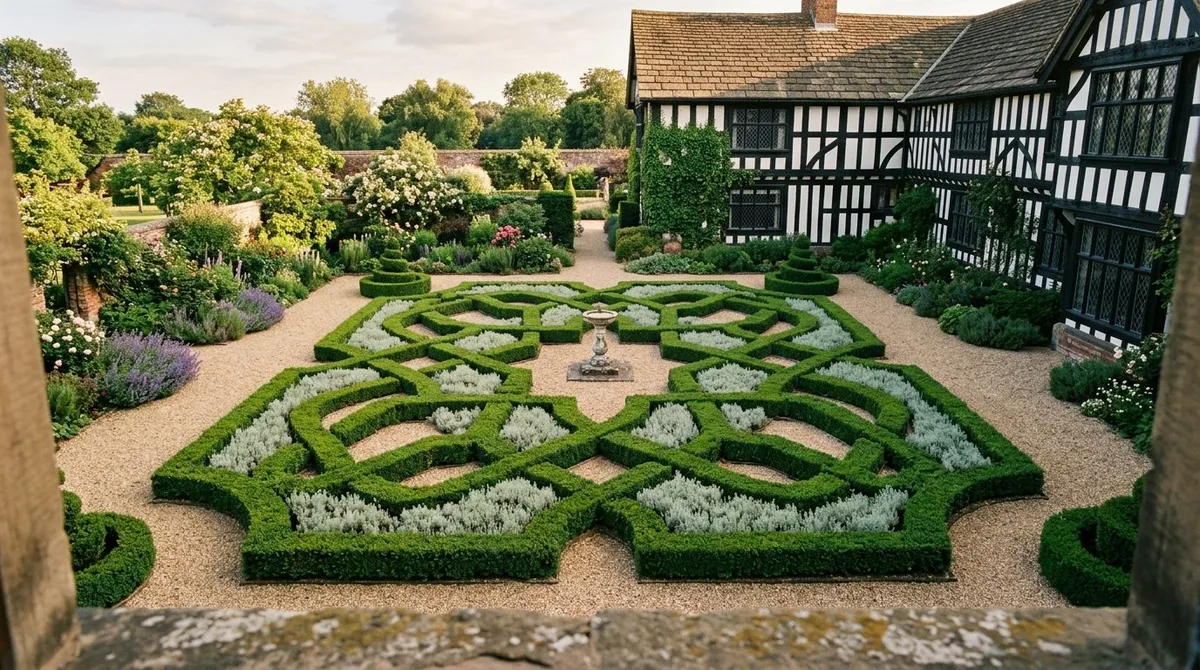
A knot garden is a formal bed of low clipped hedges arranged in an interlacing geometric pattern, designed to be viewed from above. The name comes from the knotwork of Tudor embroidery, carpets and plaster ceilings. Where two hedging ribbons cross, one appears to pass over the other, exactly like threads in a knot.
Knots appear in English garden records from the late 1400s and peaked between 1560 and 1620. Thomas Hill printed ready-made knot patterns in 1563 in the first popular English gardening book, then added more in The Gardener’s Labyrinth of 1577. Tudor owners admired their knots from first-floor windows, raised walks and purpose-built earth mounds called mounts.
Three gardens show the tradition at its best:
- Little Moreton Hall, Cheshire. The National Trust’s moated Tudor hall has a knot planted in 1972 to a design from Leonard Meager’s The Complete English Gardener of 1670. You can study it from the original earth viewing mound.
- Hampton Court Palace, Surrey. The historian Ernest Law laid out the small knot garden beside the Pond Gardens in 1924, planted with 16th-century species as a window onto Henry VIII’s lost gardens.
- Helmingham Hall, Suffolk. Lady Xa Tollemache created the knot garden here in 1982. The box ribbons trace the Tollemache family fret and initials, infilled with plants introduced before 1750.
Visit one before you draw your own. Photographs flatten a knot; seen from a mound or an upstairs window, the weave suddenly makes sense.
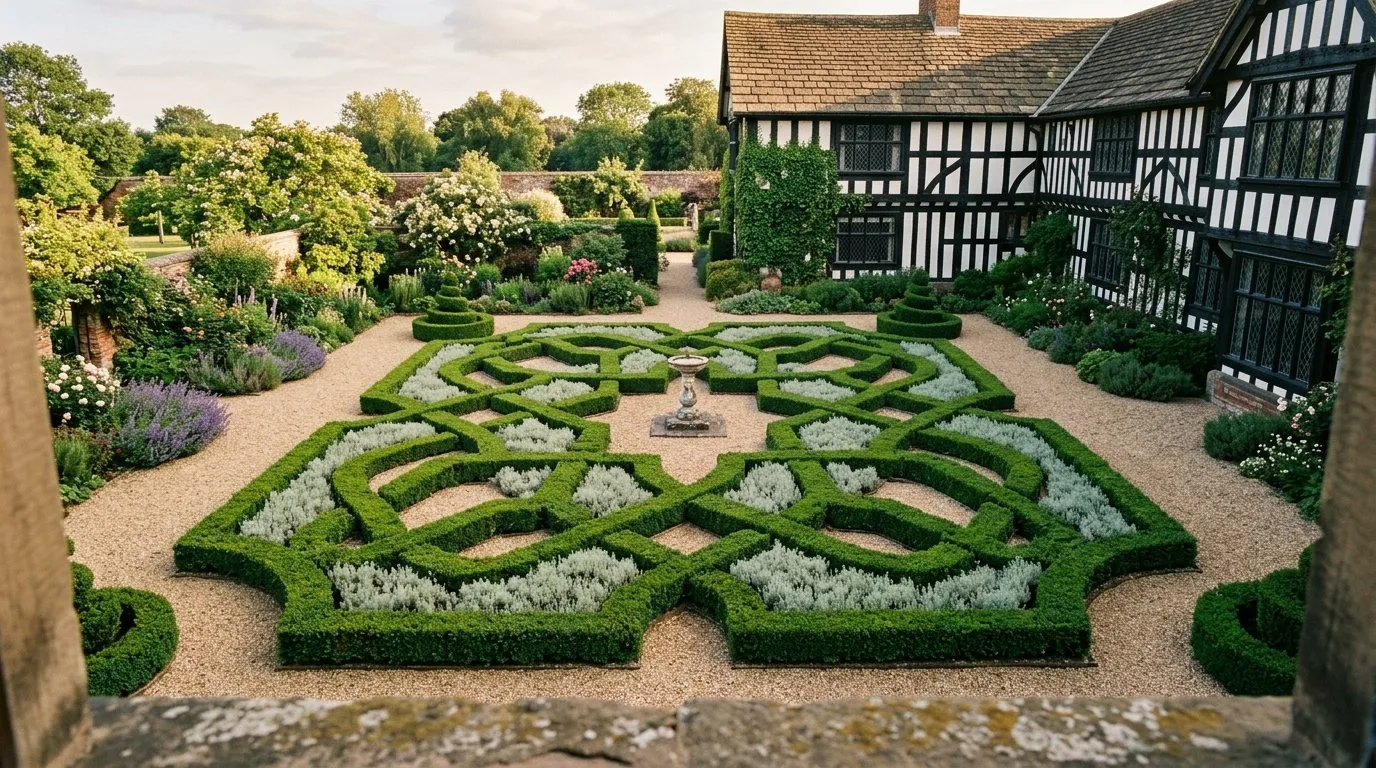 The interlace read from above, which is how every knot was meant to be seen. Height and viewpoint are part of the design.
Open knot or closed knot: which design should you choose?
Choose an open knot for a first attempt, because gravel between the ribbons is far more forgiving than packed planting. The two traditional forms differ only in what fills the gaps.
An open knot leaves the spaces between ribbons unplanted and dresses them with contrasting gravels, crushed brick, shell or bark. Tudor gardeners used coloured earths and even coal dust. The pattern reads clearly in every month of the year, and weeding takes minutes.
A closed knot fills every compartment with planting: herbs, bedding or bulbs. It looks generous from June to September, but the infill fights the hedges for light and water. Expect to edit it weekly through summer.
The interlace is what separates a true knot from plain edging. Plant each ribbon in a different foliage colour, then clip the over ribbon 3-5cm higher wherever two ribbons cross. Dark green passing over silver reads from 20 metres away.
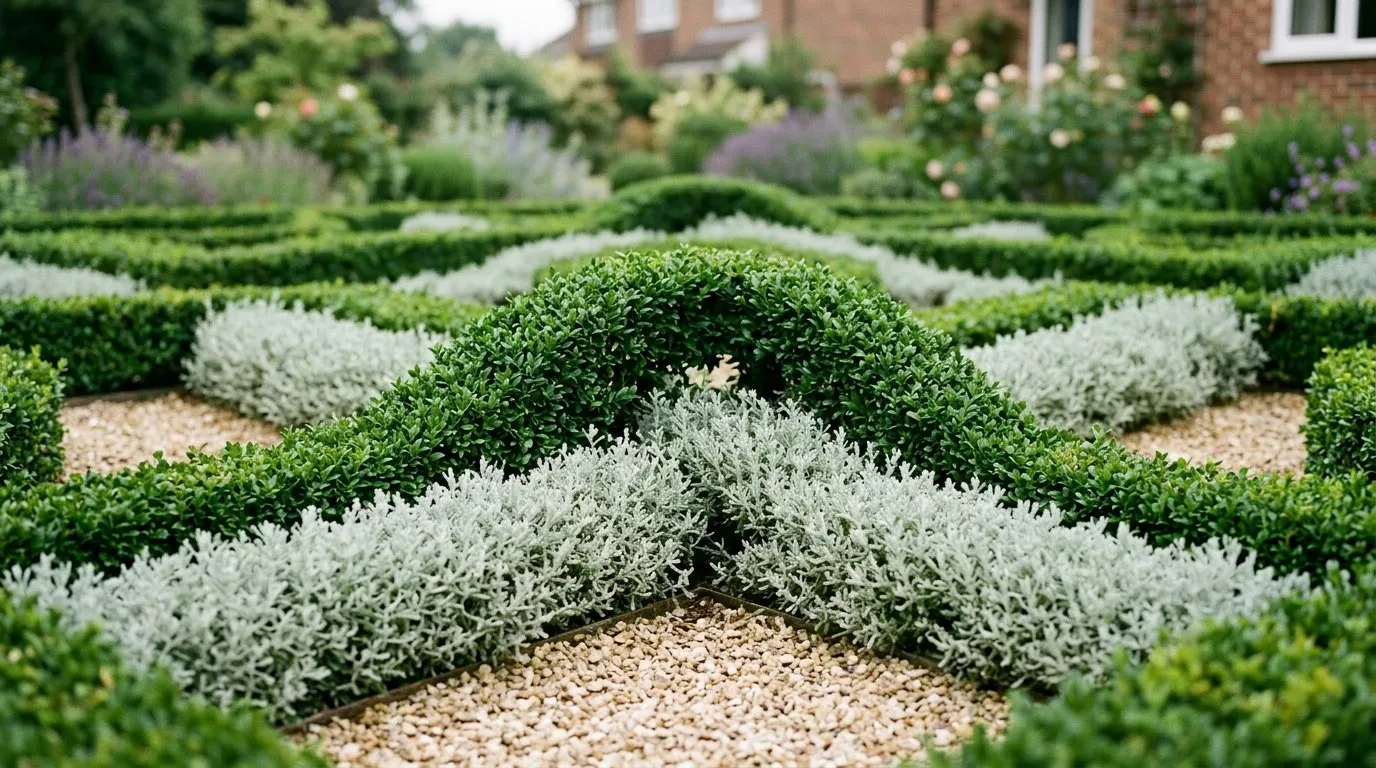 The crossing is the whole trick. The green ribbon is clipped a few centimetres proud of the silver one, so it appears to weave over it.
Start with a proven pattern rather than inventing one:
| Pattern | Difficulty | Foliage colours | Good first knot? |
|---|---|---|---|
| Quartered square with central circle | Easy | 1-2 | Yes |
| Two-ribbon interlace | Moderate | 2 | Yes |
| Threaded Celtic knot (Meager style) | Hard | 2-3 | No |
| Heraldic initials or emblem | Hard | 2 | No |
What size and site does a knot need?
A 3m x 3m square is the ideal first knot: big enough for a genuine interlace, small enough to clip in about an hour. Anything under 2.4m square cramps the pattern once the ribbons reach their working width of 20-25cm. Above 4m square, plant numbers and clipping time climb steeply.
The site matters more than the pattern does:
- Dead flat. A 5cm fall across 3m shows as a visible dip in the finished hedge lines. Level the ground first, not after.
- Open sun. Every traditional knot plant wants six hours or more of direct light. Shade brings gaps, disease and leggy growth.
- Viewed from above. Site the knot below a landing window, a raised terrace or the top of steps. At ground level, even Helmingham’s knots read as ordinary low hedges.
- Free-draining soil. Winter waterlogging kills lavender and santolina inside one season, and Ilex crenata resents it too.
A front garden suits a knot surprisingly well. The upstairs windows give the overhead view, and the pattern holds its structure through winter when everything else has collapsed.
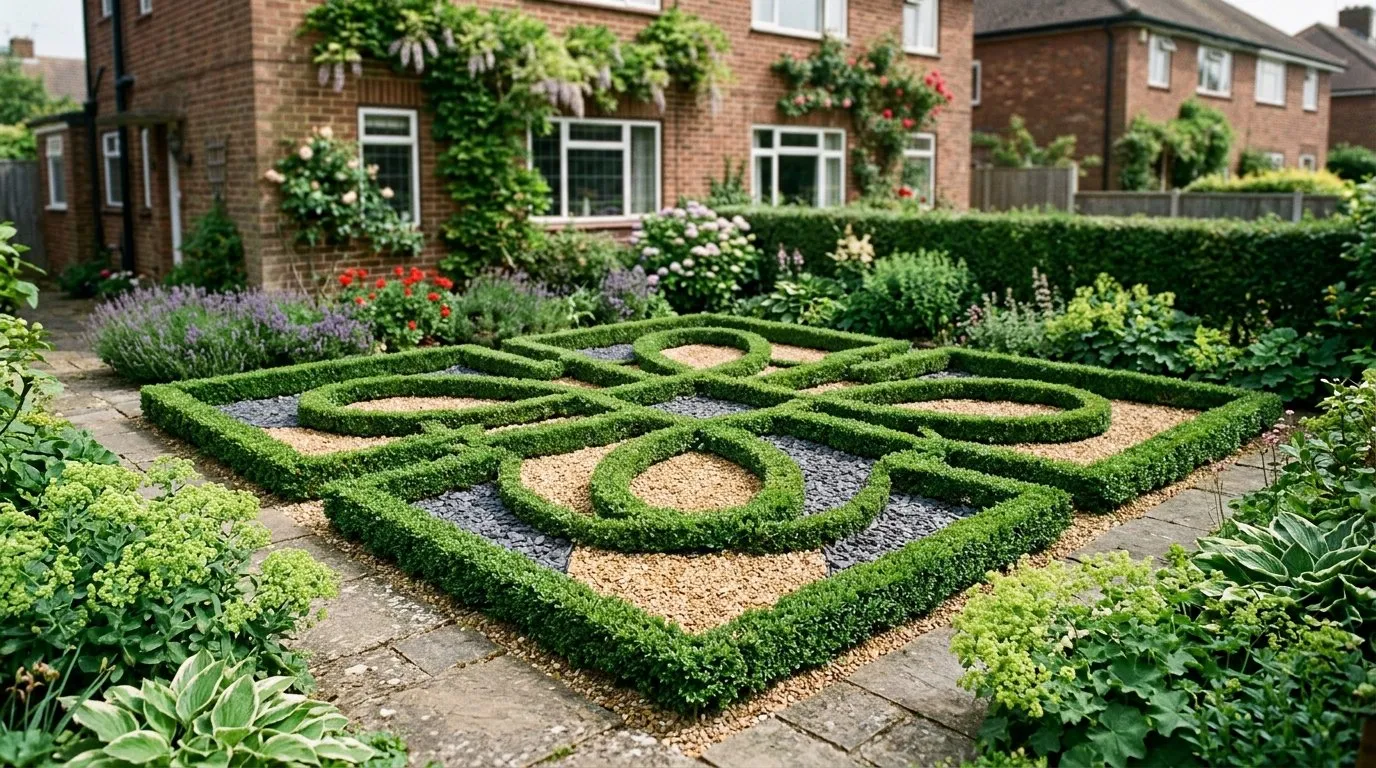 An open knot in a suburban front garden. Two gravel colours do half the work, and the bedroom window supplies the Tudor viewing mount.
Which plants are best for a knot garden?
Dwarf box edged every historic knot, but blight and caterpillars rule it out of most new plantings. Box blight reached British gardens in the mid-1990s, and the box tree moth followed from 2007; between them they have destroyed miles of historic edging. The RHS box blight profile explains the disease, and our guide to why box hedges die covers diagnosis and rescue.
If you already have healthy box, keep it; our box growing guide covers its care in detail. For a new knot, plant one of these instead.
| Plant | Foliage | Spacing | Per metre | 9cm pot price | Working height |
|---|---|---|---|---|---|
| Dwarf box ‘Suffruticosa’ | Deep green | 15cm | 6-7 | £3-5 | 25-40cm |
| Ilex crenata ‘Dark Green’ | Dark green, box-like | 20cm | 5 | £5-8 | 25-40cm |
| Euonymus ‘Jean Hugues’ | Glossy mid-green | 20cm | 5 | £4-7 | 25-35cm |
| Teucrium chamaedrys | Glossy, pink flowers | 18cm | 5-6 | £4-6 | 20-30cm |
| Lavender ‘Hidcote’ | Silver-grey | 30cm | 3-4 | £3-5 | 40-50cm |
| Santolina chamaecyparissus | Bright silver | 30cm | 3 | £4-6 | 25-35cm |
Ilex crenata, the Japanese holly, is the best box lookalike. The small dark leaves and dense twiggy habit pass for box at two metres, and it takes clipping into hard architectural lines. It wants reasonable moisture and sulks on thin dry chalk.
Euonymus japonicus ‘Jean Hugues’ is the tough choice. It knits into a solid ribbon faster than anything else here, shrugs off poor soil and costs less than Ilex. The leaf is slightly larger and glossier than box, which bothers purists and nobody else.
Teucrium chamaedrys, wall germander, is the authentic Tudor pick and appears in 16th-century knot planting lists. It carries pink flower spikes in July that bees work hard, though you sacrifice most of them if you clip for crispness.
Lavender and santolina supply the silver ribbons that make an interlace legible. Both are shorter-lived: budget for replacing lavender after 10-15 years and santolina after 5-8. Our lavender growing guide covers varieties; stick to compact ‘Hidcote’ for knots.
For a deeper ranking of substitutes, our box hedge alternatives guide compares eight of them across price, pace and clipping tolerance.
How do you set out a knot garden pattern?
Set out a knot with a one-metre string grid, then draw the pattern in dry sand before a single plant goes in. Tudor gardeners did exactly this with lines and sand, and no modern method improves on it.
Quantities for a 3m square: a border ribbon plus a simple two-ribbon interlace uses about 20 linear metres of hedging. At five plants per metre, that is 100 plants: roughly £400-550 in Ilex crenata or £300-400 in euonymus. Add £150-200 for two contrasting bulk bags of gravel, £15 for membrane and £10 for sand and string. A realistic all-in total runs £350-750 depending on species.
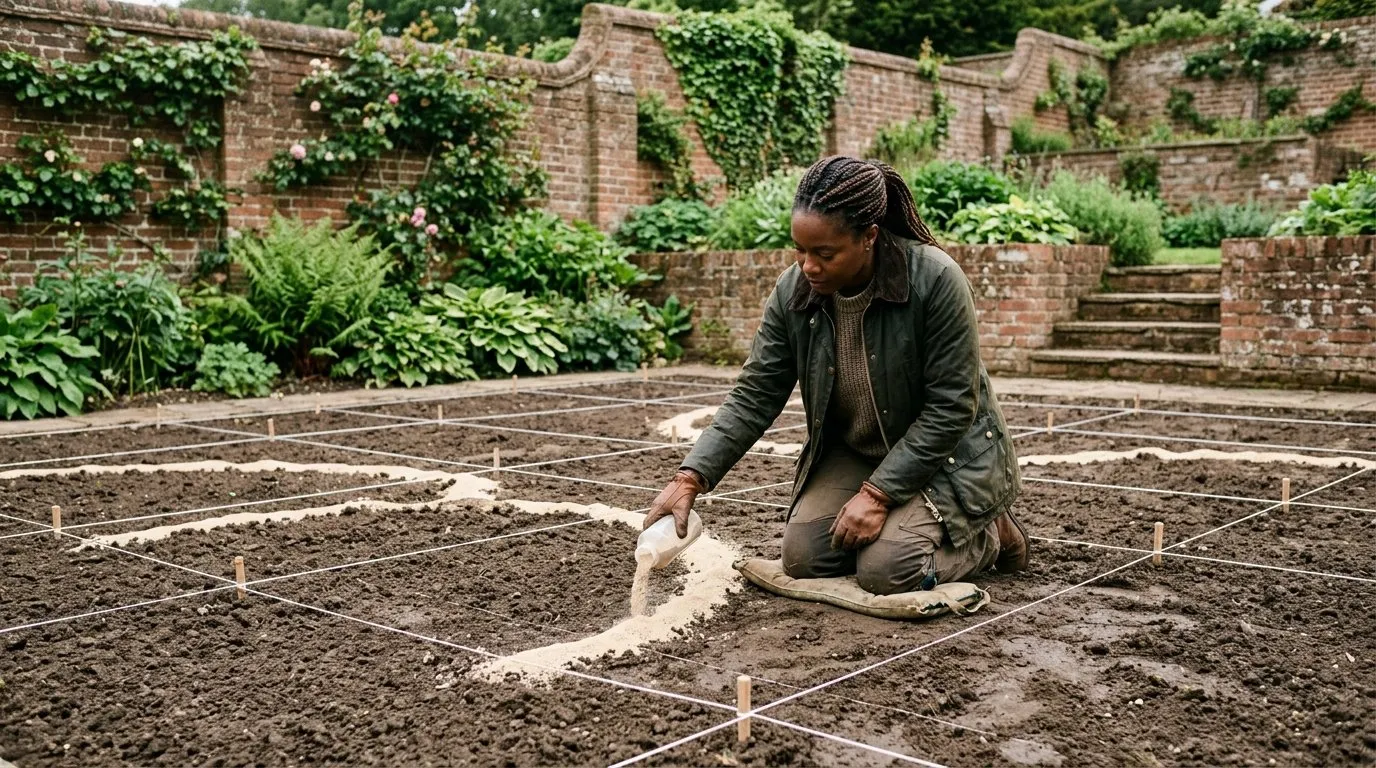 String grid first, sand lines second, spade last. An hour of marking out saves a decade of looking at a wonky ribbon.
Gardener’s tip: Buy 5% more plants than the plan needs and heel the spares into a corner bed. When drought, rabbits or a football takes out a plant in year one, you replace it with a matched spare of identical size. A bought-in replacement two years later never quite catches up, and the joint shows in the ribbon for years.
Young plants look absurdly sparse at first. Hold your nerve: at five per metre the gaps close by the end of the second summer.
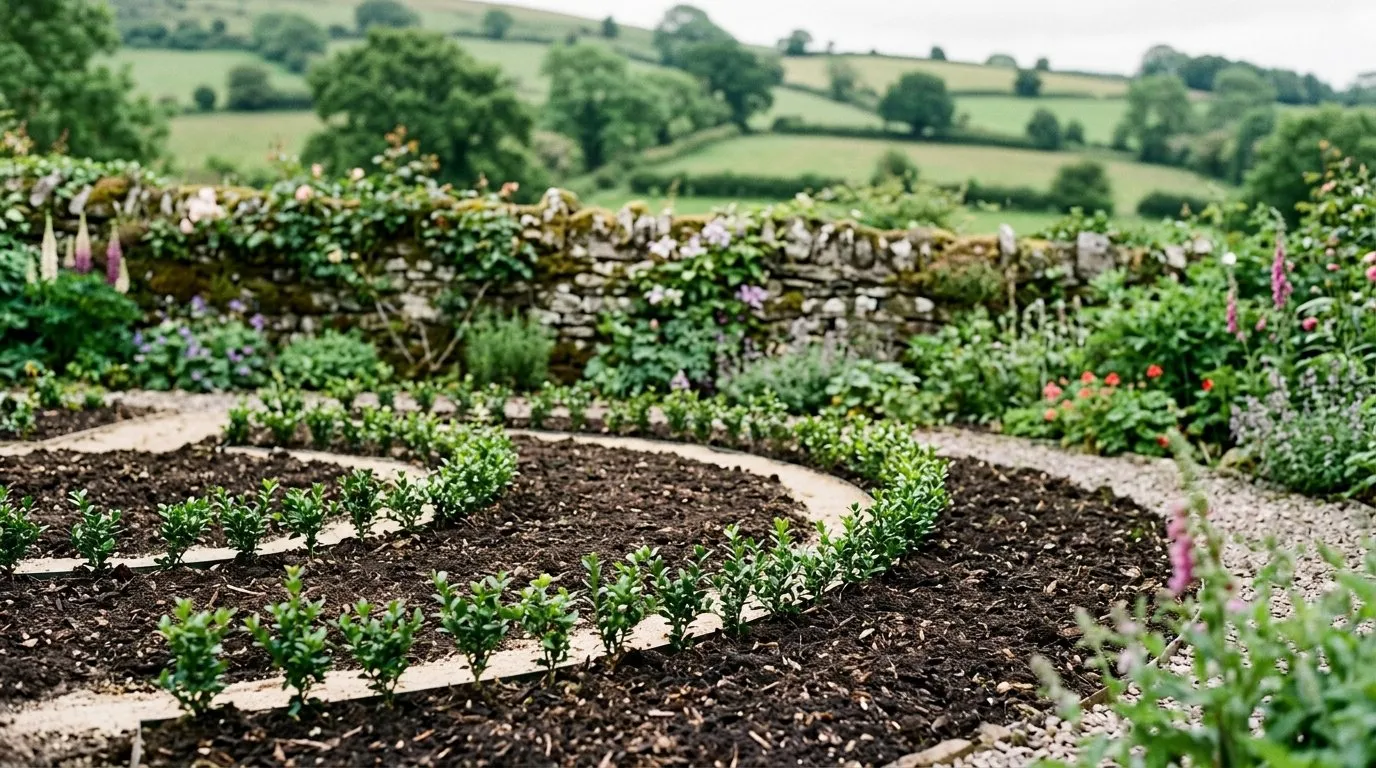 Freshly planted ribbons look thin for a season. These young plants knit into a solid line within two years.
When should you clip a knot garden?
Clip an established knot two or three times a year, making the first cut in early June and the last by mid-September. Little and often beats one savage annual cut. Each pass removes just 2-5cm of soft growth and keeps ribbons at their working width of 20-25cm.
| Month | Knot garden job |
|---|---|
| March-April | Hard-prune santolina to 10cm; tidy winter damage; first light euonymus trim late April |
| Early June | Main cut for every ribbon; re-cut crossings so the over ribbon stands 3-5cm proud |
| July | Second trim for fast growers; clip teucrium once its pink flowers fade |
| Late August | Cut lavender back hard, staying 2-3cm above the old wood |
| September | Final crisping cut for all species, finished by mid-month so regrowth hardens off |
| October-November | Plant new knots, top up gravel, clean and oil the shears |
Check for nesting birds before any cut from March to August. Even a 30cm ribbon can hide a dunnock nest, and disturbing an active nest is an offence.
Use hand shears at every crossing and save the battery trimmer for long straight runs. A string line stretched along the ribbon top, or a board stood on edge, keeps the cut honest. Our topiary trimming guide covers blade care, cutting technique and what to do with an overgrown ribbon.
Never clip in frost, drought or harsh sun. Scorched cut tips stay brown on Ilex and box for months, and a knot displays every mistake at eye level from the window above.
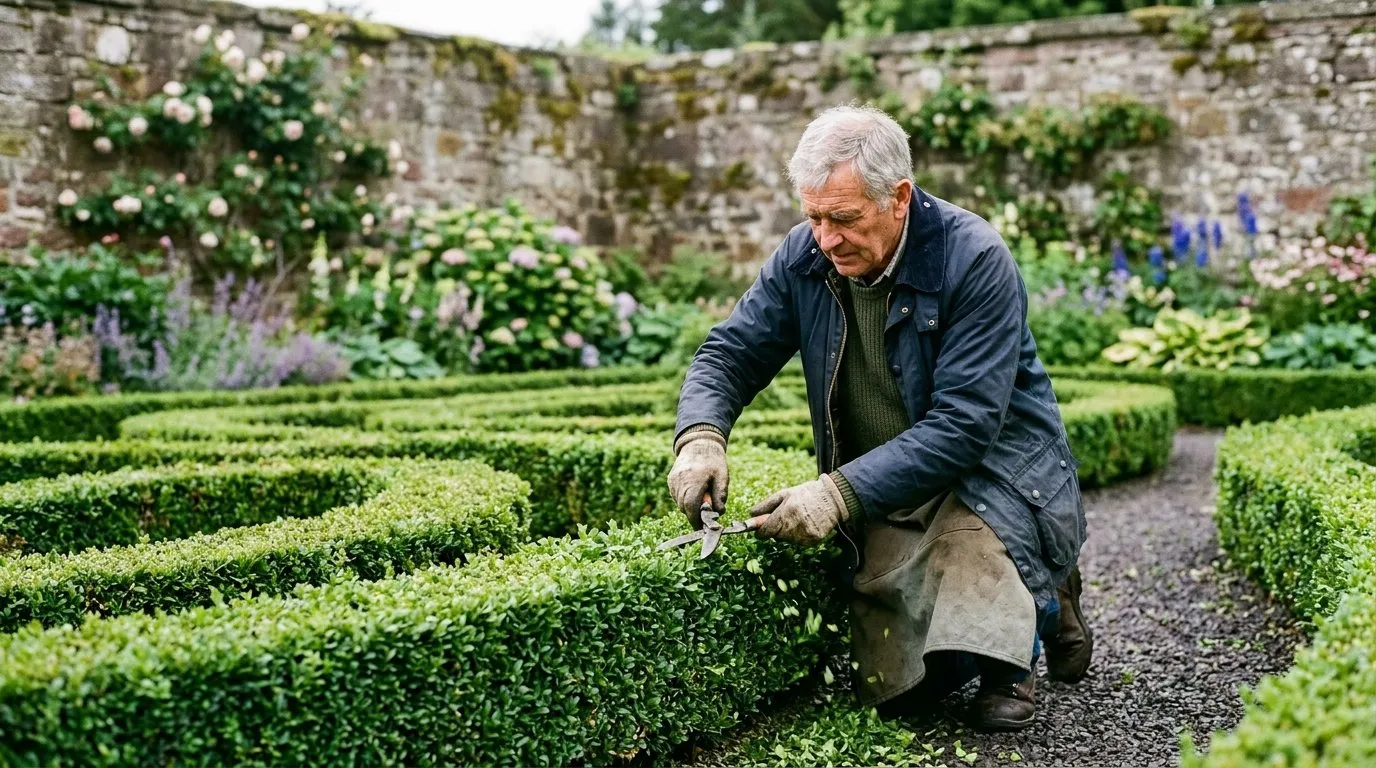 Hand shears at the crossings, trimmer on the straights. The June cut is the one that sets the shape for the year.
What should you plant inside the knot?
Gravel is the easiest infill, herbs are the most authentic, and bedding gives the most colour. Pick one approach per knot; mixing all three looks muddled from the window.
Bedding and bulbs give two displays a year: 25 tulips per compartment for April and May, then compact bedding until October. Expect to spend £40-60 per season on a 3m knot, and deadhead weekly in summer.
A centrepiece anchors the whole design. A sundial, an armillary sphere, a clipped holly ball or a standard bay all work, at anything from £30 to £150. Set it dead centre and check it from the viewing window before fixing it down.
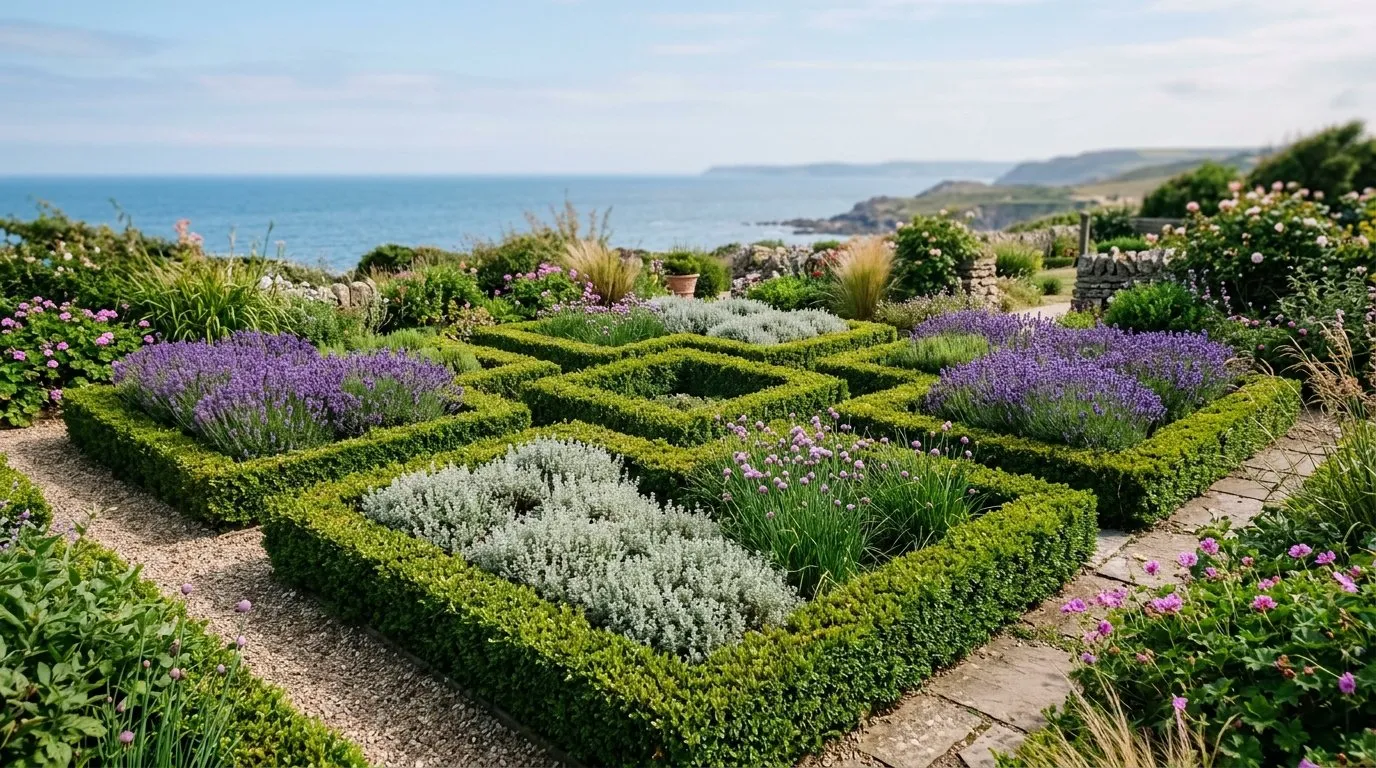 A closed knot doing its original job as a herb bed. The hedging frames the crop, and the crop softens the hedging.
Frequently asked questions
What is the difference between a knot garden and a parterre?
A knot garden interlaces its hedges; a parterre lays them flat in separate compartments. Knots are small, square and Tudor in spirit, with ribbons that appear to weave over and under at every crossing. Parterres came later from France, cover far larger areas and use scrollwork beds edged in a single height of hedging. If the ribbons never cross, you are looking at a parterre.
Can you still plant box in a knot garden?
Yes, but blight and box tree caterpillar make it a gamble in most regions. Box blight has been in Britain since the mid-1990s and the moth since 2007, and both hit clipped dwarf box hardest. If you must have box, choose an open airy site, water at the roots only and clip less often. Most designers now specify Ilex crenata or euonymus instead.
How much does a knot garden cost to make?
Expect £350-750 in plants and materials for a 3m square knot. Around 100 hedging plants at £3-8 each is the main cost, plus £150-200 of decorative gravel, membrane, sand and string. Euonymus keeps the bill near the bottom of that range; Ilex crenata sits at the top. A centrepiece sundial or clipped ball adds £30-150.
How long does a knot garden take to establish?
Two to three growing seasons for the ribbons to knit into solid lines. Plants set out at five per metre touch by the end of year two and read as continuous hedging by year three. Feed each spring, water through the first two summers and resist hard clipping until the ribbons meet. From year four you are simply maintaining the pattern.
What is the best plant for a knot garden?
Ilex crenata is the best box lookalike for new UK knot gardens. Its small dark leaves and dense habit read as box from two metres away, with no blight risk. Euonymus ‘Jean Hugues’ is tougher on poor soils and cheaper at £4-7 a pot. For silver contrast ribbons, use santolina or lavender ‘Hidcote’.
How do you keep a knot garden pattern crisp?
Clip little and often, guided by string lines and a steady eye. Two or three cuts a year, each removing 2-5cm, hold a far sharper line than one hard annual cut. Keep ribbons 20-25cm wide, re-cut crossings so the over ribbon stands 3-5cm proud, and replace any dead plant with a matched spare straight away.
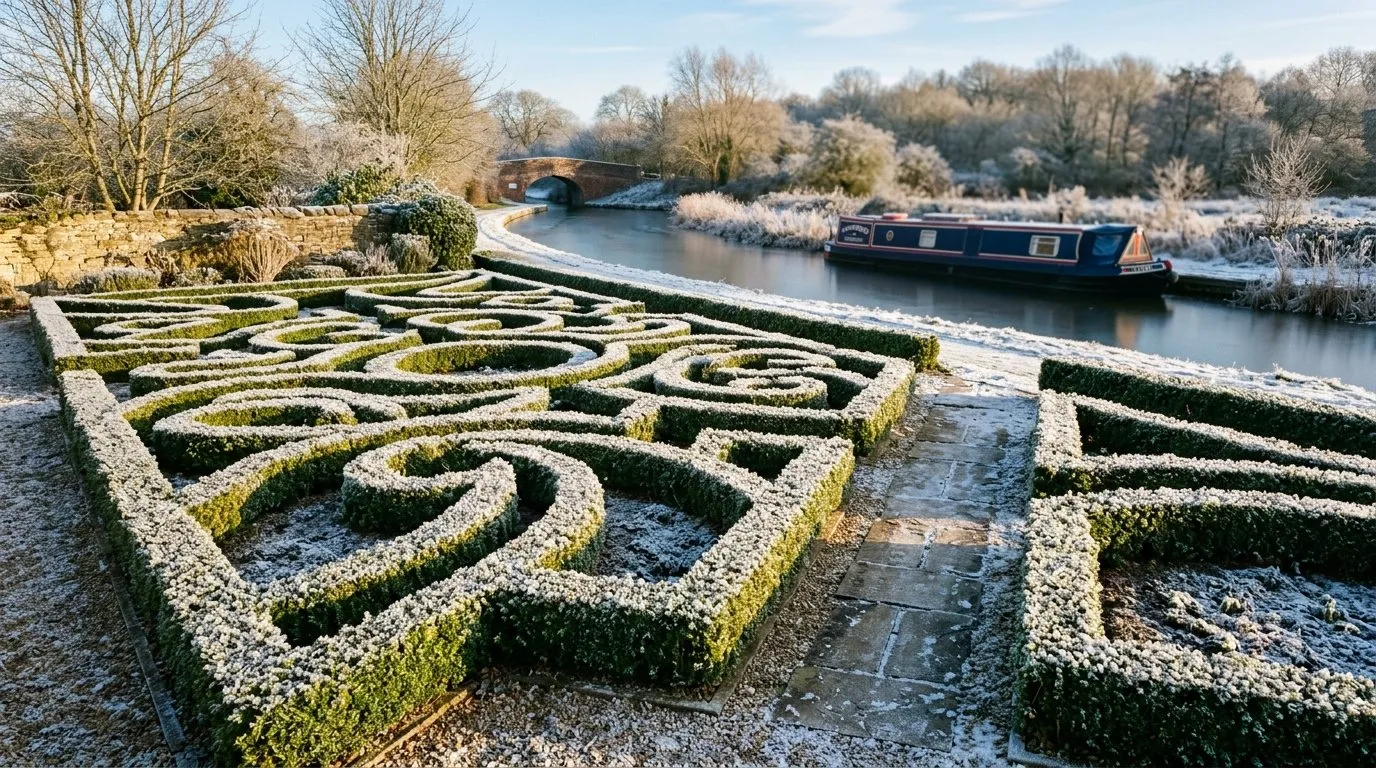 The payback for all that clipping. A knot earns its keep in January, when frost picks out every line you cut in June.
A knot garden is slow gardening in the best sense. One weekend with string and sand, 100 small plants, and then two or three unhurried cuts a year. By the third summer the ribbons have closed, the weave reads from the landing window, and you own a piece of the 1560s that the Tudors would recognise at a glance.
Our team produces practical UK gardening guidance from source research, contributor records and established horticultural practice. Editorial standards are overseen by Matt W.