Key takeaways
- A poured concrete patio costs £100 to £150 per m2 supplied and laid; bagged DIY runs about £35 to £55 per m2 in materials
- Pour at least 100mm thick over 100 to 150mm of compacted MOT Type 1, with A142 steel mesh for slabs that carry foot traffic
- Concrete is walkable in 24 to 48 hours but reaches full strength only after 28 days of curing
- Cut or form expansion joints every 3 to 4 metres and at every change of direction to stop random cracking
- Any new impermeable hard surface over 5m2 in a front garden needs planning permission or a permeable solution under UK rules
Table of contents
The 15 ideas run from large poured surfaces down to small cast objects, then the article covers cost, mixing, reinforcement, drainage law, finishes, maintenance, and mistakes.
15 concrete ideas for UK garden design
1. Poured in-situ concrete patio
A poured in-situ patio is one continuous slab, formed and floated on site. It gives a clean, joint-free look that paving cannot match across an open area. Pour at least 100mm thick over 100 to 150mm of compacted MOT Type 1, with A142 mesh in the lower third. Set a fall of 1 in 80 away from the house for drainage. Cost runs £100 to £150 per m2 supplied and laid, or about £35 to £55 per m2 in materials if you mix and pour yourself. A power float gives a smooth finish; a wood float or broom gives grip. For a step-by-step on the base build, our guide to how to lay a patio in the UK covers sub-base depth and falls.
2. Board-formed concrete walls
3. Exposed-aggregate paths and patios
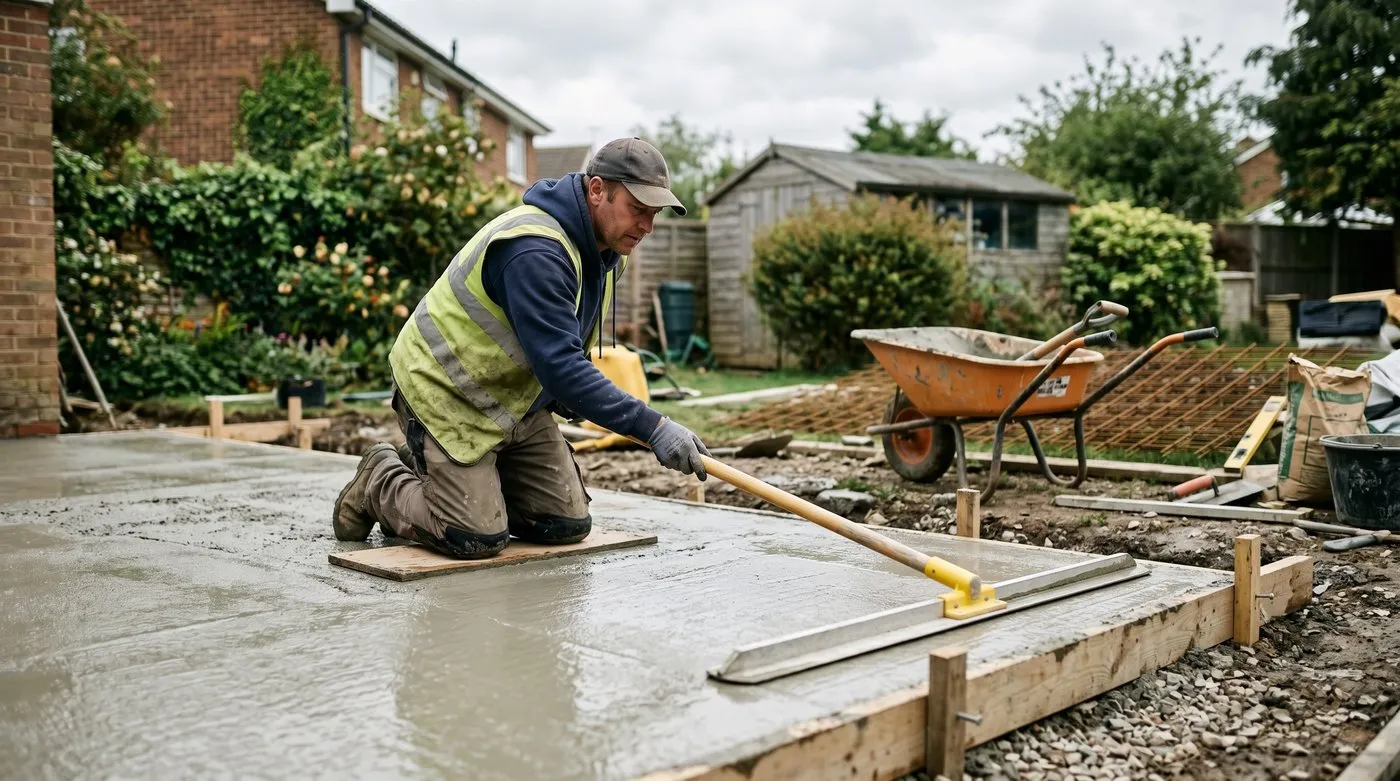 A poured in-situ patio being floated smooth. One continuous slab gives the clean, joint-free look that paving cannot match.
4. Polished and power-floated concrete
Polished concrete is ground back with diamond pads to expose a smooth, slightly reflective surface, then sealed. Power-floated concrete uses a spinning trowel machine to compact and smooth the top while wet. Both finishes suit covered patios, garden rooms, and outdoor kitchens where a sleek floor matters. Polished concrete outdoors needs a slip-resistant seal, since polished surfaces grow treacherous when wet. This is the premium route at £150 to £250 per m2 because it needs specialist machinery and labour. It is rarely a DIY job. The payoff is a smooth, joint-free floor that flows from inside to out without a break.
5. Concrete paving slabs versus a poured slab
6. Stamped and pattern-imprinted concrete
Stamped concrete is poured, then pressed with rubber moulds while still wet to mimic riven stone, brick, or timber planks. Coloured release agents and surface dyes build up the effect. It gives a patterned surface across a driveway or patio for less than natural stone, at £90 to £140 per m2 fitted. The catch is honesty: cheap stamping looks like what it is, and the surface needs resealing every 2 to 3 years to keep the colour. Specify a skilled installer and a deep, crisp pattern. Avoid glossy sealers, which turn slick in rain and look plastic.
7. Concrete screen and breeze blocks
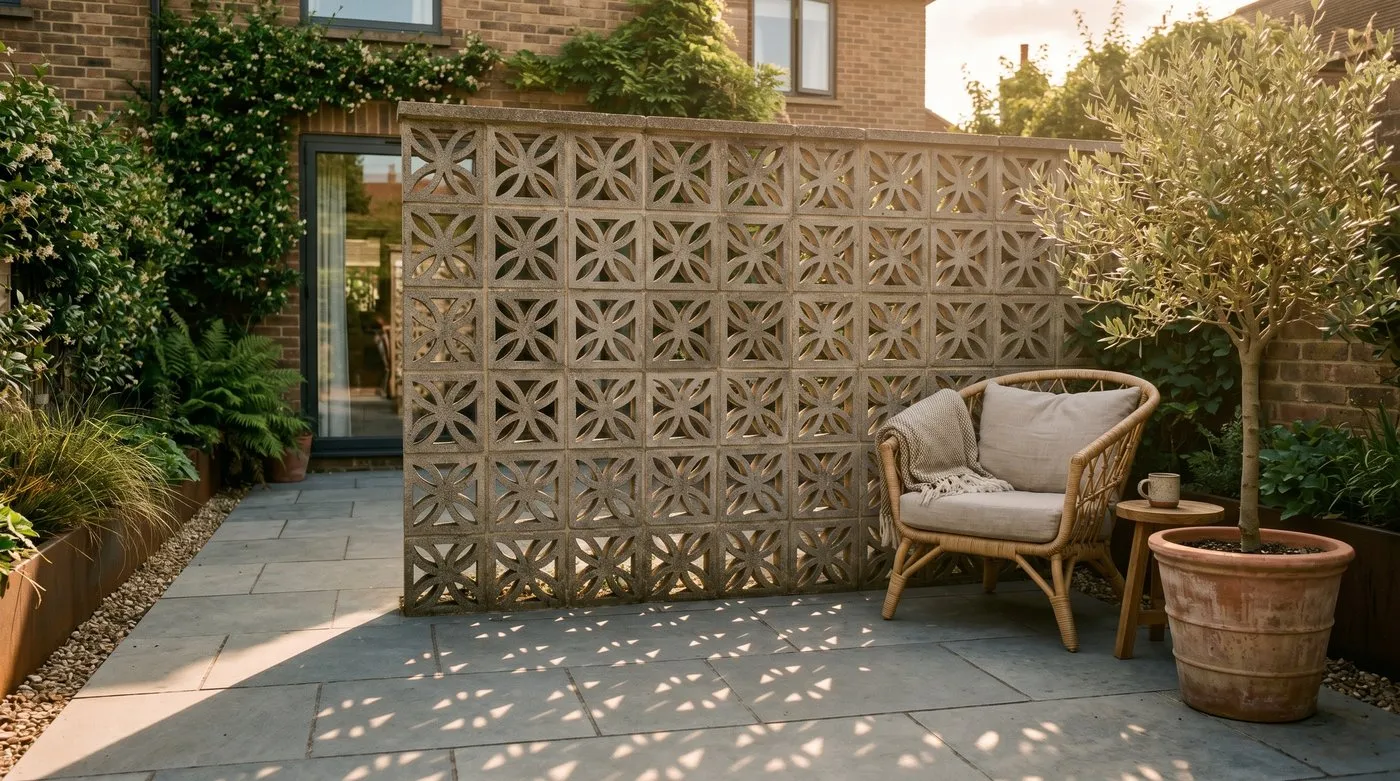 Concrete screen blocks, revived from the 1960s, divide space and throw patterned shadows across a patio.
8. Cast concrete planters
Cast concrete planters bring weight, permanence, and a modern edge to a planting scheme. You make a form from two boxes, an outer and an inner, pour concrete into the gap, and strike the mould after 48 hours. A 1:2:3 mix of cement, sand, and 10mm aggregate suits planters. Add a drainage hole with a length of dowel set in the base. Leave the walls at least 40mm thick to resist frost. Large frost-proof planters cost £80 to £250 in shops, so casting your own saves real money. Seal the inside to stop lime leaching onto plants for the first season. Cast in batches while the mixer is running.
9. Concrete bench and seating
A cast concrete bench is a permanent, sculptural seat that never needs storing or treating. You can cast a simple slab seat on two block piers, or build a full bench into a board-formed retaining wall. A bench seat 1.6m long and 450mm deep takes roughly 0.15m3 of concrete. Reinforce a spanning seat with two lengths of 12mm rebar to stop it snapping under load. Soften the cold, hard feel with timber slats or a weatherproof cushion on top. Built into a wall, a concrete bench saves space in a small garden and reads as part of the structure rather than furniture dropped on top.
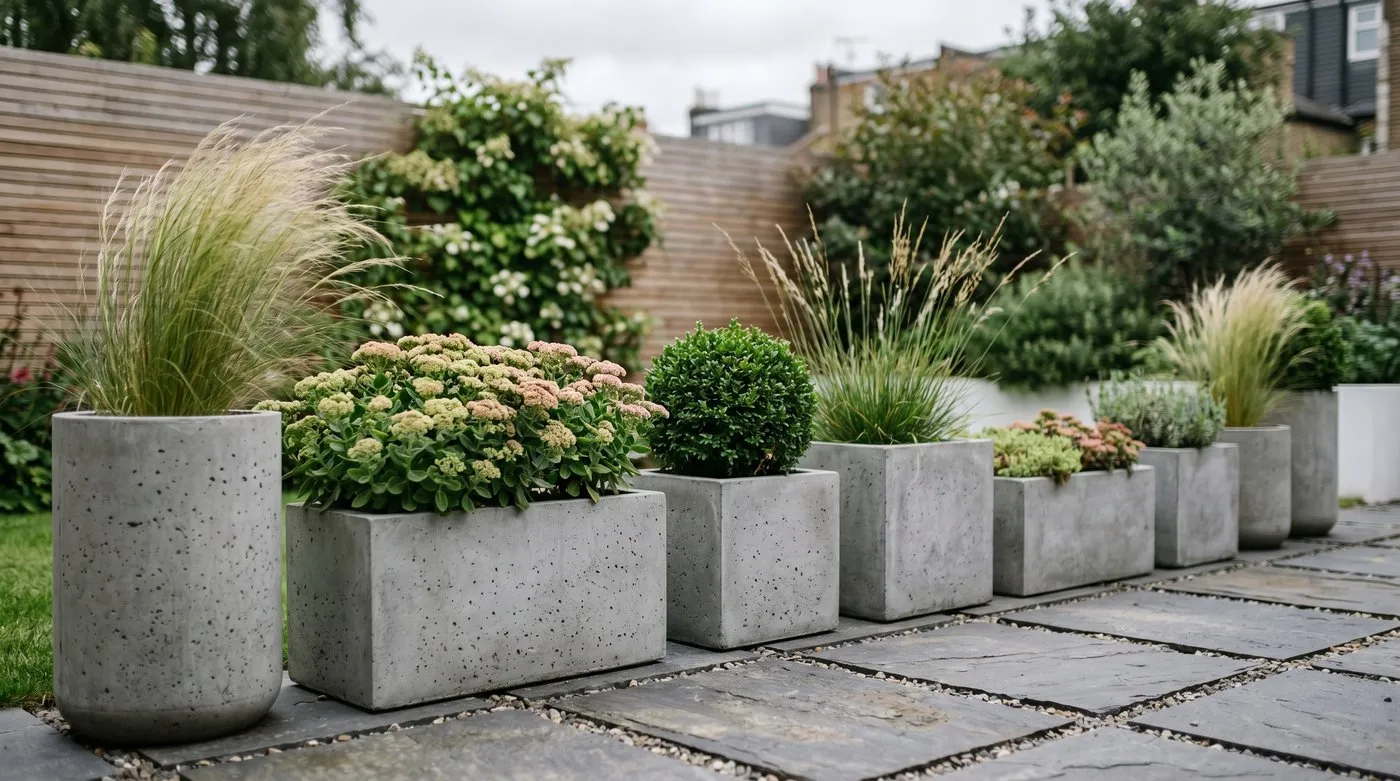 Cast concrete planters bring weight and a modern edge. Leave walls at least 40mm thick to resist frost.
10. Poured concrete raised beds
Poured concrete raised beds give crisp, permanent edges that timber sleepers cannot hold long term. They suit a modern kitchen garden or a formal scheme. Build a double-sided timber form, drop in vertical and horizontal rebar, and pour 100mm thick walls. Beds hold soil pressure well once cured, so brace the formwork firmly before pouring. A bed 2m by 1m by 450mm high needs about 0.4m3 of concrete. Concrete beds warm slowly in spring but hold heat into autumn, which extends the growing season for tender crops. Line the inside with a breathable membrane to protect the concrete from constant wet soil and to keep lime away from roots.
11. Concrete stepping stones from DIY moulds
Cast stepping stones are the easiest concrete project for a beginner. Use a bought rubber mould, a cut-down bucket, or a timber square form. Mix a 1:3 cement to sharp sand mortar, or a 1:2:3 concrete for larger pads, and press in leaves, pebbles, or a child’s handprint for character. Each 400mm round stepping stone takes about 8kg of dry mix. Leave them in the mould for 48 hours, then cure for a week before laying. Set stones on a 30mm bed of sharp sand at a comfortable stride, around 600mm centre to centre. They cost pennies compared with bought paving rounds.
12. Concrete pads for pots, bins, and shed bases
A concrete pad is the unglamorous workhorse of garden design. It gives a stable, level base for a shed, a water butt, a bin store, or a cluster of heavy pots. Pour a shed base 100mm thick over 75mm of compacted hardcore, with mesh for anything over 2m by 2m. Get the pad dead level and square, since a twisted base racks a shed frame within a season. For a small pad under 1m2, bagged concrete is fine and saves a delivery charge. Add a 1 in 80 fall on a bin pad so it drains and hoses clean. A 2m by 2m shed base costs roughly £90 to £130 in DIY materials.
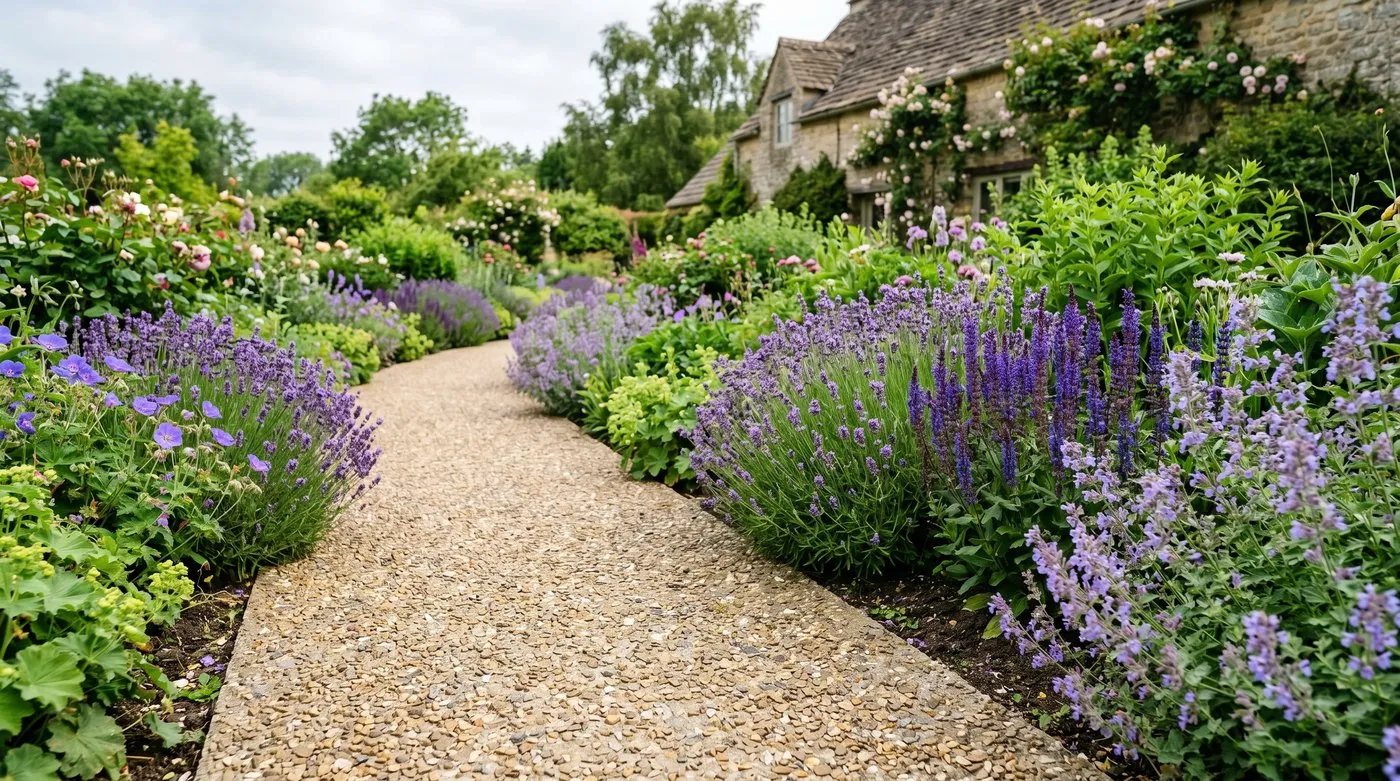 An exposed-aggregate path. The washed finish grips in frost and reads as natural gravel that cannot scatter.
13. Concrete pizza-oven base and BBQ worktop
A concrete base and worktop turns an outdoor cooking corner into a permanent fixture. Pour a reinforced slab base to carry the weight of a brick or clay pizza oven, which can exceed 300kg. Cast a worktop in a board-formed mould, 50 to 60mm thick with rebar, and grind the edges smooth. Concrete shrugs off heat, weather, and knife marks, which makes it the natural surface for an outdoor kitchen. Seal a food-prep worktop with a food-safe sealer and reseal yearly. Build the base on a footing below frost level so it cannot heave and crack under the oven. The look suits the same hard surfaces used across a modern terrace.
14. Concrete water feature and rill
15. Concrete edging and mowing strips
Concrete edging and mowing strips are the most practical small concrete job in any garden. A poured strip flush with the lawn lets a mower wheel run along it, so you never trim the edge by hand again. Dig a trench 100mm deep and 100 to 150mm wide, peg a timber form, and pour a 1:2:3 mix to lawn level. A mowing strip also stops gravel migrating into beds and holds a border edge crisp for years. Reckon on £8 to £15 per linear metre in DIY materials. It is a quick weekend job that saves hours of edging every summer and gives a garden a tidy, finished line.
What concrete costs per square metre in the UK
Concrete prices swing with the finish, the access, and whether you do the labour. The table below gives realistic 2026 UK figures, supplied and laid unless stated.
| Finish | Look | Rough cost per m2 | DIY-friendly | Durability |
|---|---|---|---|---|
| Poured plain slab | Smooth grey, joint-free | £100-£150 | Moderate | 30+ years |
| Exposed aggregate | Textured, gravel-like | £115-£170 | Moderate | 30+ years |
| Stamped/imprinted | Mimics stone or brick | £90-£140 | Low | 20-25 years |
| Polished/power-floated | Sleek, reflective | £150-£250 | Low | 30+ years |
| Concrete slabs | Modular paving units | £45-£90 | High | 25-40 years |
| Board-formed wall | Timber-grain texture | £180-£350 per m run | Low | 40+ years |
DIY changes the picture sharply. Bagged or self-mixed concrete for a plain slab costs roughly £35 to £55 per m2 in materials, against £100 to £150 supplied and laid. The saving is real, but so is the labour: a 20m2 pour by hand is two hard days for two people. Hidden costs catch people out. Budget for hardcore sub-base at £8 to £12 per m2, formwork timber, mesh at £6 to £10 per sheet, a hired mixer at £30 to £45 a day, and skip hire to clear spoil at £180 to £280.
DIY versus hiring a groundworker
Small concrete jobs suit DIY. Stepping stones, planters, edging, post bases, and pads under 4m2 are well within a confident gardener’s reach. You need a level base, sound formwork, and a mixer for anything over a few barrows. Large pours, retaining walls, and polished finishes are different. A groundworker brings a gang, a barrow-mix lorry, and the experience to get a fall, a level, and a clean finish across a big area in one continuous pour. A poured slab must go in before it starts to set, so timing matters. For a patio over 15m2, or any structural retaining work, hiring pays for itself in avoided cracks and re-pours. Always check a groundworker has poured the finish you want and ask to see a recent job.
Mix ratios, ready-mix, and curing times
Get the mix right and concrete lasts 30 years. Get it wrong and it crumbles or cracks.
Mix ratios
For most garden concrete, use a 1:2:3 ratio: one part cement, two parts sharp sand, three parts 10 to 20mm aggregate, by volume. This gives roughly a C25 to C30 strength, fine for patios, bases, and beds. For footings and heavy-load slabs, a 1:1.5:2.5 mix gives a stronger C35. Keep the water low; a wet, soupy mix is weak. Aim for a mix that holds its shape on a trowel, not one that slumps and runs.
Ready-mix versus bagged
Ready-mix delivered by lorry suits any pour over about 2m3. A volumetric truck mixes to order on site, so you pay only for what you use and the mix is consistent. Bagged concrete suits small jobs: stepping stones, post bases, and pads. Hand-mixing more than 30 bags is slow and risks an uneven set across a slab. A 25kg bag covers roughly 0.4m2 at 50mm thick.
Curing times
Concrete is walkable in 24 to 48 hours, reaches about 70 percent strength at 7 days, and full design strength at 28 days. Curing is not drying; it is a chemical reaction that needs moisture. Cover a fresh slab with polythene for 3 to 7 days in warm weather and mist it if it dries too fast. Slow curing makes a harder, less crack-prone surface than rapid drying in sun or wind.
Reinforcement and expansion joints
Two details separate a slab that lasts from one that cracks. Reinforcement spreads load and holds the slab together if it does crack. For a foot-traffic patio, A142 steel mesh laid in the lower third on plastic spacers is enough. For drives and heavy loads, step up to A193 mesh or add rebar. Never lay mesh on the bare ground, where it does nothing; lift it into the concrete.
Expansion and control joints give the slab somewhere to move as it shrinks and as temperature swings. Concrete shrinks as it cures and expands in summer heat. Without joints, that movement tears the slab apart at random. Form joints by inserting a timber fillet, or cut control joints with an angle grinder or a saw 18 to 24 hours after the pour. Space joints every 3 to 4 metres, and put one at every change of direction or width. A joint at a doorway or a corner stops a crack starting there.
The front-garden permeability rule you must not skip
This is the rule that catches out the most people. Under UK planning rules, any new impermeable hard surface over 5m2 in a front garden needs planning permission, unless the surface is permeable or the run-off drains to a soakaway or a planted border within your own boundary. The rule exists because solid front-garden surfaces shed rain straight into the road, overloading drains and worsening flash flooding. A solid poured concrete front drive almost always triggers this.
You have three legal routes that avoid an application. First, keep any solid concrete area under 5m2. Second, build a permeable surface, such as permeable block paving, gravel over a permeable base, or resin-bound gravel. Third, lay your solid surface but direct all run-off to a soakaway, a rain garden, or a border on your own land, never to the highway. A simple channel drain feeding a gravel-filled soakaway pit handles a small drive. The Royal Horticultural Society publishes useful guidance on front-garden drainage and the benefits of keeping ground permeable; see the RHS for the wider environmental case. Plan drainage before you pour, not after.
Concrete finishes compared
The same poured slab takes many finishes. The choice changes the grip, the look, and the price.
| Finish | How it is made | Grip when wet | Best use |
|---|---|---|---|
| Wood float | Smoothed with a wooden float | Good | General patio, shed base |
| Broom finish | Brushed while wet | Very good | Slopes, paths, drives |
| Power float | Machine-trowelled smooth | Poor without seal | Covered patio, garden room |
| Exposed aggregate | Top paste washed off | Very good | Paths, patios, drives |
| Polished | Ground and sealed | Poor without anti-slip seal | Covered outdoor kitchen |
| Stamped | Pressed with moulds | Moderate | Driveways, feature patios |
Match the finish to the location. A broom or exposed-aggregate finish grips in frost and rain, so it suits paths and slopes. Save the smooth power-floated and polished finishes for covered or sheltered spots, and always specify an anti-slip sealer outdoors.
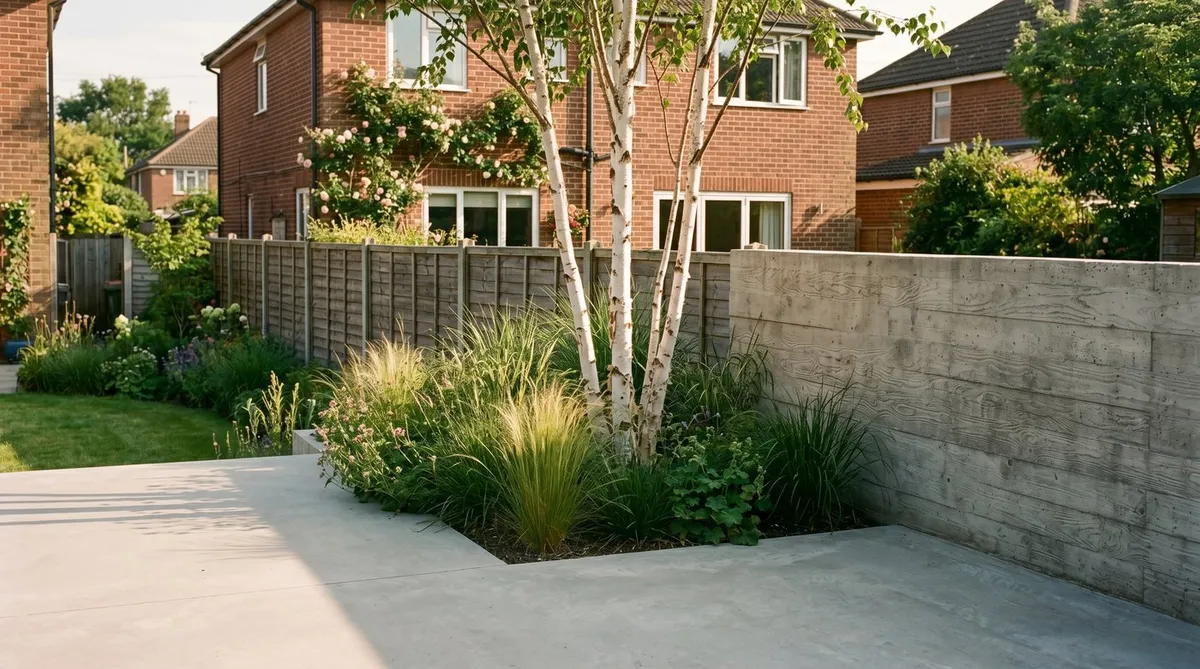
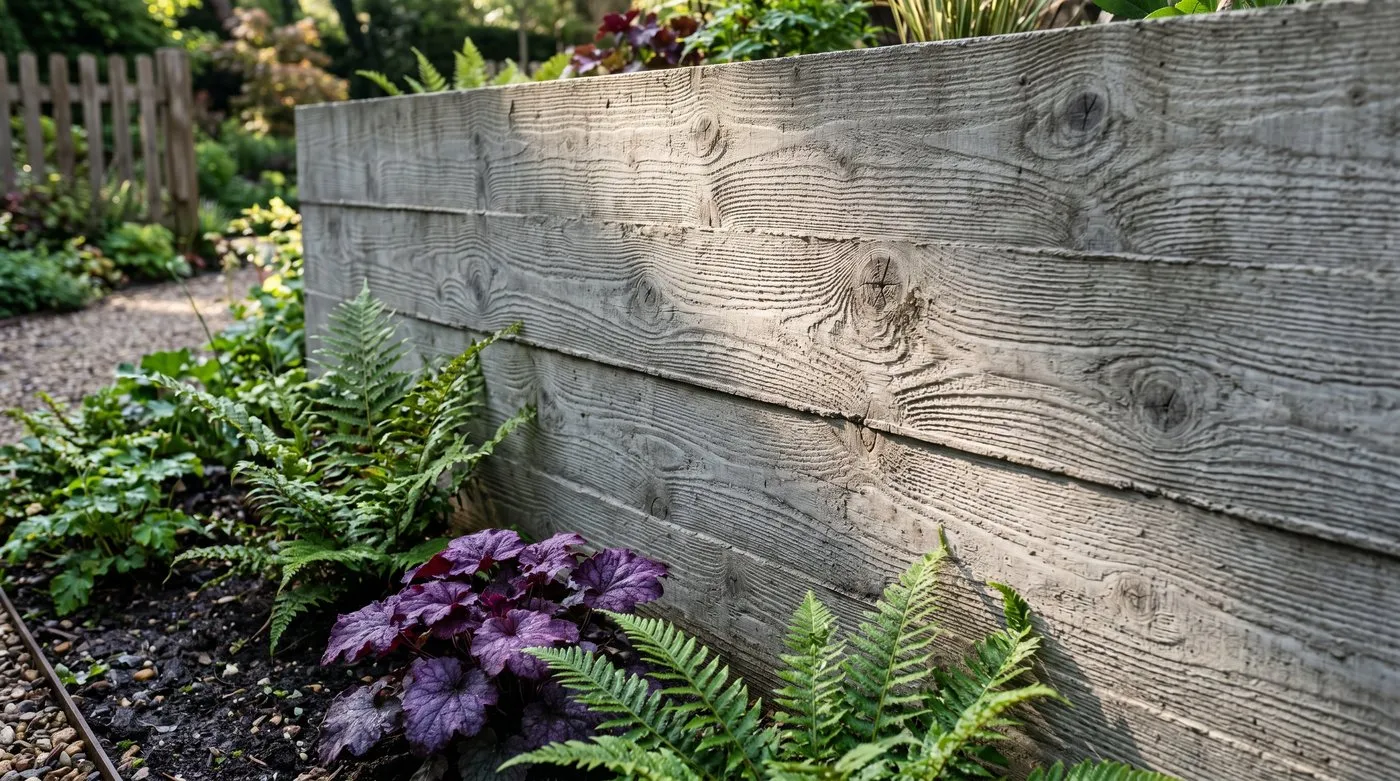 A board-formed wall carries the grain of the timber shuttering. Reinforce with rebar tied into a footing below frost level.
Maintaining concrete in a UK garden
Concrete is low-maintenance, not no-maintenance. A few habits keep it sound for decades.
Sealing is the single best protective step. A breathable masonry sealer resists frost damage, oil stains, and algae, and it deepens the colour of exposed-aggregate or coloured finishes. Reseal a patio every 2 to 3 years and a stamped or polished surface yearly. Seal a new slab only after it has cured for at least 28 days.
Algae and green film build up on shaded, north-facing concrete in the damp British climate. Scrub with a stiff brush and a patio cleaner, or jet-wash on a low setting. Hold a pressure washer at least 300mm back and keep it moving, since a tight, close blast erodes the surface and exposes aggregate unevenly. Our guide to cleaning a patio covers the right pressure and cleaners.
Cracks appear in some slabs over time. Seal a hairline crack under 3mm with a flexible concrete filler to stop water getting in and freezing. A wider or stepped crack signals a base or joint problem and may need a section cut out and re-poured. Caught early, most cracks stay cosmetic.
Common mistakes when working with concrete
Pouring in frost or extreme heat. Concrete poured below 5 Celsius can freeze before it sets, ruining the strength. Poured above 30 Celsius, it dries too fast and cracks. Aim for 5 to 25 Celsius, and cover the pour in extremes.
Forgetting a fall for drainage. A flat slab ponds water, grows algae, and pushes water back at the house. Set a fall of about 1 in 80 away from any building before you pour.
Sealing a front garden with no permeable provision. A solid front surface over 5m2 with no soakaway breaks UK planning rules and floods the road. Build it permeable or drain it to your own land.
Skipping reinforcement and the sub-base. Concrete poured straight onto soft soil with no mesh cracks and sinks. Always compact a hardcore sub-base and lift mesh into the slab.
Frequently asked questions
How much does landscaping with concrete cost in the UK?
A poured concrete patio costs £100 to £150 per m2 supplied and laid. Concrete slabs run £45 to £90 per m2 fitted. Exposed-aggregate adds £15 to £30 per m2 over a plain pour. Polished or power-floated finishes are the premium option at £150 to £250 per m2 because they need specialist labour and sealing.
How thick should a concrete patio be in the UK?
Lay a foot-traffic patio at least 100mm thick. Use 100mm over a compacted MOT Type 1 sub-base, with A142 steel mesh set on spacers in the lower third. Increase to 150mm where a car, hot tub, or heavy structure sits on the slab. Thin pours under 75mm crack within a year or two.
How long does concrete take to cure before you can walk on it?
You can walk on concrete after 24 to 48 hours. It reaches roughly 70 percent strength at 7 days and full design strength at 28 days. Keep it damp under polythene for the first 3 to 7 days in warm weather. Slow curing produces a harder, less crack-prone surface than fast drying.
Do I need planning permission for a concrete front garden?
Yes if the new impermeable surface exceeds 5m2. UK rules say any new hard surface over 5 square metres in a front garden needs planning permission unless it is permeable or drains to a soakaway. Permeable options like gravel, permeable block paving, or directing run-off to a border avoid the application.
Should I use ready-mix or bagged concrete for a garden project?
Use ready-mix for any pour over about 2m3. A volumetric or barrow-mix lorry delivers a consistent mix and saves days of hand mixing. Bagged concrete suits small jobs like post bases, stepping stones, and pads under 1m2. Mixing more than 30 bags by hand is slow, tiring, and risks an uneven set.
How do I stop a concrete patio from cracking?
Add steel mesh and cut expansion joints every 3 to 4 metres. Lay over a compacted sub-base, never bare soil. Avoid pouring in frost or above 30 Celsius. Cure slowly under polythene. Random cracking nearly always traces back to no joints, no reinforcement, a poor base, or pouring in the wrong weather.
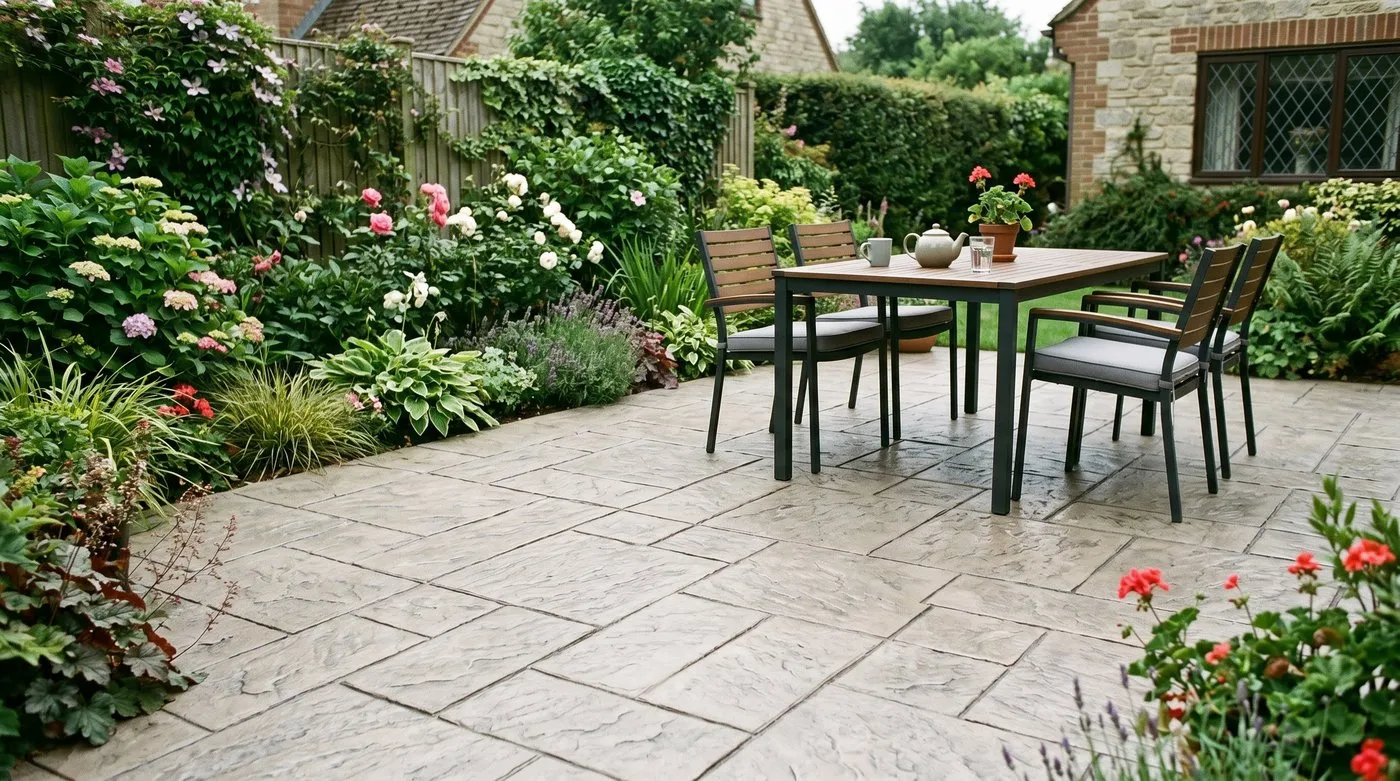 Stamped concrete pressed with rubber moulds to mimic riven stone. Specify a crisp, deep pattern and reseal every 2 to 3 years.
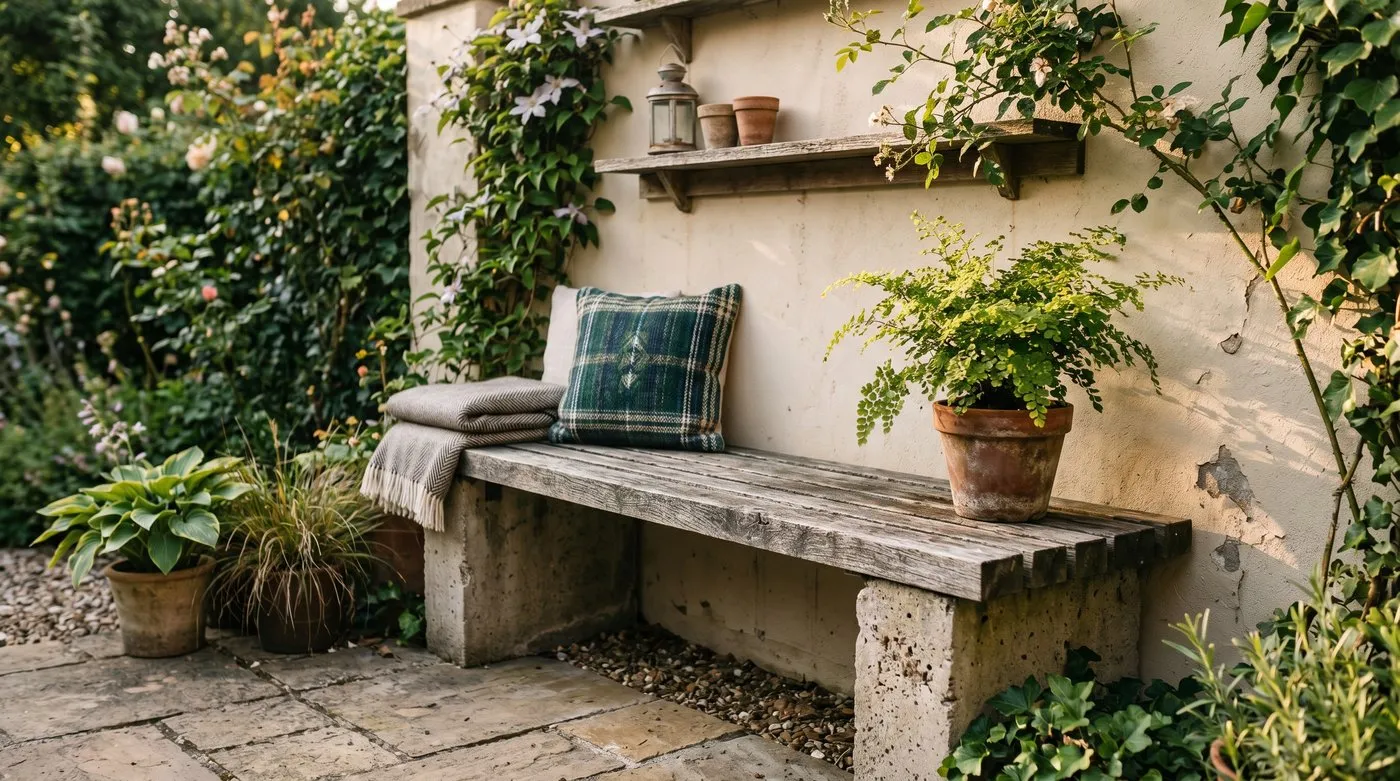 A cast concrete bench softened with timber slats. Built into a wall, it saves space and reads as part of the structure.
Now you have your concrete plan
Our team produces practical UK gardening guidance from source research, contributor records and established horticultural practice. Editorial standards are overseen by Matt W.