Key takeaways
- A roof-form tree gives 4 to 9 square metres of shade from a 2m square root area
- Clear stems are sold at 1.8m, 2.2m and 2.5m, so pick head height before you buy
- Multi-stems branch at ground level, roof forms branch above a single clear trunk
- Plant small trees at least 3m from a house wall, and 5m for Platanus
- Roof forms need one framework prune a year, in late winter or midsummer
- Semi-mature specimens cost £300 to £1,500 and more for large Platanus
Parasol trees and multi-stem trees are the two ways to get real shade into a small UK garden without losing the whole plot to a canopy. A parasol tree, sold in the trade as a roof form or a pleached flat-top, carries a flat sheet of branches on a clear trunk. A multi-stem branches at ground level and rises as a vase. Both take up far less ground than a standard tree of the same shade area, and both cost more than most people expect. This guide sets out what each form actually is, which species suit British conditions, how far from a house they can safely go, and what the annual pruning really involves.
What a parasol or roof-form tree actually is
A parasol tree is a tree trained so its branches grow horizontally along a flat frame, forming a sheet of canopy above a bare trunk. The nursery grows a straight leading stem to a set height, cuts the leader, and ties the side branches out along a rigid frame of bamboo or steel. Over three to six seasons the branches thicken in that position and hold the shape.
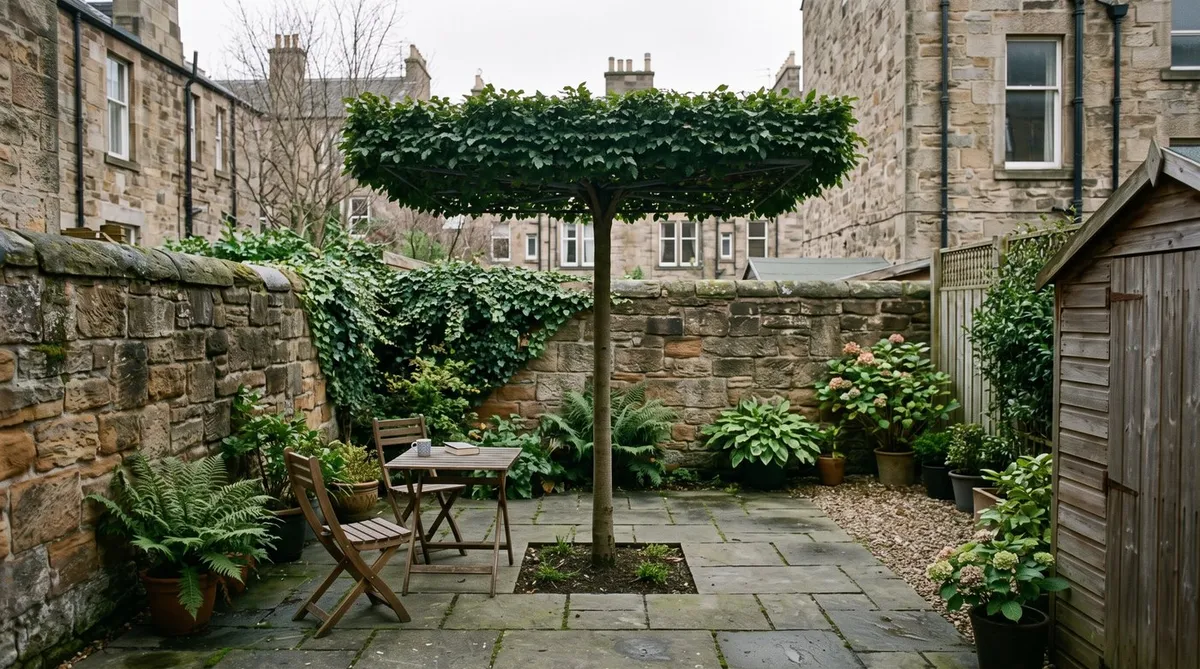
The result is a canopy typically 2 metres by 2 metres up to 3 metres by 3 metres, and only 30 to 60cm deep in profile. That is what makes it useful. A conventional tree giving 9 square metres of shade would be 7 or 8 metres tall with a rounded crown. A roof form gives the same shade footprint at 3.5 metres total height, with clear headroom underneath.
The trade uses several names for the same thing. Roof form, parasol, pleached flat-top, espalier-topped and the Dutch term dakboom all describe it. Slight differences exist: a true pleached screen is trained vertically as a hedge on stilts, while a roof form is trained horizontally. Nurseries sometimes list both under pleached, so check the photograph rather than the label.
Two things follow from the training. The tree needs one framework prune a year forever. And the shade it casts is a defined rectangle that moves predictably across the day, which you can plan for precisely.
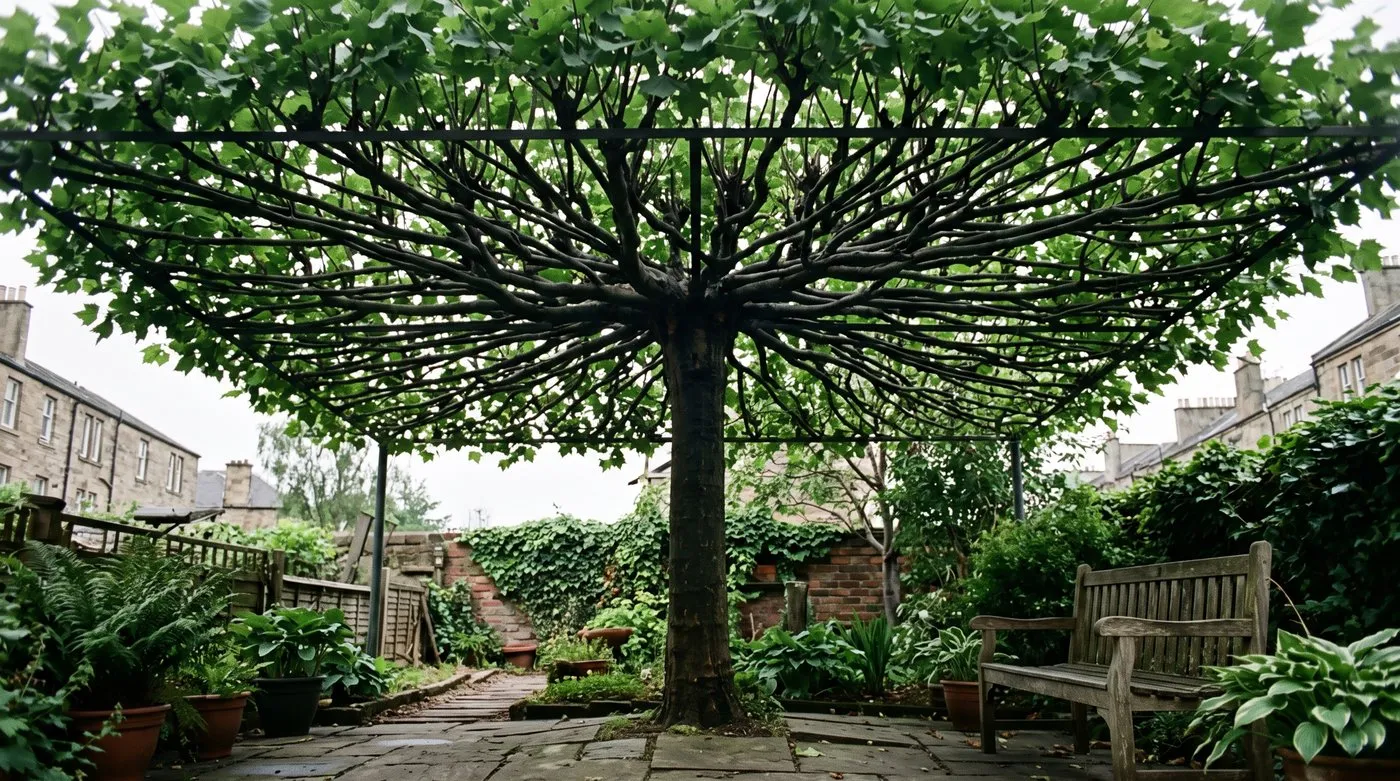 A roof form in a small Glasgow garden. The canopy is about 2.5m square and only 40cm deep, sitting on a 2.2m clear stem so a table fits comfortably underneath.
Multi-stem versus roof form: which shape suits your space
The two forms solve different problems and choosing wrongly wastes several hundred pounds.
A multi-stem tree has three to five trunks rising from ground level or just above it. It reads as sculpture: the bark is at eye level, the shape is loose and natural, and the canopy starts low. That low start is the limitation. A multi-stem Amelanchier at 3 metres tall has foliage from about 1.2 metres up, so you cannot walk or sit beneath it comfortably for the first eight years.
A roof form puts everything above head height from day one. You buy the headroom. That makes it the right answer where the shade has to cover a specific patio, a dining table, a bench or a hot tub. It is the wrong answer where you want a naturalistic garden, because a trained flat top always looks architectural.
Ground footprint is the other difference. A multi-stem needs a planting area at least 1.5 metres across to look right, because the stems flare outwards. A roof form needs only the trunk, so it can sit in a 400mm square cut in paving with a grille over it.
| Form | Ground needed | Shade at maturity | Headroom | Annual pruning | Role |
|---|---|---|---|---|---|
| Roof form on 2.2m stem | 0.4 sqm, fits in paving | 4 to 9 sqm, flat rectangle | Immediate, 2.2m | Essential, 1 cut | Gold standard for shading a fixed seating area |
| Roof form on 1.8m stem | 0.4 sqm | 4 to 6 sqm | Tight, 1.8m | Essential, 1 cut | Only where sightlines matter more than headroom |
| Multi-stem, 2.5 to 3m | 1.5 to 2.5 sqm | 6 to 12 sqm, irregular | None for 8 years | Light, every 2 to 3 years | Best for sculptural interest and bark |
| Fastigiate standard | 0.5 sqm | 1 to 2 sqm only | 1.8m | Almost none | Screening and height, not shade |
| Half standard, natural crown | 1 sqm | 8 to 20 sqm | 1.5m rising | Every 3 to 5 years | Cheapest shade if you have the room |
The roof form on a 2.2 metre clear stem is the gold standard for a small garden, because it delivers guaranteed usable shade over a known footprint in the smallest possible ground area. Its one real cost is the yearly prune, which a multi-stem does not need.
 The point of the whole exercise. A 2.5m square canopy on a 2.2m stem puts a usable patch of shade exactly where you want to sit.
Clear stem heights and why you must choose before buying
Clear stem means the height of bare trunk before the first branch. UK nurseries sell trained trees at three standard clear stems: 1.8 metres, 2.2 metres and 2.5 metres. This is fixed at purchase and cannot be changed afterwards.
Match the stem to the use. A 1.8m clear stem gives 1.8 metres of headroom, which is under the height of many adults with any downward branch sag. Use it only where the tree sits beside a route rather than over it. A 2.2m clear stem is the working default: it clears a standing adult, a parasol and a dining chair, and it keeps the canopy visually low enough to feel enclosing. A 2.5m clear stem suits a wider terrace, a driveway edge or anywhere a delivery van needs to pass.
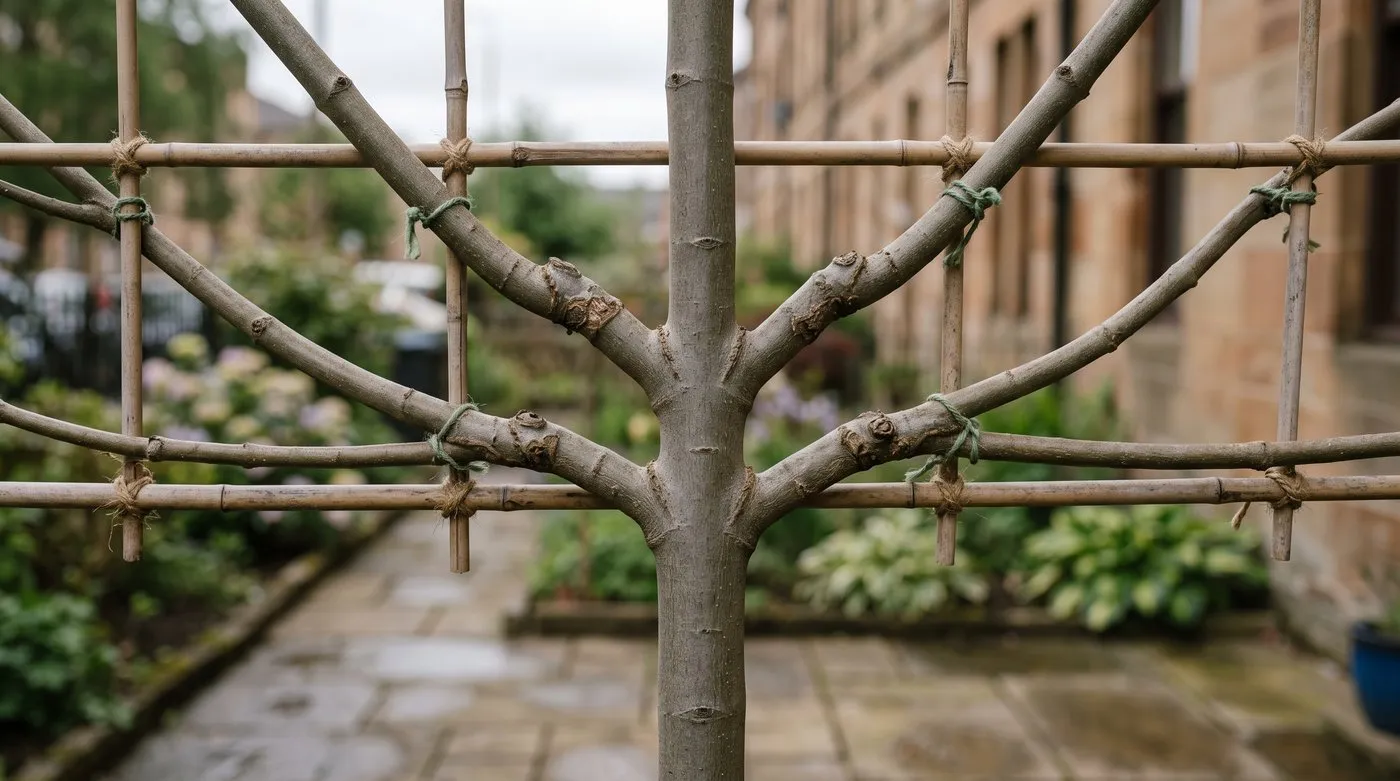 The junction between a 2.2m clear stem and the trained head. The horizontal frame stays in place for three to five years while the branches thicken into position.
Best UK species for parasol and multi-stem shade
Species choice decides how much work the tree gives you and how it behaves near buildings. These are the ten that perform in British gardens.
| Species | Mature height x spread | Canopy depth | Growth rate | Roots near buildings | Best form |
|---|---|---|---|---|---|
| Amelanchier lamarckii | 6 to 8m x 4 to 6m | Light, dappled | 25 to 40cm a year | Low risk, fibrous | Multi-stem |
| Cornus kousa | 5 to 7m x 4 to 5m | Medium, tiered | 20 to 30cm a year | Very low risk, shallow | Multi-stem |
| Crataegus prunifolia | 5 to 6m x 5 to 6m | Dense | 25 to 35cm a year | Low risk | Roof form or standard |
| Betula utilis jacquemontii | 12 to 15m x 6 to 8m | Very light | 40 to 60cm a year | Moderate, thirsty on clay | Multi-stem |
| Acer griseum | 6 to 8m x 5 to 6m | Medium | 15 to 25cm a year | Very low risk | Multi-stem |
| Cercis siliquastrum | 6 to 9m x 6 to 8m | Medium | 25 to 40cm a year | Low risk, dislikes moving | Multi-stem |
| Sorbus aucuparia | 8 to 12m x 4 to 6m | Light | 30 to 45cm a year | Low risk | Standard or multi-stem |
| Morus alba ‘Fruitless’ | 8 to 10m x 8 to 10m | Dense, large leaves | 40 to 60cm a year | Moderate, vigorous | Roof form |
| Platanus x hispanica | 25m+ if unpruned | Very dense | 50 to 90cm a year | High risk, keep 5m back | Roof form only |
| Prunus ‘Amanogawa’ | 6 to 8m x 1.5 to 2m | Narrow column | 25 to 35cm a year | Low risk | Fastigiate, no shade |
Amelanchier lamarckii is the safest first choice in a small garden. White star blossom in April, bronze new leaves, and orange-red autumn colour, on a tree that stays under 8 metres and tolerates clay. Cornus kousa flowers later, from late May into June, with creamy bracts held on horizontal tiers, and it is the least root-troublesome of the group.
Platanus x hispanica is the classic pleached parasol seen in continental squares. It takes hard annual pruning better than anything else and holds a perfect flat sheet. It is also a forest tree that will reach 25 metres if you stop cutting it, with strong roots. Never plant one within 5 metres of a building, and never plant one you are not committed to pruning every single year. Prunus ‘Amanogawa’ is included as the contrast: a fastigiate column 1.5 to 2 metres wide that gives excellent height and almost no shade.
For a wider view of the field, our guide to the best trees for small UK gardens covers untrained forms, and 10 best small native trees covers the wildlife-first options.
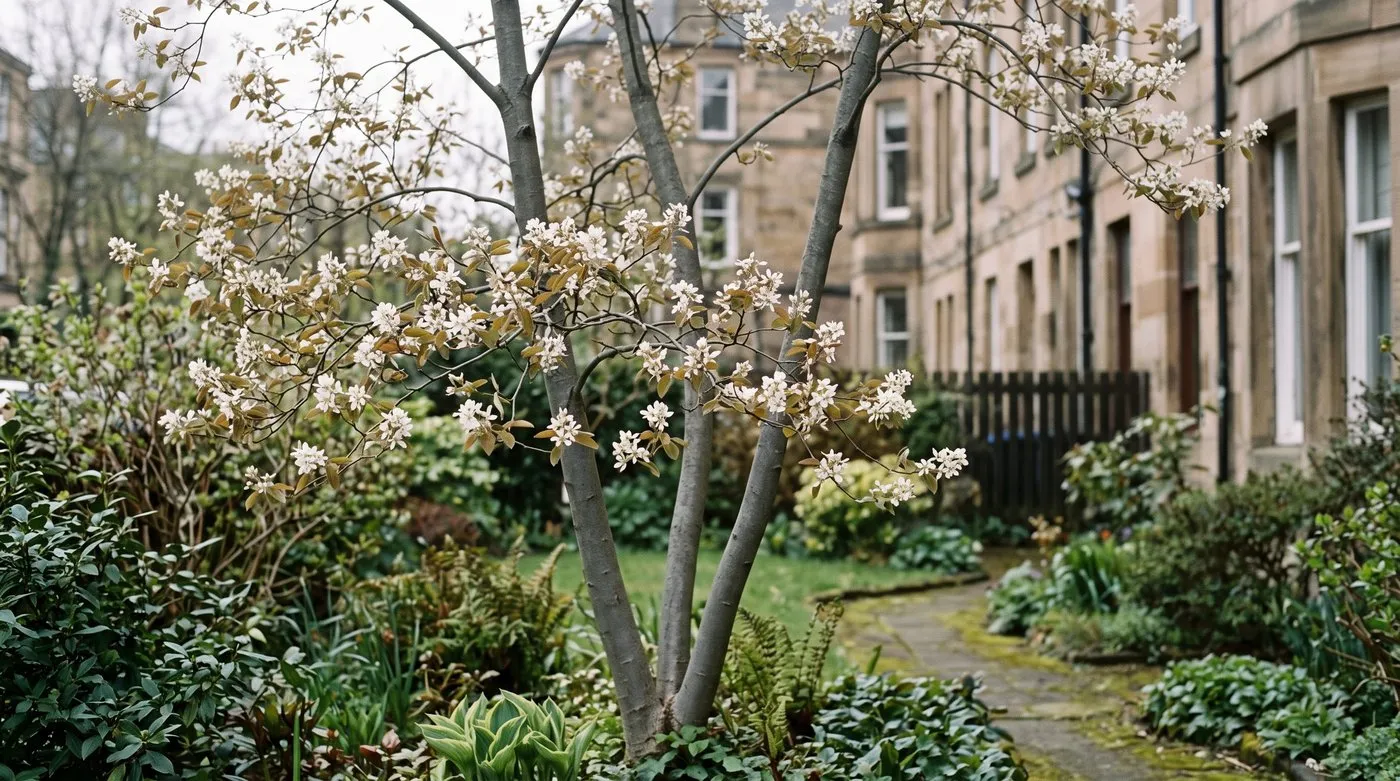 Amelanchier lamarckii in mid-April. Three stems from ground level, white five-petalled star flowers, and bronze-tinged emerging foliage that greens by late May.
Planting distance from a house, drains and boundaries
Distance is the decision people get wrong and cannot undo. Three separate risks apply.
Direct damage from a trunk or root heaving a path or a wall is a function of proximity and vigour. Keep any tree at least 1.5 metres from a hard path and 3 metres from a house wall as a baseline. For Platanus and Morus, increase that to 5 metres.
Clay shrinkage subsidence is the serious one, and it applies across much of southern and central England and parts of Scotland’s central belt. On shrinkable clay a thirsty tree dries the soil in summer and the ground drops. The working rule insurers apply is that the distance from the building should exceed the tree’s mature height. That rules out Platanus and mature birch close to a house on clay. Amelanchier, Cornus kousa and Acer griseum are the low-risk choices on those soils.
Drains are the third. Roots do not break sound plastic pipe. They exploit joints already leaking, almost always in Victorian clayware. Keep 3 metres from a known drain run, and more from an old one. A CCTV survey before planting costs £180 to £350 and is worth it near any period property.
Warning: Never plant Platanus x hispanica, Populus or Salix within 8 metres of a building on shrinkable clay. Subsidence claims on these species routinely run into tens of thousands of pounds, and insurers have refused cover where the planting distance was clearly inadequate.
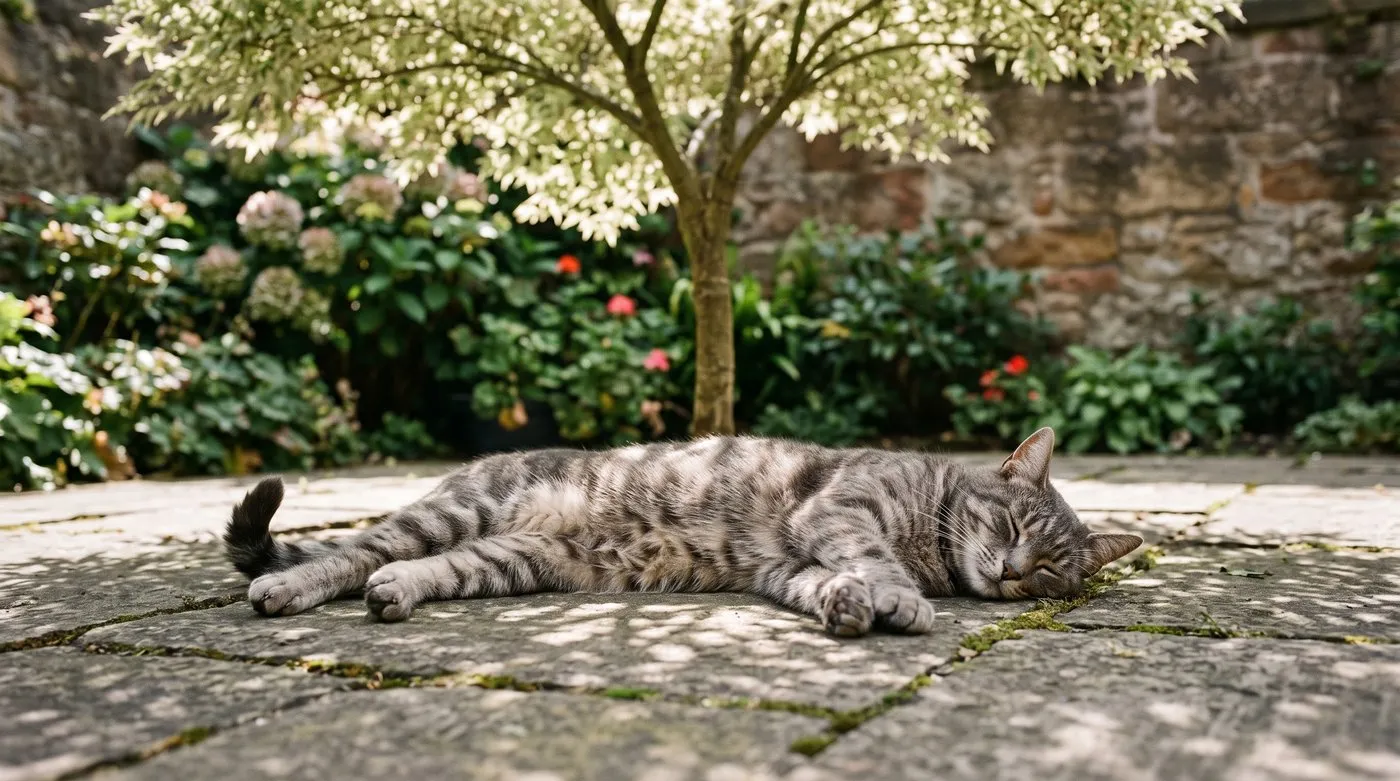 Dappled shade from a light canopy such as Amelanchier drops surface temperature on paving by 8 to 12C on a hot afternoon.
How a roof form is trained: the six-stage process
Understanding the training explains why the tree needs an annual cut, and why skipping it ruins the shape.
- Years 1 to 3, stem building. The nursery grows a single straight leader to the target clear stem height, removing all side shoots below it. Trunk girth builds to about 6 to 8cm.
- Year 3 to 4, decapitation. The leader is cut just above the intended head height. This removes apical dominance and forces multiple laterals from the top 20cm of stem.
- Year 4, frame fitting. A rigid horizontal frame of bamboo canes or welded steel is fixed above the cut. Four to eight laterals are selected and tied out along it at roughly 90 degree spacing.
- Years 4 to 6, thickening. The tied laterals grow horizontally and lay down wood in that position. Vertical shoots are removed twice a season. The branches set permanently.
- Year 6 onwards, sale and establishment. The tree is sold with the frame still fitted. It stays in place for another two to four years in the garden while the wood finishes hardening.
- Maintenance for life. Every upright shoot from the flat sheet is cut back annually to keep the profile at 30 to 60cm deep.
The critical mistake is treating the shape as permanent once the frame comes off. It is not. A roof form is a suppressed tree held in an unnatural posture. Miss one year and the uprights reach 60 to 90cm. Miss two and they thicken into structural branches you cannot remove without leaving large wounds. At that point the tree is a normal crown on a clear stem, and the parasol effect is gone for good.
Pruning a roof form and when to cut which species
The annual cut is straightforward once you know the timing. There are two windows and the species decides which you use.
Late winter, February to early March, suits most deciduous species. The framework is fully visible, the tree is dormant, and regrowth in spring covers the cuts quickly. Use this for Platanus, Morus, Crataegus and Sorbus.
Midsummer, late June to early August, is required for species that bleed sap heavily when cut in late winter. That includes Betula and Acer. It is also the safe window for Prunus, because cutting cherries in winter invites silver leaf infection through open wounds.
The cut itself: remove every vertical shoot back to within 2 to 3cm of the horizontal framework branch, cutting just above a bud or the branch collar. Do not cut flush and do not leave 10cm stubs. Work from below with the profile visible against the sky, and step back every few minutes because a flat top is judged by eye, not by measurement.
Budget 30 to 60 minutes a year for a 2.5 metre square roof form on a step ladder. A tree surgeon charges £90 to £180 for the same job on a domestic tree. On a multi-stem, work is far lighter: remove crossing stems and any growth below 1 metre every two to three seasons. Our general guide to pruning trees for privacy and light covers the wider crown work.
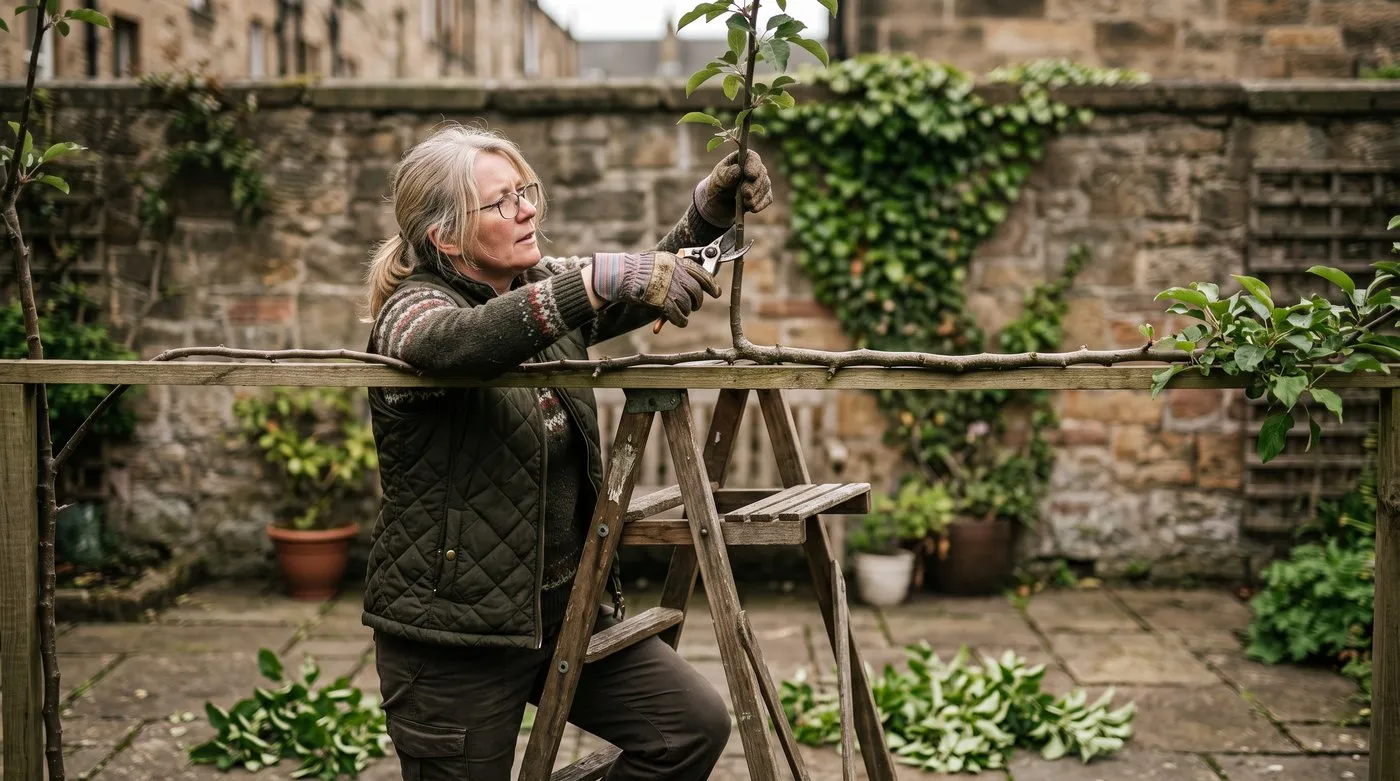 The annual framework cut. Every upright is taken back to within 2 to 3cm of the horizontal branch, keeping the profile between 30 and 60cm deep.
Growing a parasol tree in a container
Container growing works but it halves the tree’s life expectancy and doubles the attention it needs. It is still the only option on a roof terrace or over a basement vault.
Minimum container size is 80 litres for a small species, and 150 to 250 litres for anything with a 2.5 metre canopy. Depth matters more than width: aim for at least 60cm of rooting depth. Use a soil-based John Innes No 3, not a peat-free multipurpose, because the loam holds structure and nutrients for years rather than months.
Water is the killer. A roof-form tree in a 150 litre pot in a hot July week transpires 15 to 25 litres a day. Fit a drip line on a timer rather than relying on a can. Feed each March with a controlled-release fertiliser at the rate on the pack, typically 5 to 8g per litre of compost.
Every three to four years, lift the tree, trim the outer 5cm of root ball all round with a sharp saw, replace the removed compost with fresh John Innes No 3, and put it back. Skip this and the tree becomes root-bound, growth stalls, and leaf scorch sets in by late June. Cornus kousa and Acer griseum handle container life best. Platanus does not: it is too vigorous and too thirsty.
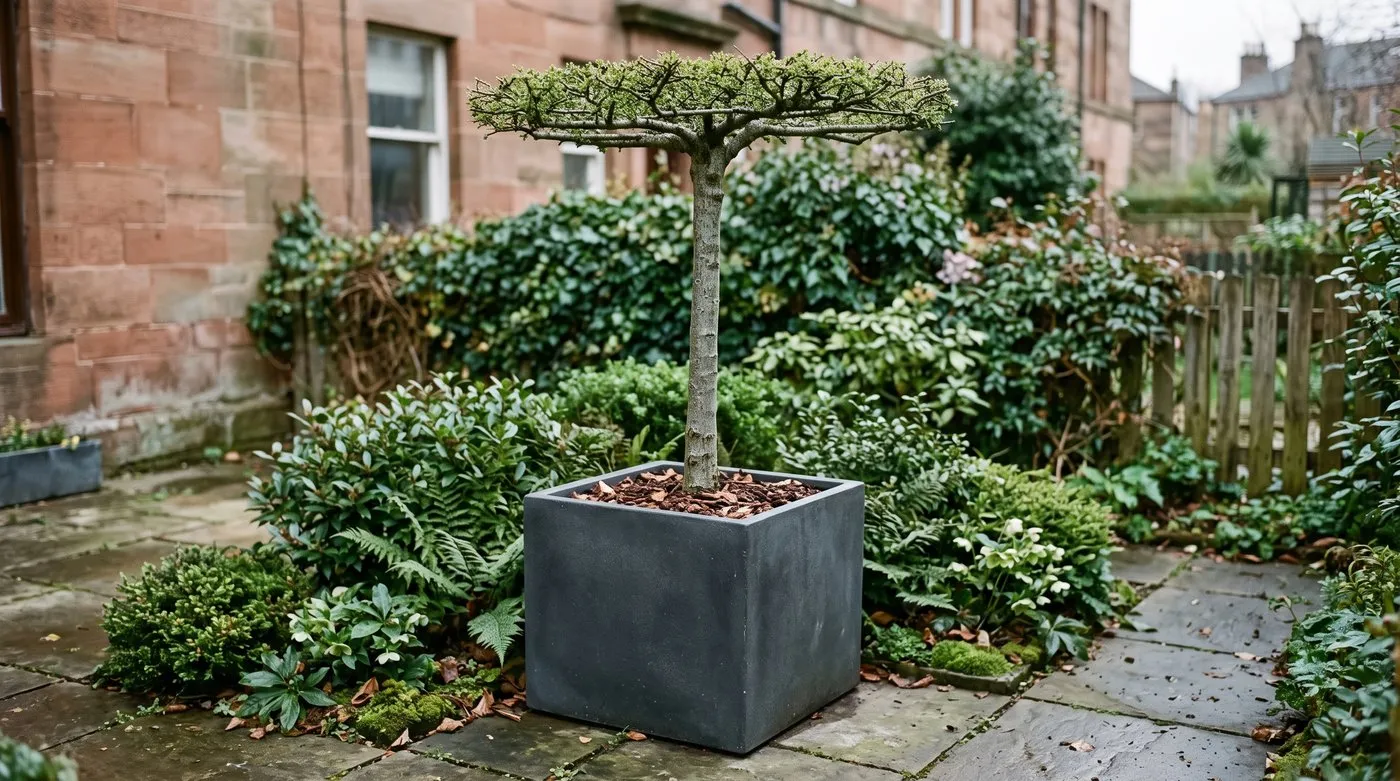 A container-grown roof form on a Glasgow terrace. A 200 litre planter, at least 60cm deep, with a drip line hidden under the mulch layer.
Why most small-garden trees disappoint: the root cause
The underlying reason a small-garden tree fails to deliver is almost never the species. It is buying a form that cannot produce the effect wanted, usually because the trade name was misunderstood.
People want shade over a table. They buy a young feathered standard because it is cheap and the label says the tree reaches 7 metres. What they get is a 2 metre whip with branches starting at 60cm, casting shade on the ground beside it, for the next decade. The mature dimensions on the label describe year 20, not year 2.
The reason it is missed is that garden centres stock by species, not by form, and the price difference between forms is enormous. A 2 metre feathered Amelanchier is £45. A trained roof form of the same species is £400 and upwards. The cheap one is not a smaller version of the expensive one. It is a different product that will take fifteen years and a lot of pruning to become something similar.
The permanent fix is to buy the form, not the species, and buy it at the size you need. Decide the clear stem height first, then the canopy dimension, then choose a species that fits the soil and the distance from the house. If the budget will not stretch to a trained specimen, a half standard with a natural crown planted 3 metres from the seating area gives usable shade in six or seven years for a fifth of the price. The RHS advice on fitting trees into small gardens is sound on matching form to space.
Month-by-month calendar for parasol and multi-stem trees
| Month | Task |
|---|---|
| January | Order bare-root and rootballed stock. Check frame ties have not girdled any branch. |
| February | Prune Platanus, Morus, Crataegus and Sorbus roof forms back to the framework. |
| March | Plant rootballed stock before bud break. Feed containers with controlled-release fertiliser. |
| April | Mulch to 75mm depth, keeping the mulch 100mm clear of the trunk. Amelanchier flowers. |
| May | Water new plantings weekly at 25 to 30 litres. Cornus kousa bracts open late in the month. |
| June | Check ties and stakes. Peg out the midday shadow if planning a new planting position. |
| July | Prune Betula and Acer roof forms now. Water containers daily in dry spells. |
| August | Prune Prunus roof forms now to avoid silver leaf. Watch for leaf scorch in containers. |
| September | Last month for a light tidy cut. Order autumn planting stock. |
| October | Best month for bare-root and rootball planting. Soil is warm and moisture returning. |
| November | Plant, stake low at one third of stem height, and mulch. Amelanchier autumn colour peaks. |
| December | Remove nursery frames from trees established three years or more. Check stake ties. |
Gardener’s tip: Stake a newly planted roof form low, at about one third of the clear stem height, using a single angled stake driven outside the root ball. A high stake holds the trunk rigid and stops it thickening. Remove the stake after two full growing seasons, or the tree never develops enough taper to stand alone.
Common mistakes with parasol and multi-stem trees
- Planting the tree where you want the shade. Shade falls north of the trunk at midday in the UK, not underneath it. At a 2.2m clear stem in June the midday shadow sits roughly 1m north of the trunk. Peg out a panel at the intended height and photograph the shadow before you dig.
- Abandoning the annual cut. A roof form left two years grows structural uprights that cannot be removed cleanly. The flat profile is then gone permanently. Diarise the cut for the same month each year and it takes under an hour.
- Buying a 1.8m clear stem for a dining area. With leaf load and sag the real clearance is nearer 1.7m, so tall guests catch it. Buy the 2.2m stem for anywhere people stand or walk.
- Planting Platanus or birch close to a house on clay. These are the highest subsidence-risk species on the list. On shrinkable clay keep the distance greater than the tree’s mature height, or choose Amelanchier, Cornus kousa or Acer griseum instead.
- Under-watering in years one and two. A semi-mature rootballed tree carries a tiny root system for its size. It needs 25 to 30 litres a week through every dry spell for two full seasons. More expensive trees die of drought in year one than any other cause.
What a parasol or multi-stem tree really costs
| Item | Typical UK cost | Note |
|---|---|---|
| Feathered whip, 1.5 to 2m | GBP 25 to 60 | Cheapest, but 12 to 15 years to give shade |
| Multi-stem Amelanchier, 200 to 250cm | GBP 250 to 550 | Best value for four-season interest |
| Multi-stem Cornus kousa, 200 to 250cm | GBP 300 to 600 | Slower, so larger sizes cost more |
| Roof form, 10 to 12cm girth | GBP 300 to 550 | Entry-level trained specimen |
| Roof form Platanus, 12 to 14cm girth | GBP 500 to 900 | The classic pleached parasol |
| Roof form, 16 to 18cm girth | GBP 900 to 1,500+ | Needs machine handling to place |
| Professional planting | GBP 150 to 400 | Includes pit, backfill and staking |
| Crane or hiab access | GBP 250 to 600 | Where a tree cannot be carried through |
| 200 litre container and John Innes No 3 | GBP 180 to 400 | For terrace and roof planting |
| Annual prune by a tree surgeon | GBP 90 to 180 | Or 30 to 60 minutes yourself |
The hidden costs are access and aftercare. A 16cm girth roof form in a rootball weighs 250 to 400kg and will not go through a standard side gate, so a crane or a fence panel removal enters the budget. And a 620 pound tree that dies of drought in year one is a 620 pound loss: budget for an irrigation bag at £15 and the time to fill it weekly.
Frequently asked questions
What is a parasol tree?
A parasol tree is trained flat on a frame above a clear stem. It is also sold as a roof form, a pleached flat-top or an espalier-topped tree. The canopy spreads sideways as a sheet rather than upwards, so it gives shade without height.
What is the difference between a multi-stem and a parasol tree?
A multi-stem branches at ground level, a parasol branches above a clear trunk. Multi-stems form a vase or fountain shape with visible bark at eye level. Parasol and roof forms give usable headroom underneath, so you can put a table and chairs beneath them.
Which trees are best for shade in a small UK garden?
Amelanchier lamarckii, Cornus kousa and Crataegus prunifolia suit most small gardens. Amelanchier gives spring blossom and autumn colour at 6 to 8 metres. For a true flat parasol effect, Platanus x hispanica trained as a roof form is the classic choice but needs annual pruning.
How far from a house should I plant a small tree?
Plant small ornamental trees at least 3 metres from a house wall. Increase that to 5 metres for Platanus and 8 metres or more for willow and poplar. On shrinkable clay soils, insurers commonly want the distance to exceed the tree’s mature height.
How much does a parasol or roof-form tree cost in the UK?
Expect £300 to £1,500 for a semi-mature roof-form tree. A 12 to 14cm girth Platanus roof form typically runs £500 to £900. Multi-stem Amelanchier and Cornus at 200 to 250cm sit around £250 to £550. Add £150 to £400 for planting.
Do parasol trees need pruning every year?
Yes, a roof form needs one framework prune a year to stay flat. Cut back the upright growth to the horizontal frame in late winter, or in midsummer for species that bleed sap. Skip two years and the flat top thickens into a normal crown.
Can you grow a parasol tree in a container?
Yes, but only in a large container of at least 80 litres. Use a soil-based John Innes No 3 mix, water through every dry spell, and feed each spring. Container roof forms need root pruning or potting on every three to four years to stay healthy.
Our team produces practical UK gardening guidance from source research, contributor records and established horticultural practice. Editorial standards are overseen by Matt W.