Key takeaways
- Design to one rule: nothing dug in, drilled in or wired in, so everything leaves with you
- Read the tenancy agreement first and get any changes agreed with the landlord in writing
- Three or four large pots, 40cm plus, do the structural work borders normally do
- Raised beds on legs, grow bags and modular planters give growing space without touching the soil
- Freestanding trellis in troughs and solar lighting add height and light with zero fixings
- A realistic starter kit costs about £350; a stripped-back version runs nearer £150
A rental garden runs on one design rule the glossy books never mention: everything you build has to be able to leave with you. No digging in, no drilling in, no wiring in. It sounds like a limitation. In practice it is a brief, and a surprisingly freeing one, because every pound you spend goes on things you own rather than improvements you hand back with the keys.
Can you have a proper garden in a rented house?
Yes, and around a third of UK renters have some outdoor space to work with, from a yard to a full garden. What you cannot usually do is alter it. The standard tenancy position is simple: you maintain what is there, mow the grass, keep it tidy, and hand it back as you found it, allowing for the seasons.
So the renter’s brief has three lines. First, take it with you: every pot, plant, screen and light should load onto a van. Second, do not breach the tenancy: no alterations without consent. Third, stay deposit-safe: the garden at check-out should match the check-in inventory photos.
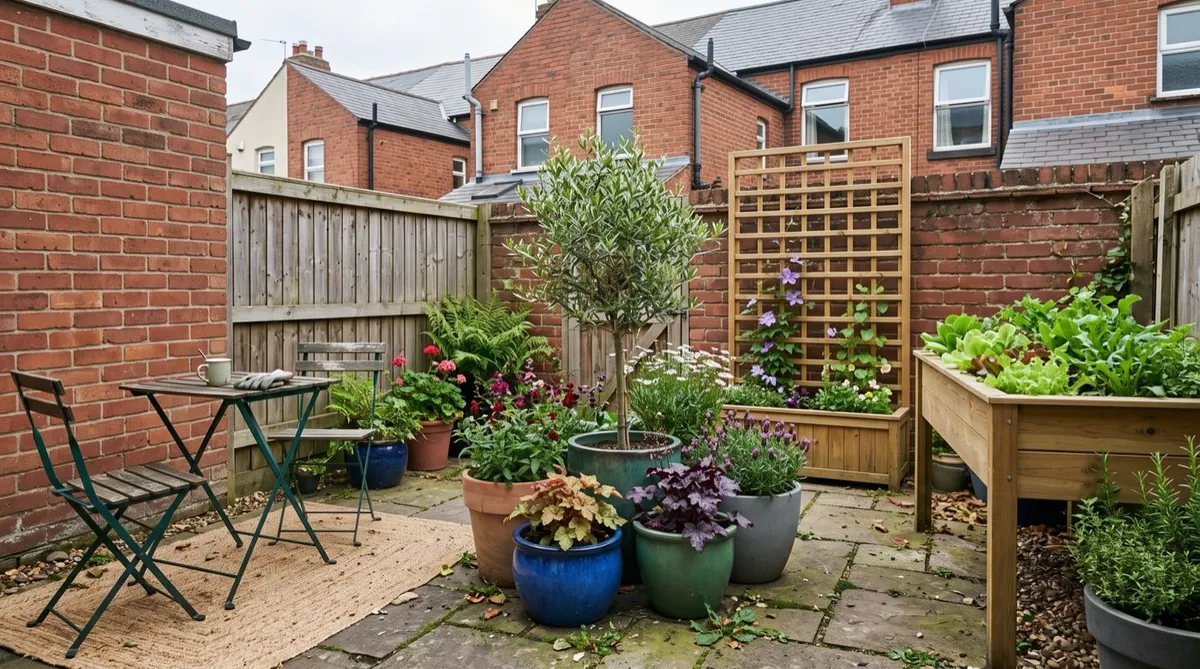
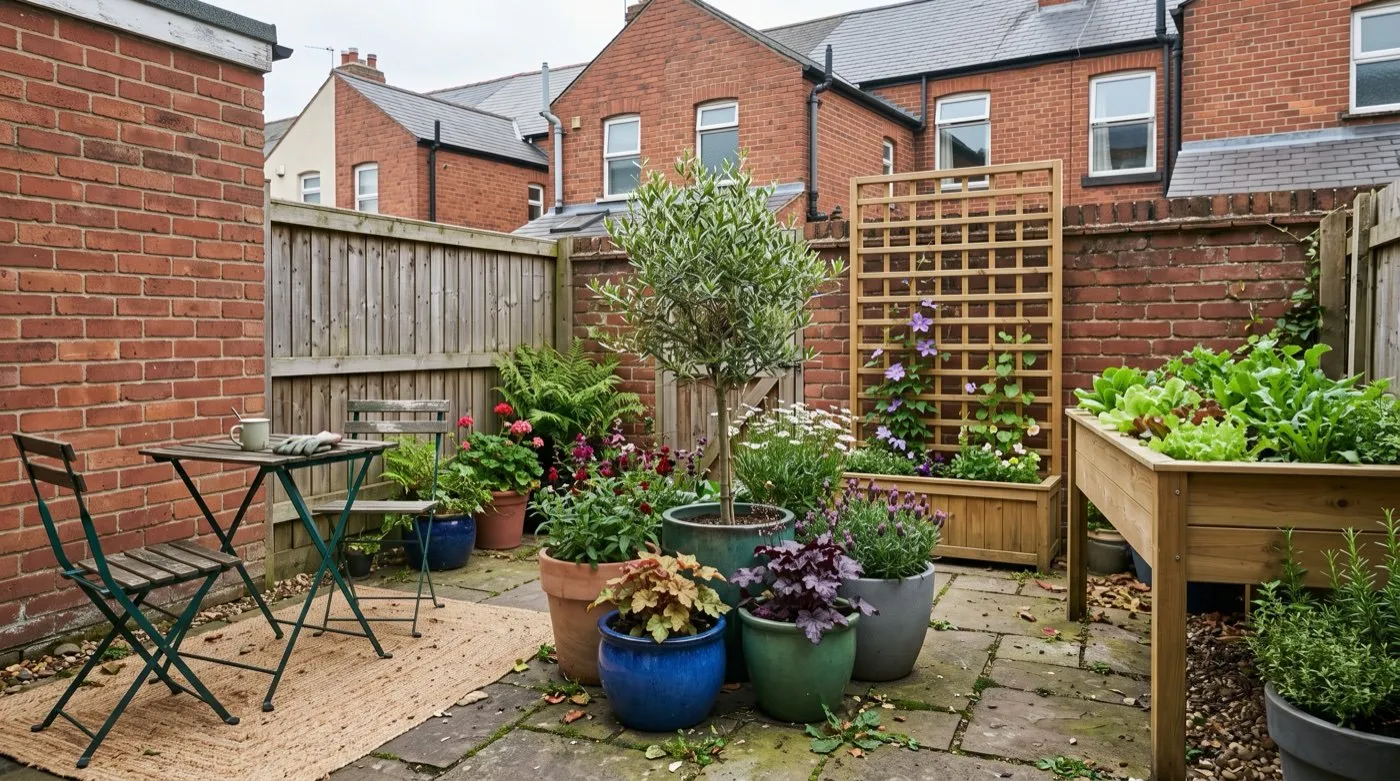 A terraced backyard garden built entirely from movable parts: grouped pots, a raised planter and trellis in troughs.
Check the tenancy agreement before you buy a single pot
Read the garden clause first, because it decides what needs permission and what does not. Most agreements make the tenant responsible for basic upkeep and ban alterations without consent. Some go further and specify the lawn, named shrubs or even weed-free paving. Ten minutes with the contract now saves an argument at check-out.
If you want to change anything fixed, ask in writing. An email is fine. Describe exactly what you propose, say how you will reverse it, and keep the reply. Landlord bodies tell their members to expect this, and written consent protects both sides. A verbal yes from a letting agent in February is worth nothing at check-out in November.
Then photograph everything on day one. Walk the garden and take 20 or 30 dated photos: lawn condition, fence panels, beds, paving. Your deposit is protected in a government scheme, and any deduction has to reflect actual loss against the check-in condition (gov.uk: tenancy deposit protection). Photos are how you prove the garden went back as it came.
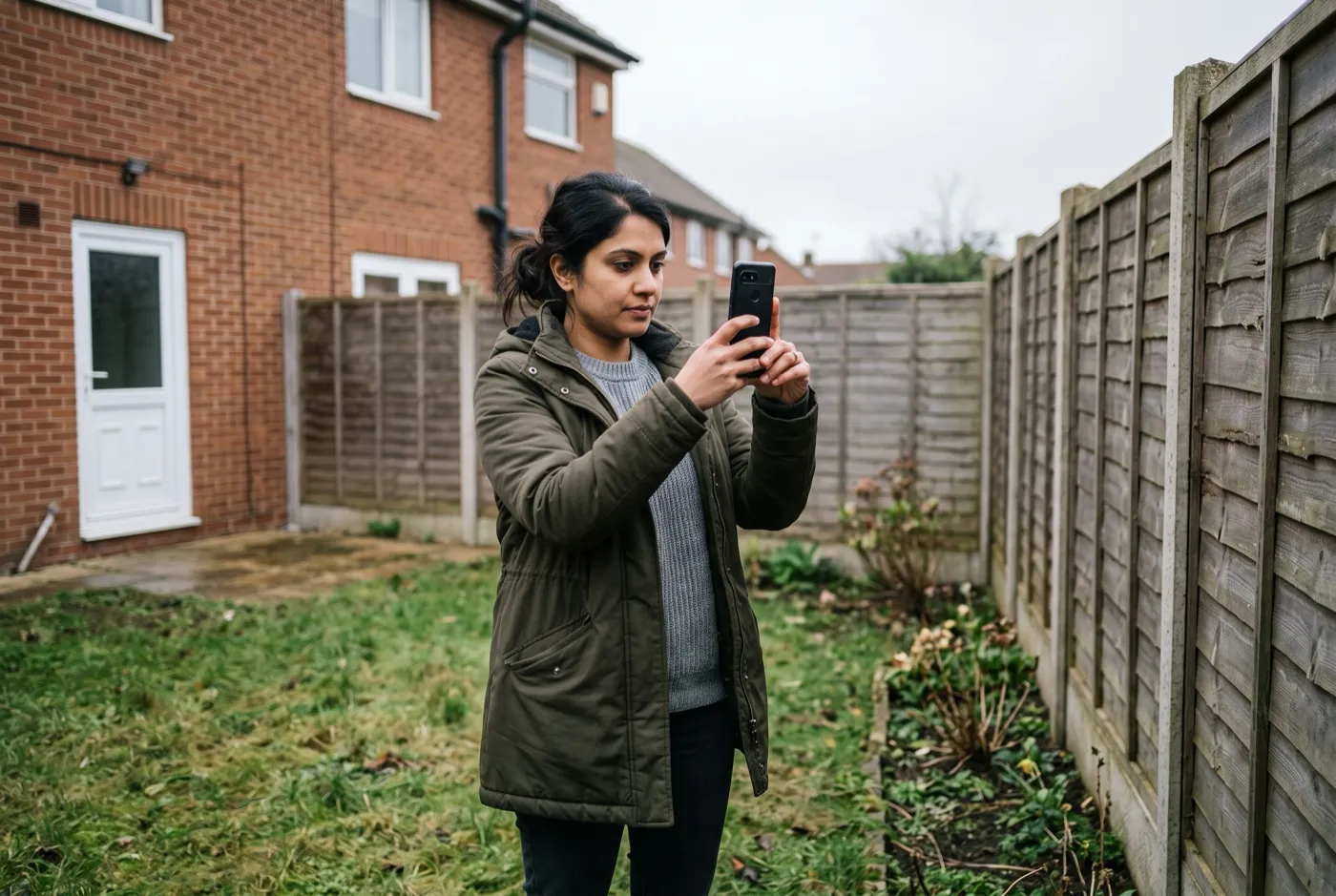 Day-one photos of lawn, fences and beds are your evidence at check-out. Take 20 or 30 and keep them dated.
How do you design a rental garden with containers?
Start with three or four genuinely large pots, 40cm across or more, and let them do the job borders normally do. This is the single biggest shift in thinking. Most renters buy ten small pots and get a cluttered windowsill effect. A 45cm pot holds a small tree, a climber on an obelisk or a shrub, and it reads as structure, not decoration.
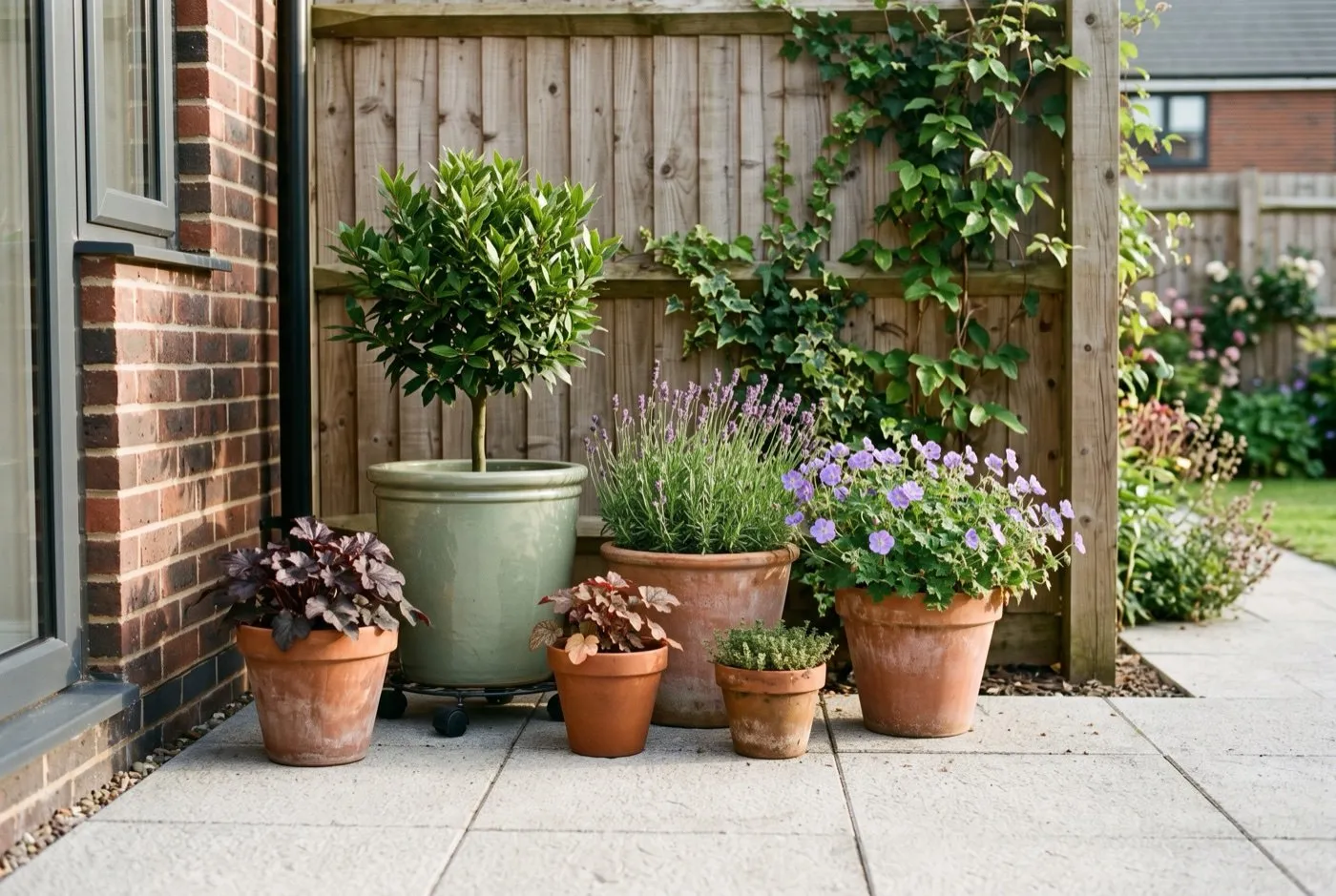 Three sizes, one corner. A grouped cluster of big pots reads as structure where scattered small pots read as clutter.
Gardener’s tip: Put every pot over 35cm on a wheeled plant caddy before you fill it, not after. A £6 caddy turns a 60kg pot into something one person can reposition in ten seconds. You can chase the sun through the season, clear the patio for a party, and on moving day the heaviest pots roll straight to the tailgate instead of breaking your back.
Are raised beds on legs worth it for renters?
For anyone renting on paving or poor soil, a raised bed on legs is the best growing investment there is. A trough planter at waist height, the VegTrug pattern, gives you 30-40cm of root depth without touching the ground beneath. Nothing to dig, nothing to make good, and it stands on four feet you can lift. A 1m version costs £60-80, a 1.8m one nearer £110.
Grow bags are the budget route. Fabric planters of 30-40 litres cost £3-5 each, fold flat between tenancies, and grow a courgette, a potato crop or a tomato apiece. They are ugly in isolation. Stand five in a row inside a cheap wooden crate surround and they look deliberate. Everything in our container vegetable growing guide works in them unchanged.
Modular planters fill the gap between the two. Interlocking cube and trough systems build an L-shaped bed around a seating area this year, then re-stack into a straight run at the next house. If you fancy building rather than buying, our £10 raised bed project makes a screw-together frame you can dismantle with the same drill that built it.
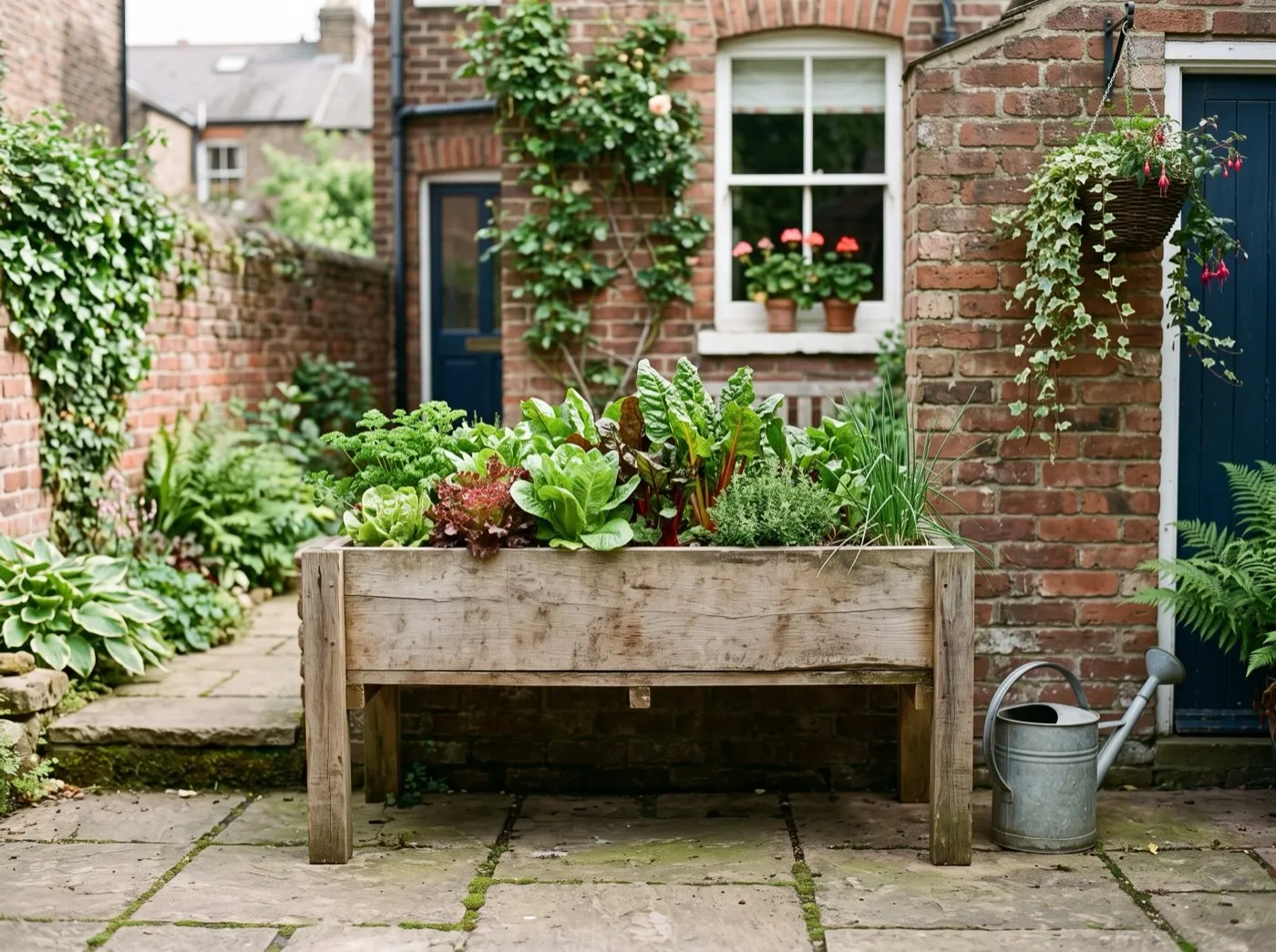 Root depth without ground contact. A raised planter on legs grows a full salad rotation and lifts away at check-out.
Container vs raised bed vs digging in: the renter’s comparison
| Container garden | Raised bed on legs | Digging in-ground | |
|---|---|---|---|
| Set-up cost | £25-60 per large pot | £60-110 per planter | £20-40 (tools, compost) |
| Permission needed | No | No | Yes, in writing |
| Reversibility | Total, lift and go | Total, four feet on paving | Poor, must re-turf or replant |
| Take it with you | Everything | Everything | Plants attach to the property |
| Deposit risk | None | None | High if not made good |
| Best for | Structure, trees, climbers | Veg, herbs, cut flowers | Long tenancies with consent |
Can you change the lawn in a rented garden?
You can borrow space from a lawn without breaking it, and that is the reversible route. The lawn itself usually belongs to the inventory, so stripping turf for a border is an alteration that needs written consent. But nothing stops you standing things on it and giving the ground back later.
If you do get permission to dig, agree the exit in the same email: whether the landlord wants the bed kept, or re-turfed at your cost. A roll of turf is about £5-7 per square metre, so re-turfing a small border is a £30 job, not a crisis. Either way you know the cost before the spade goes in.
How do you get privacy without drilling into fences?
Freestanding weight is the answer: screens anchored by planters, not by screws. Fences in rented houses are usually the landlord’s or the neighbour’s property, so drilling trellis into them is the classic check-out deduction. You do not need to touch them.
A trellis panel slotted into a 40-litre planter trough stands 1.8m tall and shrugs off wind once the compost is in, because the base weighs 40kg plus. Plant it with an evergreen climber, star jasmine or a clematis armandii, and within two seasons it is a green wall that happens to be furniture. Two or three of these placed around a seating area screen the exact sightline that bothers you, which matters more than fencing the whole boundary. Bamboo in large troughs does the same job faster; use a clumping type like Fargesia so it stays put.
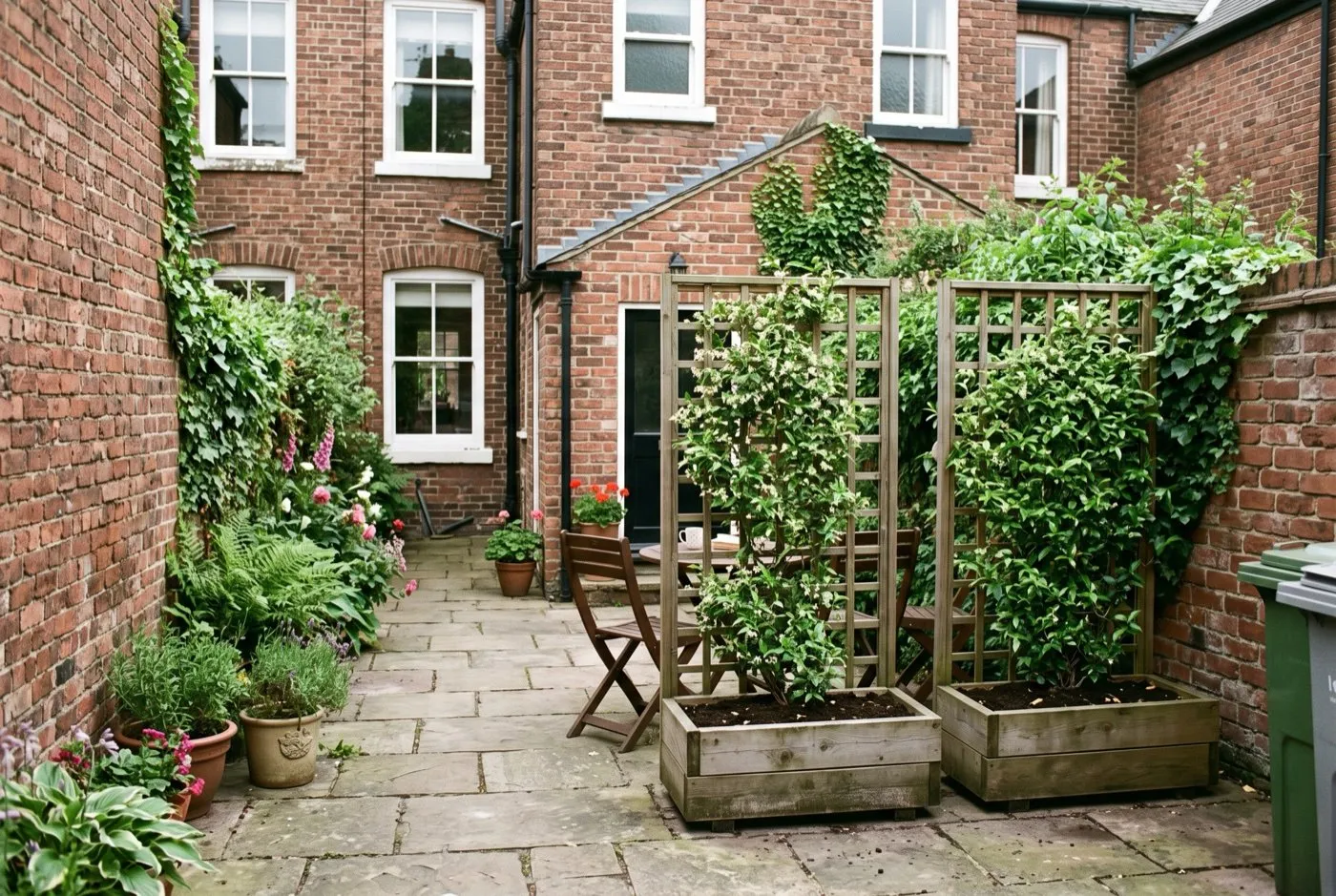 Trellis in troughs: 40kg of compost anchors a 1.8m screen with no fixings, here shielding a shared yard’s seating corner.
How do you light a rental garden without wiring?
Solar and battery lighting now covers everything a renter needs, and none of it requires a drill or an electrician. Outdoor mains work is expensive, fixed and absolutely an alteration. Skip it entirely.
Three layers do the work. First, string lights: a 10m solar string with 100 LEDs costs £12-18 and runs along trellis tops, obelisks or a freestanding pergola frame, tied with reusable cable ties rather than hooks. Second, ground level: solar stake lights pushed into pots, four to six of them, £15-25 for a set, marking the route from the back door and lighting the plants from below. Third, the table: two or three rechargeable battery lanterns, £15-25 each, charged indoors by USB and carried out like crockery. They give the warm, close light that makes people stay outside after ten.
Buy warm white, 2700K or so, across all three layers. Cool white solar kit makes a garden feel like a car park. And favour panels on a separate stake or lead, so the panel sits in sun while the light sits where you want it, under the very plants that shade it.
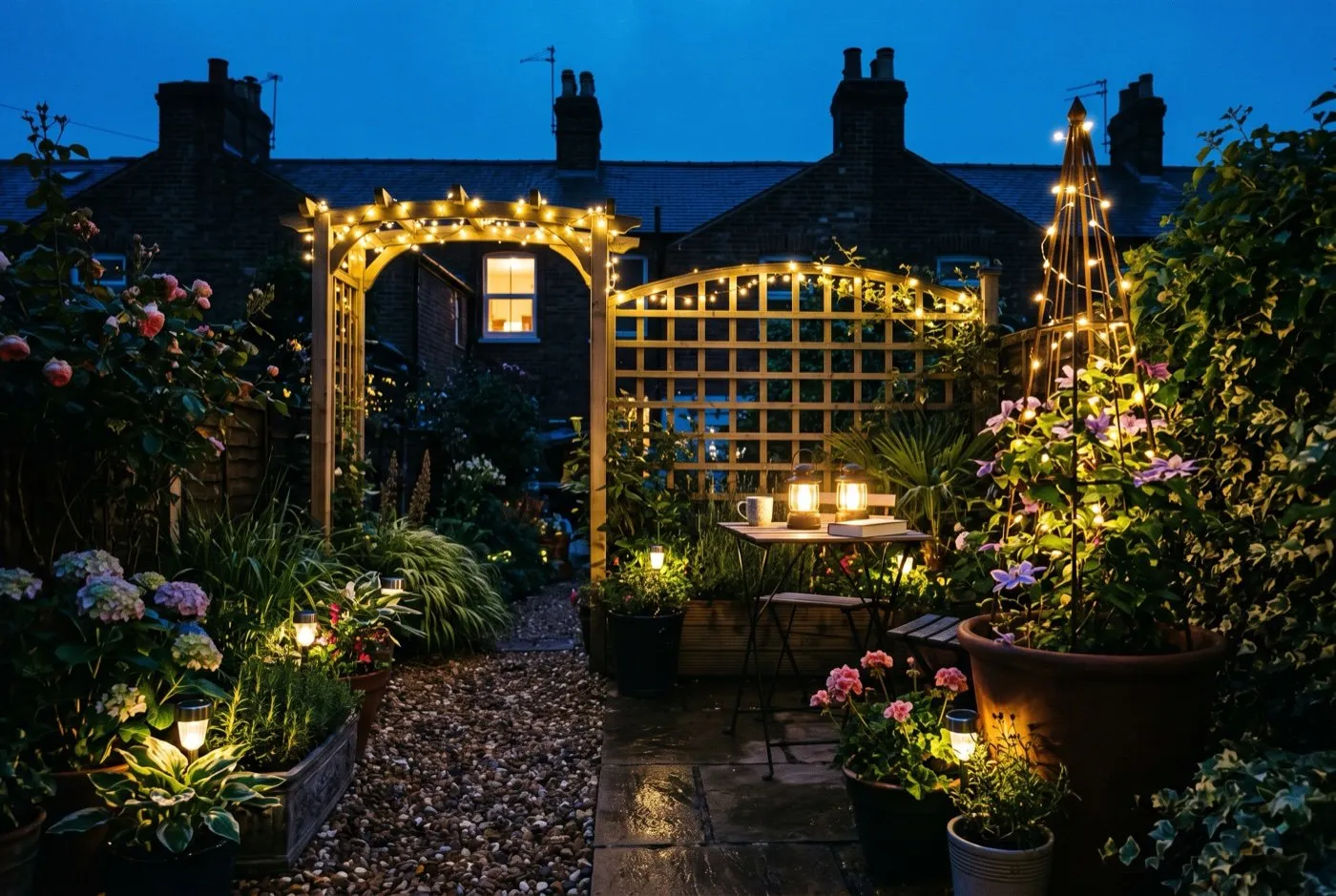 Three layers, no electrician: solar strings overhead, stake lights in the pots, rechargeable lanterns on the table.
Furniture and rugs: the fastest way to zone a rented space
An outdoor rug and a set of furniture create a room in an afternoon, and they are the most underrated tools in the rental kit. Renters inherit a lot of grim surfaces: stained slabs, grey concrete, decking painted a colour nobody chose. You cannot re-lay any of it. You can cover it.
A 120 x 170cm polypropylene outdoor rug costs £20-35, hides the worst of the paving and instantly declares “this is the sitting area”. Put the bistro set or sofa on it, cluster three pots at one corner, stand a lantern on the table, and the zone is done. In a larger garden, two rugs make two rooms: one for the table, one for the deckchairs, with a pot grouping as the divider between them.
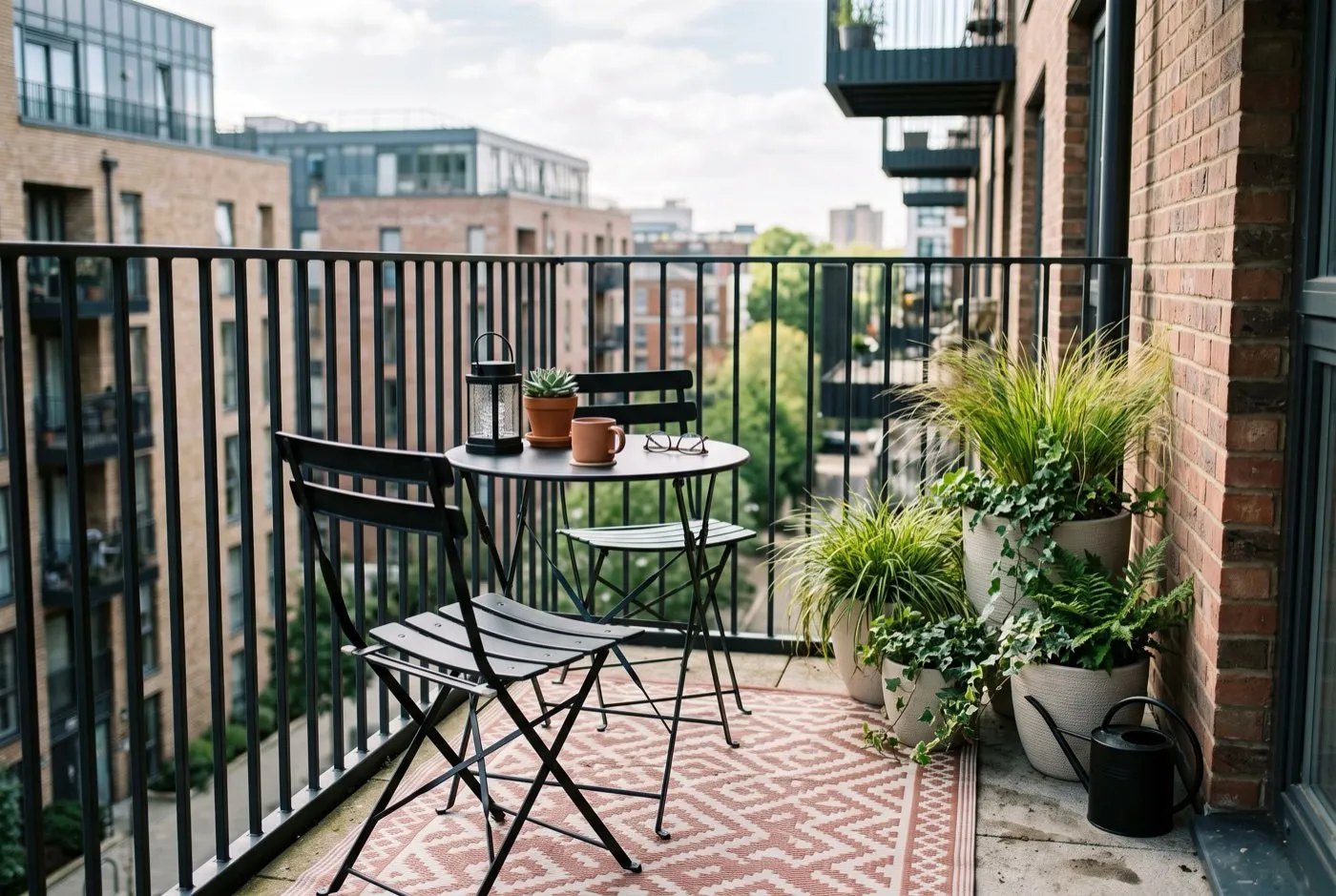 A £25 rug and a folding set turn a bare balcony corner into a room. Both fold flat and fit whatever comes next.
How much does a rental garden cost to set up?
Rental garden starter kit
| Item | Quantity | Price |
|---|---|---|
| Large frost-proof pots, 40-45cm | 3 | £75 |
| Mid-size pots, 28-30cm | 4 | £32 |
| Peat-free compost, 50L bags | 6 | £42 |
| Raised planter on legs, 1m | 1 | £70 |
| Fabric grow bags, 30-40L | 4 | £16 |
| Steel obelisks, 1.8m | 2 | £30 |
| Freestanding trellis + trough | 1 | £45 |
| Solar string lights, 10m | 1 | £15 |
| Outdoor rug, 120 x 170cm | 1 | £25 |
| Total | £350 |
Plants come on top, but £40-60 of seed and small perennials fills this kit in year one if you grow rather than buy big. Sweet peas, cosmos and nasturtiums cost £2-3 a packet and fill an obelisk or trough each.
What should you plant for a one to three year tenancy?
Match the plants to the tenancy length, not the other way round. A renter on a rolling twelve-month contract wants a garden that performs this summer, not in year three.
Year one, guaranteed: fast annuals. Sweet peas up the obelisks, cosmos and calendula in the mid-size pots, nasturtiums spilling from the grow bags, sunflowers at the back. All flower within 10-14 weeks of a spring sowing. Add cut-and-come-again salads, which crop in six weeks, and a tomato or courgette per grow bag.
Years one to three: perennials in pots. Hardy geraniums, salvias, heucheras, hostas in shade, lavender in sun, plus evergreen anchors like a clipped bay or pittosporum so the group holds together in January. These get better each season and load onto the van when you go. Our guide to plants for pots all year round has a full planting list.
The long game: dwarf fruit. An apple on M27 rootstock stays at 1.5-1.8m and crops happily in a 45-50cm pot for years; M9 suits a slightly bigger container. Patio cherries, figs and blueberries all do the same. A fruit tree is the most emotionally difficult thing to leave behind, so never plant one in a landlord’s soil. In a pot it is simply luggage. See our fruit in pots guide for varieties and rootstocks.
Moving day: how to take the garden with you
Two weeks out, stop feeding and lighten the load. Root-prune anything that has fused itself into its pot, trim tall growth by a third so it fits the van, and check pots lift free; roots often grow through drainage holes into the ground below. Our root pruning guide covers the technique, and it doubles as a health treatment for old container plants.
Two days out, water lightly, then stop. Damp compost holds together; saturated compost adds 20kg a pot and leaks all over the van floor. On the day, wrap ceramic pots in bubble wrap or towels, load them upright and packed tight so nothing slides, and put trays or bin liners underneath. A day’s van hire runs £60-90 and takes a 12-pot garden, the raised planter, trellis troughs and furniture in one load.
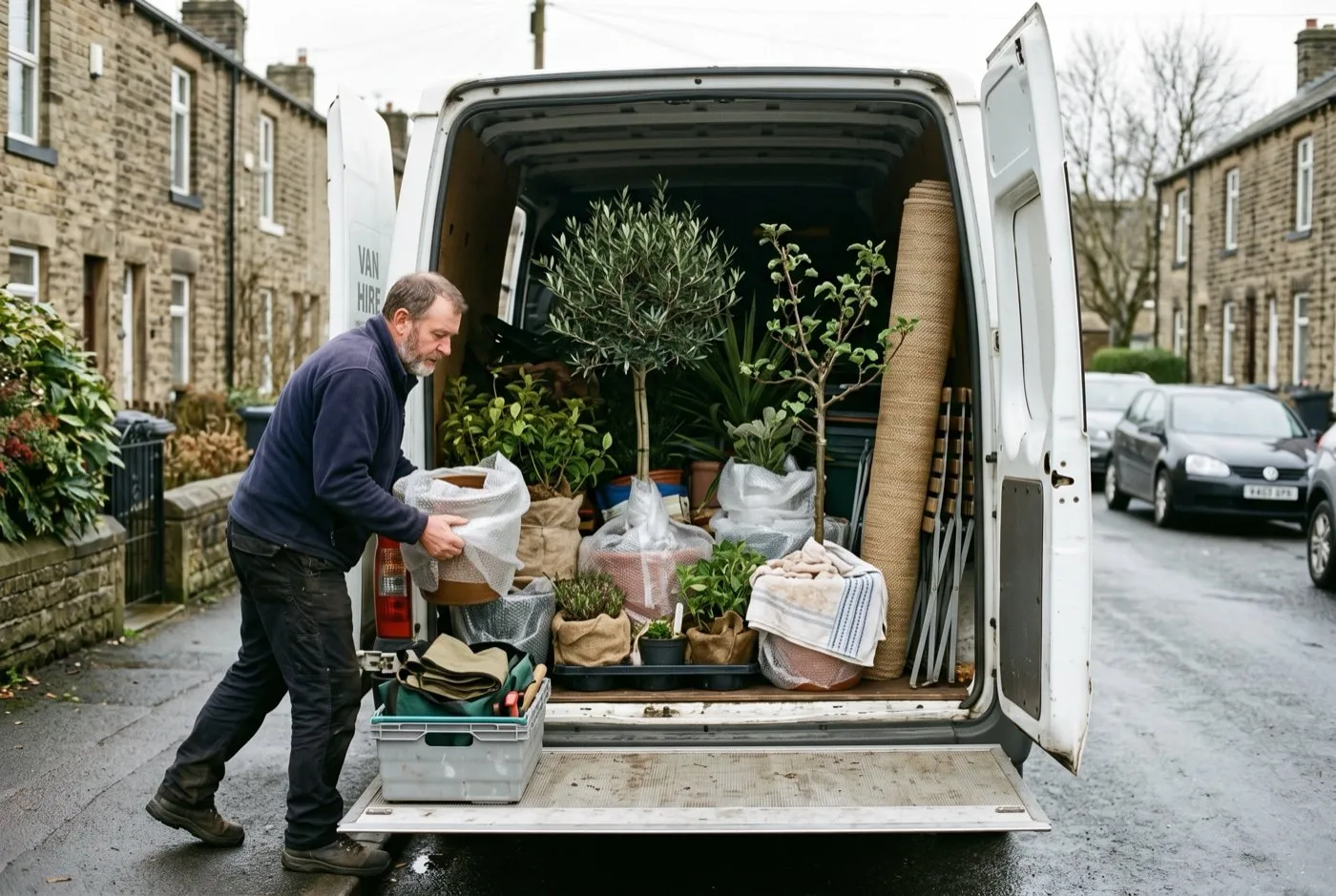 Packed tight, upright and slightly dry. A 12-pot garden plus planters and furniture fits one £70 van hire.
What not to do in a rented garden
The mistakes below cause almost every garden-related deposit dispute. All are avoidable.
Do not plant trees or shrubs in the ground. Legally, plants become part of the property once planted, so you either abandon them or dig them out and make good. Emotionally it is worse: you will grow attached to exactly the thing you cannot take. Pots only.
Do not drill walls, fences or window frames. No trellis screws, no hanging basket brackets, no light hooks. Fences are usually the landlord’s or the neighbour’s, and every hole is a potential deduction. Freestanding weight replaces every fixing in this article.
Do not alter decking, paving or structures. Painting decking, lifting slabs and dismantling a rotten pergola all count as alterations, even when you are sure it is an improvement. Report defects instead; repairs to fixed structures are the landlord’s job.
Do not let the basics slide. Most tenancies make you responsible for mowing and general tidiness, and neglect is the easiest deduction to defend. An hour a fortnight on the boring jobs protects the deposit more than anything you plant.
Do not skip the paper trail. Photograph the garden at check-in, keep permissions in writing and give the garden a final tidy and photo session at check-out. Boring, five minutes each, and it settles arguments before they start.
Frequently asked questions
Can I dig a border in a rented garden?
Not without written permission from your landlord. Most tenancy agreements require the garden to be returned in its check-in condition, and a new border changes that. Some landlords say yes, especially if you offer to re-turf at the end. Ask first, get the answer in writing, and photograph the area before you start. If permission is refused, a row of large pots or a raised bed on legs gives the same effect.
Will gardening affect my deposit?
Only if you change or damage what was there at check-in. Deposit deductions must reflect actual loss, so pots, planters and furniture standing on the surface cost you nothing. Digging up lawn, removing shrubs, drilling fences or leaving beds full of your plants can all justify a deduction. Keep everything freestanding, keep dated photos from move-in day, and the garden should never touch your deposit.
Do I need permission to put pots in a rented garden?
No, pots and containers on the surface do not alter the property. They are your belongings, the same as furniture. Permission only comes into it when you change something fixed: digging beds, drilling walls or fences, removing turf, or installing anything wired or plumbed. That said, flag heavy pots on balconies with your landlord or agent, because weight limits are a structural matter.
Can I take my plants with me when I move out?
Anything in a pot is yours and leaves with you. Plants you put in the ground are trickier: legally they attach to the property once planted, so lift them before check-out and make good, or accept they stay. This is the strongest argument for container-first design. Twelve pots load into one van; a dug border stays behind for the next tenant.
How much weight can a balcony take?
Many modern UK balconies are designed to around 150kg per square metre. A 45cm glazed pot full of wet compost weighs 50-60kg on its own, so three grouped pots can approach the limit for that square metre. Use plastic or fibre-clay pots at a third of the weight, spread the load along the supported edge near the wall, and ask the letting agent or freeholder for the rating before loading up.
What can I grow in a rental garden on a one-year tenancy?
Fast annuals and salads give you a full garden inside twelve weeks. Sweet peas, cosmos, sunflowers and nasturtiums flower from a spring sowing by early summer. Cut-and-come-again lettuce crops in six weeks, courgettes and tomatoes by July from May planting. Skip anything that needs two seasons to perform. If you might stay longer, add perennials in pots; they simply move with you if you leave.
Can I put up a trellis without drilling?
Yes, use a freestanding trellis slotted into a heavy planter trough. A 40-litre trough filled with compost anchors a 1.8m panel against wind with no fixings at all. Planted with a clematis or star jasmine it becomes a movable green screen. Never screw trellis to the fence itself; fences usually belong to the landlord or a neighbour, and holes are a classic check-out deduction.
Our team produces practical UK gardening guidance from source research, contributor records and established horticultural practice. Editorial standards are overseen by Matt W.