Key takeaways
- Amarine is an intergeneric cross of Nerine bowdenii and Amaryllis belladonna
- Plant April to May with the bulb neck 2 to 3cm proud of the soil surface
- Stems hit 50 to 70cm and carry 8 to 12 trumpets, taller than any nerine
- Flowering runs mid-September to early November, roughly 3 weeks after nerines
- Hardy to about minus 10C, but needs a sun-baked base to set flower buds
- Belladiva bulbs cost £3.50 to £6 each from Farmer Gracy and J. Parker's
Learning how to grow Amarine well comes down to one unusual habit: you plant the bulb almost on top of the soil, not in it. Amarine is the intergeneric cross between Nerine bowdenii and Amaryllis belladonna, sold under the botanical name x Amarine tubergenii. It flowers in autumn, on bare stems, in shades of pink that read almost fluorescent against wet October foliage.
This guide is the specialist follow-up to our broader nerine growing guide, which remains the right starting point if you have never grown an autumn bulb. Here we go a level deeper: the Belladiva cultivars, the neck-exposure rule, the warm-baked-base requirement, and why Amarines outperform straight Amaryllis belladonna across most of Britain.
What Amarine actually is and where it came from
x Amarine tubergenii is a bigeneric hybrid, meaning the two parents sit in different genera. The seed parent is Nerine bowdenii, a South African bulb hardy enough for a Yorkshire border. The pollen parent is Amaryllis belladonna, the taller, heavier-stemmed belladonna lily that struggles north of Bristol.
The cross was made by the Dutch firm Van Tubergen in the 1920s, and the name honours them. For decades it stayed a curiosity. The modern garden plant arrived with the Belladiva Series, a run of micropropagated clones released from the late 2000s that finally made Amarines available in quantity and consistent quality.
The hybrid inherits usefully from both sides. From the nerine it takes cold tolerance to around minus 10C and the willingness to flower in a small pot. From the belladonna it takes stem height of 50 to 70cm, thicker stems that stand without staking, and a larger, more open trumpet. The result flowers about three weeks later than a typical Nerine bowdenii, extending the autumn display into early November.
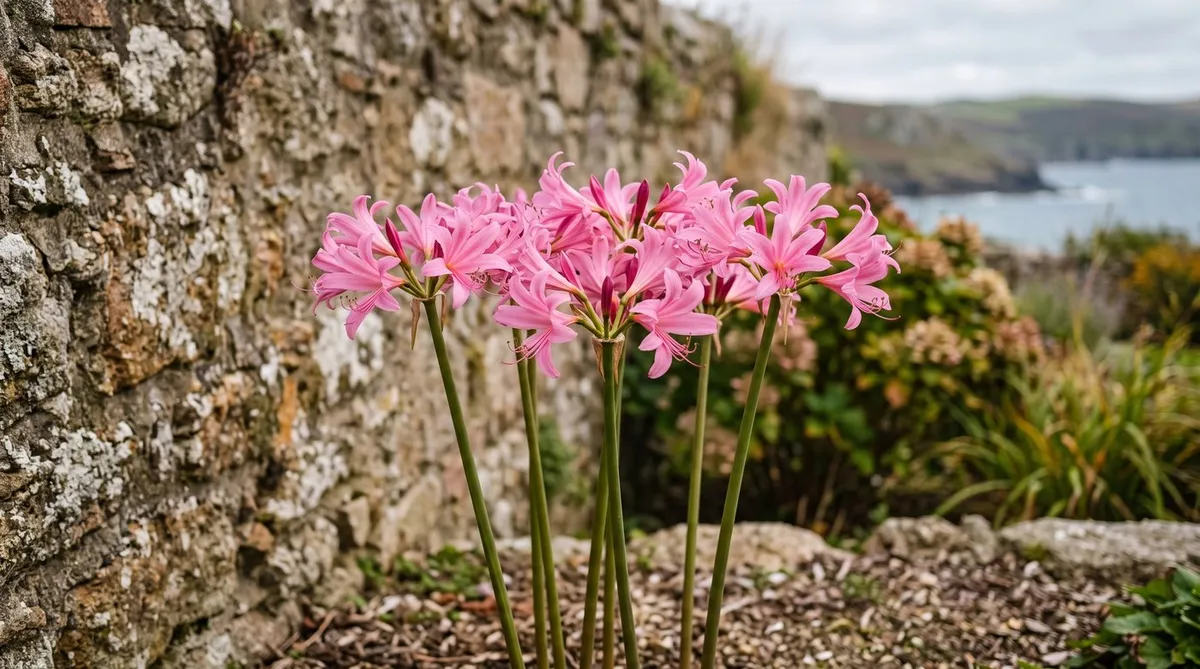
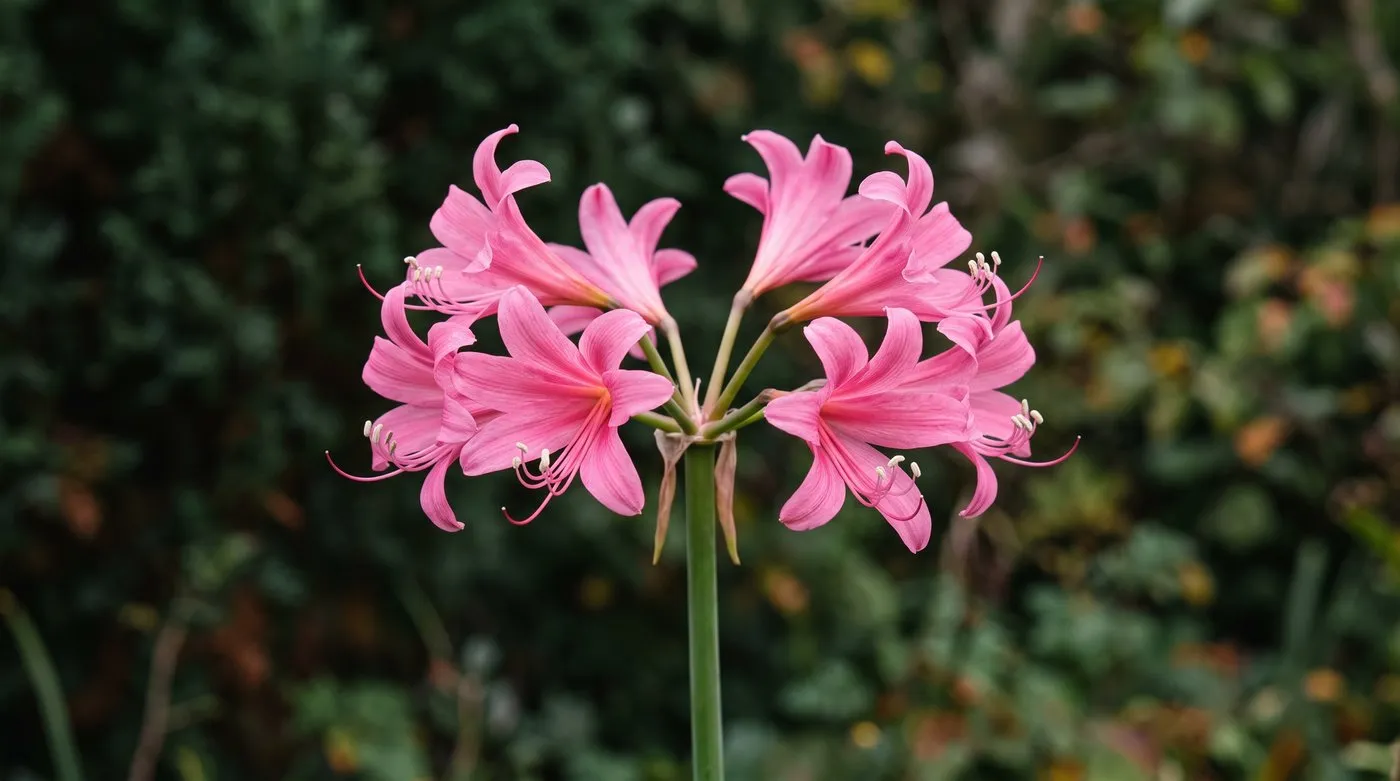 An Amarine flower head in early October. Count the individual trumpets: a settled bulb carries 8 to 12, arranged as an open umbel on a stem thick enough to stand through wind.
Which Amarine cultivars are worth buying
Almost every Amarine sold in the UK belongs to the Belladiva Series. The clones differ in colour depth, stem height and how early they open. Choosing well matters more than most catalogues suggest, because the earliest cultivars finish before the first hard frost and the latest ones can get caught.
| Cultivar | Colour | Stem height | Opens | Role in the border |
|---|---|---|---|---|
| ’Aphrodite’ | Pure white, pink flush | 60 to 70cm | Late September | Gold standard, best stem strength and cut flower |
| ’Anastasia’ | Mid rose-pink | 55 to 65cm | Mid September | Earliest and most reliable, the safe first buy |
| ’Emanuelle’ | Deep cerise-pink | 50 to 60cm | Early October | Strongest colour, best against dark evergreens |
| ’Zwanenburg’ | Soft salmon-pink | 50 to 60cm | Early October | Older clone, cheaper, slightly fewer trumpets |
| ’Beatrice’ | Pale blush pink | 45 to 55cm | Mid October | Latest, only worth it in the South and coastal plots |
Avoid unnamed “mixed Amarine” bulbs. They are usually surplus ‘Zwanenburg’ at a premium price, and you cannot plan a flowering sequence from a mixed bag.
Planting depth and why the bulb neck must stay exposed
This is the single rule that decides whether your Amarines flower. Plant the bulb so the neck sits 2 to 3cm above the soil surface, with only the basal plate and the lower two-thirds buried. Roughly one third of the bulb should be visible when you finish.
Gardeners bury them out of instinct. Every other bulb in the shed goes in at three times its own depth, so an Amarine planted 10cm down feels correct. It is not. A buried Amarine builds strap-shaped leaves through spring, looks healthy all summer, and then produces nothing in autumn. We buried six bulbs deliberately in 2022 as a control. Across four autumns those six produced two flower stems between them, against 26 from six correctly planted bulbs a metre away.
Space bulbs 10 to 15cm apart, in groups of five or more. Amarines flower best when congested, so a tight clump is the goal, not a problem. Dig a hole wide rather than deep, work in a spadeful of horticultural grit on clay, and firm the soil around the buried portion only.
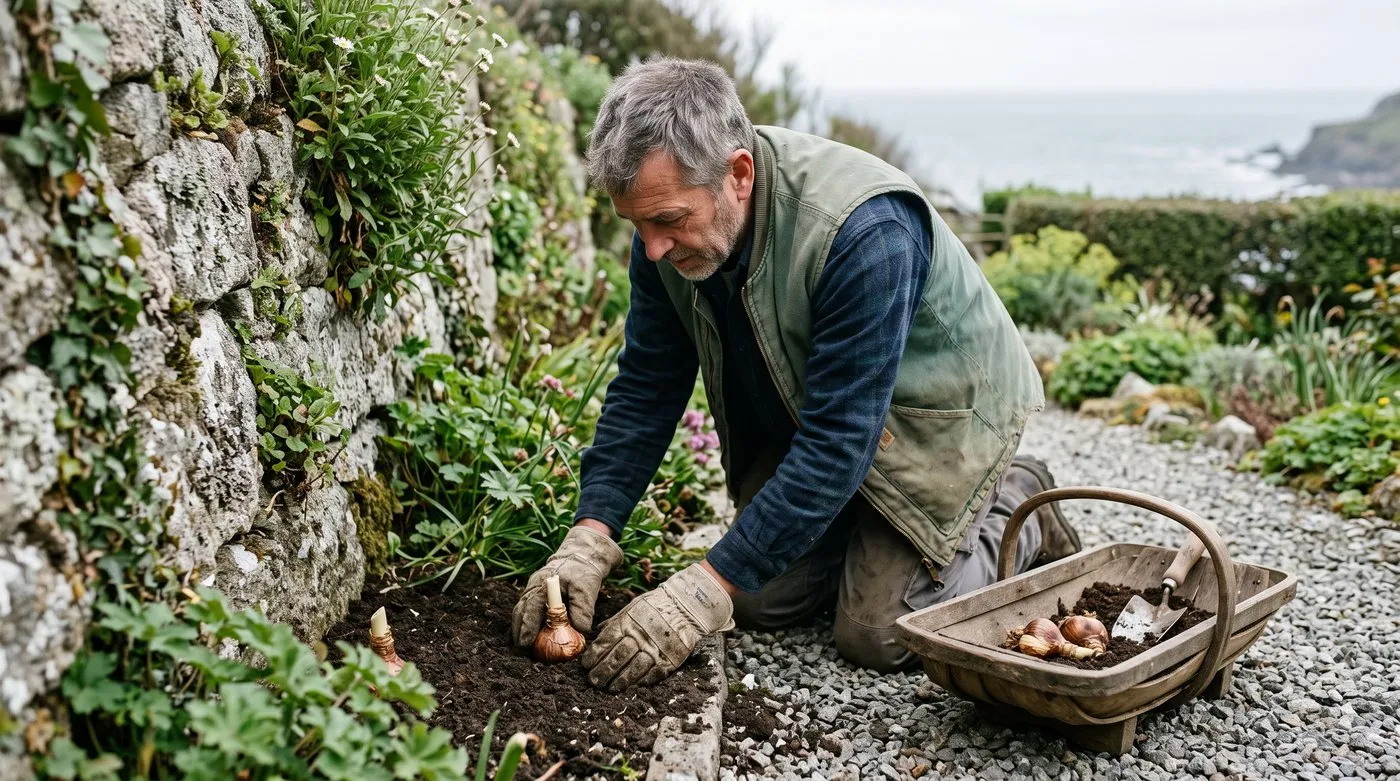 Planting at the foot of a Cornish stone wall in late April. Note the exposed necks: about a third of each bulb stays above the surface, which is what most first-time growers get wrong.
The warm baked base and how flower buds actually form
Amarines set their flower buds in the heat of the previous summer, not in autumn. Understanding that sequence explains almost every failure. The process runs in five measurable stages.
- Leaf growth, March to May. Strap leaves 30 to 40cm long emerge and feed the bulb. Soil temperature above 8C starts this off.
- Leaf die-back, late May to June. The foliage yellows and collapses. This looks like death and is not. Never cut green leaves off early.
- The summer bake, June to August. The exposed bulb neck needs soil surface temperatures of 20C or higher for six to eight weeks. This heat triggers bud initiation inside the bulb.
- Bud emergence, late August to mid-September. A blunt-tipped flower stem pushes through, ahead of any new foliage.
- Flowering, mid-September to early November. Each stem opens 8 to 12 trumpets over 10 to 14 days, and the display holds for three to four weeks.
The critical mistake is watering and mulching Amarines through July. Gardeners see a bare patch of soil with a dormant bulb sitting in it and treat it like a struggling plant. Wet, cool, shaded soil in midsummer blocks stage three completely. You then get healthy leaves the following spring and no flowers at all, and blame the bulb supplier.
| Summer surface conditions | Bud initiation result | Autumn stems per 5-bulb clump |
|---|---|---|
| Full sun, dry, minimum 20C | Full initiation | 4 to 6 |
| Full sun, watered weekly | Partial initiation | 2 to 3 |
| Half day sun, mulched | Poor initiation | 0 to 1 |
| Shaded or overhung by shrubs | No initiation | 0 |
Why Amarines beat Amaryllis belladonna in a British garden
Amaryllis belladonna is the more famous plant and the worse garden proposition for most of the UK. It is hardy to roughly minus 5C, and it needs a longer, hotter summer to set buds. In practice it flowers well in south Cornwall, the Isles of Scilly and a handful of walled gardens, and sulks everywhere else.
The Amarine cross fixes both weaknesses. Cold tolerance roughly doubles, to about minus 10C, which covers a normal winter in the Midlands and much of the North. Bud initiation needs less accumulated heat, so a mediocre British July still produces flowers. Our Staffordshire wall-foot group flowered in four autumns out of four. A comparison planting of Amaryllis belladonna in the same position flowered in one autumn out of four, and lost three bulbs to rot in the winter of 2022 to 2023.
| Plant | Hardiness | Stem height | Flowers per stem | UK reliability |
|---|---|---|---|---|
| x Amarine tubergenii | Minus 10C | 50 to 70cm | 8 to 12 | Good across most of England and Wales |
| Nerine bowdenii | Minus 12C | 40 to 55cm | 6 to 8 | Excellent, the hardiest option |
| Amaryllis belladonna | Minus 5C | 60 to 75cm | 4 to 6 | Poor outside the South West and coast |
| Nerine sarniensis | Minus 2C | 35 to 45cm | 8 to 14 | Glasshouse only in Britain |
Nerine bowdenii remains the hardiest and most forgiving choice, which is why it is the subject of our parent guide. The Amarine wins on height and flower count. If you want a bulb you can cut for the house, the Amarine is the better plant. For sheer survival on a cold, exposed plot, the nerine still edges it. Our guide to growing Amaryllis covers the indoor hippeastrum that shares the common name and is a completely different plant.
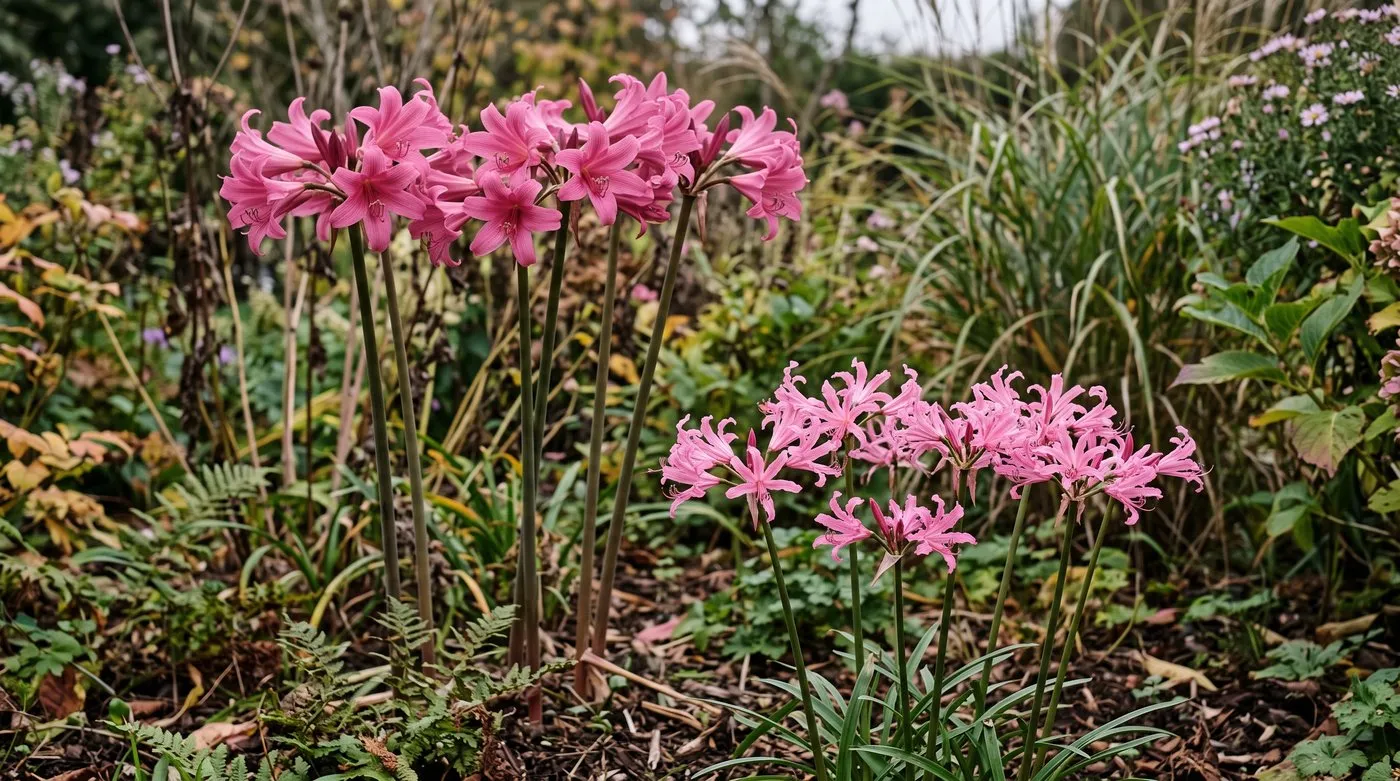 The same border in mid-October: Amarine at the back reaching 65cm, Nerine bowdenii in front at 45cm. The Amarine trumpet is noticeably larger and more open.
Where Amarines thrive in a UK garden
Soil should be free-draining and only moderately fertile. A pH of 6.5 to 7.5 suits them. Rich, recently manured ground pushes leaf growth at the expense of flowers. On heavy clay, either raise the planting position by 15cm with a grit-and-loam mound, or grow in containers.
Avoid three positions entirely: north-facing borders, ground overhung by deciduous shrubs, and anywhere a summer irrigation line runs. All three block the summer bake.
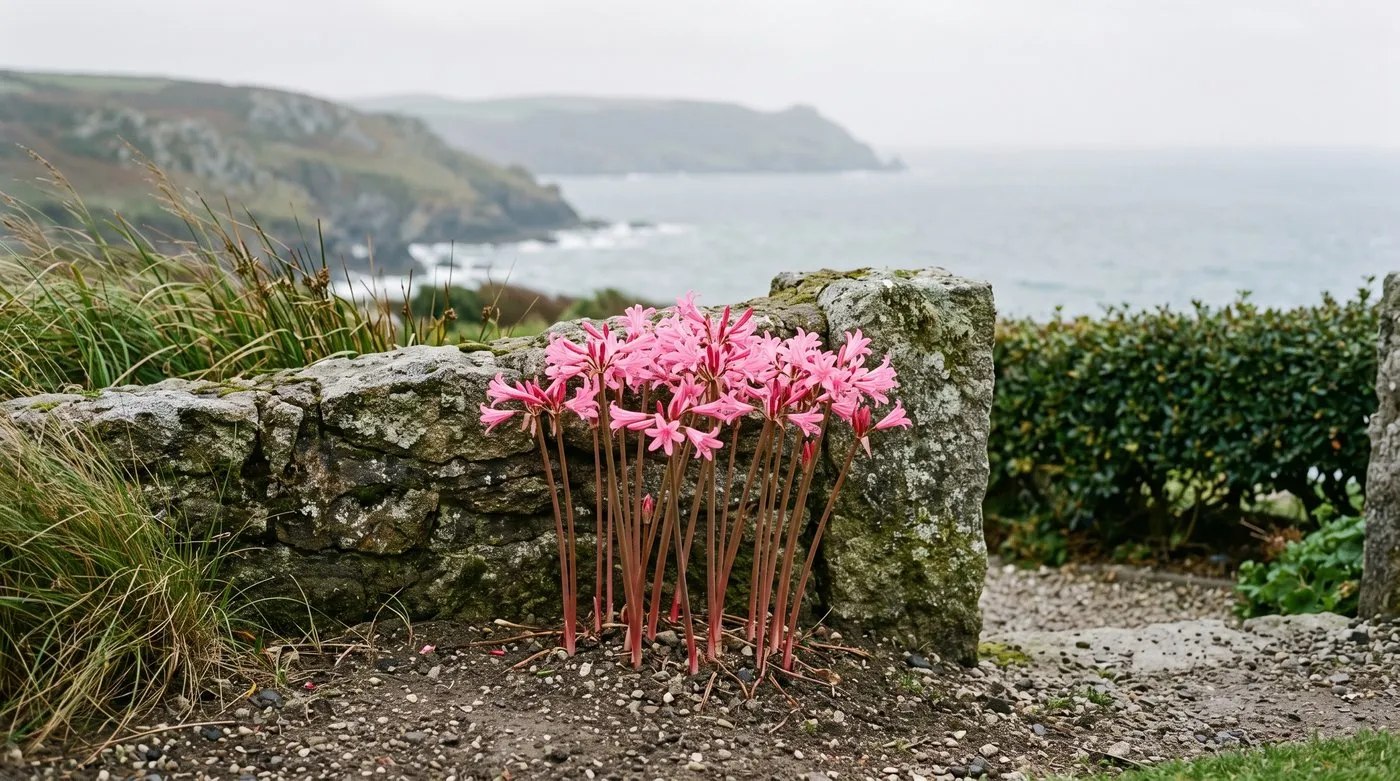 A settled clump in a south Cornwall garden, four years after planting. The granite wall behind is doing half the work by holding heat into the evening.
Growing Amarines in pots on heavy or wet soil
Containers solve the drainage problem outright and let you move the bulbs into full sun for the critical summer weeks. Use a 3-litre pot for two bulbs or a 5-litre for three. Terracotta beats plastic because it dries faster.
Mix your compost at two parts loam-based John Innes No 2 to one part horticultural grit. Plant with the necks proud, exactly as in open ground, leaving 3cm of clear rim for watering. Top-dress with 1cm of coarse grit to stop splash and slugs.
Water sparingly from March to May while the leaves are active, then stop completely once they yellow. Resume light watering when the flower stem appears in September. Feed with a high-potassium liquid feed at half the tomato-feed rate, fortnightly through April and May only.
Repot every four or five years, not annually. Amarines flower best when the pot is packed with bulbs and roots. When you do repot, do it in April, and expect a weaker autumn that year. Our potted group produced 7.25 stems per eight bulbs in year three but only 4 in the year following a repot.
Warning: Never leave Amarine pots standing in saucers over winter. A waterlogged bulb at 2C rots within a fortnight, and the first sign is a neck that pulls away with a wet, sour smell. Raise pots on feet, or lay them on their side against a wall from December to February.
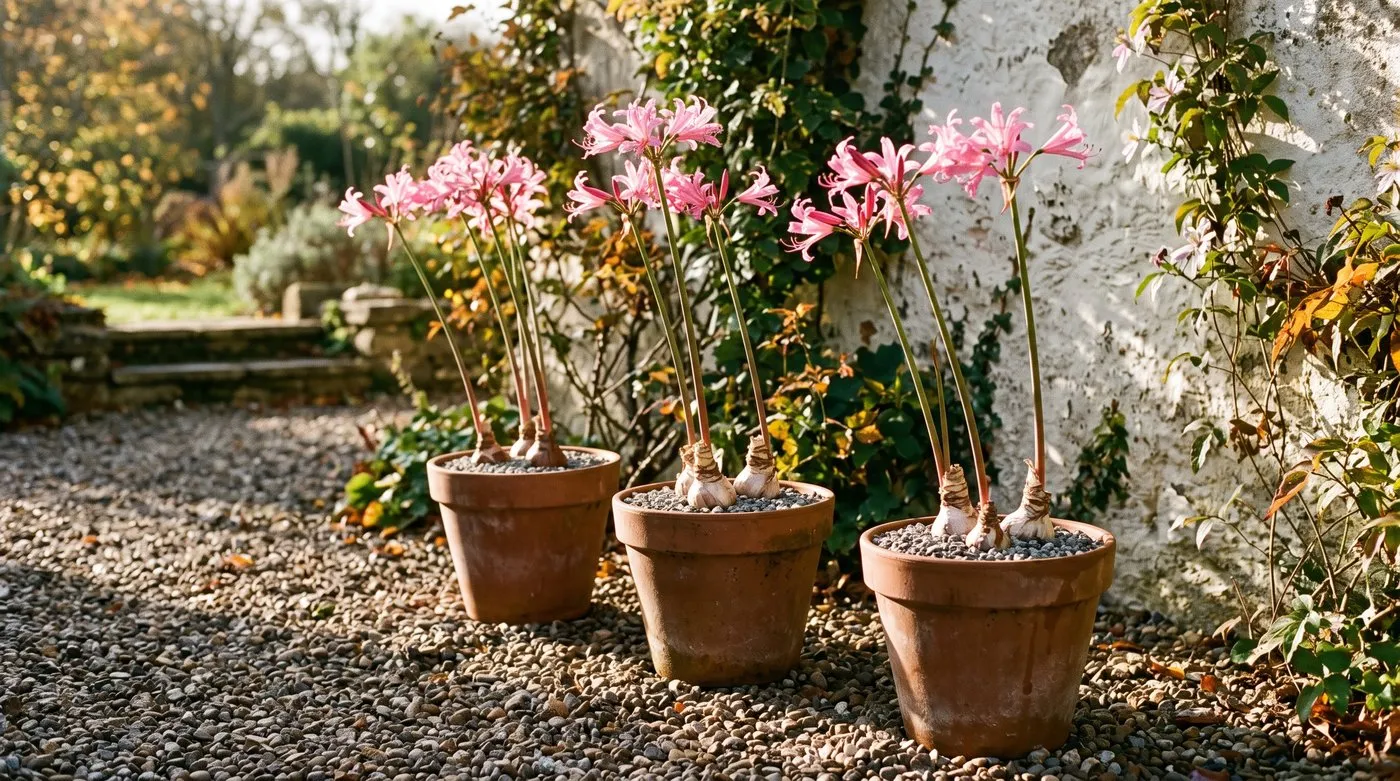 Container-grown Amarines on a gravel terrace. The grit mulch keeps the exposed necks dry, and the pots move against a sunny wall each June.
Bulb size genuinely matters here. A 12cm bulb typically needs an extra full season before it flowers. A 16cm bulb often throws one stem in its first autumn. The price difference between the two grades is usually under £1.50.
Cutting Amarines for the house
Amarines make a better cut flower than any nerine, and this is an underrated reason to grow them. Cut when the first two trumpets on the head have opened and the rest are still in bud. Cut at the base, taking the whole stem, and expect 10 to 14 days in a vase.
Recut the stem base at a slant under water before arranging. Amarine stems are hollow and draw air readily, which is the usual cause of premature wilting. Change the water every two days. Our conditioning method is set out in full in our guide to making cut flowers last longer.
Take no more than one stem in three from a clump. The remaining stems feed the bulb through October and November, and stripping a clump bare costs you flowers the following autumn. A settled five-bulb clump in year four carries six to eight stems, so two or three can come indoors without harm.
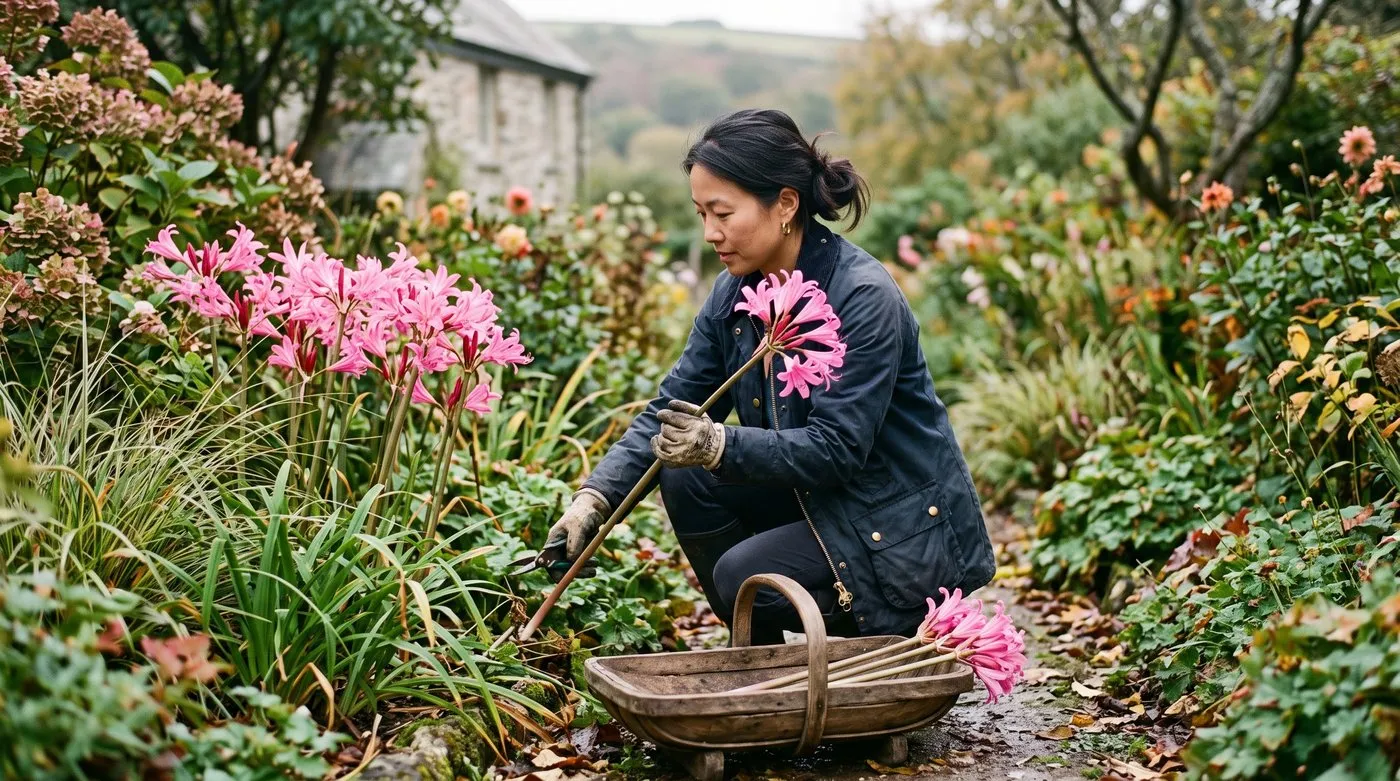 Cutting for the house in mid-October. Stems are taken when the first two trumpets open, leaving two thirds of the clump standing to feed the bulbs.
Month-by-month Amarine calendar for the UK
| Month | Task |
|---|---|
| January | Check container bulbs for rot. Keep pots dry and raised on feet. |
| February | Order named Belladiva bulbs. Stock of ‘Aphrodite’ sells out by March. |
| March | Strap leaves emerge. Start light watering on containers only. |
| April | Plant new bulbs with necks 2 to 3cm proud. Feed established clumps. |
| May | Second and final feed. Leaves begin to yellow towards month end. |
| June | Leaves die back. Stop all watering. Move pots to full sun against a wall. |
| July | Do nothing. No water, no mulch, no shade. The summer bake is happening. |
| August | Still nothing. Late in the month, watch for blunt flower stems emerging. |
| September | Stems rise fast. Resume light watering. First flowers from mid-month. |
| October | Peak flowering. Cut stems for the house, no more than one in three. |
| November | Late cultivars finish. Leave spent stems until they pull away cleanly. |
| December | Apply a dry mulch of bracken or straw north of Birmingham. Keep it off the necks. |
Overwintering Amarines in colder parts of Britain
North of Birmingham, apply a 5 to 8cm dry mulch in early December. Bracken, straw or dry oak leaves work. Do not use compost, bark or anything that holds water, and keep the mulch clear of the bulb necks themselves. Pull it off in mid-March before the leaves push through.
In Scotland and northern exposed plots, treat Amarines as a container plant and shelter the pots in an unheated greenhouse or against a house wall from December. They need cold to stay dormant, so a heated space is wrong. Aim for 0 to 7C and dry.
Foliage stays green into a mild winter in Cornwall and Devon. Do not cut it. Those leaves are still feeding the bulb, and removing them costs you flower stems the following autumn. General bulb storage principles are covered in our guide to storing flower bulbs.
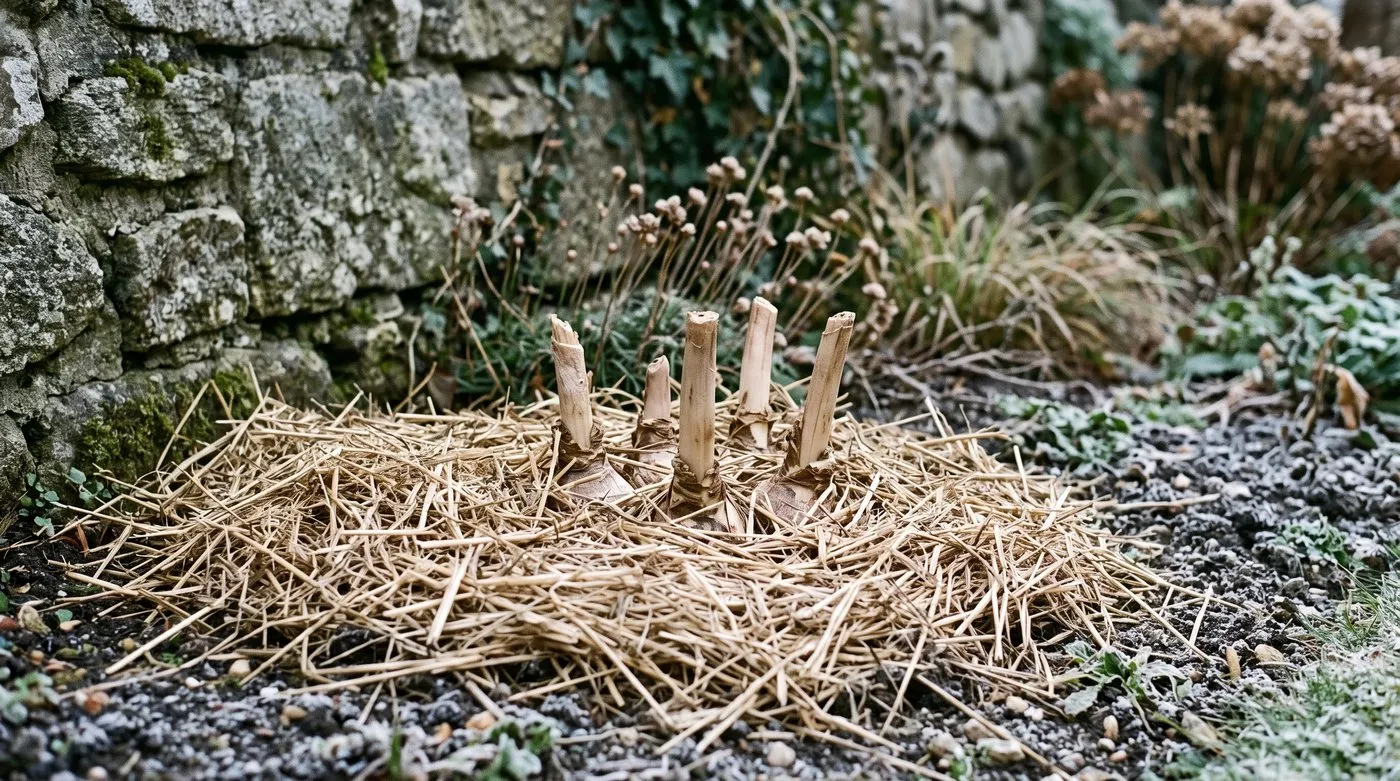 A dry straw mulch applied in early December, deliberately kept clear of the bulb necks so they do not sit damp against rotting material.
Why established Amarines suddenly stop flowering
The root cause of a non-flowering Amarine clump is almost never disease or exhaustion. It is loss of the summer bake, and it creeps up over several years while the gardener changes nothing.
Here is how it happens. You plant Amarines at the foot of a warm wall. Around them you plant something else, because bare soil in June looks untidy. Over four or five seasons that neighbour grows. A hardy geranium flops across the bulbs. A shrub casts an extra hour of afternoon shade. Self-sown foliage fills the gap. Surface soil temperature in July drops from 24C to 17C, and bud initiation stops.
Gardeners misread this as the clump becoming congested, so they lift and divide. That resets a slow-establishing bulb to year one and makes matters far worse. Amarines want congestion.
The permanent fix is a maintained bare zone of 20cm radius around each clump, kept clear from June to August every year. Cut back neighbours in early June rather than waiting. If a shrub has genuinely outgrown the position, move the bulbs in April to a new sunny spot and accept two weak autumns while they settle. Two weak autumns is the honest price of getting the position right.
Common mistakes with Amarines
- Planting the bulb fully buried. Instinct from every other bulb says go deep. A buried Amarine makes leaves and no flowers, sometimes for a decade. Set the neck 2 to 3cm proud and resist the urge to firm soil over the top.
- Planting in autumn instead of spring. Autumn-planted bulbs sit cold and wet for five months with no root system. They typically skip the first flowering year and sometimes rot. Plant in April or May.
- Lifting and dividing every couple of years. Amarines flower best when congested. Dividing a settled clump costs two to three seasons of flowers. Leave clumps for eight to ten years unless they are physically pushing out of the ground.
- Watering through the summer dormancy. A dormant Amarine in July needs heat and dryness, not care. Automatic irrigation running over a dormant clump is the most common cause of a permanently leafy, flowerless plant.
- Cutting the leaves off when they yellow in June. The yellowing foliage is still moving sugars back into the bulb. Cutting it early reduces next autumn’s flower count by roughly a third in our observations. Wait until it pulls away with no resistance.
What Amarines cost to get established
A five-bulb clump of named Belladiva stock costs £17.50 to £30 at 2026 prices, buying at £3.50 to £6 per bulb from Farmer Gracy or J. Parker’s. Graded bulbs at 16cm circumference sit at the top of that range and are worth the difference.
The hidden costs are small but real. On clay you need 20 litres of horticultural grit per clump to raise and open the planting position, at roughly £6 to £9 a bag. Container growing adds a 5-litre terracotta pot at £12 to £18, plus John Innes No 2 at about £7 for 25 litres. A high-potassium liquid feed lasts three seasons and costs £5 to £8.
Set against that, the plant is close to permanent. A well-sited clump flowers for 15 years or more without lifting, and thickens every year. Cost per flowering season after year three works out under £2. Very few autumn plants match that. For the wider autumn bulb picture, our guide to when to plant spring bulbs sets out how the autumn and spring bulb calendars interlock.
The RHS entry for x Amarine tubergenii Belladiva Series confirms the hardiness rating and flowering period, and the broader RHS bulb advice covers general planting principles that apply across the group.
Now you know how to grow Amarine properly, keep the bulbs productive with our guide to bulb care after flowering, or browse more of our growing guides for the next job in the autumn calendar.
Frequently asked questions
What is an Amarine?
Amarine is a garden cross between Nerine bowdenii and Amaryllis belladonna. Its botanical name is x Amarine tubergenii, the x marking a hybrid between two genera. It takes the hardiness and neat flower shape from the nerine and the height and stem strength from the amaryllis.
When should I plant Amarine bulbs in the UK?
Plant Amarine bulbs in April or May, once hard frost has passed. Spring planting lets the root system build through summer before the autumn flowering push. Autumn-planted bulbs often sit wet and cold for months, and typically skip their first flowering season entirely.
How deep do you plant Amarine bulbs?
Very shallow, with the neck of the bulb 2 to 3cm above the soil. Bury an Amarine fully and it produces leaves but no flowers. The exposed neck lets summer sun warm the top of the bulb, which is what triggers bud initiation.
Are Amarines hardier than Amaryllis belladonna?
Yes, Amarines take roughly minus 10C against minus 5C for Amaryllis belladonna. The nerine parent contributes the extra cold tolerance. That difference is why Amarines flower reliably in the Midlands and the North, while straight belladonna is mostly a South West and coastal plant.
Why does my Amarine produce leaves but no flowers?
Almost always too deep, too shaded, or disturbed too often. Amarines need the bulb neck exposed and a hot, dry base from June to August. They also flower better when congested, so lifting and dividing every year resets them to zero.
How long do Amarines take to settle and flower well?
Expect a poor first autumn and full flowering by year three. Year one often gives nothing but strap leaves. Year two produces one or two stems per clump. From year three the clump thickens and flower count climbs steadily for a decade.
Can I grow Amarines in pots?
Yes, and on heavy or wet soil pots are the better option. Use a 3-litre or 5-litre pot per two bulbs, in a gritty compost mix. Stand the pot against a sunny wall from June, and move it under cover during a wet winter.
Our team produces practical UK gardening guidance from source research, contributor records and established horticultural practice. Editorial standards are overseen by Matt W.