Key takeaways
- Silver forms ('Jack Frost', 'Looking Glass') need shade plus moist soil, or the leaves brown and crisp
- Plain green Brunnera macrophylla is the tough one; it copes with dry shade under trees
- Sprays of blue forget-me-not flowers open April to May and feed early bees
- Fully hardy to -20C (H6); dies back in winter and returns each spring
- Divide in spring or autumn to make more plants; take root cuttings in winter
- Cut tatty leaves off at the base in midsummer for a fresh flush of foliage
Brunnera earns its place in shade for one reason above all: the leaves. The best silver-leaved forms light up a dark corner where almost nothing else will, and they do it from spring right through to the first frosts. In April and May they add a haze of tiny blue flowers on top, the exact shade of a forget-me-not.
They are not difficult plants. But they are widely got wrong. The silver cultivars everyone buys, led by ‘Jack Frost’, have one firm rule that catches people out every summer. Break it and the leaves turn brown and crisp within weeks. Follow it and the same plant stays flawless for years. This guide covers the varieties, that rule, and the day-to-day care.
What is brunnera (Siberian bugloss) and why grow it
Brunnera is a hardy, clump-forming perennial grown mainly for its heart-shaped foliage and early blue flowers. The species behind almost every garden plant is Brunnera macrophylla, sometimes sold as Siberian bugloss or false forget-me-not. It belongs to the borage family, Boraginaceae, alongside pulmonaria and comfrey. In the wild it grows on cool, moist woodland floors, and that tells you everything about how to please it.
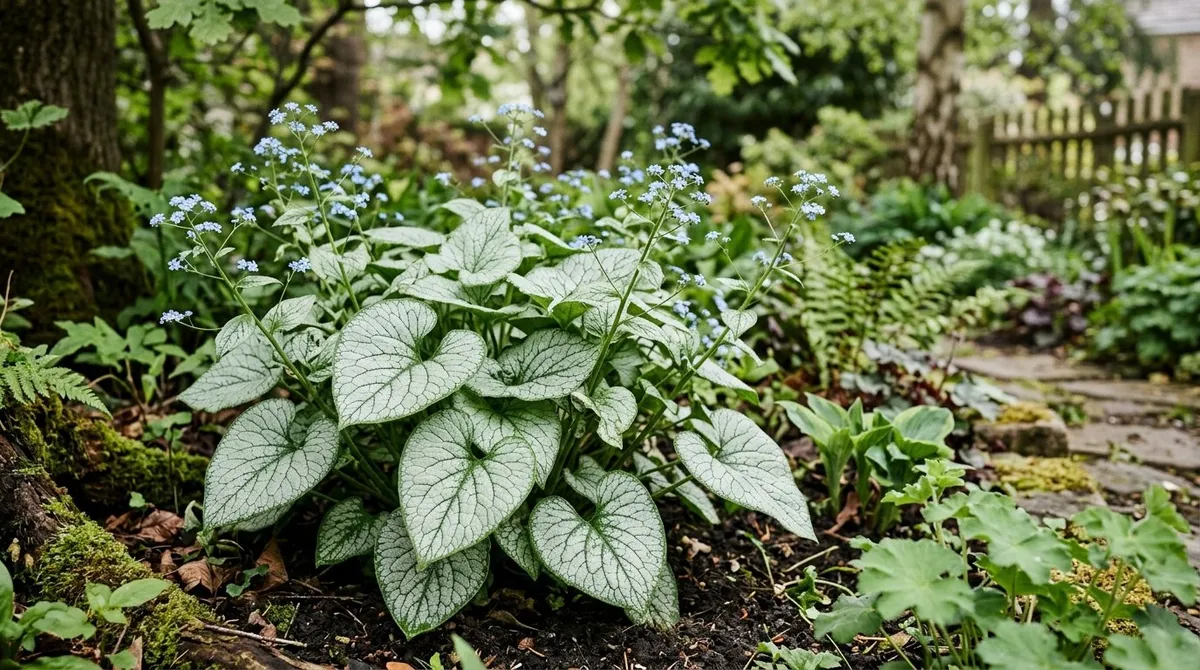
A mature plant makes a low mound around 40cm tall and 45-60cm across. The leaves are large, softly hairy and shaped like a rounded heart, held on thin stalks. In the silver cultivars the surface is overlaid with pewter, so the whole clump reads as pale grey-silver in shade. In spring, wiry branching stems rise above the leaves carrying sprays of small five-petalled flowers in clear sky blue, each with a tiny white eye.
Brunnera is fully hardy to around -20C, rated H6, so it survives any normal UK winter. It dies back in the coldest weather and pushes fresh leaves as the ground warms. Grown well it lasts many years, widening slowly into a bigger clump. For a shady bed it does two jobs at once: it flowers early, when the border is still bare, then holds good-looking foliage long after.
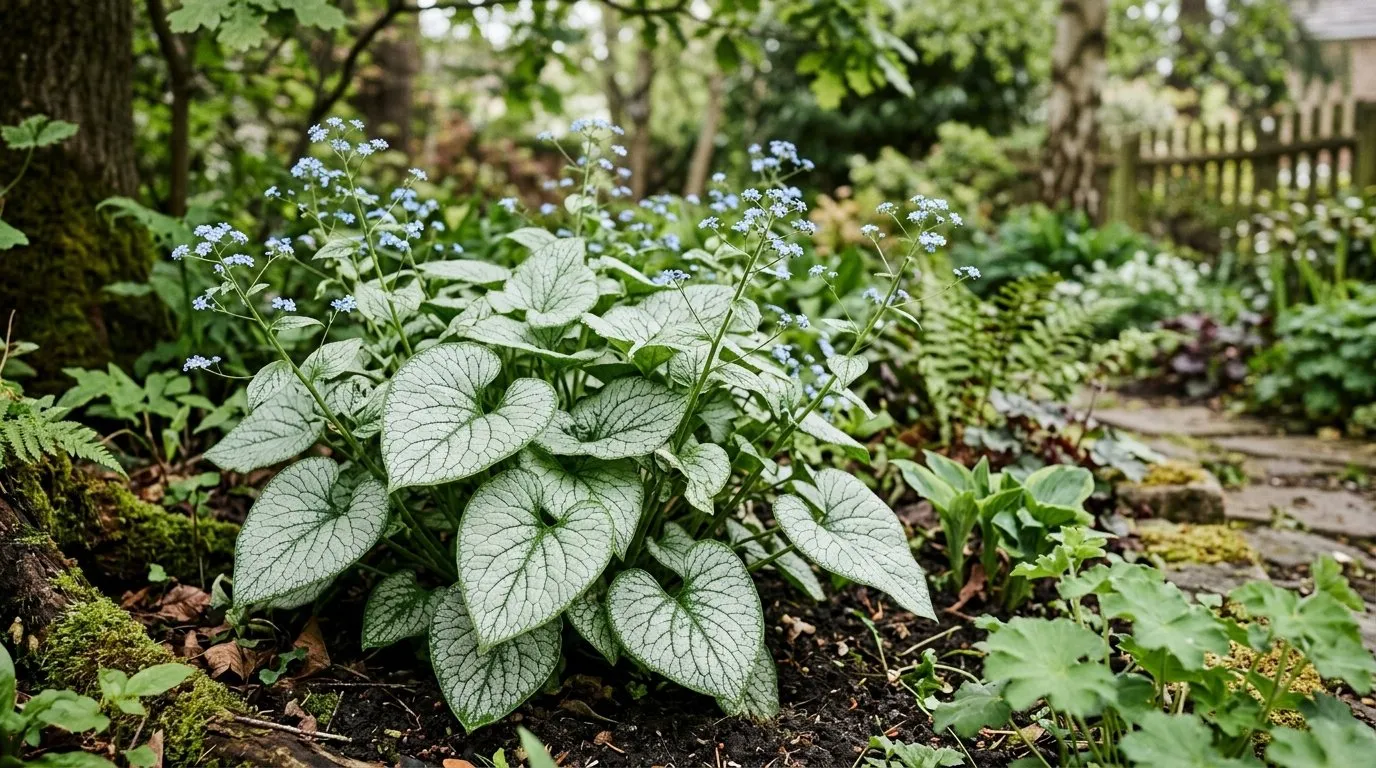 A mature ‘Jack Frost’ clump with clean silver leaves and blue spring sprays, the reward for shade and steady moisture.
Choosing brunnera varieties: silver, variegated and green
The cultivar you pick decides how much silver you get and how much scorch you risk. As a rough rule, the more silver or white on a leaf, the fussier the plant is about shade and moisture. The plain green species is the toughest of the lot.
The silver stars are led by ‘Jack Frost’, which holds an RHS Award of Garden Merit. Its leaves are frosted silver with a network of green veins and a thin green rim. ‘Looking Glass’ goes further, with almost solid pewter leaves and barely any green, which makes it the brightest and the most scorch-prone. ‘Alexander’s Great’ and ‘Jack of Diamonds’ are the giants, with big silvered leaves and more substance. ‘Silver Heart’ was bred for thicker, tougher leaves that shrug off scorch better than most.
Then come the variegated forms, edged in cream or white rather than silvered all over. ‘Hadspen Cream’ has soft cream margins. ‘Dawson’s White’, sometimes sold as ‘Variegata’, carries broad white margins and is the most delicate of all: it needs deep shade and shelter or the white edges burn away. Finally there is plain Brunnera macrophylla itself, all green, the least showy but by far the most forgiving, and the one to choose for dry shade.
Brunnera cultivar comparison
| Cultivar | Leaf | Silvering | Vigour | Scorch resistance | Height | Best for |
|---|---|---|---|---|---|---|
| ’Jack Frost’ | Silver, green veins | High | Medium | Low to medium | 40cm | The all-round silver choice (AGM) |
| ‘Looking Glass’ | Near-solid pewter | Very high | Medium | Low | 35cm | Brightest silver, deep shade only |
| ’Alexander’s Great’ | Big silvered | High | High | Medium | 45-60cm | Bold large-leaf impact |
| ’Jack of Diamonds’ | Huge silvered | High | High | Medium | 45cm | Biggest leaves of all |
| ’Silver Heart’ | Thick silver | High | Medium to high | Medium to high | 35cm | Tougher silver for trickier spots |
| ’Hadspen Cream’ | Cream-margined | None | Medium | Low to medium | 40cm | Brightening a shady corner |
| ’Dawson’s White’ | White-margined | None | Low to medium | Very low | 40cm | Deep, sheltered shade |
| B. macrophylla (plain) | Matt green | None | High | High | 45cm | Dry shade and ground cover |
Why silver-leaved brunnera scorch, and how to stop it
Leaf scorch is the failure that catches out more brunnera growers than anything else, and it comes down to light and water. The silver on a ‘Jack Frost’ leaf is not pigment. It is a thin, air-filled top layer that reflects light and makes the leaf look pewter. That layer is delicate. In strong sun, or when the roots are dry, the tissue underneath cooks and the leaf edge turns papery brown.
You will see it start at the tips and margins in June, then spread inward through July. The silver areas go first because they are thinnest. A leaf that is more than half brown will not recover, so the fix is to prevent it, not cure it. Two things drive scorch: direct afternoon sun and dry soil. Remove either and the problem eases. Remove both and it disappears.
Give silver and variegated forms a spot that never sees hot afternoon sun. Morning sun or dappled light under a deep-rooted tree is fine. Keep the ground reliably moist with a spring mulch of leaf mould or well-rotted compost, 5cm deep, spread over damp soil. If a summer turns dry, water before the leaves flag, not after. The plain green species will take far more sun and drought, which is exactly why it belongs in tougher spots. For the driest corners under hedges and trees, look past the silvers altogether to the choices in our guide to the best plants for dry shade.
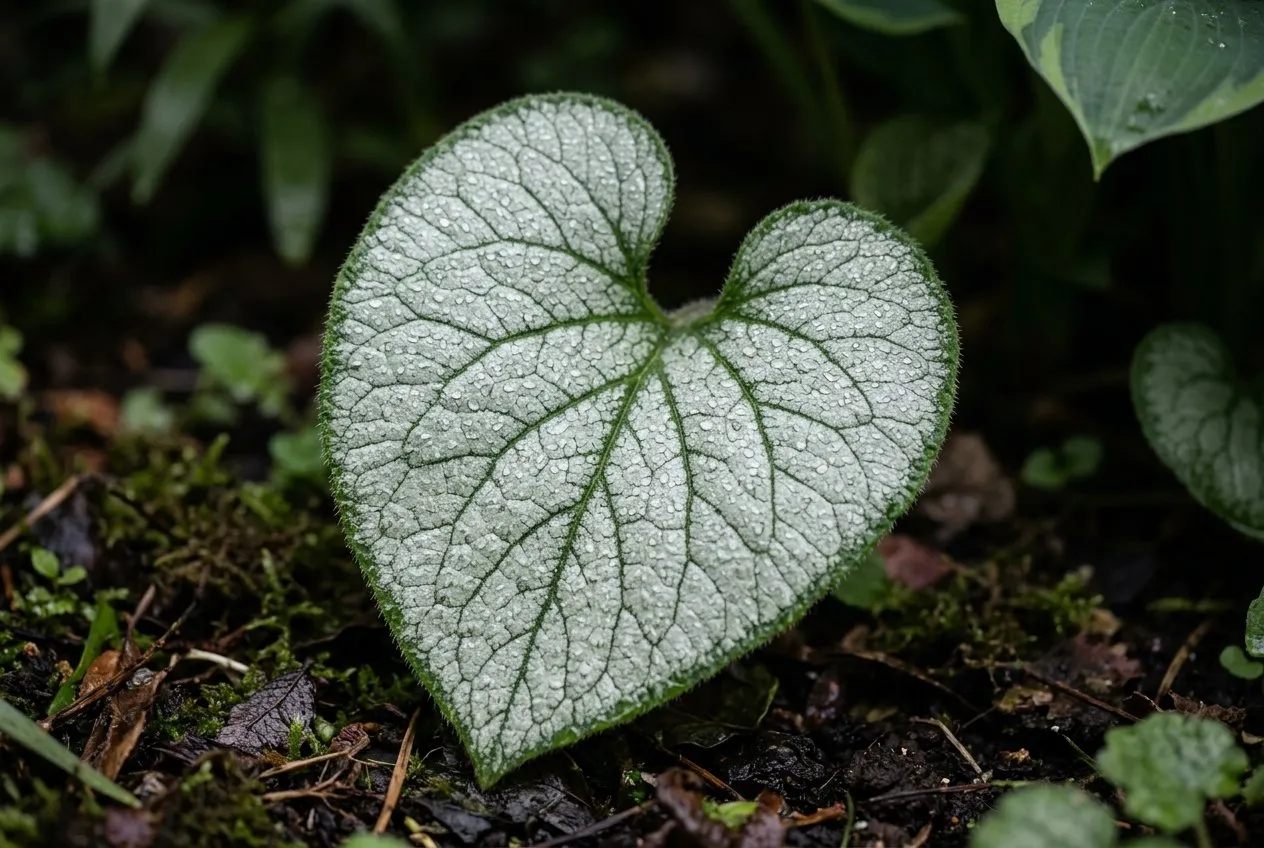 The silver on a ‘Jack Frost’ leaf is a thin reflective top layer, which is exactly why it scorches so easily in sun.
Where to plant brunnera for shade and moist soil
Brunnera wants cool shade and soil that holds moisture without turning into a bog. Picture its woodland home: leaf litter, filtered light, damp but drained ground. A north or east border, the shaded side of a shrub, the base of a tree, or a spot that gets only early morning sun all suit it well.
The plain green species is the exception on moisture. It genuinely copes with dry shade under trees and in root-filled soil where fussier plants sulk. If your only shady ground is dry, that is the plant to use, and you can lift the flowering with a few tougher partners. The silvers, by contrast, are moisture plants first and shade plants second. Keep that order in mind and you will place them correctly.
Gardener’s tip: Plant brunnera where you walk past it in spring. The blue flowers are small and the silver leaves are best seen close up in low light. A clump at the edge of a shady path or beside a bench earns its keep far more than one stranded at the back of a deep border.
How to plant brunnera and space it as ground cover
Spring and autumn are the two best planting windows, when the soil is warm and damp. Pot-grown plants can go in through summer if you keep them watered, but avoid planting into cold, waterlogged ground in the depths of winter. Aim for March to May or September to October for the easiest establishment.
Dig a hole a little wider than the pot. Set the plant so the crown sits level with the soil surface, never buried, then firm gently and water in. Work leaf mould or compost into the hole on poor soil. On heavy clay, add a little grit under the crown so water drains away over winter. A new plant can look small; give it two seasons and it fills out.
For ground cover, space plants 40-50cm apart. At that spacing the leaf mounds knit together within two or three years and shade out most weeds. Brunnera is one of the more reliable weed-suppressing plants for shade, sitting comfortably among the wider choices in our guide to the best ground cover plants. It spreads by short, slow rhizomes rather than running roots, so it thickens up without invading its neighbours. That controlled habit is a real advantage under trees and along shady boundaries.
Watering, feeding and the midsummer cut-back
Keeping the soil moist is 90 percent of brunnera care, and the rest is one summer tidy-up. In the first year, water new plants twice a week in dry spells until they root in. After that, clumps in decent soil rarely need watering except in a real drought, and even then the silvers flag before they scorch. Water in the evening so the roots take it up overnight.
Feeding is light work. A spring mulch of leaf mould or garden compost does most of the job, releasing nutrients slowly and holding moisture. If your soil is poor, add a light scatter of general fertiliser in March at around 35g per square metre. Do not overfeed. Rich, high-nitrogen conditions push soft, oversized leaves that scorch and flop more easily. Lean, damp, leafy soil is what brunnera evolved for.
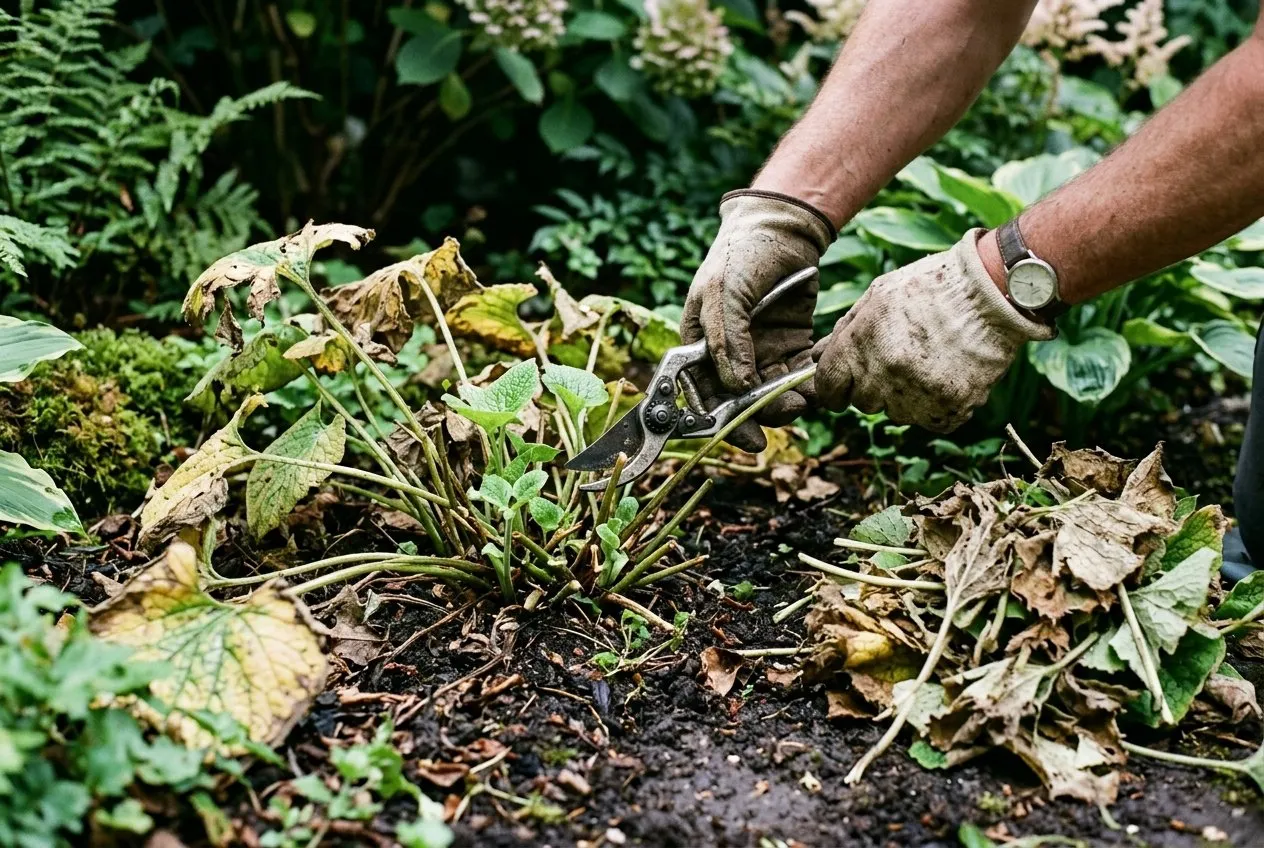 The midsummer cut-back: remove tired and scorched leaves at the base and a clean new flush follows within a fortnight.
Month-by-month brunnera care calendar
This calendar covers the whole year for an established plant on average UK soil. Adjust the watering to your own conditions and the flowering by a week or two for the north or a mild south-west garden.
| Month | Task |
|---|---|
| January | Nothing needed; the plant is dormant. Keep heavy mulch off the crown so it does not rot |
| February | Clear old dead leaves from the crown. Check for slug shelter as growth stirs |
| March | Spread a 5cm mulch of leaf mould over damp soil. Divide or plant now if the ground is workable |
| April | Flower stems rise and open blue. Watch for slugs on new leaves; protect if needed |
| May | Peak flowering. Enjoy the blue sprays; early bees work them. Keep soil moist |
| June | Flowers fade. Snip spent stems. First signs of scorch may show on silvers in bright spots |
| July | Do the midsummer cut-back on tatty or scorched leaves. Water well to trigger fresh growth |
| August | Keep the ground damp in dry spells. Apply nematodes now for vine weevil in pots |
| September | Good second planting and dividing window. Soil is warm and moisture returns |
| October | Leaves begin to tire. Tidy the worst, but leave the rest as ground cover |
| November | The plant dies back with the first hard frosts. Clear slimy fallen leaves |
| December | Dormant. No action beyond keeping mulch clear of the crown |
Dividing brunnera and taking root cuttings
Division is the main way to make more brunnera, and it is easy. Do it in spring or autumn, when the soil is moist and the plant is either just waking or settling down. Lift the whole clump with a fork. Pull or cut the crown into sections, each with a few buds and a fair share of root. Replant the divisions straight away at the same depth, firm in and water. They barely check and often flower the next spring.
There is a firm reason to divide rather than save seed from the silver cultivars. Seedlings revert to plain green. The silver and variegated patterns do not come true from seed, so the only way to keep ‘Jack Frost’ or ‘Looking Glass’ looking like the parent is to split an existing plant. If you let a silver form set seed and self-sow, expect green babies, not silver ones.
You can also take root cuttings in winter, the trick the RHS recommends for bulking up stock. Lift a dormant plant, cut sections of the thicker roots about 5cm long, lay them flat in a tray of gritty compost, cover lightly, and keep them cool and just moist. New shoots appear in spring. It is more effort than division, but it makes many plants from one, which is handy if you want a whole drift of ground cover on a budget. Plants raised this way behave just like the parent, unlike seedlings.
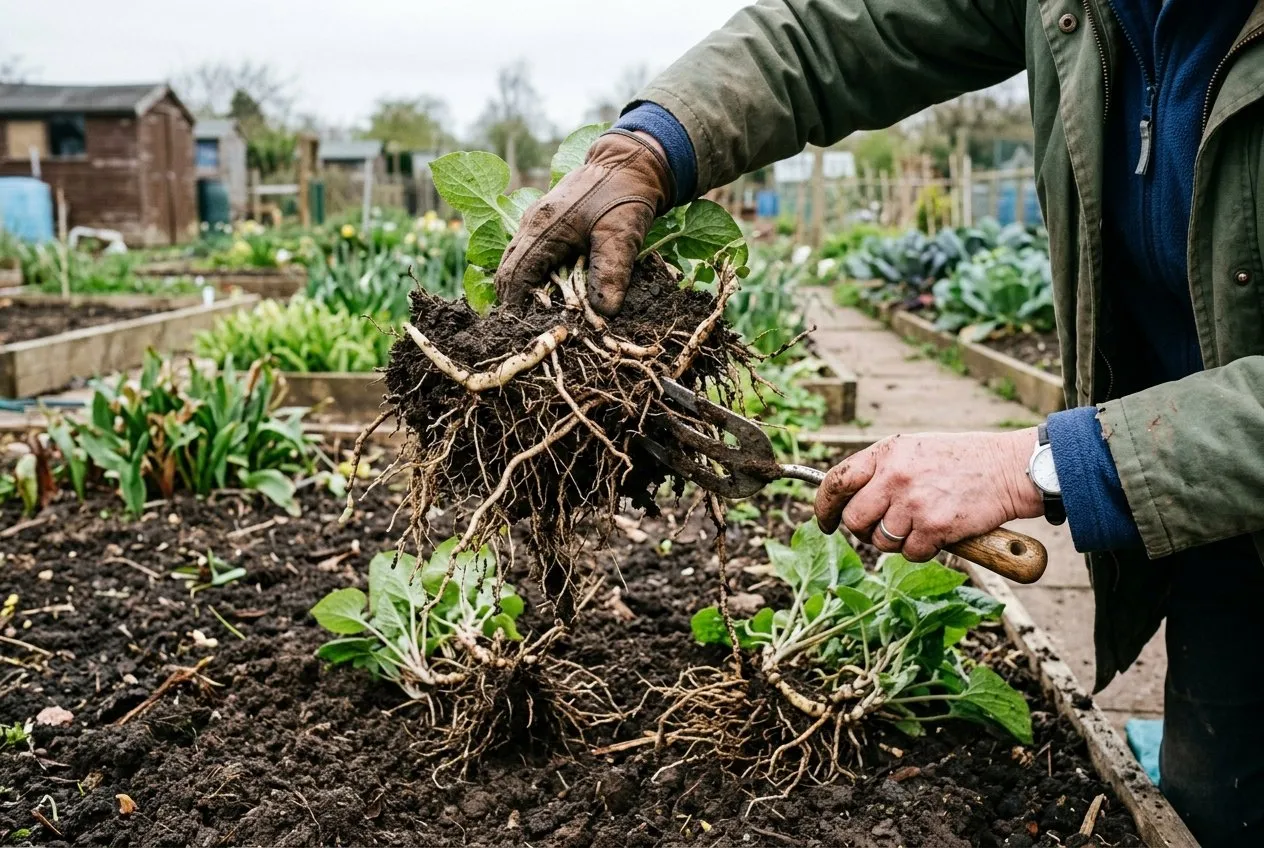 Dividing in spring: split the lifted crown into pieces that each carry roots and buds, then replant straight away.
Is brunnera invasive, and how does it differ from forget-me-nots
Brunnera is not invasive, and this is where its common name causes real confusion. It is sometimes called false forget-me-not because the spring flowers look almost identical to a true forget-me-not, Myosotis. But the two plants behave nothing alike. True forget-me-nots are short-lived and seed themselves everywhere, popping up across a border and needing pulling out by the handful each year.
Brunnera does the opposite. It is a long-lived perennial that spreads slowly by short rhizomes into a single, well-behaved clump. Named silver cultivars set very little viable seed, so you do not get a carpet of self-sown seedlings. The plant stays where you put it, widening a few centimetres a year, and you control its size simply by dividing it when it gets too big. That makes it a far more manageable choice for a tidy garden.
If you actually want the drifts of blue that Myosotis gives, and you are happy to manage the seeding, that is a different plant for a different job. Our guide on how to grow forget-me-nots covers keeping the true species in check. For most shady borders, though, brunnera gives you the same spring blue with none of the spread, plus a full season of silver foliage the annual forget-me-not cannot match.
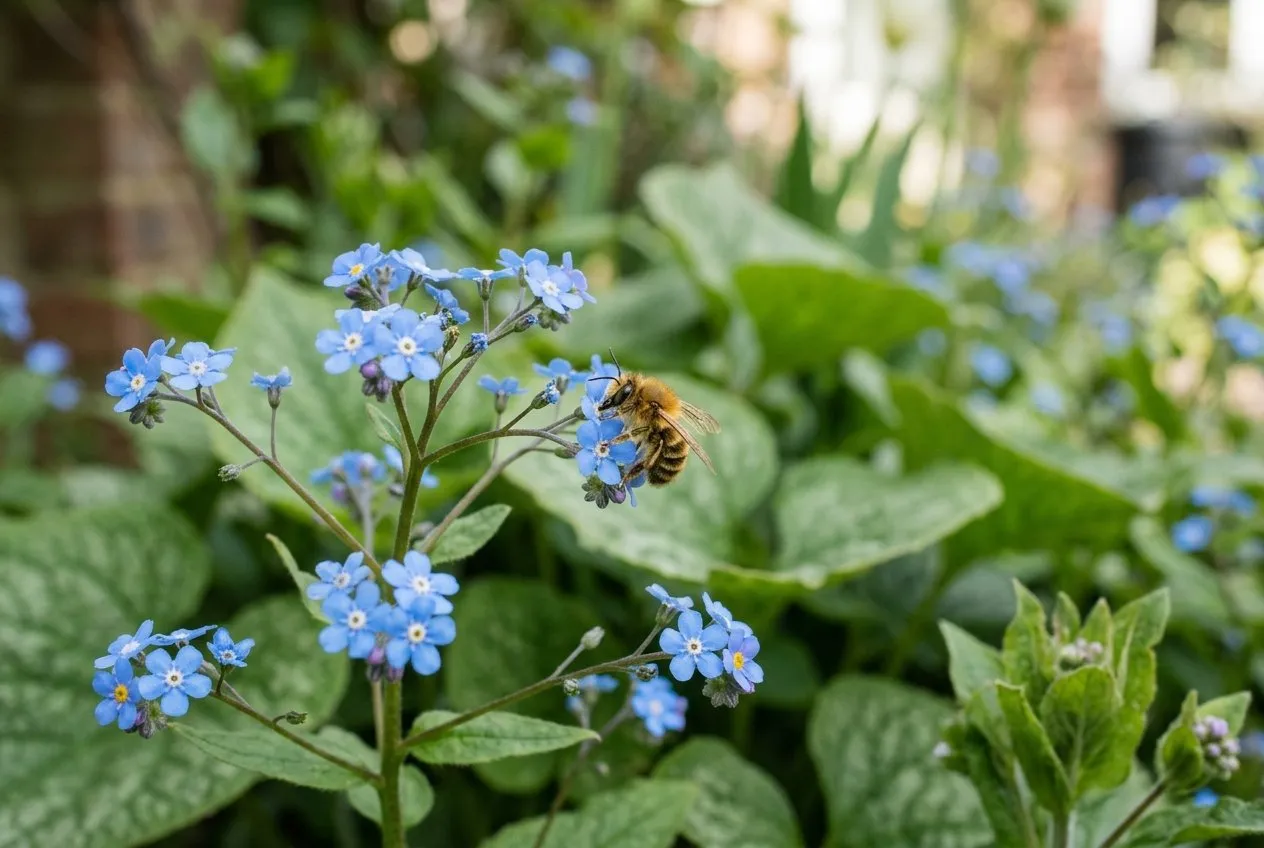 The blue flowers open in April and May, an early nectar source for bees weeks before most of the border has woken up.
Brunnera pests and problems: vine weevil and scorch
Beyond scorch, brunnera is a healthy plant with one pest worth watching: vine weevil. The adults are dull black beetles that notch the leaf edges at night in spring and summer, which looks alarming but rarely harms the plant. The real damage comes from the creamy white grubs, which feed on the roots over autumn and winter. A plant in a pot can be hollowed out and killed before you notice, with the first sign a clump that lifts away in your hand.
Container-grown brunnera is most at risk, because pots give the grubs a snug, root-filled home. Open-ground plants suffer far less. If you grow in pots, tip the rootball out each autumn to check for grubs, and treat with a nematode drench in August to early September while the soil is still warm. Our full guide to vine weevil treatment walks through the nematode timing and the other controls. The RHS advice on the pest is also worth reading before you reach for anything stronger (rhs.org.uk).
Slugs and snails graze the soft new leaves in spring, especially on young plants and fresh divisions. They rasp holes but seldom do lasting harm to an established clump. Powdery mildew shows up occasionally on plants that get too dry at the root, one more reason to keep the soil moist. Fix the water and the mildew usually fixes itself.
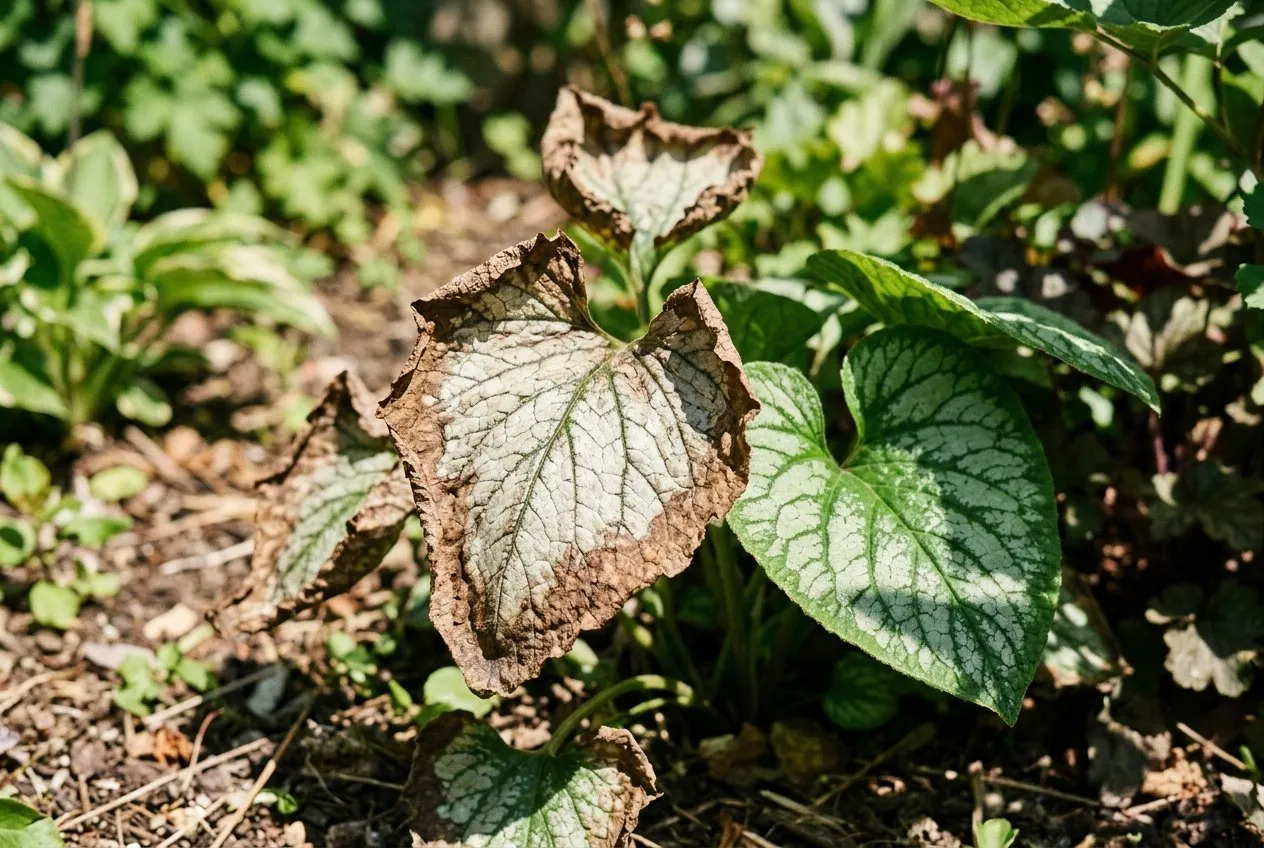 Classic scorch: brown, papery edges creeping in from the margins. Once a leaf is this far gone, cut it off rather than wait.
Planting partners for brunnera in a shady border
Brunnera earns its keep next to other shade lovers, where its silver leaves and blue flowers lift the greens around them. The classic partners are the plants that share its love of cool, moist, humus-rich soil. Hostas are the obvious one: their bold ribbed leaves in blue, gold and green set off the silver of a ‘Jack Frost’. Our guide to growing hostas covers a plant that wants near-identical conditions, so the two sit happily side by side.
Ferns are the second natural fit. The fine, feathery fronds contrast with brunnera’s broad hearts, and both thrive in the same damp shade. A drift of brunnera threaded through hardy ferns reads as a proper woodland floor, and our hardy fern guide has the tougher, easier species to start with. Hellebores complete the classic trio: they flower in late winter, brunnera takes over in April, and the hellebore leaves hold the bed together afterwards. See our notes on growing hellebores for the pairing.
Add spring bulbs for a longer show. Snowdrops, wood anemones and early narcissi flower before brunnera’s leaves are full, then the foliage hides their dying-back leaves. Epimedium, tiarella and pulmonaria layer in as more low, shade-happy ground. Keep the scheme moist and in dappled light and it looks after itself for years.
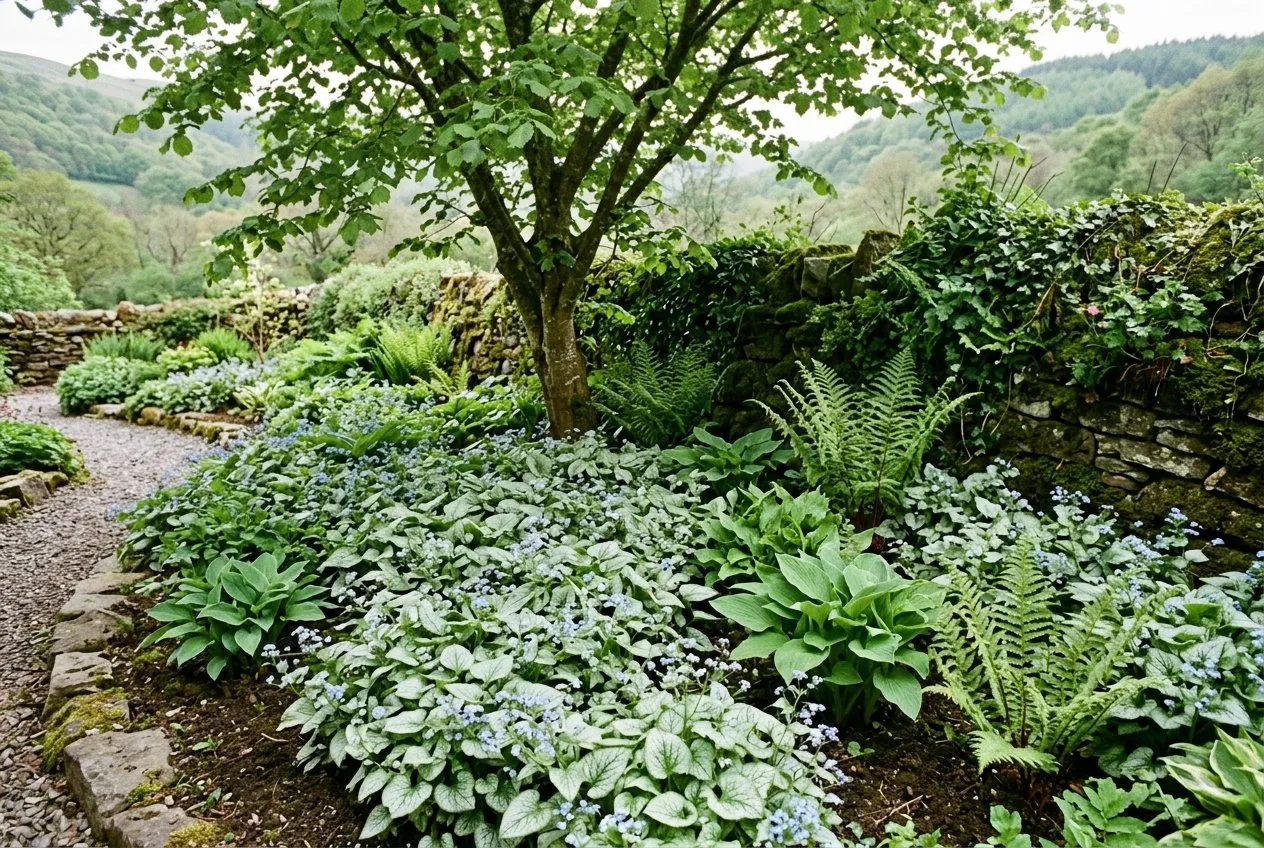 Brunnera as woodland ground cover, its silver leaves threaded between green hostas and unfurling ferns in dappled shade.
Common mistakes when growing brunnera
Most brunnera that disappoint are victims of the same handful of errors. Avoid these and the plant is genuinely low-effort.
Planting a silver form in sun
This is the number one killer of the look. ‘Jack Frost’ and the other silvers scorch in direct afternoon sun no matter how damp the soil. Put them in shade or dappled light only.
Letting the soil dry out
Dry roots plus any light equals brown leaves. Brunnera is a moisture plant. Mulch every spring, water in droughts before the leaves flag, and never plant a silver form somewhere you cannot keep damp in July and August.
Expecting silver seedlings
Let a silver cultivar self-seed and hope for free plants, and you get plain green ones. The patterns do not come true from seed. Divide the parent instead, the only way to keep the silver.
Overfeeding for bigger leaves
Rich soil and high-nitrogen feed give soft, oversized leaves that scorch and flop. A spring mulch and, on poor ground, a light spring feed is all it needs. Lean and damp beats rich and forced.
Skipping the midsummer trim
Leaving tired, scorched leaves on all summer makes a clump look shabby by August. Cut them off at the base in July, water well, and the fresh flush carries the plant looking good into autumn.
 The leaf range at a glance: the more silver or white, the more shade and moisture the plant demands.
Frequently asked questions
Where should I plant brunnera ‘Jack Frost’?
In shade, on soil that stays moist. ‘Jack Frost’ keeps its silver leaves clean only out of direct afternoon sun. A north-facing border, the base of a tree, or a spot behind a shrub all work. The soil must not dry out in summer, or the leaf edges scorch brown. Dig in leaf mould before planting.
Why are my brunnera leaves going brown and crispy?
Too much sun, dry soil, or both. This is leaf scorch, the number one problem with silver-leaved brunnera. The thin silver areas burn where light is strong and roots are dry. Move the plant to deeper shade, mulch to hold moisture, and cut the worst leaves off. Fresh growth comes back cleaner.
Is brunnera invasive?
No, brunnera is not invasive in UK gardens. It spreads slowly by short rhizomes into a tidy clump, not by running roots or heavy seeding. Named silver cultivars set little viable seed. This makes it very different from true forget-me-nots, which seed everywhere. You can lift and divide brunnera easily if a clump gets too wide.
Does brunnera flower every year?
Yes, established brunnera flowers reliably every spring. The blue sprays appear from April into May on plants a year or more old. A newly planted clump may flower sparsely in its first spring, then build up. Shade that is too deep can thin the flowering, so aim for cool dappled light rather than pitch dark.
How do you propagate brunnera?
Divide the clump in spring or autumn. Lift it, pull or cut the crown into pieces with roots and buds, and replant at once. This is the main method and gives instant plants. You can also take root cuttings in winter from thick roots. Silver cultivars must be divided, as seedlings revert to plain green.
Should I cut back brunnera in summer?
Yes, cut tatty or scorched leaves off at the base in midsummer. The plant pushes a fresh flush of clean foliage within two to three weeks if the soil is moist. Water well after cutting. This tidy-up trick keeps silver forms looking good into autumn. Leave healthy leaves alone; only remove the tired ones.
Do slugs and vine weevil attack brunnera?
Vine weevil is the main pest, especially in pots. The white grubs eat the roots over winter and can kill a plant. Slugs graze new spring leaves but rarely do lasting harm. Check container plants for grubs, use nematodes in late summer, and grow brunnera in the open ground where weevil pressure is usually lower.
Now you know how to grow brunnera from planting to the midsummer cut-back, build the rest of your shady bed around it with our guide to the best plants for shade in UK gardens.
Our team produces practical UK gardening guidance from source research, contributor records and established horticultural practice. Editorial standards are overseen by Matt W.