Key takeaways
- Gaura flowers non-stop from June to October, white or pink blooms dancing on thin wiry stems
- It demands full sun and sharp drainage; wet winter soil, not cold, is what kills it
- Rated RHS H4 and short-lived: treat it as a 2-3 year plant, or an annual on heavy clay
- The botanical name changed from Gaura lindheimeri to Oenothera lindheimeri; both are still sold
- Shear the clump back by a third mid-season to refresh flowering and cut down flopping
- It resents being moved; the deep taproot means you plant it once and leave it
What gaura is and why the name keeps changing
Gaura is a short-lived perennial from the prairies and open ground of Texas and Louisiana, grown for its long season of airy, butterfly-like flowers. It builds a basal clump of narrow leaves, then sends up branching flower stems from early summer that keep producing new blooms at the tips for months.
The name is a genuine source of confusion. For decades it was Gaura lindheimeri. In the early 2000s botanists reclassified the whole genus and moved it into Oenothera, the evening primroses, so the correct botanical name is now Oenothera lindheimeri. The trade was slow to follow, and most UK nurseries still label and sell it as Gaura. You will see both names, sometimes on the same plant, so search for either. Common names include beeblossom, bee blossom, wandflower and whirling butterflies.
The flowers themselves are small, around 2-3cm across, with four petals held to one side like a tiny moth. They open a few at a time along each wand, from the base upwards, over several weeks. Because the stems keep branching and extending, a single plant flowers continuously rather than in one flush. That long, undemanding season is the whole point of growing it.
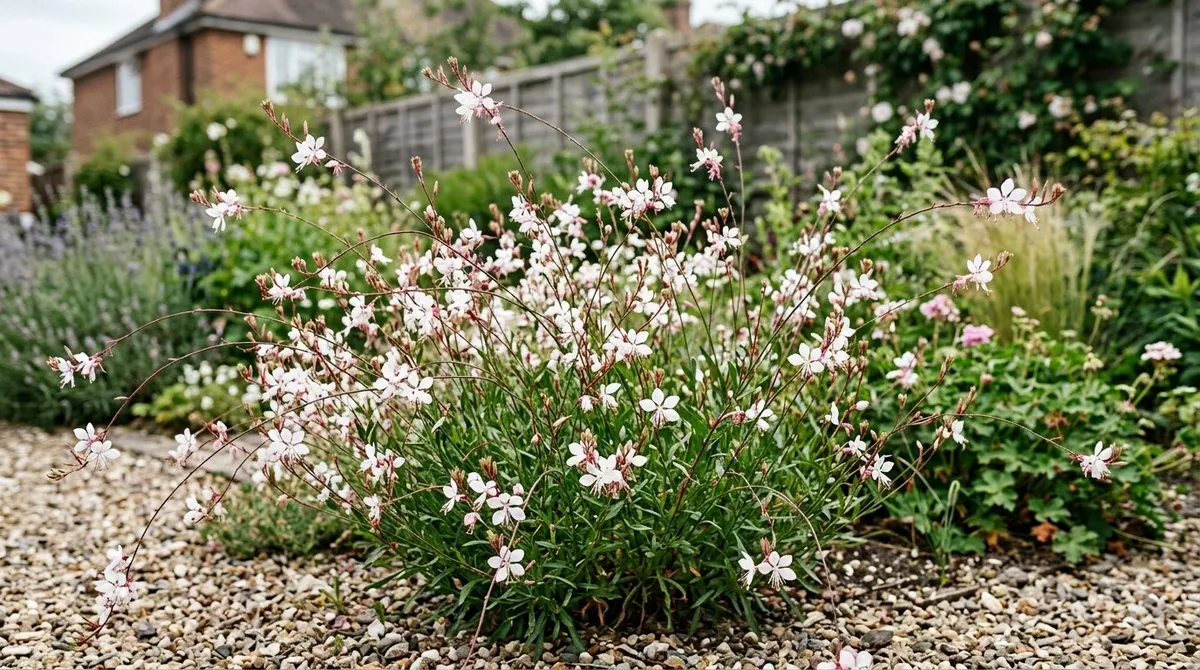
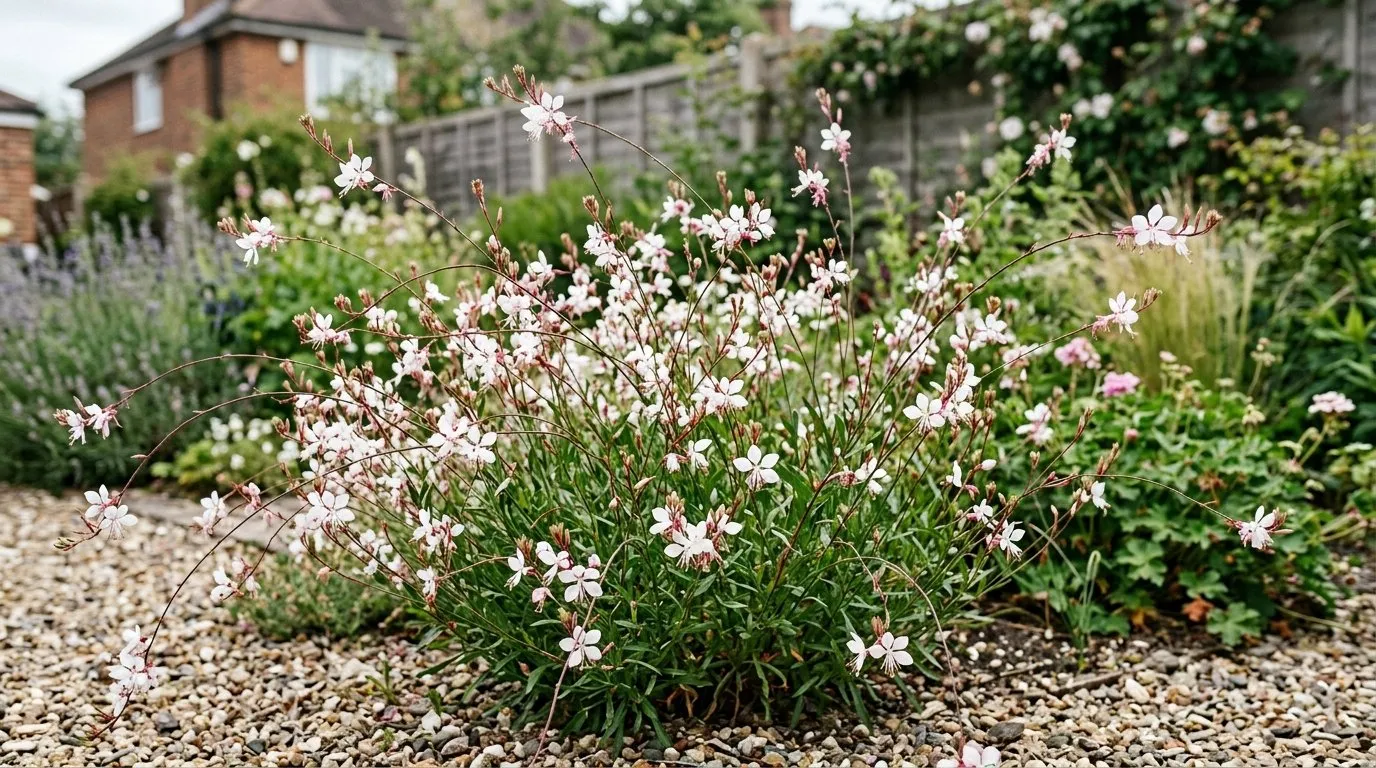 Airy white gaura on wiry stems, flowering non-stop from June to October in a free-draining gravel border.
Choosing gaura cultivars: white, pink and compact types
The right cultivar depends on how much height and flop you can live with. Tall, lax types weave through a naturalistic border but sprawl. Compact series stay tidy and suit pots and the front of a bed. Colour runs from pure white through soft pink to deeper rose.
White cultivars are the classics. ‘Whirling Butterflies’ is the one most people mean by gaura: 60-75cm, pure white flowers from pink buds on arching red stems, holds the RHS Award of Garden Merit. ‘The Bride’ is similar, tall and white, slightly earlier. For a two-tone look, ‘Rosyjane’ (sometimes ‘Rosy Jane’) carries white flowers edged with a pink picotee band, around 60cm.
Pink cultivars bring more warmth. ‘Siskiyou Pink’ is the best known, deep rose-pink flowers on dark stems to 60-75cm, though it flops as much as the whites. For pots and small borders, the compact seed and cutting series earn their place: the Belleza series and the Sparkle series (‘Sparkle White’, ‘Sparkle Pink’) stay 40-50cm, flower non-stop, and barely need support. These bred-for-containers types are the ones to grow if you garden on a balcony or want gaura at the front of a bed without the sprawl.
Gaura cultivar comparison
| Cultivar | Height | Flower colour | Flowering | Hardiness | Flop tendency |
|---|---|---|---|---|---|
| ’Whirling Butterflies’ | 60-75cm | White, pink buds | Jun-Oct | H4 (AGM) | High |
| ’The Bride’ | 75-90cm | Pure white | Jun-Sep | H4 | High |
| ’Rosyjane’ | 60cm | White, pink picotee edge | Jun-Oct | H4 | Moderate |
| ’Siskiyou Pink’ | 60-75cm | Deep rose-pink | Jun-Oct | H4 | High |
| Belleza series | 40-50cm | Pink or white | Jun-Oct | H3-H4 | Low |
| ’Sparkle White’ | 40-50cm | White | Jun-Oct | H3 | Low |
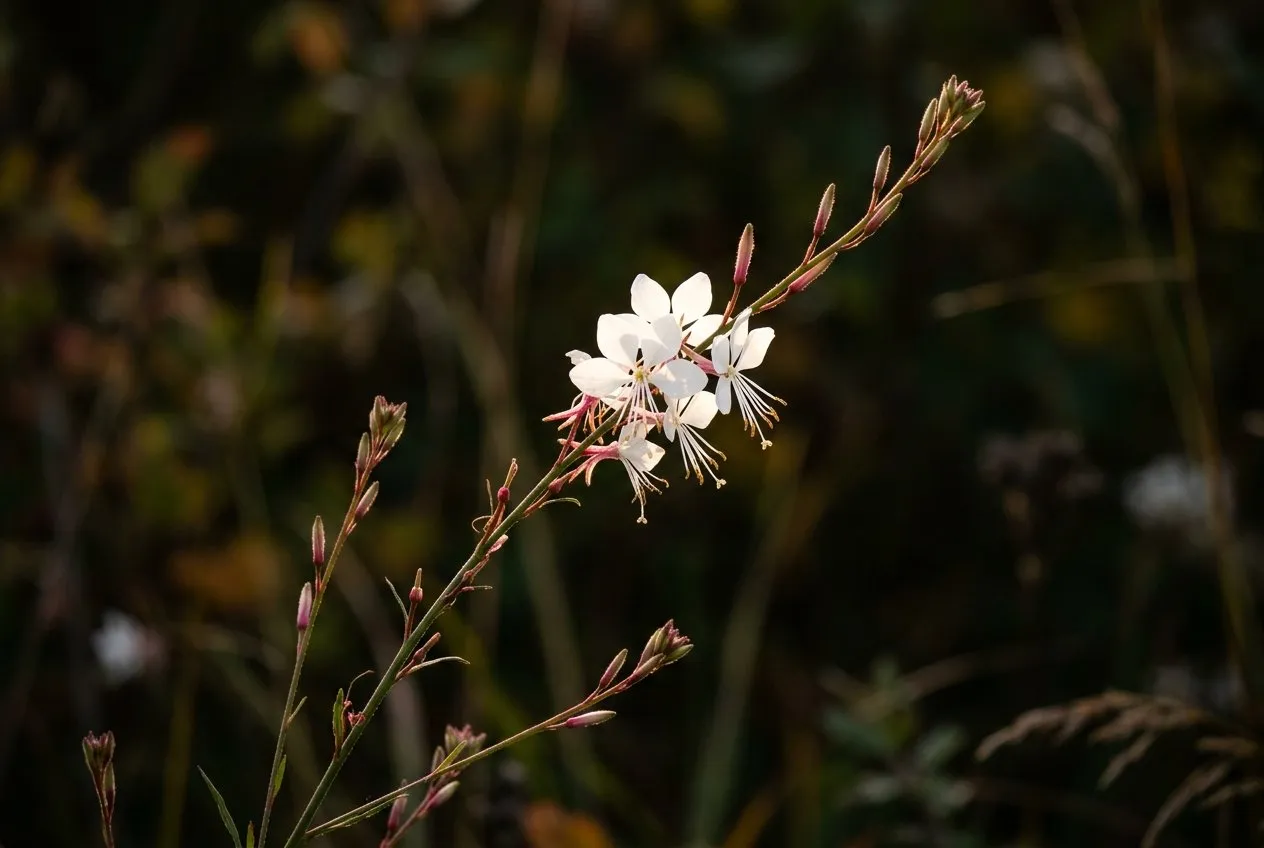 ‘Whirling Butterflies’ in close-up: four-petalled white flowers open from pink buds along a slender red stem.
Full sun and sharp drainage: the two non-negotiables
Gaura needs full sun and free-draining soil, and it will not compromise on either. This is a prairie plant adapted to open ground that bakes in summer and drains fast in winter. Give it those conditions and it flowers for months. Deny them and it either sulks or dies.
Getting the drainage right on clay soil
The method that works for me is a raised grit bed or a grit-improved planting hole. Dig in plenty of horticultural grit, 2-6mm, through the planting area, at least a third grit by volume through the top spade’s depth. Then plant on a slight mound, 8-10cm proud of the surrounding soil, so water drains away from the crown. Tuck a fistful of coarse grit right under the crown as a drainage collar. Use grit, never fine sand, which sets like concrete in clay.
Better still, if your soil is heavy, group gaura with other grit-lovers on a dedicated free-draining bed. A raised bed filled with a gritty, loam-based mix takes the whole problem away. The same conditions suit drought-tolerant plants generally, so gaura sits happily among them. For a whole-border approach to dry, sunny, free-draining planting, the Beth Chatto dry garden model is the one to study.
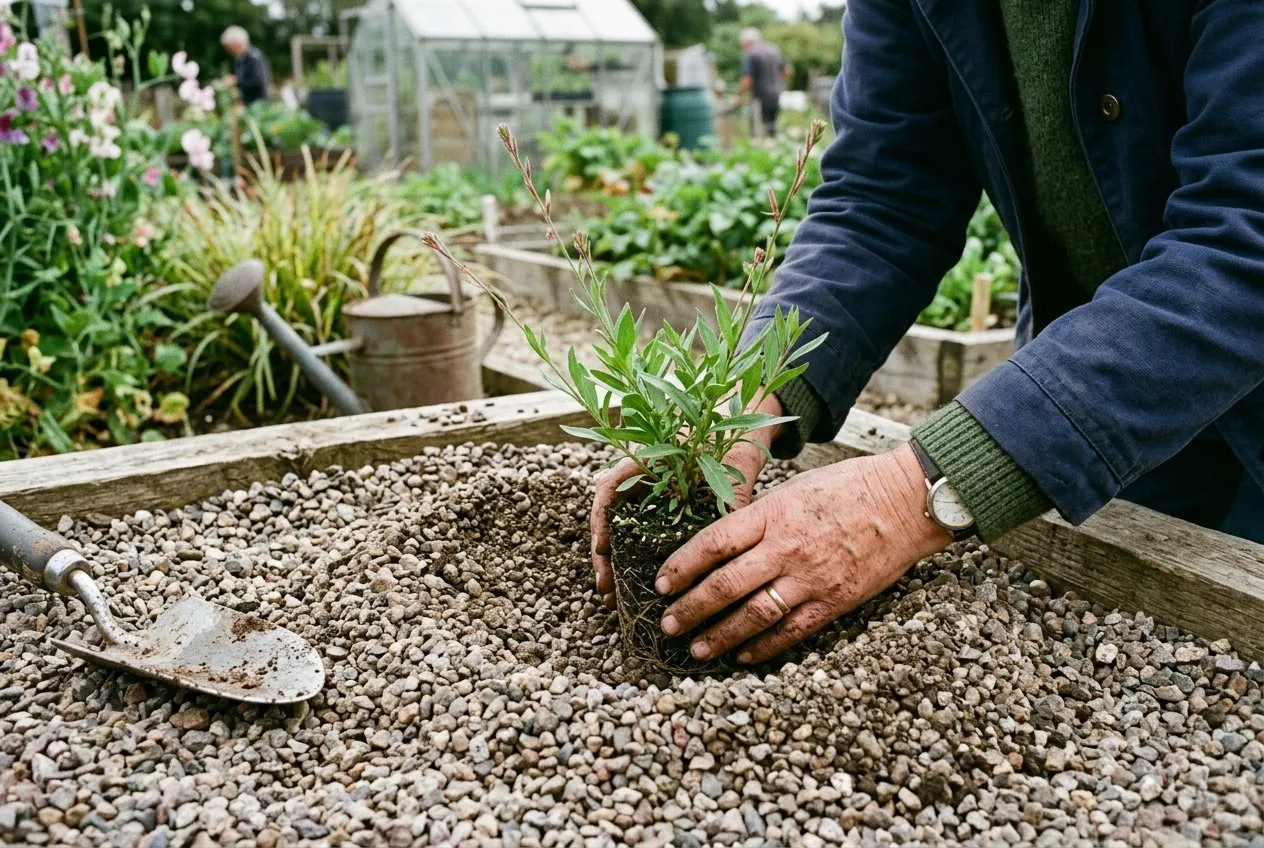 Planting on a grit mound. Coarse grit under and around the crown keeps winter water away from the roots.
When and how to plant gaura
Plant gaura in late spring, from May to early June, so it has the whole summer to root in before its first winter. Spring planting is far safer than autumn, especially on heavier soil. A young plant going into cold, wet ground in October has little chance of getting established before the winter wet arrives.
Buy pot-grown plants and get them in once the soil has warmed. Dig a hole twice the width of the rootball. On clay, half-fill it with a 50:50 mix of grit and topsoil to lift the crown. Set the plant so the crown sits level with the surface, never buried, because a buried crown holds moisture and rots. Firm gently and water in well to settle the roots.
Space plants 40-60cm apart for the taller cultivars, closer for the compact series. Gaura looks best in groups of three or five, weaving through neighbouring plants rather than standing alone. One important point: gaura forms a deep taproot and hates being moved once settled. Choose the final position carefully at planting time, because lifting an established plant usually kills it. Taprooted plants like gaura are the exception you plant once and leave, so there is no second chance to reposition it later.
Watering, feeding and keeping gaura going
Once established, gaura is genuinely drought-tolerant and needs very little from you. Water new plants through their first summer, roughly twice a week in dry spells, until the roots take hold. After the first year, leave established plants alone except in a prolonged drought. Overwatering is more dangerous than underwatering, because it keeps the crown damp and encourages soft, floppy growth.
The one job that pays off is a mid-season shear. Around early July, when the first flush starts to sprawl and look tired, cut the whole clump back by about a third with shears. It looks brutal for a fortnight, then the plant pushes fresh, bushier growth and a second wave of flowers that carries into October. This also cuts down the flopping, because the regrowth is shorter and sturdier. It is the same principle behind the Chelsea chop, applied to keep gaura tidy and floriferous.
Month-by-month gaura calendar
| Month | Task |
|---|---|
| January | Leave top growth on for crown protection; check no water is pooling at the base |
| February | Do nothing; resist the urge to cut back or tidy |
| March | Cut old stems to 10cm as new basal shoots appear; clear winter debris |
| April | Plant new pot-grown stock once soil warms; take basal cuttings if wanted |
| May | Main planting month; apply a light spring feed on poor soil only |
| June | First flowers open; water new plants twice weekly through dry spells |
| July | Peak flowering; shear the clump back by a third to refresh growth |
| August | Second flush builds; enjoy the long display, minimal care needed |
| September | Flowering continues; take softwood cuttings as insurance against winter loss |
| October | Last flowers fade; leave stems standing, do not cut back |
| November | No action; ensure crowns are not sitting in waterlogged soil |
| December | Leave alone; on very wet sites, lift potted plants under cover |
Why gaura flops and what to do about it
Gaura flops because its stems are naturally thin, wiry and lax, and no amount of staking fixes that cleanly. This is not a fault you can cure with a cane and string. The arching, sprawling habit is part of how the plant looks, and stiff staking just makes it look trussed up and unnatural. The trick is to work with the habit, not against it.
The best support is other plants. Plant gaura through low, sturdy neighbours that hold the wiry stems up and let the flowers hover above them. Ornamental grasses, hardy geraniums, low salvias and nepeta all make good scaffolding. The gaura threads through and the whole thing reads as intentional movement rather than collapse.
Warning: Do not tie gaura tightly to a single stake. The wiry stems snap at the base in wind when bundled, and a stiff column of tied stems looks worse than a natural sprawl. Support it loosely through surrounding plants or with twiggy sticks, never with one hard cane.
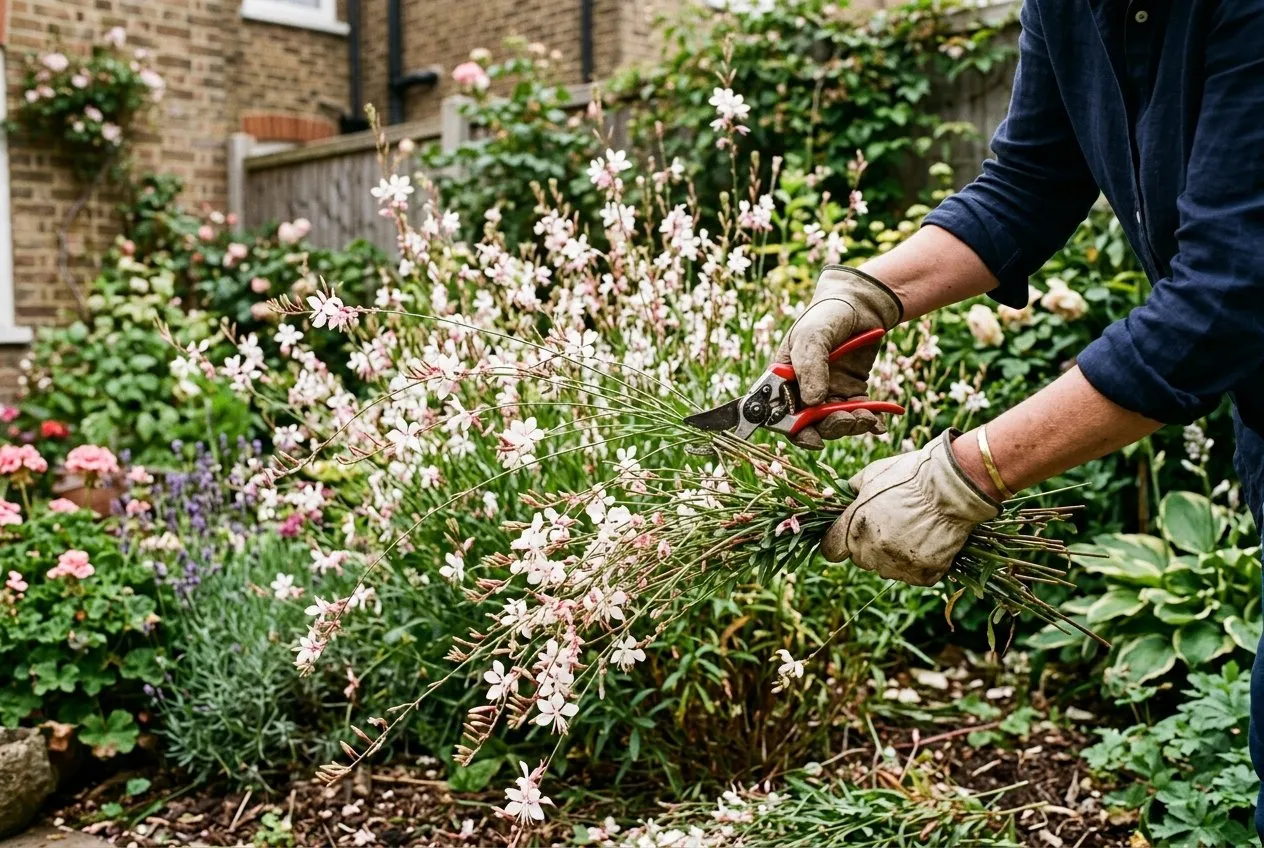 A mid-season shear back by a third looks drastic for two weeks, then triggers bushier growth and a second flush.
Overwintering gaura in the UK
Gaura survives UK winters only where drainage is sharp and the position is sunny, and even then it is short-lived. Rated RHS H4, hardy to around -10C, it should shrug off cold in principle. In practice it is winter wet, not frost, that kills it. A crown sitting in cold, saturated soil from November to March rots from the centre out, and by spring the plant has collapsed.
The first rule of overwintering is do not cut it back in autumn. Leave the old top growth standing through winter. It gives the crown a little protection and stops you exposing an open wound to cold wet soil. Cut back to about 10cm in March or April, once new basal shoots show. This single habit saves more gaura than anything except drainage.
For borderline sites, treat gaura as a short-lived plant and hedge your bets. Take cuttings in late summer, overwinter them in a cold frame, and you have replacements ready if the parent dies. On heavy clay, many gardeners simply grow it as an annual or a two-year plant and accept the turnover. Potted plants can be moved into an unheated greenhouse or against a dry wall for winter, which markedly improves survival.
Propagating gaura from cuttings and seed
Gaura is easy to increase from softwood cuttings, and the species comes true from seed, though named cultivars do not. Because the plant is short-lived and resents division, cuttings and seed are the sensible routes rather than lifting and splitting an established clump.
Softwood cuttings are the reliable method for named cultivars like ‘Whirling Butterflies’ and ‘Siskiyou Pink’. Take 8-10cm non-flowering shoots in early summer, or basal cuttings in spring. Strip the lower leaves, insert into gritty compost, and keep them in a covered propagator out of direct sun. They root in three to four weeks. Pot on and overwinter under cover for planting out the following spring.
Seed works well for the straight species, Oenothera lindheimeri, which produces the classic white flowers. Sow in spring at 15-18C, prick out, and grow on. Seed-raised plants vary a little and often flower in their first year. Named cultivars raised from seed will not come true, so use cuttings for those. Do not attempt to divide a mature gaura: the deep taproot means division usually kills both halves.
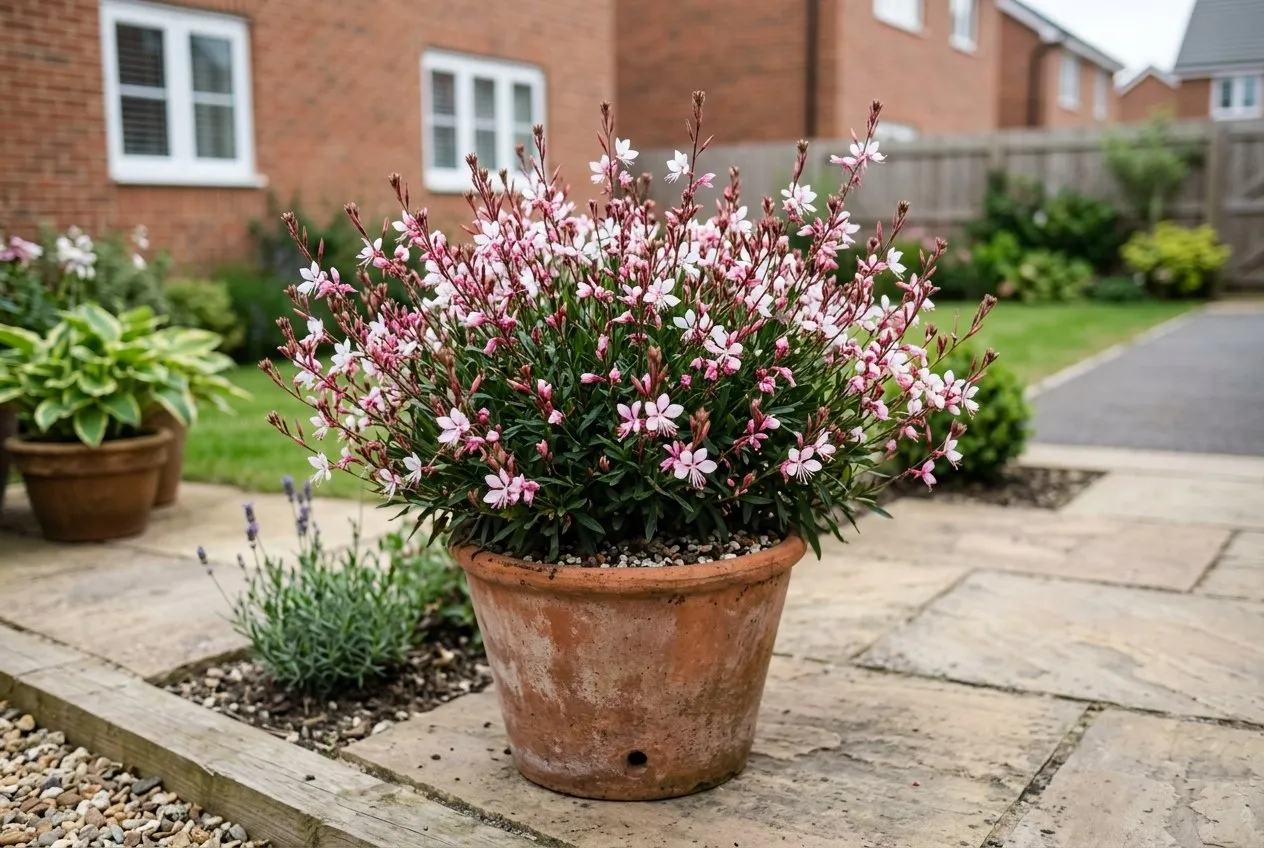 Compact series like Belleza flower all summer in a pot and stay tidy without support. Gritty compost is essential.
Growing compact gaura in pots
Compact cultivars make gaura an excellent container plant, and a pot solves the winter drainage problem at a stroke. The Belleza and Sparkle series, at 40-50cm, are bred for this: tidy, floriferous, and far less prone to flopping than the tall border types. In a pot you also control the compost and can move the plant under cover for winter.
Use a pot at least 30cm wide with plenty of drainage holes. The compost must drain freely: mix two parts loam-based compost, John Innes No.2, to one part horticultural grit. This mimics the sharp drainage gaura needs and stops the crown sitting wet, which is an even bigger risk in a container than in the ground. Raise the pot on feet so water runs straight through.
Stand the pot in full sun and water when the top few centimetres dry out, never leaving it in a saucer of water. Feed once in spring, then leave it. In winter, move the pot somewhere sheltered and dry, an unheated greenhouse, a porch or hard against a south wall, and keep it on the dry side. That overhead shelter carries container gaura through the winter that would kill it in an open border.
Gaura for pollinators and naturalistic borders
Gaura is a strong pollinator plant, which is how it earned the name beeblossom. The long succession of nectar-rich flowers, open from June to October, feeds bees, hoverflies and butterflies across the whole season, including the late-summer gap when many border plants have finished. Bumblebees in particular work the wands steadily. The Bumblebee Conservation Trust rates long-flowering, nectar-rich plants like this as valuable forage through late summer and autumn.
The RHS lists Oenothera lindheimeri and its cultivars with full growing guidance and hardiness ratings, and ‘Whirling Butterflies’ carries the Award of Garden Merit for reliable garden performance (RHS: gaura ‘Whirling Butterflies’).
 Gaura threaded through grasses and salvias in a coastal border. Plant it through low neighbours that hold the wiry stems up.
Common mistakes when growing gaura
Most gaura failures trace back to a handful of avoidable errors. Get these right and the plant is close to trouble-free for the two or three years it gives you.
Planting in heavy wet soil
This is the number one killer. Gaura set into unimproved clay sits in cold water all winter and rots at the crown. Always dig in a third grit, plant on a mound, or grow it in a raised bed or pot. On the wettest ground, treat it as an annual and accept the turnover.
Feeding and watering too much
Rich soil and frequent watering give lush leaves, weak floppy stems and fewer flowers. Gaura flowers best kept lean and slightly dry. Skip the feed on decent ground, water only when establishing, and let it grow hard.
Cutting back in autumn
Tidying the stems off in autumn exposes the crown to winter wet and frost. Leave the top growth standing until spring, then cut to 10cm once new shoots appear. This one habit saves plants every winter.
Trying to move or divide it
Gaura forms a deep taproot and resents disturbance. Lifting an established plant, or trying to divide the clump, usually kills it. Plant it in its final spot from the start and propagate from cuttings or seed instead.
Expecting it to live forever
Gaura is short-lived by nature, two to three years even when happy. Gardeners who expect a permanent perennial are disappointed. Treat it as a fast, generous, replaceable plant, take cuttings each year, and you will never be without it.
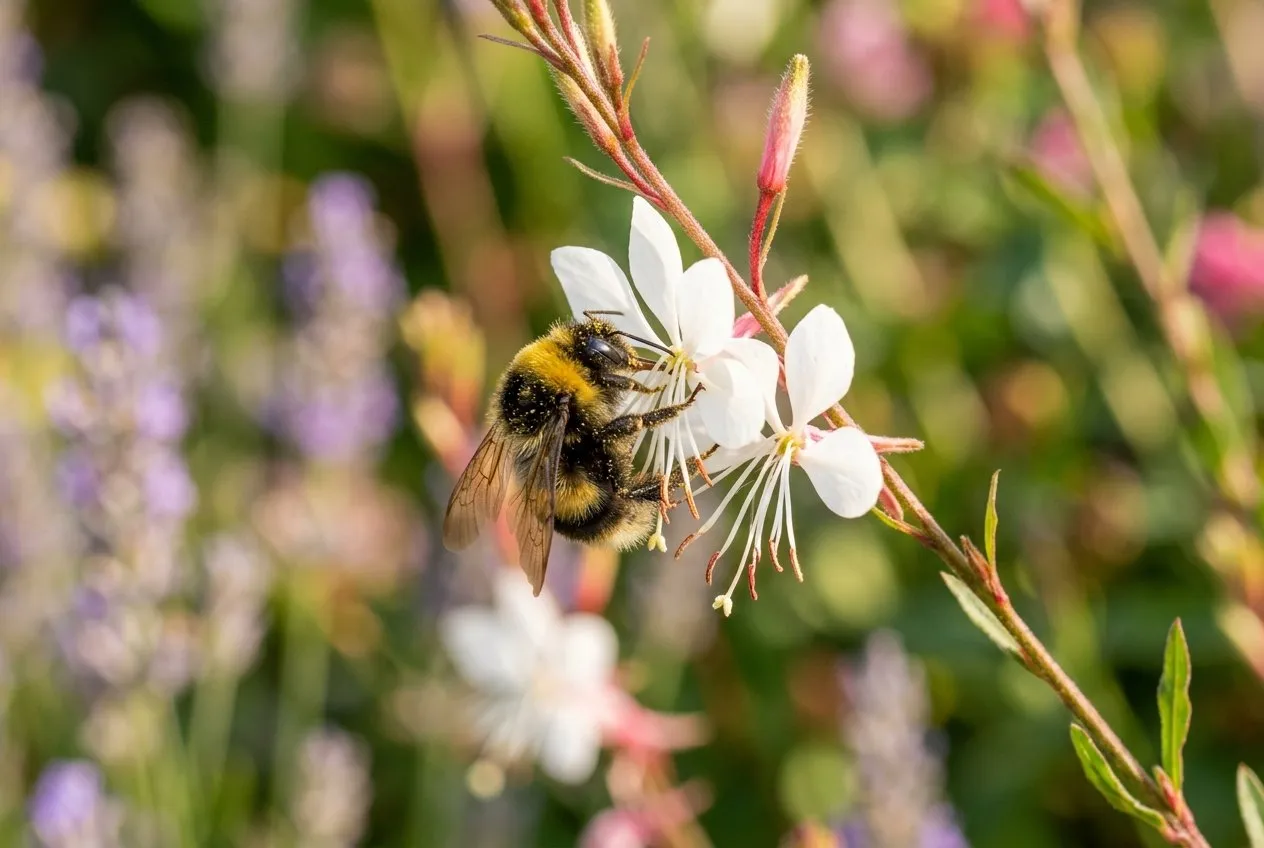 A bumblebee working a gaura flower. The long June to October season feeds pollinators through the late-summer gap.
Pairing gaura with pink and rose cultivars
The pink gauras change the mood of a border completely. Where the whites read cool and misty, ‘Siskiyou Pink’ and the pink Belleza types bring warmth and sit well against silver foliage, deep purples and hot oranges. They flower on the same long schedule and want identical conditions: full sun, sharp drainage, lean soil.
One practical note on the pinks: ‘Siskiyou Pink’ flops at least as much as the whites, so give it the same treatment. Plant it through low neighbours, shear it mid-season, and keep the soil lean. The compact pink series, if you want the colour without the sprawl, stays tidy enough for a pot or the front of a bed and flowers just as long.
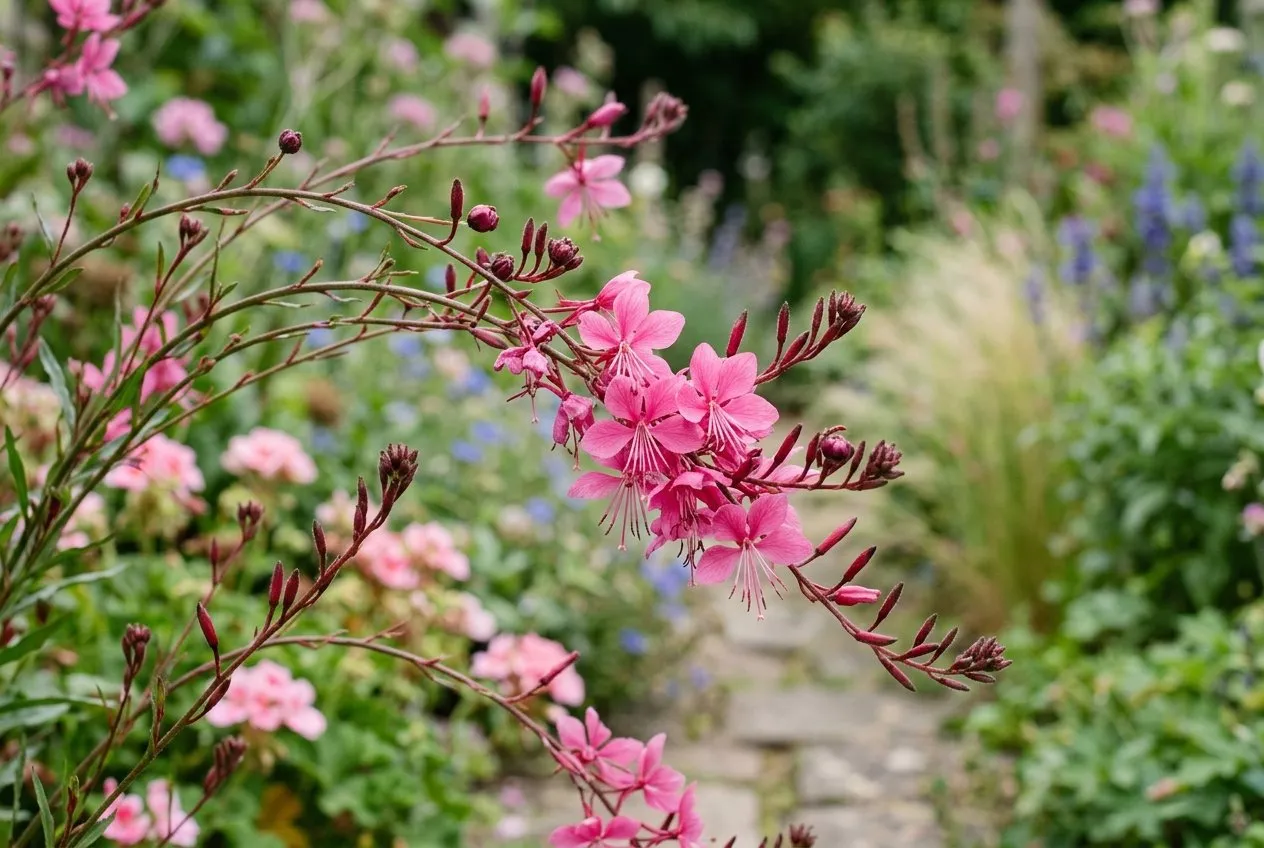 ‘Siskiyou Pink’ brings warmth to a border. It flops as much as the whites, so plant it through low supporting neighbours.
Frequently asked questions
Is gaura the same as Oenothera lindheimeri?
Yes, gaura was reclassified as Oenothera lindheimeri in the early 2000s. Botanists moved it into the evening primrose genus, so the correct name is now Oenothera lindheimeri. Nurseries still sell it as Gaura lindheimeri, and both names appear on labels. It is also called beeblossom or wandflower. Search either name and you will find the same plant.
Is gaura hardy in the UK?
It is borderline, rated RHS H4, hardy to about -10C. Gaura survives most UK winters in free-draining soil and full sun. On cold wet clay it usually rots at the crown over winter. It is short-lived even when happy, so treat it as a two to three year plant and take cuttings as insurance.
Why is my gaura flopping over?
Gaura has naturally lax, wiry stems that arch and sprawl. Rich soil, shade or too much water makes it worse by forcing soft growth. Do not stake it stiffly; instead plant it through low neighbours that hold it up, keep the soil lean, and shear the clump by a third in early summer to build a bushier, self-supporting plant.
Should I cut back gaura in winter?
No, leave the top growth on until spring. The old stems give the crown some protection from winter wet and frost. Cut back to about 10cm in March or April once new shoots appear at the base. Cutting hard in autumn exposes the crown to cold, saturated soil, which is exactly what kills the plant.
Can you grow gaura in pots?
Yes, and compact cultivars are bred for it. The Belleza and Sparkle series stay 40-50cm and flower all summer in a container. Use a gritty, free-draining compost, a pot with good drainage holes, and full sun. Pots also let you move the plant somewhere sheltered and dry over winter, which improves its survival chances.
How do you keep gaura flowering all summer?
Keep the soil lean, the position sunny, and shear it once mid-season. Gaura flowers continuously from June without deadheading each stem. A single shear back by a third in early July removes tired growth and triggers a fresh flush that carries the display into October. Avoid feeding heavily, which gives leaves at the expense of flowers.
Can you move an established gaura?
It is risky because gaura forms a deep taproot. Mature plants resent disturbance and often fail to re-establish after being lifted. Plant it in its final position from the start. If you must propagate, take softwood cuttings in early summer or grow the species from seed rather than trying to divide or transplant a settled clump.
Our team produces practical UK gardening guidance from source research, contributor records and established horticultural practice. Editorial standards are overseen by Matt W.