Key takeaways
- Sow April to mid-May, transplant at 60cm spacing into firm soil from June to July
- Plants occupy the bed 9-11 months, longer than almost any other vegetable
- Spears crop February to April, filling the UK hungry gap between stored and fresh crops
- Pick the central spear first at 10-15cm with buds tight to trigger weeks of sideshoots
- 'Rudolph' crops from late December; 'Late Purple Sprouting' runs into early May
- Net against pigeons and cabbage white, and stake tall plants against winter wind-rock
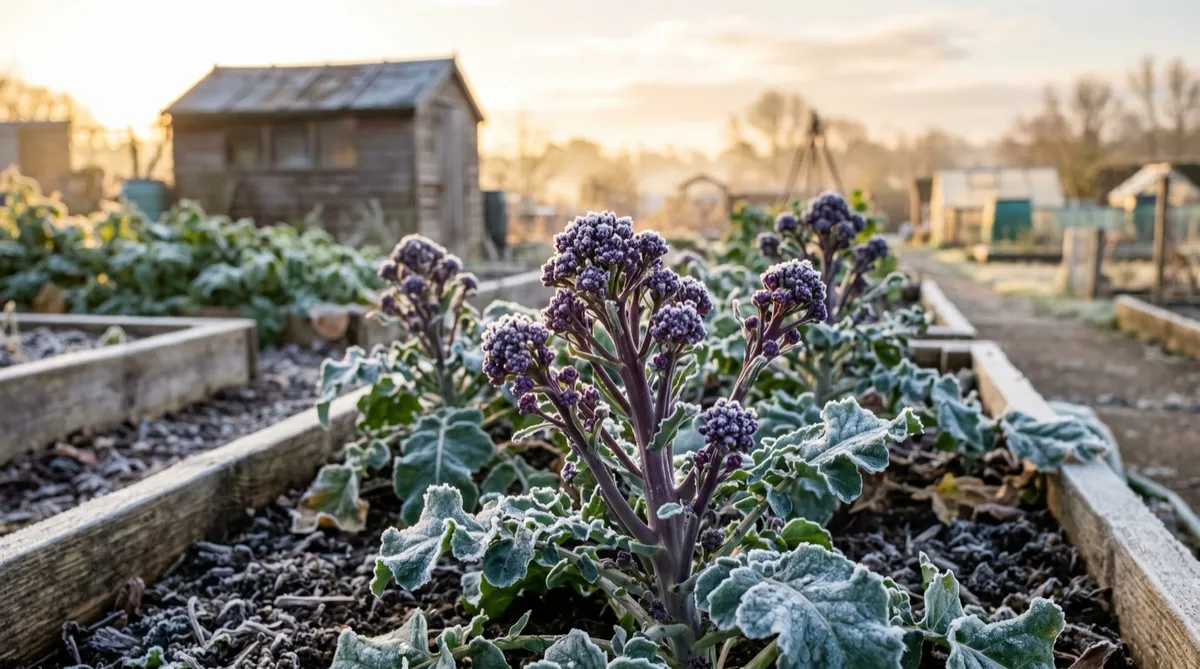
Purple sprouting broccoli is the crop that earns its keep when the vegetable plot is otherwise bare. It sits in the ground through autumn and winter, then throws out tender purple spears from February to April, exactly when stored crops have run low and spring sowings are weeks from cropping. That window is the hungry gap, and few vegetables fill it as well. This guide covers sowing in April, transplanting at 60cm spacing into firm soil, overwintering tall plants safely, and cutting the central spear first to keep sideshoots coming for weeks. It is a long commitment, but a rewarding one.
The trade-off is patience. From sowing to the first spear runs 9 to 11 months, longer than almost anything else on the plot. In return you get a steady harvest in the leanest weeks of the year.
What makes purple sprouting broccoli different from calabrese
Purple sprouting broccoli and the green broccoli sold in shops are different crops with different jobs. Both belong to Brassica oleracea, but they sit in separate groups bred for separate ends.
Purple sprouting broccoli (PSB) is a hardy biennial grown as an overwintering crop. It produces dozens of small purple spears over several weeks in late winter and early spring. It needs cold to crop well and shrugs off frost down to around minus 12C in most UK winters.
Calabrese, the green broccoli in supermarkets, is a fast summer annual. It forms one large central head in 12 to 16 weeks, with a few small sideshoots after. It will not survive a UK winter outdoors. If you want that quick summer dome rather than late-winter spears, follow our separate guide on how to grow broccoli, which covers calabrese in full.
The headline difference is timing. PSB feeds you in February when the plot is empty. Calabrese feeds you in July when courgettes and beans are already flooding the kitchen. Growing both spreads your brassica harvest across most of the year.
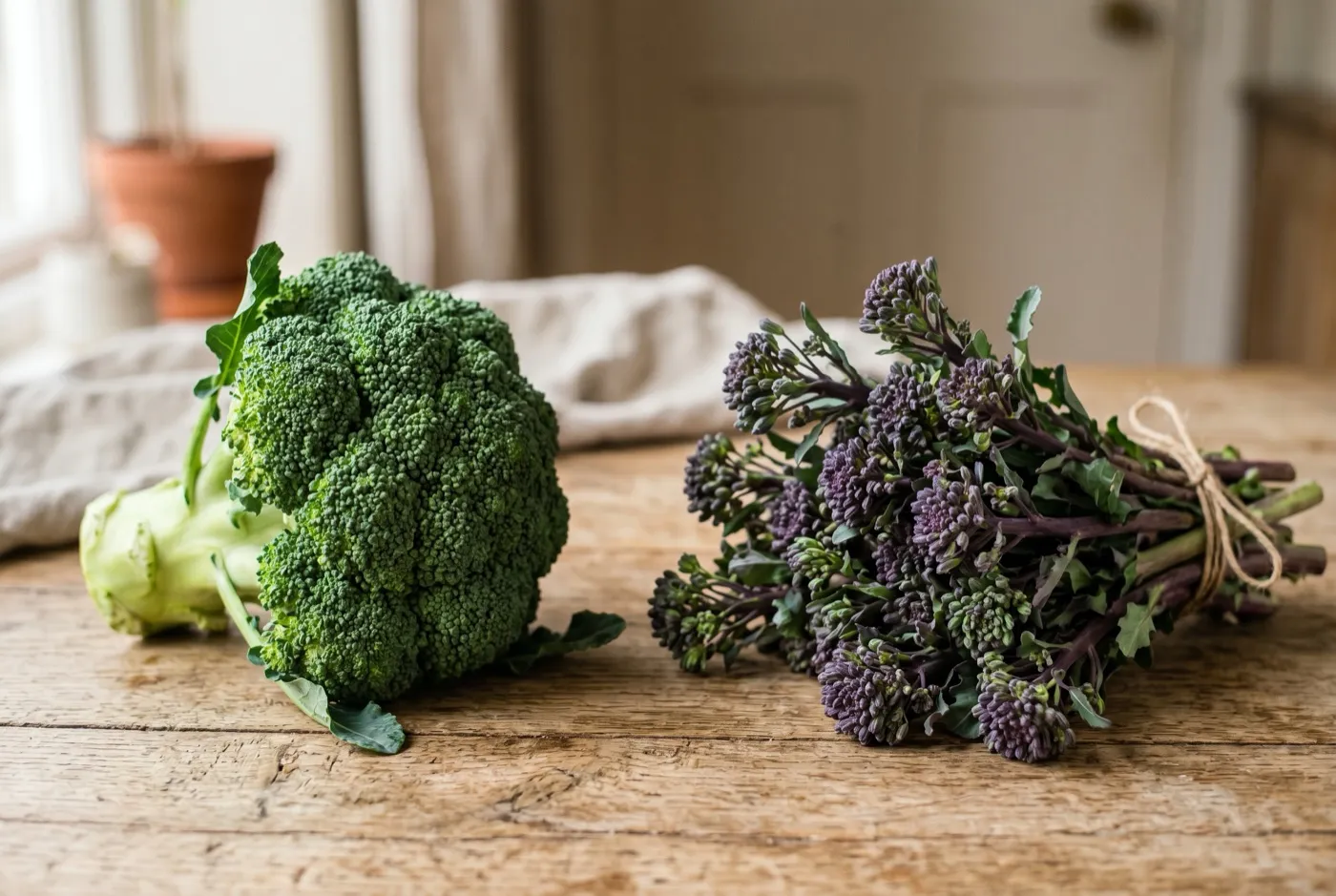 Left, a single calabrese head harvested in summer. Right, the many small purple spears of PSB cut in early spring. Two crops, two seasons.
When to sow purple sprouting broccoli in the UK
Sow purple sprouting broccoli from April to mid-May for spears the following spring. This timing gives plants the full summer to build a large, sturdy frame before winter. Sown too late, they stay small and weak, and a small plant overwinters poorly and crops thinly.
You have two sowing methods. Module sowing under cover gives the most reliable plants: sow one or two seeds per cell in 9cm modules at 1.5cm deep, thin to the strongest, and harden off before planting out. Seedbed sowing works outdoors in a spare corner: sow thinly in shallow drills 15cm apart, then lift and transplant when seedlings reach 10-15cm with four or five true leaves.
Early varieties such as ‘Rudolph’ can be sown in late March to crop from late December. Late types like ‘Cardinal’ and ‘Late Purple Sprouting’ are best sown in May to crop through April into early May. Staggering varieties stretches the harvest across four months rather than one.
Gardener’s tip: Sow a few cells of an early and a late variety on the same day in April. The early one crops in January, the late one in April, and you barely notice the gap between them.
Transplanting at the right spacing into firm soil
Transplant purple sprouting broccoli from June to July, once plants stand 10-15cm tall with a strong stem. Space them 60cm apart in each direction. That looks generous for a small transplant, but a mature PSB plant reaches 75-90cm tall and as wide, and crowded plants give fewer, smaller spears.
The single most important condition is firm soil. Brassicas hate loose ground. Plant into a bed that has settled for months, not one freshly dug and fluffed up. Tread the soil before planting, plant deep so the lowest leaves sit near the surface, then firm hard around each stem with your knuckles or a heel. The root ball should not move when you tug a leaf.
Choose a fertile, well-drained, alkaline site at pH 6.8-7.2. Dig in well-rotted manure the autumn before, not at planting, so the bed has time to settle. Avoid following other brassicas in the same bed within three years to break disease cycles.
 Firm planting is non-negotiable. Treading soil around each stem anchors the plant against the wind-rock that ruins winter brassicas.
The growing season month by month
Purple sprouting broccoli is a marathon, not a sprint. Knowing what each stage demands keeps the crop on track across its long life in the ground. The critical mistake most growers make is treating it like a fast summer crop and giving up on protection over winter, when pigeons and wind do the worst damage.
| Month | Task |
|---|---|
| March | Sow early ‘Rudolph’ in modules under cover |
| April | Main sowing in modules or seedbed, 1.5cm deep |
| May | Sow late varieties, harden off module plants |
| June | Transplant into firm soil at 60cm spacing, net at once |
| July | Finish transplanting, water in dry spells, hoe weeds |
| August | Feed with high-potash liquid feed, keep netting on |
| September | Earth up stems 10cm, check stakes, watch for caterpillars |
| October | Stake tall plants firmly against autumn wind |
| November | Remove yellowing lower leaves, firm any rocked plants |
| December | Early ‘Rudolph’ may start cropping, check pigeon netting |
| January | Protect spears from hardest frost, firm soil after thaws |
| February | Main harvest begins, cut central spears first |
| March | Peak cropping, pick sideshoots every few days |
| April | Late varieties crop, pull spent early plants |
The autumn jobs matter most. Staking by October and earthing up the lower stem in September give the plant the anchorage it needs before winter gales arrive. A plant that rocks loose in November will struggle to crop in February.
How to harvest for the longest, heaviest crop
Harvest is where most of the yield is won or lost. Cut the central spear first, when it reaches 10-15cm and the buds are still tight, dark and unopened. Use a sharp knife and take 10-12cm of stem with it. That first cut is the trigger.
Removing the lead spear breaks the plant’s apical dominance and forces a flush of sideshoots from the lower leaf joints. These secondary spears are the bulk of the crop. Pick them every two or three days over the next four to six weeks, always taking them young with closed buds.
The moment to stop is when buds open into small yellow flowers. Flowered spears turn woody and bitter, and leaving them on the plant tells it the job is done, which slows sideshoot production. Keep cutting little and often and a single plant yields 500-650g of trimmed spears across the season.
Warning: Never let spears flower if you want a long harvest. Once a plant sets flower, it diverts energy to seed and sideshoot production stalls. Pick young and pick often, even if you cannot eat it all that day.
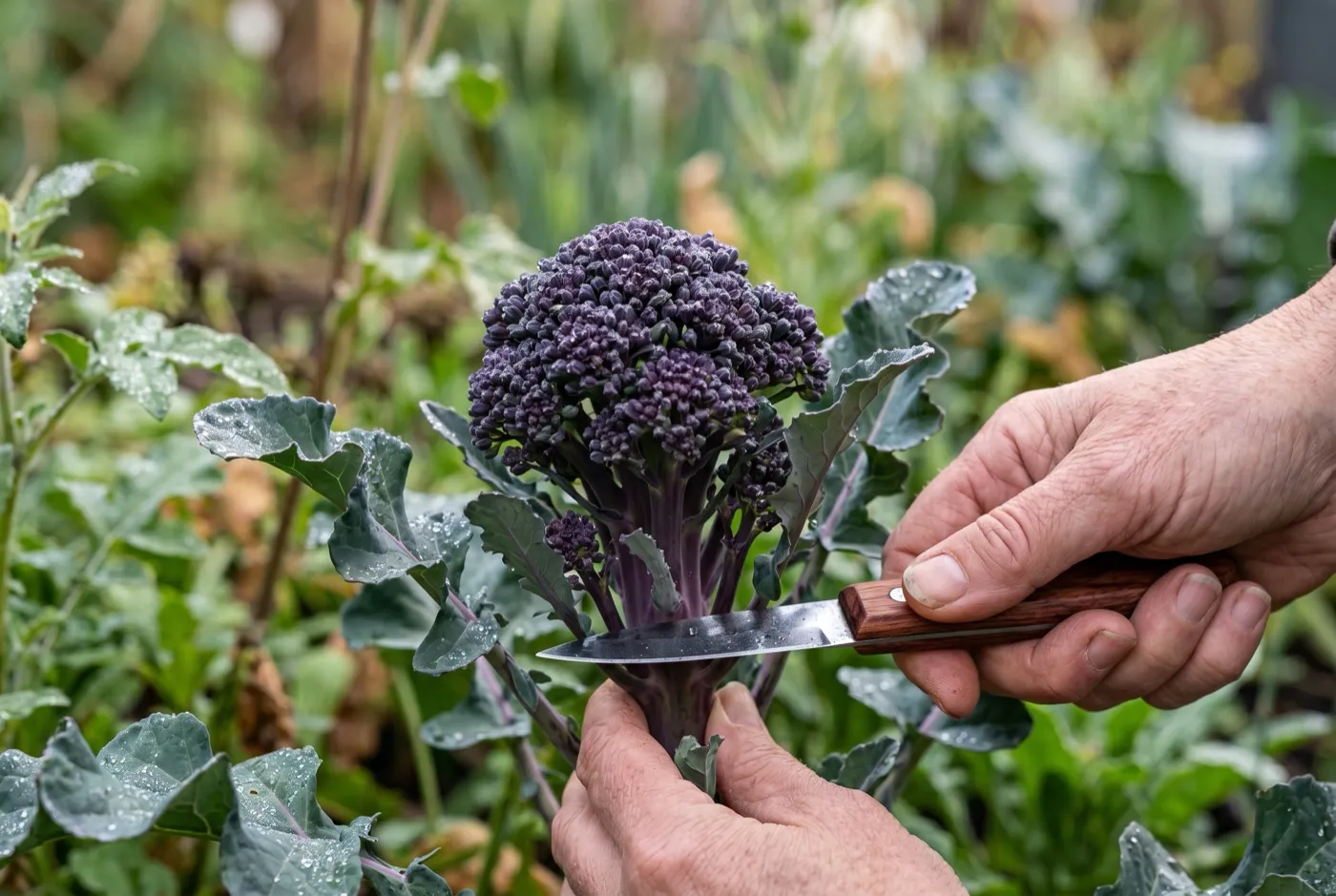 Cut the central spear with buds tight and unopened. This single cut triggers weeks of sideshoots from the leaf joints below.
Choosing the right variety for your harvest window
Variety choice decides when you eat. Picking an early, a mid-season, and a late type spreads spears from late December to early May. The table ranks the main UK varieties by harvest date, earliest first.
| Variety | Type | Harvest window | Height | Notes |
|---|---|---|---|---|
| ’Rudolph’ | Very early purple | Late Dec to Feb | 90cm | Earliest of all, large spears, sow March |
| ’Claret’ F1 | Early-mid purple | Feb to March | 90cm | Heavy uniform cropper, good vigour, reliable |
| ’Red Spear’ | Mid purple | March | 75cm | Compact, good flavour, suits smaller plots |
| ’Red Arrow’ | Mid purple | March to April | 80cm | Productive, long picking season |
| ’Cardinal’ | Late purple | April | 100cm | Tall, very late, prolific sideshoots |
| ’Late Purple Sprouting’ | Late purple | April to May | 90cm | Latest crop, hardiest, fills the very end of the gap |
| ’White Sprouting’ | Late white | March to April | 90cm | White spears, sweeter, a calabrese-like flavour |
‘Rudolph’ is the gold standard for an early crop, cropping from late December in a mild winter and bridging the gap between autumn cabbage and spring spears. For the latest possible harvest, ‘Late Purple Sprouting’ runs into May. What no single variety can do is crop across the whole window, which is why growing two or three types together is the only way to get five months of spears. The ‘White Sprouting’ option offers a sweeter, paler spear for cooks who find purple types too strong.
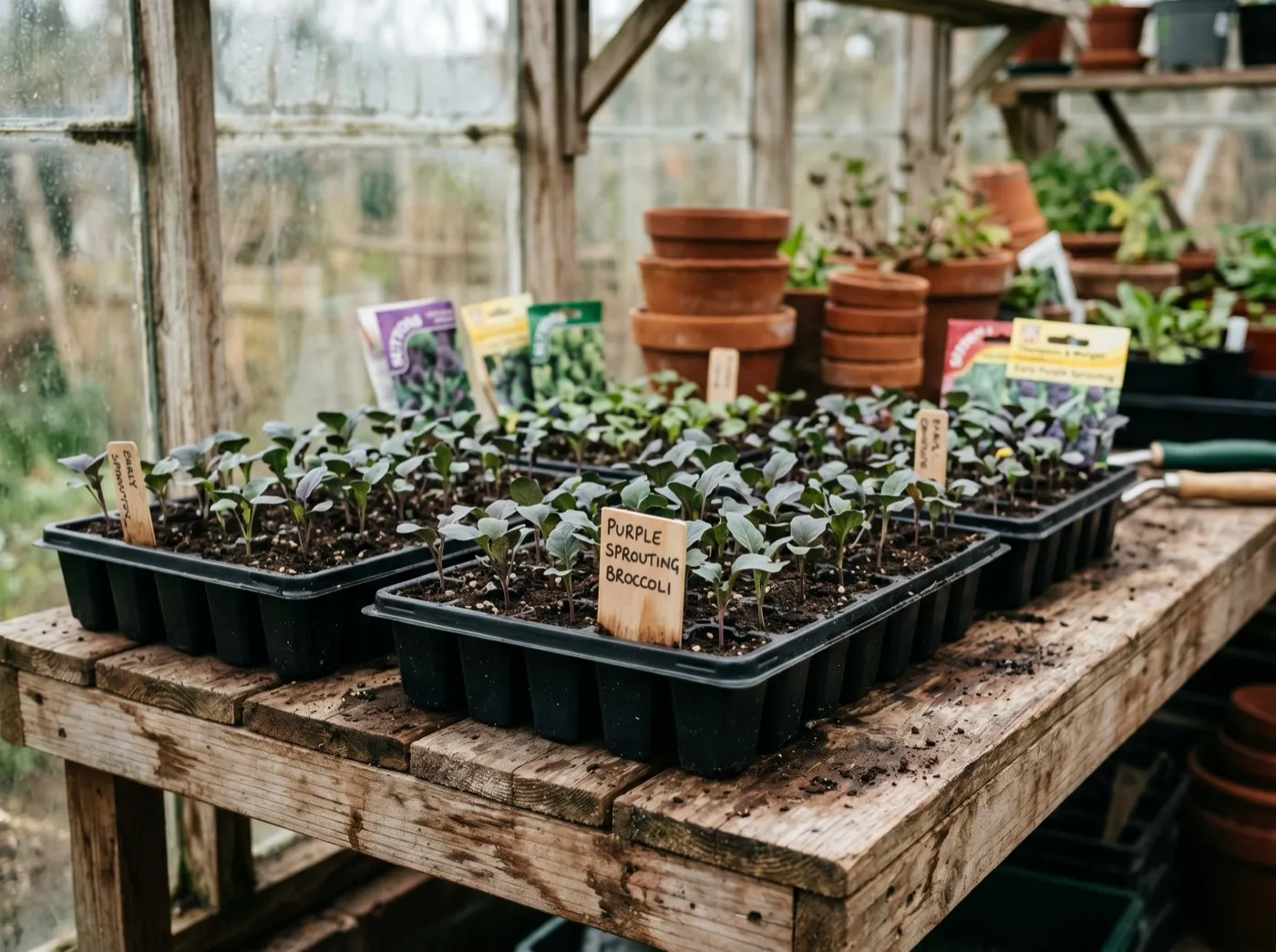 Sowing early, mid and late varieties together in spring spreads the harvest across four months rather than crowding it into one.
Protecting plants from pests, disease and winter wind
Purple sprouting broccoli sits exposed through the worst of the year, so protection is constant. Three threats do the real damage: birds, caterpillars, and the soil-borne diseases that haunt all brassicas.
Pigeons strip leaves to the ribs in hard winters when other food is scarce. Cabbage white butterflies lay eggs from May to September, and the caterpillars shred foliage fast. Cover plants with insect mesh with holes under 7mm from the day they go out, and keep it on year-round. Our guide to cabbage white butterfly control covers the lifecycle and timing in detail, and the same netting helps deter cabbage root fly and flea beetle on young brassica leaves.
Soil-borne club root is the most serious long-term threat. It thrives in acidic, wet ground, so liming to pH 6.8-7.2 and improving drainage are the front-line defences. Learn to spot it early with our guide on club root identification and treatment, and read up on the wider range of common brassica diseases before committing a long-stay crop to a bed.
Wind-rock is the physical threat. Tall plants catch winter gales and loosen at the root, which tears the fine feeding roots and can blow plants flat. Stake each plant with a cane by October and re-firm any that rock after storms.
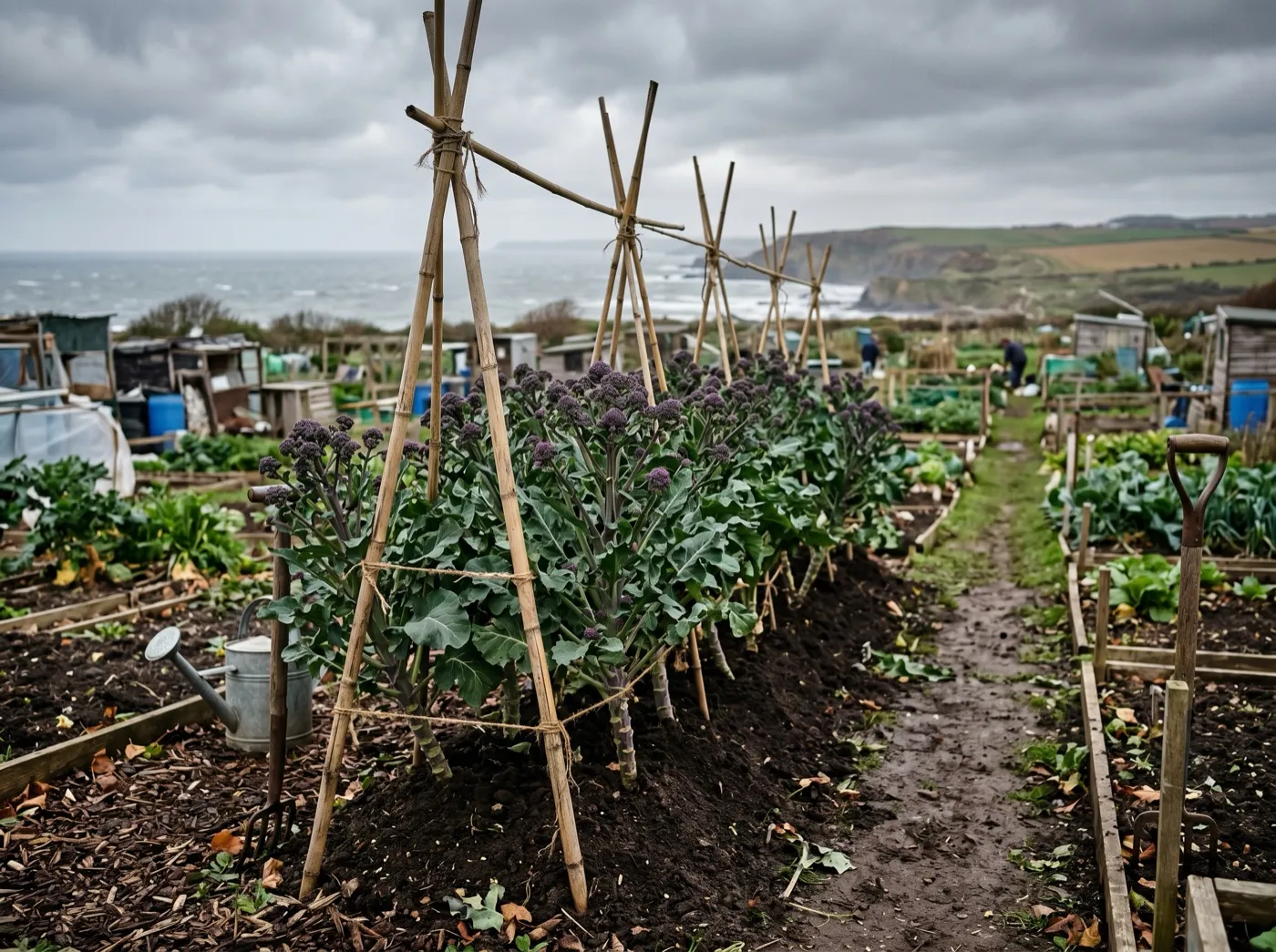 Canes and earthed-up stems anchor tall plants against the winter gales that cause wind-rock on exposed plots.
Root cause: why winter brassicas fail and how to prevent it
Most purple sprouting broccoli failures trace back to one underlying cause: the plant was never anchored properly. Growers focus on the spring harvest and overlook the autumn groundwork that makes it possible. A loose plant in soft soil is the root problem, not the symptom of blown heads you see in March.
The mechanism is straightforward. PSB grows tall and top-heavy through summer. Planted in fluffy, freshly dug ground, the root plate never grips. Autumn and winter gales then rock the stem, the fine roots tear, and the plant cannot draw water or feed efficiently through the cold months. By spring it lacks the reserves to push a heavy crop of spears, and the few it makes are small and loose.
A seedbed also costs almost nothing, freeing your modules and greenhouse space for tender summer crops through the same weeks.
Common mistakes when growing purple sprouting broccoli
Most problems with PSB come down to a handful of avoidable errors. These are the ones that cost growers a winter crop.
- Sowing too late. A June sowing leaves plants too small to overwinter. They sit in the ground all winter and crop thinly. Sow by mid-May at the latest so plants build a full frame before autumn.
- Planting into loose soil. Soft, freshly dug ground lets plants rock and blow over. Always plant into firm, settled soil and tread it down hard around each stem.
- Skipping the stake. Unstaked tall plants snap or loosen in winter gales. Cane every plant by October, especially on exposed plots.
- Cutting spears too late. Spears left until the buds open turn woody and stop the plant making sideshoots. Cut young, with buds tight and closed.
- Dropping the netting in winter. Pigeons do their worst damage in January when other food is gone. Keep insect mesh or netting on the plants right through to harvest.
For more on building healthy beds for a long-stay crop like this, browse the full range of guides in our vegetable growing section.
Frequently asked questions
What is the difference between purple sprouting broccoli and normal broccoli?
Purple sprouting broccoli is a hardy overwintering crop, not a summer head. It produces many small purple spears from February to April rather than one large green dome like calabrese. PSB sits in the ground 9-11 months and survives hard frost. Calabrese matures in 12-16 weeks over summer.
When should I sow purple sprouting broccoli in the UK?
Sow from April to mid-May for spears the following spring. Sow in modules or a seedbed, then transplant in June or July at 60cm spacing. Early varieties like ‘Rudolph’ can be sown slightly sooner. A sowing later than May leaves plants too small to overwinter well.
Why does purple sprouting broccoli need firm soil?
Firm soil anchors the tall plants against winter wind-rock. Loose or freshly dug ground lets roots move, which causes loose, blown heads and snapped stems. Tread the bed before planting and firm soil around each plant. Brassicas crop best in ground that has settled for months, not soft beds.
How do I harvest purple sprouting broccoli to get more spears?
Cut the central spear first at 10-15cm with buds still tight and closed. Removing the lead spear triggers a flush of sideshoots from lower leaf joints. Pick every few days over four to six weeks. Stop cutting once buds open into yellow flowers, as the spears turn woody.
Does purple sprouting broccoli need protection from pests?
Yes, net plants against pigeons and cabbage white butterflies year-round. Pigeons strip leaves in hard winters, and caterpillars shred foliage from May to September. Use insect mesh with holes under 7mm. Lime the soil to pH 6.8-7.2 where club root is a known risk on your plot.
Can you grow purple sprouting broccoli in pots?
It is possible but difficult in containers under 30 litres. The plants grow 90cm tall and need a stable, deep root run to resist wind-rock. A large 40-litre pot with a cane and firm compost can work on a sheltered patio. Open ground gives far better, less stressed crops.
Our team produces practical UK gardening guidance from source research, contributor records and established horticultural practice. Editorial standards are overseen by Matt W.