Key takeaways
- Microgreens are the only winter crop that needs no extra light, harvesting in 7 to 14 days
- UK December daylight falls to about 7.5 hours, which rules out tomatoes and full lettuce hearts
- Cut-and-come-again leaves like mizuna and mustard 'Red Frills' regrow 3 to 4 times indoors
- A 20 to 40 watt LED grow light runs 12 to 14 hours daily for under 4 pounds a month
- Cold glass drops sill temperature to 4 to 6 Celsius at night, so move trays back at dusk
Winter is the season most people give up on growing food indoors, and most of them are right to be cautious. The vegetables to grow indoors in winter are a narrow group: fast leaf crops that crop before short days and cool sills can defeat them. Microgreens, pea shoots, sprouts and cut-and-come-again salad leaves all work from November to February. Fruiting crops do not.
What makes winter growing indoors so different
Winter indoors is a light and temperature problem, not a space problem. Two hard limits decide what you can grow, and ignoring either is why most attempts fail.
Daylength is the first limit. London gets about 16.5 hours of daylight in late June and only 7.5 to 8 hours in late December. Further north it is worse: Edinburgh drops below 7 hours. Plants measure the day, and short days slow every leaf and stem.
The lesson is simple. Grow crops you harvest young, before they need strong light, and keep them warm and steady. For a general year-round overview of indoor crops, see our guide to growing vegetables on a windowsill. This guide is about the specific winter challenge.
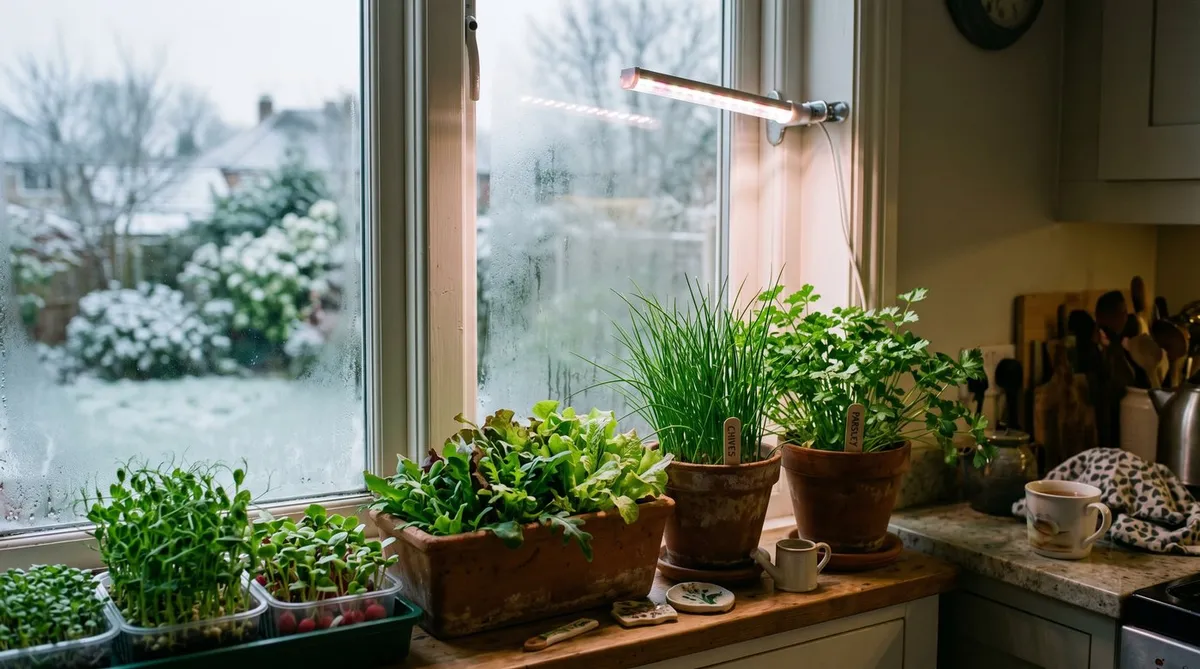
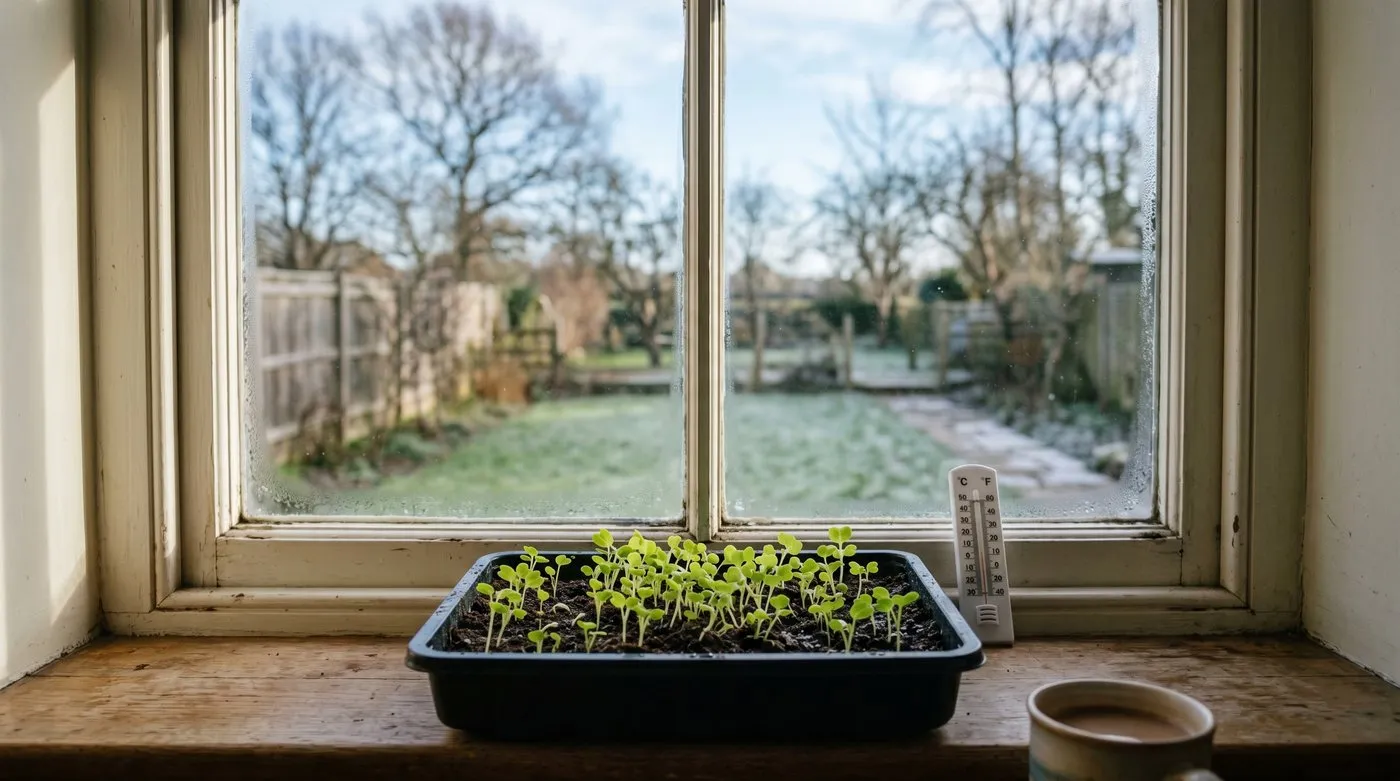 A south-facing kitchen sill in December. Midday light here measured 4,200 lux, against 38,000 lux outdoors the same hour.
The crops that genuinely work from November to February
Microgreens (the no-light winners)
Microgreens are seedlings harvested at the first true-leaf stage, 5 to 10cm tall. Because you eat them so young, they barely need light. Radish, broccoli, mustard and cress crop in 5 to 10 days; pea and sunflower shoots in 10 to 16 days. Grow them at 15 to 18 Celsius in a shallow tray of compost. A single 18 by 14cm tray yields 50 to 120g. They are the one crop that works on a dull north sill. Read our full method in how to grow microgreens.
Pea shoots
Sprouting seeds and cress
Sprouts need no soil, no light and no sill at all. Rinse seeds in a jar twice a day and they crop in 2 to 6 days in a kitchen cupboard. Alfalfa, mung bean, broccoli and radish all sprout reliably at room temperature. Cress on damp kitchen roll crops in 5 to 7 days on any windowsill. Our guides to windowsill sprouts and microgreens and growing sprouts and shoots cover the jar method in full.
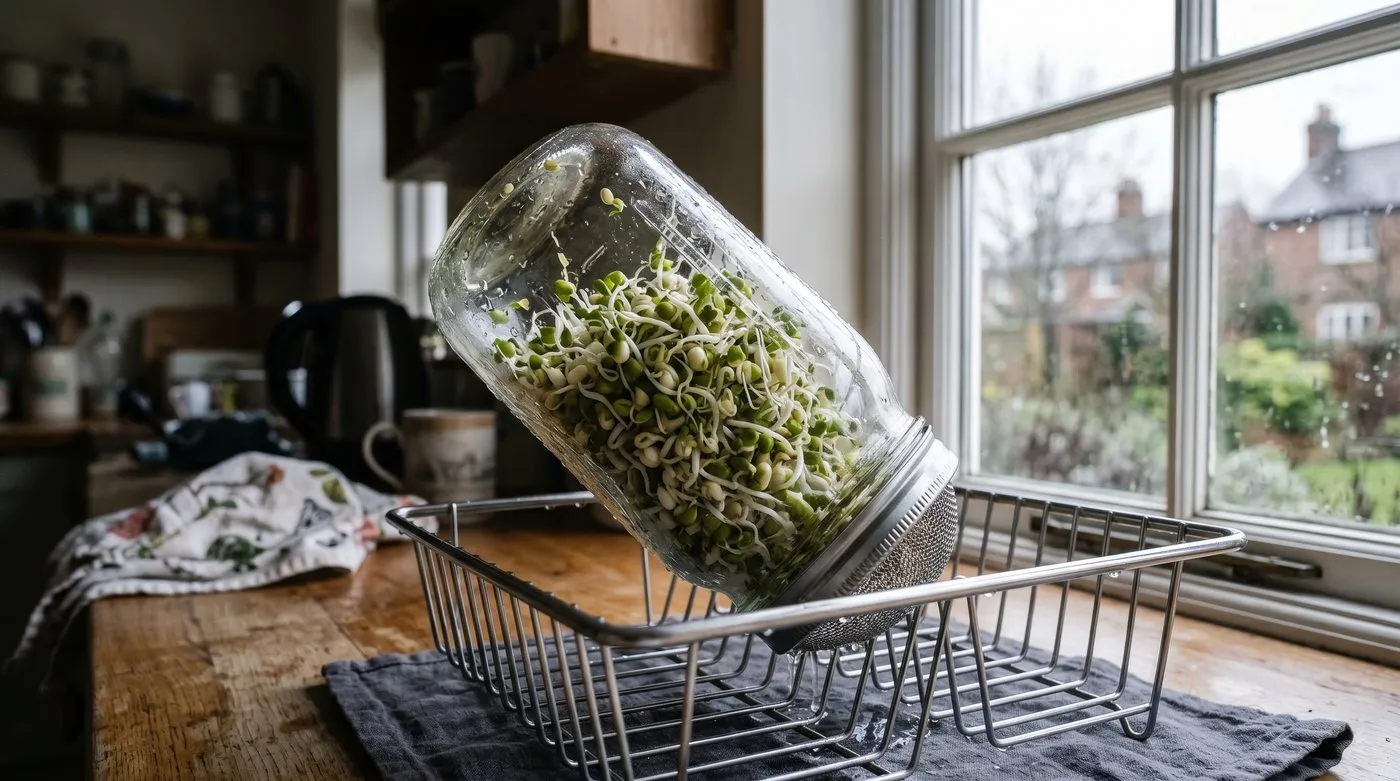 Mung bean and alfalfa in a sprouting jar, ready in 2 to 6 days. Sprouts need no soil, no light and no windowsill at all.
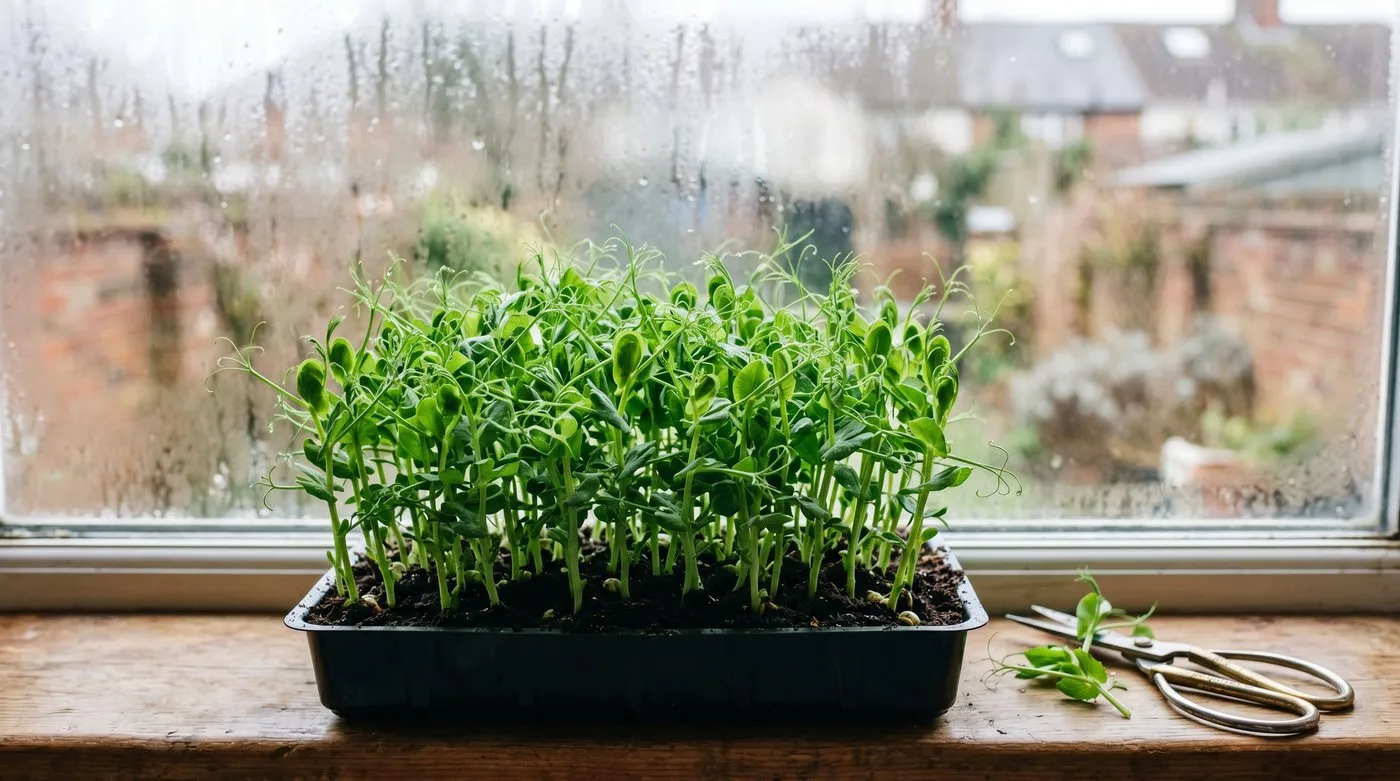 Pea shoots ready to cut at 11 days on a warm kitchen sill. The same sowing in a cold porch took 19 days.
Winter salad leaves
Cut-and-come-again salad is the closest you get to a real harvest indoors. Pick the right cold-tolerant varieties and you get three to four cuts over winter. The reliable performers are mizuna, mustard ‘Red Frills’, winter lettuce ‘Winter Density’, land cress, and lamb’s lettuce (corn salad). All grow at 8 to 15 Celsius and tolerate dull light better than most. Sow in a 15cm-deep trough, snip leaves at 8 to 10cm, and let the plant regrow. First cut comes in 28 to 45 days in winter, against 21 days in summer. Land cress and lamb’s lettuce keep going to 5 Celsius. See winter salad harvesting and our guide to growing corn salad for variety detail.
Baby spinach and rocket
Baby spinach and wild rocket both crop as young leaves indoors, picked small at 6 to 8cm. They are slower than mustard, taking 35 to 50 days to a first cut in winter, and need the brightest sill you have or they stretch. Spinach prefers cooler conditions and bolts less in a 10 to 15 Celsius room.
Herbs
Chives, parsley, coriander and mint all hold through winter indoors with enough light. Chives can be forced: lift a clump from the garden in autumn, pot it, and it pushes fresh green spears at 12 to 18 Celsius. Parsley and coriander are slow but steady on a south sill. Mint tolerates a dull north sill better than any other herb. Supermarket pots can be split and grown on, as covered in keeping supermarket herbs alive indoors.
Spring onions and garlic greens
Spring onions regrow from kitchen scraps. Stand the white root ends in a glass of water on a sill and they push new green shoots in 7 to 10 days, good for two or three cuttings. Garlic greens work the same way: plant a sprouting clove and snip the green tops like chives. Neither makes a bulb indoors in winter, but the greens are a free, fast harvest.
Radishes and overwintered chillies
Radishes can crop indoors in a cool porch at 8 to 12 Celsius, taking 35 to 50 days in winter against 21 outdoors in summer. They need a 15cm-deep pot and a bright sill or they make leaf and no root. Overwintering chilli plants is the one fruiting crop worth keeping indoors, but for survival not cropping. Cut a plant back to 10cm, keep it at 12 to 15 Celsius on a bright sill, water sparingly, and it will reshoot in spring.
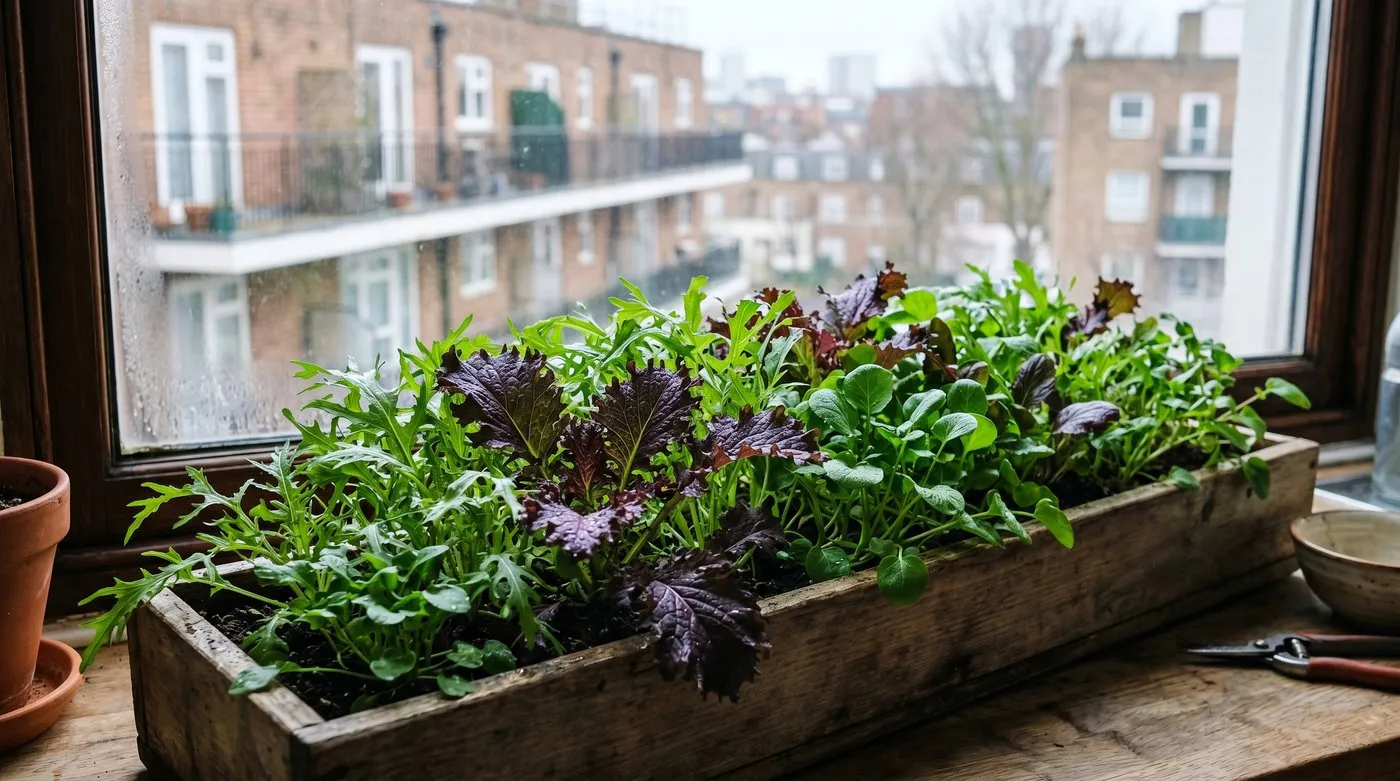 A 15cm trough of mizuna, mustard ‘Red Frills’ and land cress at 32 days. Cut-and-come-again leaves regrow three to four times over winter.
How much light winter crops really need
Light is the single biggest factor in winter success indoors, and most disappointment comes from misreading it. The crops split into three light groups.
No extra light needed: microgreens, sprouts and cress. You harvest them before strong light matters. A dull north sill or even a kitchen worktop is fine.
A bright sill is enough: pea shoots, mizuna, mustard, land cress, lamb’s lettuce, mint and forced chives. A south or south-east sill giving two to four hours of weak winter sun keeps these cropping, if slowly.
A grow light helps a lot: baby spinach, rocket, lettuce, coriander, parsley and radishes. On a natural winter sill these stretch and pale. A small LED transforms them.
When a grow light earns its keep
A 20 to 40 watt full-spectrum LED suits one or two trays. Hang it 20 to 30cm above the leaves and run it 12 to 14 hours a day on a plug-in timer. A 30 watt panel on 13 hours uses about 0.4 kWh a day. At 28p per kWh that is roughly 11p a day, or under 4 pounds a month. Cheap clip-on LED bars cost 15 to 30 pounds. You do not need an expensive grow tent for a windowsill.
The honest truth: without enough light, leafy winter crops go leggy. Stems stretch thin and pale, leaves stay small, and flavour weakens. If your seedlings lean hard towards the window and topple, that is the signal to add a light or switch to microgreens, which do not care.
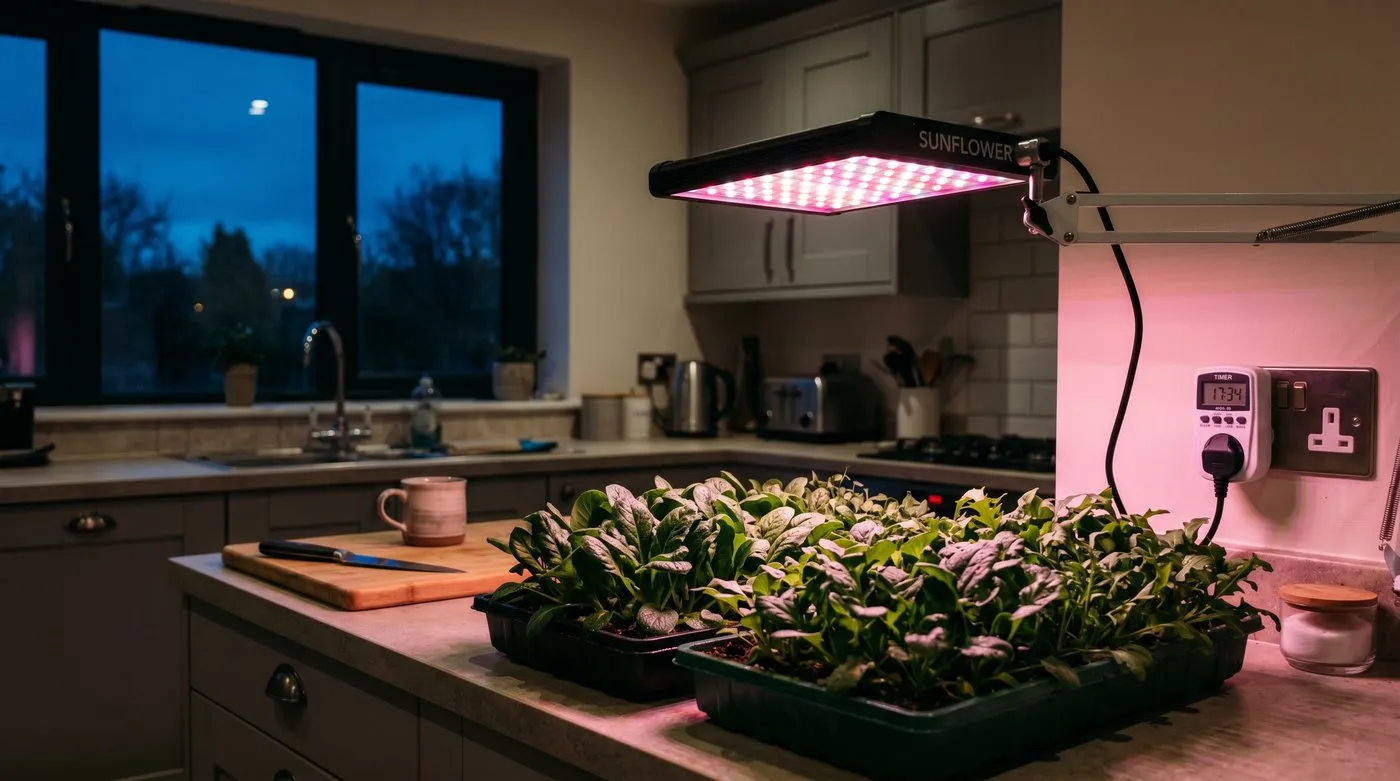 A 30 watt LED panel 25cm above the leaves, on a 13-hour timer. Running cost is around 11p a day.
Managing temperature, humidity and cold sills
Warmth matters as much as light in winter, and the cold-glass swing catches most growers out. Aim for a steady 15 to 18 Celsius for fast growth and never let crops sit below 5 Celsius.
Draughts chill plants and dry leaves. Keep trays away from a door that opens to the cold and from the direct blast of a radiator, which scorches and parches young leaves.
Humidity runs low in a centrally heated UK home, often 30 to 40 percent. Microgreens and seedlings prefer 50 to 60 percent. A clear propagator lid or a loose freezer bag over a freshly sown tray holds moisture until germination, then comes off to stop damping off. A pebble tray of water under herb pots lifts local humidity without wetting the compost.
Gardener’s tip: Stand a cheap min-max thermometer on the sill for a week before you sow. Knowing your sill drops to 6 Celsius at dawn tells you to grow land cress and lamb’s lettuce, not coriander. Measure first, sow second.
What fails indoors in winter and why
Setting expectations saves money and disappointment. These crops do not work indoors from November to February, and the reasons are physics, not technique.
Tomatoes, peppers and cucumbers. These fruiting crops need 6 to 8 hours of strong direct light and 18 to 24 Celsius to set and ripen fruit. A UK winter sill gives neither. A plant may survive, but it will not flower or fruit. Sow these in March, not December.
Firm-hearted lettuce. Hearting types like ‘Little Gem’ need bright light to form a dense centre. In low winter light they bolt loose and leggy. Grow loose-leaf and cut-and-come-again types instead.
Root vegetables for full roots. Carrots, beetroot, parsnips and turnips will not bulk a root indoors in winter. They make thin pale tops and nothing below. Radishes are the only root worth attempting, and only in a bright cool porch.
Brassicas to maturity. A cabbage or Brussels sprout needs months of strong light and outdoor space. Indoors you can crop their seedlings as microgreens, but never a head.
Step by step: a microgreens tray
Microgreens are the best first winter crop because they ignore the light problem. This method works on any sill from November to February.
- Fill a shallow tray (18 by 14cm, 4cm deep, drainage holes) with 2 to 3cm of peat-free multipurpose compost. Firm it level.
- Sow thickly. Scatter seed so it almost covers the surface. Radish, broccoli, mustard, cress or pea are reliable winter starters.
- Cover lightly. Press large seeds in and sieve 3mm of compost over them. Leave tiny seeds like cress uncovered.
- Water from below. Stand the tray in 1cm of water for ten minutes, then drain. This avoids dislodging seed.
- Cover until germination. A propagator lid or loose bag holds humidity. Keep at 15 to 18 Celsius. Remove the cover the moment shoots appear.
- Move to the brightest sill. Light now prevents legginess. Mist if the surface dries.
- Harvest in 7 to 14 days. Snip at compost level with scissors when the first true leaves show. Expect 50 to 120g a tray.
Step by step: a cut-and-come-again salad trough
A salad trough gives weeks of leaves from one sowing. Pick cold-tolerant varieties and a bright sill or LED.
- Use a trough at least 15cm deep with drainage. A window box on a worktop works well.
- Fill with peat-free compost and firm to 2cm below the rim.
- Sow in rows or scatter. Mix mizuna, mustard ‘Red Frills’, ‘Winter Density’ lettuce, land cress and lamb’s lettuce. Sow 1cm deep.
- Water in and keep at 10 to 15 Celsius. Germination takes 7 to 14 days in winter.
- Add light if needed. A 20 to 40 watt LED for 13 hours stops the leaves stretching.
- Cut at 8 to 10cm. Snip outer leaves with scissors and leave the growing centre. First cut comes in 28 to 45 days.
- Let it regrow. Water lightly and feed fortnightly with half-strength liquid feed. Expect three to four cuts before the plants tire.
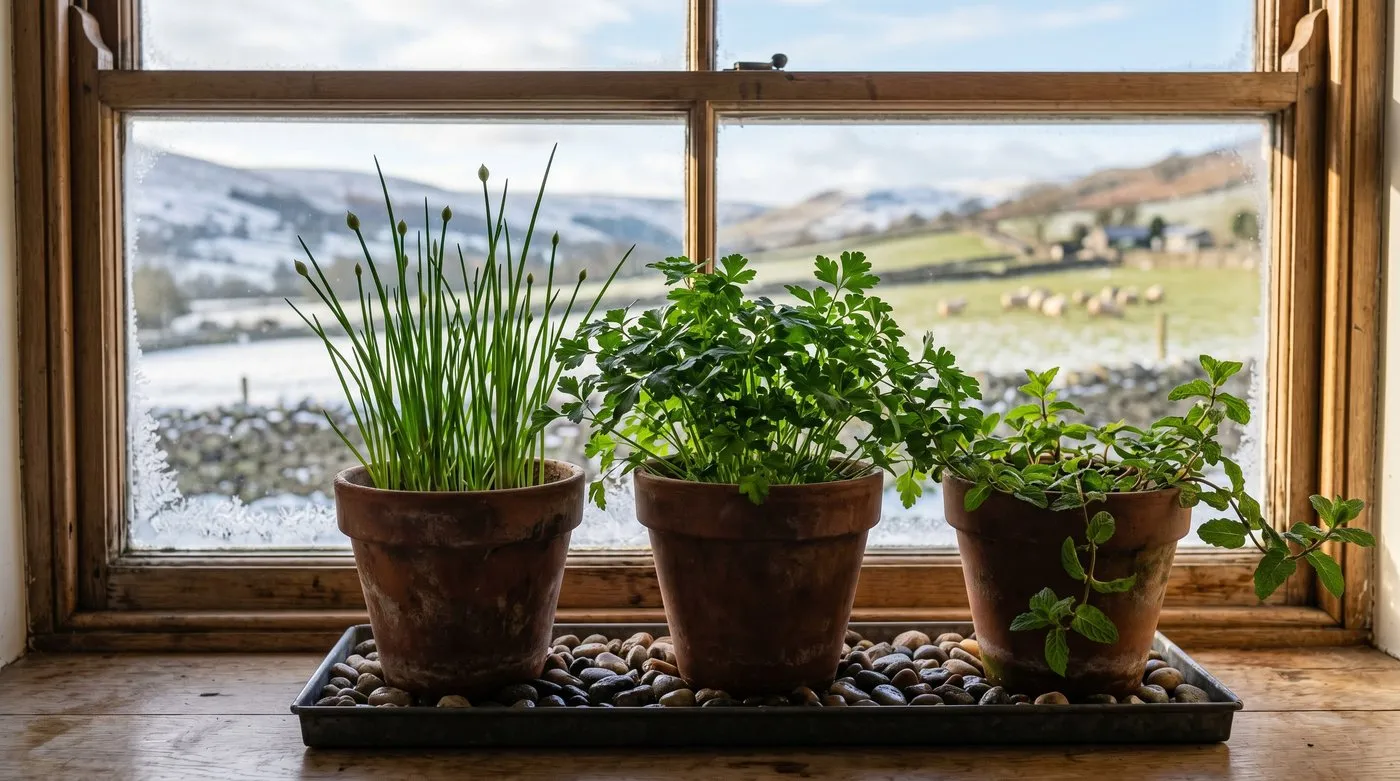 Forced chives, parsley and mint on a south sill in January. Mint copes with a dull north sill better than any other herb.
Winter indoor crop comparison
This table ranks the reliable winter crops by how easy they are to crop indoors, from the most forgiving down. All figures are for November to February in a UK home.
| Crop | Min temp | Light need | Days to first harvest | Difficulty | Yield per sowing |
|---|---|---|---|---|---|
| Sprouts (jar) | 15C | None | 2-6 days | Very easy | 100-200g |
| Microgreens | 12C | None to low | 5-14 days | Very easy | 50-120g per tray |
| Cress | 10C | Low | 5-7 days | Very easy | 30-50g per tray |
| Pea shoots | 10C | Low to medium | 11-19 days | Easy | 60-95g per tray |
| Mustard ‘Red Frills’ / mizuna | 8C | Medium | 28-40 days | Easy | 3-4 cuts |
| Lamb’s lettuce / land cress | 5C | Low to medium | 30-45 days | Easy | 3-4 cuts |
| Spring onion (regrow) | 10C | Medium | 7-10 days | Easy | 2-3 cuttings |
| Winter lettuce ‘Winter Density’ | 8C | Medium to high | 35-45 days | Moderate | 3 cuts as loose leaf |
| Baby spinach / rocket | 8C | High | 35-50 days | Moderate | 2-3 cuts |
| Radish (cool porch) | 8C | High | 35-50 days | Hard | Small roots |
Month by month indoor winter calendar
UK conditions shift through the winter, so the best crop changes month to month. This calendar covers what to sow and harvest indoors.
| Month | Sow indoors | Harvest indoors |
|---|---|---|
| November | Microgreens, pea shoots, mizuna, mustard, land cress, lamb’s lettuce | Late autumn salad leaves, herbs, sprouts |
| December | Microgreens, sprouts, cress, pea shoots only (light too low for slow crops) | Microgreens, pea shoots, sprouts, regrown spring onions |
| January | Microgreens, sprouts, cress, pea shoots; start salad under an LED | Microgreens, pea shoots, sprouts, forced chives |
| February | Microgreens, salad leaves, spinach, rocket; sow chillies and tomatoes to plant out later | First salad cuts, microgreens, herbs, radishes from a cool porch |
By late February daylength is back above 10 hours and intensity climbs fast. That is the point to widen the range and start seed for the outdoor season.
Common mistakes growing vegetables indoors in winter
Five errors account for most failed winter crops indoors. Each one traces back to misreading light or warmth.
Overwatering in low light. Plants drink far less in dull, cool conditions. Soggy compost in low light invites damping off, where seedlings rot at the base and collapse. Water only when the surface feels dry, and water from below where you can.
Too little light. The classic winter fault. Seedlings stretch tall, pale and floppy reaching for weak light. Move to the brightest sill, add a 20 to 40 watt LED, or grow microgreens that do not need light.
Sowing fruiting crops. Tomatoes and peppers in December waste compost and hope. They cannot fruit without summer light. Keep these for a March sowing.
Leaving trays on a cold sill overnight. Roots chilled to 5 Celsius behind a curtain stall for days. Move trays back into the room at dusk on frosty nights.
Sowing slow crops in deep midwinter. Lettuce and spinach sown in December crawl along in the dark. Stick to microgreens and pea shoots from late November to mid-January, then widen out as light returns.
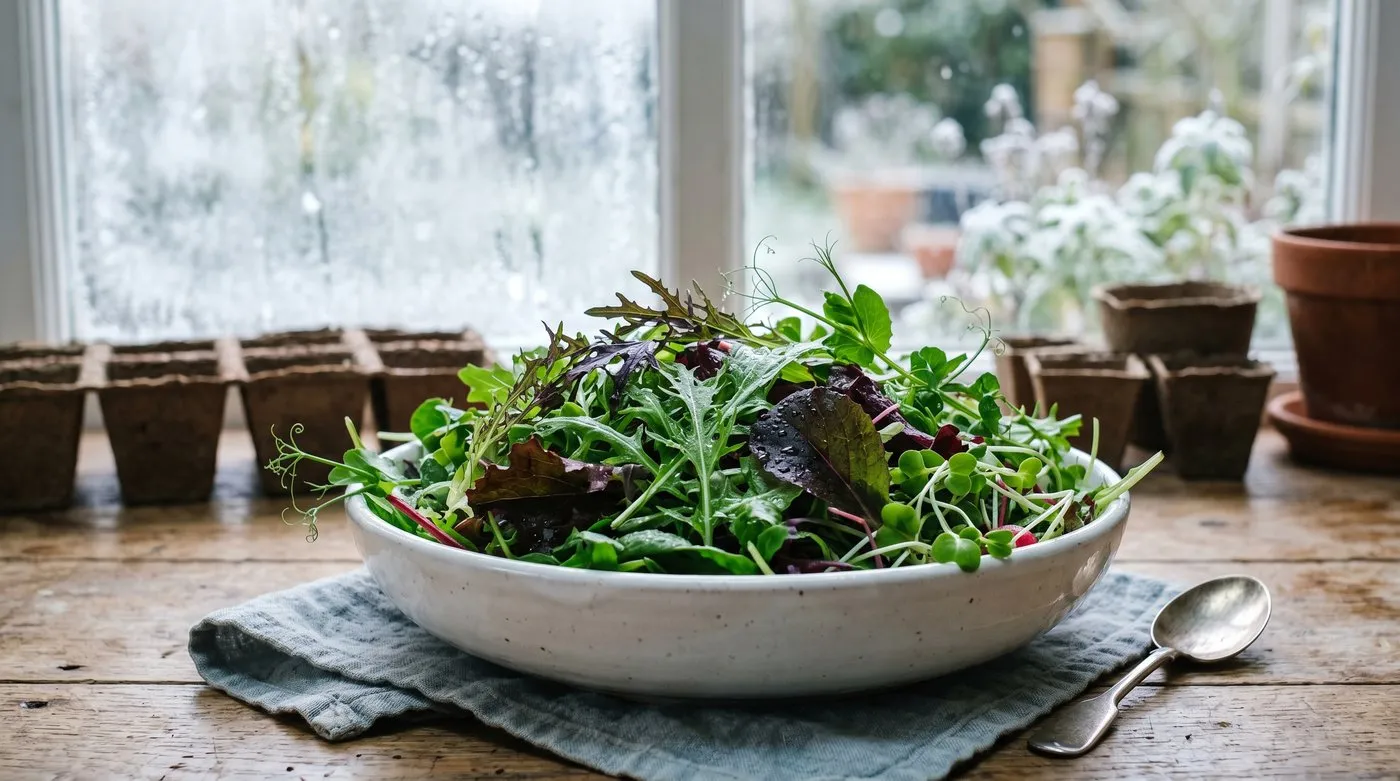 A January cut from one trough and two microgreen trays. Fast leaf crops give a real harvest when fruiting crops cannot.
Eight winters of logging on two Staffordshire sills produced clear patterns worth sharing, because most are not in any general indoor-growing guide.
Warmth beat light for fast crops. Pea shoots on the warm 18 Celsius kitchen sill cropped in 11 days at 95g a tray. The same sowing in the 5 Celsius porch took 19 days for 60g, despite both getting weak winter light. For microgreens and shoots, a steady warm sill matters more than the brightest window.
Variety choice decided salad success. Of the salad leaves trialled, mustard ‘Red Frills’ and mizuna gave the most usable winter leaf, three to four cuts before tiring. ‘Winter Density’ lettuce managed three cuts but stretched without an LED. Lamb’s lettuce was slowest but cropped through the coldest porch nights down to 4 Celsius, when everything else stalled.
The LED paid for itself in leaf quality. Salad under a 30 watt LED stayed compact and dark green. The same varieties on the natural sill grew 40 to 60 percent taller with thinner, paler leaves and noticeably weaker flavour. For leaf crops in the darkest weeks, the light was the difference between a real crop and a sad one.
Frequently asked questions
What vegetables can you grow indoors in winter in the UK?
Microgreens, pea shoots, sprouts, winter salad leaves and herbs grow indoors in winter. These are fast leaf crops that cope with short days and cool sills. Microgreens need no extra light at all. Salad leaves and herbs crop better with a south-facing sill or a small LED grow light from November to February.
Can you grow vegetables indoors without a grow light in winter?
Yes, microgreens and sprouts grow with no extra light at all. Microgreens are harvested as seedlings before they need strong light, so a dim winter sill is fine. Sprouting seeds grow in a jar in a kitchen cupboard. Salad leaves and herbs grow without a light but turn pale and leggy on a dull windowsill.
Why do my indoor winter plants grow tall and floppy?
Too little light makes seedlings stretch and flop. This is called legginess and it is the main winter problem indoors. In low light a plant reaches upward for more, producing thin, weak, pale stems. Move plants to the brightest sill, add a 20 to 40 watt LED on a timer, and sow leaf crops you eat young rather than fruiting crops.
What temperature do indoor winter vegetables need?
Most winter leaf crops grow well at 10 to 18 Celsius. Microgreens and salad leaves germinate fastest at 15 to 18 Celsius. Cold-tolerant crops like land cress and lamb’s lettuce keep going down to 5 Celsius. Keep trays off cold glass at night, when an uninsulated UK sill can drop to 4 to 6 Celsius behind the curtain.
How long do microgreens take to grow in winter?
Most microgreens crop in 7 to 14 days, even in winter. Fast types like radish, cress and mustard reach harvest in 5 to 10 days. Pea shoots and sunflower shoots take 10 to 16 days. Cooler rooms slow growth, so a tray on a warm kitchen sill crops several days faster than one in a chilly porch.
Can you grow lettuce indoors over winter in the UK?
You can grow loose-leaf and cut-and-come-again lettuce, not firm hearts. Hearting types need more light and warmth than a UK winter sill gives. Sow cut-and-come-again varieties like ‘Winter Density’ picked young as loose leaves. Pick the outer leaves and the plant regrows two to four times over the winter.
Start with the easiest winter crop
Winter growing indoors rewards anyone who matches the crop to the conditions. Start with a microgreens tray, since it ignores the light problem and crops in under two weeks, then add a salad trough once you trust your sill. For the full sprouting and shoot method that needs no light or soil at all, read our guide to growing sprouts and shoots, and browse more seasonal food-growing guides in our growing section. The Royal Horticultural Society holds further detail on individual salad and herb varieties.
Our team produces practical UK gardening guidance from source research, contributor records and established horticultural practice. Editorial standards are overseen by Matt W.