Key takeaways
- Allium fistulosum is a true perennial, cropping from the same clump for 10 years
- Spring onions are annual and pulled whole, Welsh onions are cut and regrow
- Sow at a soil temperature of 12 to 20C, germinating in 10 to 14 days
- Cut leaves 3cm above the base and expect regrowth in 18 to 25 days
- Divide congested clumps every 3 years, in March or September
- Hardy to minus 15C and green through winter when spring onions are gone
Welsh onions are the vegetable most British gardeners buy by accident and then never plant again properly. They are perennial bunching onions, botanically Allium fistulosum, and they are not spring onions. That distinction is the whole point of this guide. A spring onion is an annual you sow, pull and replace. A Welsh onion is a clump you plant once and cut from for a decade.
Get the difference right and you gain a crop that stands green through a Midlands winter, regrows in under a month after cutting, and costs nothing after the first packet of seed. Get it wrong and you treat a permanent plant like a disposable one, pull the clumps, and wonder why they never come back.
Welsh onions versus spring onions, the difference that matters
The confusion is understandable because supermarkets label both as spring onions. In the ground they behave nothing alike.
Spring onions are almost always Allium cepa, the same species as a maincrop onion, grown as an immature annual. ‘White Lisbon’ is the standard UK variety. You sow it, wait 8 to 10 weeks, pull the whole plant, and the plant is gone. Succession sowing every three weeks keeps you supplied from June to September, then nothing.
Welsh onions are Allium fistulosum, a distinct species that never forms a proper bulb. The base swells slightly into an elongated shank and then splits. One plant becomes three, three become nine, and a clump 25cm across builds within two seasons. You harvest by cutting the hollow leaves and the plant regrows from the base.
| Feature | Welsh onion (A. fistulosum) | Spring onion (A. cepa) |
|---|---|---|
| Life cycle | Perennial, 10 years plus | Annual, one harvest |
| Harvest method | Cut leaves, plant regrows | Pull whole plant |
| Bulb | None, elongated shank only | Small forming bulb |
| Winter standing | Green to minus 15C | Dies or bolts |
| Sowings per year | One, or none after year one | Every 3 weeks, March to July |
| Role on the plot | Permanent perennial bed | Rotation salad crop |
The Welsh onion is the gold standard for year-round supply, because it delivers usable green leaf in February and November when no spring onion is standing. Spring onions still win on one point: the crisp white bulb-end for salads. Grow both, in different beds. Our guide to growing spring onions covers the annual crop and its succession timings in full.
Where Welsh onions came from and why the name misleads
Welsh onions have nothing to do with Wales. The plant originates in western China, where it has been cultivated for over 2,000 years, and it is the standard bunching onion of Japanese and Korean cooking. The name comes from the Old German welsche, meaning foreign or non-native, which was applied to the plant when it reached northern Europe.
It arrived in Britain in the seventeenth century and appears in cottage garden records through the Victorian period as a reliable winter salad. It fell out of favour once commercial spring onion seed became cheap, and it is only now returning through the perennial vegetable revival.
Understanding the origin helps in the garden. This is a plant adapted to continental conditions with cold winters and hot summers, not to a Mediterranean climate. It shrugs off frost and dislikes drought. On a British plot that means it wants moisture-retentive soil and no fleece, which is the opposite of how gardeners instinctively treat an onion.
Choosing between ‘Ishikura’, ‘Red Welsh’ and the rest
Three types cover almost every UK need. Seed comes from Kings Seeds, Chiltern Seeds and Real Seeds, typically £2.20 to £3.50 a packet for 200 to 500 seeds.
| Variety | Type | Shank | Hardiness | Role |
|---|---|---|---|---|
| ’Ishikura’ | Japanese bunching | 30 to 40cm white | Minus 10C | Gold standard, longest blanched stem |
| ’Red Welsh’ | Traditional Welsh onion | 10cm red-flushed | Minus 15C | Toughest, best for cold wet ground |
| ’White Welsh’ | Traditional Welsh onion | 10cm white | Minus 15C | Heaviest leaf yield, mildest flavour |
| ’Performer’ | Modern bunching | 25cm white | Minus 8C | Uniform, best for a market row |
| ’White Lisbon’ | Spring onion, not a Welsh onion | 8cm white | Not hardy | Contrast crop only, annual |
‘Ishikura’ is the one to grow if you want a single variety. It produces the longest, straightest shanks, up to 40cm when earthed up, and the thickest leaves for cutting. It splits more slowly than ‘Red Welsh’, so clumps stay tidy for longer.
‘Red Welsh’ earns its place on cold, heavy or exposed plots. It has survived every winter on our Staffordshire clay since 2019, including minus 12C in December 2022 with no protection. The leaves are thinner and the flavour noticeably sharper. ‘White Lisbon’ sits in the table only as the contrast: it is a spring onion, and it will not overwinter or regrow.
Seed remains the only route to some varieties. ‘Red Welsh’ in particular is rarely sold as a plant, and it is the one worth the extra wait on cold, wet ground.
Sowing Welsh onion seed at the right soil temperature
Welsh onion seed is fussier about temperature than most gardeners expect. It germinates in 10 to 14 days at a soil temperature of 12 to 20C. Below 8C germination stalls entirely and the seed sits in cold ground until it rots. Above 25C the rate drops away again.
In practice that means mid-March at the earliest in the South, and mid-April in the Midlands and North. Use a soil thermometer pushed 5cm into the bed. Guessing from air temperature is the usual cause of a failed first sowing.
Sow thinly in drills 1cm deep, with rows 25cm apart. Thin seedlings to 5cm at the three-leaf stage. Unlike a maincrop onion, you are not aiming for a wide-spaced single plant, because the clump will fill the space itself.
Module-sowing is the better route on cold or heavy ground. Sow 6 to 8 seeds per module in a 4cm cell, grow on at 15C, and plant the whole module out as a single mini-clump when roots fill the cell, around six weeks later. Space these mini-clumps 20cm apart. This method skips the slug-vulnerable seedling stage entirely.
A second sowing window opens in August. Plants overwinter small, then power away in March and give a heavy crop weeks ahead of a spring sowing.
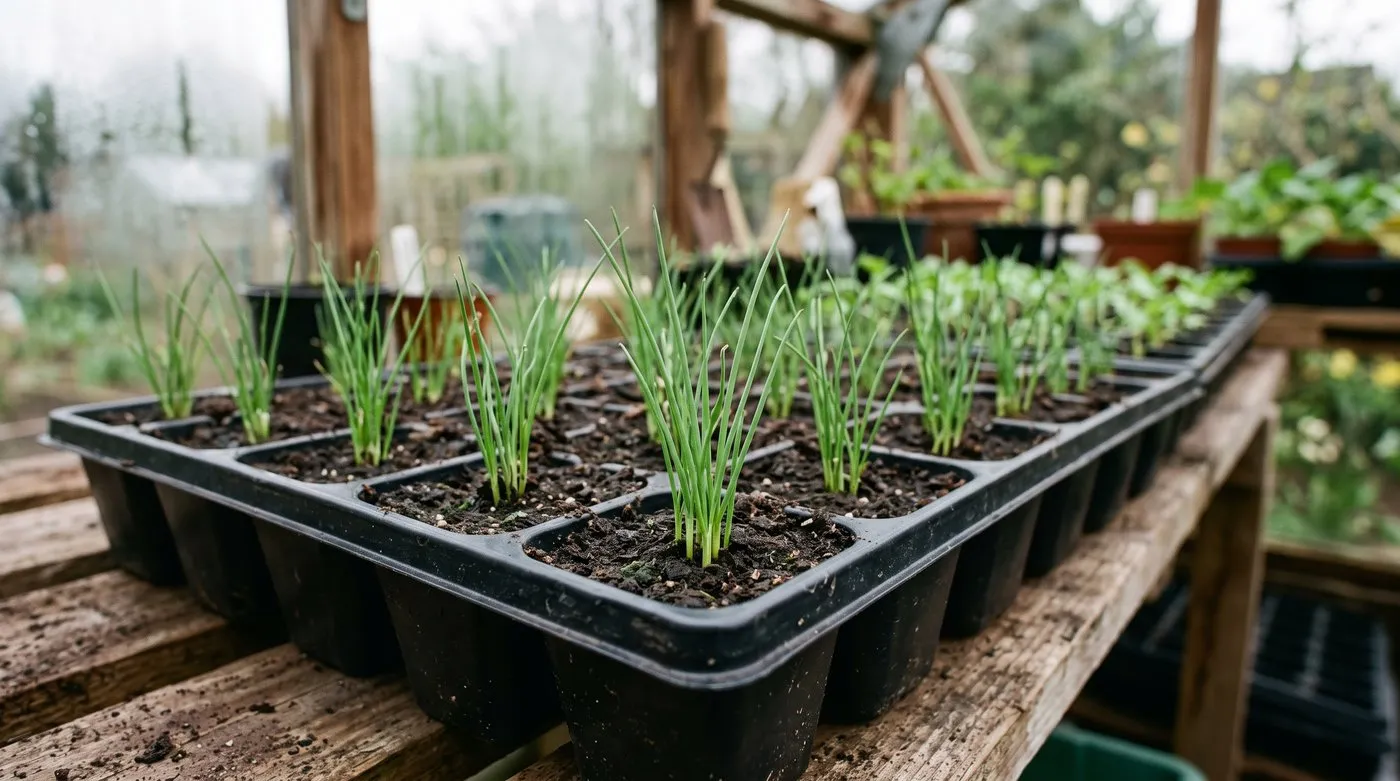 Multi-sown modules in a Birmingham allotment greenhouse. Six to eight seeds per cell go out as a single mini-clump, which skips the vulnerable direct-sown seedling stage.
The cut-and-come-again harvest method, stage by stage
This is where Welsh onions earn their keep, and where most people go wrong. The plant regrows from a basal growing point that sits just above the root plate. Damage it and regrowth slows or stops. The cycle runs in five stages.
- Establishment, 0 to 90 days. From sowing to first cut. Leave the plant entirely alone until leaves reach 25cm and the clump has at least four shoots.
- First cut. Take leaves with scissors 3cm above the base, cutting no more than half the shoots in one clump. Leave the rest to keep photosynthesis running.
- Regrowth, 18 to 25 days. New leaf pushes from the cut shank. Growth is fastest at soil temperatures of 12 to 22C and slows to 40 days plus below 8C.
- Second and later cuts. Rotate around the clump. A settled clump supports a cut every 21 days through the growing season, giving 8 to 12 cuts a year.
- Winter holding, November to February. Growth nearly stops. Leaves stay green and usable, but cut sparingly, no more than once every six weeks.
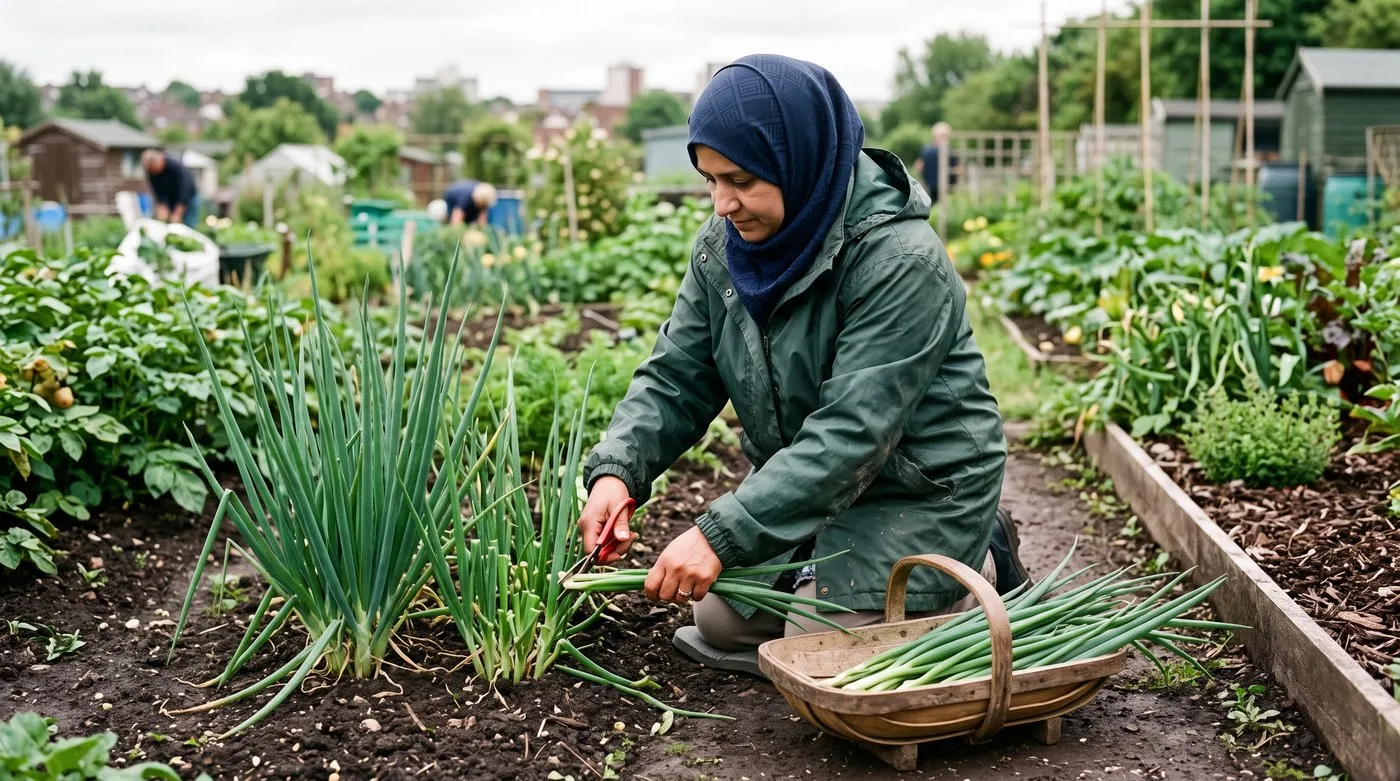 Cutting on a Birmingham allotment in June. The scissors go in 3cm above the base and only half the shoots in the clump are taken, which keeps the regrowth clock at three weeks.
Dividing Welsh onion clumps every three years
A Welsh onion clump multiplies by basal splitting. One shoot becomes two, and by year three a clump can hold 25 to 40 shoots in a 25cm circle. At that density the leaves thin, toughen and start to flop.
Divide in March or September, when the soil is workable and growth is active but not peak. Lift the whole clump with a fork, working 15cm out from the edge to keep the shallow roots. Shake off soil, then pull the clump apart by hand into groups of three to five shoots. A knife is rarely needed and cuts more roots than fingers do.
Trim leaves back to 10cm to reduce water loss, and trim any long straggling roots to 5cm. Replant at 20cm spacing, at the same depth the shoots were growing before. Water in well and keep moist for a fortnight.
Expect a three to four week pause before normal cutting resumes. One clump divided in March 2019 gave us eight plants, and those eight had become an unbroken 2m row by 2021.
Gardener’s tip: Divide in September rather than March if your plot is heavy clay. Autumn soil is warmer and the divisions root before winter, so you get a full crop the following March. Spring divisions on wet clay sit sulking until May.
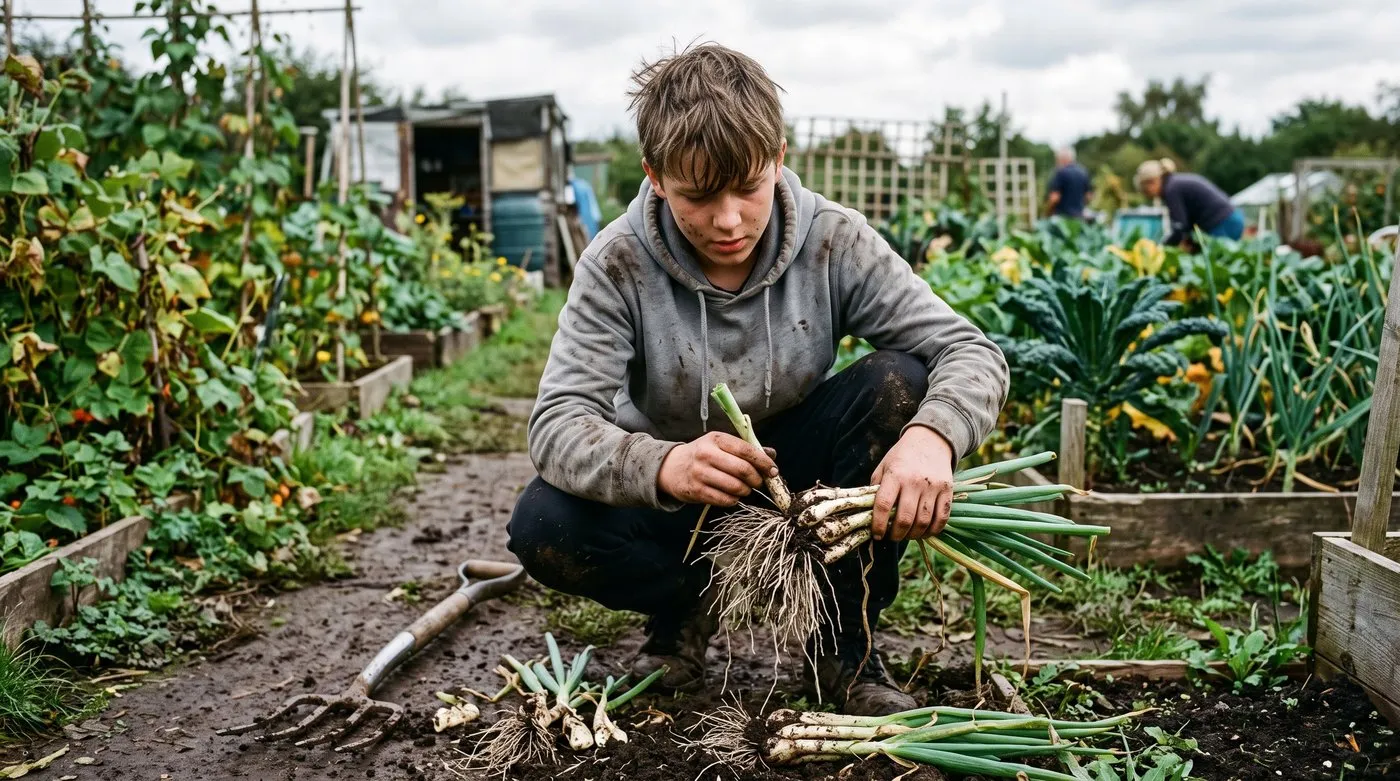 Splitting a three-year-old clump by hand in September. Groups of three to five shoots are pulled apart and replanted at 20cm spacing, with leaves trimmed to 10cm.
Soil, feeding and where Welsh onions fit in a rotation
Welsh onions want moisture-retentive but not waterlogged soil, at a pH of 6.0 to 7.0. They tolerate heavier ground than maincrop onions because they never form a storage bulb that can rot. Our Staffordshire clay-loam suits them better than it suits any Allium cepa.
Feed matters more than most guides admit. Cut-and-come-again cropping strips nitrogen fast. Apply 50g per square metre of pelleted chicken manure in March, and a second dose in July. Without it, leaves get progressively thinner from year two onwards. A mulch of 3cm of garden compost each spring holds moisture and feeds slowly.
Because they are perennial, Welsh onions sit outside your normal rotation. Give them a permanent bed, ideally at the end of a plot where they will not be disturbed. That does raise the same soil-borne disease question that governs any allium ground, and our guide to four-year crop rotation explains why a permanent allium bed needs watching.
Full sun is best, but Welsh onions cope with half a day of shade better than any other allium. That makes them useful on the shaded north edge of an allotment where little else earns its space.
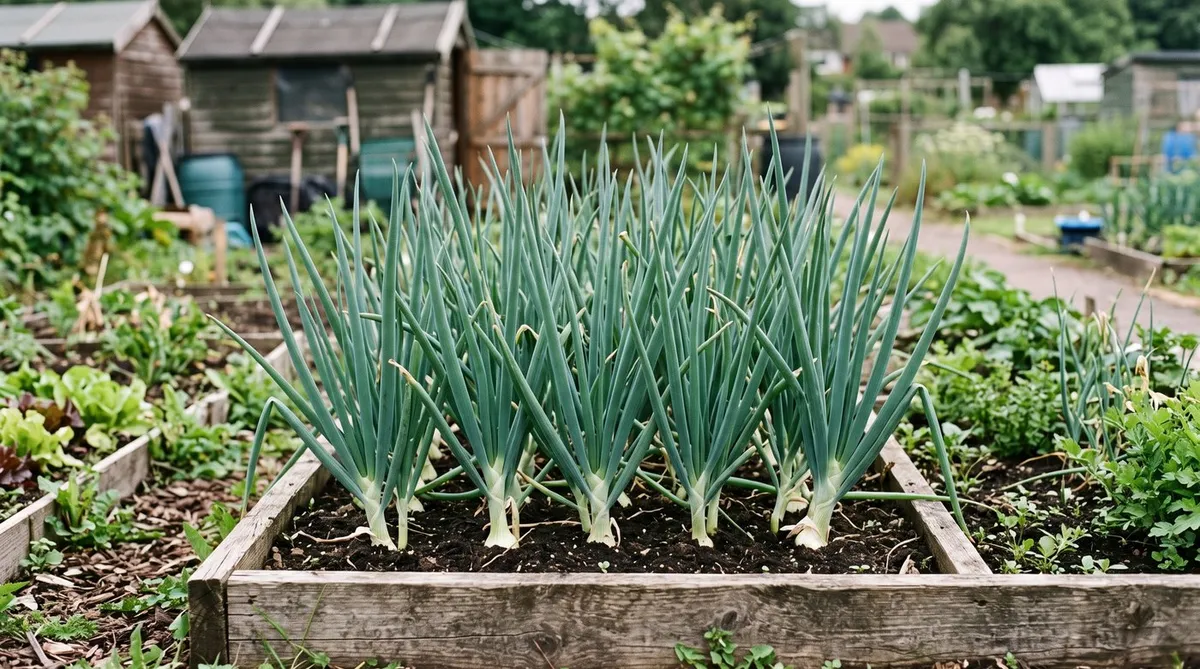
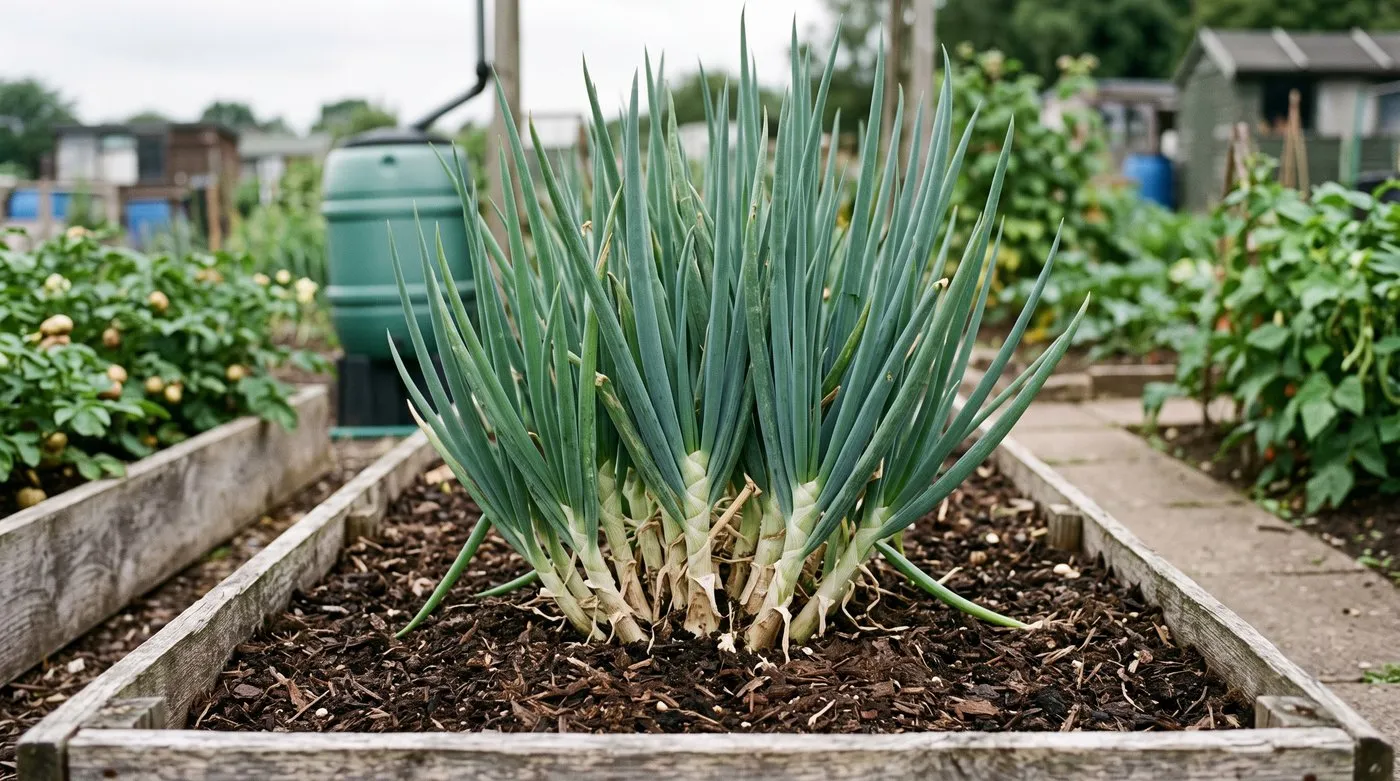 A four-year-old clump in its permanent bed on a Birmingham allotment. Thick hollow leaves and a base that has split into more than twenty shoots, all from one original plant.
Flowering, bolting and whether to let it happen
Welsh onions produce creamy-white spherical flower heads on hollow stalks in June and July, usually from the third year onwards. The flower stem is tough and inedible, and it diverts energy from leaf production.
Cut flower stems out at the base as soon as you spot the swelling bud. A clump allowed to flower drops leaf yield by roughly 30 per cent for the rest of that season in our observations.
There is a case for letting one clump flower. The blooms are strongly attractive to hoverflies and solitary bees, and self-sown seedlings appear around the parent the following spring. If you want free plants, sacrifice one clump in three and cut the rest. Guidance on supporting garden pollinators is set out well by Garden Organic.
Unlike spring onions, Welsh onions do not truly bolt in the damaging sense. A flowered spring onion is finished. A flowered Welsh onion simply carries on next season once the stem is removed.
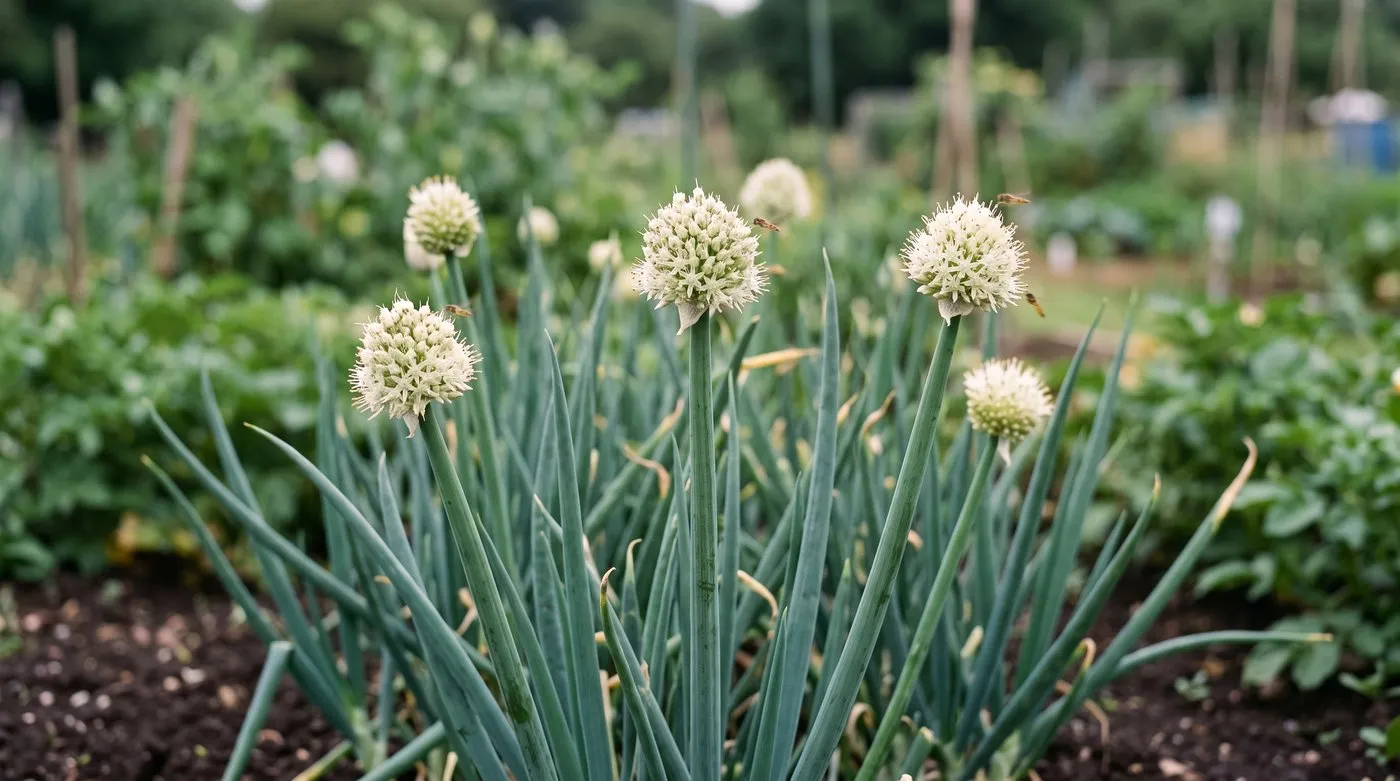 Flower heads in early July. One clump in three is left to bloom for the hoverflies, and the rest are cut out at the base to protect leaf yield.
Month-by-month Welsh onion calendar for UK plots
| Month | Task |
|---|---|
| January | Cut sparingly. Clear fallen leaves off clumps to stop rot at the base. |
| February | Apply a 3cm compost mulch. Uncloche any protected clumps late in the month. |
| March | Divide congested clumps. Sow seed once soil reaches 12C. Feed with chicken manure. |
| April | Thin direct-sown seedlings to 5cm. Plant out multi-sown modules at 20cm. |
| May | First cuts from established clumps. Keep beds weed free while plants are small. |
| June | Cut flower stems out at the base. Full cutting rotation every 21 days. |
| July | Second feed. Water in dry spells, 10 litres per square metre weekly. |
| August | Sow for overwintering. Continue cutting. Watch for onion root fly damage. |
| September | Best month to divide on clay. Replant divisions at 20cm and water in. |
| October | Reduce cutting frequency as growth slows. Tidy dead outer leaves. |
| November | Last significant cut. Clumps stand green through frost with no protection. |
| December | Leave alone. Cloche one clump in the North for winter kitchen supply. |
Why third-year clumps go thin and tough
The root cause of a declining Welsh onion clump is not age, disease or exhausted soil. It is basal congestion combined with nitrogen depletion, and the two arrive together at the same point in the plant’s life.
Here is the mechanism. Each shoot splits into two roughly every ten months. By month 30 a single planted shoot has become eight to twelve shoots packed into a circle 20cm across. Those shoots compete for the same root volume. Individual leaf diameter drops from around 12mm to 5mm, and the leaves toughen because they hold proportionally more fibre.
Gardeners misread this as the variety degenerating, or the plant “going over”. Many pull the clump out and start again from seed, losing two years. The plant is not failing. It is doing exactly what a bunching onion is supposed to do, and it has outgrown its space.
Common mistakes with Welsh onions
- Pulling the whole plant like a spring onion. The instinct is hard to break. Pulling destroys a perennial that would have cropped for a decade. Always cut, always 3cm above the base, and always leave half the clump standing.
- Sowing too early in cold soil. Seed sown into 6C soil in February simply rots. Wait for 12C, measured with a thermometer at 5cm depth, not guessed from the weather forecast.
- Never dividing. A clump left five or six years thins out and toughens. Gardeners blame the variety and buy new seed. Divide every three years and the same original plants crop indefinitely.
- Forgetting to feed a permanent bed. Cut-and-come-again cropping is hungry, and a perennial bed never gets the fresh compost a rotated bed receives. Two feeds a year, March and July, is the minimum.
- Letting every clump flower. Flowering costs about 30 per cent of the season’s leaf yield. Cut the stems as buds swell, and leave only one clump in three for the pollinators.
Warning: Welsh onions are attacked by the same pests as any allium. Onion root fly maggots hollow out the shanks and a permanent bed gives them a permanent home. Cover new divisions with insect mesh for six weeks after planting, and read our guide to onion root fly control before you site the bed.
What a Welsh onion bed costs to establish
The economics are the strongest argument for the crop. One packet of ‘Ishikura’ seed costs £2.20 to £3.50 and holds 300 to 500 seeds. That is enough to plant a 3m row with plenty spare. After the first year you never buy seed again, because divisions supply every replacement.
Compare that to spring onions. Keeping a household supplied from June to September needs five successional sowings, which is two to three packets a year at £2 to £3 each. Over ten years that is £40 to £90 in seed for a crop that stops in autumn.
Hidden costs on the Welsh onion side are modest. Pelleted chicken manure runs about £12 for 8kg, and a 3m row uses roughly 300g a year across two feeds. Insect mesh at £8 to £15 for a 3m length lasts five seasons. A soil thermometer, genuinely worth buying, is £8 to £12.
Total ten-year cost for a productive 3m row sits under £45, against £90 or more for the equivalent in spring onions, with a longer season and no annual sowing work. Rust and other leaf problems are the main thing that can undercut that, and the same treatment principles apply as in our guide to leek rust.
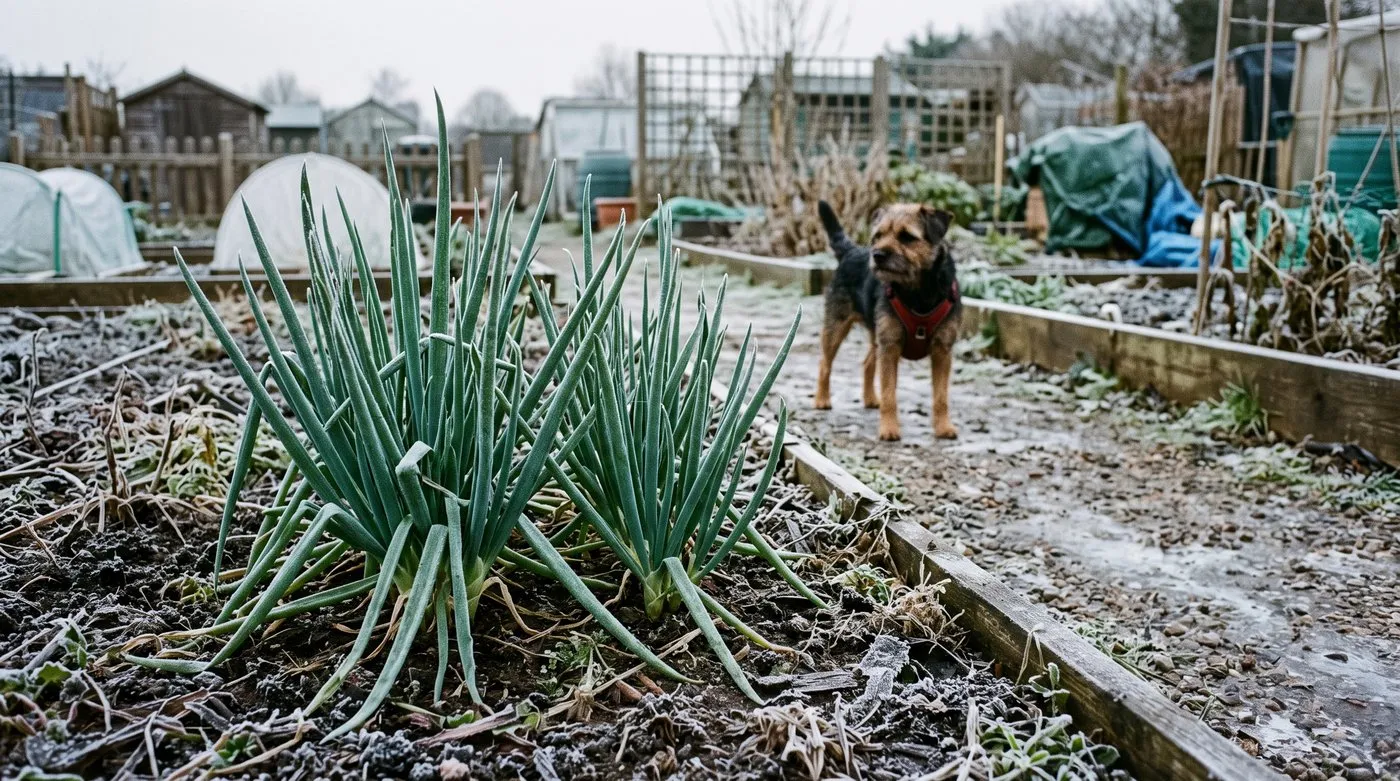 January on a Birmingham allotment. The clumps are frosted but fully green and cuttable, which is the whole case for growing a perennial onion.
Cooking and storing what you cut
Welsh onion leaves are hollow and milder than a chive but sharper than a spring onion. Use them raw, chopped into salads and dressings, or added to a stir fry in the last 30 seconds of cooking. Longer heat collapses them entirely.
The shank, the thickened white base, is the prize on ‘Ishikura’. Earth up soil or dry leaf mould around the base to 15cm in early summer to blanch a longer, sweeter section. Cut the shank from a shoot you are removing during division rather than from a plant you want to keep.
Cut leaves keep five to seven days in a sealed bag in the fridge, which is longer than a pulled spring onion because there is no wet root plate to rot. They also freeze well chopped, holding usable flavour for six months, though the texture goes soft. For the wider allium picture in the kitchen garden, our guide to growing chives covers the other perennial you should have in a permanent bed.
The RHS profile for Allium fistulosum confirms the H7 hardiness rating and flowering period used throughout this guide.
Frequently asked questions
What is the difference between Welsh onions and spring onions?
Welsh onions are perennial and cut repeatedly, spring onions are annual and pulled whole. Welsh onion is Allium fistulosum and forms a permanent clump that splits and thickens. Spring onions are usually Allium cepa varieties like ‘White Lisbon’, sown fresh every few weeks and lifted once.
Are Welsh onions actually from Wales?
No, Welsh onions come from China and have no connection to Wales. The name derives from the old German welsche, meaning foreign. They reached Britain in the seventeenth century and were grown widely in cottage gardens before spring onions took over.
When should I sow Welsh onion seed in the UK?
Sow from March to May once soil reaches 12C, or in August. Germination takes 10 to 14 days at 12 to 20C and stalls below 8C. An August sowing overwinters as small plants and gives a strong crop the following spring.
How do you harvest Welsh onions without killing the plant?
Cut leaves with scissors 3cm above the base, never pull the whole plant. Take no more than half the leaves from one clump at a time. Cutting flush to the soil damages the growing point and can double the regrowth time.
How often should you divide Welsh onion clumps?
Divide every three years, in March or September. A clump left longer becomes congested, and leaves get thinner and tougher. Lift the whole clump, pull it into groups of three to five shoots, and replant 20cm apart.
Do Welsh onions survive a British winter?
Yes, they are hardy to around minus 15C and usually stay green. Growth slows sharply below 5C but the leaves remain usable. In an exposed northern plot a cloche keeps the foliage in better cutting condition through January and February.
Which Welsh onion varieties are best for UK gardens?
‘Ishikura’ for thick white shanks, ‘Red Welsh’ for hardiness and colour. ‘Ishikura’ is the standard Japanese bunching type and gives the longest blanched stem. ‘Red Welsh’ is smaller and stronger flavoured but the toughest survivor on cold, wet ground.
Our team produces practical UK gardening guidance from source research, contributor records and established horticultural practice. Editorial standards are overseen by Matt W.