Key takeaways
- The number one beginner killer: an outdoor species (juniper, maple, larch) kept indoors, or a tropical tree left cold
- Chinese elm is the best first bonsai: forgiving, £30-60 at garden centres, happy in a cool bright room or outside
- Water by feel, never by rota: check daily and expect to water every day in July heat
- Indoor bonsai need the brightest windowsill in the house; most fade out slowly in dark corners
- Feed fortnightly from April to September and repot every 2-3 years in early spring with a root prune
- Outdoor bonsai need winter cold for dormancy: cold frame in hard frost below -4C only, never the house
Most bonsai tree care guides start with watering, but the mistake that kills most beginner trees in the UK happens earlier, in the shop. Bonsai is not one plant. Some are tropical houseplants, some are hardy outdoor trees, and each one dies in the other’s home. Get that single decision right and everything else is routine.
Why do most beginner bonsai trees die in the UK?
Most beginner bonsai die because an outdoor species is kept indoors, or a tropical species is left in the cold. Everything else, even bad watering, kills fewer trees than this one placement error.
Supermarkets and gift shops sell junipers as desk ornaments every Christmas. A juniper is a hardy conifer that needs a cold winter. Indoors it dies in 8 to 12 weeks, and conifers hold their green colour for weeks after death, so the owner blames the watering. It was never the watering.
The reverse happens too. Carmona, the Fukien tea tree sold for £15-25 in supermarkets, is tropical. Below about 10C it sheds leaves, and a cold porch or an unheated conservatory in January finishes it. Ficus wants a minimum of 12C all year.
Chinese elm sits between the camps. It tolerates a cool bright room and it tolerates a sheltered garden, which is a big part of why it makes such a good first tree. The species decides the position. The label often lies.
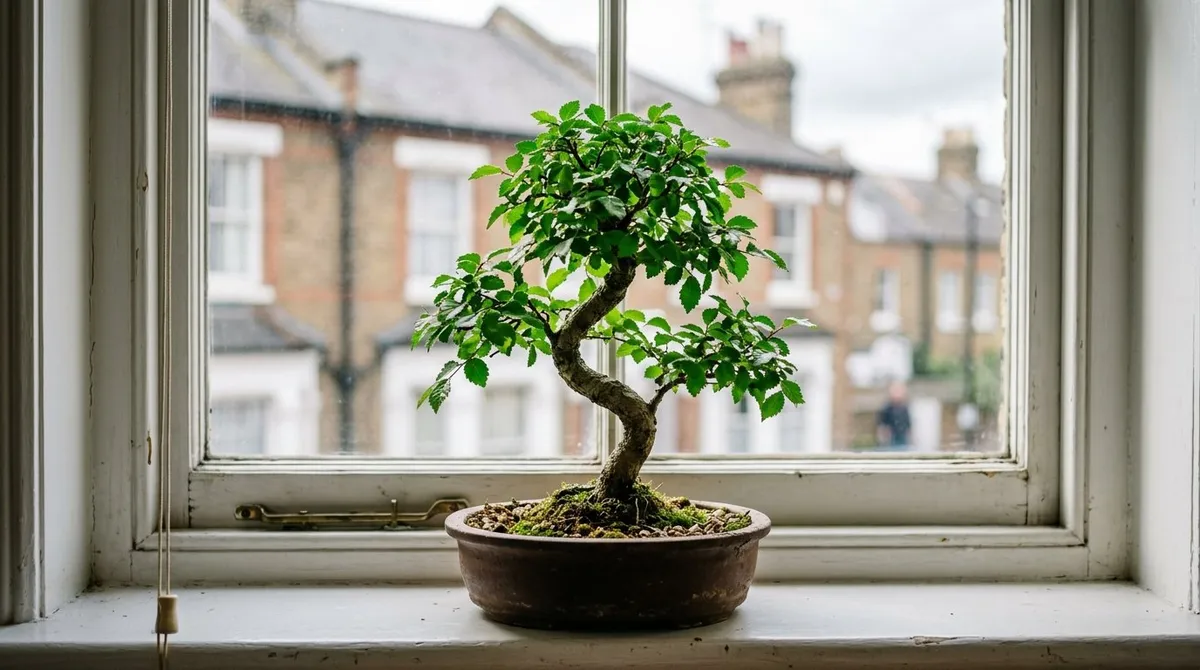
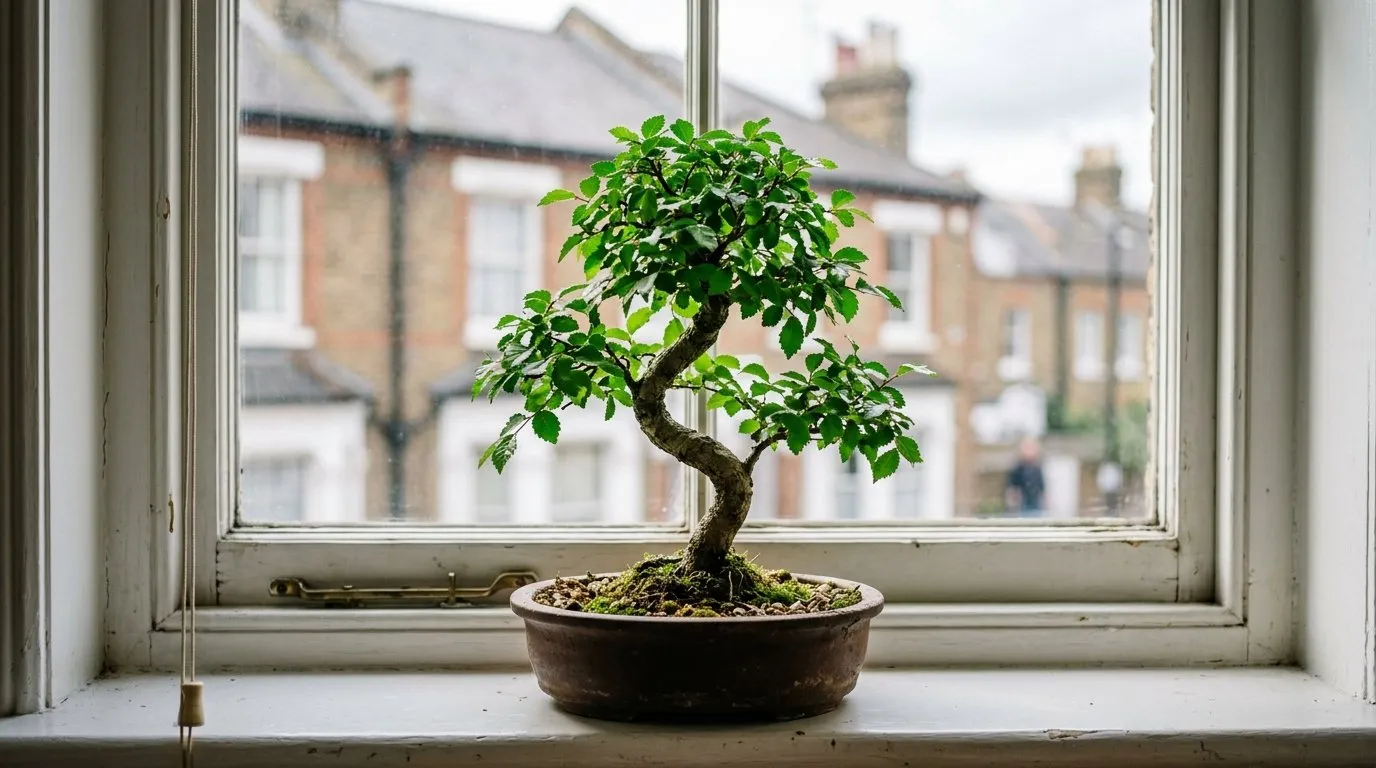 A Chinese elm within 30cm of the glass. Bright, cool and slightly humid beats warm and dark every time.
Indoor or outdoor bonsai: the first decision for beginners
Decide where the tree will live before you decide which tree you like. Indoor bonsai are tropical species that never see frost: Ficus retusa and Carmona retusa are the two you will meet most often. Outdoor bonsai are hardy trees that need real seasons: Juniperus chinensis, Acer palmatum (Japanese maple) and Larix decidua (European larch) lead the beginner list. The RHS bonsai guide adds Scots pine, yew and maidenhair tree for outdoor collections.
| Species | Type | Position | Winter treatment | Difficulty | Typical price |
|---|---|---|---|---|---|
| Ficus (Ficus retusa) | Tropical indoor | Bright windowsill, min 12C | Indoors, cut watering back | Easiest indoors | £20-40 |
| Carmona (Fukien tea) | Tropical indoor | Warm bright sill, 15C+ | Indoors, needs humidity | Fussy; poor first tree | £15-25 |
| Chinese elm (Ulmus parvifolia) | Borderline | Cool bright room or sheltered outside | Cold frame or cool room | Best first tree | £30-60 |
| Juniper (Juniperus chinensis) | Hardy outdoor | Outside all year, full sun | Outside; shelter below -4C | Best outdoor starter | £25-50 |
| Japanese maple (Acer palmatum) | Hardy outdoor | Outside, light shade at midday | Outside; shield from late frost | Moderate | £40-80 |
| Larch (Larix decidua) | Hardy outdoor | Outside all year, full sun | Fully hardy, minimal fuss | Easy outdoors | £30-70 |
A maple bonsai obeys the same rules as its full-size parent, only faster: wind scorch, late frosts and midday sun all show within days in a shallow pot. Our Japanese maple care guide covers those weaknesses in detail, and every one applies double in a bonsai dish.
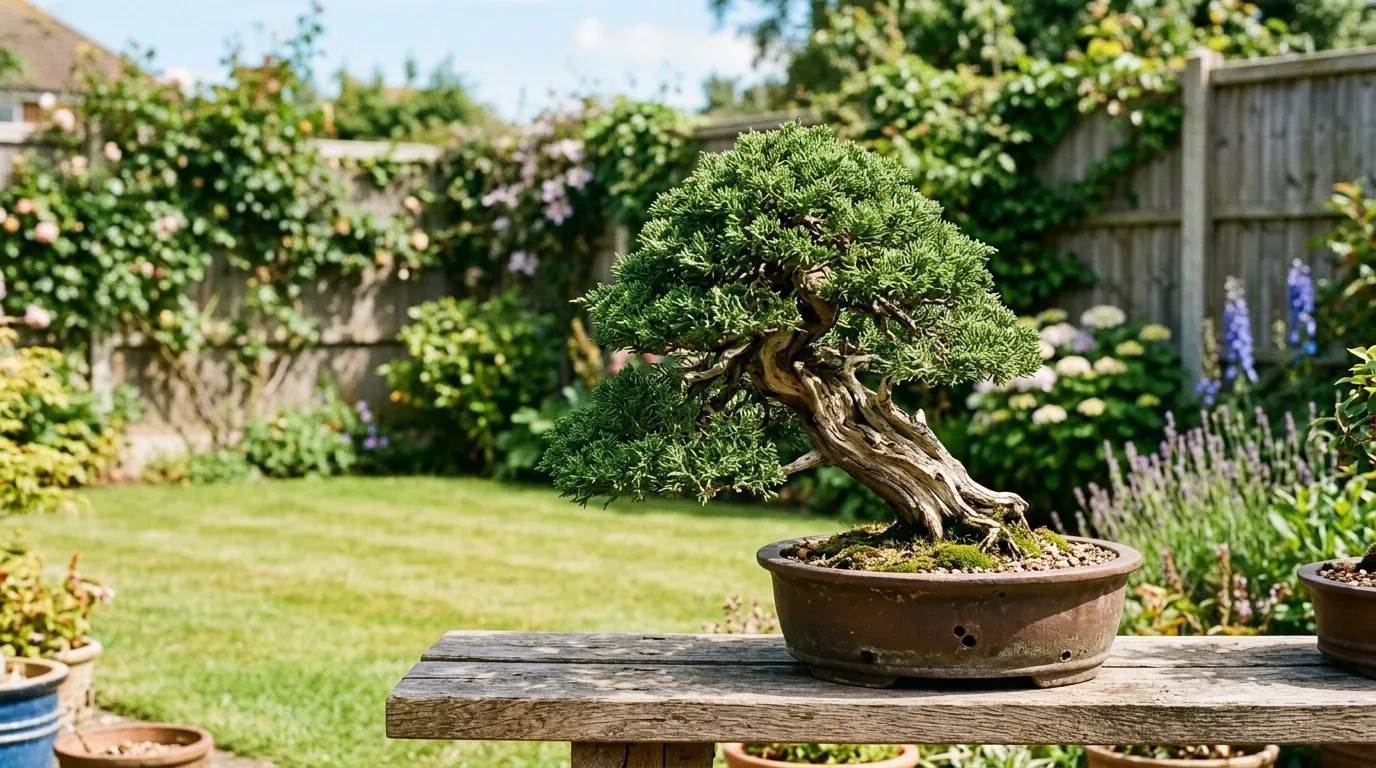 A juniper where it belongs: outside on a bench in full sun, twelve months a year.
How often should you water a bonsai tree?
Water a bonsai when the surface starts to dry, never on a fixed rota. A bonsai pot holds as little as 300ml to 1 litre of soil, so it swings from soaked to bone dry faster than any houseplant pot you have owned. In a British July heatwave that means watering every day, occasionally twice. Drying out in summer is the number one killer of trees that survived the placement test.
Two checks take the guesswork out of it.
The chopstick test. Push a plain wooden chopstick 2-3cm into the soil and leave it for 20 minutes. Pull it out. Damp and stained means wait. Clean and dry means water now. Leave the chopstick in the pot as a permanent moisture gauge.
The dunking method. Stand the whole pot in a basin of water up to the rim for 5-10 minutes, until air bubbles stop rising, then let it drain fully. This is the rescue move for a rootball that has dried hard, because dry akadama repels watering-can water and the pot stays parched inside while the surface looks wet.
Rainwater beats tap water where you can store it, because shallow pots show limescale build-up within weeks. In winter the whole rhythm slows: an indoor elm might want water weekly, an outdoor juniper barely at all.
Gardener’s tip: Water in the morning, and water the whole pot until it runs from the drainage holes. A polite splash wets the top centimetre and nothing below it. The roots that matter sit at the bottom, and they are the first to die of thirst.
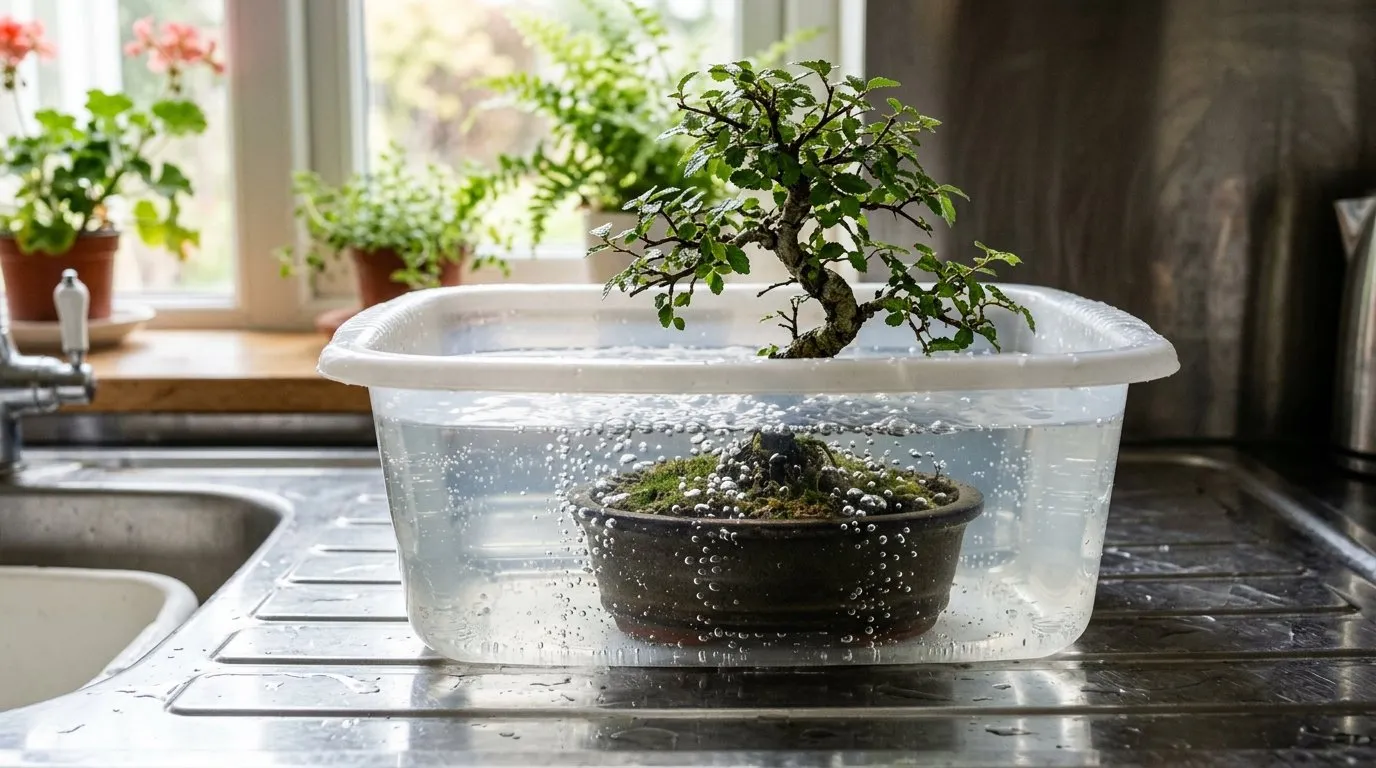 The dunk: submerge to the rim until bubbles stop. It is the only reliable fix for a dried-out rootball.
How much light does an indoor bonsai need?
An indoor bonsai needs the brightest windowsill in the house, ideally within 30cm of the glass. This is the second great beginner killer after wrong placement. A bonsai on a coffee table or a shelf across the room starts failing the day it arrives; it just takes three months to admit it.
British light is the problem. A UK living room in December offers a fraction of what a ficus enjoyed in the Dutch glasshouse that raised it, and daylight shrinks to under 8 hours. Give an indoor tree a south- or west-facing sill from October to March, and turn the pot a quarter-turn each week so it grows evenly instead of leaning into the glass.
Summer offers a bonus most owners skip: an indoor elm or ficus stood outside from June to September grows more in those 14 weeks than in the rest of the year put together. Move it into light shade for the first fortnight, then full morning sun. If what you really want is greenery for room corners, our best indoor plants guide lists species that genuinely tolerate low light. Bonsai are not among them.
Feeding and repotting: the bonsai care calendar
Feed fortnightly from April to September, and repot every two to three years in early spring. Those two habits, more than any styling skill, keep a bonsai alive for decades.
A shallow pot holds almost no nutrients, so the tree eats only what you give it. Use a balanced liquid feed at half strength every 14 days through the growing season, or a dedicated bonsai feed at £6-9 a bottle. Stop feeding outdoor trees in October; give indoor tropicals a monthly feed at most through winter. The little-and-often principle in our houseplant feeding guide is the same one, turned up a notch.
Repotting frightens beginners more than it should. In early March, as buds swell, ease the tree from its pot, comb out the edge of the rootball and trim away up to one third of the root mass with clean scissors. Return it to the same pot with fresh granular soil: an akadama-based mix at £8-12 for 2 litres, never ordinary compost. The basic sequence matches our houseplant repotting guide, except you cut roots instead of moving up a pot size. And if removing a third of the roots sounds brutal, the same principle powers commercial root-pruning pots: cut roots regrow dense and fibrous, and a fibrous rootball feeds a healthy tree.
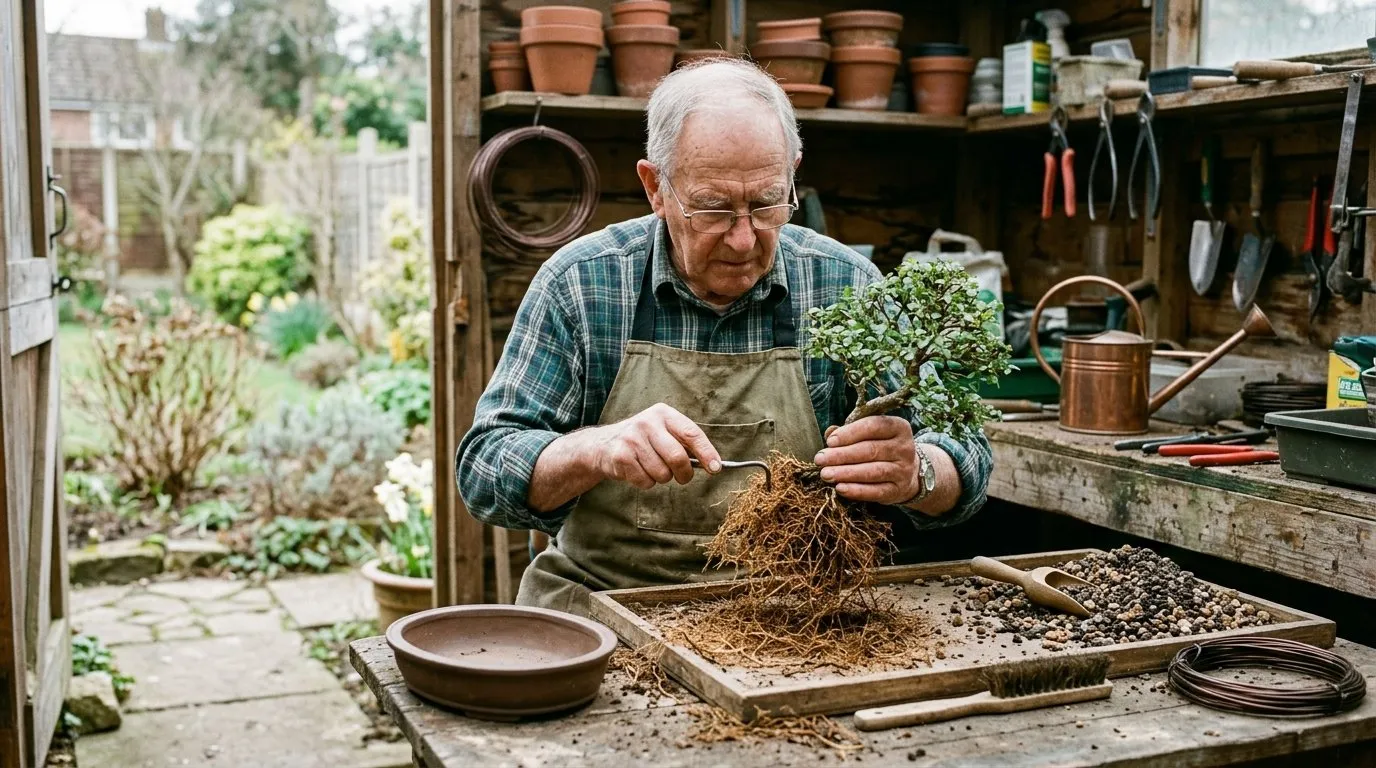 Early March repot: rootball combed out, a third trimmed off, fresh akadama mix underneath.
How do you prune a bonsai for beginners?
Maintenance pruning happens all summer; structural pruning waits for dormancy. Keep those two jobs separate in your head and pruning stops being mysterious.
Maintenance pinching keeps the shape you bought. When a new shoot extends to 6-8 leaves, cut it back to the first 2-3 with sharp scissors. On a Chinese elm you will do this every two or three weeks from May to September, and each cut makes the foliage pads denser. It takes five minutes over a cup of tea.
Structural pruning removes whole branches to change the design, and it belongs in late winter while the tree is dormant and leafless. Beginners rarely need it in year one. If a branch clearly ruins the silhouette, take it off in February with a clean cut close to the trunk, then leave the rest of the design alone for a season.
Wiring is how growers set branch angles: aluminium wire about one third the thickness of the branch, coiled at 45 degrees, left on for 8-12 weeks in the growing season and checked monthly so it never bites the bark. Worth learning eventually. Also worth skipping in your first year, because pinching alone keeps a garden-centre tree in shape.
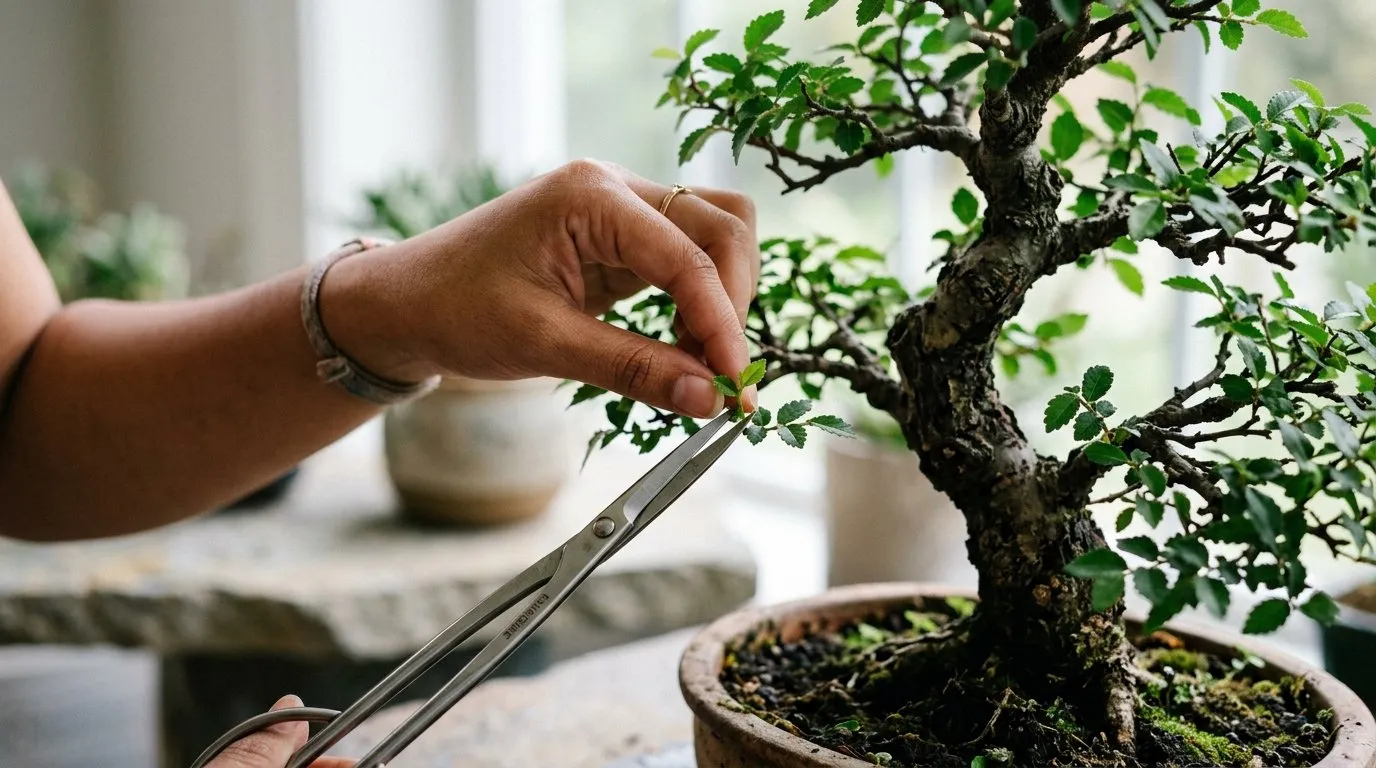 Shoot back to two leaves. Little cuts, made often, do more for the shape than any dramatic surgery.
Winter care for outdoor bonsai in the UK
Outdoor bonsai must stay outside in winter, because cold dormancy keeps them alive. A juniper, maple or larch carried into the lounge in November reads the warmth as spring, burns its stored energy, and is usually dead by March. This is the placement mistake in reverse, and it catches kind-hearted owners every year.
The roots are the one weak point. In open ground, roots sit below the frost line; in a 5cm-deep dish they freeze solid. UK winters rarely threaten a hardy tree until frost drops below about -4C. When a hard freeze is forecast, move pots into an unheated greenhouse or cold frame, or heel the pot into a spare corner of a border so the soil insulates it. Back out they go the moment the freeze lifts. A basic £30-60 cold frame handles the whole job; our cold frame gardening guide shows the set-up, and the wider principles are in how to overwinter plants.
Two winter chores remain. Water pots on mild days, roughly every 7-10 days, because winter wind desiccates evergreens even at 3C. And enjoy the season: a leafless elm shows its branch structure better in January than it ever does in July.
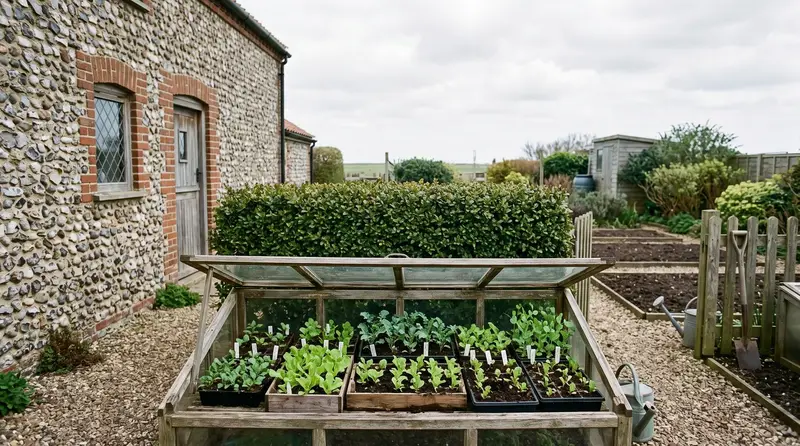
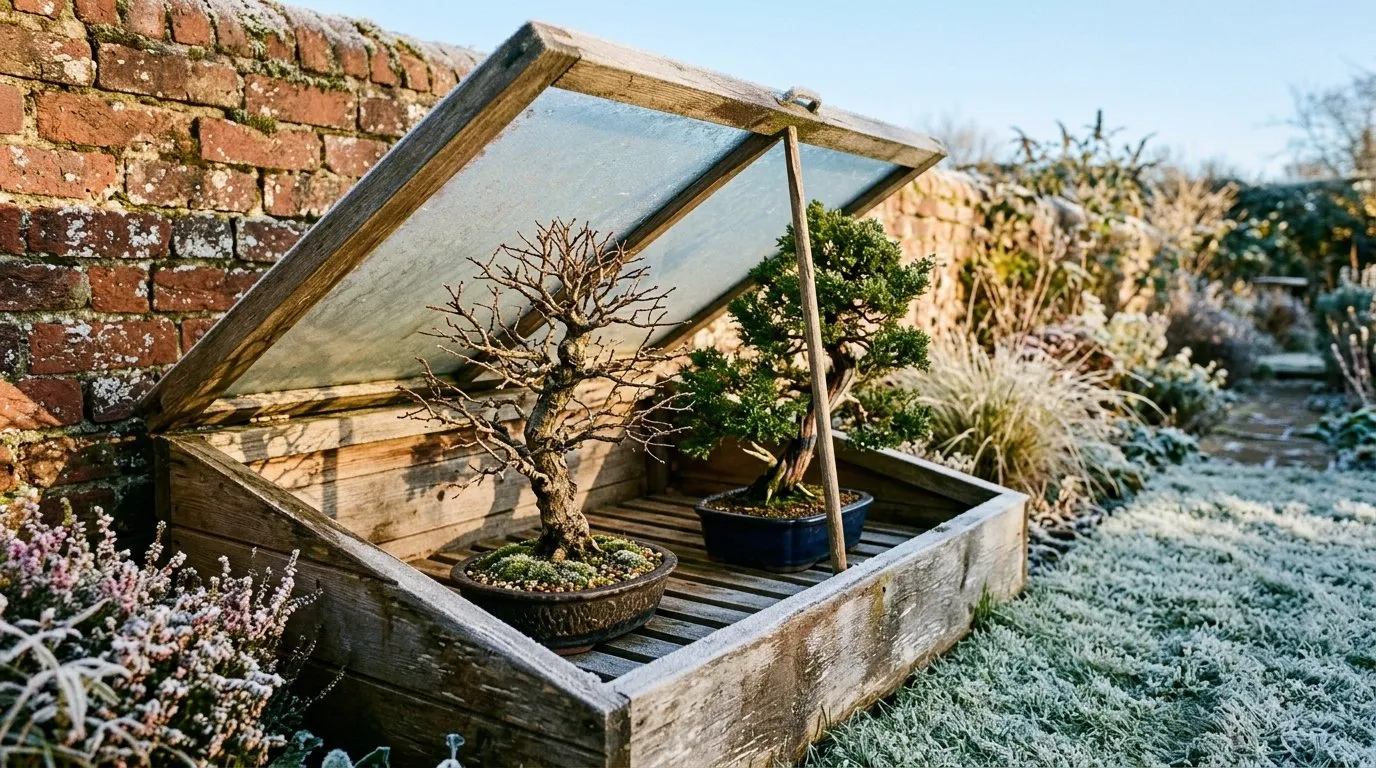 Hard-frost lodgings only. The cold frame empties again in mild spells so dormancy holds.
Which bonsai tree is best for beginners?
Chinese elm is the best first bonsai, ficus is the most forgiving indoors, and juniper is the best outdoor starter. That ranking has held for decades because it tracks how each species handles neglect.
Chinese elm, £30-60 at garden centres. Small serrated leaves, fine twigging, buds back from old wood after any pruning blunder, and copes indoors or out. If you buy one tree, buy this.
Ficus, £20-40. Glossy leaves and thick trunks, and it shrugs off dry air and erratic watering better than anything else on a windowsill. The right pick for a warm flat.
Juniper, £25-50. Handsome driftwood styling and very hard to kill outdoors. Impossible to keep indoors, which is the only warning it needs.
The £15-25 supermarket carmona is, oddly, the hardest of the lot: it wants steady warmth, high humidity and bright light, and it sulks when any of the three slips. Specialist bonsai nurseries charge £50-150 for a starter tree, and the extra money buys a developed trunk, a proper root spread and honest advice; the UK has around a dozen such nurseries plus club sales run by local societies.
Before paying for any tree, check four things. Rock the trunk gently: it should sit firm in its pot, because a loose trunk means no roots. Look for glossy, full-size leaves with no crisp edges. Check the soil is granular, not black compost. And turn the pot over for drainage holes; none means it was potted for the gift market, not for the tree.
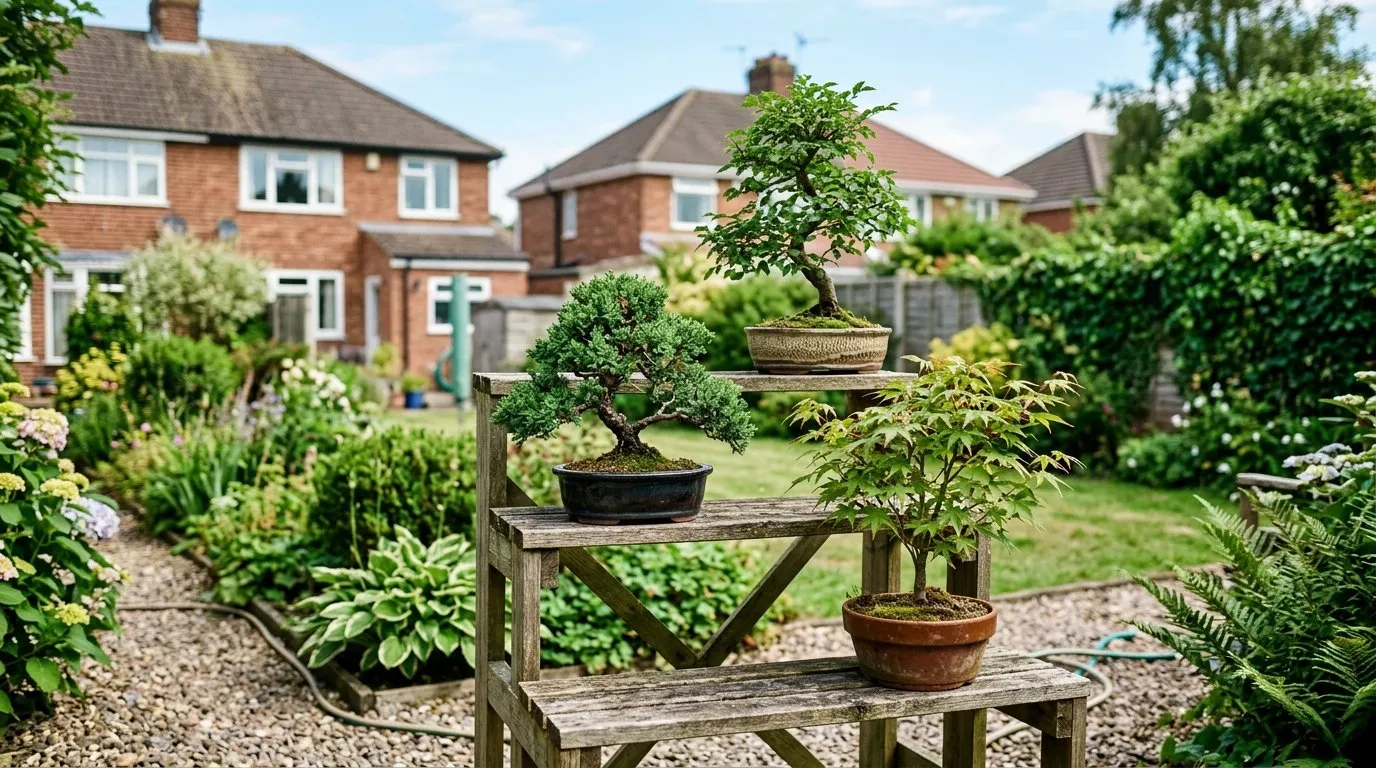 Elm, juniper and maple on garden staging. Three species, three price points, all under £80 to start.
Leaf drop straight after moving a tree is normal acclimatisation, not disease. Ficus is notorious for it: bring one home and it can shed a third of its leaves in a fortnight while it adjusts to the new light. Hold your nerve, keep the watering steady, and new buds appear within six weeks.
The other symptoms carry clearer messages.
Crispy, brown, dry leaves mean underwatering, the most common true killer. Dunk the pot immediately and scratch a twig with a fingernail: green under the bark means the tree lives, and daily checks from today usually save it.
Yellow leaves on wet, heavy soil mean overwatering. Check the drainage holes are clear, let the surface dry before the next water, and move the tree somewhere brighter so the pot dries faster.
Pale, sparse, stretched growth means too little light. The fix is a brighter sill, not more feed.
Fine webbing and speckled leaves mean red spider mite, common on windowsill elms above winter radiators. The treatments in our spider mite control guide work just as well at house scale.
Autumn leaf drop on an outdoor deciduous tree means nothing at all. A maple or larch colouring in October and standing bare by November is doing exactly what it should.
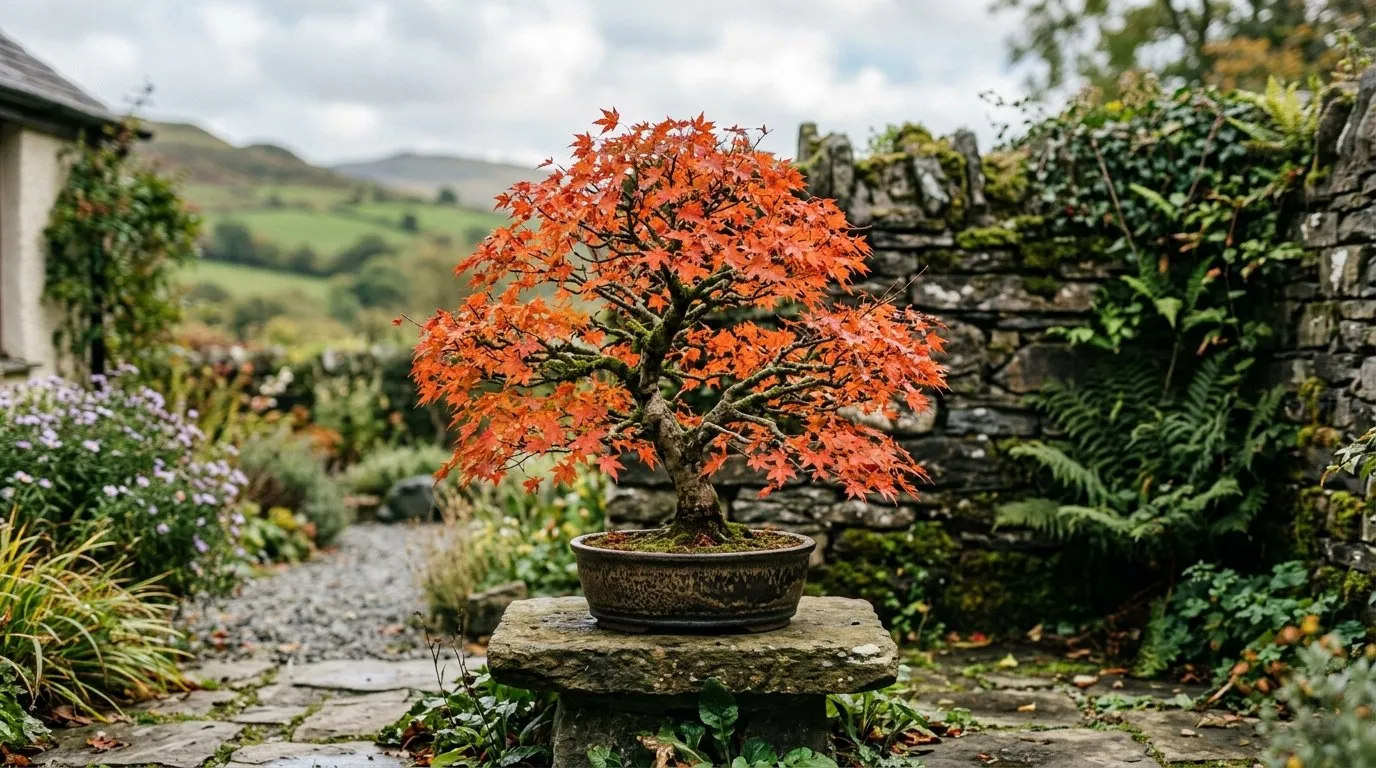 An Acer palmatum colouring up before dormancy. Autumn leaf drop on outdoor trees is health, not trouble.
Frequently asked questions
Can you keep a bonsai tree indoors in the UK?
Only tropical species such as ficus and carmona live indoors year-round. Hardy species like juniper, maple and larch fail slowly in heated rooms because they need winter dormancy. Chinese elm copes with either, given a cool bright spot. If a label just says indoor bonsai, check the actual species before you trust it.
How often should you water a bonsai tree?
Check daily and water only when the top centimetre feels dry. In July heat a small pot can need water every day, sometimes twice. In winter an indoor tree may need it weekly. Push a chopstick into the soil for 20 minutes; if it comes out clean and dry, water.
Why is my bonsai dropping leaves?
Leaf drop within two weeks of moving a tree is usually normal acclimatisation. Crispy brown leaves point to underwatering, the most common cause of death. Yellow leaves on soggy soil mean overwatering. Fix the position and the watering first; most trees recover within six weeks.
What is the best bonsai tree for beginners?
Chinese elm is the best first bonsai for UK beginners. It forgives irregular watering, buds back readily after pruning and costs £30-60 at garden centres. Ficus is the toughest choice for a warm indoor room, and juniper is the best outdoor starter at £25-50.
Do bonsai trees need special soil?
Yes, bonsai need free-draining granular soil, not ordinary potting compost. Most growers use a mix based on akadama, a Japanese fired clay, blended with pumice and fine bark. A 2-litre bag costs £8-12. Ordinary compost holds too much water in a shallow pot and rots the roots.
Should outdoor bonsai come inside for winter?
No, hardy bonsai need the cold to go properly dormant. A juniper, maple or larch brought into a heated room in November will be dead by spring. Move pots into an unheated greenhouse or cold frame only when frost dips below about -4C, then put them back out.
Our team produces practical UK gardening guidance from source research, contributor records and established horticultural practice. Editorial standards are overseen by Matt W.