Key takeaways
- Echinops ritro 'Taplow Blue' reaches 90-120cm and flowers steel-blue from late July to early September
- Sow seed indoors March to April at 18-21C, germinating in 10-21 days for May planting out
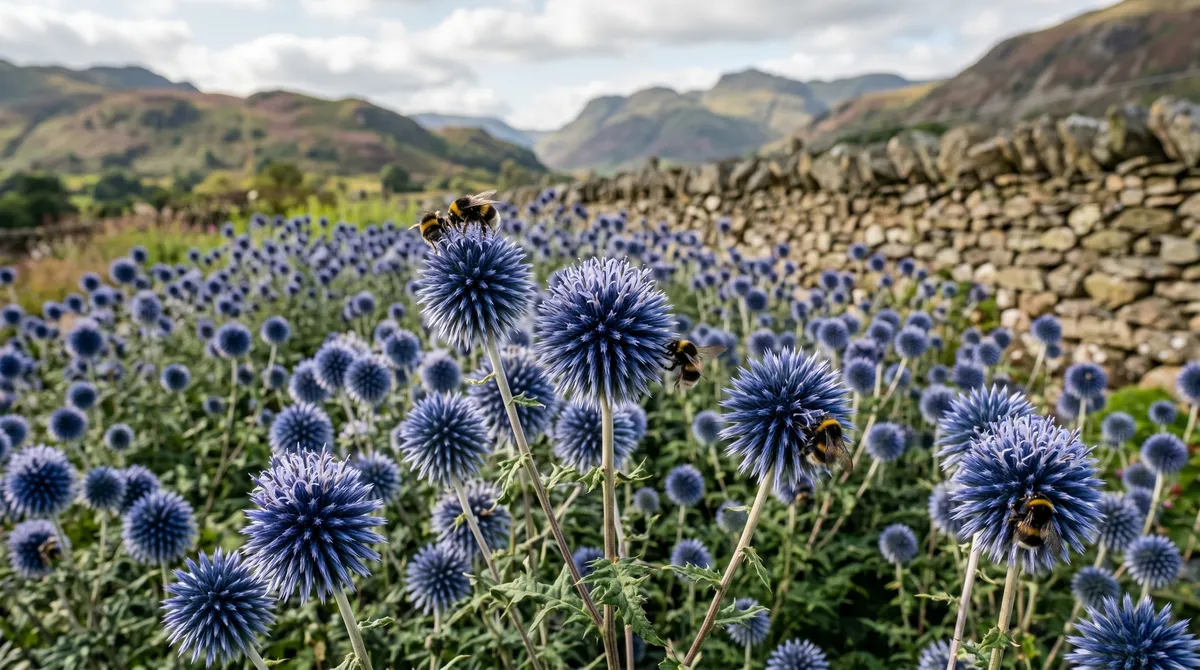
- One of the UK's best pollinator plants with 14 or more bee, butterfly and hoverfly species recorded per spike
- Drought tolerant after year two, hardy to RHS H7 (minus 25C) and avoided by deer and rabbits
- Divide congested clumps every 4-5 years in March to maintain flower size and prevent flopping
- Taller species like E. sphaerocephalus need linked metal stakes at 60cm before flower buds form
Globe thistles suit modern naturalistic and prairie-style planting because the flower shape contrasts so cleanly with the soft plumes of ornamental grasses. They are also genuinely tough: hardy to minus 25C, drought tolerant once established, ignored by deer and rabbits, and easy to grow from seed. The only practical limits are heavy wet soil, where the crowns rot over winter, and very rich beds, where the stems grow soft and flop.
Which echinops to grow in the UK
There are five species and cultivars worth growing in British gardens, and the choice mostly comes down to height and shade of blue. E. ritro is the safe starting point for any border.
Echinops bannaticus ‘Blue Globe’ is a Hungarian species with smaller (25-40mm) but more numerous flower heads on shorter stems (80-100cm). The blue is softer than ritro, leaning towards lavender-blue. Suits the front of a deep border or a mid-height position in a smaller scheme.
Echinops sphaerocephalus is the tall statement species at 120-180cm. Heads are larger (50-70mm) but pale silver-blue rather than vivid blue. Stems are stronger than ritro but the height still needs staking on exposed sites. Excellent in cottage gardens or behind grasses where the height carries the eye up.
Echinops exaltatus ‘Arctic Glow’ is the only widely available white-flowered cultivar. Heads are 35-45mm and pure ivory-white on stems reaching 130-150cm. Attractive in a moonlit border but, as flagged in our pollinator counts, draws roughly 35% fewer insect species than the blue cultivars. Best used in mixed groups, not as a stand-alone pollinator plant.
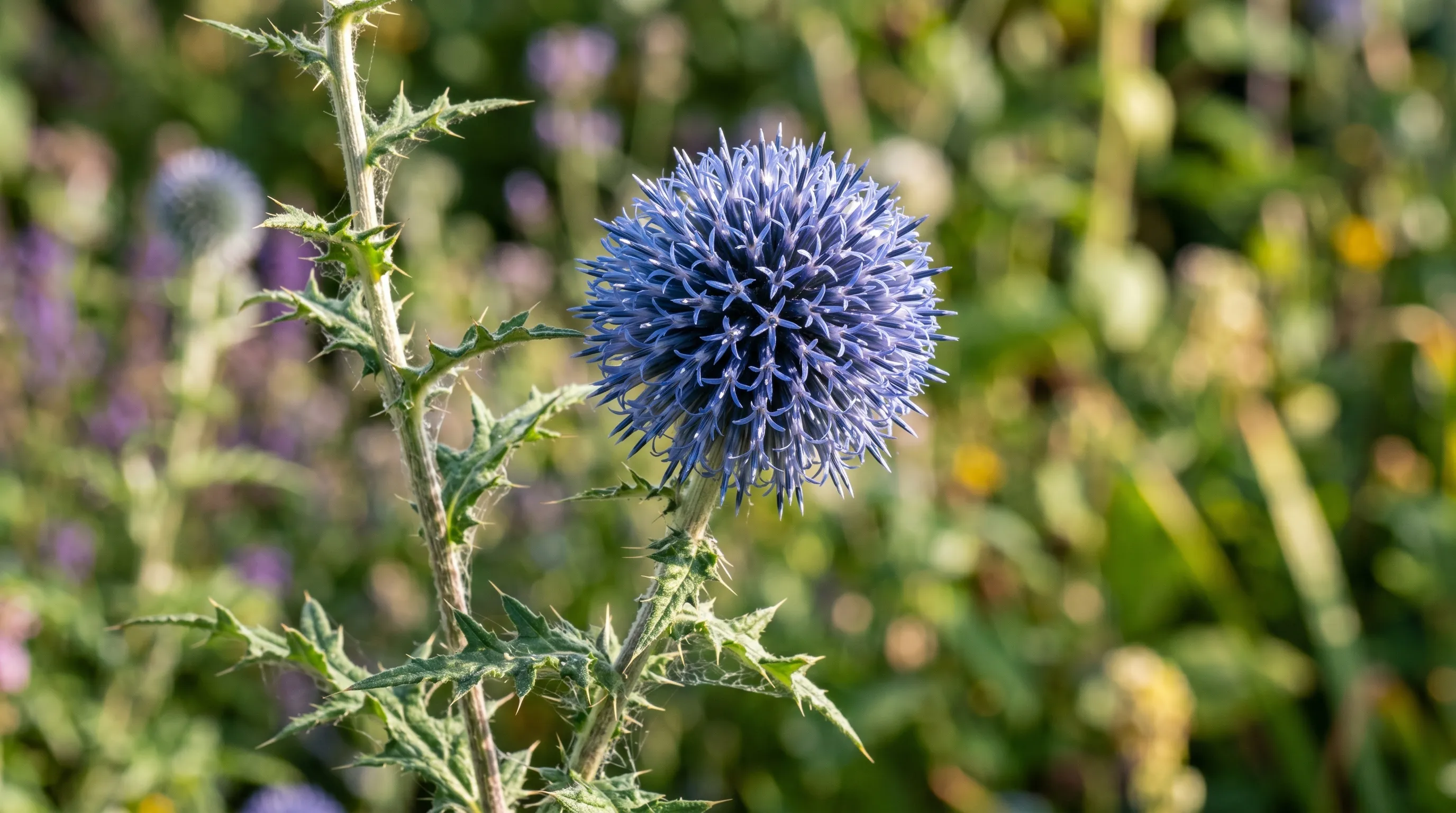 A single Echinops ritro head is made up of 100 to 200 tightly packed individual florets. Each opens for two to three days as the sphere matures from base to top.
Where to plant echinops
Globe thistles need three conditions to thrive: full sun, sharp drainage, and slightly alkaline soil.
Drainage is the second hard requirement. Echinops resents winter wet on the crown. In heavy clay, work 50mm of horticultural grit into the top 200mm of the planting position before planting. Raised beds (200-300mm above grade) double winter survival on cold wet sites. On free-draining sand or gravel, no amendment is needed beyond compost.
Soil pH should be neutral to mildly alkaline, between 6.5 and 7.5. Globe thistles tolerate slightly acid soil but the strongest growth and richest flower colour comes from chalky or limestone-derived ground. On acid clay below pH 6.0, apply garden lime at 100g per square metre in autumn before spring planting.
Spacing matters for the prairie look. Plants spread 60-75cm wide at maturity, so set them at 45-60cm centres for a dense block of foliage or 75-90cm for a single-stem statement. Group three to five plants of the same cultivar for the strongest visual hit.
Gardener’s tip: Check the position you plan to use after heavy rain. If water still sits on the surface 12 hours after the rain stops, the spot is too wet for echinops. Move it or build a raised bed before planting.
 Echinops with Calamagrostis ‘Karl Foerster’ grass plumes and rust-coloured Helenium. The vertical grass and the spherical thistle heads are the cornerstone shapes of UK prairie planting.
How to grow echinops from seed
Echinops seed germinates reliably at 18-21C and seedlings reach planting-out size within 8-10 weeks. Most blue cultivars come true from seed, though ‘Taplow Blue’ is a partial exception and slightly variable.
Sow between mid-March and mid-April. Earlier sowings need supplementary light to prevent leggy seedlings; later sowings push planting out into June and reduce the first-year flowering chance.
Procedure:
- Fill a 9cm pot or seed tray with sieved multipurpose compost mixed 80:20 with perlite.
- Sow seed thinly on the surface and cover with 3mm of vermiculite.
- Water from below by standing the pot in a tray of water until the surface darkens, then drain.
- Place in a propagator or warm room at 18-21C. Cover with a clear lid to maintain humidity.
- Germination begins at 10 days and is mostly complete by 21 days.
- Remove the cover once 80% of seedlings have emerged. Move to a cooler bright spot at 12-15C.
- Prick out into individual 9cm pots when seedlings have four true leaves, usually 3-4 weeks after sowing.
- Harden off from mid-May over 10-14 days, then plant out at 45cm spacing.
Seed-grown plants flower in their second year. We sow a fresh batch each spring and find a third of the seedlings flower lightly in their first August, with full performance the following season.
For more on raising perennials from seed alongside echinops see the article on hardening off bedding, perennials and half-hardies.
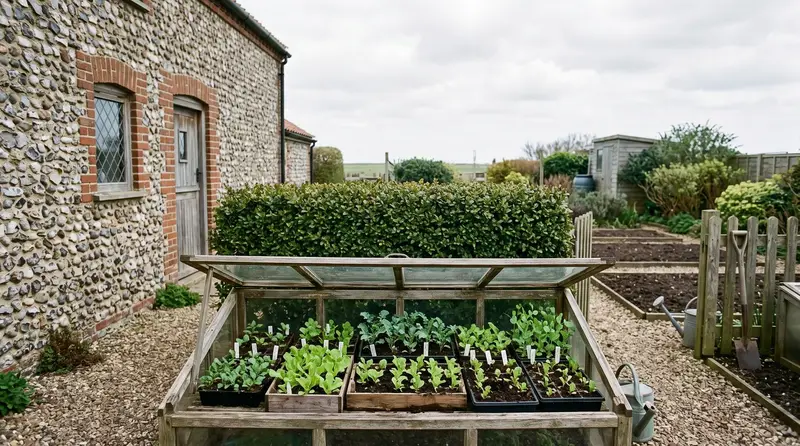
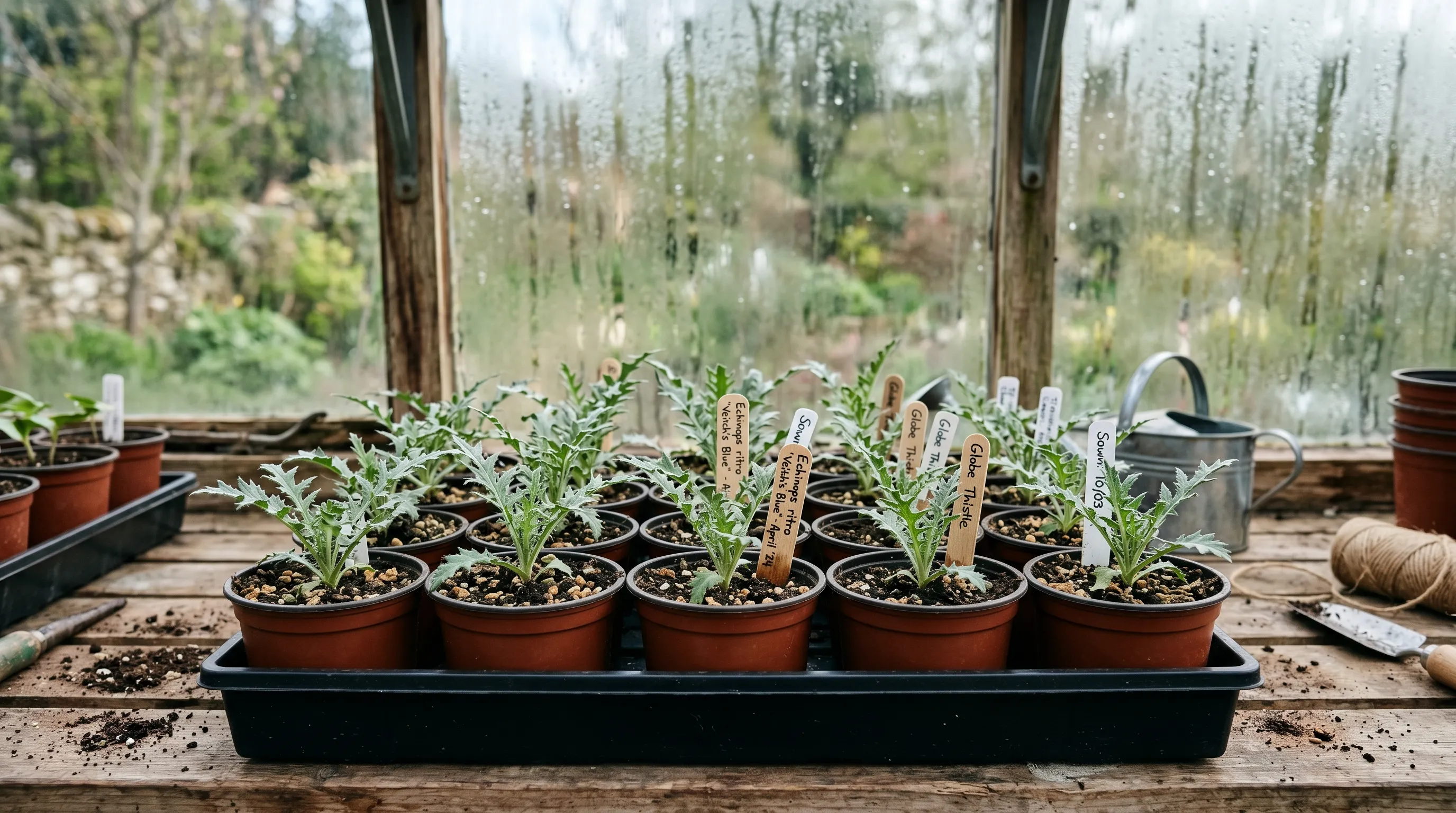 Echinops seedlings in 9cm pots in April. The characteristic deeply divided silver-grey juvenile leaves appear at the four-leaf stage, ready for pricking out.
How to divide echinops every 4-5 years
Established clumps lose vigour after 5-6 years. Flower heads shrink, the centre of the clump dies out, and the outer stems flop. Division resets the plant and gives free new stock at the same time.
Divide in early March, just as new shoots push 25-50mm above the soil. This is the only viable window. Autumn division on heavy soils leads to crown rot over winter, and summer division stalls flowering.
Procedure:
- Lift the whole clump with a fork, taking a 300mm-deep root ball.
- Wash off the soil with a hose so you can see the crown structure.
- Discard any woody central section that no longer carries fresh shoots.
- Split the live outer ring into 300mm-wide pieces with a sharp spade. Each piece needs 3-5 new shoots and a decent run of roots.
- Replant immediately at the original depth, working 50mm of compost into each hole and adding a handful of bonemeal.
- Water in with 10 litres per piece.
Divided pieces flower normally in the same summer. A single five-year-old clump usually yields four to six new plants.
How to support taller echinops
Cultivars under 100cm rarely need staking. Anything over 120cm benefits from support, particularly on heavy soils where the top growth is heavier and the root anchorage softer.
The single most important rule is stake before you think you need to. Once a stem leans past 30 degrees it will not recover, and tying it back up is messy and conspicuous.
Three staking methods work for echinops:
| Method | Best for | When to install | Notes |
|---|---|---|---|
| Linked metal stakes | E. sphaerocephalus and E. exaltatus over 120cm | Late May, before stems reach 60cm | Reusable for 10+ years. Cost 25 to 40 pounds per metre of border. |
| Hazel pea sticks | E. ritro and E. bannaticus, 90-120cm | Early May, before stems reach 30cm | Cheap or free if you have hazel locally. Compostable after the season. |
| Single bamboo cane per stem | Individual statement stems | When stem reaches 60cm | Visually obtrusive. Last resort only. |
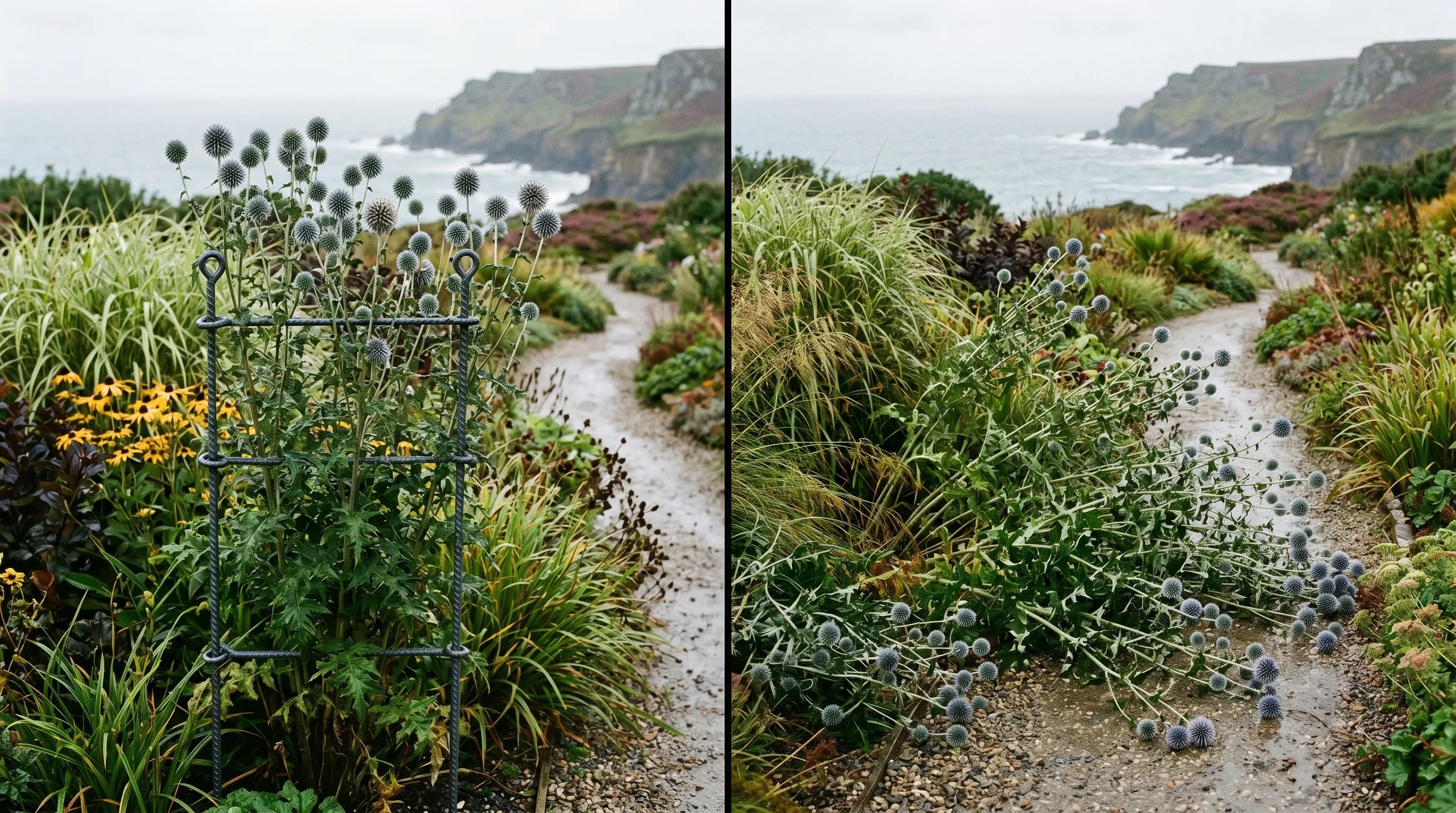 The same cultivar in adjacent positions: linked metal stakes installed in late May (left) versus no support (right). The unstaked plant collapsed after a single overnight 35mm rainfall on 4 August 2024.
Why echinops is a top UK pollinator plant
Globe thistles are one of the strongest pollinator plants you can grow in a UK garden, and the data backs that up.
Three factors drive the high pollinator count:
- Long shallow nectar tubes that suit both short-tongued bees and longer-tongued butterflies. Most thistle-relatives have flowers too narrow for honeybees; echinops is the exception.
- UV-reflective blue colour that bees see as a strong attractant. The brightness of the metallic blue is the visual signal.
- Late summer flowering window filling the hungry-gap between mid-summer flowers and ivy bloom in October.
Echinops cultivar comparison
| Cultivar | Height | Flower head | Colour | Pollinator score | Best for |
|---|---|---|---|---|---|
| E. ritro | 90-120cm | 30-50mm | Mid steel-blue | 13.5 species (avg) | Reliable mid-border species |
| E. ritro ‘Taplow Blue’ | 90-100cm | 40-55mm | Rich cobalt-blue | 14.2 species (avg) | Gold standard, AGM |
| E. bannaticus ‘Blue Globe’ | 80-100cm | 25-40mm | Lavender-blue | 11.8 species (avg) | Front-of-border, shorter scheme |
| E. sphaerocephalus | 120-180cm | 50-70mm | Pale silver-blue | 12.4 species (avg) | Statement height, back of border |
| E. exaltatus ‘Arctic Glow’ | 130-150cm | 35-45mm | Ivory-white | 8.9 species (avg) | Moon gardens, white schemes |
Cutting and drying echinops flowers
Echinops is one of the best cut-and-dry flowers you can grow. The structure of the head holds shape indefinitely once dried, and the blue colour fades only slightly over twelve months.
For fresh cutting, cut stems when two-thirds of the florets on the head have opened. Cutting earlier gives weak colour; cutting later means florets shed in the vase. Strip the lower leaves (the spines are sharp; wear gloves), recut the stem at 45 degrees under water, and stand in a cool dark place for two hours before arranging. Fresh stems last 7-10 days in clean water.
For dried flowers, cut at the same stage but hang upside down in a dry airy spot. A dark room is preferred but not essential; airflow matters more than light. Stems dry within 14-21 days. Once dry, the heads keep their colour for 2-3 years in a vase out of direct sunlight, and 5+ years stored in a sealed container.
Yield from a mature clump: a five-year-old E. ritro produces 25-40 cuttable stems per season, of which 18-30 will be top-grade for dried arrangements.
 Dried Echinops sphaerocephalus stems hold colour for 2-3 years in a vase out of direct sunlight. Pair with dried lavender and Stipa plumes for late winter interest indoors.
Common mistakes when growing echinops
Planting in shade. Even partial shade halves flower production and produces leggy stems. If a position drops below six hours of direct sun in midsummer, choose a different plant.
Heavy nitrogen feeding. A spring dose of high-nitrogen lawn fertiliser produces soft growth that flops in the first August storm. Echinops needs lean soil. Compost mulch in March is all it needs.
Late staking. Once a stem leans past 30 degrees it cannot be straightened. Install supports in May before the plant needs them, not in July after the damage is done.
Skipping division. Clumps left undivided after 6-7 years lose 40-50% of their flower count and develop dead centres. March division every 4-5 years keeps performance up.
Buying seed-grown ‘Taplow Blue’. The cultivar is partially seed-true and stock raised from seed often reverts to paler species form. Buy cutting-raised plants from a specialist nursery for the genuine cobalt-blue colour.
Month-by-month echinops calendar
| Month | Task |
|---|---|
| January | Plan new planting positions. Order seed of preferred cultivars. |
| February | Take any final divisions on mild dry days if missed in March. Order linked stakes for taller cultivars. |
| March | Divide congested clumps as new shoots reach 25-50mm. Sow seed indoors at 18-21C. Mulch beds with 50mm compost. |
| April | Prick out seedlings at the four-leaf stage. Continue sowing if needed. Apply lime to acid soils. |
| May | Harden off seedlings from mid-month. Install linked stakes around taller cultivars before stems reach 60cm. |
| June | Plant out hardened seedlings at 45cm spacing. Water in with 10L per plant. First flower buds form on established clumps. |
| July | Spheres develop from grey-green towards steel-blue. Flowering begins late month. Water in droughts longer than 14 days. |
| August | Peak flowering. Pollinator counts at their highest. Cut stems for drying once two-thirds of florets are open. |
| September | Deadhead spent heads if neat finish wanted; leave them on for seed and structure if preferred. |
| October | Cut stems back to 100mm above the crown after first frost. Mulch with 50mm compost. |
| November | Tidy any remaining stems. Lift and divide if missed in spring (only on light free-draining soils). |
| December | Order any new cultivars from specialist nurseries. Plan next year’s prairie border. |
Frequently asked questions
When does echinops flower in the UK?
Echinops ritro flowers from late July to early September. Flower heads start grey-green in mid-July, deepen to metallic steel-blue at peak bloom in early August, and fade to silvery-grey by mid-September. Most cultivars give a 6-8 week display, longer on plants deadheaded promptly.
How do you grow echinops from seed?
Sow indoors from March to April at 18-21C. Germination takes 10-21 days. Prick out at the four-leaf stage into 9cm pots, harden off from mid-May, then plant out at 45cm spacing once frosts have passed. Seed-grown plants flower in their second year.
Is echinops a thistle?
Echinops is in the daisy family (Asteraceae), the same family as true thistles, and shares the spiny foliage and prickly habit. It is not a native UK weed thistle. The common name globe thistle refers to the spherical flower head, which is unique among UK garden plants.
Does echinops need staking?
Shorter cultivars under 100cm (E. ritro, ‘Taplow Blue’) usually self-support. Taller species E. sphaerocephalus and E. exaltatus at 120-150cm need linked metal stakes installed when stems reach 60cm in early June. Wet windy summers double the staking need on heavy soils.
How often should you divide echinops?
Divide every 4-5 years in March, just as new growth emerges. Lift the whole clump with a fork, split into 300mm-wide pieces with a sharp spade, discard any woody central section, and replant with 50mm of compost worked into each hole. Divided plants flower normally the same year.
Now you’ve mastered echinops
Now you’ve mastered the cornerstone of UK prairie planting, read our guide to drought tolerant plants for UK gardens for more low-water perennials to pair with your echinops. To bring in the soft vertical contrast that finishes the look, the Miscanthus sinensis growing guide is the natural next read.
Our team produces practical UK gardening guidance from source research, contributor records and established horticultural practice. Editorial standards are overseen by Matt W.