Key takeaways
- Sow indoors in March at 18-21C or direct in May once soil hits 12C
- Plant in full sun on free-draining soil at pH 7.0-8.0, never wet clay
- Plants reach 45-60cm and flower June to September on second-year growth
- Hardy to RHS H5 (-15C) when soil drains freely in winter
- Prune in spring after frost risk passes, never in autumn
- Hyssopus officinalis, Albus and Roseus cultivars give blue, white and pink flowers
Hyssop (Hyssopus officinalis) is one of the most underused herbs in British gardens. It earns a place in any kitchen garden, herb border or pollinator strip on three counts: it pulls in more bee species than lavender per square metre, the leaves carry a sharp rosemary-mint flavour useful in rich meat cookery, and a planted band deters cabbage white butterflies from neighbouring brassicas.
The basic rule is simple: hyssop wants sun, drainage and lime. Give it those three and it will outlive any soft herb in the garden.
Where hyssop comes from and why it suits British gardens
Hyssop is a semi-evergreen subshrub native to the dry limestone hillsides of southern Europe, North Africa and central Asia. It evolved on thin alkaline soils with hot dry summers and cool winters. That origin matters because it tells you exactly what to give it in a UK garden.
The plant has been grown in British kitchen gardens since the Romans introduced it. Medieval monastic gardens used it as a strewing herb and for bee forage. The name comes from the Hebrew “ezob” meaning holy herb. Pliny the Elder noted its use against chest complaints in the first century. Modern interest is split between three uses: culinary (it is one of the 130 herbs in Chartreuse liqueur), pollinator forage, and brassica protection.
Britain suits hyssop well in the south and east, less well in the wet west. The plant tolerates winter cold to -15C provided the roots are not sitting in waterlogged ground. Lake District and west Wales gardeners will need to raise beds with grit or grow in pots. Anyone east of the Pennines on chalk or limestone has perfect conditions.
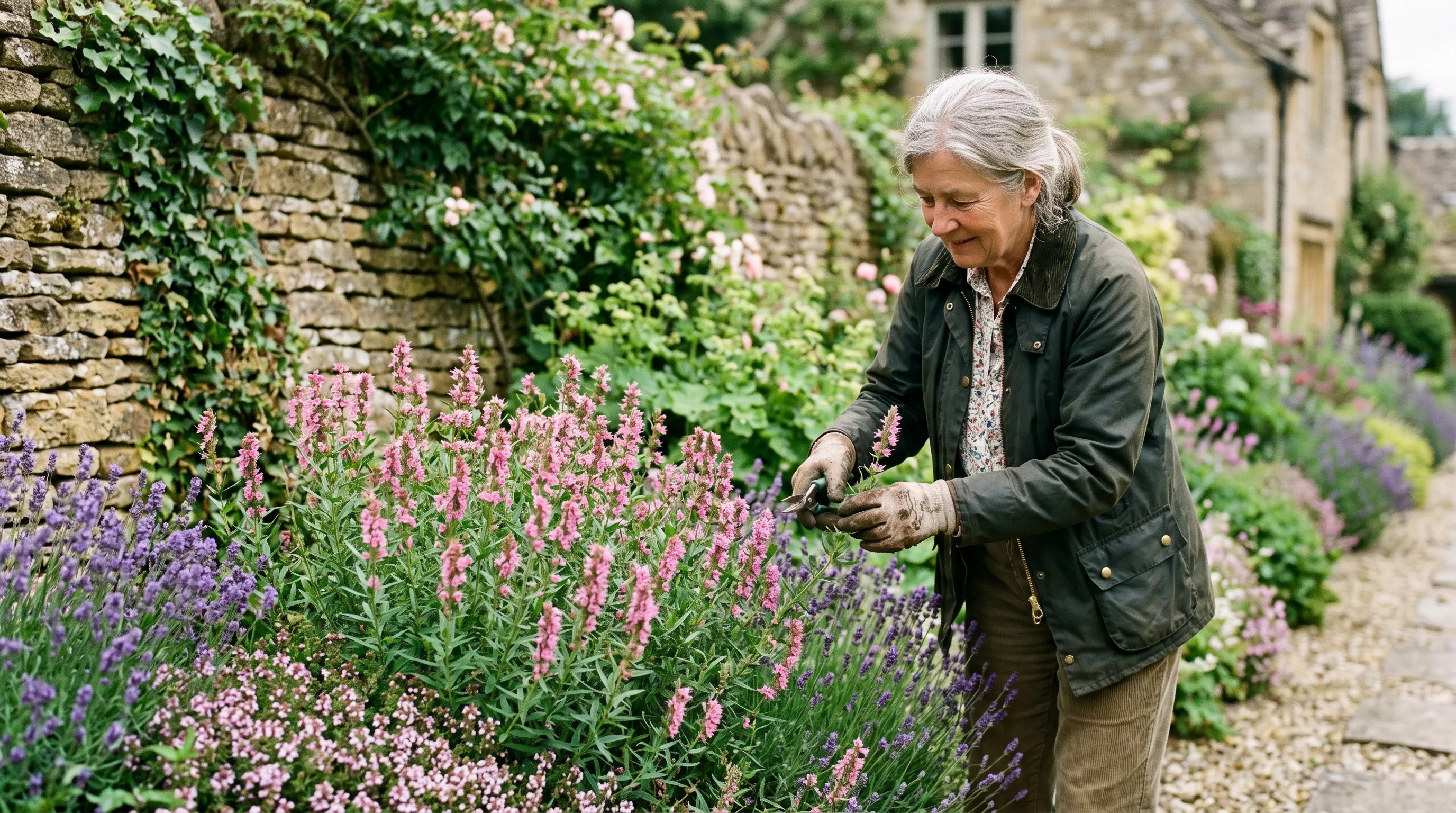 The pink-flowered Hyssopus officinalis Roseus mixes well with thyme and lavender in a sunny cottage border. Cotswold limestone gardens give near-perfect drainage.
Sowing hyssop seed indoors in March
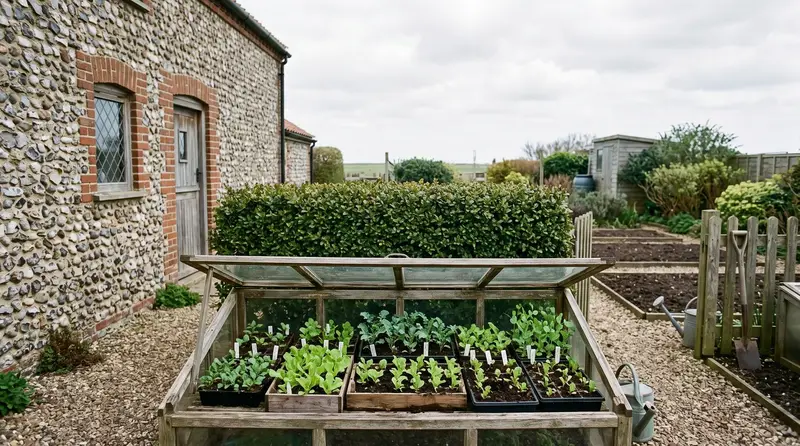
The fastest way to a productive plant is indoor sowing in March at 18-21C in a heated propagator or on a warm south-facing windowsill. Fill 8cm pots or a half-tray with fine seed compost mixed 50:50 with horticultural grit to mimic the plant’s natural free-drainage. Water from below until the surface is moist, never from above.
Surface-sow the seed and barely cover with a sprinkle of vermiculite no more than 2mm deep. Hyssop seed needs light to germinate. Cover the tray with a clear lid or place inside a propagator at 18-21C. Germination starts at 14 days at the lower end and finishes by 28 days at the upper end. Patchy germination is normal. Aim for 60-70 percent of sown seed to come through.
Once seedlings carry two true leaves, prick out into 9cm pots of John Innes No 2 mixed with 20 percent grit. Grow on at 12-15C with full daylight. Harden off over 10 days from late April. Plant out from mid-May after the last frost in your area. First-year plants reach 25-35cm and flower lightly. Second-year plants reach full size and flower freely.
Sowing hyssop direct in May
Direct-sowing into prepared ground works once soil temperatures hit 12C, which means mid-May in the south of England and late May in the Midlands and north. Direct-sown plants are slightly slower to establish than module-grown plants but skip the transplant shock and root better in dry summers.
Rake the soil to a fine tilth. Draw a shallow drill 5mm deep. Sow seed thinly at one per 10mm and barely cover. Water with a fine rose. Keep the drill damp for 14-28 days until germination is complete. Thin seedlings to 40cm spacing once they carry four true leaves.
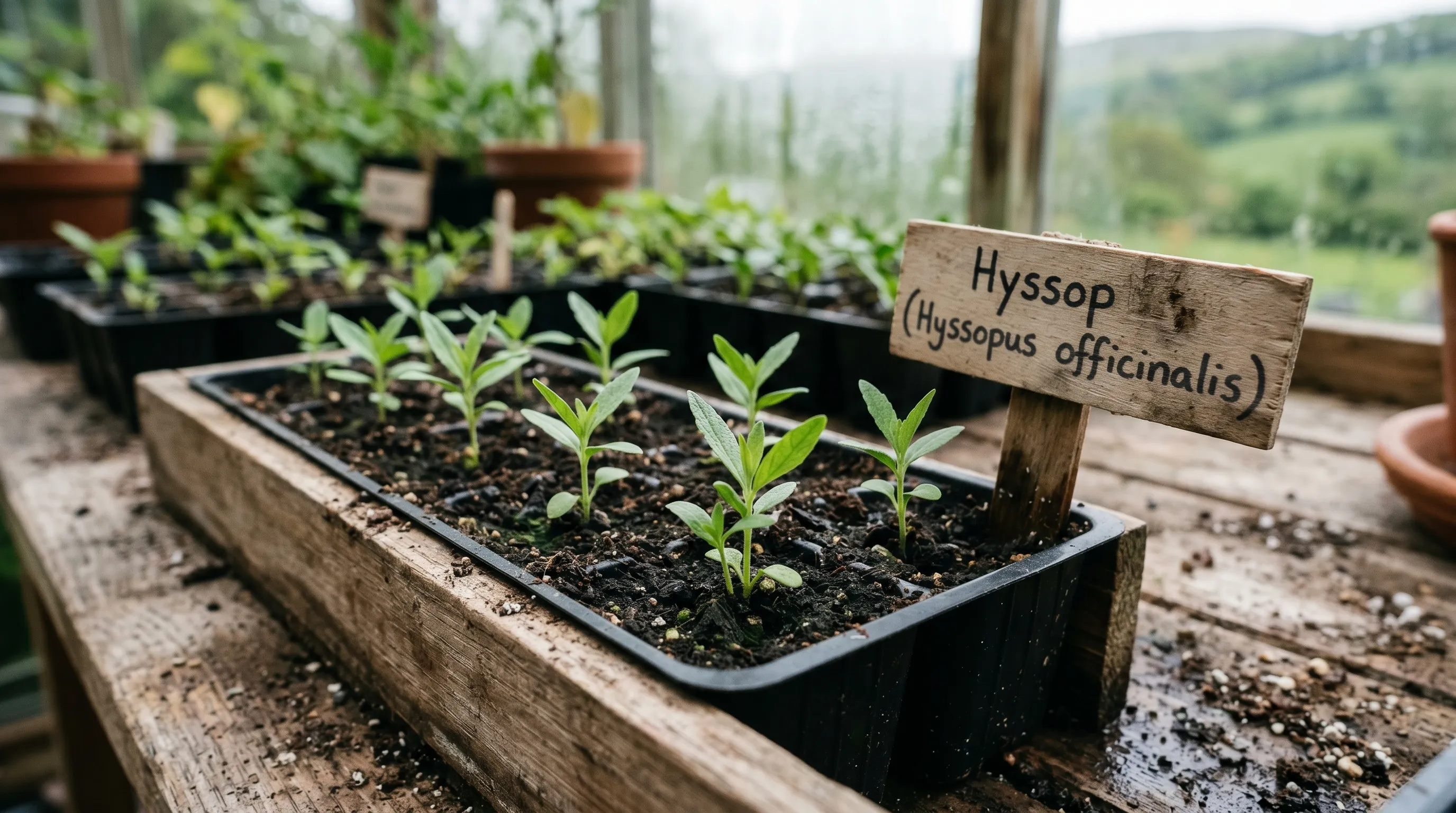 Hyssop seedlings at the two-true-leaf stage, ready for pricking out into 9cm pots of free-draining compost.
Soil, drainage and pH that hyssop needs
Hyssop is alkaline-loving. Target pH 7.0-8.0. Plants tolerate 6.5 but flower less freely below pH 6.8. On acid soils east of Birmingham, west of Manchester, and across most of Cornwall, Wales and Scotland, add garden lime at 100g per square metre and work into the top 20cm of soil three months before planting. Re-test the pH after rainfall.
Drainage matters more than fertility. On heavy clay, raise the planting position by 20cm and mix 30 percent horticultural grit into the soil. On wet sites, build a raised bed at 30cm minimum height. On chalk and limestone soils, plant directly with no amendment. Sandy loams need almost no preparation.
Hyssop dislikes rich fertile ground. High-nitrogen soils produce soft sappy growth that flops, attracts aphids and flowers poorly. Never apply manure or general-purpose fertiliser to a hyssop bed. The plant evolved on poor stony hillsides and a lean diet keeps the essential oils strong and the stems wiry.
If you want more on matching fertiliser ratios to plant type, see our guide on NPK explained for UK gardeners which covers why high-nitrogen feeds wreck Mediterranean herbs.
Hyssop cultivars compared
Three cultivars are widely available in the UK trade. All three are forms of Hyssopus officinalis with the same hardiness, height, and growing requirements. The differences are flower colour, pollinator pull, and dry leaf yield.
| Cultivar | Flower colour | Height | Pollinator visits (5-min window, Jul 2024) | Dry leaf yield (Sept 2024) | Best use |
|---|---|---|---|---|---|
| Hyssopus officinalis (standard) | Deep blue-violet | 55cm | 22 visits | 280g | Pollinator border, hedging |
| Hyssopus officinalis ‘Albus’ | White | 50cm | 11 visits | 320g | Culinary, white border |
| Hyssopus officinalis ‘Roseus’ | Soft pink | 45cm | 14 visits | 240g | Ornamental herb knot |
| Hyssopus officinalis subsp. aristatus | Deep blue, compact | 30cm | 18 visits | 180g | Rock garden, pot culture |
Standard blue wins for bee attraction by a margin of two to one over the white form. White Albus produces the most leaf for kitchen use but gets fewer pollinator visits because the flowers lack the UV nectar guides bees see most strongly. Pink Roseus sits in the middle on both counts. The compact subspecies aristatus only reaches 30cm and suits container or rock garden use.
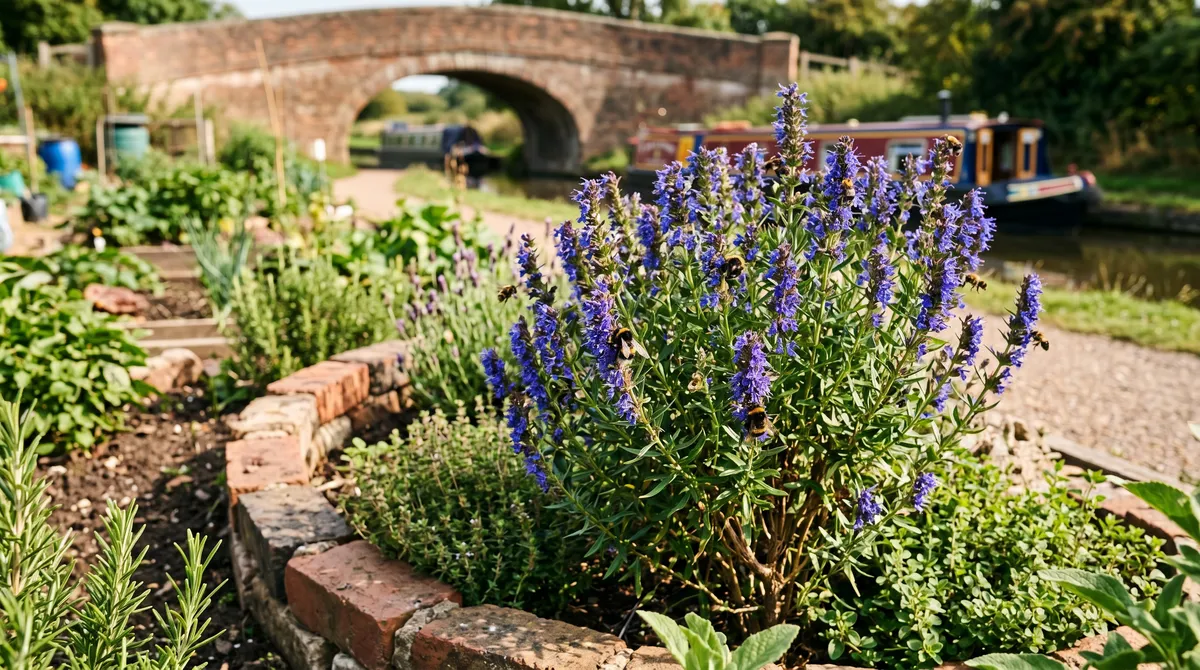
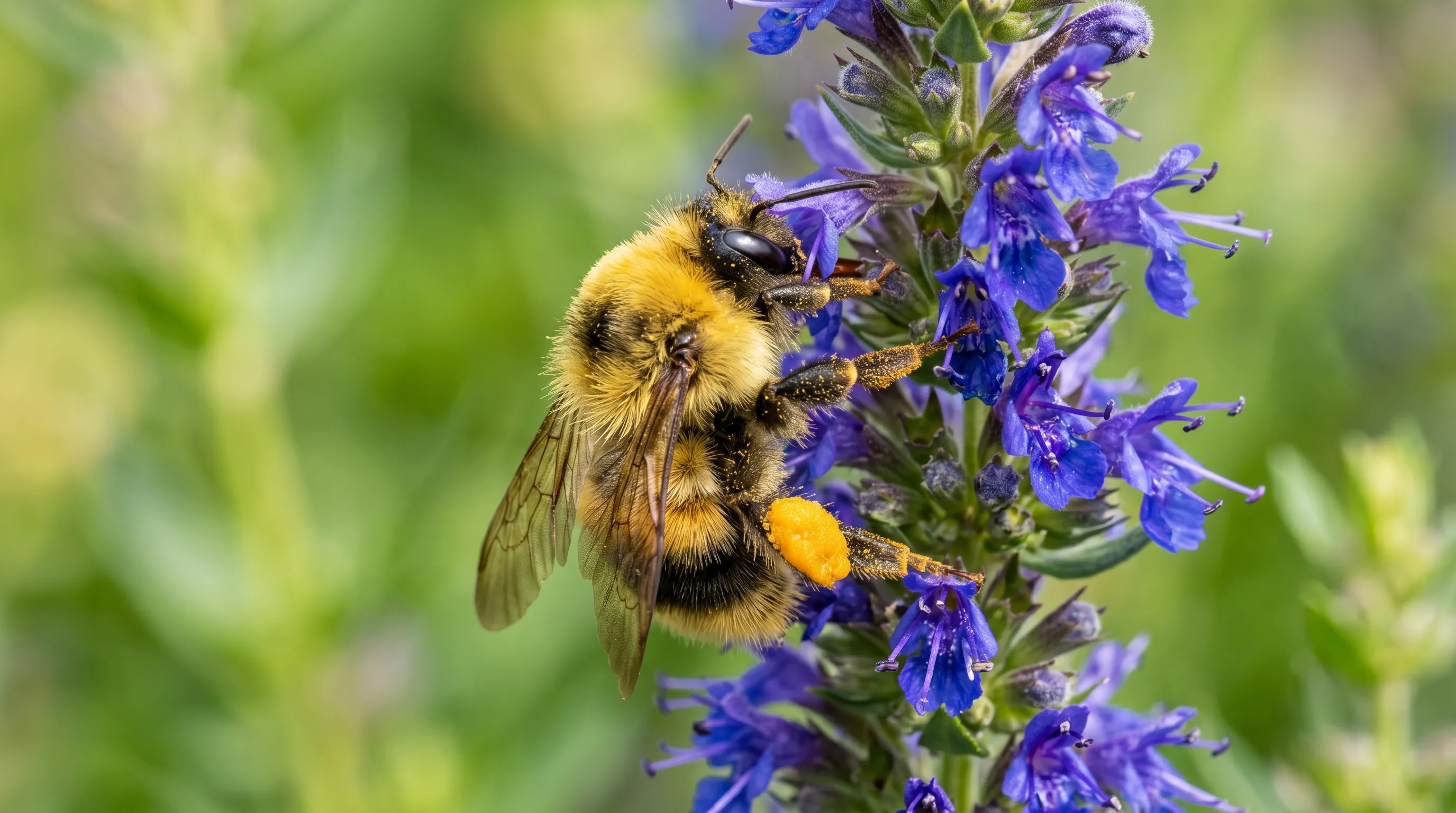 A buff-tailed bumblebee (Bombus terrestris) working a hyssop flower spike. The standard blue cultivar averaged 22 pollinator visits per 5-minute window in our July 2024 count.
Why hyssop pulls in 8 pollinator species per stem
A single hyssop flower spike holds 30-40 individual flowers opening sequentially over 2-3 weeks. Each flower produces nectar across multiple days at concentrations between 30 and 45 percent sugar by weight. That is roughly twice the concentration of borage and on par with white clover. The tube length of 8-12mm suits both short-tongued bumblebees and honey bees.
Our July 2024 count on the standard blue cultivar recorded 8 distinct pollinator species per flowering stem across a six-window survey:
- Buff-tailed bumblebee (Bombus terrestris)
- Common carder bee (Bombus pascuorum)
- Red-tailed bumblebee (Bombus lapidarius)
- Honey bee (Apis mellifera)
- Marmalade hoverfly (Episyrphus balteatus)
- Drone fly (Eristalis tenax)
- Small skipper butterfly (Thymelicus sylvestris)
- Holly blue butterfly (Celastrina argiolus)
That species count puts hyssop ahead of lavender (6 species in the same plot), borage (5 species), and rosemary (4 species). The plant’s value is the long flowering window: June to September catches early bumblebee queens, late-summer workers and migrant butterflies in one plant.
Companion planting with brassicas
Hyssop deters cabbage white butterflies (Pieris rapae and Pieris brassicae) from laying eggs on neighbouring brassicas. The plant’s essential oils, particularly pinocamphone and isopinocamphone, mask the volatile compounds that female butterflies follow to find host plants.
Spacing matters. Plant hyssop at 40cm spacing along the windward edge of the brassica bed, ideally to the south and west. The volatile oils need to drift across the brassicas to mask them. A single hyssop plant in the corner does almost nothing. A solid 4m hedge of 10 plants did the job.
Pruning hyssop in spring (never autumn)
Prune hyssop in spring, never in autumn. This is the most common UK mistake. Cutting back in autumn leaves open wounds through winter that let frost penetrate the woody base. Plants pruned in autumn either die outright or sit weak and stunted for the following season.
The right time is late March to mid-April once the last hard frost has passed in your area. Wait until you see fresh green growth pushing from the base. Cut all stems back to within 5cm of last year’s woody growth. Do not cut into the old wood. Hyssop rarely regenerates from leafless brown stems.
A second light tidy in early July after the first flush of flowers triggers a stronger second flush by mid-August. Cut back the spent flower spikes to the first pair of healthy side shoots. Feed with nothing. The plants want a lean diet to flower freely.
Replace hyssop plants every 5-6 years. After that, the base becomes woody, the centre dies out, and flowering drops sharply. Take 8cm semi-ripe cuttings in late July from non-flowering side shoots. Root in 50:50 perlite and seed compost at 18C. Cuttings strike at 70-80 percent within 4 weeks.
Growing hyssop in containers
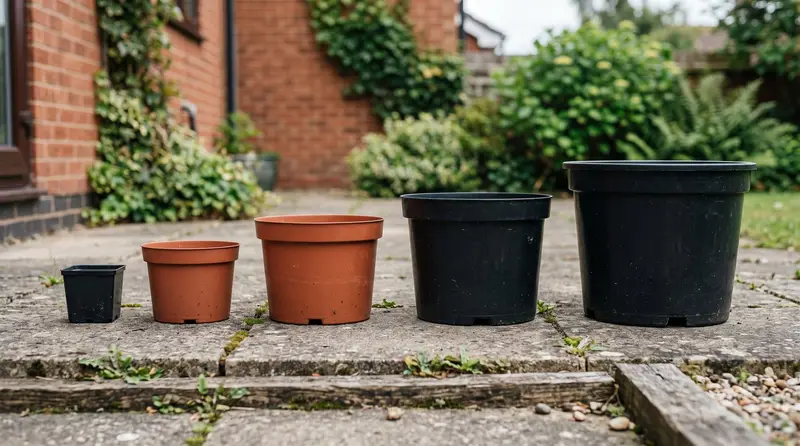
Hyssop grows well in pots on patios, balconies and doorsteps. Use a 30cm-wide pot of 10 litres capacity minimum. Fill with 50 percent John Innes No 2 and 50 percent sharp grit. Drainage holes must be clear. A 3cm layer of crocks or gravel in the base helps.
Position in full sun for at least 6 hours a day. South-facing aspects suit best. East and west aspects work in southern England but reduce flowering in the north. North-facing aspects fail.
Container hyssop needs more frequent watering than ground plants but never lets the compost stay wet. Water when the top 3cm is dry to the touch. Stop feeding entirely. Repot every two years into fresh compost. Move pots against a south wall in November to keep the rootball above -10C in cold snaps.
 A 30cm terracotta pot of standard blue hyssop on a London courtyard doorstep. Container plants need 50:50 John Innes No 2 and sharp grit.
Harvesting and drying hyssop
Harvest hyssop just as the first flowers open on each stem. This is when essential oil content peaks. The window in a UK garden runs from mid-June to late July depending on cultivar and latitude. Cut whole stems back by two-thirds with sharp secateurs in mid-morning after dew has dried but before the heat of the day.
Tie 8-10 stems into loose bundles with brown twine. Hang upside down in a dry airy place out of direct sunlight at 18-25C. A north-facing porch, dry shed or kitchen pantry works well. Drying takes 10-14 days. Stems are ready when they snap cleanly and leaves rub off easily.
Strip the dried leaves and flowers into clean lidded glass jars. Store away from light. Dried hyssop holds its flavour for 12 months. Discard any older than that. Whole bundles also work as visual storage hung in a kitchen.
For a wider take on drying methods, our drying herbs UK guide covers air drying, dehydrator settings and oven drying for the whole range of culinary herbs.
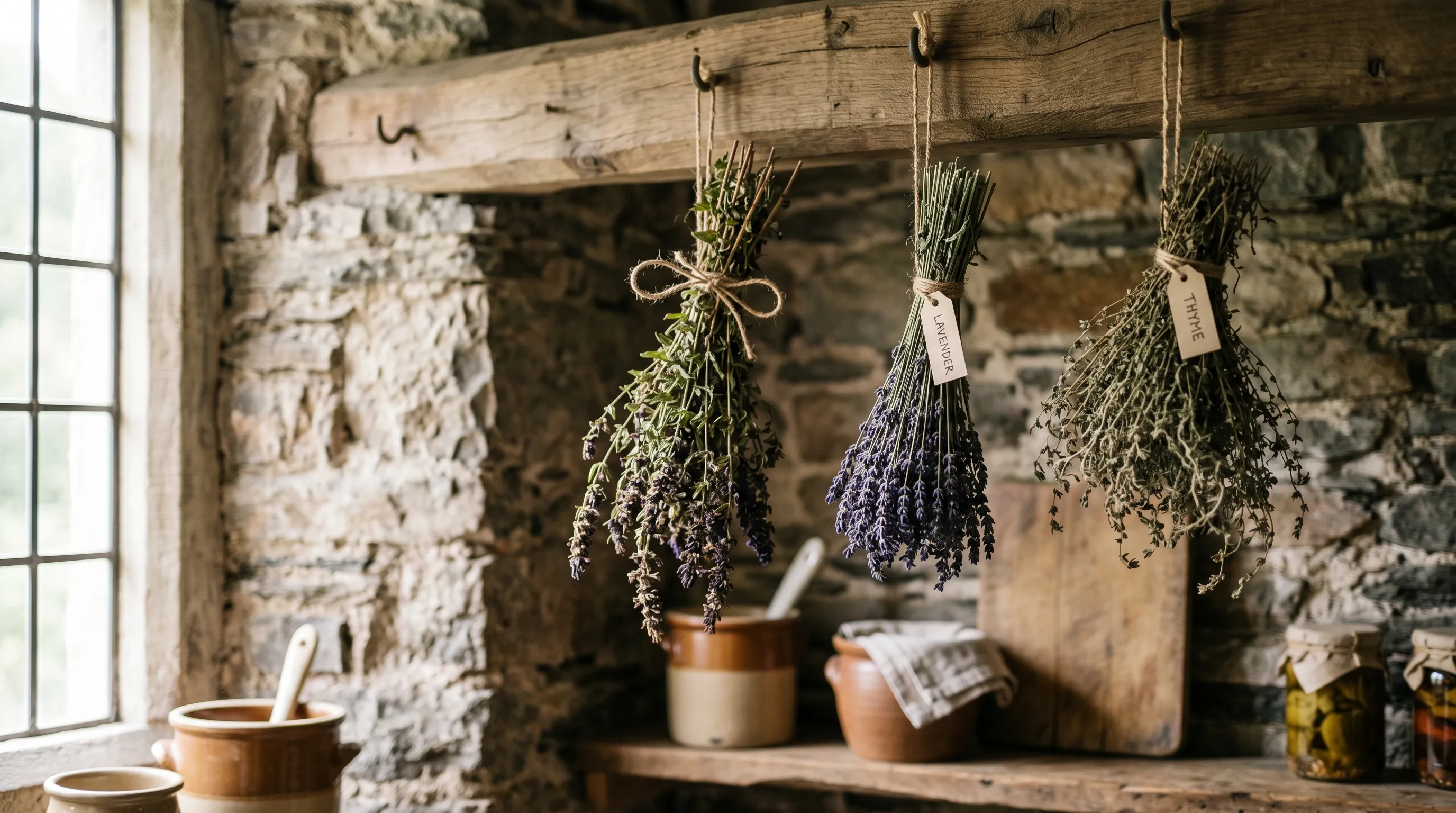 Dried hyssop bundles in a Lake District stone-walled pantry. Drying takes 10-14 days at 18-25C out of direct sunlight.
Culinary uses for hyssop
Hyssop carries a sharp resinous flavour combining notes of rosemary, mint, sage and a faint bitter undertone. The flavour is strong and easily dominates a dish. Use sparingly: 2-3 fresh leaves or a quarter-teaspoon of dried per serving is usually enough.
The herb suits rich slow-cooked meats including lamb, mutton, goose, duck and game. A traditional French recipe pairs hyssop with apricots in pork stuffing. Italian peasant cooking adds hyssop to bean and chestnut soups. Eastern European cuisines use it in pickled cucumber and beetroot brines.
Hyssop is one of the 130 herbs in Chartreuse, the French monastic liqueur made by the Carthusian order since 1737. The recipe is secret but hyssop is known to contribute the sharp green note that makes Green Chartreuse distinct from yellow.
The fresh flowers garnish summer salads, gin and tonic, and freeze well in ice cubes for cold drinks. Avoid medicinal doses (concentrated essential oil, tinctures, large quantities of tea) during pregnancy because the volatile oils can stimulate uterine contraction. Culinary use of fresh or dried leaves at normal cooking quantities is safe.
Month-by-month hyssop calendar
| Month | Task |
|---|---|
| January | Order seed from UK suppliers. Suttons, Chiltern Seeds and Jekka’s Herb Farm all stock the three main cultivars. |
| February | Prepare beds. Lime acid soils at 100g per square metre. Add 30 percent grit to clay beds. |
| March | Sow seed indoors at 18-21C. Surface-sow on fine compost. Prune established plants once frost risk passes. |
| April | Prick out seedlings into 9cm pots. Begin hardening off from late April. Apply nothing to established plants. |
| May | Plant out hardened-off seedlings from mid-May at 40cm spacing. Direct-sow seed once soil hits 12C. |
| June | First flush of flowering opens late June in the south. Thin direct-sown seedlings to 40cm. |
| July | Peak flowering and pollinator activity. Harvest stems for drying just as flowers open. Take semi-ripe cuttings. |
| August | Second flush of flowers if first flush was cut back in early July. Continue harvesting fresh leaves. |
| September | Last flush of flowers in warm gardens. Final harvest for drying. Save seed from spent flower heads. |
| October | Let foliage stand for winter shelter. Do not cut back. Mulch crowns with grit on heavy clay. |
| November | Move container plants against south walls. Stop watering pots unless prolonged dry spells. |
| December | Plan next year’s bed layout. Hyssop is reliable for hedging at 40cm spacing along brassica beds. |
Common mistakes
Pruning in autumn. The single most common cause of dead hyssop in spring. Open wounds let frost penetrate the woody base. Always wait until late March or early April once fresh shoots appear.
Planting in rich soil. High-nitrogen ground produces soft floppy growth, weak flowering, and rapid aphid colonisation. Never feed hyssop with general-purpose fertiliser or manure. The plant wants poor stony ground to thrive.
Wet feet in winter. Hyssop tolerates -15C cold but not waterlogged roots. On clay or in high-rainfall western areas, raise beds by 20cm and mix in grit, or grow in containers brought against a south wall over winter.
Cutting into old wood. Pruning back into bare brown stems below this year’s growth usually kills that branch. Stay 5cm above last year’s woody base when pruning in spring. Replace the whole plant every 5-6 years rather than trying to renovate.
Expecting flowers in year one. First-year plants stay compact at 25-35cm and flower lightly. Full flowering and pollinator value comes in year two from a March-sown seed. Plan a two-year horizon when starting a pollinator border.
Gardener’s tip: If you only plant one hyssop, plant the standard blue (Hyssopus officinalis). It pulls twice as many pollinator visits as the white form and gives a respectable 280g of dried leaf per plant per year on a well-grown second-year specimen.
Where to buy hyssop in the UK
Plug plants from Jekka’s Herb Farm (Bristol) and Norfolk Herbs (Dereham) ship between March and September. Both stock all three main cultivars and the compact aristatus subspecies. Expect to pay £4-6 per 9cm pot or £18-22 for a tray of 6 plugs.
Seed from Chiltern Seeds, Suttons and Mr Fothergill’s is reliable. Packets cost £2.50-3.50 and contain enough seed for 30-50 plants. Sow within two years of the packed date for best germination. Older seed germinates patchily.
Garden centres rarely stock hyssop because it lacks shelf appeal in pots. The plant looks scruffy until established. Specialist herb nurseries and mail-order growers are the best route.
Ready to plant a pollinator border
The Bumblebee Conservation Trust publishes a useful field guide to identifying garden bumblebees at bumblebeeconservation.org which helps confirm the species visiting your plants.
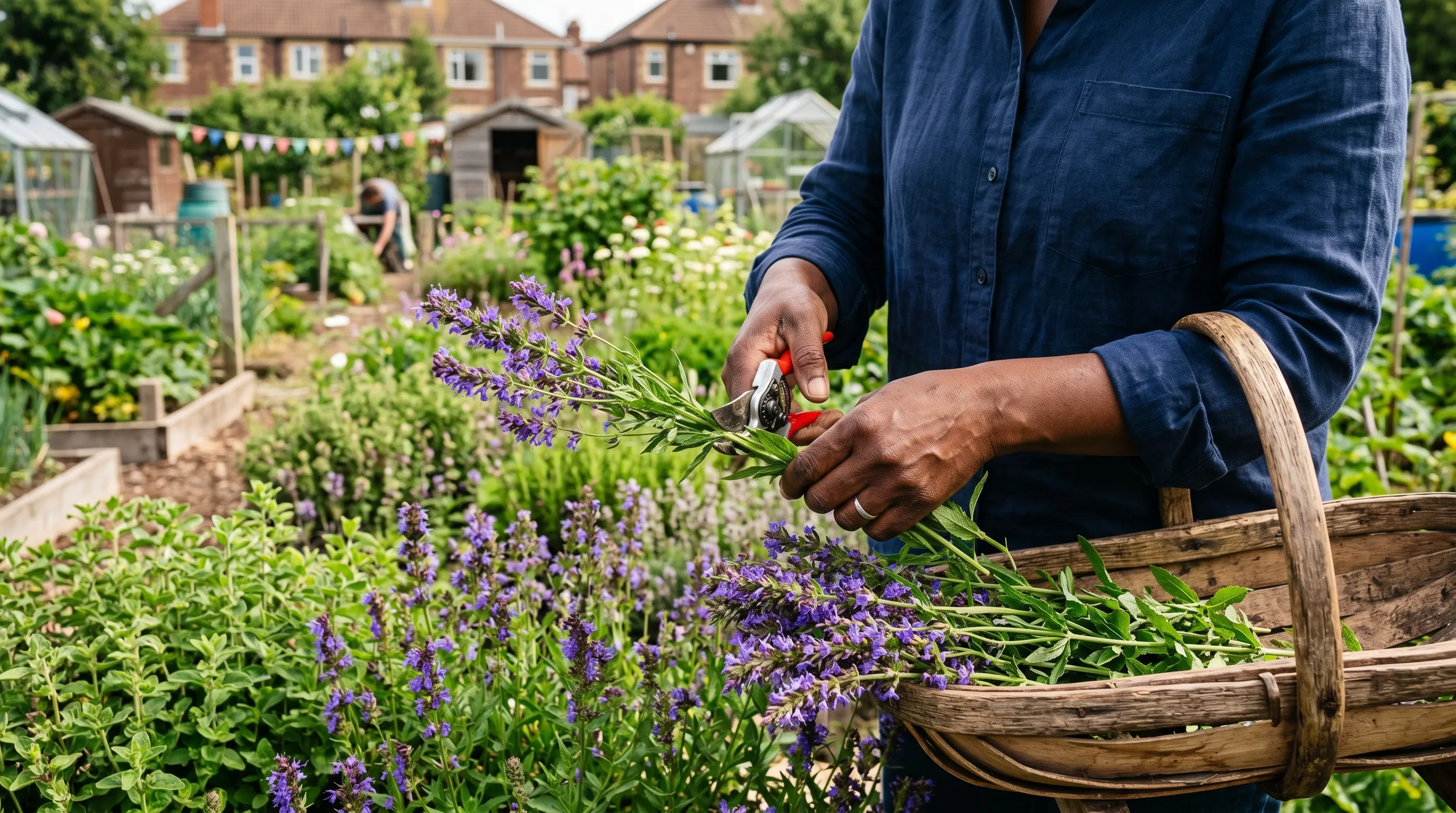 Harvest hyssop just as the first flowers open. The window in a UK garden runs from mid-June to late July depending on cultivar and latitude.
Our team produces practical UK gardening guidance from source research, contributor records and established horticultural practice. Editorial standards are overseen by Matt W.