Key takeaways
- Rose seedlings never come true to the parent: a Peace hip gives you something that is not Peace
- Cold stratification at 4-6C for 8-16 weeks is the step that decides success; a freezer kills the seed
- A realistic germination rate is 10-30%, and it can spread across two seasons, so never bin the tray
- Species roses such as Rosa rugosa and Rosa glauca come far truer from seed than any hybrid
- Rosa canina uses a rare pentaploid canina meiosis, passing on four chromosome sets from the mother
- First flowers arrive 12-18 months from sowing, but judging a seedling properly takes 3-5 years
Take a hip from a Peace rose, sow the seed, and you will not get Peace. You will get something else entirely: a rose nobody has grown before, which might be lovely and will more likely be forgettable. That unpredictability is not a flaw in the method. It is the entire point of it, and it is how every named rose you have ever bought came to exist.
This guide covers how to grow roses from seed in UK conditions: harvesting hips, cleaning and testing seed, the cold stratification that makes or breaks the job, and the realistic germination rates nobody prints on a packet. It also tells you when not to bother. If you want a copy of a rose you already own, seed is the wrong tool and this guide will point you at the right one.
Your rose seedling will not be the rose you picked
Start here, because everything else follows from it. Named rose cultivars do not come true from seed.
A rose like Peace, bred by Francis Meilland in France in the 1930s and released in 1945 as Madame A. Meilland, is a heterozygous hybrid. It carries two different versions of most of its genes, inherited from a long line of crossings. When it makes seed, those pairs are shuffled and dealt out again. Every seedling gets a different hand.
The result is segregation. Sow 50 seeds from one Peace hip and you get 50 genetically distinct roses. Some will be single-flowered where the parent was double. Some will be pink where the parent was yellow. Most will be less good than Peace, because Peace was selected out of thousands of siblings precisely for being the best of them.
Professional breeders live with this ratio. They raise tens of thousands of seedlings a year and introduce a handful. Over 99% are discarded. That sounds brutal until you understand it is the only way new roses have ever been made.
For the home grower the same maths applies at a smaller scale, and it cuts both ways. You will not reproduce a favourite. You will produce something genuinely unique: a rose that exists nowhere else, with a fair chance of being the only one of its kind in the country.
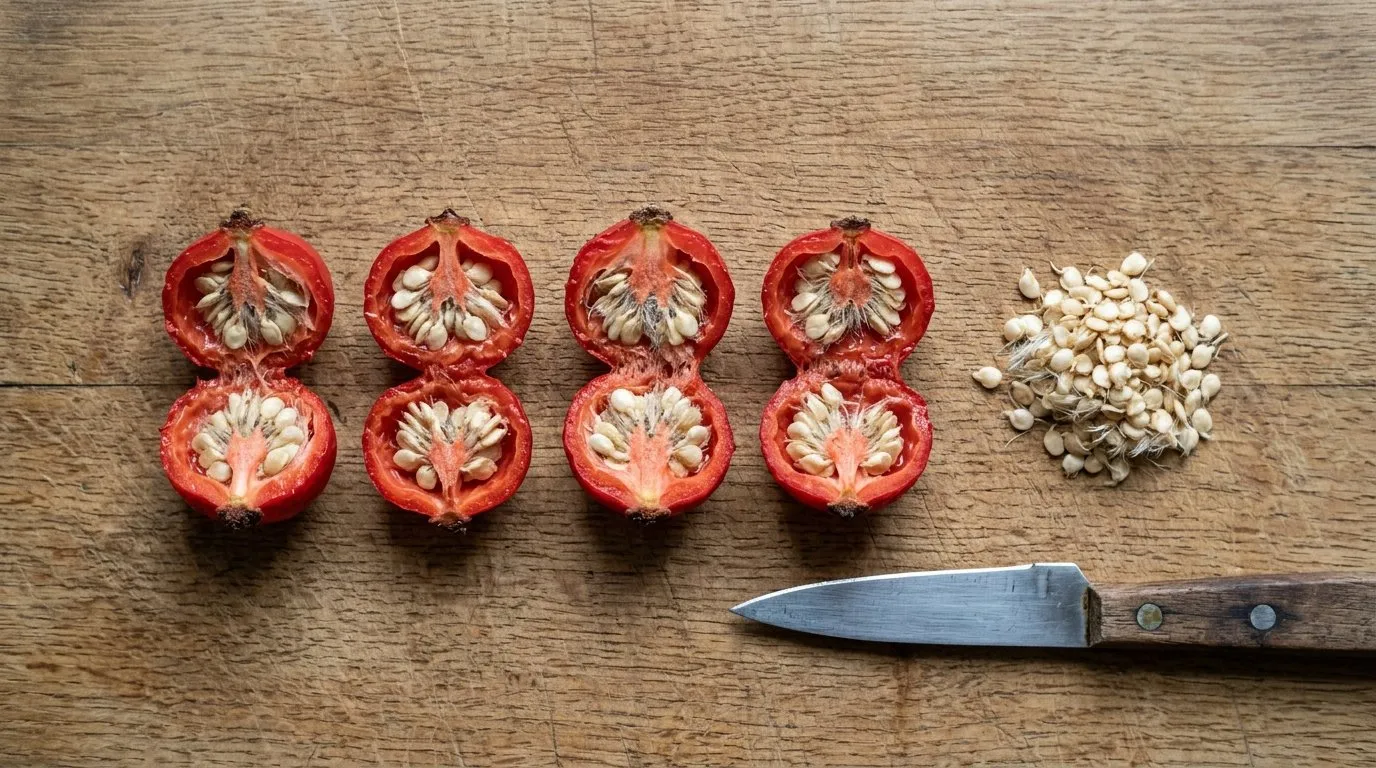 A rugosa hip holds 10 to 25 seeds packed in irritant hairs. Each one is a genetically different rose.
Why named roses are sold as cuttings and grafts
If seed does not replicate a cultivar, something else must. That something is vegetative propagation, and it explains the entire structure of the rose trade.
Every Peace rose on earth is a clone, a piece of the original 1935 seedling kept going by cuttings and budding for ninety years. Budding takes a single growth bud from the cultivar and inserts it under the bark of a rootstock, usually a Rosa laxa or dog rose understock. Hardwood cuttings root a length of stem so it grows on its own roots. Both methods copy the parent exactly, because there is no sexual shuffle involved.
This is why a rose nursery sells you a grafted plant rather than a seed packet. Seed cannot deliver what the customer is paying for, which is a specific, named, predictable rose.
So be honest with yourself about which job you are doing. If you want another plant of a rose you already love, take cuttings: rose hardwood cuttings taken in November root at 60-70% and cost nothing. Our guide to plant propagation by cuttings, division and layering covers the technique and timing in full. Come back here only when you want something new rather than something copied.
Which roses are worth growing from seed
Not all roses are equal candidates, and this is where most beginners go wrong before they even pick a hip.
Species roses are the wild originals, and they breed far truer than any hybrid. They have been pollinating themselves in the wild for millennia, so their genes are relatively uniform. A Rosa rugosa seedling looks recognisably like a rugosa. A hybrid tea seedling looks like a lottery ticket.
Rosa rugosa is the best starting point in Britain. It is diploid, carrying 14 chromosomes, comes reasonably true, germinates more willingly than most, and its hips are big fleshy things that are genuinely pleasant to process. It also naturalises along UK coasts, so seed is easy to find.
Rosa glauca is tetraploid with 28 chromosomes and passes on its blue-grey foliage to most seedlings, which makes it satisfying to raise because the seedlings are visibly worth having from the first true leaf.
Rosa canina, the native dog rose, does something genuinely strange. It is pentaploid, carrying 35 chromosomes in five sets, and uses a rare reproductive system called canina meiosis. Four of those five sets pass down the maternal line and only one comes through the pollen. The practical effect is that dog rose seedlings resemble their mother far more closely than ordinary genetics would allow. It is the closest thing to a rose that clones itself through seed.
Hybrid teas, floribundas and David Austin English roses are the poorest candidates for a predictable result, and the most interesting for a gamble. Our guide to the types of roses grown in UK gardens explains where each group sits and which species are worth hunting for hips.
| Rose group | Comes true from seed? | Germination rate | Difficulty | Best for |
|---|---|---|---|---|
| Rosa canina (dog rose) | Very close, via canina meiosis | 20-35% | Easy | Hedging, rootstock, predictable seedlings |
| Rosa rugosa | Close | 15-30% | Easiest | First attempt, hedging, big easy hips |
| Rosa glauca | Close for foliage | 15-25% | Easy | Foliage colour, reliable seedlings |
| Old garden roses | Loosely | 10-20% | Moderate | Scent breeding, character |
| Floribunda / shrub | No | 10-20% | Moderate | Gambling on something new |
| Hybrid tea (Peace etc.) | Not at all | 10-25% | Hardest | Breeding projects only |
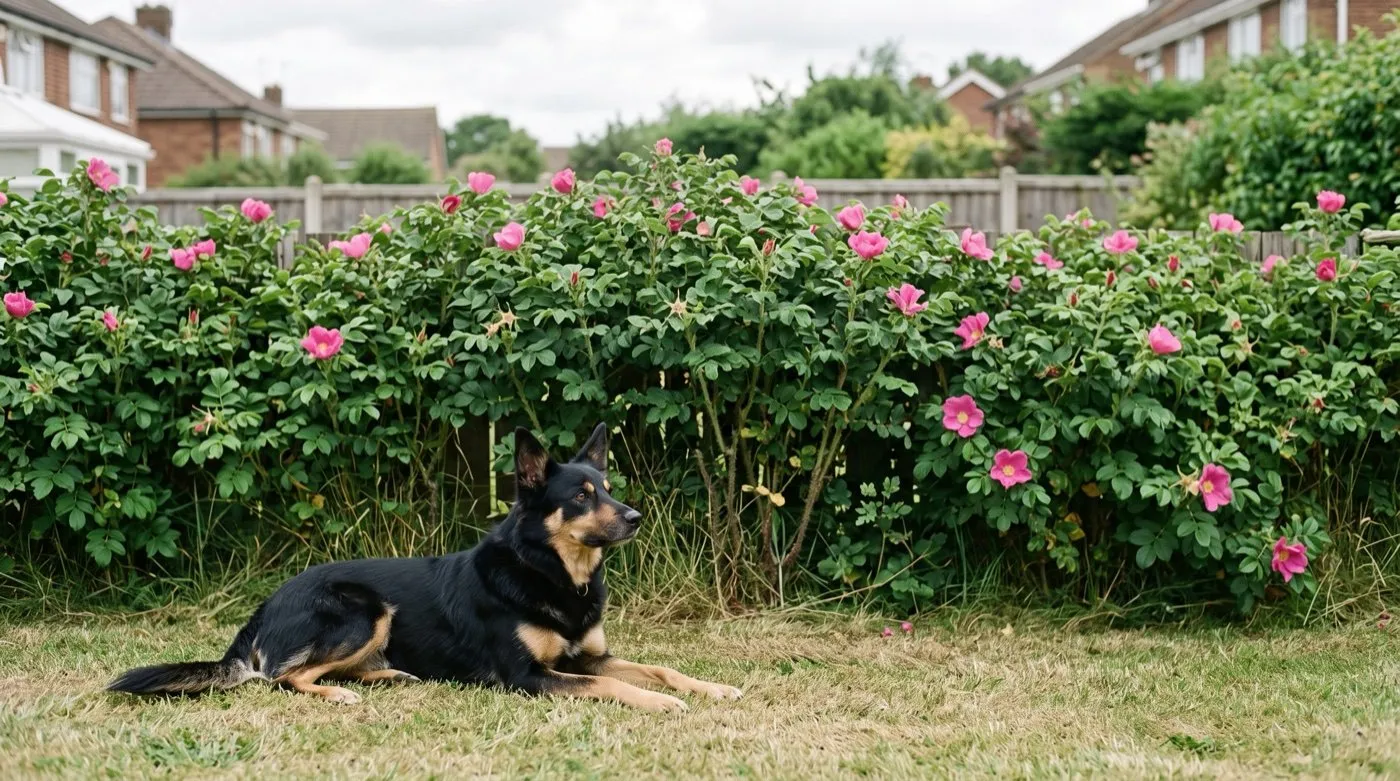 A Rosa rugosa boundary hedge in June. Species roses pass their character down to most seedlings, and rugosa hips are free for the picking in October.
When to harvest rose hips for seed
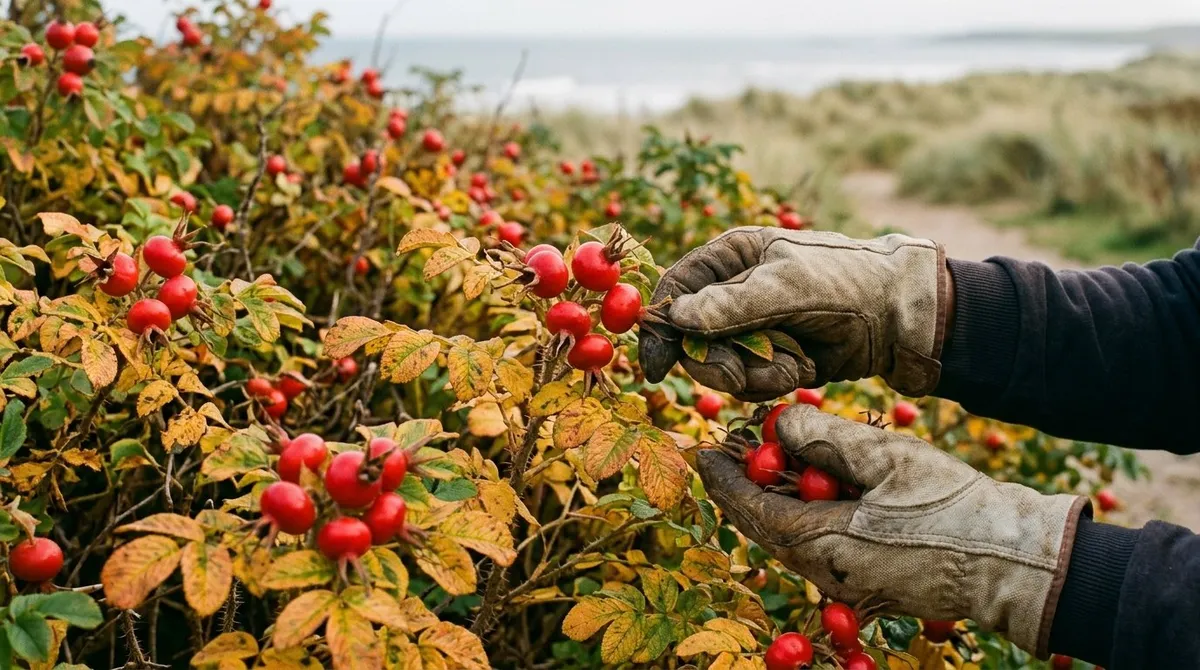
Timing is narrow and it matters. Pick October to November, when hips are fully coloured but still firm to a squeeze.
Green hips hold immature embryos that will not germinate whatever you do to them afterwards. Go too far the other way and soft, wrinkled or blackening hips have usually let mould reach the seed, and a mouldy seed will not survive three months in a warm damp bag. On our rugosa hedge in north Staffordshire that window is reliably the last three weeks of October. In Cornwall it runs a fortnight earlier; in Aberdeenshire a fortnight later.
Pick from a plant you can identify. Hips off an unknown garden rose are a genuine lottery, since you know neither parent. Hips off a labelled species rose at least tell you the mother.
Wear gloves. The inside of a rose hip is lined with fine hairs that itch ferociously and are famously the raw material of childhood itching powder. This is not a minor detail. Processing 40 hips barehanded is a mistake you make exactly once.
Cleaning off the pulp and why it matters
Slice each hip in half around its equator and scoop the seed out with the knife tip. What you are removing is technically an achene, a dry single-seeded fruit, though everyone calls them seeds and so will we.
Then clean them, properly, and do not rush this. Rub the seed in a kitchen sieve under running water until not a trace of orange pulp remains. The flesh carries germination inhibitors, chiefly abscisic acid, that actively suppress the embryo. It also feeds mould through the long chill ahead. Half-cleaned seed is the single most common reason a stratification bag comes out of the fridge furry and dead in February.
Spread the clean seed on kitchen roll for about an hour to take the surface water off. No longer. Rose seed must not dry out completely, because unlike a bean it has no dry-storage phase in its natural cycle. It goes from hip to damp soil in the wild, and the process you are copying is exactly that.
Count what you have. A rugosa hip gives 10 to 25 seeds and a dog rose hip 15 to 30. Forty hips is therefore a realistic 200 or more seeds, which at a 20% germination rate is still 40 roses. Scale your ambition accordingly, because 40 rose seedlings need 40 pots and somewhere to put them.
The float test and what it actually tells you
Drop the cleaned seed into a glass of water and leave it 20 minutes. Sinkers are dense, generally full, and are your best material. Floaters are lighter, often carrying trapped air or an underdeveloped embryo.
Standard advice says bin the floaters. Our own numbers say do not, and this is the one place where we part company with almost every rose book in print.
The float test is a rough sort, not a verdict. It tells you where your best odds are, which is useful when tray space is short. It does not tell you what is dead. Treat it as a way to prioritise, sow the floaters separately, and let them prove themselves.
Stratification is the step that makes or breaks the job
If you take one thing from this article, take this. Cold moist stratification is not optional and nothing substitutes for it.
Rose seed carries physiological dormancy, an internal chemical brake that stops it germinating in the autumn it falls. In the wild the seed sits in cold wet soil through winter. Those months of cold slowly break down the inhibitors and shift the embryo’s hormone balance until it is ready to grow. Skip the cold and the brake stays on, whatever the compost or the windowsill offers.
Reproduce it like this. Mix the seed into barely damp vermiculite, or fold it into damp kitchen roll, and seal it in a labelled zip bag. Put it in the salad drawer of the fridge at 4-6C for 8 to 16 weeks. Put a fridge thermometer in the drawer and check it, because plenty of domestic fridges run at 8C or above, which is too warm to do the job.
Never use the freezer. Stratification needs cold, moisture and oxygen together. Freezing halts the biochemistry entirely and can rupture the cells with ice. A frozen batch is not a chilled batch; it is usually a dead one.
Check the bag fortnightly. Pick out anything furry before it spreads. Towards the end of the chill some seed will chit, sending a white root out inside the bag. Pot those up straight away rather than waiting for the calendar. Seed that has decided to grow will not wait for you.
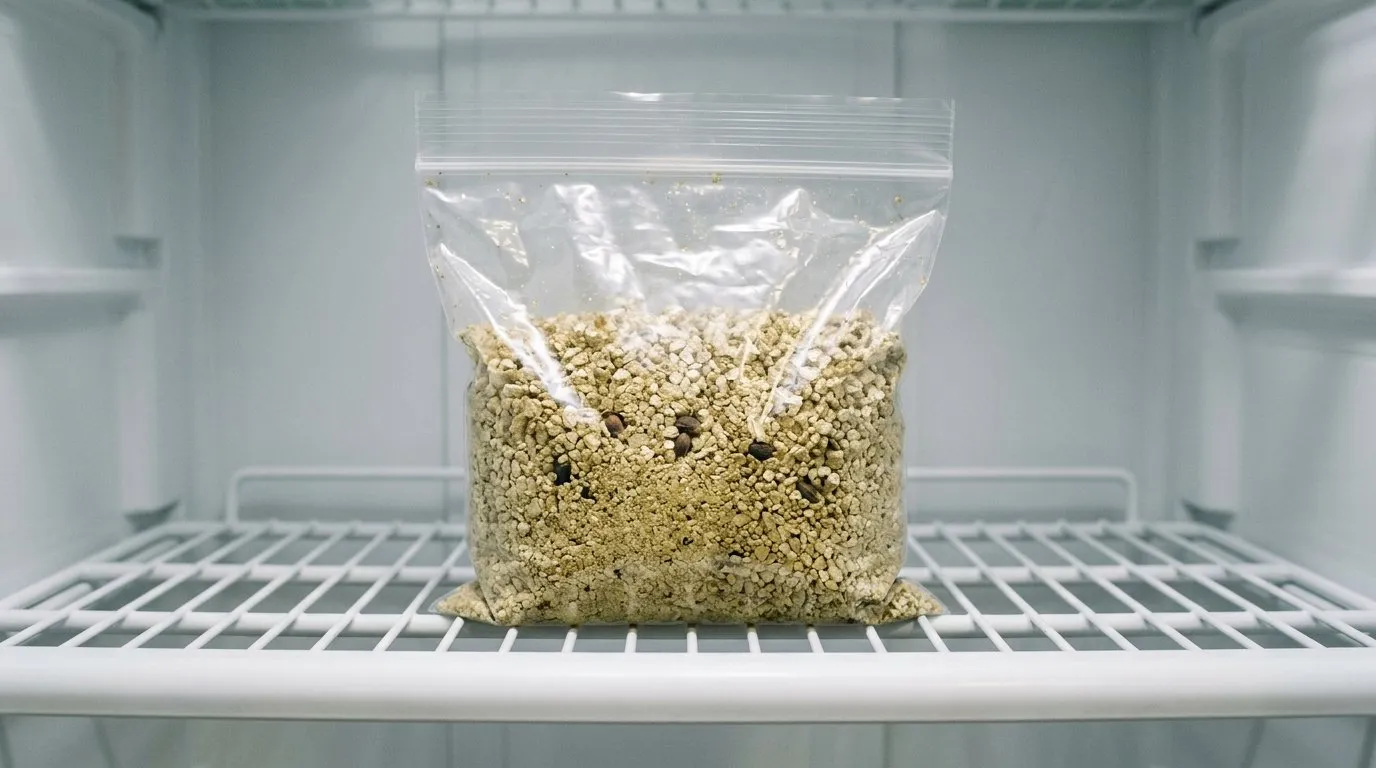 Barely damp vermiculite, a labelled bag and 4-6C in the salad drawer. A fridge thermometer is worth more here than any gadget.
Warning: Do not stratify seed in soaking wet vermiculite. Waterlogged seed suffocates, because the embryo needs oxygen throughout the chill. The mix should feel barely damp, like a wrung-out cloth, with no water running when you squeeze it.
Sowing rose seed after chilling
Sow into moist peat-free seed compost in 9cm pots or a standard tray, at about 5mm deep, and top with 3-4mm of fine grit or perlite. The grit keeps the surface open, discourages moss and liverwort over the long germination window, and holds the seed leaves clear of wet compost.
Space the seed about 2cm apart. It sounds generous for something with a 20% success rate, but you will be pricking out over several months and crowded seedlings tear each other’s roots.
Label everything with the species and the date the chill started. You will still be looking at this tray in eighteen months and you will not remember.
Bring the tray to 18-21C, on a windowsill or in a propagator. Here is the nuance that catches people: do not push it warmer. Above roughly 21C rose seed can drop into secondary dormancy, a second brake that re-engages when conditions look wrong. A hot airing cupboard does not speed rose seed up. It shuts it down, sometimes for a whole season. Our guide to seed germination temperatures covers where other species sit on this scale, and roses are firmly at the cool end of it.
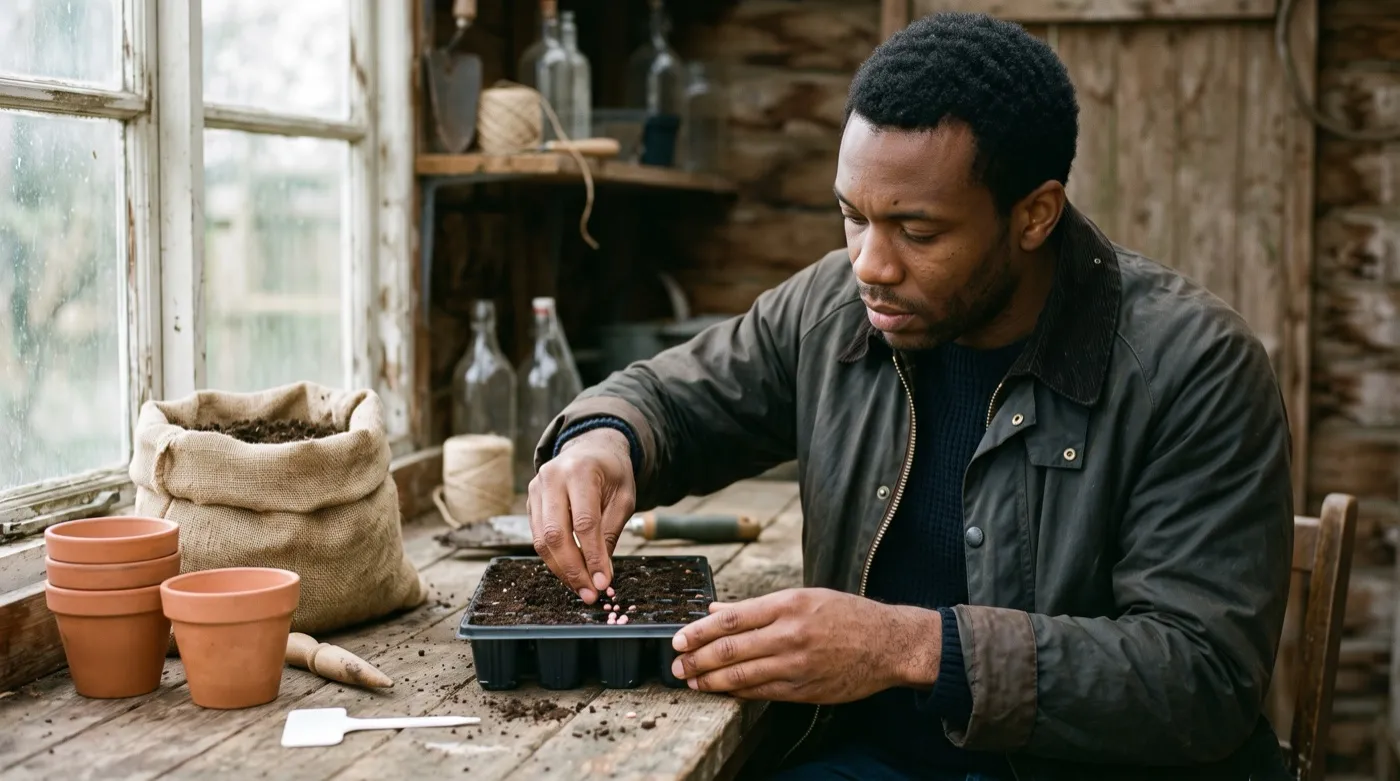 Sow at 5mm into peat-free seed compost and label the tray with the species and the date the chill started. You will still be reading that label in eighteen months.
Everything else about the sowing is standard practice, covered in our guide to sowing seeds indoors: clean pots, fresh compost, bottom watering, decent light from the moment the first seedling shows.
Why germination is so erratic
A realistic rate is 10-30%. Not 90%. Ten to thirty, and that is with everything done right.
Rose seed does not germinate as a cohort. It trickles. First seedlings usually appear 4 to 8 weeks after sowing, and the tray keeps producing at intervals for months afterwards. Some seed sits through an entire summer and comes up the following spring, having taken a second winter to finish breaking dormancy.
This is not failure. It is a survival strategy called bet-hedging. A wild rose that germinated all its seed in one week would lose the entire cohort to one late frost or one dry May. Staggering germination across two or three years is how the species insures itself. Your seed tray is doing exactly what evolution built it to do.
Damping off kills more rose seedlings than anything else
You cleared dormancy and got seedlings. Now comes the stage that actually loses them.
Damping off is a fungal collapse caused by Pythium, Phytophthora and Rhizoctonia species living in compost and water. A seedling topples at soil level, the stem pinched and brown, and is dead within a day. It travels across a tray fast, and rose seedlings are slow growers, so they sit in the vulnerable stage for weeks longer than a bean or a sunflower does.
Prevention is entirely about conditions, because there is no cure once a seedling has gone over.
Weak, stretched seedlings are far more susceptible than sturdy ones, and stretching is caused by poor light. If your seedlings are reaching and pale, fix the light before you worry about the fungus: our guide to leggy seedlings and how to fix them covers the causes.
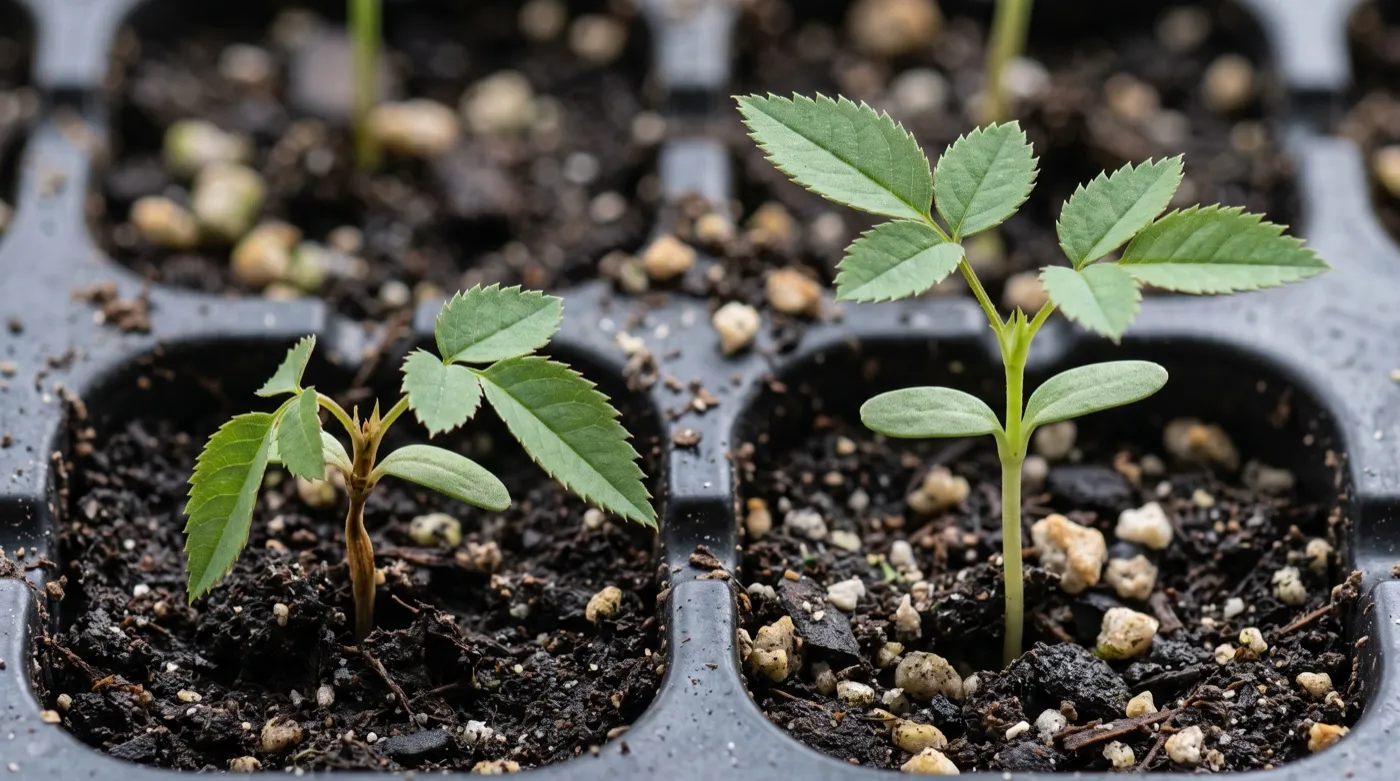 Damping off pinches the stem at compost level and the seedling goes over within a day. The healthy seedling beside it is the same age.
Rose propagation methods ranked
Seed is one of four ways to make a rose, and it is the slowest and least predictable of them. That is worth seeing plainly before you commit eighteen months.
| Method | Effectiveness | Role | What it cannot do |
|---|---|---|---|
| Budding onto rootstock | 85-95% take | Primary: the nursery gold standard | Needs skill, a rootstock and a July window |
| Hardwood cuttings, November | 60-70% root | Primary for home growers | Cannot make anything new |
| Layering a low shoot | 70-80% | Supplementary, one or two plants | Slow, and only for lax-stemmed roses |
| Seed, species rose | 15-35% germination | Primary for new plants and hedging | Cannot copy a named cultivar |
| Seed, hybrid cultivar | 10-25% germination | Experimental only | Cannot reproduce the parent at all |
The gold standard for reproducing a rose is budding, which is why every nursery does it. The gold standard for making a rose that has never existed is seed, and nothing else will do the job at all. They are different tasks and the table is not really a competition.
Month by month for growing roses from seed
The whole cycle spans about eighteen months from hip to first flower. This calendar assumes an October start.
| Month | Task |
|---|---|
| October | Pick fully coloured, firm hips. Extract, clean and float-test the seed. Start the chill. |
| November | Seed in damp vermiculite at 4-6C in the fridge. Take rose hardwood cuttings now if you want copies instead. |
| December | Check bags fortnightly for mould. Confirm the drawer is holding 4-6C, not 8C. |
| January | Chill continues. Watch for early chitting; pot up anything that sends out a root. |
| February | End of an 8-16 week chill for October seed. Sow at 5mm into peat-free seed compost. |
| March | Hold 18-21C, no warmer. First seedlings appear from 4 weeks. Light matters from day one. |
| April | Prick out at first true leaf into 9cm pots. Water from below with mains water only. |
| May | Peak damping-off risk. Keep air moving. Do not use water-butt water under cover. |
| June | Grow on. Late germinators still arriving. Keep the original tray, do not bin it. |
| July | Harden off seedlings gradually. Move the old tray somewhere cool and shaded. |
| August | Pot on strong seedlings to 2 litre pots. Some may show a first bud already. |
| September | Overwinter seedlings in a cold frame. Let the old tray sit outside for a second winter. |
| Second spring | Watch the original tray again. Expect roughly a third more seedlings. First flowers from 12 months. |
Planting a seedling out permanently follows normal rose rules, and the timing is the same as for any bought plant: our guide to when to plant roses in the UK covers the bare-root and container windows.
The first flower and the long wait after it
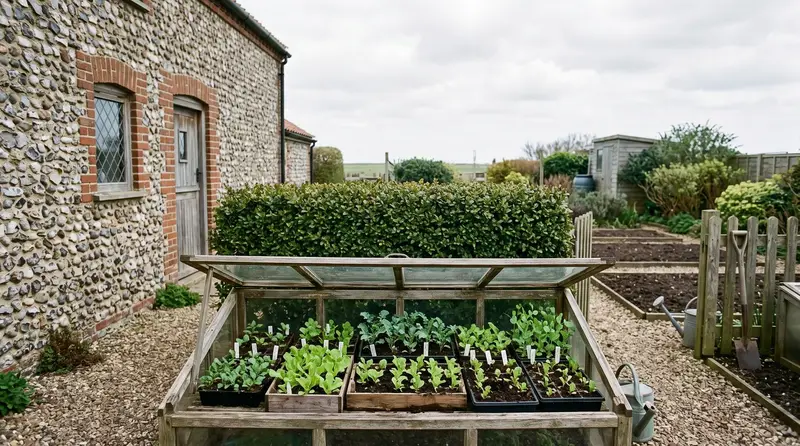
Expect the first bloom 12 to 18 months from sowing. Ours have run from 12 months for a rugosa to 26 months for a stubborn canina.
Then comes the part that separates growing roses from breeding them. That first flower tells you almost nothing. A maiden bloom on a young seedling is routinely smaller, flatter, paler and less petalled than the same plant will produce at maturity. Judging on it is like judging a puppy on its first haircut.
Give a seedling 3 to 5 years before you decide. Over that time you are watching four things: whether it repeats or flowers once, whether it holds any scent, whether it shows disease resistance through a wet British August, and whether it has decent habit and vigour. Blackspot resistance in particular cannot be assessed in year one, because a seedling in a pot is a different plant from a seedling in clay.
Be ruthless, eventually. Breeders bin over 99% and they are not being cruel; they are being honest about how rarely a genuinely good rose turns up. Keep the one in fifty that earns it, and compost the rest without ceremony. The one you keep is a rose nobody else in the world grows.
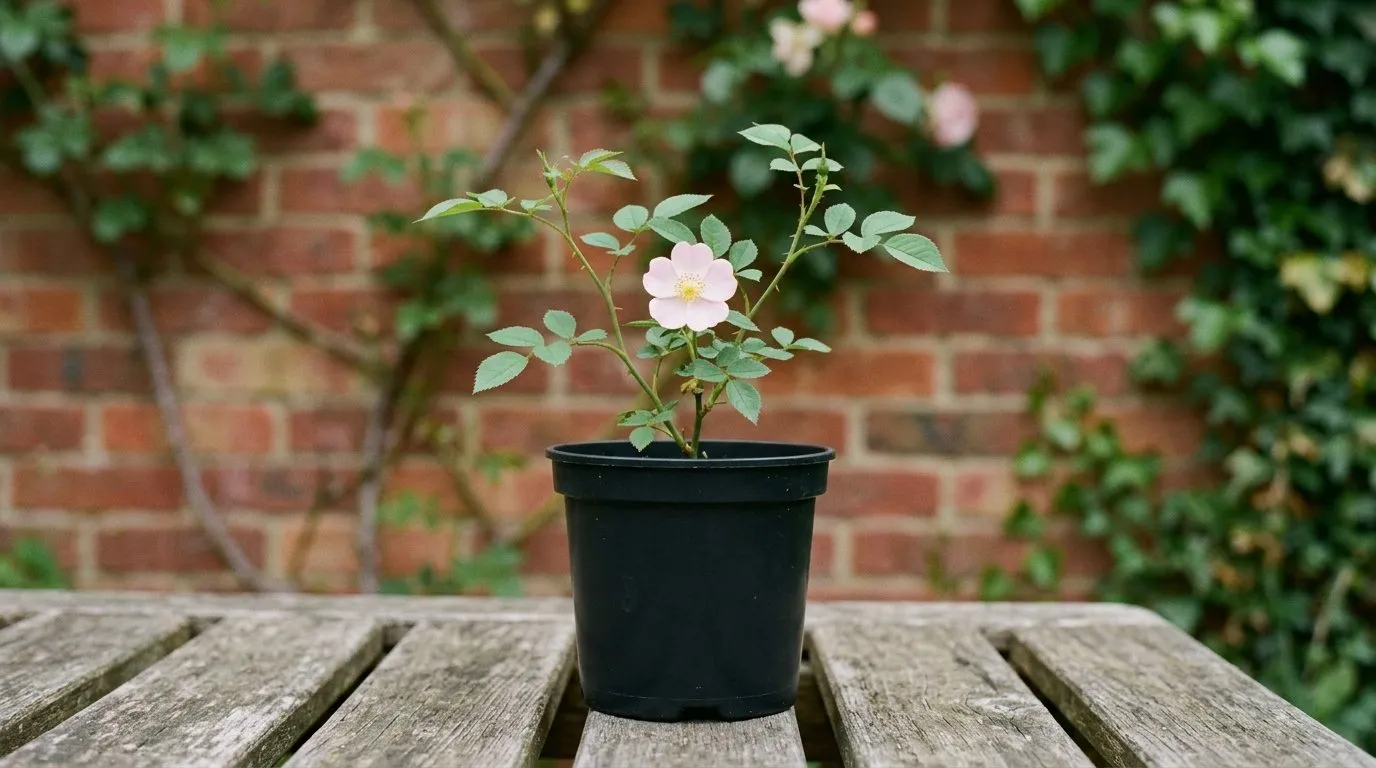 A first flower at 14 months from sowing. It tells you very little: colour, scent and repeat all settle over the following three years.
Why most rose seed never comes up
The underlying cause of failure is almost never the seed. It is dormancy that was never properly broken, and it is missed because the symptom looks identical to dead seed.
A gardener sows rose seed straight from the hip into a warm propagator. Nothing happens for six weeks. The obvious conclusion is that the seed was no good, so the tray goes on the compost heap. The seed was fine. The chemical brake was still fully on, and it would have stayed on until the seed had spent a winter’s worth of cold in damp conditions. There is no visual difference between a dormant rose seed and a dead one, which is exactly why the mistake survives.
The second layer of the same root cause is a fridge that is not cold enough. Plenty of domestic fridges sit at 7-9C. That is cold enough to feel cold and too warm to break rose dormancy efficiently. The gardener does everything right, waits sixteen weeks, sows, and still gets nothing, and now concludes stratification does not work either.
Permanent prevention is two cheap things. Buy a fridge thermometer, about £4, and confirm the drawer holds 4-6C before the seed goes in. Then give the seed the full 16 weeks rather than the minimum 8, because over-chilling rose seed does no harm at all while under-chilling ruins the batch. Both fixes cost almost nothing and remove the failure mode permanently. The seed-banking work at Kew’s Millennium Seed Bank is built on the same principle: dormancy is a mechanism to be satisfied, never a defect to be worked around.
Common mistakes when growing roses from seed
If you would rather work with reliable seed while a rose tray does its slow thing in the background, plenty of species behave far more predictably than roses. The rest of our how-to section has the practical jobs that fill the eighteen months of waiting.
Is it worth it
Honestly, it depends what you want. If you want roses in the garden next June, buy a bare-root plant in November for £12 and skip all of this. Seed is slower, less certain, and mostly produces plants you will discard.
What it produces the rest of the time is something no money can buy: a rose that has never existed before, raised on your own soil, growing nowhere else. Every named rose in every catalogue started exactly this way, as one seedling out of thousands that somebody decided to keep. The process has not changed since Meilland was raising the seedling that became Peace, and it is fully available to anyone with a fridge and eighteen months of patience.
Start with rugosa. Chill it properly. Sow the floaters. Keep the tray two years. That is the whole trick.
Now you know how to raise a rose from seed, read our guide to growing roses in the UK to give your seedling the soil, feeding and pruning it needs once it goes in the ground.
Frequently asked questions
Can you grow roses from seed?
Yes, but the seedlings will not match the parent rose. Rose seed grows readily once the dormancy is broken by cold stratification. What you cannot do is reproduce a named cultivar this way, because hybrid roses are heterozygous and their seedlings segregate. Growing from seed makes a new rose, not a copy of an old one.
Will rose seeds grow the same rose as the parent?
No, not with any named cultivar. A hip taken from Peace produces seedlings that are not Peace and never will be. Named roses are propagated by cuttings and budding precisely because seed does not replicate them. Species roses such as Rosa rugosa come much closer to true, which is why they are the sensible place to start.
Do rose seeds need stratification?
Yes, almost always. Rose seed carries physiological dormancy that only a long cold moist period breaks. Hold the seed at 4-6C in damp vermiculite for 8 to 16 weeks. Skip this step and germination collapses to near zero, no matter how good the compost or how warm the windowsill.
Can I put rose seeds in the freezer?
No. Freezing does not substitute for stratification and can kill the embryo. Stratification needs cold, moisture and oxygen together, at 4-6C, which is fridge temperature and not freezer temperature. A salad drawer with a thermometer in it is the right tool.
How long do rose seeds take to germinate?
First seedlings usually appear 4 to 8 weeks after sowing, once chilled. Germination is famously erratic and a single batch can keep producing seedlings for months, sometimes appearing again the following spring. A realistic total is 10-30%. Keep the tray for two full seasons before giving up on it.
When should I pick rose hips for seed?
October and November, once hips are fully coloured but still firm. Picking green means immature embryos that will not germinate. Leaving them until soft, wrinkled or black usually means mould has reached the seed. On Rosa rugosa in the Midlands that window is normally the last three weeks of October.
How long until a rose grown from seed flowers?
Typically 12-18 months from sowing for the first bloom. That first flower rarely represents the mature plant. Colour, scent, repeat flowering and disease resistance all settle down later, so give a seedling 3-5 years before deciding whether to keep it. Breeders routinely discard over 99% of theirs.
Our team produces practical UK gardening guidance from source research, contributor records and established horticultural practice. Editorial standards are overseen by Matt W.