
Key takeaways
- You need a ring, moss, reel wire, secateurs and a big pile of evergreen foliage
- Cut foliage into 12-15cm pieces and wire them on in small bundles, all facing the same way
- Holly, ivy, conifer, bay, Viburnum tinus and skimmia all last well outdoors
- An outdoor wreath stays fresh for four to five weeks, so late November is the time to make one
- Skip floral foam. Moss raked from the lawn holds water just as well
- Take only from your own garden, or ask permission first
Making a Christmas wreath is easier than it looks. You cover a ring with moss, then wire on small bundles of evergreen foliage until it’s full. A morning, a bucket of garden cuttings and a reel of wire is all it takes.
A homemade wreath also lasts longer than most bought ones, because the moss underneath keeps it damp. Below you’ll find what to buy, which plants to cut, a step-by-step method and how to keep it fresh into January. There’s also a quick guide to taking foliage legally and a timetable for when to do each job.
What you need to make a Christmas wreath
To make a Christmas wreath you need a ring, moss, reel wire, secateurs and about a bucketful of evergreens. Most of it is free if you have a garden. Expect to spend £5-25 in total, depending on how much ribbon and decoration you add.
A 30-35cm wreath ring is the right size for a front door. Wire and copper rings are cheap and reusable. Willow or vine rings look more rustic and don’t need hiding.
For the base, use moss. Moss raked out of the lawn in autumn works perfectly, and it’s a handy way to use up what you’ve scarified. The guide to getting rid of moss in your lawn shows how to rake it out. You’ll need about two carrier bags full.
Reel wire binds everything on. Stub wires, which are short, straight lengths, are useful for fixing pine cones and other decorations. Most garden centres sell rings, wire and ribbon from November. You can find one near you in the garden centre directory.
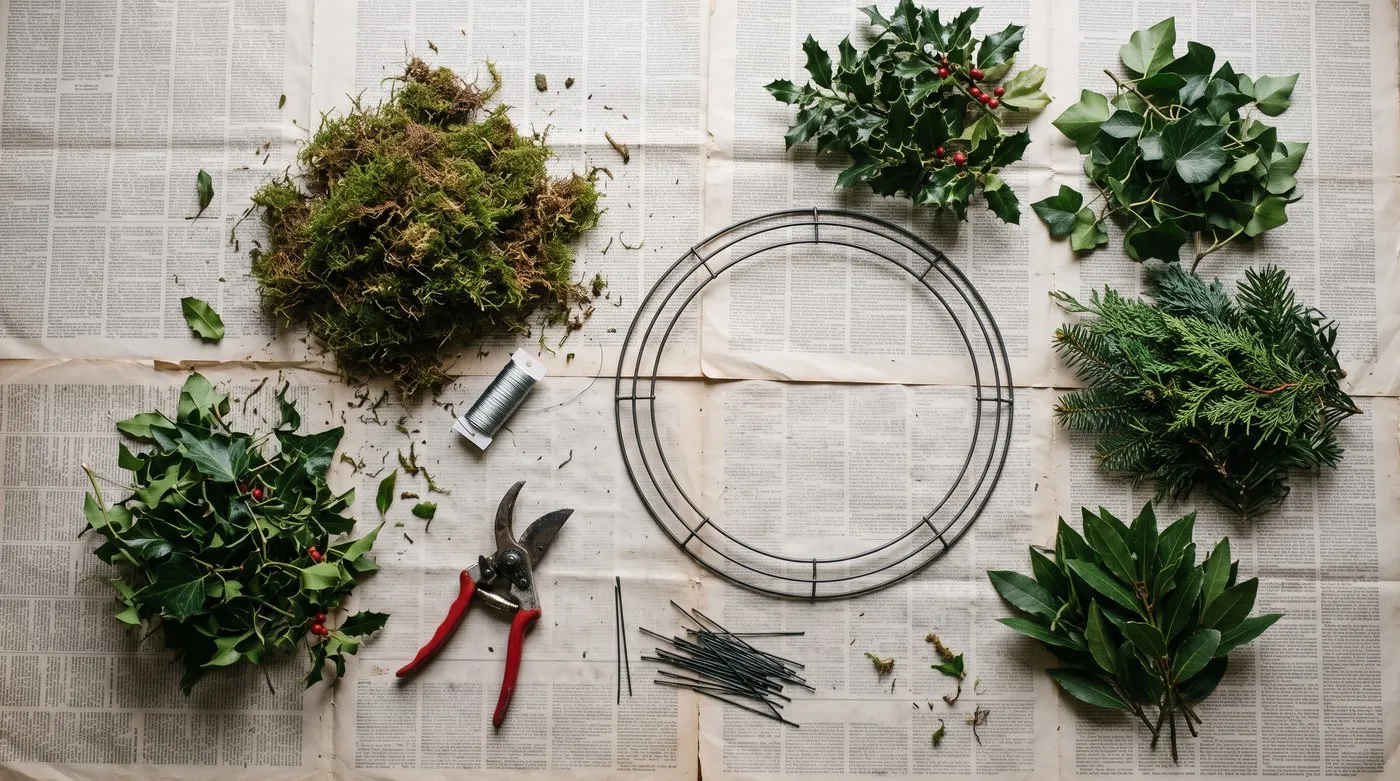
Everything you need, laid out before you start. Cut about twice as much foliage as you think you’ll use.
Gardener’s tip: Skip floral foam. It’s a plastic that breaks into tiny pieces and can’t be composted. Moss holds water just as well.
The best garden foliage for a Christmas wreath
The best wreath foliage is tough, evergreen and slow to wilt. Holly, ivy and conifer are the classics. Bay, Viburnum tinus and pittosporum add different leaf shapes, and silver or red stems give a modern look.
Mix two or three types. One bold, glossy leaf plus one fine, feathery one usually looks best.
| Foliage | Look | Lasts outdoors | Good to know |
|---|---|---|---|
| Holly | Glossy, spiky, red berries | 4-5 weeks | Wear gloves. Berried stems come from female plants |
| Ivy | Trailing, dark green, black berries | 4-5 weeks | Use the flowering, round-leaved shoots for bulk |
| Conifer (fir, spruce, pine, cypress) | Fine, feathery, scented | 4-6 weeks | Noble fir and Nordmann fir hold their needles best |
| Bay | Smooth, oval, aromatic | 3-4 weeks | Dries well, so it lasts indoors too |
| Viburnum tinus | Matt leaves, pink buds | 3-4 weeks | Its buds and flowers add soft colour |
| Pittosporum | Small, wavy, silver or green leaves | 3-4 weeks | Great for filling gaps |
| Eucalyptus | Round, silver-blue leaves | 2-4 weeks | Dries well and smells lovely |
| Skimmia | Red buds or berries | 3-4 weeks | Adds colour without holly prickles |
| Dogwood stems | Bright red or lime twigs | 4-6 weeks | Push them in at an angle for a starburst |
If you’re planting for next year’s wreath, holly is a good place to start. The guide to growing holly explains why you need a female plant for berries. Our guides to Viburnum and red-stemmed dogwood cover two more good wreath plants.

Cut a few stems from each shrub so no single plant ends up lopsided.
Where you can and can’t pick foliage
Your own garden is the simplest source. Cut small amounts from the back of each shrub so the plant still looks good.
Hedgerows and woods always belong to someone. You need the landowner’s permission to cut anything, and uprooting any wild plant without permission is against the law. Leave plenty of holly and ivy berries behind too, as birds rely on them in winter.
How to make a Christmas wreath, step by step
Here’s the full method. Allow about two hours for your first wreath. The second one takes half the time.
Step 1: Cover the ring with moss
Squeeze fist-sized handfuls of damp moss onto the ring. Bind each one on tightly with two or three turns of reel wire, then add the next handful right up against it. Keep going until the whole ring has a firm, even layer about 5cm thick. Don’t cut the wire. You’ll use the same length for the foliage.
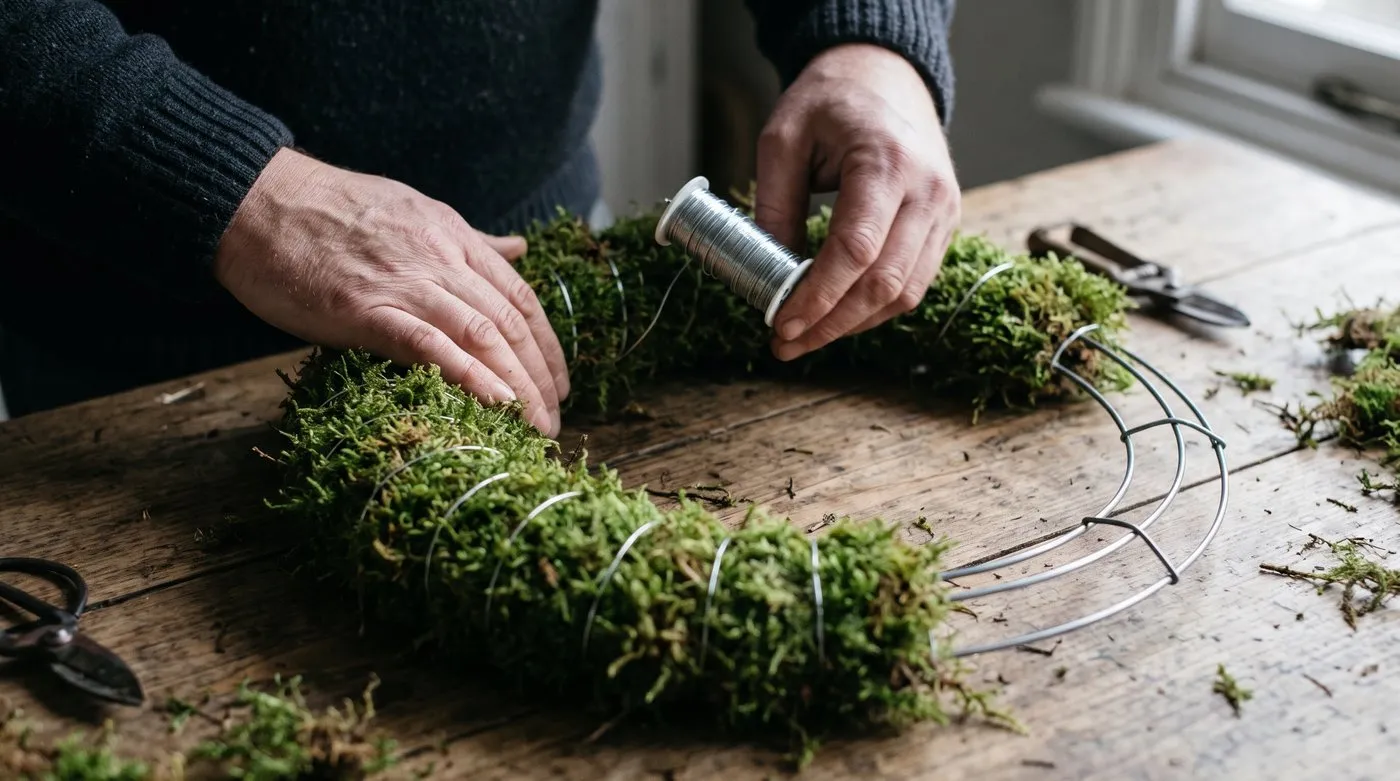
Pull the wire tight as you go. A firm moss base is what keeps the finished wreath neat.
Step 2: Make small foliage bundles
Cut the foliage into pieces about 12-15cm long. Then put three or four mixed pieces together in a small fan, with the stems lined up. Make 20-30 bundles before you start wiring, so you aren’t stopping every minute.
Step 3: Wire on the bundles
Lay the first bundle on the moss with the stems pointing round the ring. Bind the stems with two tight turns of wire. Lay the next bundle so its leaves cover the stems of the first, facing the same way. Work around the inside edge, the top and the outside edge in turn so no moss shows. When you get back to the start, tuck the last stems under the first bundle’s leaves.

Each new bundle hides the stems of the last one. Keep them all pointing the same way round the ring.
Step 4: Add decorations
Push a stub wire through the base scales of a pine cone, twist it tight and push both ends deep into the moss. Twist the ends together at the back. Do the same with dried orange slices, cinnamon sticks, rose hips or bundles of berries. Group decorations in threes or fives and they’ll look more natural than a dotted line.
If you grow roses, hips make lovely red dots. The guide to rose hips shows which roses fruit best. Dried orange slices are easy to make in a low oven, using the method in the guide to drying garden produce.

Group decorations in small clusters. Pine cones, dried orange and rose hips all last the season.
Step 5: Add a hanging loop and ribbon
Twist a loop of wire at the back, at the point you want to be the top. Tie on a velvet or hessian bow if you like. A wired ribbon holds its shape better in the rain. Then mist the whole wreath with water and hang it up.
When to make your wreath and how long it lasts
Make an outdoor wreath in late November or the first week of December. On a cold front door, a fresh moss-based wreath stays green for four to five weeks. That takes it nicely through to New Year.
Indoors it’s a different story. In a heated room, a wreath dries out in one to two weeks. If you want one inside, make it a week or so before Christmas. Bay, eucalyptus and conifer cope best in the warm.
Keeping a wreath fresh
Mist the wreath with rainwater once a week, or soak the back in a sink for a few minutes if it feels light. Hang it out of direct sun if you can. A north- or east-facing door is ideal.
Warning: Holly berries, ivy berries and mistletoe are toxic to pets. Hang wreaths high enough that dogs can’t reach them, and sweep up fallen berries. The guide to plants toxic to dogs lists other festive plants to watch.
Wreath-making calendar
This timetable spreads the jobs out so nothing is rushed in December.
| When | Job |
|---|---|
| October | Collect pine cones on dry days. Pick rose hips. Rake moss from the lawn and keep it in a bag somewhere cool |
| Early November | Dry orange slices. Buy rings, reel wire and ribbon before they sell out |
| Late November | Cut foliage and make outdoor wreaths |
| Early to mid December | Make indoor and table wreaths. Mist outdoor wreaths weekly |
| 5-6 January | Take the wreath down. Strip off the wire and decorations, then compost the greenery and moss |
Common wreath-making mistakes
The most common mistake is running out of foliage halfway round. It always takes more than you expect. Cut twice what you think you’ll need, and you’ll have spare for a table centre.
A thin moss base is the next problem. If the moss is loose or patchy, the wreath dries out fast and the foliage sits flat. Pack it tight and bind it firmly.
Bundles that face different ways make a messy wreath. Pick a direction and stick to it, so each bundle hides the stems of the one before.
Hanging a wreath above a radiator or a wood burner will dry it out in days. Indoors, a cool hallway or porch is a much better spot.
Finally, don’t throw the whole thing in the green bin. Wire, ribbon and plastic aren’t compostable, and the ring and wire can be used again next year.
What to do with your wreath after Christmas
Take your wreath down by Twelfth Night, on 5 or 6 January. Cut or untwist the wire, then pull off the ribbon and decorations to keep for next year. The foliage and moss can go on the compost heap or in the garden waste bin. Shred woody stems first so they break down faster.
Wire and copper rings last for years. Dry the ring, coil the leftover reel wire around it, and store it with your Christmas decorations.
Frequently asked questions
What do you need to make a Christmas wreath?
You need a ring, moss, reel wire, secateurs and plenty of evergreen foliage. A 30-35cm ring makes a good door wreath. Pine cones, dried orange slices and a ribbon are nice extras, but not essential.
When should I make a Christmas wreath?
Make an outdoor wreath in late November or the first week of December. A fresh wreath lasts four to five weeks on a cold door. That means it should still look good on New Year’s Day.
How do I keep a fresh wreath from drying out?
Mist it with rainwater once a week and hang it out of direct sun. Moss underneath holds moisture and keeps the foliage green. Indoors, warmth dries a wreath out in one to two weeks.
What is the best foliage for a Christmas wreath?
Holly, ivy, conifer, bay and Viburnum tinus all last well. Mix two or three types for texture. Silver eucalyptus, skimmia buds and red dogwood stems add extra colour.
Can I make a wreath without moss or floral foam?
Yes, you can wire foliage straight onto a willow or vine ring. It is quicker but dries out faster. Moss is still the best base for a wreath that needs to last for weeks.
How much does it cost to make a Christmas wreath?
It costs about £5-25 if you use foliage from your garden. A ring costs £2-5 and a reel of wire around £3. Ribbon and decorations add the rest.
Is it legal to pick holly and ivy from the countryside?
Only with the landowner’s permission. Cutting plants on someone else’s land without permission can be theft, and uprooting any wild plant without permission is illegal. Your own garden is the easiest source.
For more festive ideas, browse our how-to guides. Then read the guide to poinsettia care to keep your Christmas plants looking good.
Our team produces practical UK gardening guidance from source research, contributor records and established horticultural practice. Editorial standards are overseen by Matt W.