Key takeaways
- Fix horizontal wires 45cm apart with vine eyes every 1.2-1.8m; wiring a 3m wall costs £25-40
- Plant climbers 30-45cm out from the wall base and lean canes in at 45 degrees
- Keep 3-5 strong shoots as leaders on a young climber and cut the weak ones at the base
- Tie in fortnightly from April to September using soft twine in a figure of eight
- Expect a framework by the end of year one and a flowering fan in year two
What training actually does to a climbing plant
Training replaces the tree a climber evolved to scramble through. Left alone against a flat wall, a young rose or honeysuckle grows straight up, flowers thinly at the top, and goes bare at the base within three seasons. Training spreads the stems wide while they are still soft, fixes them to a framework, and bends them toward horizontal so they flower low down where you can see them.
How much help a plant needs depends on how it climbs. Twiners such as honeysuckle and wisteria wrap their whole stem around a support. Tendril climbers like clematis grab with twisting leaf stalks. Scramblers, which include every climbing rose, hold on with thorns and need tying to everything. Only the self-clingers, ivy and climbing hydrangea among them, manage without a framework. If you have not yet chosen a plant, our guide to the best climbing plants sorts 12 of them by aspect and vigour. This article assumes the plant is in the ground and the wall is bare.
How do you fix training wires to a wall?
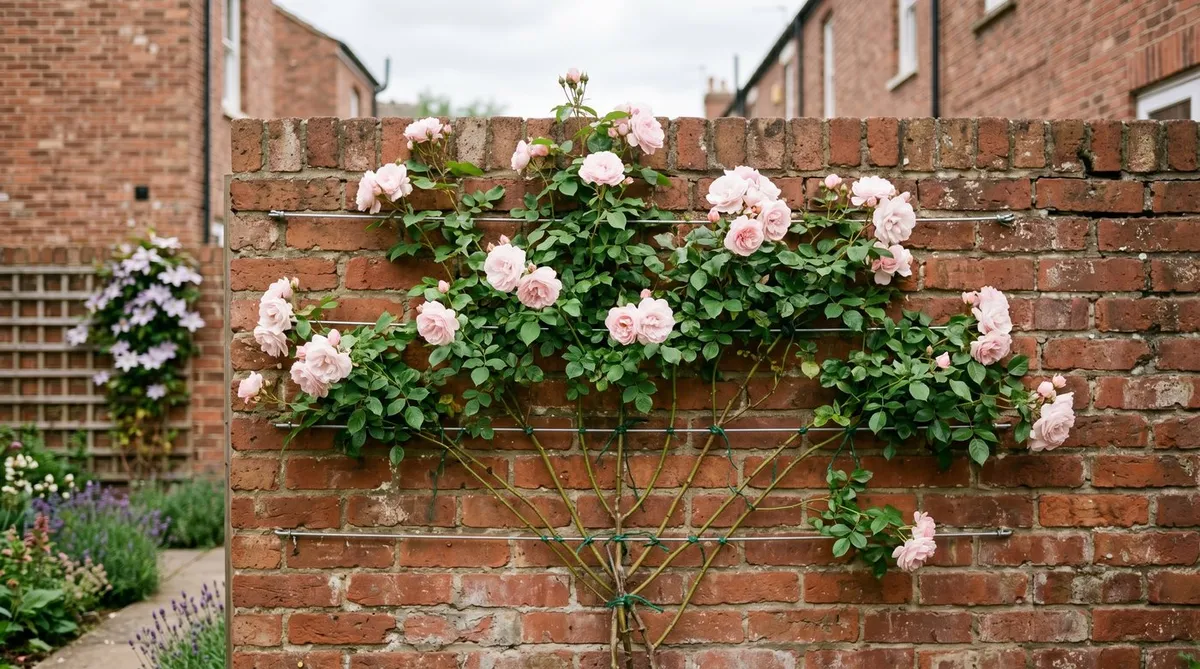
A wall framework is horizontal rows of 2mm galvanised wire, spaced 45cm apart, held 5cm off the brickwork by vine eyes. The 45cm spacing is not arbitrary. A standard brick course is 75mm including mortar, so 45cm lands on every sixth course. Mark the rows with chalk, set the lowest wire 45cm above soil level, and the grid lines up with the brickwork by itself.
Fit a vine eye every 1.2-1.8m along each row, always one at each end. On brick, drill the mortar joint with a 6mm masonry bit, push in a brown wall plug and drive a screw-in vine eye home. Drilling the joint spares the brick face; on a pre-1920 wall with soft lime mortar this matters, because old bricks spall. Thread the wire through the eyes and strain it tight with pliers. Runs over 3m want a straining bolt at one end, £3 each, or the middle sags within a season.
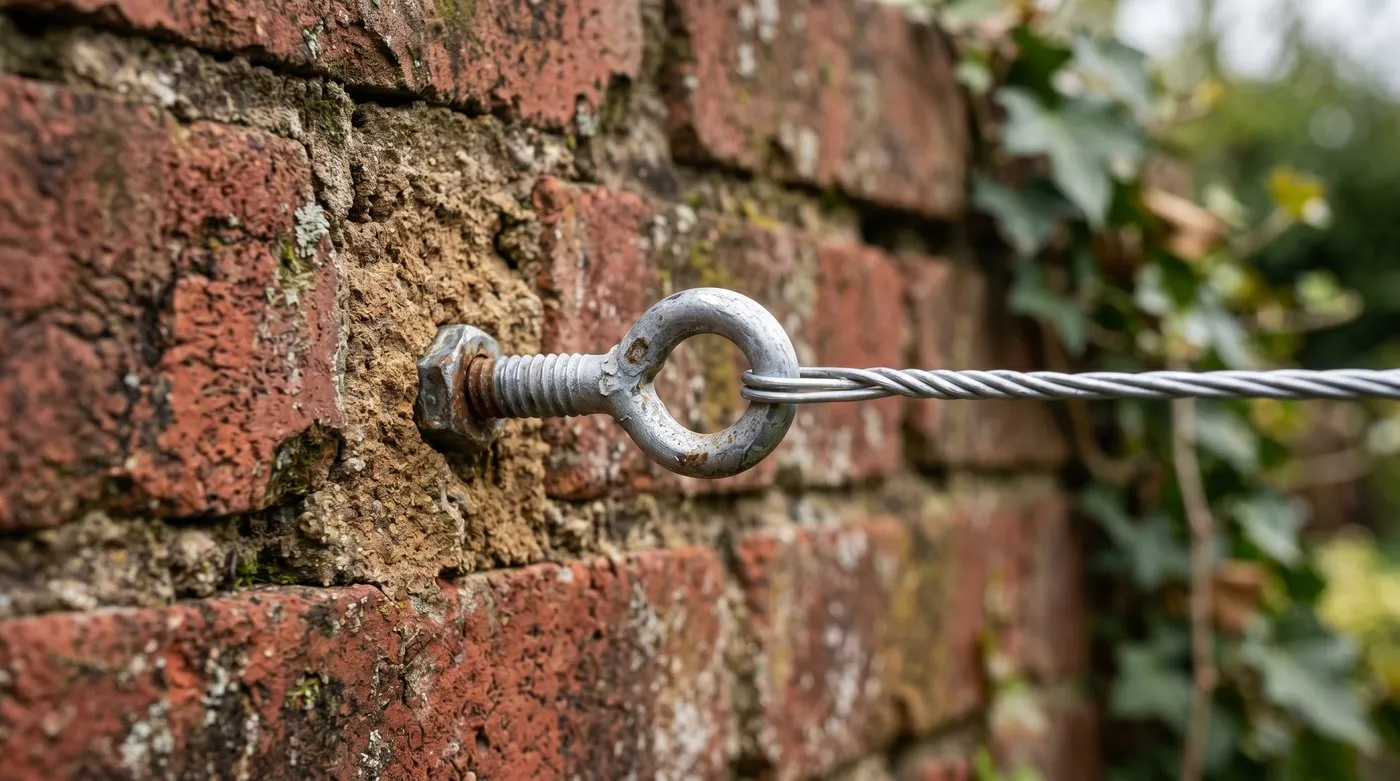 Drill the mortar joint, not the brick: a 6mm hole, a brown plug and a screw-in vine eye holding 2mm wire 5cm off the wall.
Which stems do you keep? Choosing the leaders
Keep 3-5 strong shoots on a newly planted climber and remove everything weaker at the base. Those keepers are your leaders, the permanent framework the plant builds on, so choose evenly spaced stems that can fan out without crossing. A pencil-thick shoot makes a better leader than a fat, soft one, which often dies back over its first winter.
The numbers vary by plant. A bare-root climbing rose usually arrives with 3-4 usable stems; keep them all unless one is damaged. Wisteria gets just one or two leaders, trained out along the top wires, with everything else cut back, and the routine in our wisteria pruning guide keeps it that way for life. Clematis is the odd one out. Cut the whole plant back to 30cm in its first February. It feels brutal, but it forces 4-6 basal shoots where an unpruned plant sends up one thin stem that goes bald at the bottom by year three.
Once a leader is tied to the framework, side shoots will break from it every year. The leaders are permanent. The side shoots are the renewable, flowering part, pruned back to the framework on a schedule that depends on the plant.
How to tie in a climbing plant properly
Jute rots in 12-18 months, and that is a feature. Old ties fall away before they can bite into thickening wood. Check everything twice a year anyway, in spring and late summer, and retie anything tight. The full audit takes 15 minutes and prevents the strangled, flat-topped growth that shows up a year after a forgotten tie.
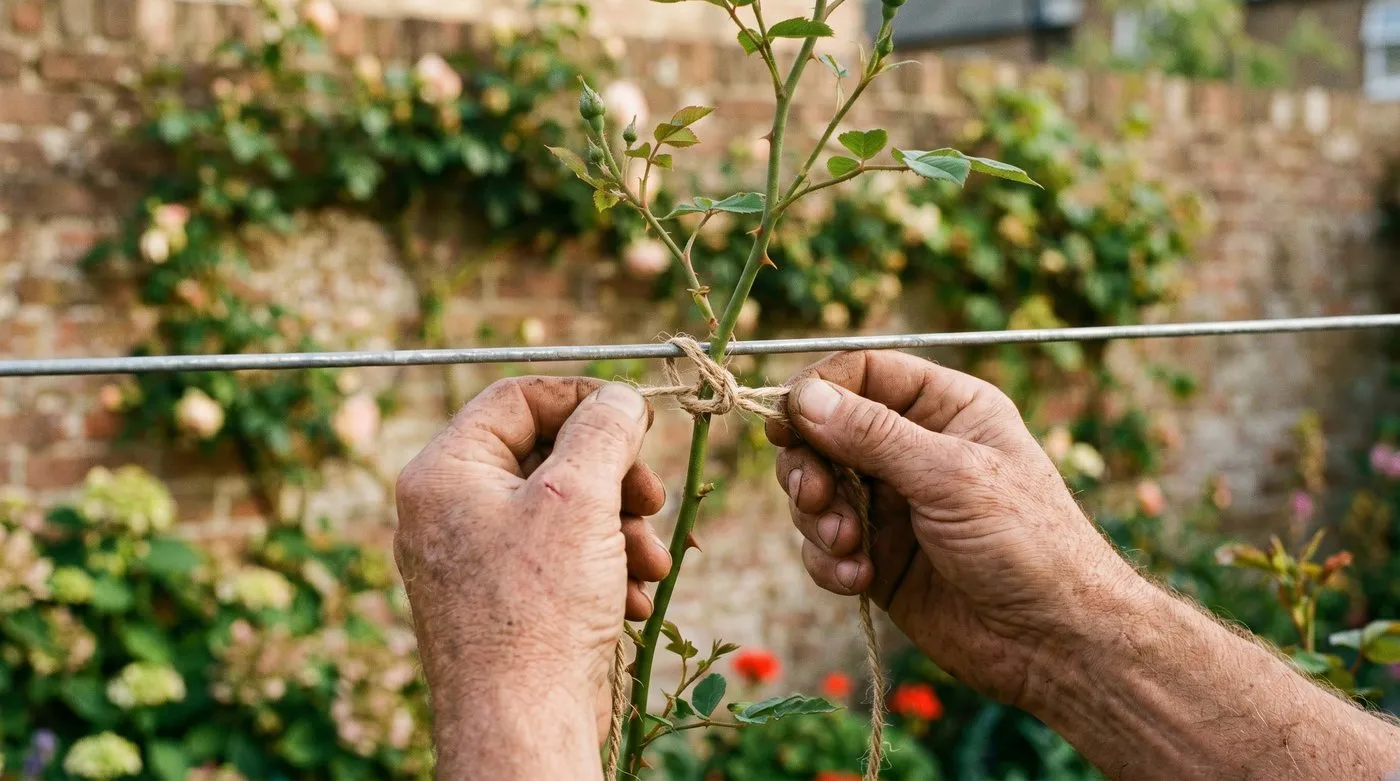 The figure of eight in close-up: twine crosses between wire and stem, leaving a finger’s width of slack for the stem to thicken.
Fan spreading: getting the width early
Width comes first, height second. Plant the climber 30-45cm out from the wall base, because the soil tight against a house wall sits in a rain shadow and is the driest in the garden. Lean 3-5 bamboo canes from the root zone to the bottom wires at roughly 45 degrees, fanned like spokes, and tie one leader along each cane. The plant covers wall sideways from day one instead of racing up a single line.
Clematis gets one extra step at planting: set the rootball 6cm deeper than it sat in the pot, which buries dormant buds that regrow if wilt strikes later. Water everything hard through the first two summers, 10 litres a week in dry spells, because that rain-shadow soil lies even when the lawn looks wet.
The fan is the same shape the fruit growers use, just looser. If you fancy the precision version, our guide to fan-training a fruit tree builds a measured 8-rib fan on the identical wire grid, and the espalier method takes the horizontal idea to its logical end with fruiting tiers. An ornamental climber forgives far more than a peach does. Aim the leaders at the gaps, keep the centre open, and adjust each fortnight as you tie.
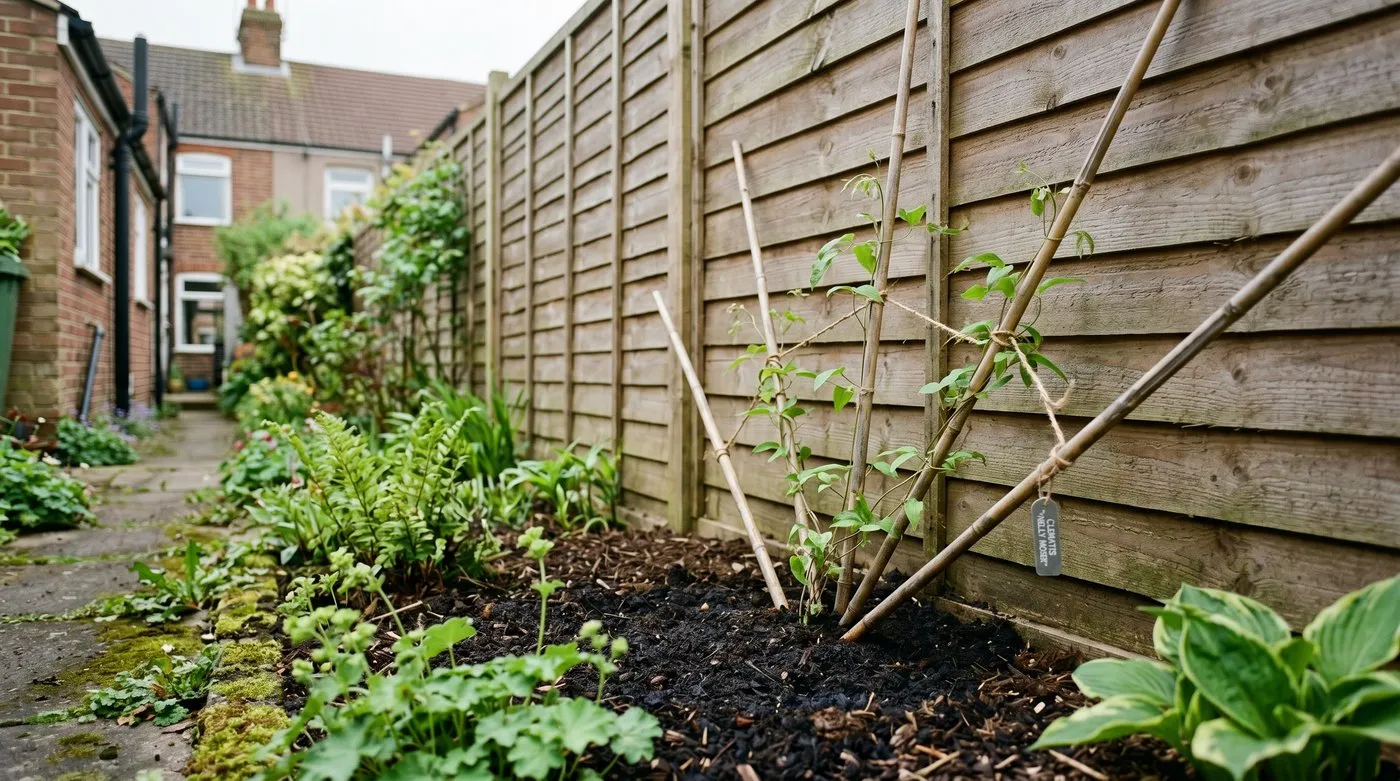 Width before height: leaders tied along canes set at 45 degrees, planted 40cm out from the fence to dodge the rain shadow.
Why does horizontal training give more flowers?
A stem lowered to horizontal flowers along its whole length; an upright stem flowers only at the tip. The mechanism is apical dominance. The growing tip of a vertical stem produces auxin, a hormone that flows downward and holds every bud below it dormant. Lay the stem flat and that flow is disrupted, so the side buds all break at once and each becomes a flowering shoot. The RHS describes the same principle across its rose and climber training advice.
The lowering itself happens between October and February, when stems are leafless and the sap is down. Bend gradually; a stem that resists at horizontal can rest at 45 degrees for a season and come down the rest of the way next winter. Anything that creaks, stop. The principle pays on most flexible-stemmed climbers, and it is the single habit that separates a wall of flower from a top-knot. It is also half the answer to choosing varieties, which is where our pick of the best climbing roses starts: every rose on that list takes happily to wires worked this way.
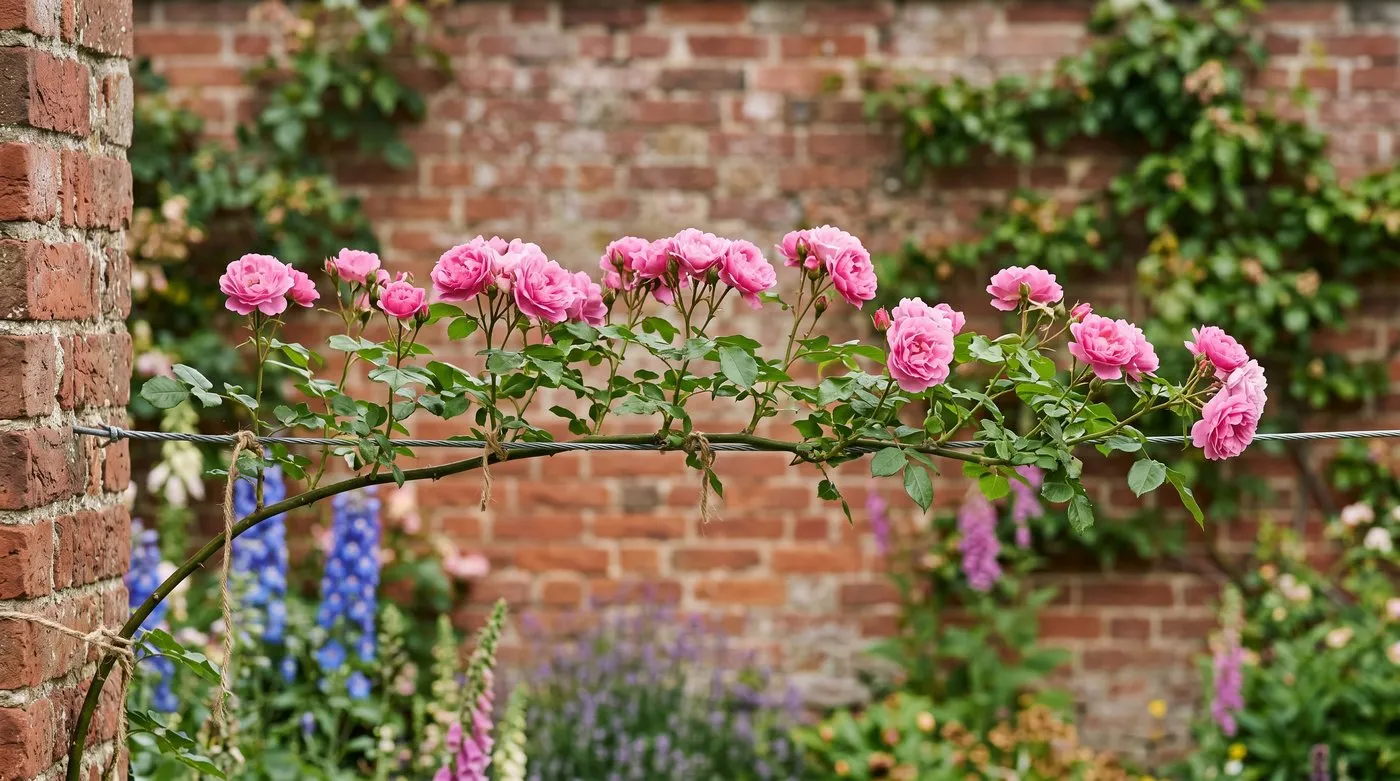 The payoff: this near-horizontal stem carried 23 flowering shoots in July 2025, while its upright neighbour managed 6.
The first two years, season by season
Which method suits which climber?
The framework is identical for almost everything; the tying and the timing differ. The table covers the four climbers most often planted against UK house walls and fences.
| Climber | How it holds on | Training job | Tie how often | First flowers |
|---|---|---|---|---|
| Climbing rose | Scrambler, no grip | Tie every stem, lower leaders to horizontal in winter | Fortnightly in season | Year 2 |
| Clematis (viticella types) | Twisting leaf stalks | Cut to 30cm in first Feb, then steer onto wires, it grips alone | Monthly, light steering | Year 1-2 |
| Honeysuckle | Twining stems | Tie leaders to the fan, untangle the rest, thin after flowering | Fortnightly in June | Year 2 |
| Wisteria | Strong twiner | One or two leaders along the top wires, twice-yearly side-shoot pruning | Monthly while extending | Year 3-5 |
Honeysuckle deserves one warning: it twines so fast in midsummer that a missed fortnight leaves a bird’s nest of self-wrapped stems that cannot be untangled, only cut. Our honeysuckle growing guide covers the thinning that keeps an established plant open. Wisteria is the opposite problem, slow to commit and then immensely strong; check its wires annually, because a 10-year-old wisteria will pull a slack wire, eye and plug clean out of the mortar.
Common training mistakes
Frequently asked questions
How far apart should wires be for climbing plants?
Space horizontal wires 45cm apart, with the lowest 45cm above soil level. On a standard brick wall that is every sixth course, which makes marking out easy. Fit vine eyes every 1.2-1.8m along each row so the wire cannot sag under a mature plant.
What is the best way to tie in a climbing plant?
Use soft jute twine tied in a figure of eight. The twine crosses between stem and wire, so the two never rub. Leave a finger’s width of slack for the stem to thicken. Check every tie in spring and late summer, and let old jute rot away after a year.
Why does horizontal training produce more flowers?
When should I start training a new climber?
Start within two weeks of planting, while the shoots are soft and flexible. Spread them onto canes angled at 45 degrees and tie loosely. A stem left to harden upright for a season will snap rather than bend later.
Do self-clinging climbers like ivy need wires?
No, self-clinging climbers grip walls with aerial roots or adhesive pads. Ivy, climbing hydrangea and Virginia creeper need no framework at all. Everything else, including roses, clematis and honeysuckle, needs wires, mesh or a trellis to hold onto.
Can I train a climber on a fence instead of a wall?
Yes, drive screw-in vine eyes into the fence posts and run wire between them. Never fix wires to the panels, which flex in wind and rot first. A 1.8m panel takes three wires, and the bottom rail of the fence sets your lowest row.
Our team produces practical UK gardening guidance from source research, contributor records and established horticultural practice. Editorial standards are overseen by Matt W.