Key takeaways
- Clay particles are under 0.002mm wide, so pore space and drainage are far lower than in sand
- Hollow-tine aeration to 75-100mm is the single highest-impact quick win on a waterlogged clay lawn
- Top-dress with 3-4 tonnes of sharp horticultural sand per 100 square metres, never builder's or soft sand
- Sand alone spread on clay without coring sets like weak concrete, so always aerate first
- Repeat aeration and sand top-dressing every autumn for 3-4 years to build a 50mm free-draining layer
- Land drains or slit drains to a soakaway are the one-off fix for ground that stays wet all winter
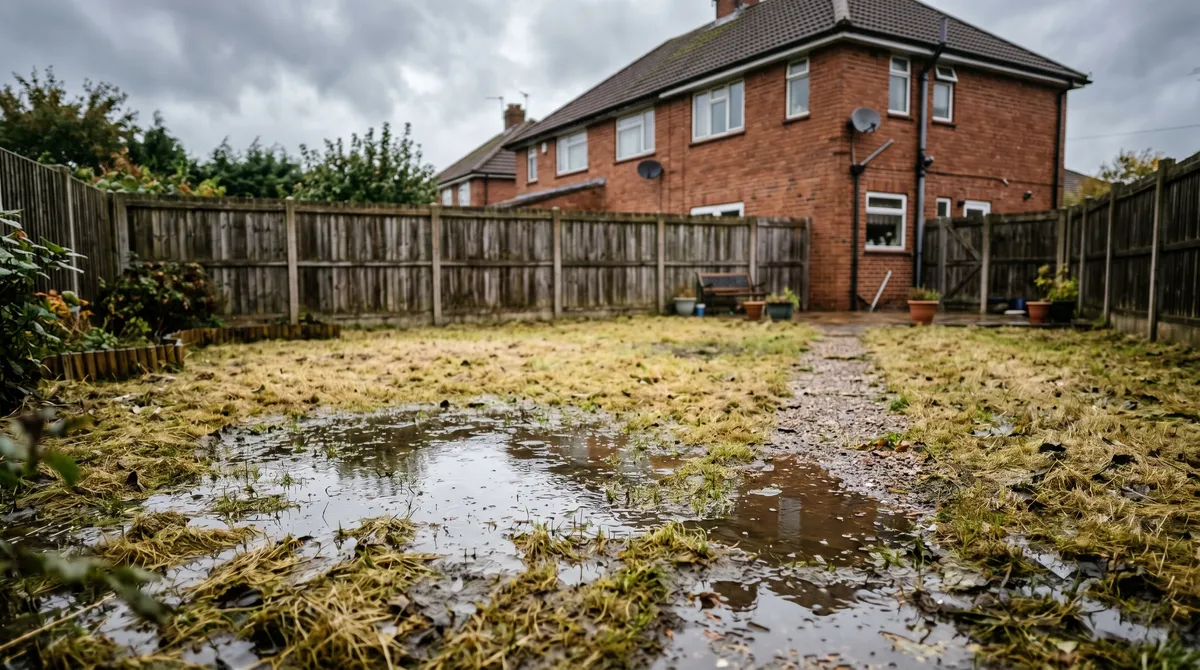
Improving lawn drainage on heavy clay soil is one of the most common gardening problems in Britain, and one of the most fixable. A waterlogged lawn sits in puddles for hours or days after rain, turns spongy underfoot, and grows moss and rushes instead of grass. The cause is the soil itself. Clay holds water because its particles are tiny and pack tightly, leaving very little room for air or drainage.
Why heavy clay soil holds water and waterlogs
Clay waterlogs because its particles are minute and pack together with almost no space between them. A clay particle is under 0.002mm across. A sand grain is 50 to 1,000 times bigger. When you stack tiny flat clay platelets, the gaps left for air and water (the pore space) are very fine. Water moves through them slowly and clings to the particle surfaces. A sandy soil drains at 50mm or more per hour. A compacted clay can manage less than 5mm per hour.
Three things make a clay lawn worse than the soil alone. Compaction from mowers, feet and play squeezes the few pores shut. A pan layer, a hard compressed band 100 to 250mm down, often forms where a rotavator or digger smeared the clay during the original build. New-build estate lawns are notorious for this, because heavy plant works the subsoil and topsoil is laid thin over the top. Finally, a high water table in low-lying gardens leaves nowhere for water to go.
Understanding the cause matters, because each fix targets a different part of it. Aeration opens pore space. Sand widens the pores permanently. Drains give trapped water an exit. Treat the symptom alone and the lawn floods again next winter.
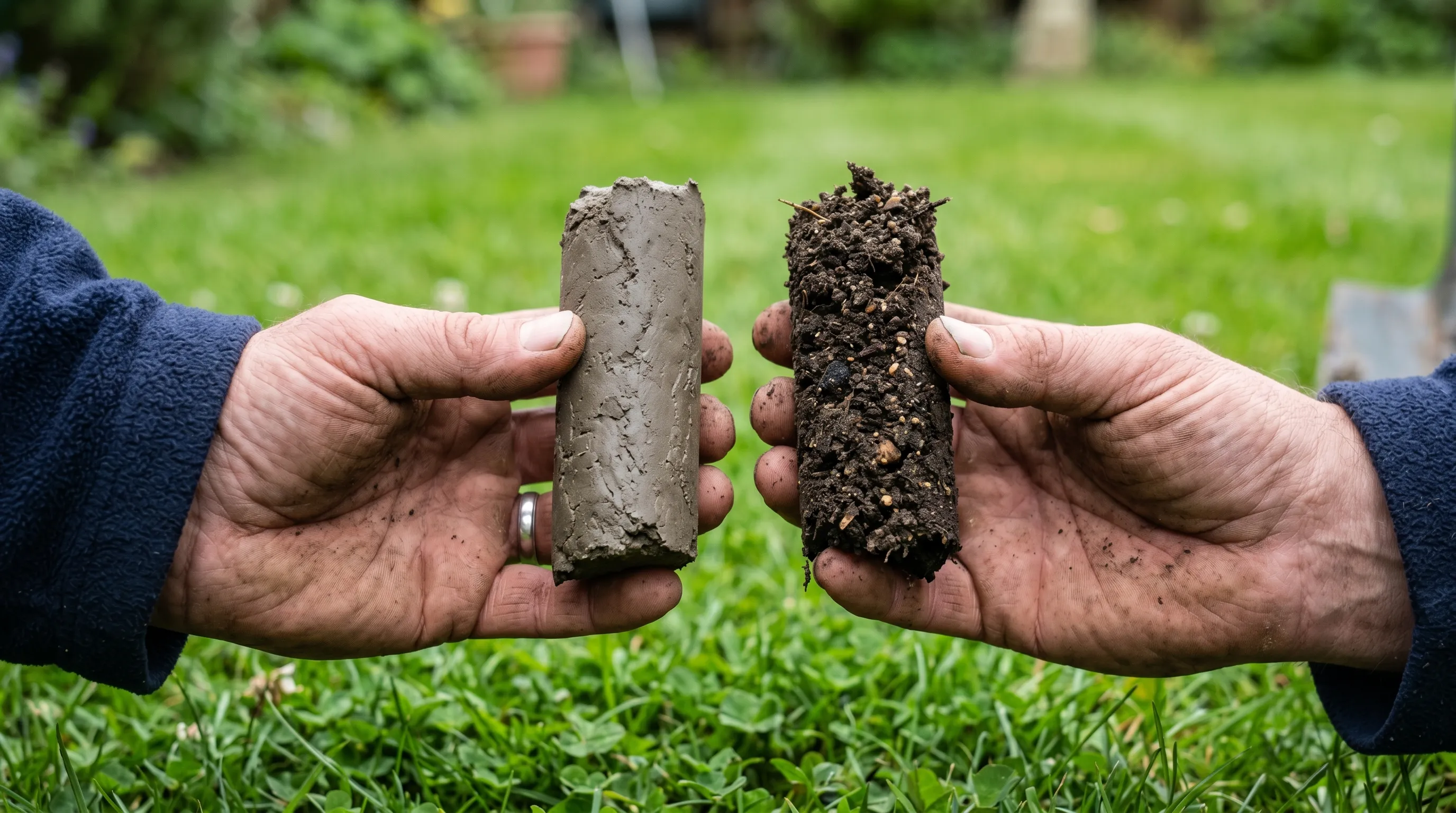 Left: a solid column of compacted clay with no visible structure. Right: the same soil after three years of coring and sanding, now crumbly and open.
How to test how badly your lawn drains
Before you spend money, find out how bad the problem really is with a simple percolation test. Dig a hole 300mm deep and 300mm wide where the lawn floods worst. Fill it with water and let it drain fully once to wet the sides. Then fill it again and time how long the second fill takes to empty.
Read the result against this scale. Water gone in under 4 hours means free-draining soil with no real problem. 4 to 12 hours is moderately impeded clay that aeration and sanding will fix. 12 to 24 hours is poor drainage needing aeration plus a sand-banding or slit-drain programme. Over 24 hours, or a hole that holds water for days, means you need land drains or a soakaway as well.
While the hole is open, look at the sides. Find the depth where the soil changes from dark crumbly topsoil to pale dense clay. If that change sits within 150mm of the surface, your topsoil is thin and a buried pan is likely. Push a screwdriver or a length of steel rod into the lawn. A sudden hard stop at one consistent depth confirms a compaction pan that you will need to break.
The ranked fix hierarchy for a waterlogged clay lawn
Not every method earns its effort. The table below ranks the fixes by how much they improve drainage on a real clay lawn, from the cheap annual quick win to the one-off major job. Order your work top to bottom. Most gardens only ever need the first three rows.
| Method | What it does | Effectiveness | Effort and cost | Role |
|---|---|---|---|---|
| Hollow-tine aeration | Pulls out soil cores, opening 75-100mm channels for air and water | High, immediate but short-lived | Low, hire 35-60 pounds per day | Quick win, repeat annually |
| Sharp sand top-dressing | Fills core holes with grit, widening pores permanently over years | High, builds cumulatively | Low to medium, 30-50 pounds per 100 sq m | Annual, the gold standard |
| Adding organic matter | Improves crumb structure and feeds soil life that builds pores | Moderate, slow and steady | Low, sieved compost or loam | Annual, alongside sand |
| Breaking a compaction pan | Shatters the hard buried band that blocks downward flow | High where a pan exists | Medium, deep tines or sub-soiler | One-off, only if a pan is present |
| Sand-banding / slit drainage | Cuts narrow sand-filled slots linking surface to free-draining sand bands | High on stubborn lawns | Medium to high, 600-1,200 pounds contractor | One-off major, severe cases |
| Land drains to a soakaway | Perforated pipe carries trapped water away to a soakaway or ditch | Highest for true waterlogging | High, 1,500-4,000 pounds contractor | One-off major, last resort |
| Clay-tolerant grass seed | Swaps in grasses that cope with wet, heavy ground | Low for drainage, high for cover | Low, 15-30 pounds per 100 sq m | Supplementary finishing step |
The gold standard combination for most UK clay lawns is hollow-tine aeration plus sharp sand top-dressing, repeated every autumn. It is the cheapest sustained route to a dry lawn and the only one a normal household can do alone. Drains are for ground that stays wet all winter no matter what you do above it.
Hollow-tine aeration is the highest-impact quick win
Hollow-tine aeration removes plugs of soil rather than just spiking holes. A hollow-tiner pulls cores 12 to 18mm wide and 75 to 100mm deep, lifting solid soil out of the lawn. That open channel is where air and water flow, and where sand goes next. Spike or solid-tine aerators only push soil sideways, which on clay can compact the hole walls and achieve little.
Hire a powered hollow-tine machine for 35 to 60 pounds a day, or use a hand corer on a small lawn. Aim for cores roughly 50 to 75mm apart, which gives 150 to 200 holes per square metre. Always brush or rake the pulled cores off the surface. Left lying, they break down and reseal the very holes you just opened. The drainage gain from coring alone lasts a few months, which is why you pair it with sand and repeat each year.
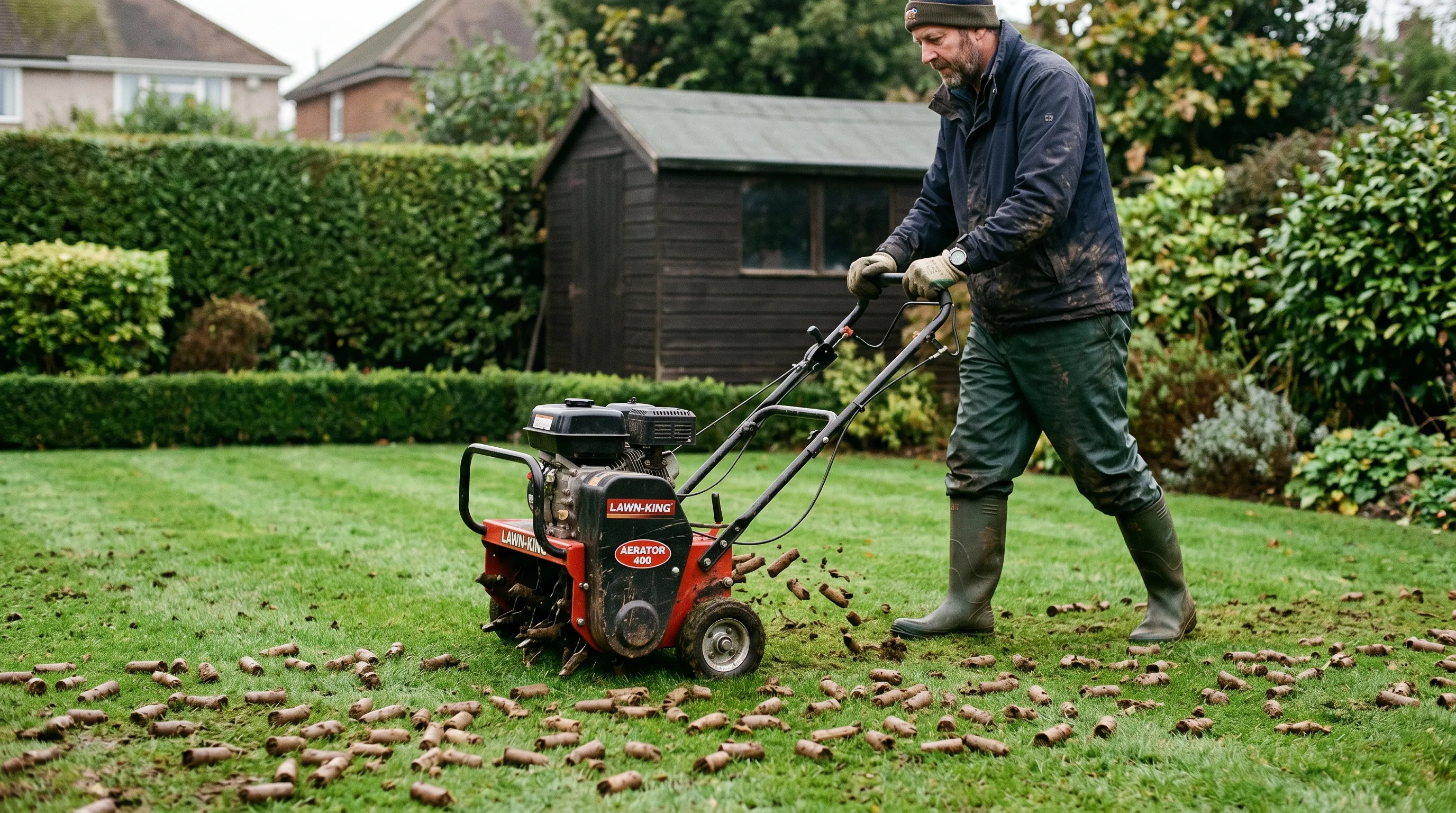 A hollow-tiner lifts hundreds of soil plugs out of the lawn. Brush the cores off, then dress sand straight into the open holes.
Sharp sand top-dressing builds a free-draining layer
Sharp horticultural sand top-dressing is the method that fixes clay drainage for good. Spread sharp sand over a freshly cored lawn and brush it into the holes with a stiff broom or a levelling lute. The sand fills each channel with coarse grit that water passes through easily. Done once it helps a little. Repeated every autumn for three to four years, it builds a continuous free-draining layer 30 to 50mm thick across the whole surface.
Warning: Never spread a layer of sand straight onto solid clay without hollow-tining first. A sand layer sitting on top of dense clay traps water at the join and can set into a hard cap, almost like weak concrete. The grass roots cannot pass through it and the lawn drains worse than before. The sand must go down into open core holes, not over the top.
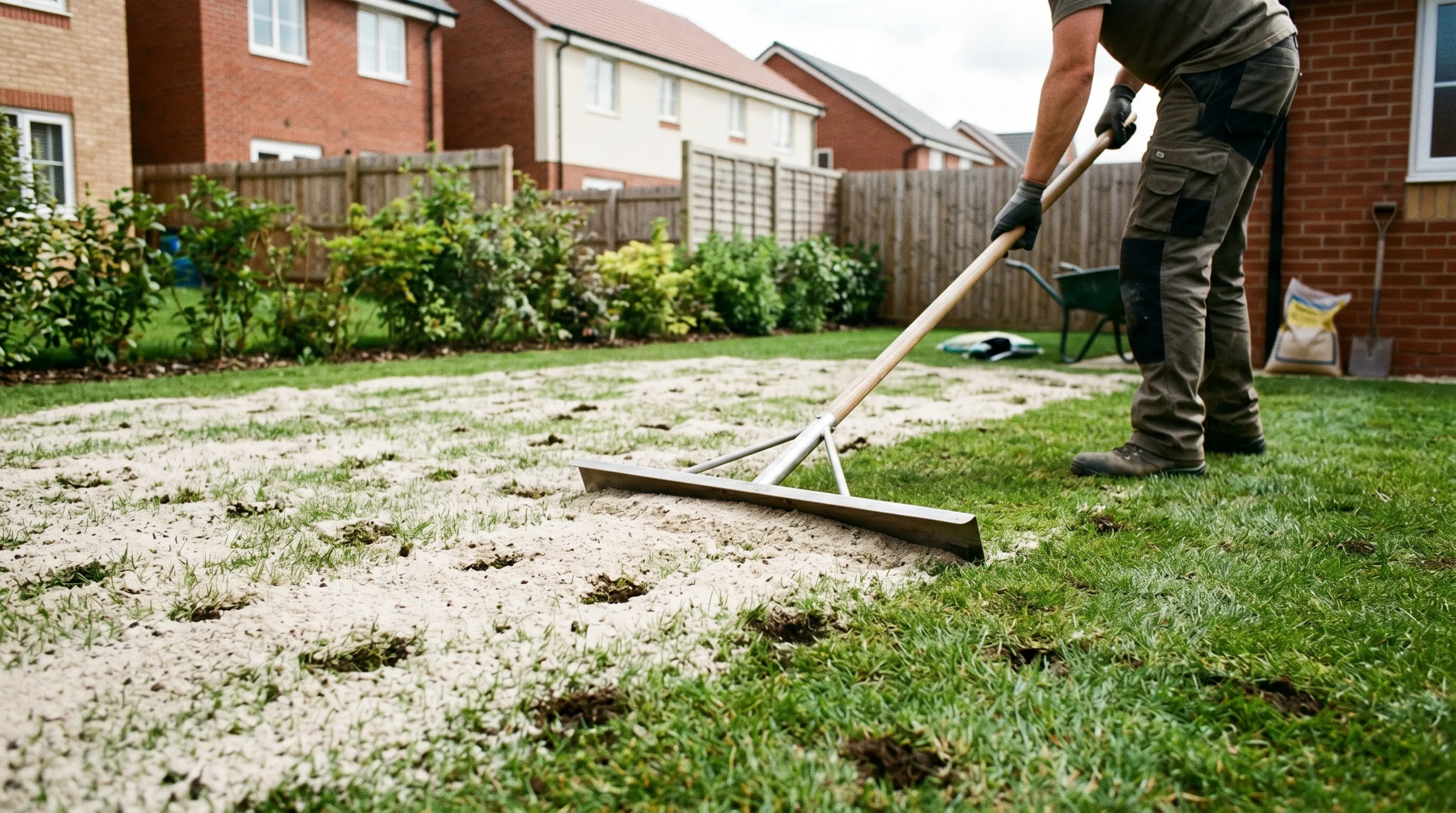 Sharp sand brushed into core holes with a levelling lute. Angular grit keeps the channels open and draining for years.
Breaking a buried compaction pan
A compaction pan is a hard, smeared band of clay 100 to 250mm down that stops water draining no matter how well you aerate the surface. It forms when machinery works wet clay during a build, or under years of mowing on the same ground. Surface coring cannot reach it. If your screwdriver test hit a sudden consistent stop, you likely have one.
Breaking a pan needs depth. A deep-tine aerator reaching 200 to 250mm, hired for around 80 to 120 pounds a day, fractures the band without turning the lawn over. On a new lawn or a full renovation, a contractor with a sub-soiler can rip the pan in one pass for 200 to 400 pounds. Once shattered, water that pooled above the pan can finally drain down, and your surface aeration starts to work properly.
Add organic matter to build lasting structure
Organic matter is the slow partner to sand, building crumb structure that holds the gains. Where sand creates physical channels, organic matter feeds the soil life that binds clay particles into larger crumbs, opening pore space naturally. Worms pull organic matter down and leave drainage burrows behind them. A clay lawn rich in organic matter stays open and workable, where bare clay slumps shut again.
Top-dress with sieved garden compost or a sandy loam dressing alongside your sand, at roughly 2 to 3kg per square metre. Mix it 70:30 with sharp sand for a clay lawn so you keep the gritty drainage while adding the biology. Brush it in after coring, same as sand. For a deeper rethink of working organic matter into heavy ground, our guide on no-dig methods for heavy clay soil explains how surface mulching builds structure without disturbing the soil.
Avoid fresh manure or thick, lumpy compost on a lawn. It smothers grass and can sour the surface. Keep the dressing fine, sieved, and thin enough that grass blades still show through after you brush it in.
Slit drainage and land drains for stubborn ground
When the lawn stays wet all winter despite years of aeration, you need to give the water a physical exit. Slit drainage cuts narrow vertical channels, 50mm wide and up to 250mm deep, and backfills them with gravel and sharp sand. The slits link the wet surface to a free-draining gravel band or a main drain below. A contractor with a chain trencher can sand-band a lawn for 600 to 1,200 pounds, depending on size.
Land drains are the heavy fix for true waterlogging. Dig trenches 400 to 600mm deep, lay a perforated 80 to 100mm plastic land-drain pipe on a gravel bed, wrap it in permeable membrane, and backfill with clean angular gravel topped with sharp sand. Run the pipes in a herringbone pattern falling at least 1 in 100 (10mm per metre) towards an outfall. That outfall must be a soakaway, a ditch, or a watercourse, never a foul sewer.
Warning: Site a soakaway at least 5 metres from any house or wall, and never connect garden land drains to the foul sewer. Check whether your outfall needs permission. Discharging to a ditch or watercourse can require consent from the lead local flood authority or the Environment Agency.
A soakaway is a pit, typically 1 to 1.5 metres cube, filled with clean rubble or modular crates, that holds drained water and lets it seep slowly into the subsoil. It only works if the soil below the pit drains faster than the clay above, so dig a percolation test at soakaway depth before committing. On dense clay over more clay, a soakaway can simply fill and stay full. A planted rain garden is often a better answer than a soakaway where the subsoil itself drains poorly.
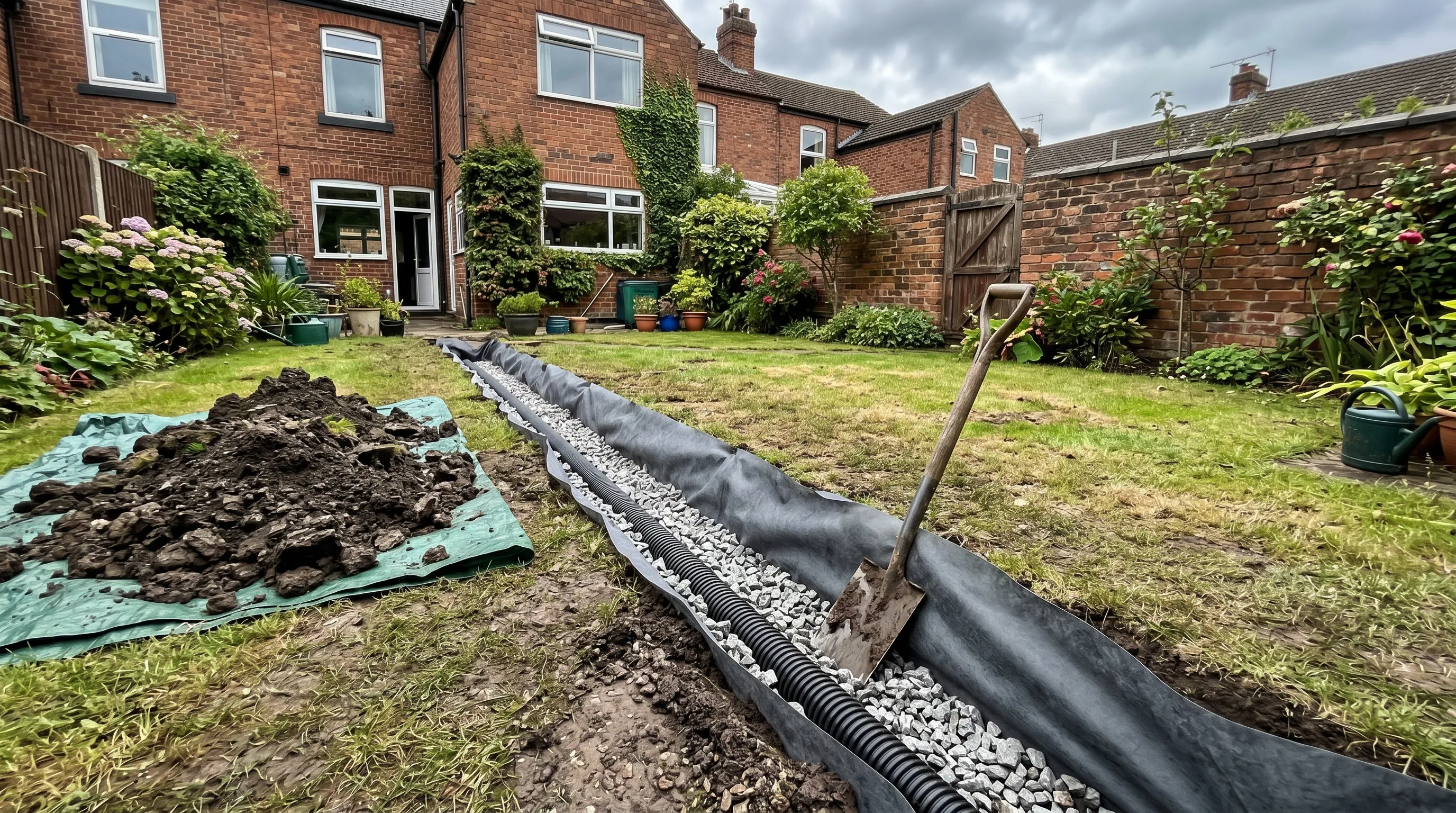 A land drain: perforated pipe on a gravel bed, wrapped in membrane, falling towards a soakaway. The one-off fix for ground that never dries.
The gypsum myth on UK clay lawns
Gypsum is widely sold as a clay-breaker, but it does almost nothing on most UK clay. The chemistry is specific. Gypsum (calcium sulphate) works by displacing sodium ions that make sodic clays disperse and seal. That flocculation effect is real on the sodium-rich clays of arid regions like parts of Australia and the American west. British clays are a different beast.
Most UK clay is calcium-rich already, not sodic. Adding more calcium through gypsum gives almost no structural change, because there is little sodium to displace. Trials and soil scientists consistently find a negligible drainage benefit on typical British garden clay. You are far better spending the money on sharp sand, which gives a physical, lasting improvement. We cover the full evidence in our honest assessment of whether gypsum works on UK clay soil.
There is one narrow exception. If a soil test shows genuinely high sodium, often near coastal or de-iced ground, gypsum can help. For an ordinary inland clay lawn, treat it as a myth and skip it.
Switching to clay-tolerant grass for wet ground
Drainage work fixes the soil, but the grass on top can help too. Fine-leaved fescues and bent grasses struggle on wet clay, while stronger ryegrass and certain creeping species cope far better. A lawn that thins, moss takes over, and rushes invade is partly telling you the species mix is wrong for the conditions.
Overseed a wet clay lawn in early autumn with a hard-wearing ryegrass-based mix, or a dedicated shade-and-wet blend that includes creeping red fescue and smooth-stalked meadow grass. These knit a denser sward that copes with the spongy ground while your drainage improvements take hold. Seed at 35g per square metre into a freshly cored, sanded surface so the seed drops into the grit.
Grass alone will not cure waterlogging. But the right species buys you a usable lawn during the three to four years your aeration and sanding programme needs to build the free-draining layer. For broader help thickening thin patches, see our guide on fixing a patchy lawn.
Common mistakes that make clay drainage worse
A few well-meant actions actively damage a clay lawn. Avoid these and the fix has a chance to work.
Spreading sand alone on clay. This is the single most common error. Sand over solid clay without coring caps the surface and can set hard, draining worse than bare clay. Always hollow-tine first, then dress sand into the open holes, never over the top.
Mowing or walking on the lawn when it is wet. Foot and mower traffic on saturated clay smears and compacts the surface, squeezing the pores shut. Stay off a waterlogged lawn entirely until the surface firms up. On clay, the safe answer after rain is almost always to wait a few days before mowing.
Rolling the lawn. A roller looks tidy but compacts clay badly, which is exactly the opposite of what waterlogged ground needs. Never roll a clay lawn to flatten it. Lift any bumps by coring and top-dressing instead.
Treating the symptom and ignoring the cause. Spiking holes once after a flood, then doing nothing else, achieves nothing lasting. Drainage on clay is a multi-year programme, not a single rescue job. Commit to the autumn routine or install drains, but do not expect one afternoon to fix years of compaction.
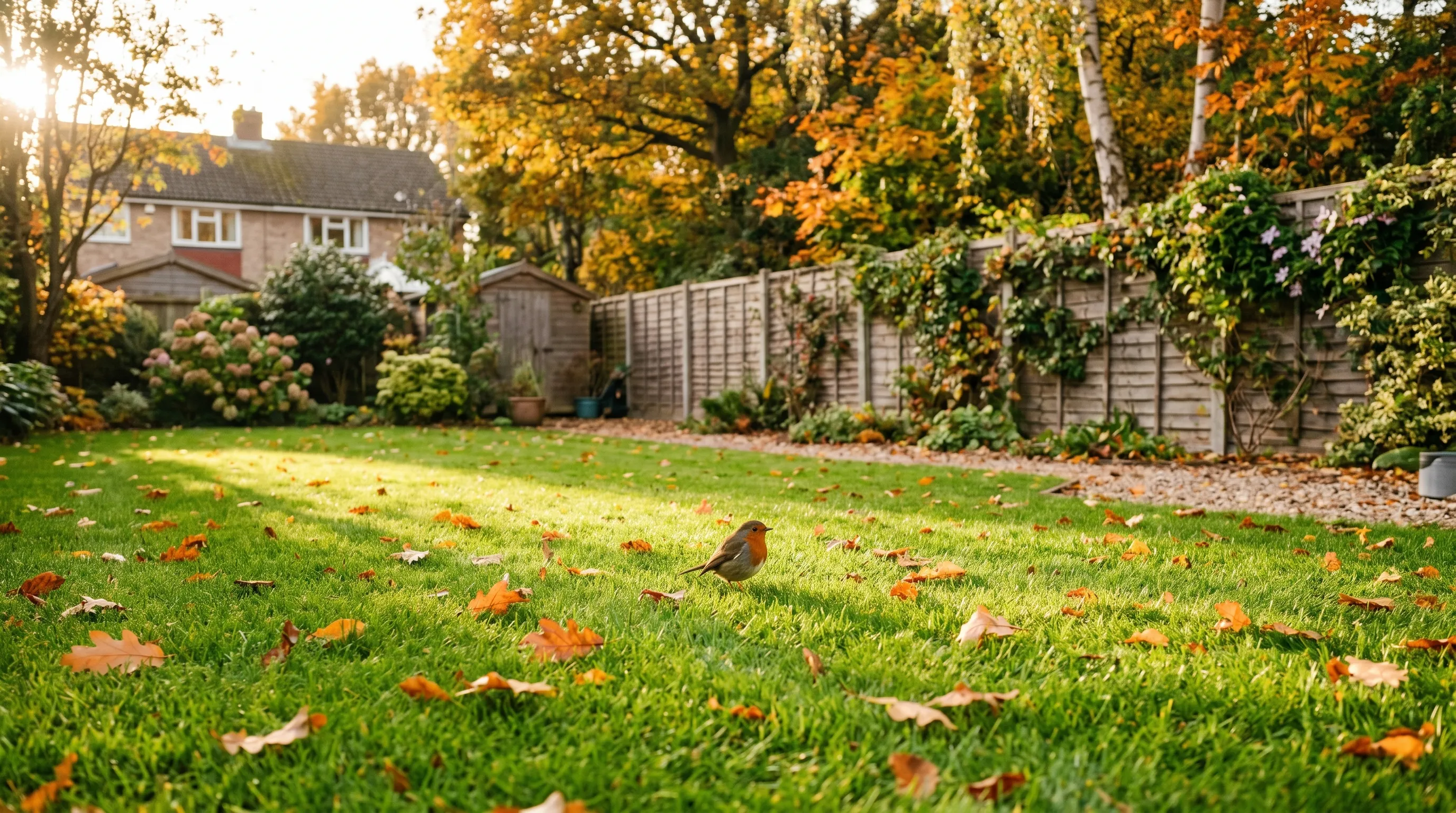 The goal: even, dry turf that sheds rain within hours. Four autumns of coring and sanding turned waterlogged clay into this.
Month-by-month clay lawn drainage calendar
Timing decides results on clay. The table sets out a realistic UK year for a drainage renovation, built around the early-autumn window when grass recovers fastest.
| Month | Task |
|---|---|
| January | Stay off the saturated lawn. Note where water sits longest for autumn targeting |
| February | Dig a percolation test once soil is workable. Plan the year’s work |
| March | Light spring scarify to remove moss if soil is firm. Do not core wet clay |
| April | Apply a spring feed. Let the grass strengthen before summer |
| May | Mow regularly. Keep blades high at 30-40mm to shade and cool the clay |
| June | Spot-treat moss and weeds. Hold off all heavy work in dry, hard soil |
| July | Water only if the lawn browns badly. Avoid coring stressed dry turf |
| August | Order sand and hire a hollow-tiner for September. Plan drain routes if needed |
| September | The main job. Hollow-tine to 90mm, brush off cores, top-dress with sharp sand |
| October | Overseed any thin clay-tolerant areas. Brush in remaining sand. Install land drains now if planned |
| November | Keep leaves cleared so the surface breathes. Final mow at 40mm |
| December | Rest the lawn. Walk on boards if you must cross it on saturated ground |
September is the pivot of the whole year. The soil is still warm, so grass roots quickly into the new sand. Autumn rain washes the dressing down into the cores. Doing the same job in spring risks coring still-wet clay, and in summer it stresses dry grass that cannot heal.
What it costs to fix a waterlogged clay lawn in the UK
Costs vary hugely between doing it yourself and calling a contractor. The figures below are realistic UK prices for a typical 100 square metre back lawn in 2026.
| Job | DIY cost | Contractor cost |
|---|---|---|
| Hollow-tine aeration | 35-60 pounds machine hire per day | 120-250 pounds per visit |
| Sharp sand top-dressing | 30-50 pounds sand per 100 sq m | 200-400 pounds supplied and spread |
| Breaking a compaction pan | 80-120 pounds deep-tiner hire | 200-400 pounds sub-soiling |
| Slit drainage / sand-banding | Not practical DIY | 600-1,200 pounds |
| Land drains to a soakaway | 400-800 pounds materials | 1,500-4,000 pounds installed |
| Overseeding | 15-30 pounds seed per 100 sq m | Included in renovation packages |
The hidden cost most people miss is repetition. A single autumn of coring and sanding will not fix clay. Budget for three to four years of the DIY 65 to 110 pound annual routine before you see a dry lawn. That total, around 300 pounds spread over four years, still undercuts a single contractor drainage job and leaves you with a soil that keeps improving. Only commit to drains if the percolation test shows water sitting for more than 24 hours after every fix above ground has been tried.
For the wider picture on improving heavy ground beyond the lawn, our guide on how to improve clay soil covers beds and borders, and a planted approach using the best plants for clay soil can soak up water in the wettest corners.
Frequently asked questions
How do I fix a waterlogged lawn on clay soil?
Hollow-tine aerate, then top-dress with sharp sand. Core the lawn to 75-100mm in early autumn, brush off the plugs, then spread 3 to 4 tonnes of sharp horticultural sand per 100 square metres and work it into the holes. Repeat every autumn for three to four years to build a free-draining layer. For permanently wet ground, add land drains running to a soakaway 5 metres from the house.
Will sand alone improve drainage on a clay lawn?
No, and it can make things worse. Sand spread on clay without aerating first traps water at the boundary and can set into a hard cap, almost like weak concrete. The grass roots cannot pass through it. Sand only helps when it goes down into hollow-tine core holes, so the gritty channels link the surface to the soil below. Always core first, then dress.
When is the best time to aerate and sand a clay lawn?
Early autumn, usually September. The soil is still warm enough for grass to recover and root into the sand, and returning rain washes the dressing in. Avoid summer, when coring stresses dry grass and cores are hard to pull. Avoid winter, when working saturated clay compacts it further and the grass cannot heal the holes.
Does gypsum work to break up clay soil under a lawn?
Gypsum rarely helps on UK clay lawns. It only flocculates sodium-rich clays, which are common in arid regions but rare in Britain. Most UK clay is calcium-rich already, so gypsum adds little structural change. Spend the effort on hollow-tine aeration and sharp sand top-dressing instead, which give a far bigger and longer-lasting drainage gain on British clay.
How long does it take to drain a waterlogged clay lawn?
Now you understand how to drain heavy clay, take the next step and master the aeration technique itself with our detailed guide on how to scarify and aerate a lawn. For more ways to tackle difficult ground, browse all our how-to gardening guides.
Our team produces practical UK gardening guidance from source research, contributor records and established horticultural practice. Editorial standards are overseen by Matt W.