Key takeaways
- Blood fish and bone (NPK 5-5-6) at 70g/m² is the best general organic feed for UK veg plots
- Bone meal supplies 22% phosphorus and lasts 18 months from one autumn application
- Comfrey liquid feed reaches NPK 1.8-0.5-5.3 by week 6 of fermentation
- Dried blood delivers 12% nitrogen in 14 days, the fastest organic nitrogen source
- Vegan organic options: seaweed, comfrey, nettle, rock phosphate, organic potash
Each fertiliser is rated by NPK ratio, dose per square metre, release speed, cost per kilogram, what to grow it with, and whether it suits vegan organic gardens. The application calendar at the end ties everything together from March to October. The aim is to give you a working organic feeding system, not a list of products.
Best natural organic fertilisers for UK vegetable plots
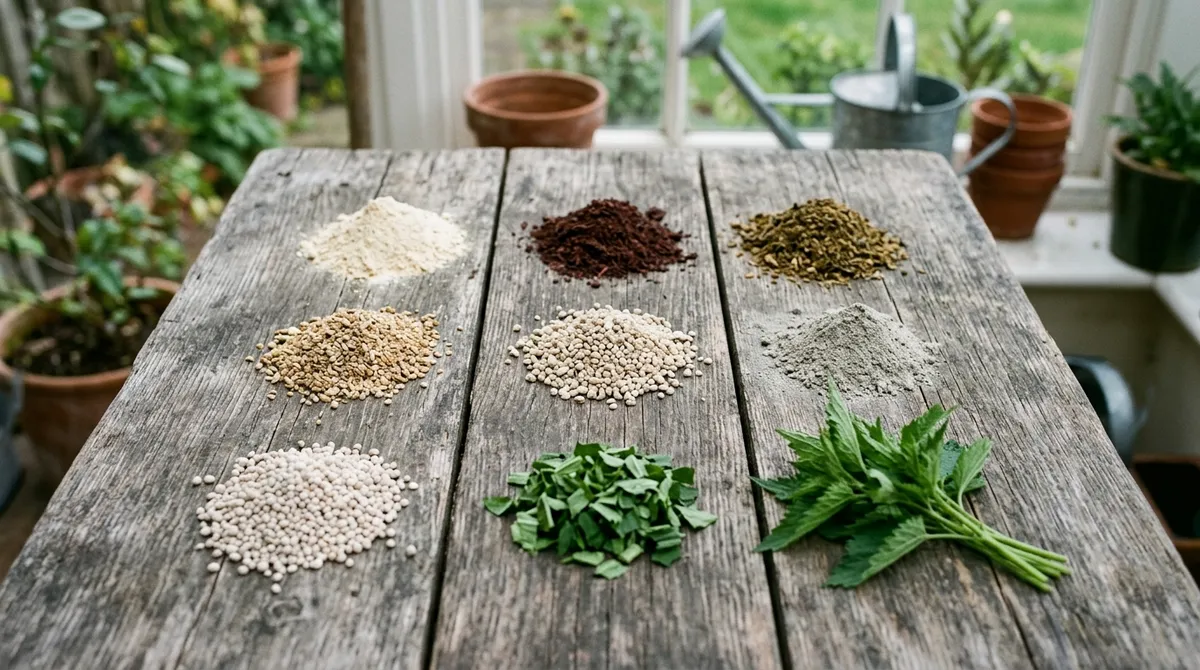
The nine fertilisers below cover every macronutrient need on a UK plot from sandy chalk to heavy clay. Five are bought (blood fish and bone, bone meal, dried blood, hoof and horn, seaweed meal), two are homemade (comfrey liquid, nettle tea), and two are mineral-based vegan options (rock phosphate, organic sulphate of potash).
The choice depends on three things: which crop you are feeding, when you are feeding it, and whether you garden vegan organic. Brassicas, sweetcorn, and potatoes need heavy nitrogen. Tomatoes, peppers, and fruit need heavy potassium once flowering starts. Root crops need phosphorus but not much else. Match the feed to the crop and you skip 80% of the guesswork.
| Fertiliser | NPK | Dose g/m² | Release speed | Cost £/kg | Best crops | Vegan? | UK supplier |
|---|---|---|---|---|---|---|---|
| Blood fish and bone | 5-5-6 | 70 | 8-10 weeks | £3-£5 | All vegetables | No | Vitax, Westland |
| Bone meal | 3.5-22-0 | 90 | 12-18 months | £4-£6 | Roses, fruit, brassicas | No | Vitax Q4, Westland |
| Dried blood | 12-0-0 | 35 | 10-14 days | £8-£12 | Brassicas, leafy crops | No | Vitax, Garden Organic |
| Hoof and horn | 13-0-0 | 60 | 6-12 months | £6-£9 | Slow-release N for fruit trees | No | Maxicrop, Vitax |
| Seaweed meal | 1-0-2 | 100 | 4-8 weeks | £4-£7 | All crops, especially brassicas | Yes | Maxicrop, SeaMagic |
| Comfrey liquid | 1.8-0.5-5.3 | n/a liquid | 1-3 days | Free home | Tomatoes, peppers, fruit | Yes | Bocking 14 (homemade) |
| Nettle tea | 2.5-0.5-1 | n/a liquid | 1-3 days | Free home | Leafy crops, brassicas | Yes | Wild-foraged |
| Rock phosphate | 0-26-0 | 120 | 24-36 months | £3-£5 | Long-term P building | Yes | Garden Organic, VON |
| Organic sulphate of potash | 0-0-50 | 30 | 4-6 weeks | £6-£9 | Fruit, flowers, root crops | Yes | Vitax, Westland |
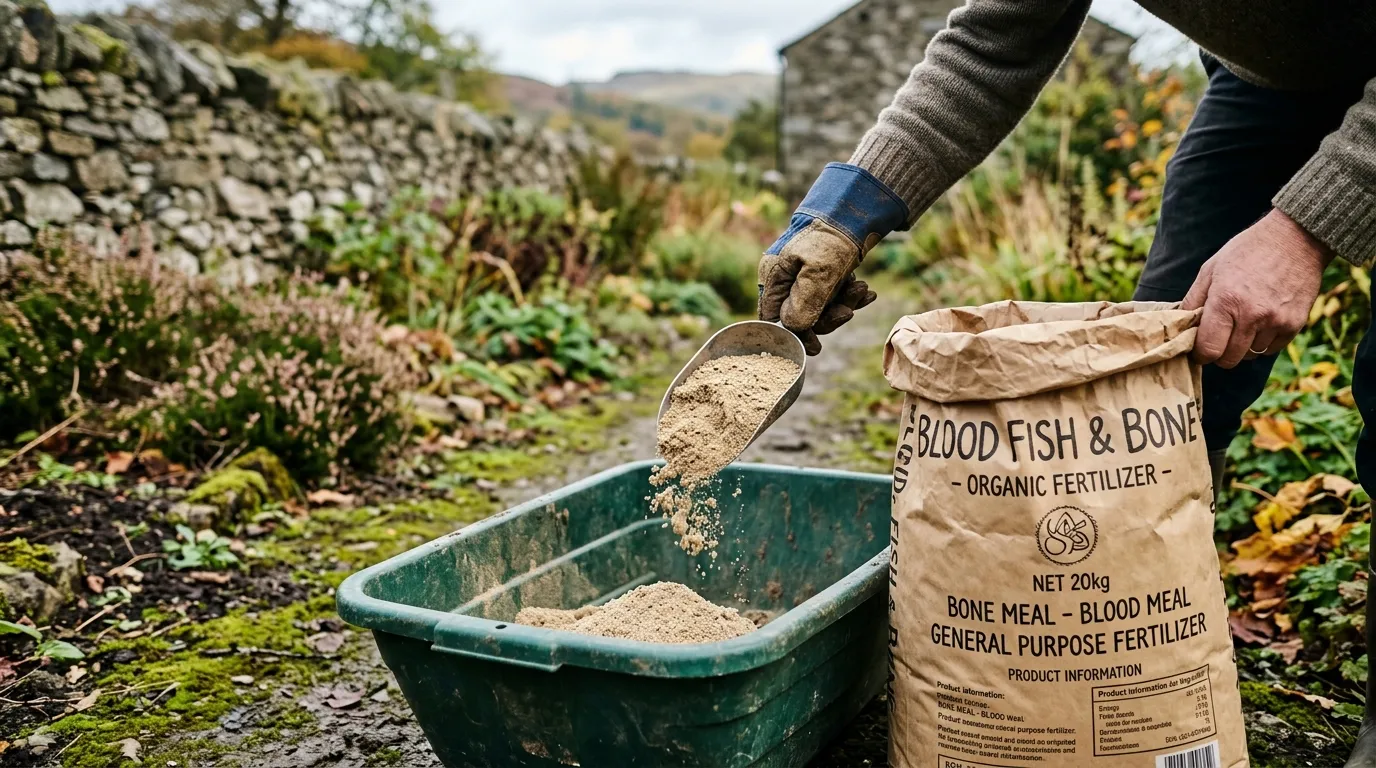 Blood fish and bone being measured into a trug for a brassica bed. At 70g per square metre, a 1.5kg tub covers roughly 20 square metres of vegetable bed.
Blood fish and bone NPK and how much to use
Blood fish and bone is the workhorse of UK organic feeding. The standard formulation runs NPK 5-5-6 with traces of calcium and sulphur. It combines fast-acting dried blood, medium-speed fish meal, and slow-release bone meal in one product, so it feeds across 8-10 weeks from a single application.
Standard dose is 70g per square metre for general beds. For heavy feeders such as cabbages, leeks, and sweetcorn, use 100g per square metre. For light feeders such as lettuce, radish, and carrots, use 35g per square metre. Apply two to three weeks before sowing or planting. Rake into the top 50mm of soil and water in well if the soil is dry.
Not suitable for vegan organic gardens. Some commercial blends use abattoir by-products from non-organic livestock, so check the label. The Vegan Organic Network certifies stockfree alternatives.
Bone meal application rate for UK roses and brassicas
Bone meal runs roughly NPK 3.5-22-0 and supplies phosphorus that lasts 12-18 months from a single autumn application. It is the standard rose and fruit tree planting feed, but it also works for autumn-sown brassicas and overwintered alliums that need slow phosphorus through the cold months.
Apply at 90g per square metre in October-November, raked into the top 100mm. For individual rose planting, mix 100g into the bottom of the planting hole. For fruit trees, use 200g per tree.
Bone meal feeds slowly because phosphorus is locked into calcium phosphate crystals that need soil biology to break down. This makes it pointless to apply in spring for a quick boost: it will not release fast enough to feed the current crop.
Not vegan. Rock phosphate is the direct vegan substitute, but it releases even slower (24-36 months).
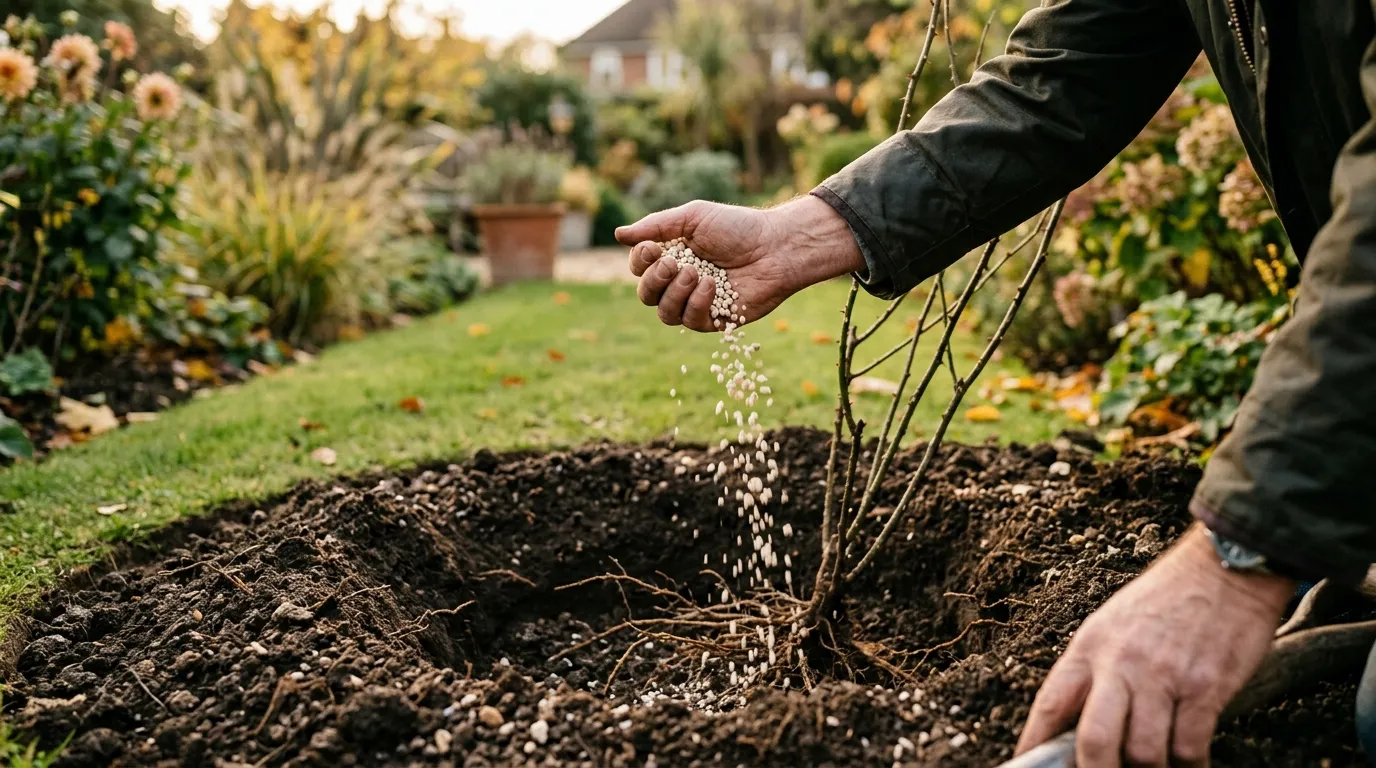 Bone meal being added to a rose planting hole at 100g per plant. Phosphorus needs to be placed where the roots will reach it within the first 18 months.
Dried blood: fastest organic nitrogen source for UK gardens
Dried blood is the fastest natural nitrogen source available. At NPK 12-0-0 it matches the nitrogen content of many synthetic fertilisers, releases over 10-14 days, and suits emergency rescue feeding for nitrogen-starved crops showing yellowing lower leaves.
Apply at 35g per square metre for leafy crops and brassicas. Top-dress around the plants, not on the leaves, and water in well. Reapply at 6-week intervals if growth is still slow.
The release speed comes from the high protein content of spray-dried animal blood. Soil bacteria break down the protein quickly in warm moist conditions (above 10C), releasing ammonium and nitrate forms of nitrogen that plants take up within days.
The risk is over-application: 50g per square metre or more produces soft sappy growth that attracts aphids and reduces frost hardiness. Use sparingly and only when nitrogen deficiency symptoms appear: pale lower leaves, slow growth, purple stems.
Not vegan. The vegan substitute for fast nitrogen is nettle tea (covered below), which reaches around NPK 2.5-0.5-1 and works in similar timeframes when applied as a liquid feed.
Hoof and horn for long-season nitrogen on fruit trees
Hoof and horn runs NPK 13-0-0 and releases nitrogen over 6-12 months. The release speed depends on the grade: fine grade (1-2mm) releases over 6 months, coarse grade (3-6mm) over 12 months. It suits perennial crops, fruit trees, and any planting where you want sustained nitrogen across a growing season without repeat applications.
Apply at 60g per square metre in March, raked into the top 100mm. For fruit trees, use 100-150g per tree at the drip line. Coarse grade is better for trees, fine grade for soft fruit and asparagus beds.
The slow release comes from the keratin protein in animal horn and hoof. Soil microbes break down keratin slowly, releasing nitrogen at roughly the rate plants need it. This makes overfeeding almost impossible at recommended doses.
Not vegan. The vegan substitute for slow-release nitrogen is composted green manure (read our green manures and cover crops guide for the species that fix the most nitrogen).
Seaweed meal application rate UK
Seaweed meal is the trace element specialist. At NPK 1-0-2 it does not supply much macronutrient, but it delivers 60+ trace elements including iodine, boron, manganese, and copper, plus natural plant hormones (cytokinins, auxins, gibberellins) that promote root growth and disease resistance.
Apply at 100g per square metre in March, raked into the top 50mm. For new beds, apply at 200g per square metre as a single soil-conditioning dose. Liquid seaweed (sold as Maxicrop or SeaMagic) is sprayed at fortnightly intervals as a foliar feed at 10ml per litre of water.
Fully vegan organic. Maxicrop harvest sustainably from the West Coast of Scotland; SeaMagic from Wales. Both are certified by the Soil Association.
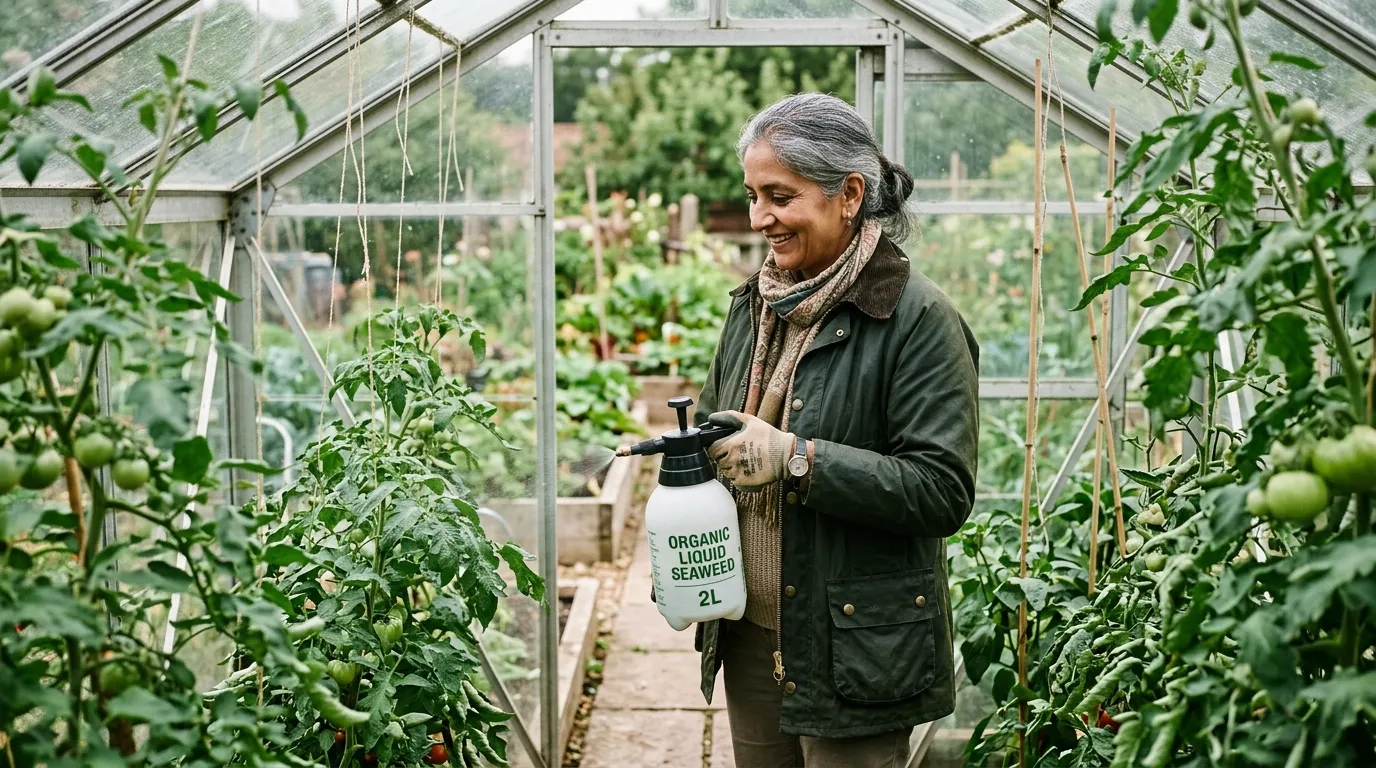 Liquid seaweed applied as a fortnightly foliar feed on greenhouse tomatoes. Foliar uptake delivers trace elements directly through the leaves within 24 hours.
Homemade comfrey fertiliser for UK tomatoes
Comfrey liquid feed is the best free natural fertiliser any UK gardener can make. Mature Bocking 14 comfrey leaves reach NPK 1.8-0.5-5.3 after 6 weeks of fermentation, with extremely high potassium that suits tomatoes, peppers, courgettes, and soft fruit once flowering starts.
The Bocking 14 cultivar is sterile (will not seed and spread). It can be cut 4-5 times per season from May to September, yielding around 4kg of fresh leaves per established plant. One plant supplies enough comfrey for a 6m tomato row across the season.
Making comfrey concentrate (no water method)
- Cut 1kg of fresh comfrey leaves and bruise them lightly.
- Pack into a 10L bucket with a tap at the bottom (or holes drilled into a smaller container suspended over a collection vessel).
- Weigh down with a brick or paving slab.
- Cover loosely and leave for 4-6 weeks.
- The leaves break down into a dark brown-black concentrate that drips out the bottom.
Dilute 1:15 with water before applying. The concentrate alone is too strong and burns roots. Apply 500ml of diluted feed per plant per week from first flower to late August.
The smell is the main drawback. Make the brew in a corner of the garden you do not visit often. The finished concentrate can be stored in sealed plastic bottles for 6 months.
Fully vegan organic. Garden Organic sell Bocking 14 root cuttings for £4-£6 per crown. Plant in October or March in deep moist soil, well away from beds you intend to dig (comfrey roots regrow from any fragment left in the soil).
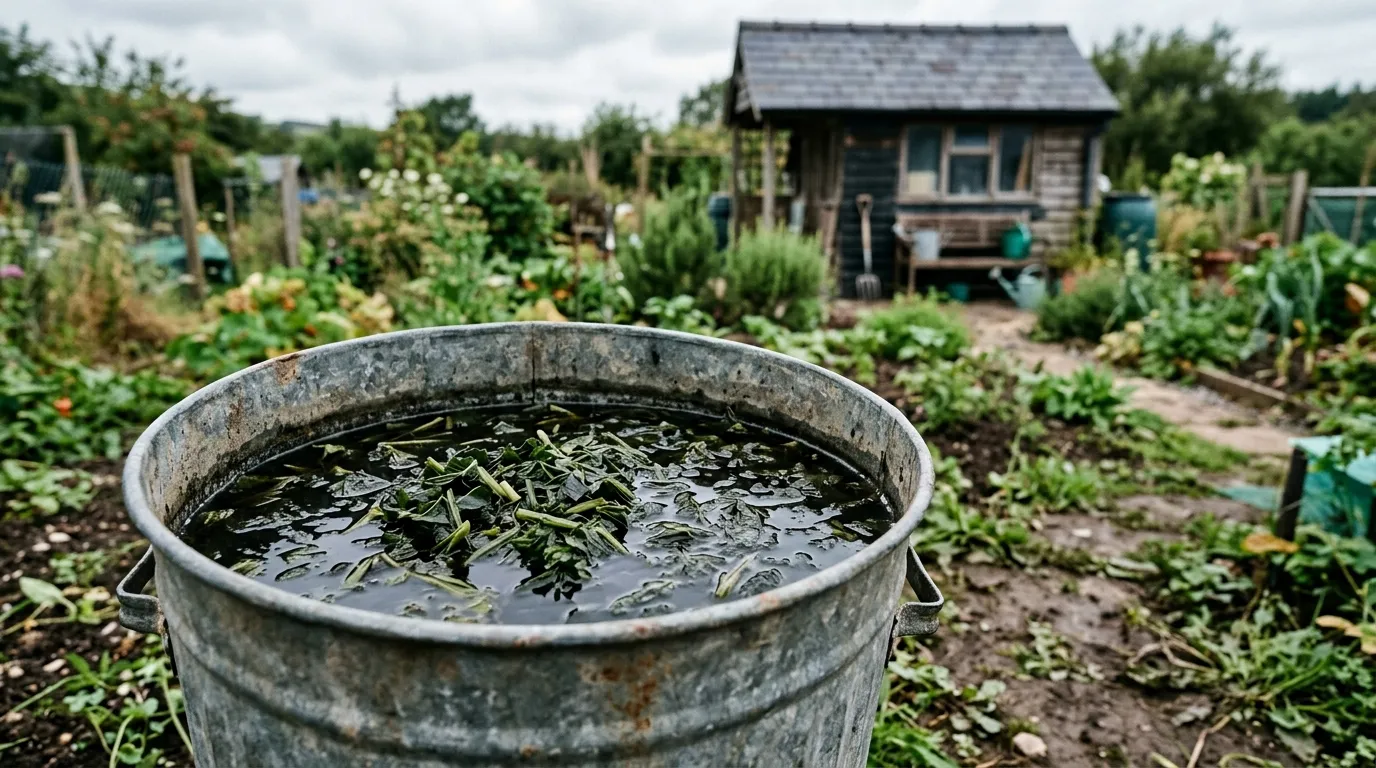 A galvanised dustbin set up for the water-method comfrey brew: 5kg of comfrey leaves topped with rainwater. Strain at week 4 and dilute 1:10 with water.
Making nettle tea fertiliser for UK leafy crops
Nettle tea is the nitrogen-rich counterpart to comfrey. At roughly NPK 2.5-0.5-1, fermented nettle leaves produce a fast-acting liquid feed that suits brassicas, leafy crops, and any plant in early vegetative growth. Use it before flowering. Switch to comfrey once flowers and fruit set.
Making nettle tea
- Cut 1kg of young nettle tops in April-May (before the plants flower).
- Wear gloves. Pack into a 10L bucket.
- Cover with 5L of water.
- Cover loosely and leave for 2-4 weeks (the shorter time in summer).
- Strain through old fabric into a sealed container.
Dilute 1:10 with water before applying. Pour 500ml around each plant every 10-14 days from late April to mid-June.
The smell is even worse than comfrey. Make the brew downwind of the kitchen. After straining, the spent nettle leaves go on the compost heap.
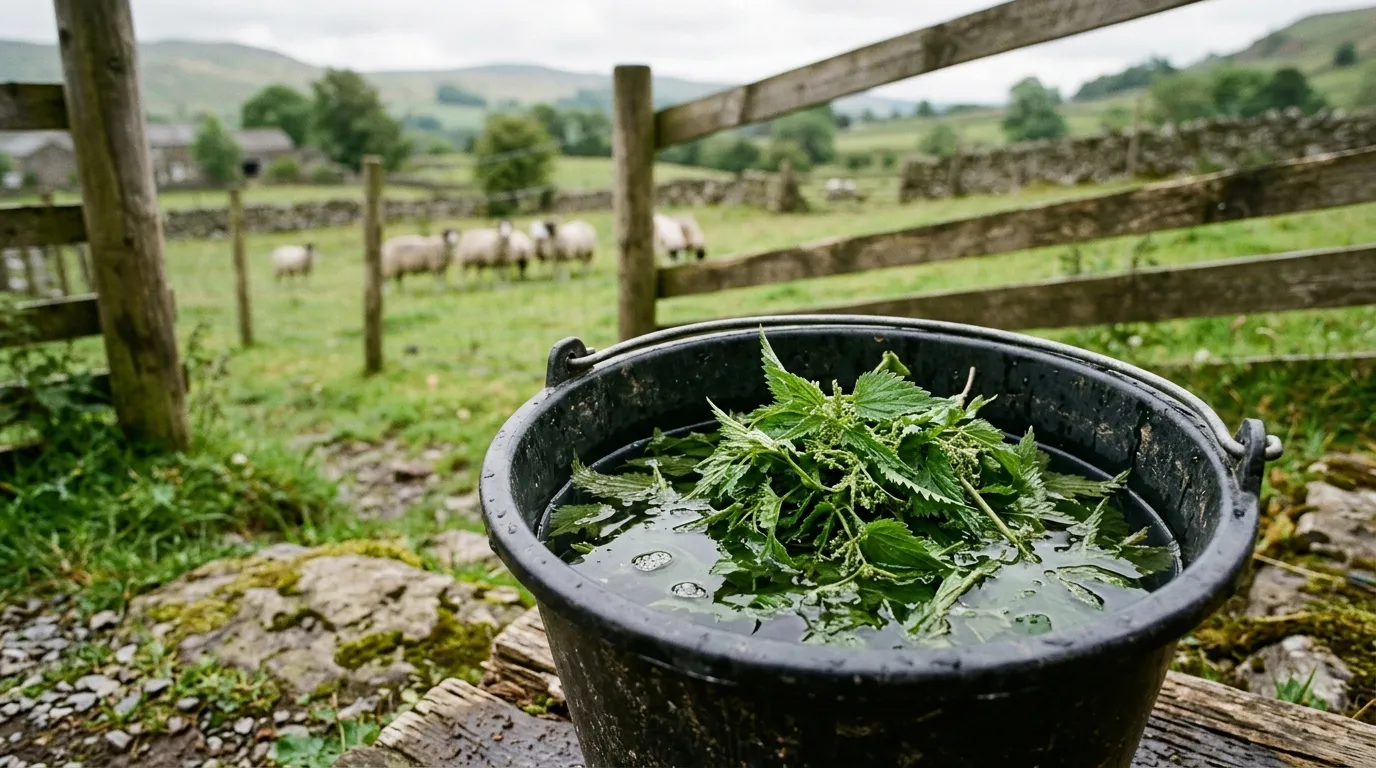 Young nettle tops packed into a bucket of rainwater. Cut nettles before flowering for the highest nitrogen content. After 3 weeks the brew is ready to strain and dilute.
Rock phosphate and organic sulphate of potash for vegan gardens
The two vegan organic mineral feeds cover the macronutrients that animal-based feeds usually supply.
Rock phosphate
NPK 0-26-0. Mined ground rock that releases phosphorus over 24-36 months as soil acids and biology break down the calcium phosphate. Apply at 120g per square metre when establishing a new bed, or 60g per square metre as an annual top-up.
Organic sulphate of potash
NPK 0-0-50. Mined mineral source of potassium with high sulphur content. Suitable for fruit, flowers, root crops, and any plant entering the flowering or fruiting stage. Apply at 30g per square metre in spring, top-dressed and watered in.
Faster-releasing than rock phosphate (4-6 weeks). Avoid muriate of potash (potassium chloride), which is the non-organic alternative and damages soil microbes at repeated doses.
Combined with seaweed meal (for K and trace) and comfrey or nettle tea (for liquid feeds), rock phosphate and organic sulphate of potash give a fully vegan organic feeding system that matches or beats blood fish and bone for sustained yields.
Why synthetic NPK damages UK soil microbiome over 5 years
The root cause of declining yields in heavily fertilised UK gardens is not nutrient deficiency. It is the collapse of soil biology that releases nutrients from organic matter.
Synthetic NPK delivers nutrients directly to plant roots in salt form (ammonium nitrate, ammonium phosphate, potassium chloride). Plants take them up within days. The benefit is fast growth. The cost is that soil microbes are bypassed entirely. Worse, the high salt index of synthetic feeds (averaging 70-100 on the salt index scale) draws water out of microbe cells through osmosis, killing earthworms, mycorrhizal fungi, and bacteria.
Soil Association trial data across 30 UK farms over 10 years showed:
- Earthworm counts dropped 60-80% under synthetic-only feeding compared to organic-only.
- Mycorrhizal fungal networks collapsed within 3 years on synthetic NPK plots.
- Soil organic matter fell by 0.8-1.5% per decade on synthetic systems, rose by 0.5-1.0% on organic.
- Soil water-holding capacity dropped 30-40% as organic matter declined.
The fix is not a partial swap. Soil biology recovers when you stop feeding plants directly and start feeding the soil. Natural organic fertilisers release nutrients slowly through microbial action, which means the microbes get fed first. This is why a 5-year organic transition produces visibly darker, looser, wetter-when-it-should-be-wet soil with more worms.
For long-term soil building alongside fertilisers, our four-year crop rotation guide and green manures and cover crops guide cover the practices that pair with natural fertilisers to build organic matter year on year.
Natural fertiliser application calendar UK
| Month | Action | Product | Dose |
|---|---|---|---|
| March | Pre-planting feed beds | Blood fish and bone | 70g/m² |
| March | Slow-release N for fruit | Hoof and horn | 60g/m² |
| March | Trace element top-up | Seaweed meal | 100g/m² |
| April | Side-dress brassicas | Dried blood | 35g/m² |
| April | Plant new comfrey crowns | Bocking 14 | n/a |
| May | Start liquid feeding | Nettle tea (diluted 1:10) | 500ml per plant |
| May | First comfrey cut | Make concentrate | n/a |
| June | Switch to high-K liquid | Comfrey (diluted 1:15) | 500ml per plant fortnightly |
| June | Side-dress sweetcorn | Blood fish and bone | 50g/m² |
| July | Continue comfrey feeding | Comfrey (1:15) | Fortnightly |
| July | Foliar trace feed | Liquid seaweed | 10ml/L weekly |
| August | Final feed (stop end of month) | Comfrey or seaweed | Fortnightly |
| September | Cut back comfrey, last brew | Bocking 14 | n/a |
| October | Autumn P for next year | Bone meal or rock phosphate | 90-120g/m² |
| November | Sheet mulch with compost | Garden compost | 50mm |
Stop all feeding by the end of August. Late feeding produces soft growth that does not harden before the first frost. Plants fed into September show 20-30% more frost damage in November-December than plants finished by mid-August.
Common mistakes with natural organic fertilisers
Applying granular feeds in summer
Granular feeds need 2-6 weeks for soil biology to break them down. Apply blood fish and bone in July and the crop is finished before the nutrients release. Granular feeds go on in March-April for spring planting, or October-November for overwintering crops.
Skipping the dose calculation
A “handful” of feed is roughly 80-100g, which works for blood fish and bone (target 70g/m²) but overdoses dried blood (target 35g/m²) by 2-3x. Use a kitchen scale and a 1m² marker until the dose is in your hand.
Mixing comfrey concentrate too strong
Undiluted comfrey concentrate burns roots within hours. Always dilute 1:15 with water. The same applies to nettle tea (1:10) and any homemade liquid feed.
Feeding too late into the season
Stop liquid feeding by end of August. Late-season nitrogen produces soft growth that does not harden before frost. Fruit trees in particular suffer winter dieback from August-September feeds.
Assuming all “organic” labels are vegan
Most commercial organic fertilisers contain animal by-products: blood, bone, fish, hoof, horn, feathers. Check labels carefully. Genuine vegan organic feeds are clearly marked, often certified by the Vegan Organic Network or Stockfree Organic Standards.
Warning: Never apply natural fertilisers to dry soil. Granular feeds need moisture to begin breaking down, and dry soil holds the salts on the surface where they can scorch any plant they touch. Water the bed 24 hours before applying granular feeds, then water in well after raking the feed into the surface.
Frequently asked questions
What is the best natural organic fertiliser for a UK vegetable garden?
Blood fish and bone at NPK 5-5-6, applied at 70g/m². It feeds for 8-10 weeks, covers all three macronutrients, and suits most UK soils. Add seaweed meal for trace elements and potash. For vegan gardens, swap blood fish and bone for seaweed meal plus rock phosphate plus organic potash.
How much blood fish and bone per square metre UK?
Apply 70g per square metre for general beds. Use 100g per square metre for hungry brassicas and sweetcorn. Use 35g per square metre for leafy salad beds. Rake into the top 50mm of soil two weeks before planting, then water in well.
How do you make comfrey liquid fertiliser UK?
Cut 1kg of comfrey leaves (Bocking 14 cultivar best), pack into a 10L bucket, weigh down with a brick. Add no water. After 4-6 weeks the black liquid drips out the bottom. Dilute 1:15 with water before applying. NPK reaches 1.8-0.5-5.3 by week 6.
Is bone meal vegan?
No, bone meal is made from ground steamed animal bones, usually cattle. Blood fish and bone, dried blood, and hoof and horn are also non-vegan. Vegan organic alternatives are rock phosphate (for P), seaweed meal (for K and trace), and organic sulphate of potash.
When should you apply natural fertiliser to UK garden?
Apply slow-release feeds in October-November. Apply granular feeds two weeks before planting in March-April. Apply liquid feeds fortnightly from late May to mid-August. Stop all feeding by end of August so soft growth hardens before frost.
Do natural fertilisers work as well as synthetic NPK?
Yes for sustained yields, no for instant rescue feeding. Natural fertilisers feed soil biology that then feeds plants over 6-18 months. Synthetic NPK feeds plants directly within days but bypasses soil biology, reducing earthworm counts by 60-80% over 5 years of repeated use according to Soil Association data.
Can I use comfrey and nettle feed on tomatoes?
Yes. Comfrey is the best UK liquid feed for tomatoes once flowers set. Use diluted comfrey (1:15) every 10-14 days from first truss until late August. Nettle tea (high nitrogen) is better for early leafy growth before flowering. Alternate the two for a balanced feed across the season.
Now build your organic feeding system
Our team produces practical UK gardening guidance from source research, contributor records and established horticultural practice. Editorial standards are overseen by Matt W.