Key takeaways
- Use the three-cut method on any branch over 25mm thick to stop bark tearing down the trunk
- Make the undercut 200-300mm out from the trunk, cutting one-third up through the limb
- Cut the final stub just outside the branch collar, never flush and never leaving a long stub
- Never apply wound paint or sealant; it traps moisture and stops the tree compartmentalising
- Prune most deciduous trees November to February, but stone fruit only June to August to avoid silver leaf
- Call an NPTC-qualified arborist for work above shoulder height, near power lines, or needing a chainsaw off the ground
Knowing how to remove large tree branches safely protects both the tree and you. A heavy limb cut the wrong way tears a long strip of bark down the trunk. That open wound invites decay and can shorten the tree’s life by years. Get it wrong above head height and you risk far worse than a damaged tree. This how-to guide covers the three-cut method used by professional arborists, the distances to measure, where to place the final cut, and how to read the branch collar. It also sets out the timing rules by tree type, the right tool for each job, and the clear line where a sensible gardener stops and calls a professional.
Why a single cut rips bark down the trunk
A heavy branch betrays you halfway through a single cut. As the saw blade passes the midpoint, the weight of the limb levers the partly cut wood downward. The fibres tear before the blade reaches them. The branch drops and peels a strip of bark and live wood down the trunk, sometimes 300mm or more below the cut.
That long tear is the real damage. The clean saw cut would have healed. The ragged strip below it exposes the cambium, the thin layer of living tissue under the bark. Water, fungal spores and boring insects move straight into open wood.
The fix is simple. Take the weight off the branch with two cuts before you make the precise final cut. That is the whole logic of the three-cut method.
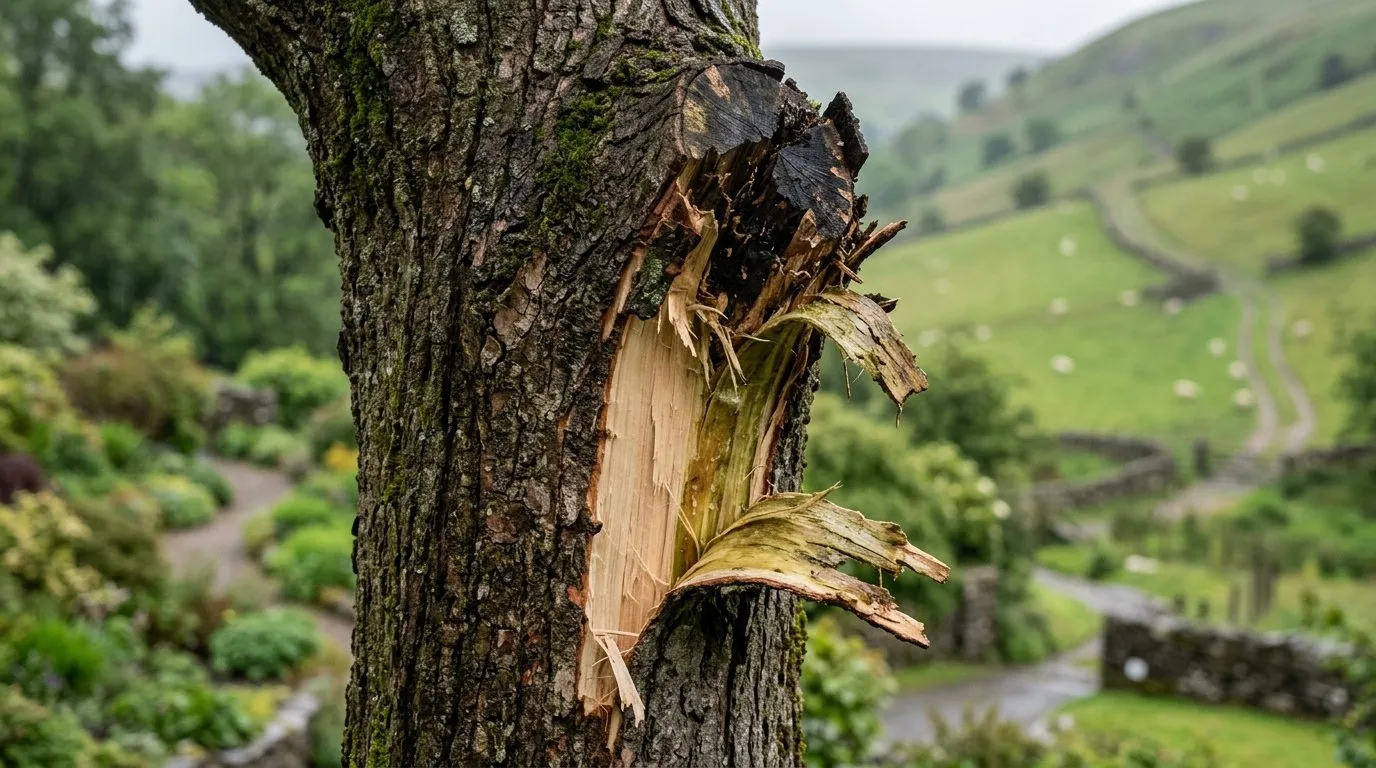 A single cut lets the limb’s weight strip bark down the trunk below the cut.
The three-cut method step by step
The three-cut method removes any branch thicker than about 25mm without tearing bark. Use it on every heavy limb. The sequence matters as much as the cuts themselves.
- Undercut. Measure 200-300mm out from the trunk along the underside of the branch. Saw upward from below, cutting about one-third of the way through the limb. Stop before the blade binds. This cut breaks the bark fibres on the underside so any tear cannot run past it.
- Top cut, or relief cut. Move 30-50mm further out from your undercut, toward the branch tip. Saw down from the top. The branch drops away cleanly. Because the undercut is already there, the snapping limb tears only as far as the undercut and no further. You are left with a short, light stub.
- Final cut. Now remove the stub. Find the branch collar, the swollen ring where the branch meets the trunk. Cut just outside it, following the angle of the collar. The stub is light, so it cannot tear anything. You finish with a small, round wound the tree can seal.
The single mistake most people make is skipping the undercut and going straight to a top cut. Without that first relief cut, the limb still peels bark as it falls. The undercut is not optional. It is the cut that protects.
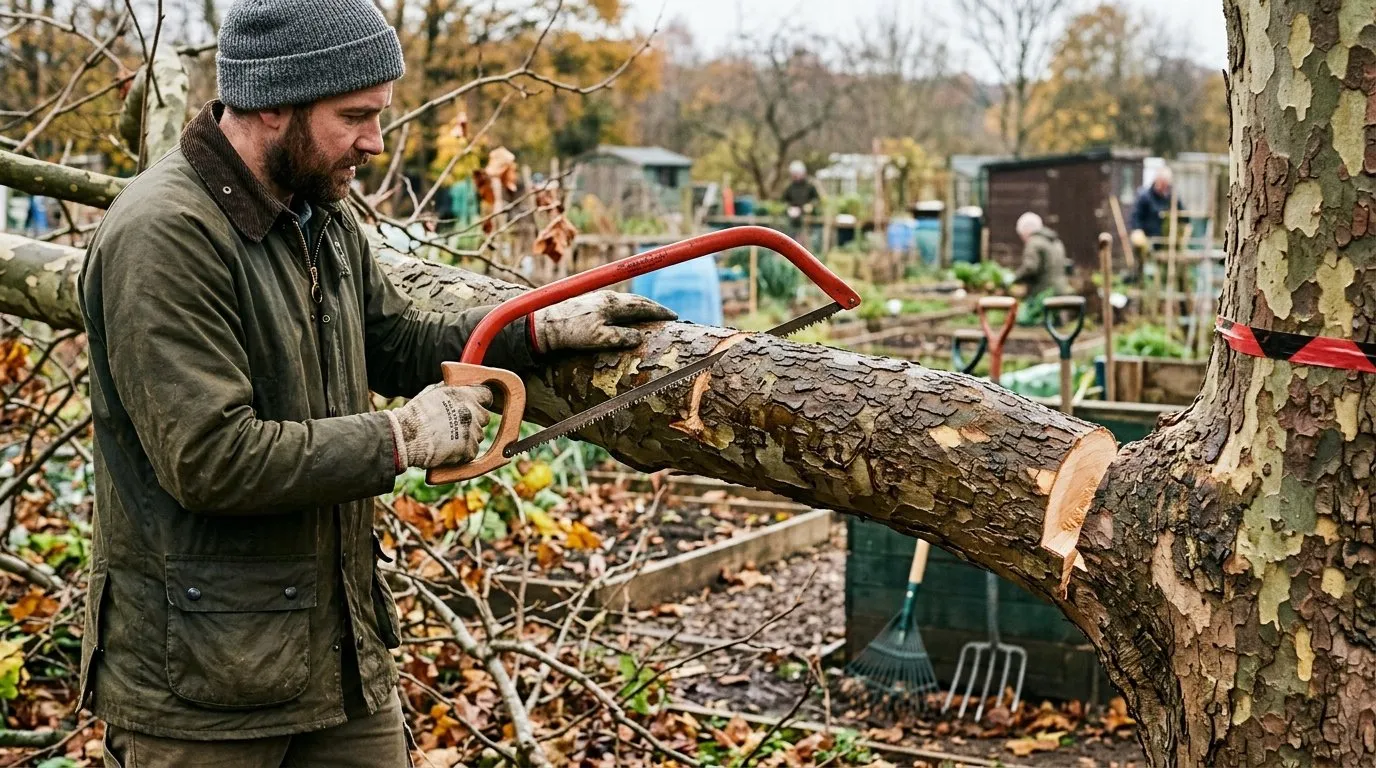 The undercut goes in first, then the top cut drops the limb, then the stub comes off at the collar.
Reading the branch collar and bark ridge
The branch collar is the key landmark for the final cut. It is the slightly swollen, often wrinkled ring of trunk tissue that wraps around the base of the branch. On a lime or an oak it is obvious. On a smooth-barked silver birch it can be subtle, so look closely before you cut.
Above the branch, in the crotch where it joins the trunk, sits the bark ridge. This is a raised line of rougher bark, usually pushed up slightly. It marks the boundary of the trunk’s own tissue.
Your final cut runs just outside both features. Start the blade level with the outer edge of the bark ridge and angle down to just outside the bottom of the collar. You are aiming to leave the collar fully intact while removing all the branch.
Two errors ruin this cut. A flush cut slices into the trunk, removing the collar and the zone the tree uses to seal wounds. A stub cut leaves a long peg of dead wood that rots back into the trunk. The collar is the target. Cut just past it, no closer and no further.
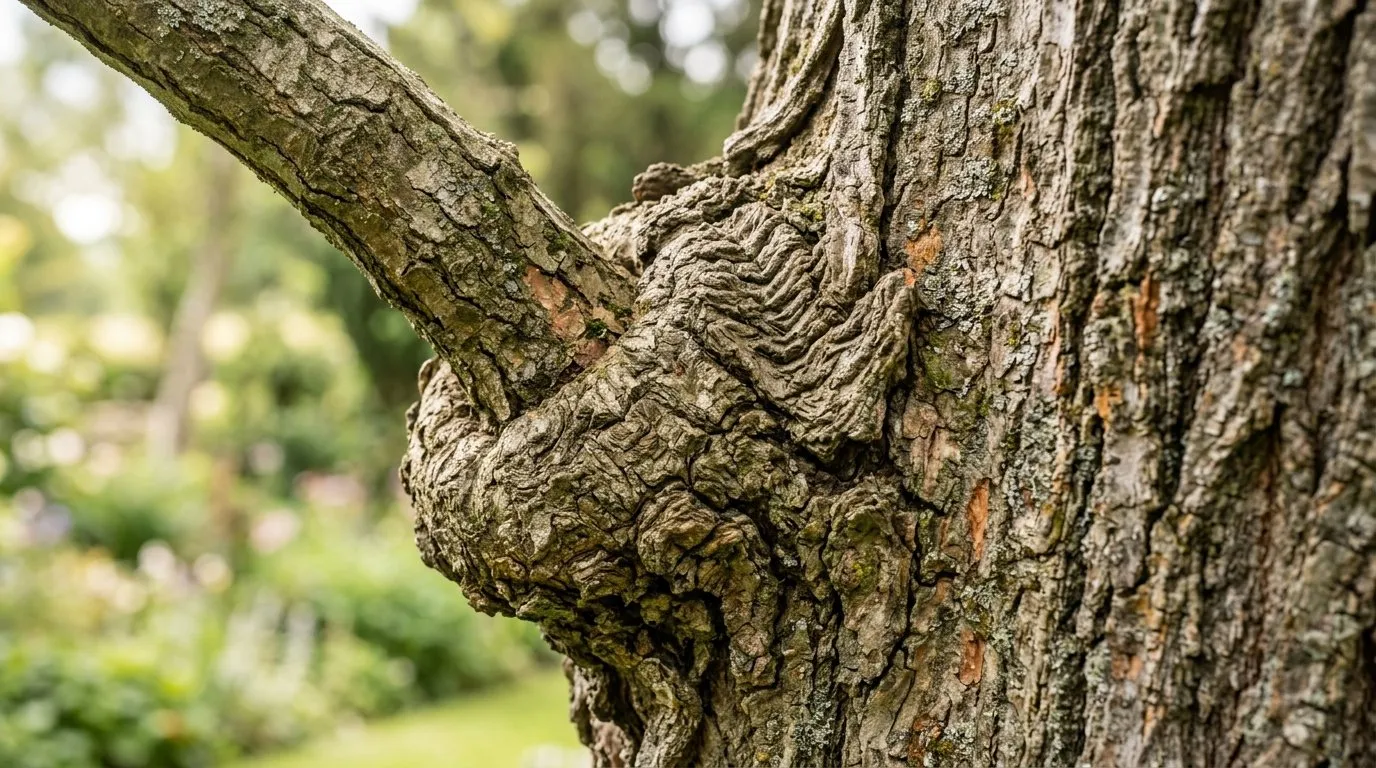 The branch collar is the swollen ring at the base; cut just outside it, never flush.
Choosing the right tool for the branch
Match the tool to the branch diameter. The wrong tool either fails to cut or tempts you into something dangerous.
| Branch situation | DIY or pro | Recommended tool | How well it works |
|---|---|---|---|
| Soft, green shoots under 25mm | DIY | Bypass loppers | Clean cut in one squeeze, no crushing |
| Dry or live wood 25-50mm, within reach | DIY | Curved pruning saw | Fast, controlled, cuts on the pull stroke |
| Branch 50-100mm, feet on the ground | DIY | Bow saw | Strong cut for thick limbs, two-handed control |
| Branch above shoulder height, light | DIY with care | Pole pruner or pole saw | Keeps you on the ground, limited to about 50mm |
| Large limb above shoulder height | Pro | Arborist with rope and chainsaw | Only safe option off the ground |
| Any limb needing a chainsaw off the ground | Pro | NPTC-qualified arborist | Required for safety and insurance |
Bypass loppers beat anvil loppers for live wood because they slice rather than crush. The same logic applies to lighter jobs like pruning roses, where a clean slice prevents stem dieback. A curved pruning saw is the workhorse for most garden branches; it cuts on the pull stroke, so it is hard to bind. A pole pruner extends your reach to a few metres, but a branch you can only reach with a pole is often a branch better left to a professional. For the smaller cuts, a sharp pair of secateurs handles anything under 25mm.
A chainsaw is appropriate only with both feet on solid ground, the branch below shoulder height, and proper training. It is never appropriate up a ladder or in a tree for a DIY gardener.
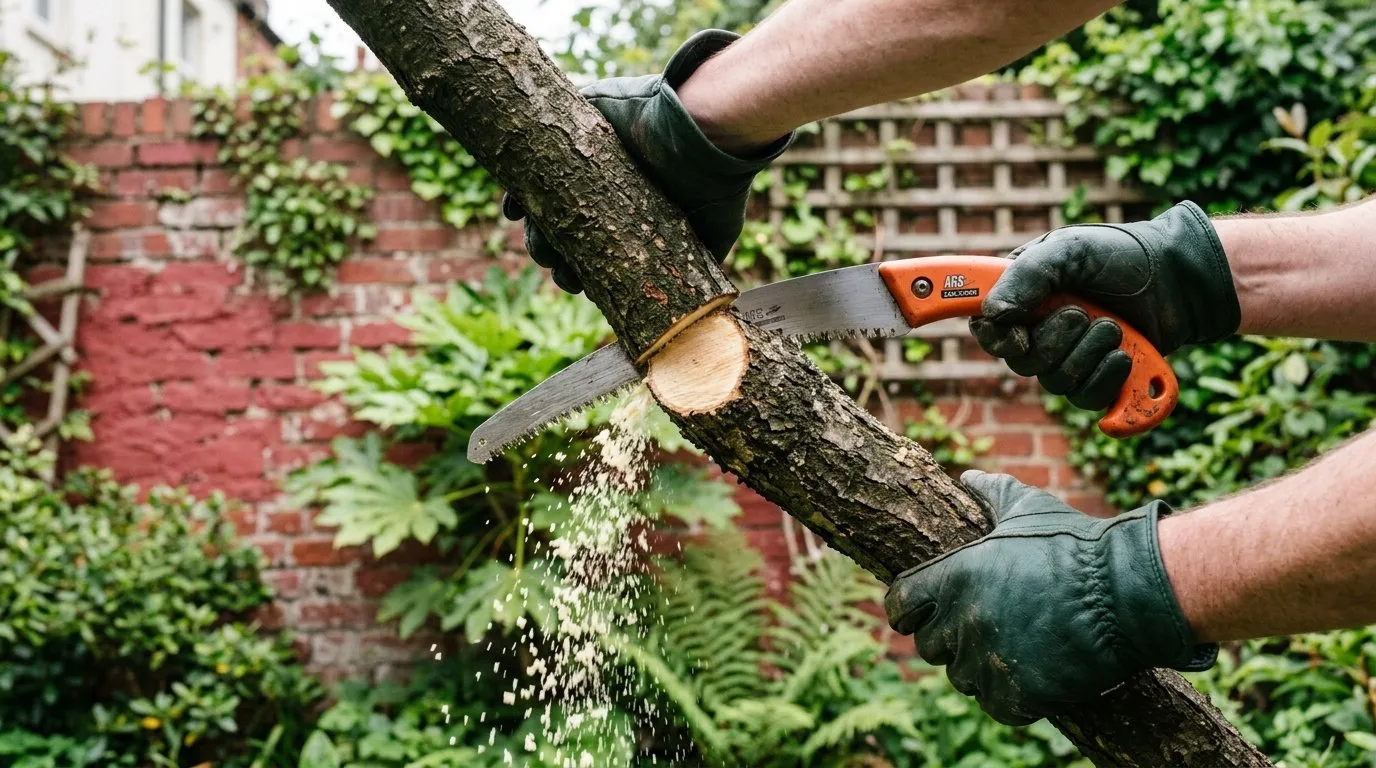 A curved pruning saw cuts on the pull stroke and handles most live garden branches.
When to cut, by tree type
Timing depends on the species. The general rule is to prune most deciduous trees from late autumn to late winter, while they are dormant and the structure is visible. November to February suits oak, lime, sycamore, hawthorn and most ornamental deciduous trees.
Avoid heavy pruning in mid spring. As sap rises in March and April, fresh wounds bleed and heal slowly, draining the tree’s reserves.
| Tree group | Best time to cut large branches | Reason |
|---|---|---|
| Most deciduous (oak, lime, sycamore) | November to February | Dormant, structure visible, low disease pressure |
| Cherry, plum, damson and other prunus | June to August only | Avoids silver leaf disease, active September to May |
| Birch, walnut, maple, grapevine | Mid to late summer | These bleed sap heavily from late-winter cuts |
| Apple and pear | November to February | Dormant pruning shapes the tree without bleeding |
| Evergreens and conifers | Late spring to summer | Cut into live growth only, never bare old wood |
The trap is treating every tree the same. Prunus species are the big one. Cut a cherry or plum in winter and you open the door to silver leaf, a fungal disease that can kill the tree. The fungus releases spores from autumn to late spring, so summer cuts heal before infection. The Royal Horticultural Society sets out the same windows in its pruning guidance for trees and shrubs.
For a fuller month-by-month plan across your whole garden, see our year-round pruning calendar.
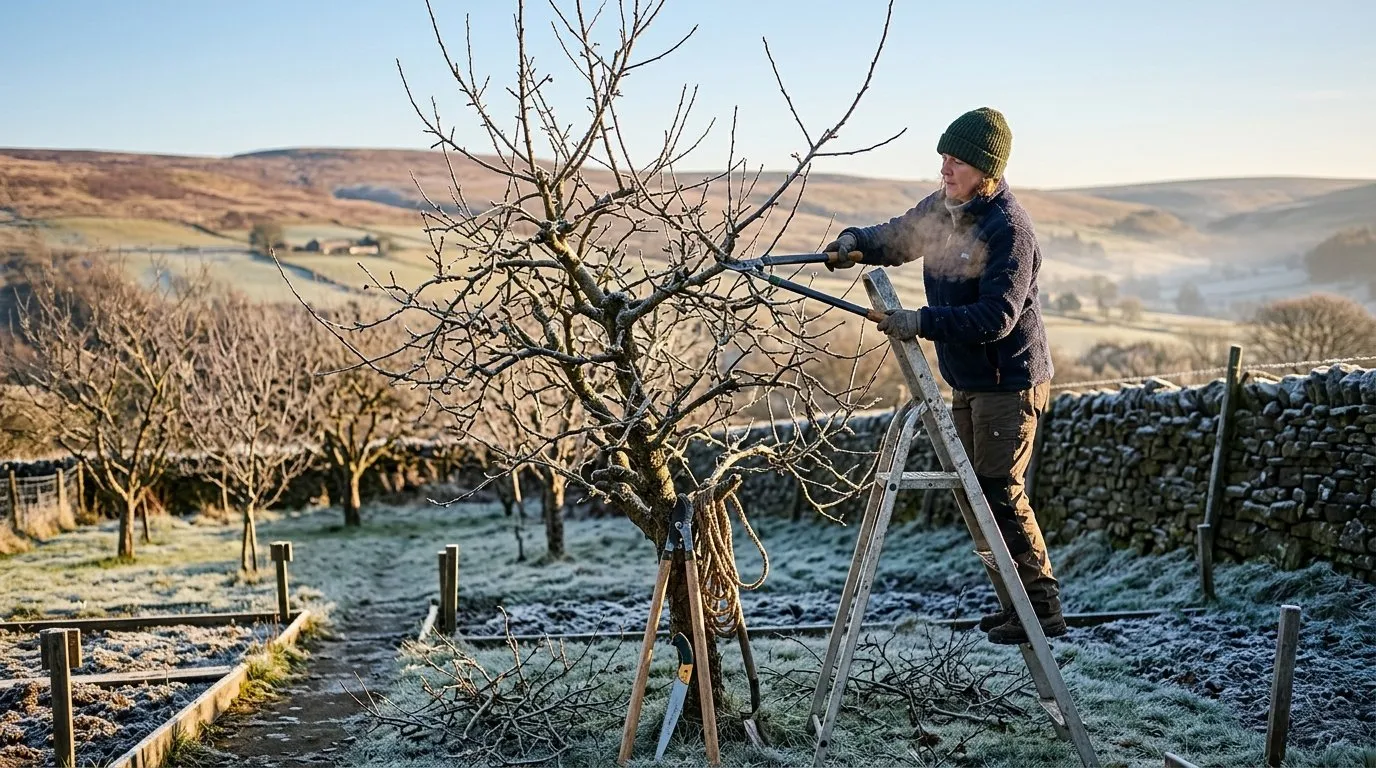 Most deciduous trees are best pruned November to February while dormant.
The method costs nothing extra. It takes one more cut and about thirty seconds. The payoff is a clean wound the tree seals in one or two seasons rather than a tear it fights for years.
The real reason cuts fail to heal
Most failed pruning cuts trace back to one root cause: cutting in the wrong place rather than at the wrong time. A tree does not heal a wound the way skin heals. It cannot regrow lost tissue. Instead it walls the damage off, a process called compartmentalisation, growing new wood and bark over the top from the edges of the collar.
That sealing tissue lives in the branch collar. Cut flush and you remove it, leaving the tree nothing to grow over the wound from. Cut too far out and the dead stub blocks the collar from closing. Either way decay creeps in.
This is also why wound paint fails. Sealing the cut traps moisture and locks decay fungi inside, against the very wood the tree is trying to protect. The Arboricultural Association and the RHS both advise leaving cuts bare. Get the position right and the tree does the rest.
Working safely around the drop zone
Safety planning matters more than cutting technique on a large limb. Before any cut, clear the drop zone, the area where the branch and any kickback debris will land. Allow more space than the branch length; limbs bounce and roll.
Plan two escape routes at roughly 45 degrees back from the trunk, away from the drop zone. Keep them clear of hose, tools and trip hazards. Move along one the moment the limb falls.
Warning: Never use a chainsaw overhead, up a ladder, or while standing in a tree. Chainsaw kickback at head height kills. Power lines are a hard stop. If a branch is anywhere near an electricity line, do not touch it. Call your local Distribution Network Operator on 105, or hire a professional. Treat every line as live.
Always work with a helper on the ground who can watch, hold the base of a step, and call emergency services if needed. Wear proper PPE: gloves, eye protection, a hard hat for overhead work, and steel-toed boots. If you use a chainsaw, that means chainsaw trousers, gloves and a helmet with visor and ear defenders.
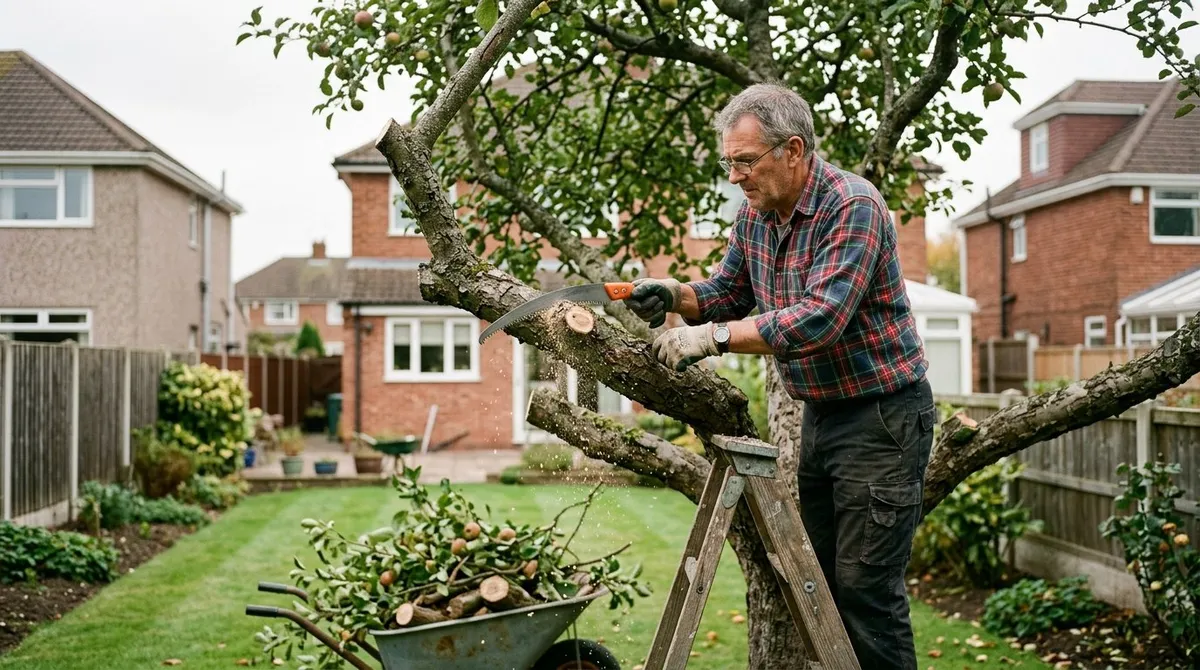
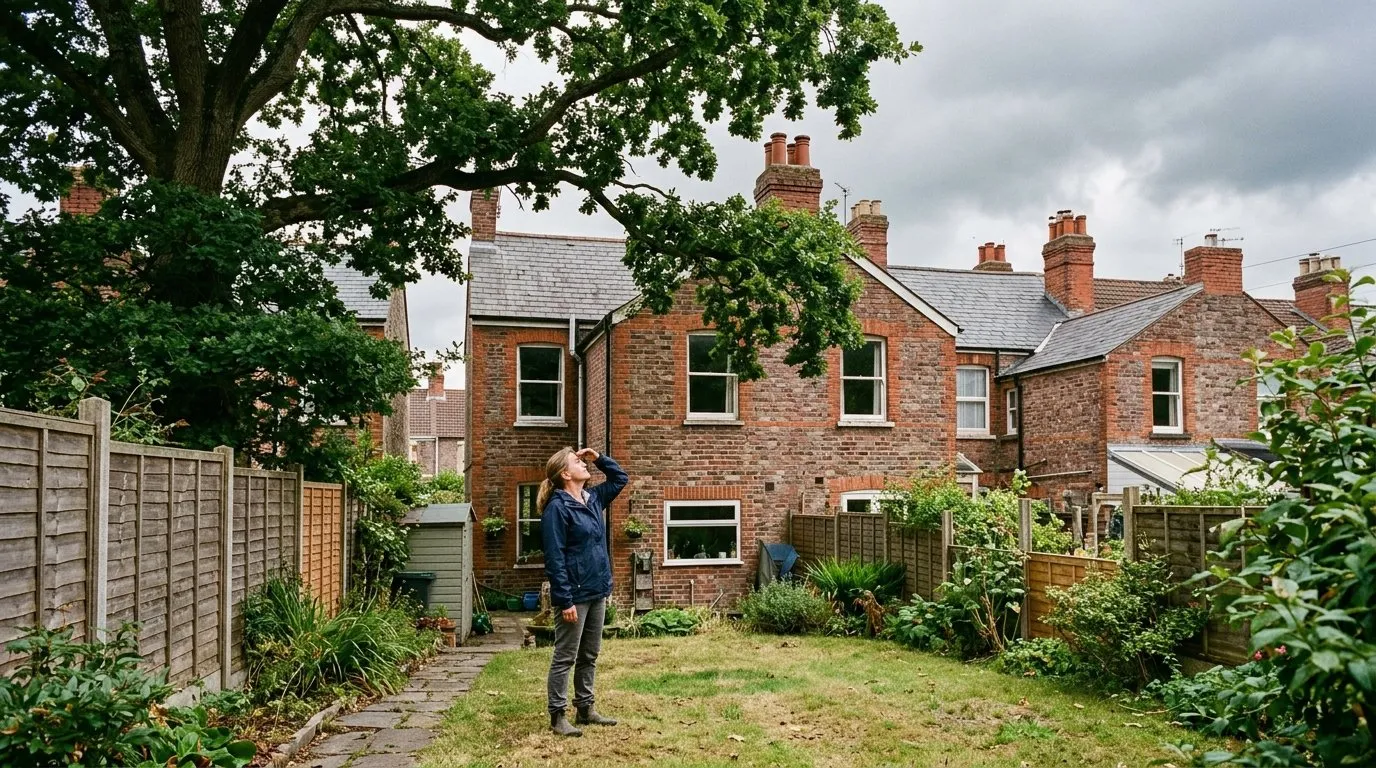 Assess the drop zone, escape routes and any overhead lines before making a single cut.
Common mistakes that damage the tree
- Skipping the undercut. What happens: the gardener goes straight to a top cut on a heavy limb. Why: the undercut feels fiddly and slow. How to avoid it: treat the undercut as the first cut on anything over 25mm, every time, no exceptions.
- Cutting flush to the trunk. What happens: the collar is sliced off, leaving a flat wound that never seals. Why: a flush cut looks tidy and complete. How to avoid it: find the swollen collar first and aim your blade just outside it.
- Pruning prunus in winter. What happens: a cherry or plum cut in January catches silver leaf. Why: gardeners apply the deciduous winter rule to all trees. How to avoid it: cut all stone fruit in June to August only.
A fourth mistake is taking too much at once. Removing more than a quarter of the canopy in one year stresses the tree and triggers weak water shoots. Spread big reductions over two or three seasons.
Gardener’s tip: Before you cut anything, stand back and look at the whole tree. Mark the branches you plan to remove with a loop of garden twine. Once they are tied, walk round the tree and check the shape still works. It is far cheaper to untie twine than to wish back a branch.
When to call a professional arborist
There is a clear line between sensible DIY and a job for a professional. Call a qualified arborist when any of these apply: the limb is above shoulder height, the work needs a chainsaw off the ground, the branch is near a building, boundary or power line, or the tree is large, dead or diseased.
Look for NPTC qualifications and membership of the Arboricultural Association. An ARB Approved Contractor carries the right insurance and training. Ask to see proof before work starts.
Expect to pay roughly £250-£500 per day for a small two- or three-person team nationally, rising to £900-£1,500 a day in London and the South East. A single large limb is often a half-day job. Get two or three quotes first.
A tree surgeon will also reach work that defeats ground-based tools. If a conifer has outgrown its space, our guide on what to do when a conifer is too big covers the options before you commit. The same goes for invasive trees; removing one is rarely a one-cut job, as our guide to tree of heaven removal explains.
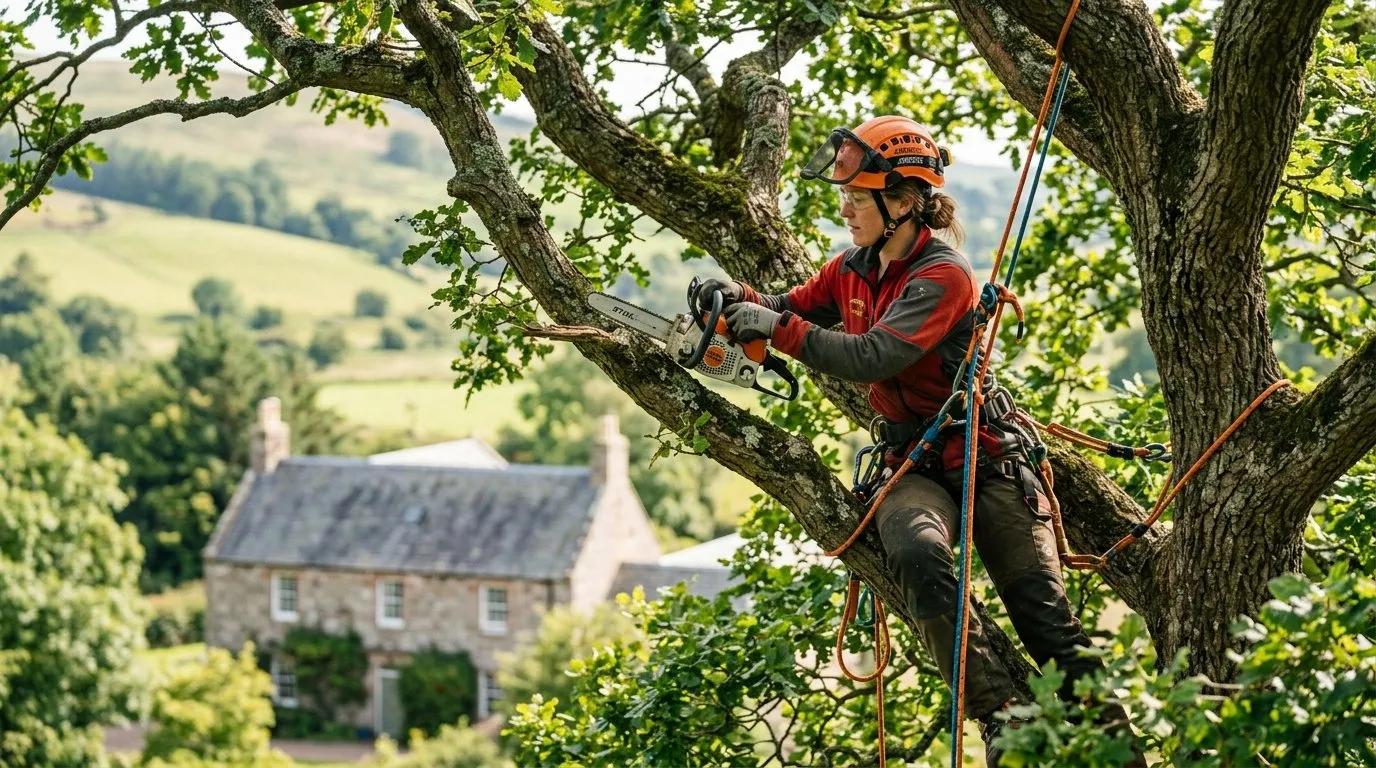 Anything above shoulder height or near a building belongs to a roped, qualified arborist.
The legal side: TPOs, conservation areas and neighbours
Check the law before you cut. A Tree Preservation Order, or TPO, protects specific trees, and you need written consent from your local planning authority before any work, even on your own tree. Cutting a TPO-protected tree without permission risks a fine of up to £20,000 in the magistrates’ court, or an unlimited fine in the crown court for destroying a tree.
If your garden sits in a conservation area, different rules apply. You must give the council six weeks’ written notice using a section 211 notice before working on any tree with a trunk over 75mm in diameter, measured 1.5m up. The council can then decide whether to make a TPO. The full rules sit on the government’s guidance on Tree Preservation Orders.
A quick call to your council’s tree officer settles it. Most will tell you within minutes whether a tree is protected.
Neighbours add another layer. You may cut branches that overhang your boundary, but only back to the boundary line, and only if the tree is not protected. The cut material legally belongs to your neighbour, so offer it back. Never cut beyond the boundary.
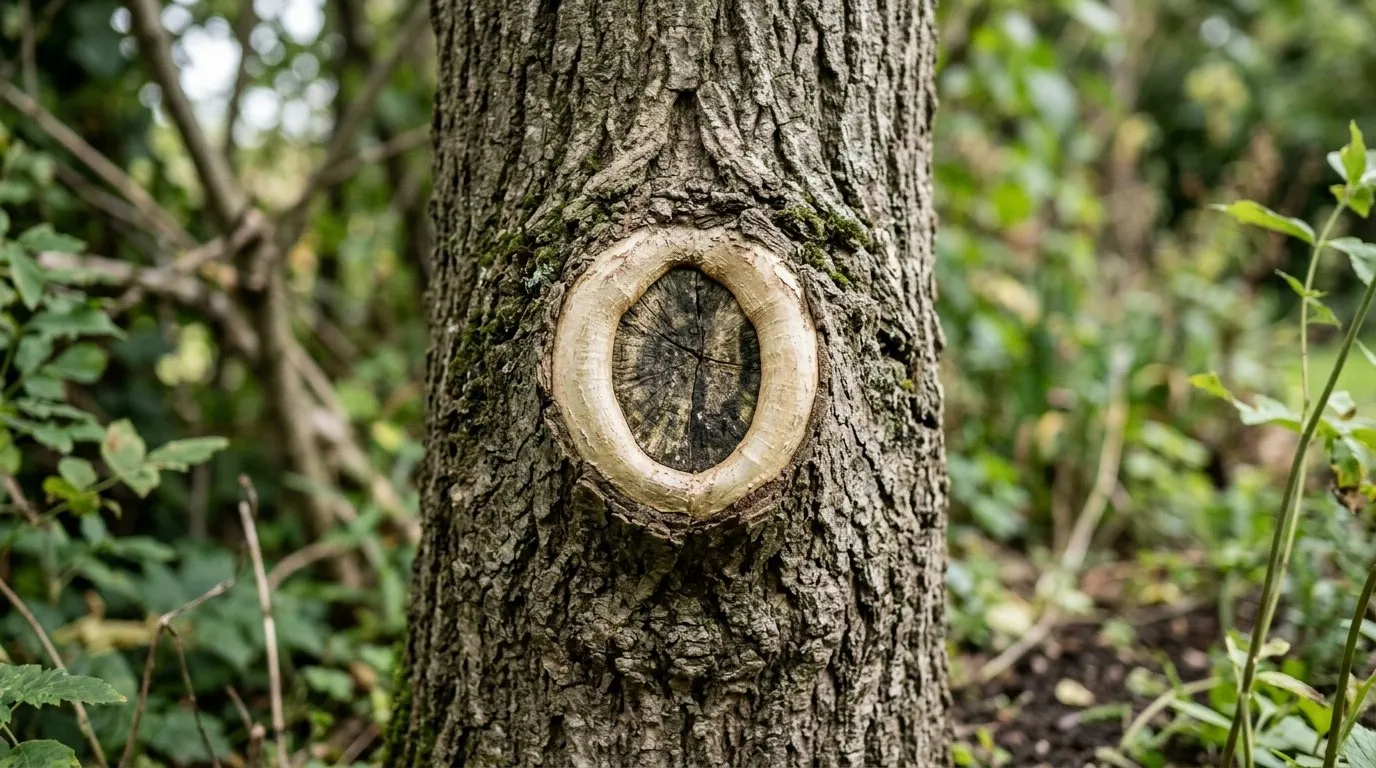 A correctly placed cut a year on: callus tissue rolls in from the collar to seal the wound.
Frequently asked questions
What is the three-cut method for removing a tree branch?
It is a three-stage sequence that removes a heavy branch without tearing bark. First you undercut the branch one-third through, 200-300mm from the trunk. Then you cut from the top slightly further out to drop the limb cleanly. Finally you remove the short stub just outside the branch collar. The first two cuts take the weight off before the precise final cut, so the falling limb cannot strip bark down the trunk.
Where exactly should I make the final pruning cut?
Cut just outside the branch collar, never flush with the trunk. The branch collar is the swollen ring of bark where the branch meets the trunk. The bark ridge is the raised line in the bark crotch above the branch. Cut at a slight angle following the line of the collar, leaving the collar intact. A flush cut removes the tissue the tree needs to seal the wound.
Should I paint or seal a large pruning cut?
No, leave the cut bare. Wound paints and sealants trap moisture against the wood and encourage fungal decay. The RHS and the Arboricultural Association both advise against them. A clean cut just outside the branch collar lets the tree compartmentalise the wound naturally by walling off the damaged tissue. Sealants slow this process down.
When can I cut large branches off a tree in the UK?
Most deciduous trees are best pruned November to February while dormant. Avoid heavy cutting in spring when sap is rising hard. Prune cherries, plums and other prunus only in June to August to dodge silver leaf disease. Do not cut birch, walnut, maple or grapevine in late winter or early spring because they bleed sap heavily from fresh wounds.
Can I use a chainsaw to remove a tree branch myself?
Only with both feet on the ground and the branch below shoulder height. Never operate a chainsaw overhead, up a ladder, or in a tree. Chainsaw kickback at head height is frequently fatal. For any limb you cannot reach standing on firm ground, hire an NPTC-qualified arborist. A bow saw or curved pruning saw handles most garden branches safely.
When should I call a tree surgeon instead of doing it myself?
Call an arborist for any work above shoulder height. That includes large limbs, branches near buildings, boundaries or power lines, dead or diseased trees, and anything needing a chainsaw off the ground. Look for NPTC qualifications and Arboricultural Association membership. Expect to pay £250-£500 a day for a small team, more in London and the South East.
Do I need permission to cut branches off my own tree?
Possibly yes, so check with your council first. If the tree has a Tree Preservation Order you need written consent before any work. In a conservation area you must give the council six weeks’ notice for trees over 75mm trunk diameter. Cutting a protected tree without consent risks a fine of up to £20,000 in the magistrates’ court.
Why does a single cut tear bark down the trunk?
The weight of the limb peels it away before the cut finishes. As the saw passes halfway, the branch sags under its own weight and snaps. The breaking limb rips a long strip of bark and wood down the trunk below the cut. That tear becomes an open wound the tree struggles to seal, inviting decay. The three-cut method removes the weight first.
Now you have removed the limb cleanly, read our guide on how to prune fruit trees for shaping apples, pears and stone fruit through the year.
Our team produces practical UK gardening guidance from source research, contributor records and established horticultural practice. Editorial standards are overseen by Matt W.