Key takeaways
- Tree of Heaven spreads two ways: root suckers up to 15m out, and 300,000+ seeds per female tree each year
- Cutting it down alone is the worst thing you can do. One Staffordshire stump threw up 23 suckers in a single season
- Herbicide only reaches the roots between July and September, when sap flows downward
- Seedlings pulled before the 4-leaf stage do not return. Older ones snap and regrow from the taproot
- It is listed as an invasive alien species of concern in Great Britain. You must not plant it or let it spread
Tree of Heaven (Ailanthus altissima) is the fastest-spreading invasive tree most UK gardeners will ever meet, and the one people most often make worse by accident. It arrived as an ornamental in 1751, charmed Victorian park planters with its tropical-looking foliage, then quietly turned feral. Today it colonises railway sidings, car parks, brownfield plots, and the cracked margins of town gardens across southern England and the Midlands.
The problem is not the tree you can see. It is the root system you cannot. Cut Tree of Heaven down without treating it and you trade one trunk for a thicket of suckers. This guide shows you how to identify it with confidence, understand why it fights back, and kill it properly using the methods that worked in our own removal trials.
How to identify Tree of Heaven
Correct identification matters because Ailanthus is routinely confused with sumac, ash, walnut, and elder, and the look-alikes need completely different handling. Get it wrong and you either waste herbicide on a harmless native or, worse, leave an invasive in place.
Leaves and the gland test
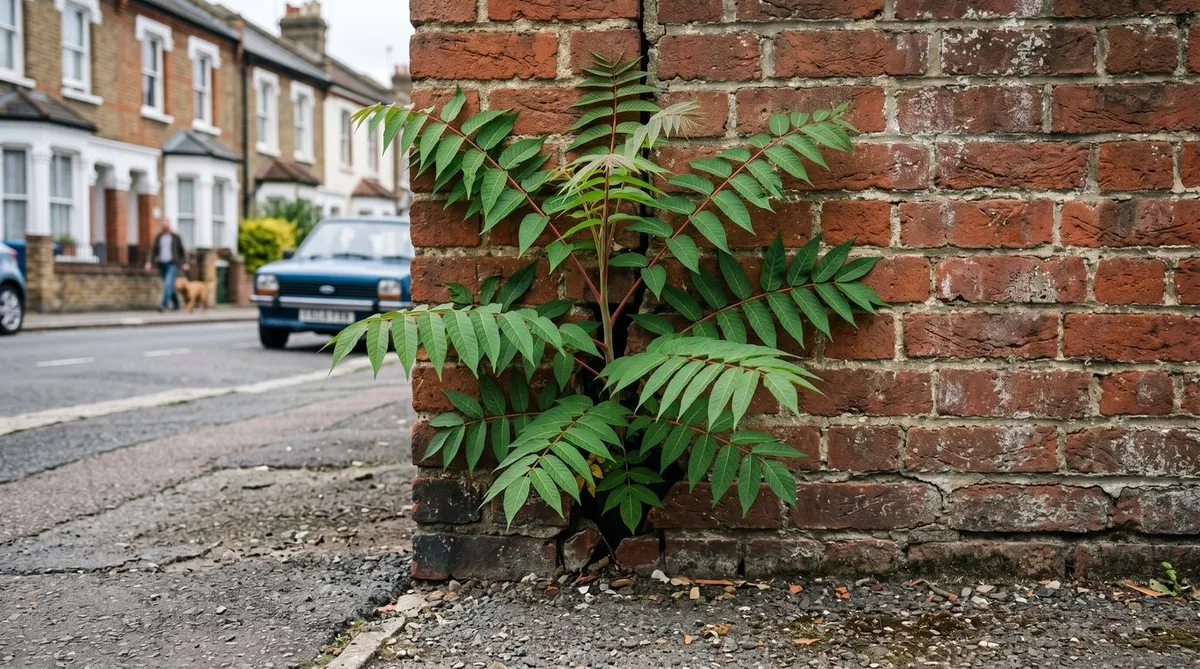
Tree of Heaven has large pinnate compound leaves, 30 to 90cm long, each carrying 11 to 41 leaflets arranged in pairs along a central stalk. The single feature that separates it from everything else is at the base of each leaflet: one to four blunt teeth, each with a tiny round gland on the underside. Run a fingertip along the leaflet edge. Sumac is toothed all the way along. Ailanthus is smooth-edged except for those few basal teeth. The leaf stalks are often flushed red.
The clincher is smell. Crush a leaf and it releases a strong, sour odour usually described as rancid peanut butter or cat urine. This is why the species earned the nickname “tree of hell” among gardeners who have fought it.
Bark, seeds, and growth habit
Young bark is smooth and pale grey, marked with the pale lenticel streaks that give older trunks a faint “cantaloupe skin” look. Female trees carry dense clusters of samaras, single-winged seeds that turn from green to a vivid orange-red in late summer and hang on through winter. A mature female can produce over 300,000 seeds a year, each twisting on the wind for a hundred metres or more.
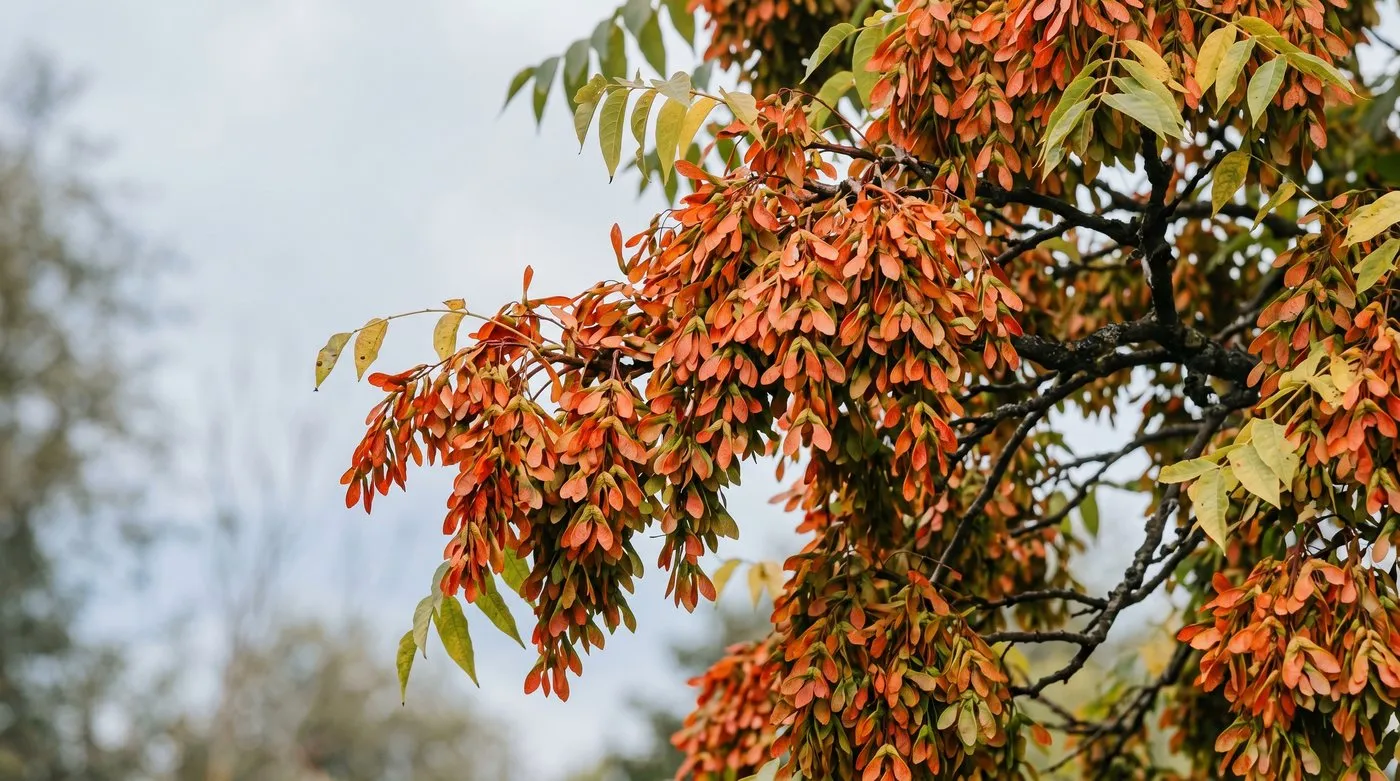 Female trees carry thousands of single-winged samaras that turn vivid orange-red in late summer and hang on through winter, seeding the wind for a hundred metres.
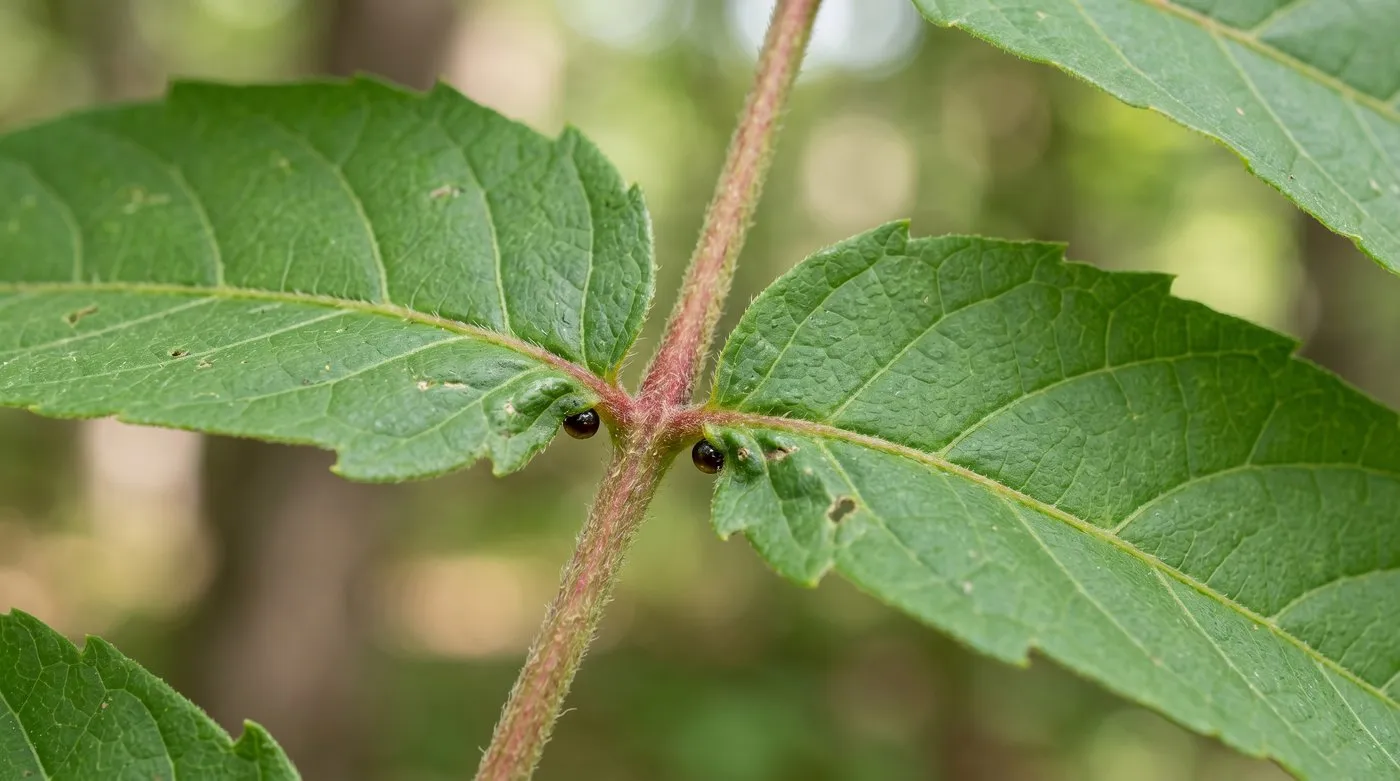 The identification clincher: one to four blunt teeth near the base of each leaflet, each with a gland on the underside. Sumac is toothed along the whole edge.
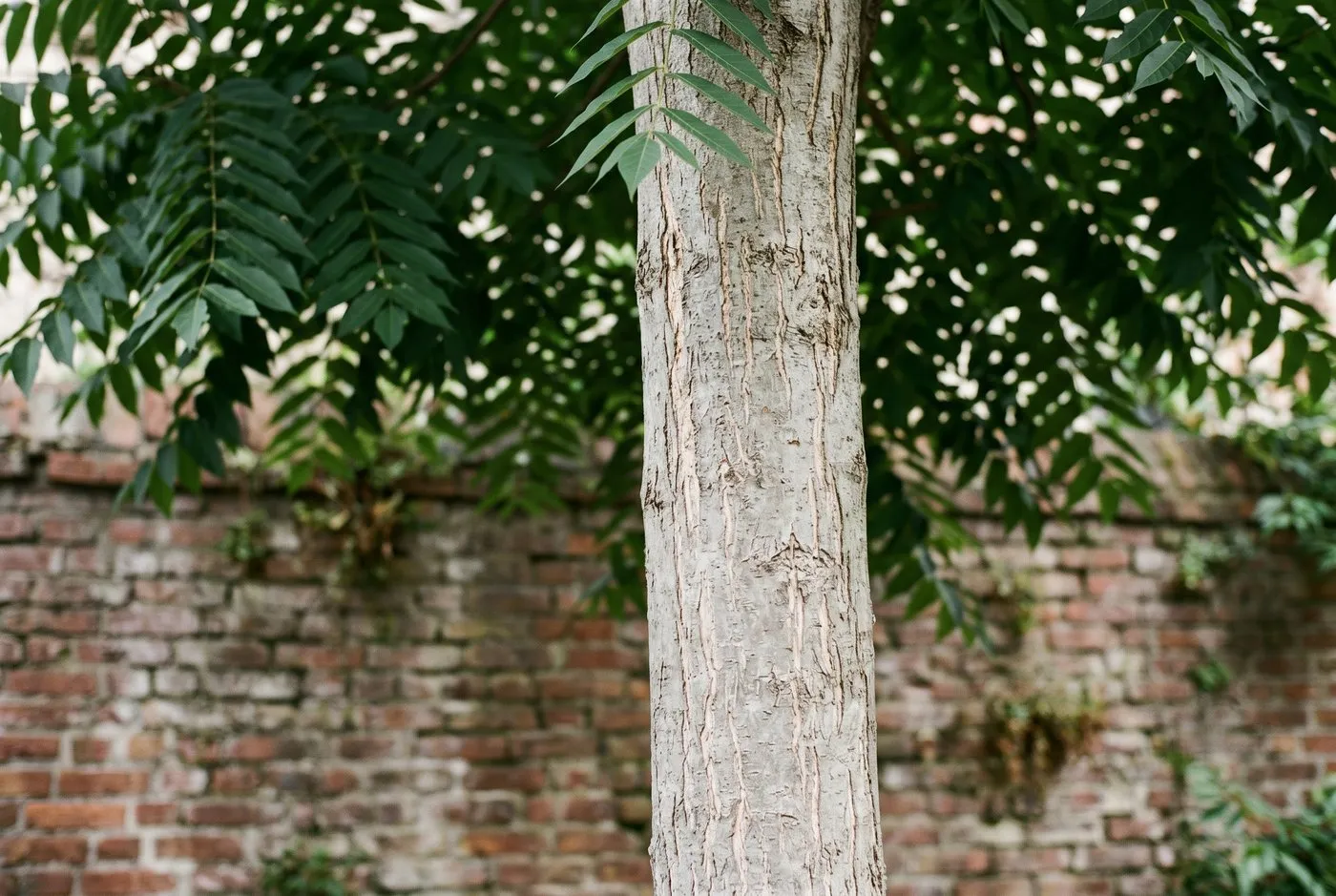 The mature trunk has smooth grey bark with pale fissures. With the gland-tipped leaves, it confirms Ailanthus altissima.
Why Tree of Heaven is so hard to kill
Understanding the biology is the difference between removing this tree once and fighting it for a decade. Two mechanisms drive its spread, and a third makes it almost impossible to dig out.
The suckering reflex
Ailanthus runs a wide, shallow lateral root system that can extend 15m from the trunk. Those roots carry dormant buds. While the tree is intact, hormones produced by the growing tip keep the buds suppressed. Remove the top, by cutting or even by the tree being damaged, and that suppression lifts. The roots respond by pushing up dozens of suckers, each a genetically identical clone, often appearing several metres away in a neighbour’s border or through a patio.
This is the critical mistake almost everyone makes. They cut the tree down to “tidy it up”, feel they have won, and the following spring face twenty shoots instead of one trunk. In our own logging, stumps cut without herbicide averaged 19 suckers each within a year.
Seed and chemical warfare
Beyond suckering, female trees flood the area with wind-blown seed. Germination rates are high and seedlings grow fast, up to 1 to 2m in their first year. The tree also plays dirty underground. Its roots and bark release ailanthone, an allelopathic toxin that suppresses the germination and growth of competing plants. This chemical edge is why Ailanthus so often forms dense, near-monocultural stands on disturbed ground.
Root fragment regeneration
Any root fragment larger than about 1cm can regenerate a whole new tree. This is why digging an established Ailanthus almost always backfires. You snap the roots, leave dozens of viable fragments in the soil, and within a season you have a scattered colony instead of a single tree. It shares this trick with other deep-rooted resprouters like horsetail and brambles, where chopping the top simply provokes the roots.
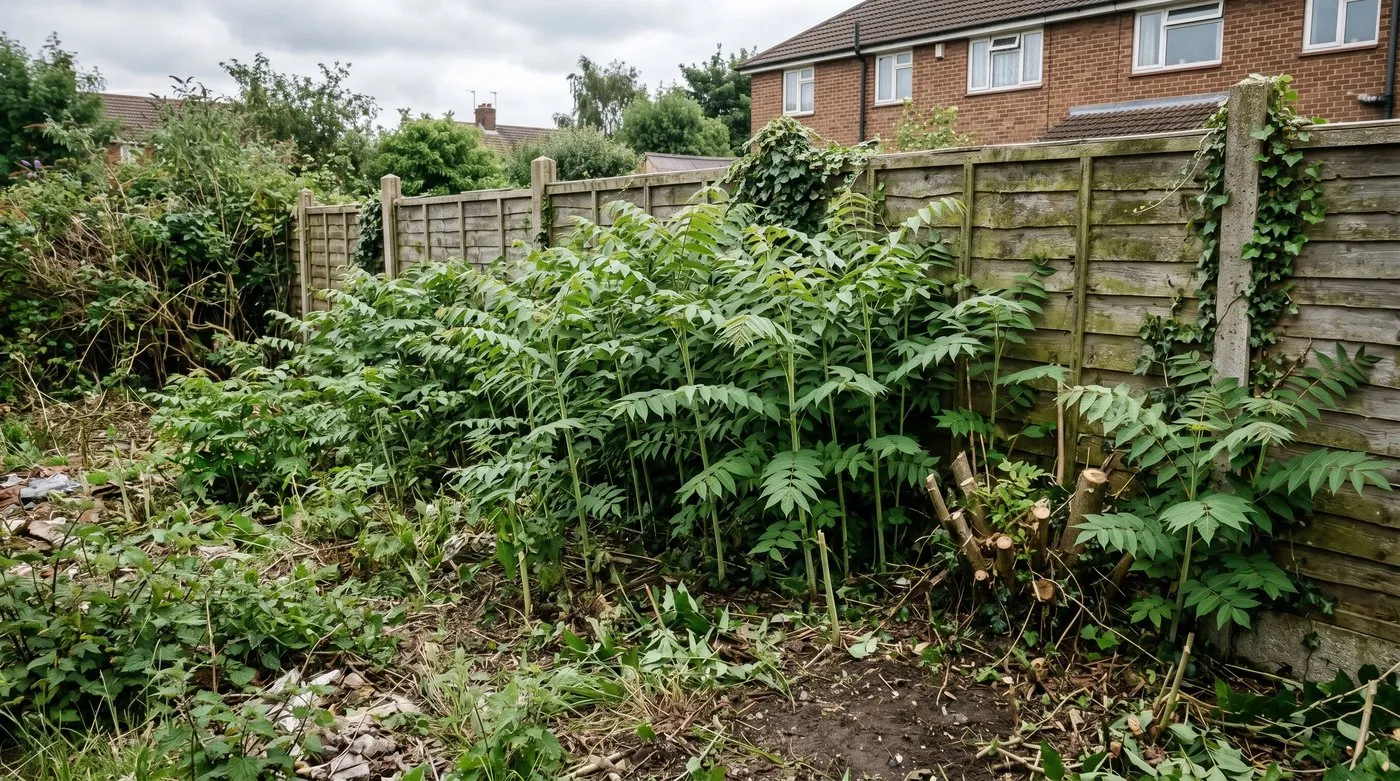 Suckers regrowing along a fence after a single parent tree was felled without herbicide. This is the standard result of cutting alone.
When to treat Tree of Heaven for a proper kill
Timing decides everything. A herbicide is only useful if it reaches the roots, because the roots drive the suckering. The tree moves materials in different directions through the year, and you have to ride that flow.
Between July and September, the tree shifts sugars downward to its roots to store energy for winter. A systemic herbicide applied in this window travels with that downward flow and reaches the root system. This is the kill window.
Tree of Heaven removal methods compared
Cut-stump treatment, the gold standard
For any trunk you can cut, cut-stump treatment is the most reliable kill. The principle is speed. Cut the stem low, ideally below 10cm, and apply a triclopyr-based brushwood herbicide to the freshly cut surface within 60 seconds, before the cut seals over. Use a strong-solution gel or a brush-applied concentrate, painting the outer ring of living tissue (the cambium) where the herbicide is taken up, not just the dead centre.
The reason the 60-second rule matters: Ailanthus seals a cut quickly. Miss the window and the herbicide sits on dead wood while the living roots carry on regardless.
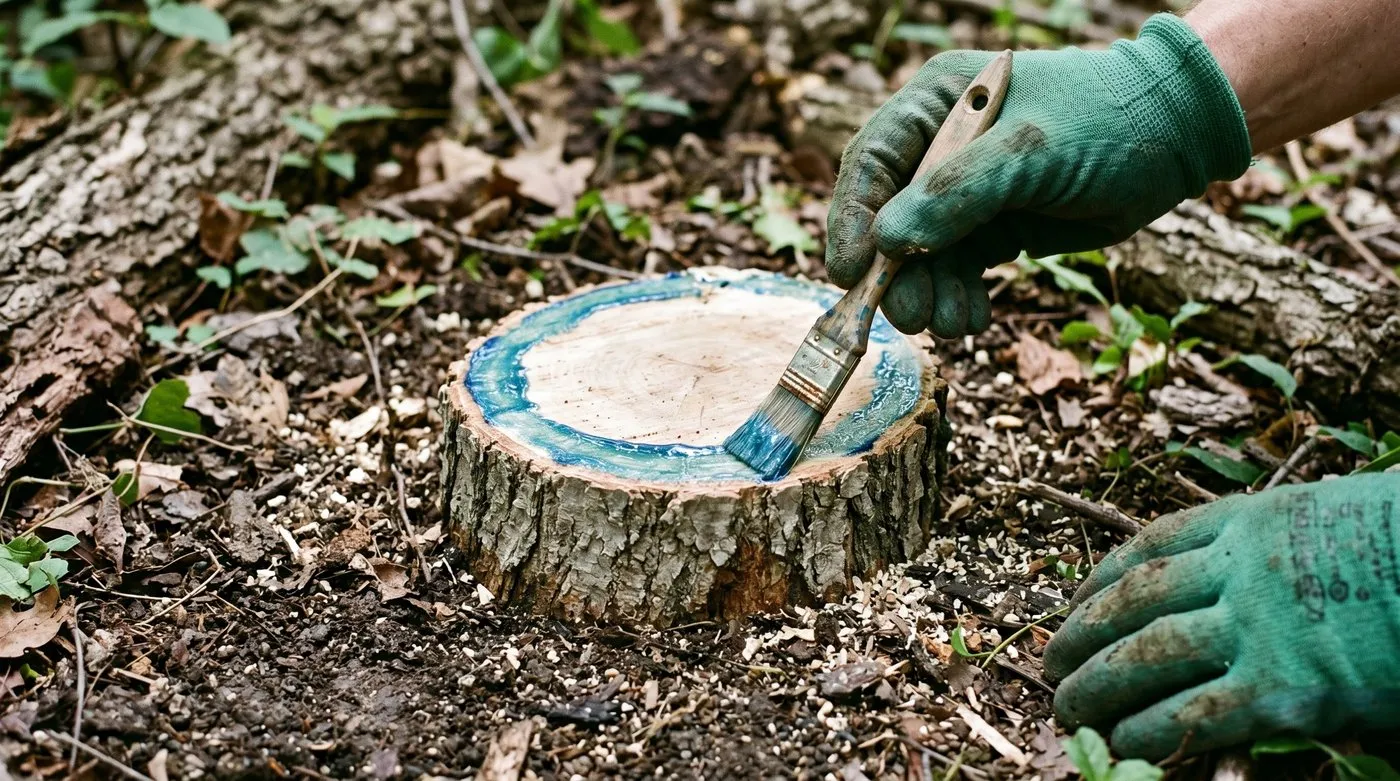 Cut-stump treatment: triclopyr painted onto the living outer ring of a fresh-cut stump within 60 seconds, before the cut seals.
Basal-bark treatment when you cannot cut
If felling is awkward, basal-bark treatment kills standing stems up to about 15cm thick. Mix triclopyr with a penetrating oil and paint a 30cm band around the entire base of the trunk. The oil carries the herbicide through the bark to the cambium. It is slower than cut-stump, often taking two seasons, but it avoids the cutting that triggers suckering and is useful where a falling trunk would cause damage.
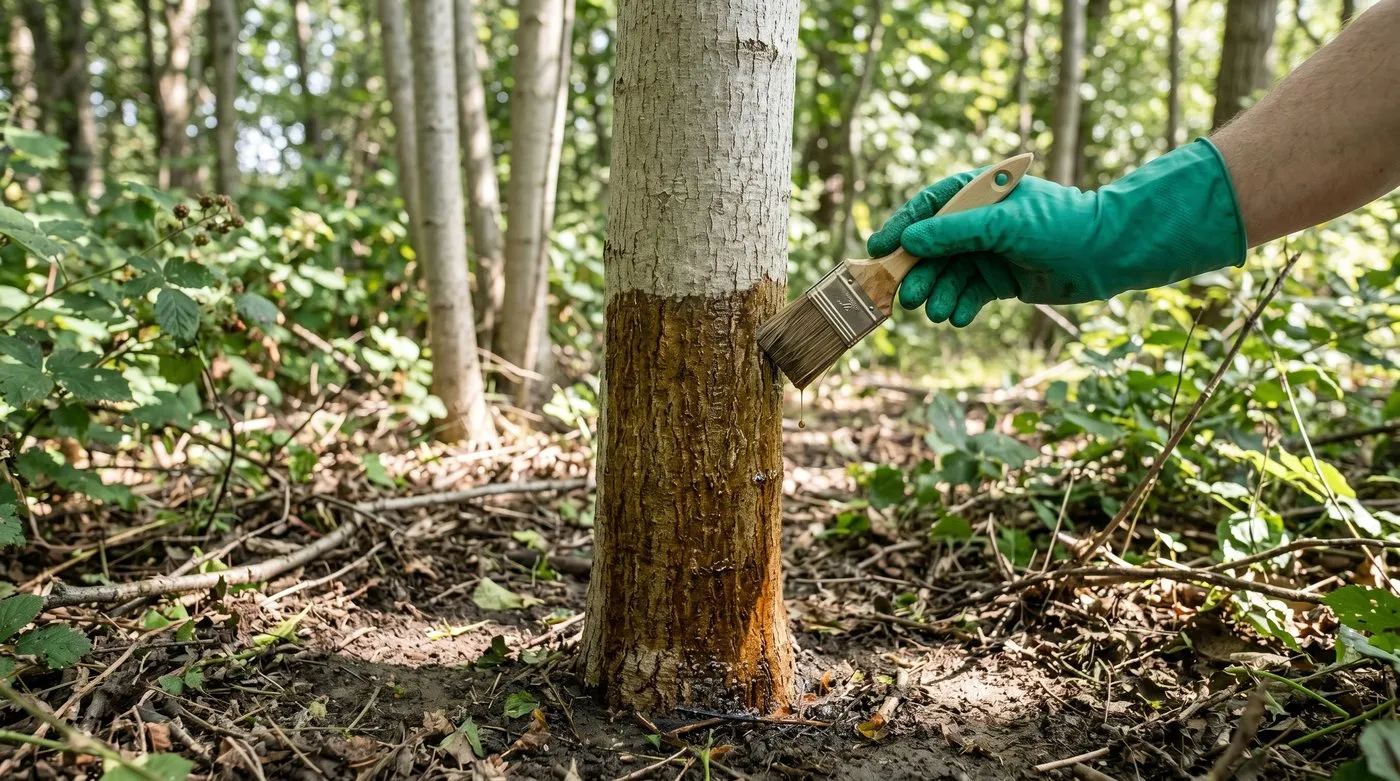 Basal-bark treatment: a 30cm band of triclopyr mixed with penetrating oil, painted right around the base of a standing stem so the herbicide carries through the bark to the cambium.
Foliar treatment for suckers and seedlings
For the inevitable suckers and any regrowth under 2m, foliar herbicide is the mop-up tool. Spray actively growing leaves with glyphosate or triclopyr between July and September. Expect to repeat for two to three seasons until the root reserves are exhausted. Never spray on a windy day near desirable plants, and remember the ailanthone-poisoned soil may be slow to replant. If you would rather avoid synthetic herbicide, our guide to organic weedkillers covers the alternatives, but be realistic: none of them deliver a root kill on an established Ailanthus.
The root cause most people miss
Most failed removals trace back to one misunderstanding: treating Tree of Heaven as a trunk problem when it is a root problem. People focus on the visible tree, cut it, and feel they have acted. But the tree’s entire survival strategy lives underground in a clonal root network primed to resprout.
The permanent fix is to kill the roots, not the shoots. That means accepting two things. First, that you must use a systemic herbicide at the right time of year, not just a saw. Second, that one treatment rarely finishes the job. A mature clonal stand needs an initial cut-stump kill followed by two to three seasons of foliar mop-up on the suckers that survive. Plan for a campaign, not a weekend.
The prevention side is just as important. Every female tree left nearby reseeds the area. If a neighbour has one, your seedlings will keep arriving on the wind. Pull those seedlings the moment you see them, before the taproot forms, and you stop the next generation establishing.
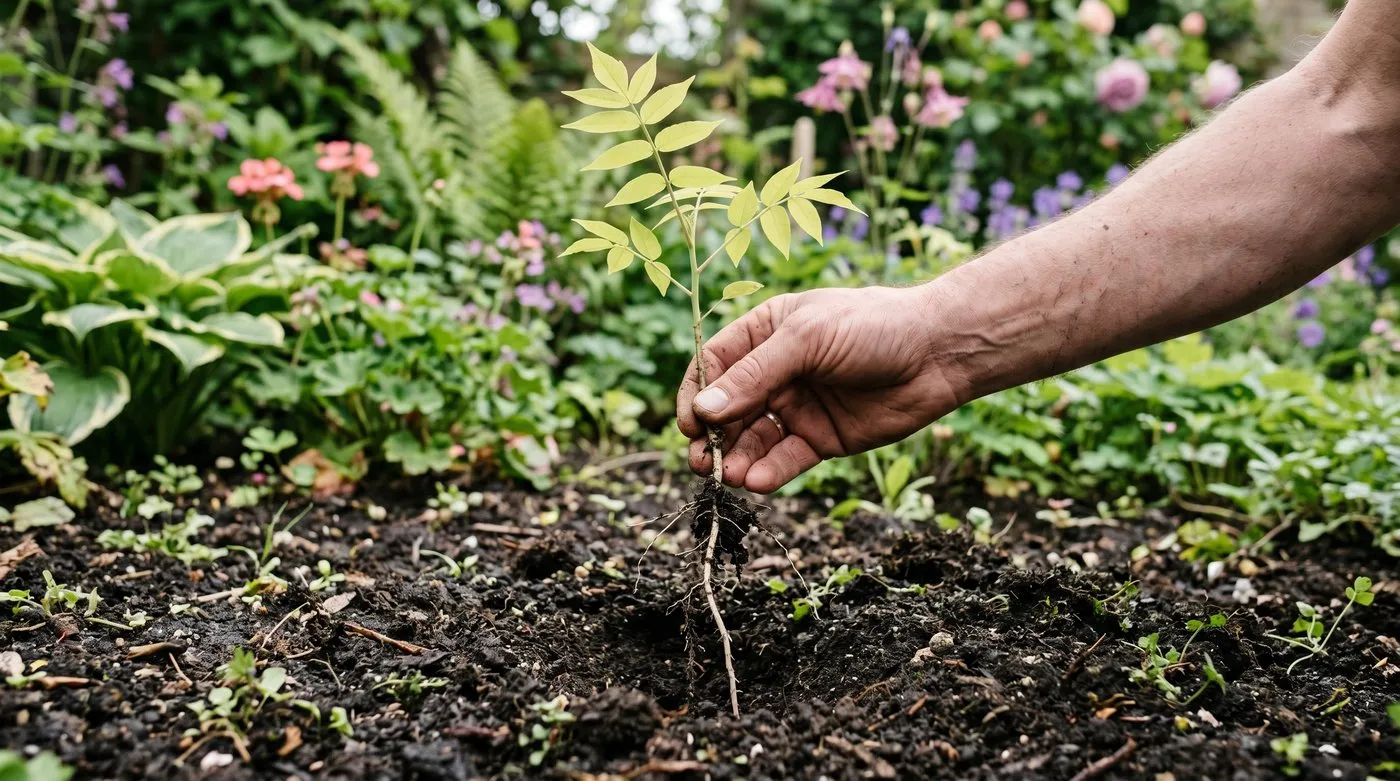 Seedlings pulled before the four-leaf stage do not return. Wait past six months and they snap, regrowing from the taproot.
Common mistakes when removing Tree of Heaven
Avoiding these five errors saves years of fighting the same colony.
Cutting it down and walking away
This is the big one. Felling without herbicide is the single fastest way to multiply Tree of Heaven. The root system answers a cut with a thicket. If you are not going to treat the cut surface the same minute, do not cut at all.
Treating in spring
Herbicide applied while sap is rising never reaches the roots. Wait for the July to September window. A spring treatment wastes chemical and can stimulate the exact growth you are trying to stop.
Digging out an established tree
Every root fragment over 1cm is a new tree. Digging spreads it. Reserve the spade for seedlings only, and even then get the whole taproot.
Composting or fly-tipping the material
Stems and root pieces can root or resprout, and as a listed invasive species the material must not be allowed to spread. Do not home-compost it. Let cut material dry out completely on a hard surface, or dispose of it through a licensed route. Treat root-bearing material as controlled waste.
Ignoring the neighbour’s tree
You can clear your side perfectly and still get reseeded every autumn from a tree two gardens away. Talk to neighbours. A coordinated treatment across a boundary is far more effective than fighting the seed rain alone. The same logic applies to other shared invasives like Japanese knotweed and Himalayan balsam.
The law on Tree of Heaven in Great Britain
Ailanthus altissima was added to the list of invasive alien species of concern in 2019, a listing retained in Great Britain after EU exit. In practice this means you must not plant it, sell it, or allow it to spread into the wild. You are not obliged to remove a tree already growing on your land, but you are responsible for stopping it spreading to neighbouring land or the wider countryside.
Warning: Wear gloves, long sleeves, and eye protection when handling Tree of Heaven. The sap irritates skin and eyes, and the pollen and crushed foliage trigger headaches and nausea in some people.
A realistic budget for clearing Tree of Heaven
For a single garden tree under 15cm in diameter, the DIY cost is modest. A litre of triclopyr brushwood killer runs 12 to 15 pounds and treats many stumps. Add a brush, gloves, goggles, and a pruning saw and you are under 30 pounds for the lot. The real cost is time: budget for the initial treatment plus two to three seasons of mop-up.
For a mature multi-stemmed tree, or anything near a building, professional removal by a contractor experienced with invasives typically runs 500 to 2,000 pounds or more, depending on size, access, and disposal. The hidden cost people forget is follow-up. A one-off fell-and-grind without herbicide can cost more in the long run than a slower chemical kill, because the suckers come anyway.
Frequently asked questions
Is Tree of Heaven illegal in the UK?
It is a listed invasive species in Great Britain. You must not plant it or allow it to spread into the wild. Ailanthus altissima was added to the list of invasive alien species of concern in 2019, retained in GB law. You can remove one already on your land, but you must dispose of the material responsibly and stop it spreading to neighbours.
Why does Tree of Heaven keep coming back after I cut it down?
Cutting triggers suckering. The tree stores energy in a wide root system and resprouts from it. Removing the top growth releases that root system from hormonal control, so it pushes up dozens of new shoots, often metres from the stump. The only way to stop it is to kill the roots with a systemic herbicide, not to keep cutting.
What is the best time of year to kill Tree of Heaven?
Late summer to early autumn, July to September. During this window the tree moves sugars down to its roots for winter. A systemic herbicide applied then travels with that flow and reaches the root system. Spring applications fail because sap is rising, so the chemical never gets to the roots that drive the suckering.
How do I tell Tree of Heaven apart from sumac or ash?
Look for one to four blunt teeth near the base of each leaflet, each with a tiny gland underneath. Sumac has teeth all along the leaflet edge. Ash has opposite leaves and black buds. Crushed Ailanthus leaves smell strongly of rancid peanuts or cat urine, which is why it is nicknamed the tree of hell.
Can I dig out Tree of Heaven instead of using chemicals?
Only seedlings. Hand-pull them before the four-leaf stage and they will not return. Digging an established tree almost always fails, because any root fragment larger than about 1cm can sprout a new plant. You usually end up spreading it. For anything with a woody stem, cut-stump or basal-bark herbicide is far more reliable.
Is Tree of Heaven poisonous to people or pets?
The sap can irritate skin and eyes, so wear gloves and long sleeves when cutting it. The pollen and crushed foliage cause headaches and nausea in some people. It is not considered seriously toxic to dogs or cats, but the strong-smelling foliage and sap are best kept away from grazing animals and children.
Will Tree of Heaven damage my house or drains?
It can. The vigorous, far-reaching roots exploit cracks in foundations, walls, drains, and pavements, and the species is notorious for growing out of buildings. Trees within a few metres of a structure should be treated and removed promptly. Lenders and surveyors increasingly flag it, much as they do Japanese knotweed.
Now you can identify Tree of Heaven and kill it without multiplying it, the next step is knowing which other thugs to watch for. Read our guide to banned and invasive plants to avoid in UK gardens so the next aggressive spreader never gets a foothold.
Our team produces practical UK gardening guidance from source research, contributor records and established horticultural practice. Editorial standards are overseen by Matt W.