Key takeaways
- AllotMe and Lend & Tend are the two main UK platforms; AllotMe is paid for growers and free for owners, Lend & Tend is free and produce-share based
- A free arrangement (produce share, no cash) sits outside HMRC income rules; cash rent over 1,000 pounds a year may count as miscellaneous income
- Always use a written one-page agreement covering access hours, plot area, water, harvest split and notice period to avoid an accidental tenancy
- Trial any match for 4 weeks before committing to a full growing season; about 1 in 3 matches drop off between weeks 6 and 10
- Confirm your home insurance covers visitor injury on the garden and ask the sharer to hold personal liability cover
- Allotment waiting lists run 5-10 years across most UK councils, so a back-garden plot of 9x6m is a genuine alternative for a flat-dwelling grower
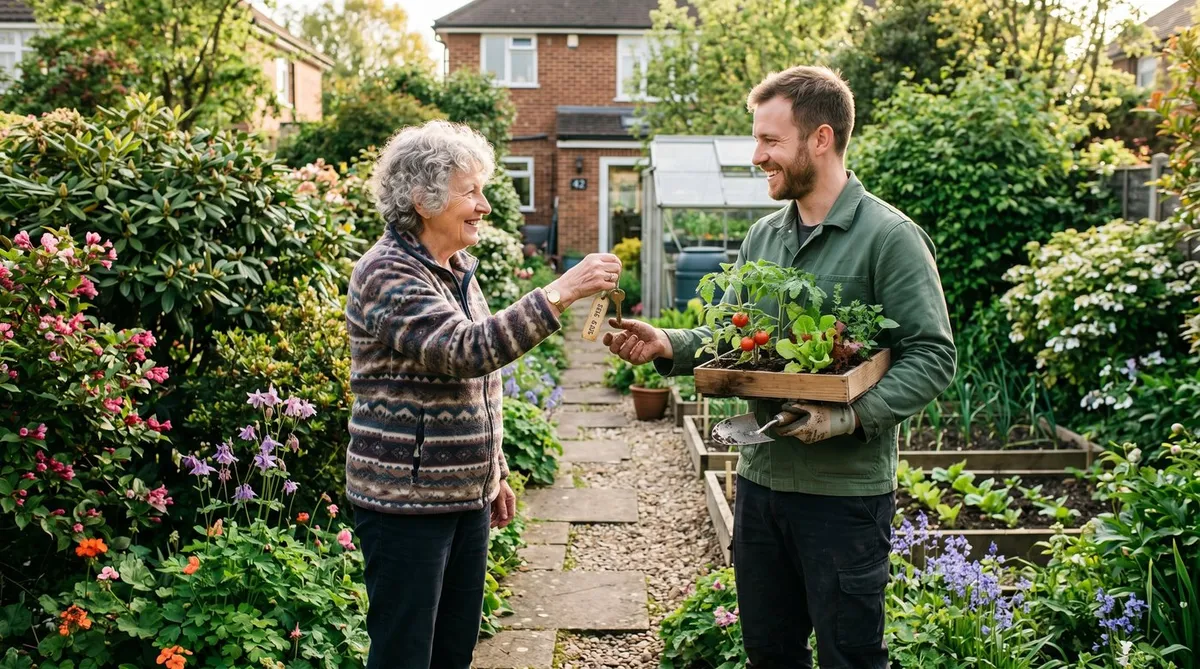
A back garden in 2026 is worth more than it was ten years ago. Allotment waiting lists run 5-10 years across most UK councils, food-grower flats in cities have no growing space at all, and the climate-conscious cohort who want to grow their own keep arriving in bigger numbers. At the same time roughly a third of UK back gardens sit underused: owned by older people who can no longer dig, by young families with no time, or by professionals who simply lost interest. Garden sharing matches one side to the other.
Why garden sharing is growing in the UK
Three forces meet in the middle. Council allotment waits sit at 8 years in Bristol, 10 years in central London, 6 years in Sheffield and 4-7 years across most large UK cities, according to the National Allotment Society’s 2024 figures. A young grower on the list at 25 is roughly 33 before a plot opens. The other side of the trade is the under-used back garden: industry surveys put it at 30-40% of UK private gardens spending most of the year unused for growing.
The third force is climate. The cohort wanting to grow vegetables, run a small orchard or keep a polytunnel busy is growing fast, especially in 2-bed flats with no outside space at all. The match between the two groups was largely informal until 2021 when AllotMe launched as a postcode-based platform.
For owners the upside is a tidy plot, free produce, occasional company and (if you choose) a small rent. The downside is a stranger in your garden two or three times a week and the work of writing an agreement and vetting an applicant.
The three main UK routes compared
| Route | Cost to owner | Cost to grower | How matches work | Best for |
|---|---|---|---|---|
| AllotMe | Free to list | Annual platform fee (around 25 pounds in 2024) | Postcode search, owner approves messages, terms agreed direct | Owners wanting a structured platform and a reasonable size pool |
| Lend & Tend | Free | Free | Volunteer-style, owner offers the plot in exchange for help, often a produce share | Older owners or those unable to garden who want help, not rent |
| Private agreement (local Facebook group, parish notice, allotment society) | Free | Free or by direct arrangement | Word of mouth, social media post, parish newsletter | Rural and village settings where neighbours already know each other |
AllotMe is the largest UK platform. It launched in 2021, listed more than 8,000 matches by the end of 2024 and works on a postcode-based map. The owner sets the listing for free; the grower pays an annual fee to message owners and access the full map. The contract sits between the owner and the grower, not the platform. Full details at allotme.co.uk.
Lend & Tend is free at both ends and built around an exchange rather than rent. The model fits owners who can no longer garden themselves and want a helper, with the grower taking most of the produce as their reward. The site is smaller but the matches that stick tend to last for years.
Private agreements run through local Facebook gardening groups, parish noticeboards, allotment society contacts and the National Allotment Society’s local affiliates (nsalg.org.uk). The pool is smaller but the social trust is higher because both parties usually have a mutual contact.
For a wider view of the alternatives to a private back-garden match, the community gardening UK guide covers shared plots, school gardens and church-land projects worth joining if a one-to-one match feels too involved.
Step-by-step setup for a garden owner
Decide what you offer
Be specific. The options range from full plot use (grower runs the whole vegetable garden) to a single raised bed with weekend visits only. The narrower the offer, the easier the match. A common middle ground is one raised bed of around 2x1m plus access to one greenhouse or polytunnel shelf, with twice-weekly visits.
Also decide who keeps what. The simplest split is: grower keeps everything they plant and harvest. The owner keeps the rest of the garden as their own. A produce-share is fairer if the owner pays for compost or water but adds a layer of bookkeeping nobody enjoys.
Photograph and measure the plot
A measuring tape, a phone camera and twenty minutes. Note plot length and width in metres, sun aspect (south-facing, east-facing etc.), soil type if you know it, water tap distance, shed or tool storage availability and parking. A clear listing gets responses; a vague one does not. The allotment for beginners UK guide has a soil-test method worth running before the photos go up.
Write a clear listing
Cover six points in plain English:
- Plot size and what is included (beds, greenhouse, polytunnel, water, tools)
- Sun aspect and rough soil type
- Access hours and method (front gate, side gate, key, code)
- Parking and travel access
- House situation: dogs, children, parties, garden parties
- What you keep and what the grower keeps
The same listing template works on AllotMe, Lend & Tend or a Facebook group post.
Vet applicants
Two-stage vetting works well. Stage one is a 20-30 minute meeting at the garden so both sides see what they are signing up to. Stage two is a short reference exchange: a previous allotment plot, a community garden, even a current neighbour. Anyone reluctant to give one reference is not the right match.
If the platform charges the grower a fee (AllotMe), assume the grower is serious because they have paid to access you. If the match is free at both ends (Lend & Tend, Facebook), expect a higher drop-off rate and trial more carefully.
Run a 4-week trial
Sign a one-page agreement
After the trial, agree the proper terms in writing. The detail in the next section covers what to put in.
How it works for the grower
The grower side is simpler but worth understanding because a good owner-side listing answers the grower’s questions in advance.
A grower on AllotMe pays the annual fee, filters by postcode, reads listings, sends introduction messages and arranges a viewing. After a viewing they typically agree a trial, then a written agreement, then start the growing season. Lead time from registration to first sowing is 2-8 weeks in busy spring months.
What growers look for: water within 10m of the bed, a south-facing or west-facing aspect for at least 4 hours a day, somewhere to leave tools (often a shared shed with a lock), and a written agreement so they are not turfed out mid-season.
A grower also wants honest expectations. The most common complaint from growers about a match that failed is “the owner kept changing the rules”. A written agreement on day one prevents that.
The money side: tax, insurance and Rent a Room
Three rules cover most UK garden-share arrangements.
Free arrangement (produce share, no cash)
No income tax due. No declaration required. The exchange of labour for produce is not income under HMRC rules. Most Lend & Tend matches and many AllotMe matches sit here.
Cash rent under 1,000 pounds a year
Covered by the HMRC trading allowance. No declaration required unless you already file a self-assessment return for other reasons. Many AllotMe matches set a rent of 50-200 pounds a year for a back-garden plot, comfortably inside the allowance.
Cash rent above 1,000 pounds a year
Counts as miscellaneous income and goes on a self-assessment return. The Rent a Room scheme (which gives a 7,500 pound tax-free allowance) does not apply: it is for furnished rooms in a main residence, not garden plots. Current guidance is on the gov.uk Tax-free allowances on property and trading income page. Check the latest figures because the allowance has been static at 1,000 pounds since 2017.
Insurance
Two layers. Confirm your home insurance covers accidental injury to a visitor in the garden (most standard UK policies do, but read the wording). Ask the grower to hold personal liability cover, often included in a contents policy or available as a standalone add-on for around 20 pounds a year. Put both in writing in the agreement.
Tenancy concerns
The biggest legal risk is accidentally creating a tenancy. A tenancy gives the grower legal occupation rights and is governed under the Allotments Act 1908 for allotment land or under tenancy law more generally. Three drafting rules keep an agreement out of tenancy territory:
- No exclusive possession: the owner can also access the plot
- Time-limited: review every 12 months at most
- Licence wording, not lease: the agreement grants a “personal licence to use the plot”, not “exclusive occupation”
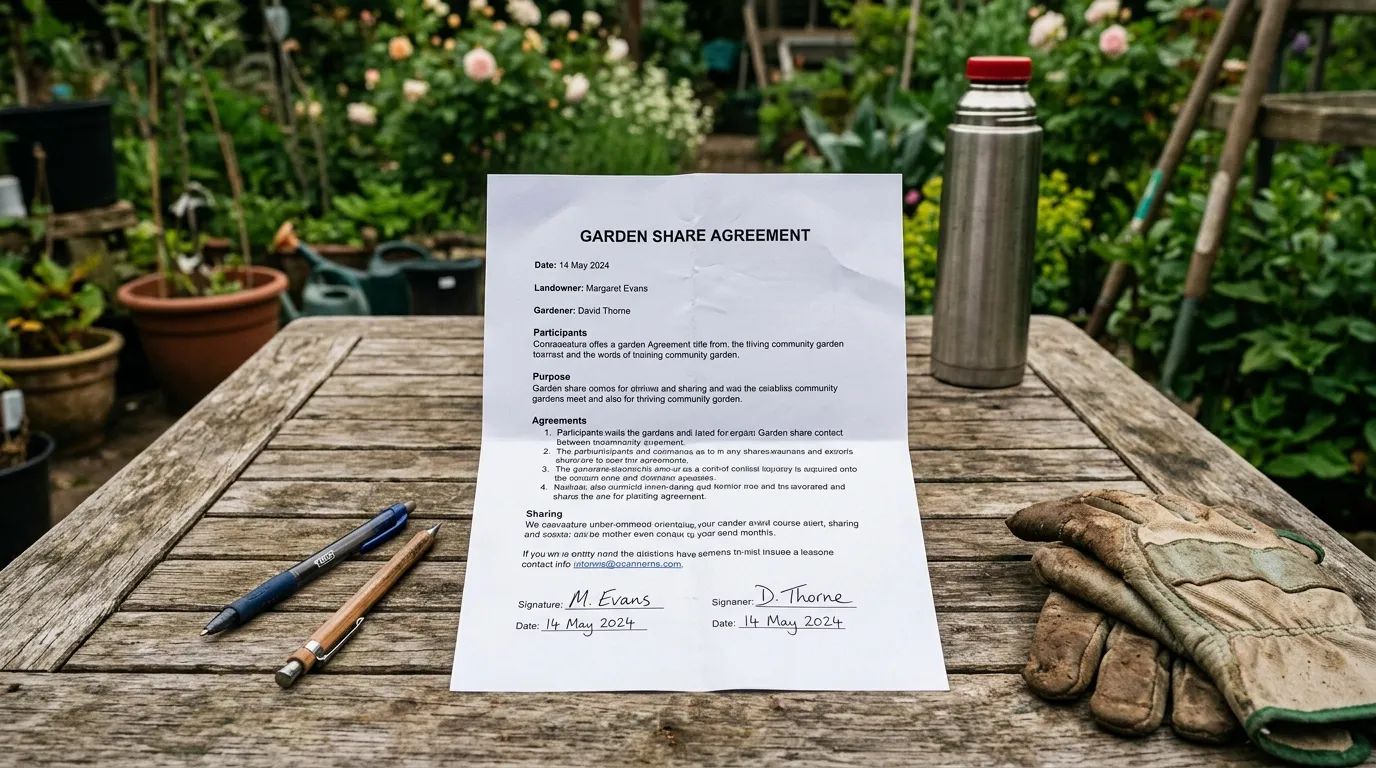
A one-page agreement using licence wording is enough for the value involved.
The one-page agreement: what to put in writing
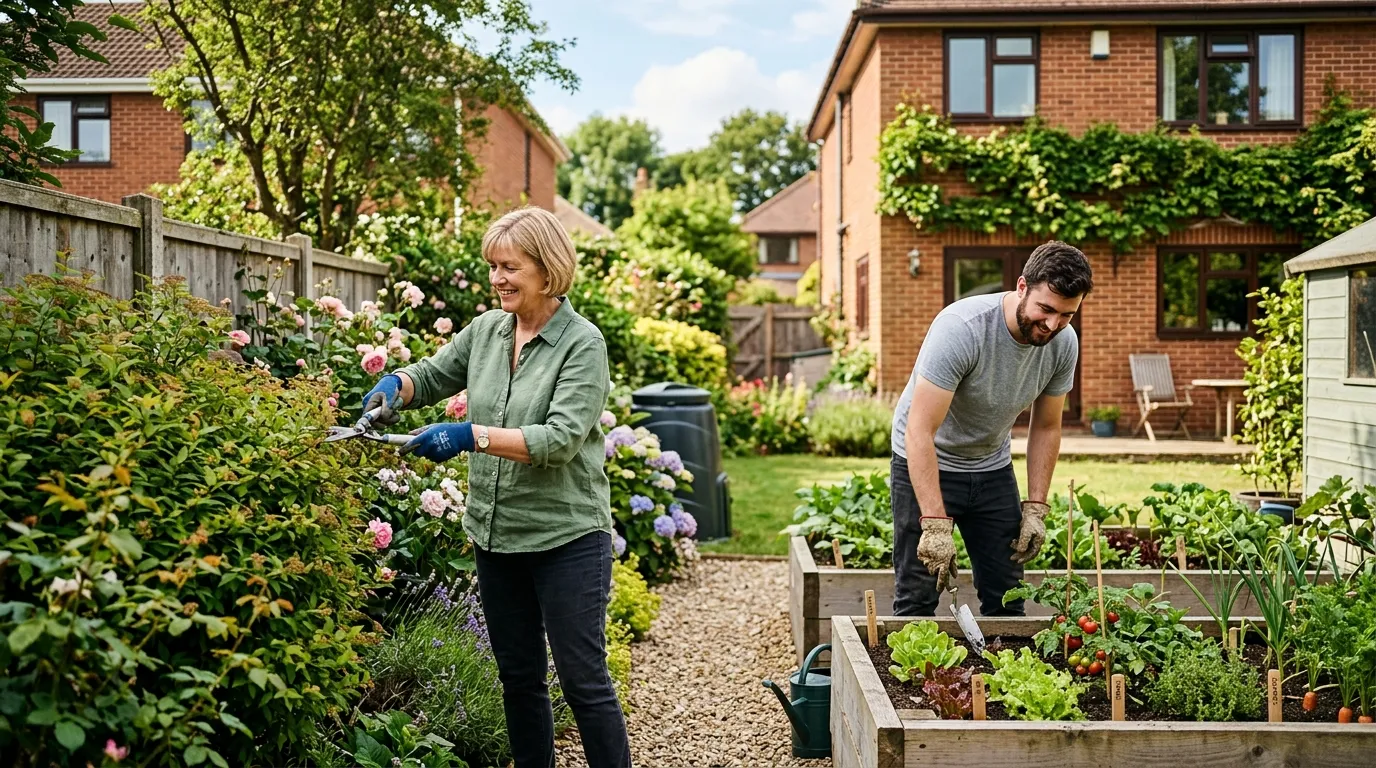
A working garden-share agreement covers ten points. Anything longer than a side of A4 becomes off-putting. Keep it short, sign it, put a copy on the kitchen pinboard.
The 10-point checklist
- Parties (owner name, grower name, addresses)
- Plot description (size in metres, beds included, structures included)
- Term (12 months, with a 4-week trial at the start)
- Access (days, hours, gate/key method)
- Notice period (30 days written notice on either side)
- Water and electricity (who pays, fair-use rule)
- Tools and consumables (who owns what, what the grower brings, what the owner provides)
- Harvest split (the percentage or “grower keeps everything they plant” rule)
- Plant choice limits (what the owner does not want planted, e.g. mint, raspberries, large fruit trees)
- Insurance and liability (both sides hold cover, basic visitor-injury wording)
A template covering all ten points is downloadable from AllotMe’s owner resources page. The National Allotment Society also publishes a sample agreement aimed at allotment-style arrangements that adapts well to a back-garden share.
For a grower already part of a council allotment scheme, the nature-friendly allotment guide is useful reading on plant choice rules and biodiversity-led growing that suits a small shared plot.
Practical examples help more than abstract advice.
Owner: retired couple, 9x6m back garden, three raised beds, water tap on house wall, side-gate access. Listed in March 2023.
First match: a flat-dweller 1.2 miles away. Started in late March, lasted through April and May (visits twice a week), tailed off in June and dropped to one visit in July. Match formally ended in early August at the owner’s request because the beds were unmaintained and the owner ended up doing the work.
Second match: a young couple already 4 years into a council waiting list, signed in August 2023. We wrote a one-page agreement covering Saturday and Wednesday evening visits, a 60/40 harvest split in the couple’s favour, and a 30-day notice clause. Match still running into the 2026 season.
Match 2: Lewes village garden, Lend & Tend match, 2024
Owner: 78-year-old retired teacher, mobility issues after hip surgery, large mature garden with productive vegetable beds. Posted on Lend & Tend in February 2024.
Match: a 32-year-old gardener from a neighbouring village without their own outside space. The arrangement: helper visits twice a week, does all the digging and harvest work, keeps the produce, and helps the owner with general garden tidiness once a month. No money changes hands.
Match still running 18 months on. The owner has the garden she could not maintain herself, and the helper has a productive plot 4 miles from home. Both sides describe it as the easiest thing they have set up.
What made each match work
Things that go wrong, and how to fix them
Lapsed commitment in weeks 6-10. Mid-summer is the test. The grower’s holiday plans, the heat and the volume of work all pile up. The fix: set a calendar reminder for week 6 to check in. A simple “How is the plot going?” message catches drift early. About 1 in 3 matches stall here without an active check-in.
Harvest disputes when both sides assumed 50/50. The fix: write the split down on day one. The cleanest split is “grower keeps everything they plant”. The next cleanest is a 60/40 in the grower’s favour for the time they put in.
Plant choice clashes. The grower puts in raspberries (perennial, runs everywhere, takes years to remove); the owner wanted annuals only. The fix: a “permitted plants” or “not permitted plants” line in the agreement. Mint, raspberries, comfrey, Jerusalem artichokes and large fruit trees are the usual flashpoints.
Neighbour complaints about activity. A side gate banging at 7am on a Sunday is the most common one. The fix: spell out the access hours (typically 8am-8pm in summer, 9am-5pm in winter).
Awkward end-of-season conversations. The fix: the 30-day notice clause. Either side can end the arrangement with written notice. No drama, no guilt.
For a grower who has dealt with similar tension on a council plot, the half plots and sharing allotment UK guide has useful framing on how to split a single plot between two growers, which translates well to a back-garden share with two beds.
Alternatives if a share is not right for you
A back-garden share is not the only answer to an under-used plot. Three alternatives work for different situations.
Hire a one-off gardener. A maintenance gardener at 25-35 pounds an hour, two visits a year, keeps the garden presentable without involving anyone long-term. The cost works out lower than the time and admin of a share if all you want is a tidy lawn.
Hand the garden back to lawn. Lift the raised beds, top-dress, sow lawn seed in September, and run a strimmer over it once a month. The garden looks intentional rather than abandoned and you take all the decisions back yourself.
Donate produce to a local scheme. If you can still garden but the harvest exceeds household needs, local food banks, Incredible Edible groups and church kitchens take fresh produce. Many UK towns now have weekly drop points. The community gardening UK guide lists routes worth following.
Take on or inherit an allotment. If the demand is the other way round and you want a plot rather than a sharer, a council allotment may open faster than expected if you accept an overgrown plot or an inherited vacant plot that other applicants have turned down.
For someone setting up a small productive plot from scratch on a shared garden, the allotment planner month by month guide is a good drop-in calendar that suits a 9x6m or smaller plot equally well.
What a fair rent looks like in 2026
For owners who do want a cash arrangement rather than a produce share, pricing is the most common confusion. Too high and the listing sits empty; too low and the grower treats the plot as disposable. Guide figures drawn from AllotMe listings in 2024 and 2025:
| Plot type | Typical UK rent (per year) | What is included |
|---|---|---|
| One raised bed (around 2x1m) | 25-60 pounds | Bed, water access, twice-weekly visits |
| Two to three raised beds | 60-150 pounds | Beds, water, basic tool storage, shared shed |
| Half a back garden (around 30m squared of growing space) | 150-300 pounds | Beds, polytunnel or greenhouse shelf, water, parking |
| Full back garden | 250-500 pounds | Whole growing area, water, electricity for a kettle, shed access |
| Larger rural plot (over 100m squared) | 400-800 pounds | Full garden, possible orchard or paddock edge, parking, water |
A useful test is the council allotment fee in your area. A typical UK council charges 30-90 pounds a year for a 10-rod (around 250m squared) full plot. A grower comparing your back-garden offer to the council option will not pay 300 pounds for a 9m squared plot unless the location is so much closer to home that the travel saving makes the maths work.
Two rules keep pricing honest. The grower should feel the rent is fair for the size, not a bargain that breeds resentment when something breaks. The owner should feel the rent is fair for the disruption, not a token that makes the inconvenience feel pointless. Most matches that fail on money were either too cheap or too expensive on day one.
How to handle water, tools and electricity
The fiddly operational detail is what makes or breaks a long-running match. Three sub-rules cover most of it.
Water. Either the grower pays a fixed contribution (typical: 20-40 pounds for the May-September season) or the owner provides water free and the grower agrees a fair-use rule (no sprinklers, no filling paddling pools). A water butt by the shed reduces metered water use by 40-60% over a season and is worth installing before the first match starts.
Tools. The cleanest rule is: the owner provides what is already there, the grower brings anything else they want. List the owner-provided tools in the agreement (typical: spade, fork, rake, hoe, watering can, secateurs). The grower brings their own gloves, knee pad, hand fork, harvest knife and any specialist kit. Shared shed access works if the lock has two keys.
Electricity. Rarely an issue for a small grower but worth covering. A kettle, a phone charger and an occasional radio cost pennies. A heated propagator or fan heater in the greenhouse costs real money. The agreement should say either “personal use is free, propagators and heaters are the grower’s responsibility” or set a flat-rate contribution (typical: 10-20 pounds for the season).
A note on timing and the UK growing year
A garden-share works best if both sides start the agreement in February or March. That gives a 4-week trial in March-April when the workload is light (clearing, planning, sowing under cover), and a full first season from May. Starting in mid-July is the worst timing: the work is at its heaviest, the heat is brutal and a new arrival drops off fast.
If you missed the spring window, start the listing in early August. Trial through September. Sign for the full term in October so both sides have all winter to plan and the first sowing in March belongs to a properly bedded-in match.
The Cheshire match that has run since August 2023 started exactly this way and has worked through three growing seasons because the planning conversations all happened before the busy spring.
Special situations: shared garden, rented home, restrictive lease
Three less-common situations need a slightly different approach.
Owner-occupier in a leasehold flat with private garden. Check the lease before listing. Some long leases restrict use of the garden to “private domestic enjoyment” and a grower visiting twice a week may technically breach the clause. A short conversation with the freeholder usually clears it; a written agreement keeps both sides covered. The freeholder rarely objects when there is no rent involved.
Shared garden between flats. A back garden divided between two or three flat owners is the trickiest setup because all parties need to agree. The cleanest answer is to share the listing across all owners and treat the grower as a shared visitor with a shared agreement. The harvest split has to factor in three or four parties, which usually means a produce-share that gets distributed across the flats rather than a cash rent.
In all three situations the test is the same: would the freeholder, landlord or other flat owner be happy to find the grower in the garden? If yes, get the agreement in writing. If no, choose a different route.
Related guides
For the council allotment route as the obvious alternative, see how to get an allotment UK and the allotment for beginners UK starter guide. For a productive shared plot, the allotment planner month by month calendar fits a back-garden share as well as a council plot. For wider community routes, community gardening UK covers shared plots, school gardens and church-land projects.
Our team produces practical UK gardening guidance from source research, contributor records and established horticultural practice. Editorial standards are overseen by Matt W.