Key takeaways
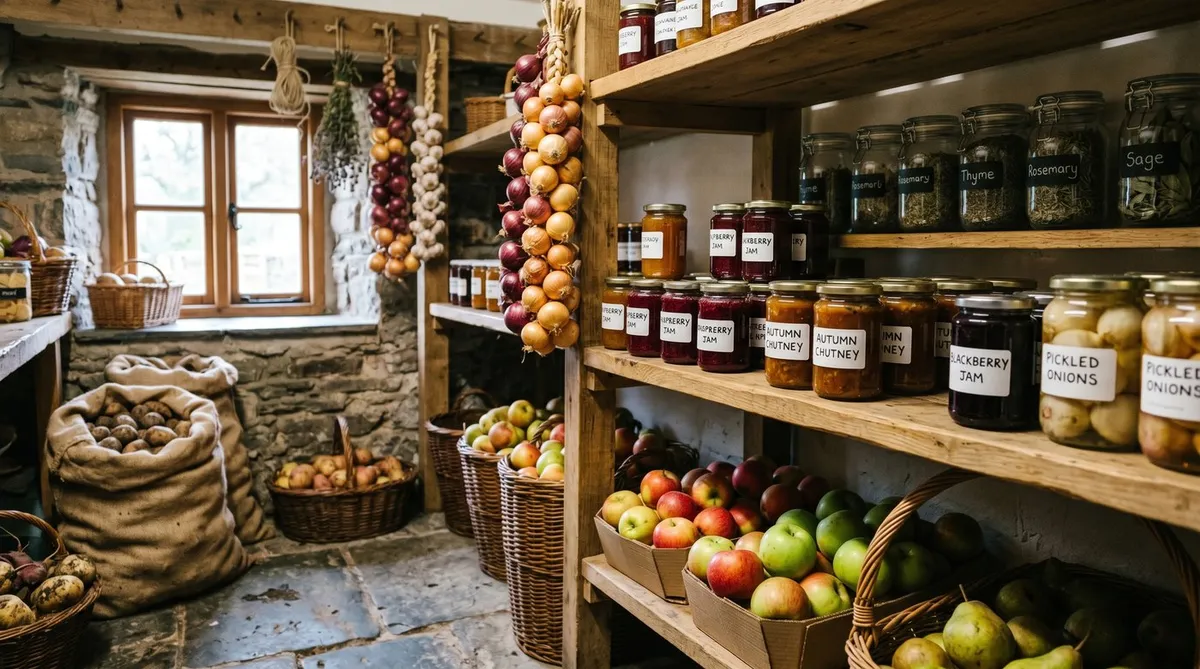
- Match the crop to the store: apples and pears on slatted racks at 1 to 4 degrees, root crops in a sand clamp, onions and garlic in a dry frost-free shed
- Never wash produce before storage. Soil left on the skin is a natural barrier; washing introduces water that triggers rot within a fortnight
- Keep apples and pears away from potatoes, carrots and onions. Apples release ethylene gas that ripens or sprouts every neighbour by four times normal speed
- Cure onions, garlic, shallots, squashes and main-crop potatoes for 7 to 14 days at 20 to 25 degrees before moving them to long-term storage
- Soft fruit, tomatoes, cucumbers and runner beans must be processed within 48 hours. Freezing, jam, bottling, drying or pickling are the four routes
- Inventory the stores in November and again in February. A peak-year 340 kg of preserved and fresh produce only works if you eat it in rotation, oldest first
Every UK kitchen garden produces more than it eats between July and October. The question is whether September’s harvest is still feeding the household in March, or whether half of it ended up in the compost heap by Christmas. The difference is storage. This is the pillar reference for the whole topic: the four storage keys, the right store for each crop, a 30-crop reference table, and the practical detail on clamps, fruit rooms, freezing, drying, bottling and jam.
The four keys: temperature, humidity, ventilation, ethylene
Every successful produce store balances the same four variables. Get one wrong and the harvest spoils inside a fortnight.
Temperature. Most stored produce wants 0 to 5 degrees. Apples, pears and roots sit at the cold end. Potatoes, squashes and onions slightly warmer. A frost-free brick garage, stone larder or cool spare room covers the range. A heated kitchen at 18 degrees is the opposite of a store: too warm, too dry, too short a shelf life.
Humidity. Roots and apples want 85 to 95 per cent relative humidity so the skin does not desiccate. Onions, garlic, shallots, squashes and beans want the opposite: 60 to 70 per cent so they cure off and seal. Mixing the two in one room makes both spoil. A dustbin of damp sand in the corner of a dry room is a fast humidity fix for one or two boxes of roots.
Ventilation. Gentle air movement carries away the ethylene and the carbon dioxide produced by ripening fruit, and stops surface condensation. Slatted shelves, hessian sacks, mesh bags and wire racks all let air move. Sealed plastic boxes with no holes are a trap: every crop inside sweats and rots.
Ethylene management. Apples and pears release ethylene gas as they ripen. So do tomatoes (off the vine), bananas and ripening soft fruit. Ethylene ripens or sprouts every neighbouring crop at three to five times its normal pace. Keep ethylene producers in their own sealed space, well away from the ethylene-sensitive crops: potatoes, carrots, beetroot, parsnips, onions, garlic, leafy greens.
Get the four right and almost any UK crop will keep for months. Get one wrong and even a perfect harvest spoils.
Storage method decision table by crop type
Before getting into the crop-by-crop detail, here is the overview of which method fits which produce. The same crop may appear in more than one column because the right answer often depends on quantity.
| Crop type | Best store | Second choice | Avoid |
|---|---|---|---|
| Apples and pears | Slatted rack in cold fruit room, 1 to 4 degrees | Cardboard tray, single layer, paper between | Fridge, plastic bags, shed with onions |
| Carrots, beetroot, parsnips, swede | Sand clamp, 0 to 5 degrees | Boxed in damp sand in a garage | Fridge bag (sweats), shed with apples |
| Potatoes (main crop) | Hessian sack in dark frost-free shed, 4 to 6 degrees | Paper sack in stone larder | Light (greens up), shed with apples |
| Onions, garlic, shallots | Cured then plaited or netted, 0 to 5 degrees, dry | Slatted tray, single layer, in dry garage | Fridge, plastic bag, damp shed |
| Squashes and marrows | Cured 10 days, then dry shelf at 10 to 15 degrees | Net hammock under a porch roof | Cold damp store, freezer (whole) |
| Climbing and runner beans (dry) | Pods left on plant to maturity, then podded into a jar | Spread on a tray indoors for a week, jar | Picked young (will not dry) |
| Cabbages, leeks, kale | Stand in soil with roots, or pack in damp sand | Outer leaves on, stored upright in shed | Trimmed back, in a bag |
| Tomatoes, cucumbers, courgettes | Must process within 48 hours: freeze, sauce, can | Brief fridge storage 5 to 7 days | Long-term ambient storage |
| Soft fruit (raspberries, currants) | Must process within 48 hours: freeze, jam, syrup | Brief fridge storage 2 to 3 days | Room-temperature for over a day |
| Stone fruit (plums, damsons) | Eat fresh, freeze in chunks, jam, or bottle | Cool larder 1 week | Fruit room with apples |
| Herbs (soft and woody) | Dry whole, freeze in cubes, salt-pack | Air dry hung in bunches | Storing wet, sealed in bag |
This table sits at the top of the article because every other section flows from it. The rest of this guide is the detail behind each row.
Apples and pears: the fruit room
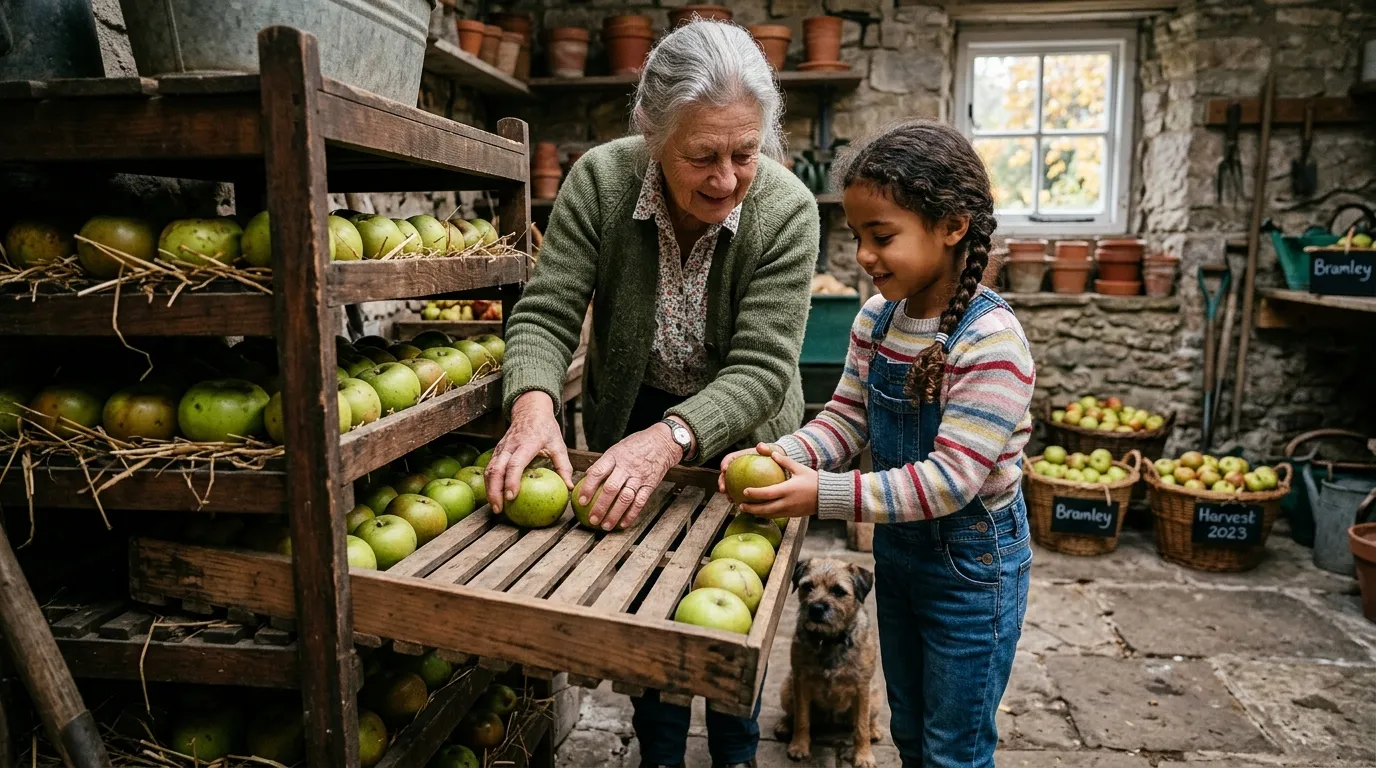
Apples and pears are the flagship UK long-store crop. A well-set fruit room keeps Bramleys, Cox, Russets and Conference pears in eating condition from October to March or April.
Temperature 1 to 4 degrees. A brick outhouse, north-facing porch or stone larder hits this in most UK winters. A frost-free garage runs warmer at 6 to 10 degrees, which cuts storage life to 8 to 12 weeks instead of 5 to 6 months.
Humidity 85 to 95 per cent. A stone-floored room holds this naturally. In a drier garage stand a tray of water under the rack or hang a damp hessian sack to lift the humidity.
Ventilation. Slatted wooden racks, single layer, fruits not touching. Or cardboard apple trays from the local fruit wholesaler, single layer, with newspaper between layers if stacking. Never bag apples or store them in sealed crates.
Variety matters. Early apples (Discovery, Worcester Pearmain) do not store. Mid-season (Cox, Egremont Russet) keep 2 to 3 months. Late-season (Bramley, Crispin, Newton Wonder) keep 5 to 7 months. Group the rack by variety and eat the early-keepers first.
Inspect weekly. A single rotting apple gives off ethylene at 50 times the normal rate and ruins its neighbours within 7 days. Pull spoilt fruit out at every visit.
Root crops: the clamp and the sand box
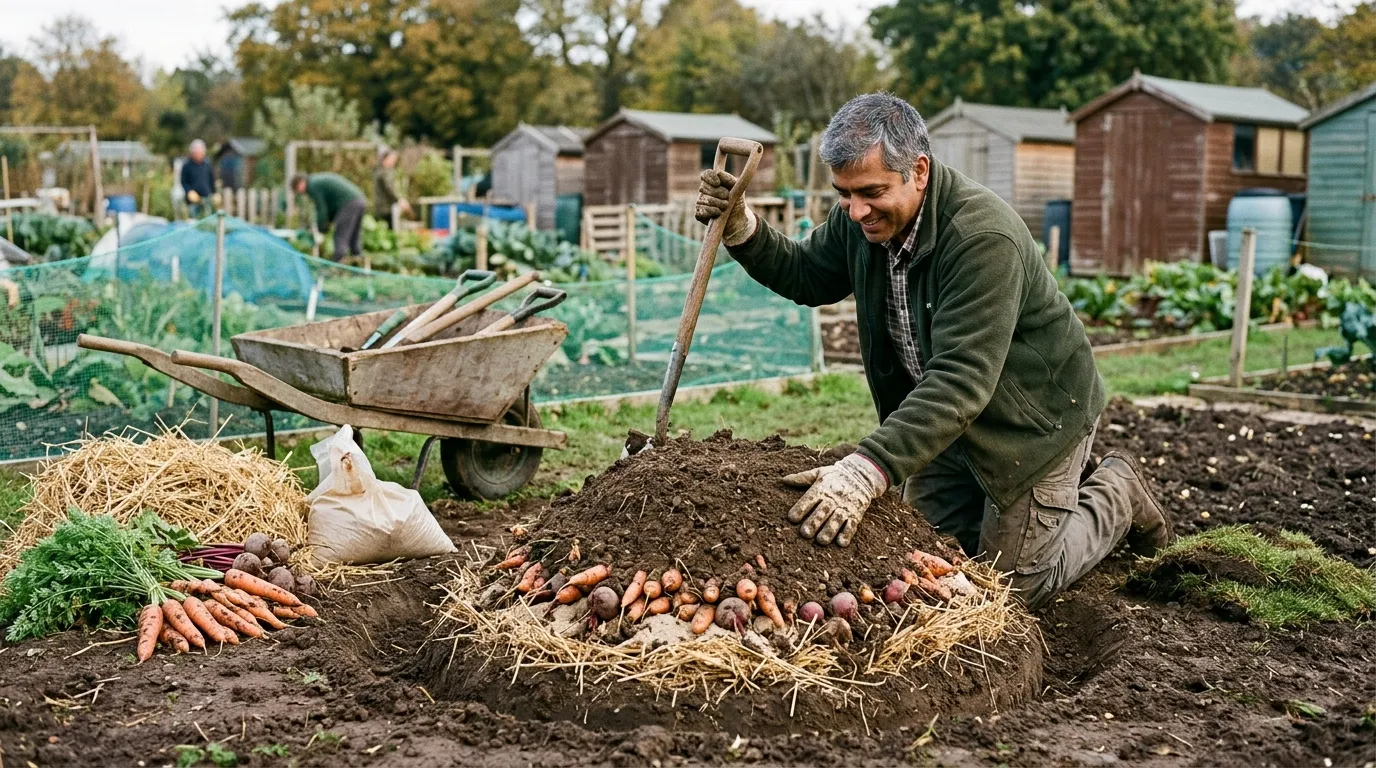
The traditional UK garden clamp keeps carrots, beetroot, parsnips, swede and turnips in eating condition from October until April. It is essentially free to build and works without electricity, which is why every Victorian kitchen garden had one.
Build sequence:
- Pick a free-draining site away from buildings.
- Lift the crop on a dry day, cut tops back to a 25 mm stub, leave the soil on.
- Lay 50 mm of clean dry sand or straw on the ground.
- Pile the roots in a dome 600 to 800 mm tall, layered with sand or straw at 50 mm intervals so no two roots touch.
- Cover the whole dome with 100 mm of straw.
- Pack 150 to 200 mm of soil over the straw, leaving a small vent of straw at the top.
- Dig a drainage channel around the base.
Take out a week’s supply at a time through one face of the clamp, then re-cover with straw and soil.
If a clamp feels too rural, the indoor equivalent is a deep wooden or plastic crate of damp sand in a frost-free garage. Layer roots horizontally with the sand between them, not touching. Lift the lid weekly to vent and to pick out anything soft. Crate roots keep almost as long as clamp roots, around 4 to 6 months. For the full step-by-step plan see the winter root vegetable storage guide.
Onions, garlic and shallots: cure first
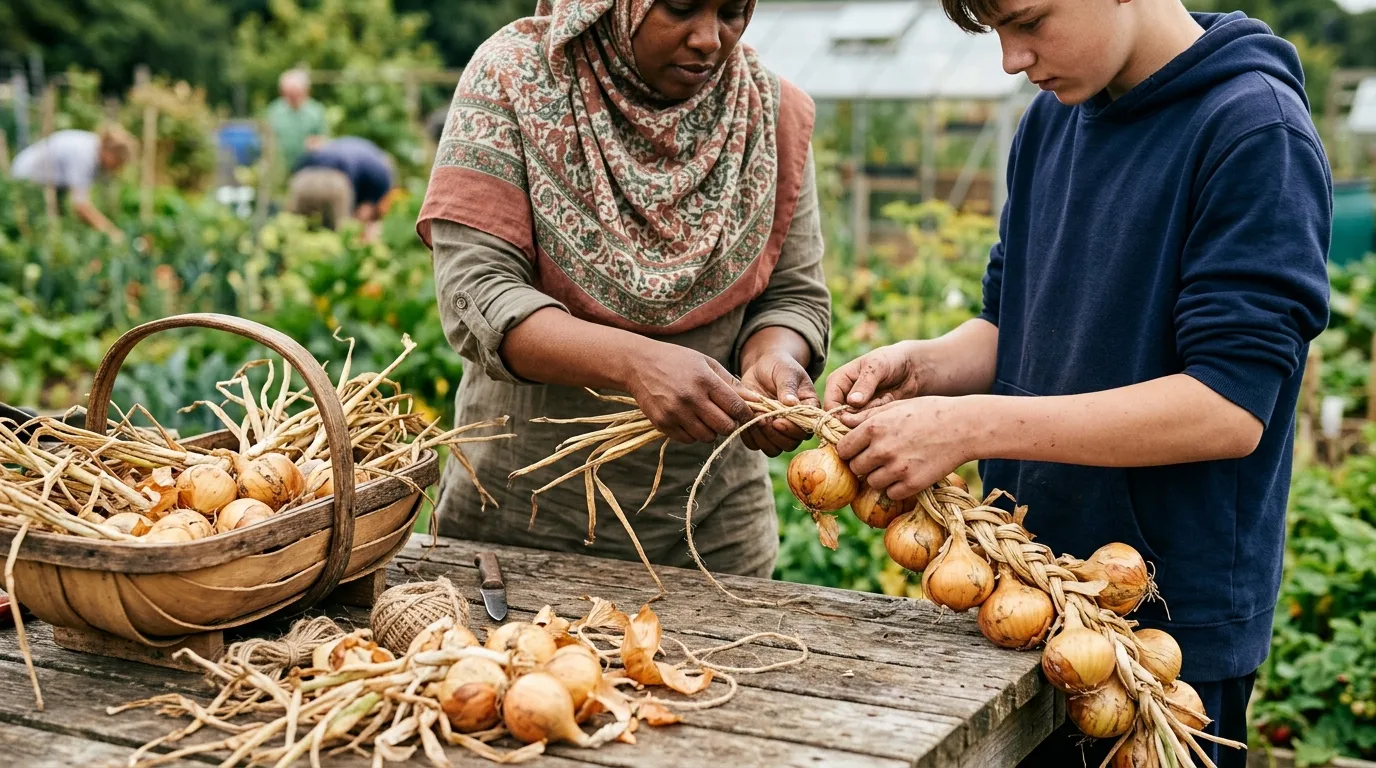
Curing is what makes the difference between a 6 week store and a 9 month store. The neck of an onion or garlic bulb has to seal off before the bulb will keep. Skip the curing step and the whole crop goes soft and mouldy by Christmas.
Cure outdoors on a wire mesh, single layer, for 7 to 14 days at 20 to 25 degrees in dry sunny weather. A polytunnel, greenhouse bench or a south-facing porch all work. Bring them inside if rain is forecast. The bulb is cured when the neck is fully dry and the outer skins are papery and rustle to the touch.
Once cured, three storage routes work for any UK garden:
- Plait or string the cured bulbs by their dried stems and hang them from a kitchen beam or shed nail. Visually pleasing, well ventilated, easy to pull bulbs from. Best for small to medium crops.
- Net bag the bulbs and hang them from a beam. Faster than plaiting, identical performance.
- Tray rack in a slatted wooden tray, single layer, in a dry frost-free shed. The simplest method for a 20 to 50 kg crop.
Target 0 to 5 degrees, dry, dark. A fridge does not work because the humidity is too high and the bulbs sprout. For the full growing-to-store cycle on onions see the UK onion growing guide.
Potatoes: dark and cool
Main-crop potatoes are the bulkiest UK store crop. A 50 kg sack feeds two adults from October to March with regular cooking. The two storage rules are non-negotiable.
Rule one: dark. Potatoes exposed to any light produce solanine, the green tint that is mildly toxic and bitter. Hessian sacks, paper sacks, paper-lined wooden boxes and double-skinned cardboard boxes all work. Clear polythene does not.
Rule two: well away from apples. The ethylene problem again. Apples sprout potatoes 4 weeks faster than they would otherwise. Even a single bushel of apples in the next bay of the shed is enough to write off a potato crop by January.
Temperature 4 to 6 degrees. A frost-free brick shed or unheated garage is usually fine. Below freezing the cells burst and the potato turns sweet, watery and unusable. Above 10 degrees the eyes break dormancy and the spuds sprout. If your only available shed dips below freezing in a hard winter, line the inside of the sack with crumpled newspaper for insulation.
Cure briefly. Main-crop potatoes from a dry lift cure in 7 to 10 days in a dry shed at 12 to 18 degrees before going into long-term storage. This dries the skin and seals minor scrapes.
Sort by size. Small ware (under 40 g) for early eating, medium for baking and roasting, large for storage. Cut and bruised tubers go into the eating bag first because they will not keep.
Squashes and marrows: cure then dry shelf
Winter squashes (Butternut, Crown Prince, Hubbard, Uchiki Kuri) and culinary marrows are the second easiest UK long-store crop after onions. The whole technique is two steps.
Step one: cure in the sun for 10 to 14 days. Lay the fruit on a wire mesh in a polytunnel, greenhouse bench or south-facing porch. Turn every 2 days so every face gets light. The skin hardens off and any stem cuts seal over. Cured squashes feel dry and slightly waxy and tap with a hollow sound.
Step two: store on a dry shelf at 10 to 15 degrees. A spare bedroom, dry hallway, conservatory or insulated garage all work. The fruit should not touch each other and the shelf should be dry. Inspect monthly for soft spots; one spoiled fruit does not spread but is worth pulling and eating quickly.
A cured Crown Prince stored well will keep until March. Uchiki Kuri keeps for around 3 months and is the first off the shelf. Butternut keeps for 4 to 6 months. Stick a date and variety label on each fruit with masking tape as it comes off the cure.
Drying climbing and runner beans
The simplest long-term protein store in a UK kitchen garden is the dry bean. Leave the pods on the plant until they are papery and brittle, the seed rattling inside, then pick the lot and finish drying indoors.
Field-dry on the plant through September and early October. Choose a sheltered, sunny row. Resist the urge to pick green pods late in the season; they will not dry properly.
Finish indoors on a tray in a warm dry room for 5 to 10 days. Pod by hand into a sieve, discarding any discoloured or insect-damaged seeds.
Freeze for 48 hours to kill any weevil eggs that may have hatched in the pod, then transfer to an airtight glass jar.
Store at 10 to 18 degrees, dark, dry. Dried beans keep 2 to 3 years in a sealed jar. Climbing French beans (Borlotti, Cannellini, Cherokee Trail of Tears) are the most useful UK varieties because they double as fresh-eating crops in July and August and dry-store crops by October.
Leafy crops: cabbages, leeks, kale
Three winter staples that store best by being left almost where they grew.
Cabbages. Late autumn savoy and Dutch white cabbages either stay in the ground until needed (winter savoys are bred for it) or get lifted with the root intact in late October and stood in damp sand in a frost-free shed. Outer leaves stay on. Inspect weekly for slugs and rot. A well-grown Dutch white keeps 3 to 4 months in the sand.
Leeks. Stand in the soil until the moment of harvest. Hard frosts do not damage them. The only reason to lift before use is if the ground is going to be needed for a successional crop, in which case heel them in to a temporary trench of damp soil in a sheltered spot.
Kale. Stand in the ground all winter and pick fresh as needed. The cold actually sweetens the leaves. No store required.
This approach buys 4 to 6 months of winter greens for almost no work and no shed space.
Tomatoes, cucumbers, courgettes: process within 48 hours
These three crops do not store in any meaningful sense. They are 90 per cent water and rot fast.
Tomatoes. Pick at full colour. Eat fresh within 5 days at room temperature, or process the surplus within 48 hours into:
- Tomato sauce, bottled or frozen in 500 ml portions.
- Tomato passata, sieved and frozen in 1 litre bags.
- Oven-dried slices, finished in a dehydrator.
- Green tomato chutney for end-of-season fruit that never ripened.
Cucumbers. Process into pickles within 48 hours or eat fresh. Whole cucumber does not freeze or dry.
Courgettes. Either eat within 5 days, freeze grated and squeezed dry for cake and fritters, or process into chutney with the rest of the late-season glut.
The decision rule is simple: if you cannot eat it in the next 48 hours, it goes into a process the same day, not the day after.
Soft fruit: freeze, jam, bottle, syrup
Soft fruit (raspberries, blackcurrants, redcurrants, blackberries, strawberries, gooseberries) is the second must-process group. Picked at full ripeness it lasts 24 to 48 hours in the fridge, after which it spoils fast.
Freezing is the simplest route. Spread the fruit on a baking tray in a single layer, freeze for 2 hours until firm, then bag up. This open-freezing trick stops the berries clumping into a single block. Frozen fruit keeps 12 months and is perfect for crumbles, sauces, smoothies and out-of-season jam.
Jam and jelly. Sugar at 60 per cent by weight preserves indefinitely. A 1 kg batch of raspberry jam uses 1 kg fruit and 1 kg jam sugar and produces around 6 jars. Sealed in sterilised jars while still hot, the jam keeps 2 years on a pantry shelf.
Bottling. Whole or halved fruit packed into Kilner jars with sugar syrup and water-bath processed for 20 to 40 minutes seals indefinitely. The fruit keeps its shape better than jam. See the bottling and canning guide for the equipment list and processing times.
Syrup. Heat fruit and sugar to release the juice, strain through muslin, bottle the liquid. Blackcurrant cordial, raspberry coulis and elderberry syrup all work. Refrigerated, syrups keep 3 months; frozen, 12 months.
Stone fruit: plums, damsons, gages
Plums and damsons have a 7 to 14 day window. Once they release from the stalk they are about to spoil. Process the bulk of the crop the day it comes down.
Eat fresh the first 5 kg of any harvest. The rest goes into:
- Freezing in chunks with the stone removed. Best for crumbles and stewing.
- Plum jam with 70 to 80 per cent sugar by weight (plums set easily).
- Damson cheese (a thick set spread for cheeseboards).
- Bottling in sugar syrup, processed 25 to 30 minutes.
- Sloe-and-damson gin for the Christmas market.
For the varieties that fruit reliably in the UK and freeze well see the tested UK plum tree varieties guide.
Herbs: dry, freeze, salt-pack
Soft herbs (basil, parsley, coriander, dill, chives) and woody herbs (rosemary, thyme, sage, bay, oregano) need different approaches.
Air dry woody herbs by tying small bunches with garden twine and hanging upside down in a dry airy room for 2 to 4 weeks. Crumble into a labelled jar when fully crisp. Rosemary, thyme, sage, oregano and bay all work brilliantly.
Freeze soft herbs in ice-cube trays. Chop the herb, pack the trays, top with water or olive oil, freeze, pop the cubes into a labelled freezer bag. Basil, parsley, coriander, dill, chervil and tarragon all keep 12 months this way.
Salt-pack for parsley, chives and dill. Layer chopped herb with coarse sea salt in a small jar at a 1:1 ratio by volume. The salt draws out moisture and preserves the herb for 6 months refrigerated. Use as a seasoning rather than a fresh garnish.
The drying and storing herbs guide covers the timings and humidity targets in more detail.
Six seasons of running a kitchen garden inventory turn up the same handful of mistakes year after year. None of them are obvious until they have bitten you.
- Washing produce before storage. The single biggest avoidable cause of rot. The soil and the bloom on the skin are protective. Brush, do not wash. See the Royal Horticultural Society guidance on storing vegetables which is unambiguous on this point.
- Mixing ethylene producers with sensitives. Apples in the same shed as carrots, onions or potatoes. Costs at least 6 weeks of storage life every time.
- Fridge for everything. The fridge is too humid for onions and garlic, too dry for apples, and not cold enough to hold roots in dormancy. Use it for short-term holding only.
- Storing wet or damaged produce. Any bruise, cut or wet skin is an entry point for rot. Eat the damaged fruit first; only the perfect specimens go into long-term store.
- No inventory. A 200 kg autumn store that is not catalogued ends up half-forgotten in March. Five minutes with a clipboard in November is worth a fortnight’s eating in February.
- Storing produce at unsafe temperatures. Home-bottled vegetables (not fruit) need pressure canning to be safe; sugar in jam does the same job; salt or vinegar in pickles does it differently. Read the Food Standards Agency guidance on home food preservation before bottling low-acid vegetables.
Complete crop-by-crop reference table
Storage spaces in a UK home
Not every garden has a Victorian fruit room. Most UK households have a mix of these spaces and can use them in combination.
Cool larder or pantry (8 to 12 degrees). A north-facing brick or stone-floored room or an unheated cupboard against an external wall. Best for short-to-medium-term storage of squashes, jars of jam, onion plaits, dried beans.
Garage (variable, 0 to 15 degrees). The most flexible store in most UK homes. Roots and apples in winter (when the temperature is closer to outside), squashes and dried produce in autumn. Insulate against summer heat and freeze risks.
Shed (frost risk). Only suitable for crops that tolerate occasional sub-zero temperatures: dried beans in sealed jars, plaited onions and garlic, cured squashes. Hessian-wrap potato sacks for the coldest weeks.
Garden clamp (0 to 5 degrees). The traditional UK answer for the largest crops: 30 kg or more of carrots, beetroot, parsnips, swede. Cheap, durable, frost-proof if built right.
Stone or brick root cellar. Vanishingly rare in modern UK homes but the gold standard if you have one. Naturally holds 4 to 8 degrees and 90 per cent humidity year-round.
Fridge (3 to 5 degrees, 90 per cent humidity). Short-term holding only. Useful for soft fruit picked the same day, salad crops, and produce destined for processing the next day. Not a long-term store.
Freezer (-18 degrees). Everything freezes given the right preparation. A 250 litre chest freezer holds the surplus of an average kitchen garden across a full season.
Dry attic (warm, dry, dark). Best for plaited onions, dried herbs, dried beans in jars. Unusable for damp-loving crops (everything cold-store).
The trick is to think in storage tiers: process the must-process crops first, fill the freezer next, pack the clamp and the fruit room with the long-keepers, and use the larder shelves for the cured and dried goods. A good kitchen garden uses all of these in rotation rather than depending on any single space.
DIY: building the stores
Three small DIY projects pay back for years.
The garden clamp. Materials: a 2 metre square of free-draining ground, 100 kg of clean dry builder’s sand or chopped straw, a wheelbarrow of garden topsoil. Time: 90 minutes to build, 10 minutes a week to access. Follow the seven-step build sequence in the root crops section above. A well-built clamp lasts the whole winter and rebuilds in autumn from the same materials.
Lining a fruit room. Materials: 6 mm marine plywood for slatted shelves, 25 mm batten for shelf supports, galvanised nails. Time: a weekend. Slats spaced 25 mm apart, shelves 350 mm deep, 300 mm vertical clearance between shelves so a hand fits. Paint with limewash for breathability and to discourage mould. A 2 metre run of slatted shelving holds 60 to 80 kg of apples in single-layer storage.
Hanging onion net rack. Materials: a 1 metre length of 200 mm diameter green plastic netting tube (the kind onion sacks come in), garden twine, two beam hooks. Time: 20 minutes. Knot a string at the bottom of the tube, fill with cured onions one by one, knot a string above each onion, hang from the beam. Holds 4 to 6 kg of onions in 1 metre of vertical space.
Drying rack for herbs and seeds. Materials: a 600 x 400 mm wooden frame, fine-mesh galvanised wire stretched across, four legs cut from 25 mm dowel. Time: an hour. Stack in a warm dry airing cupboard. Dries a kilo of herbs in 7 to 10 days.
Preservation strategy decision table
The fastest way to choose between freezing, drying, bottling and jam is to match the method to the crop’s water content and acidity. This table is the working answer.
| Method | Best for | Equipment | Shelf life | When to choose |
|---|---|---|---|---|
| Freezing | Soft fruit, peas, beans, herbs, sauces | Freezer | 12 months | Easy, no learning curve, retains flavour |
| Drying | Herbs, beans, apple rings, mushrooms | Airing cupboard or dehydrator | 12 to 24 months | Saves freezer space, concentrates flavour |
| Bottling (canning) | Whole fruit, tomato sauce, pickled veg | Water bath or pressure canner | 1 to 2 years | Pantry storage, presentable jars |
| Jam and jelly | Soft fruit, stone fruit, currants | Jam pan, sterilised jars | 2 years | Sugar does the work, fast process |
| Pickling and chutney | Cucumbers, beetroot, green tomatoes, onions | Sterilised jars, vinegar | 1 to 2 years | Glut crops, end of season |
| Salting | Beans, parsley, chives | Salt, jar | 6 to 12 months | Brief storage, well-flavoured use |
| Fermenting | Cabbages, cucumbers, peppers | Crock or jar with airlock | 2 to 12 months | Probiotic foods, sauerkraut, kimchi |
For most UK kitchen gardens the working answer is freezing for 60 per cent of the surplus, jam and bottling for 25 per cent, drying for 10 per cent, and pickles and chutneys for the last 5 per cent. Scale the numbers up for the household and the freezer size; the proportions are roughly stable across most years.
Pair the preservation work with the best-fertilisers guide so that next year’s crop is bigger again, and the inventory is even more rewarding.
The November inventory
Weigh each crop in its store. A simple set of bathroom scales is enough.
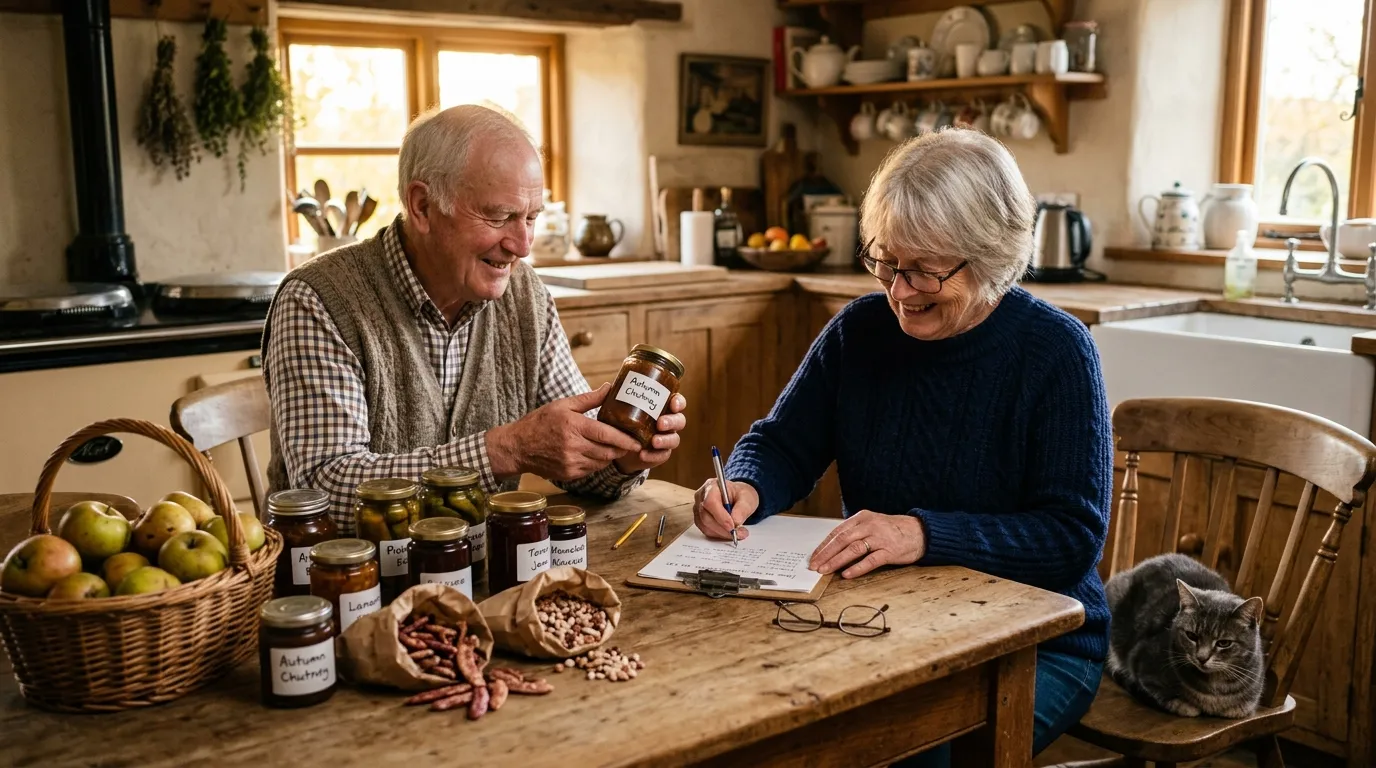
Date and label. Every jar, every sack, every shelf. Variety, harvest date, weight, target eat-by.
Map the store: a sketch of the fruit room, the clamp, the garage shelves and the freezer drawers, marked with what is where.
Plan the eating order. Earliest-keepers first, longest-keepers last. Cox apples in November and December. Bramleys from January. Damson jam straight away because the colour fades after a year. Plum jam from spring.
Cross-check in February. Anything that has not been eaten yet by mid-February is at risk of spoiling. Move it to the kitchen and use it that week.
A 200 to 300 kg store sounds like a lot of work to track. Done as a one-off November exercise and a one-off February cross-check, it takes two short sessions and turns the whole store into a working pantry rather than a slow compost heap.
Related guides
Pair this pillar reference with the practical step-by-step guides on each store type: the winter root vegetable storage guide, the drying and dehydrating guide, and the bottling and canning guide. For the herbs route see the herb drying and storing guide. For next year’s better crop see the best-fertilisers guide, the UK onion growing guide and the tested UK plum varieties guide.
Sister deep dives in the preserves cluster: the dedicated storing onions, garlic and shallots guide, the drying apples and pears guide with its three-method comparison, the drying stone fruit guide for plums, damsons and apricots, the freezing vegetables guide with the 30-row blanching times table, and the freezing fruit guide covering dry-pack, sugar-pack and syrup-pack methods.
Our team produces practical UK gardening guidance from source research, contributor records and established horticultural practice. Editorial standards are overseen by Matt W.