Key takeaways
- Spherical golden heads sit on 60cm leafless stems, flowering June to September
- Surface sow indoors at 18-20C in February or March; seed needs light, never bury it
- Rated RHS H3: survives only mild, dry winters and dies in cold wet clay
- Plant out in full sun with very sharp drainage after the last frost in late May
- Cut heads when fully coloured and firm, then hang to dry for 2-3 weeks
- Dried heads hold their colour for years, far longer than most fresh cut flowers
Craspedia, known as billy buttons or the drumstick flower, carries perfectly round golden-yellow heads on tall, leafless stems. Each spherical head sits like a button on a wiry 60cm stalk, flowering from June through September. It has become one of the most sought-after flowers for both fresh bunches and dried arrangements. Get the sowing right and a single tray fills a cutting bed.
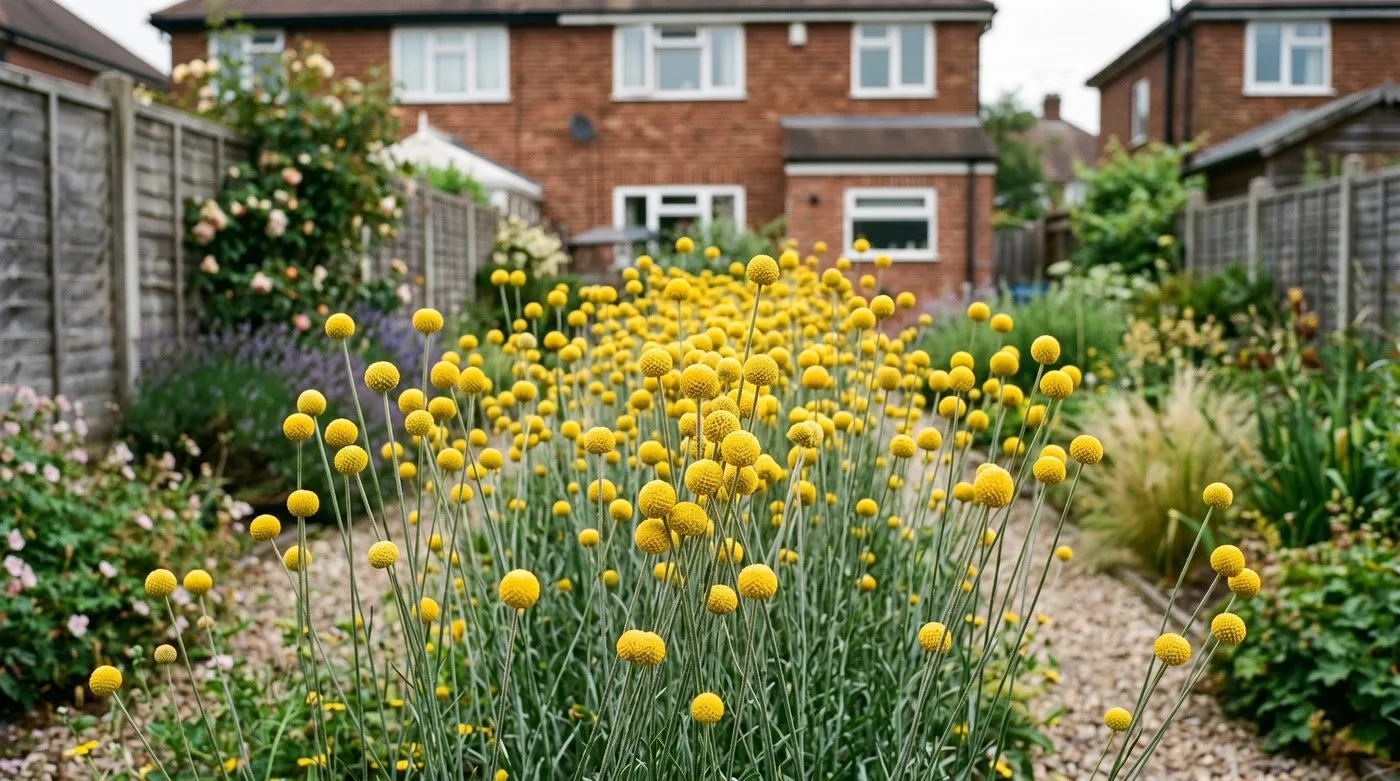
What billy buttons are and why growers want them
Craspedia, or billy buttons, is a daisy-family plant grown for its dense, spherical golden flower heads. Each head is a tight cluster of hundreds of tiny florets packed into a ball 2 to 3cm across. The stems are leafless, wiry, and grey-green, rising to around 60cm. There are no petals to drop or brown, which is the whole point.
The flower belongs to the same broad group of drought-tolerant plants that thrive on poor, dry soil and resent rich, wet conditions. Florists prize the clean geometric shape, which photographs well and suits the pared-back arrangements popular at weddings. Demand has pushed it up the list of cut-flower crops for small UK growers.
For the home gardener, billy buttons earn their place twice over. Cut fresh, they last two to three weeks in a vase. Dried, they hold their colour for years. Few flowers give that much return from a single February sowing.
How to sow Craspedia seed for high germination
Surface sow Craspedia indoors at 18-20C in February or March, because the seed needs light to germinate. This is the step most people get wrong. The seed is small and the instinct is to cover it, but a covering of compost blocks the light it needs and germination collapses.
Fill modules or a tray with fine, moist seed compost. Scatter the seed thinly over the surface and press it in with a flat board so it makes contact with the compost. Do not cover it. Stand the tray in a propagator or on a bright windowsill at a steady 18-20C. Keep the surface damp by watering from below. Seedlings appear in 10 to 21 days.
Once seedlings have two true leaves, prick them out into individual 7cm pots. Grow them on cool and bright, then harden them off over 10 to 14 days before planting out. For the basics of indoor sowing technique, our guide on how to sow seeds indoors covers propagators, compost, and watering.
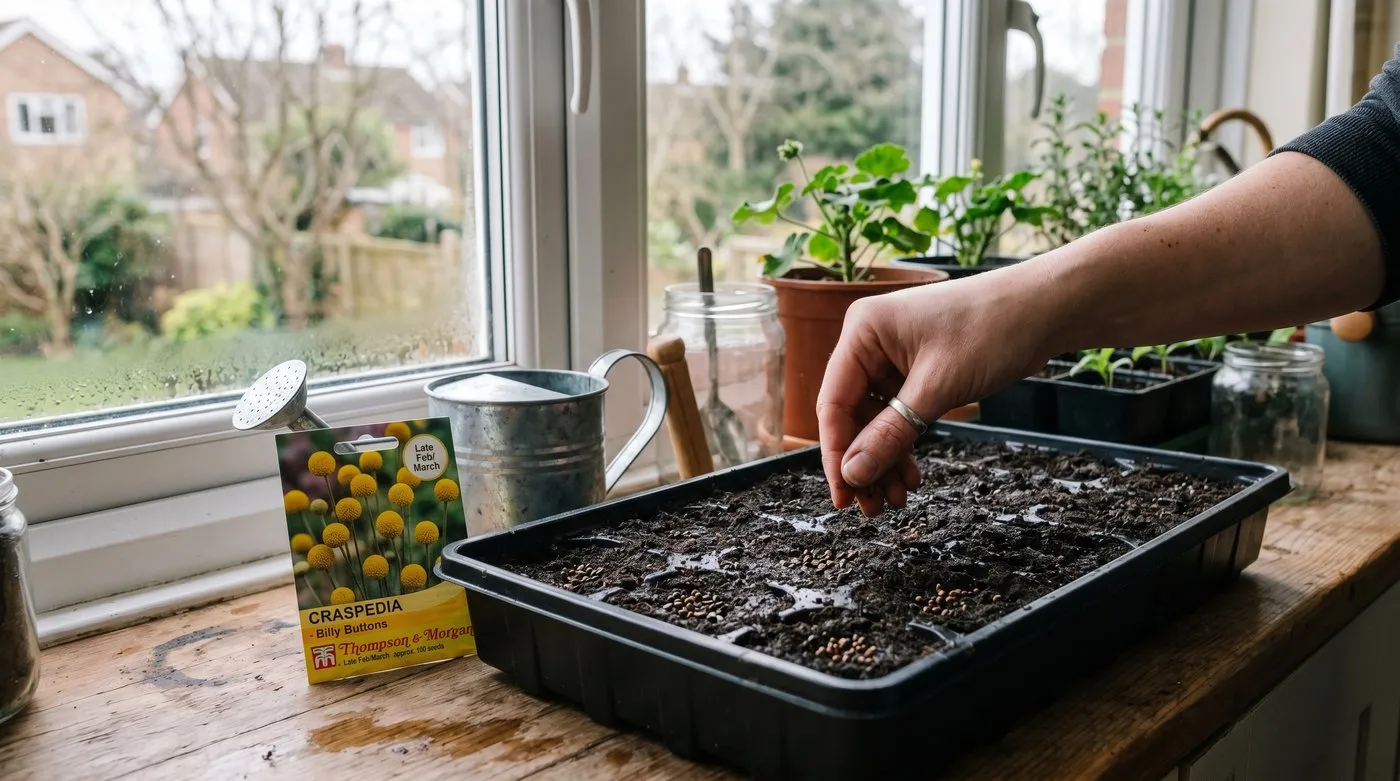 Scatter the seed on the surface and press it in. Covering it blocks the light it needs to sprout.
Why Craspedia germination so often fails
The seed germinates in stages, and each stage has a clear temperature and light trigger that most failures miss. Understanding the sequence explains why a covered tray sits bare while a surface-sown one fills with seedlings.
Stage one is imbibition. The seed takes up water from the damp compost surface over two to three days. Stage two is the light signal. Craspedia seed contains light-sensitive pigments that only fire when the seed sits in daylight, so buried seed never starts. Stage three is radicle emergence, the first root, which appears around day 7 to 10 at 18-20C. Stage four is the cotyledons unfurling by day 14 to 21.
Drop the temperature below 15C and the whole sequence stalls. Let the surface dry out during stage two and the part-swollen seed dies. The critical mistake is treating Craspedia like a bean: pushing it deep, watering heavily from above, and keeping it on a cold sill. Surface contact, steady warmth, and constant gentle moisture are what carry it through.
| Sowing stage | Days at 18-20C | What to check |
|---|---|---|
| Imbibition | Day 0-3 | Compost surface stays evenly damp, never dry |
| Light trigger | Day 2-7 | Seed on the surface, in daylight, not covered |
| Radicle emergence | Day 7-10 | First white roots visible at the seed |
| Cotyledons open | Day 14-21 | Two seed leaves up; move to brighter light |
Choosing where to plant billy buttons outdoors
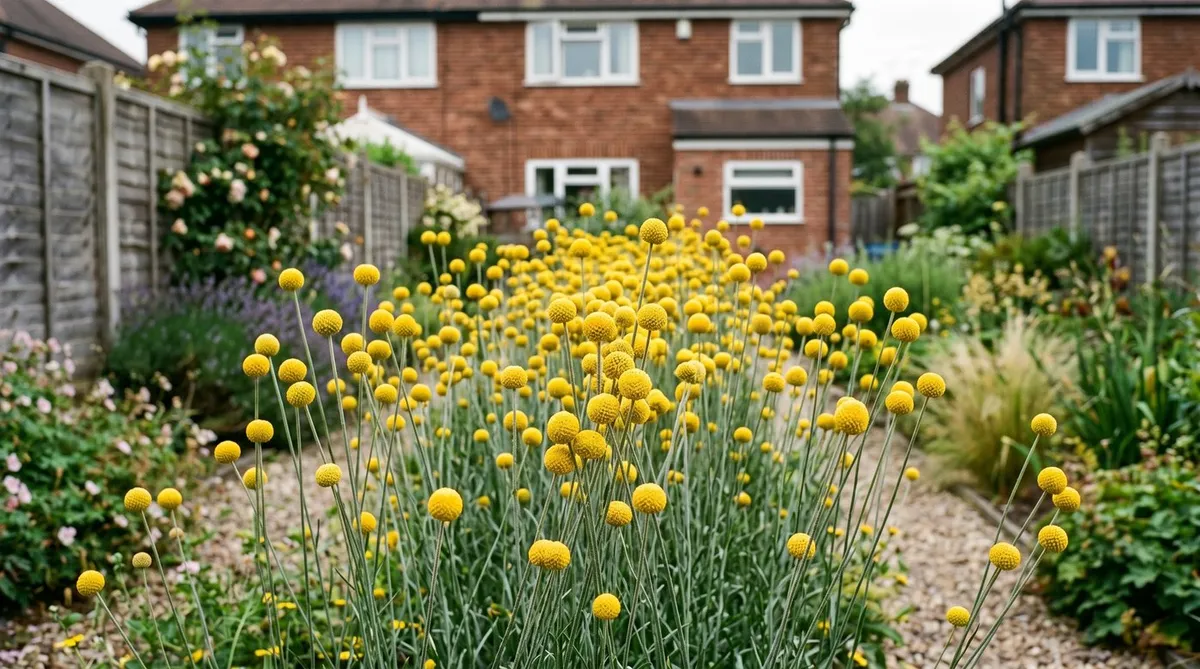
Plant Craspedia in full sun with very sharp drainage, the two conditions it cannot do without. It evolved on lean, gritty Australian soils and rots fast in the rich, damp ground many UK borders offer. Six or more hours of direct sun ripens the stems and deepens the flower colour.
Drainage is the make-or-break factor. On heavy clay, dig in plenty of horticultural grit, or better still grow it in a raised bed or gravel garden. A south-facing spot against a warm wall suits it well. Water only while the young plants settle, then leave them alone, as billy buttons are genuinely drought tolerant once established.
Space plants 25 to 30cm apart. They knit together into a low haze of bare stems topped with gold. They sit happily alongside other sun-lovers in a mixed border planting combination, and their strong shape reads well next to softer, looser flowers.
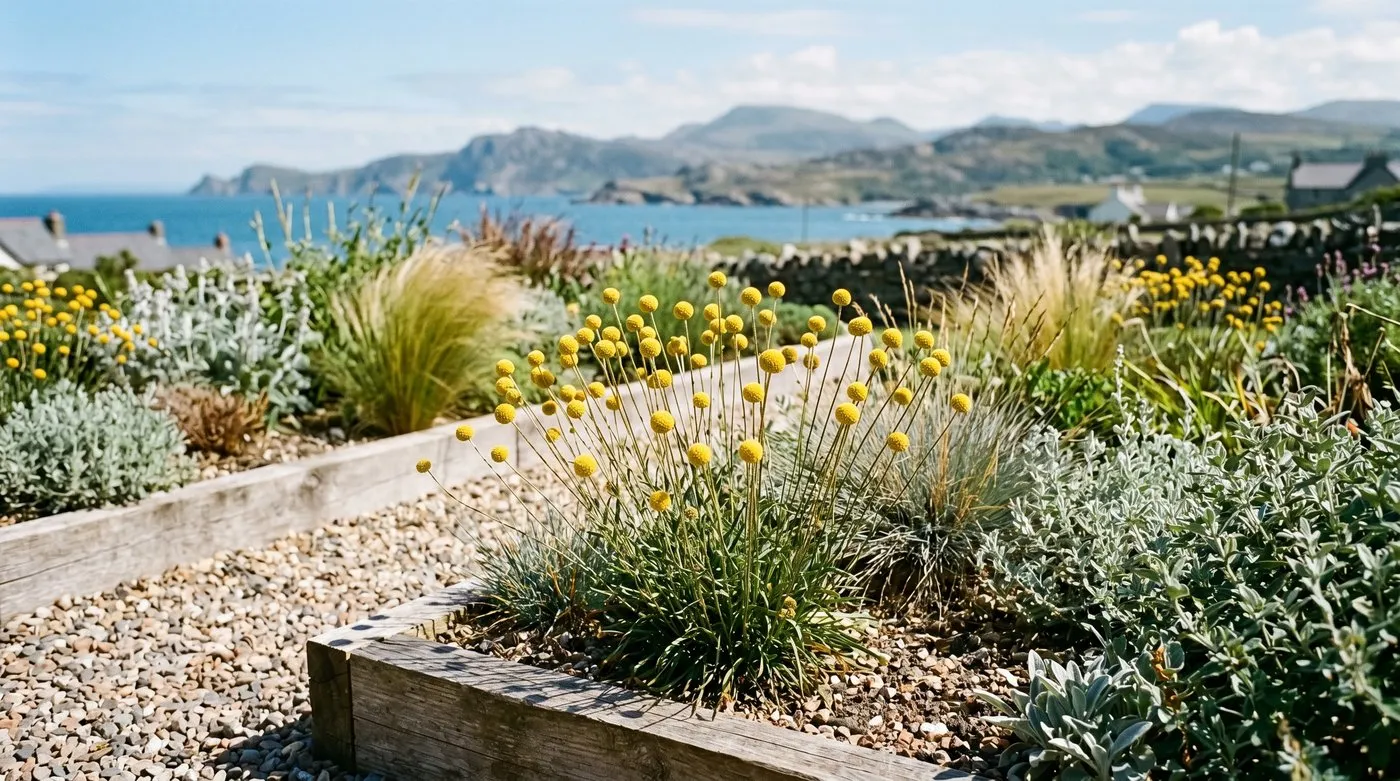 Sharp drainage is everything. A gravel border in full sun, like this Welsh coastal garden, suits billy buttons perfectly.
Craspedia compared to other everlasting flowers
Billy buttons are easy to grow and dry, but they are one of several everlastings worth a cutting bed. Comparing them to strawflower and statice helps you pick the right mix for fresh vases and dried bunches.
Craspedia gives a single bold, sculptural head per stem and the longest dried colour life. Strawflower, or Helichrysum, gives papery daisy blooms in many colours but on leafier, floppier stems. Statice, or Limonium, gives clouds of tiny papery flowers that bulk out a bunch. All three are half-hardy annuals sown the same way. For a fuller picture of the crop, see our guide to growing cut flowers in the UK.
| Everlasting | Fresh vase life | Dried colour life | Ease (1-5) | Best use |
|---|---|---|---|---|
| Craspedia (billy buttons) | 2-3 weeks | Several years | 4 | Bold single heads, modern bunches |
| Strawflower (Helichrysum) | 1-2 weeks | 2-3 years | 5 | Colour and volume, mixed posies |
| Statice (Limonium) | 1-2 weeks | 2-3 years | 5 | Filler and bulk in dried bunches |
| Honesty (Lunaria) | n/a (seed pods) | Several years | 4 | Silvery translucent discs, winter decor |
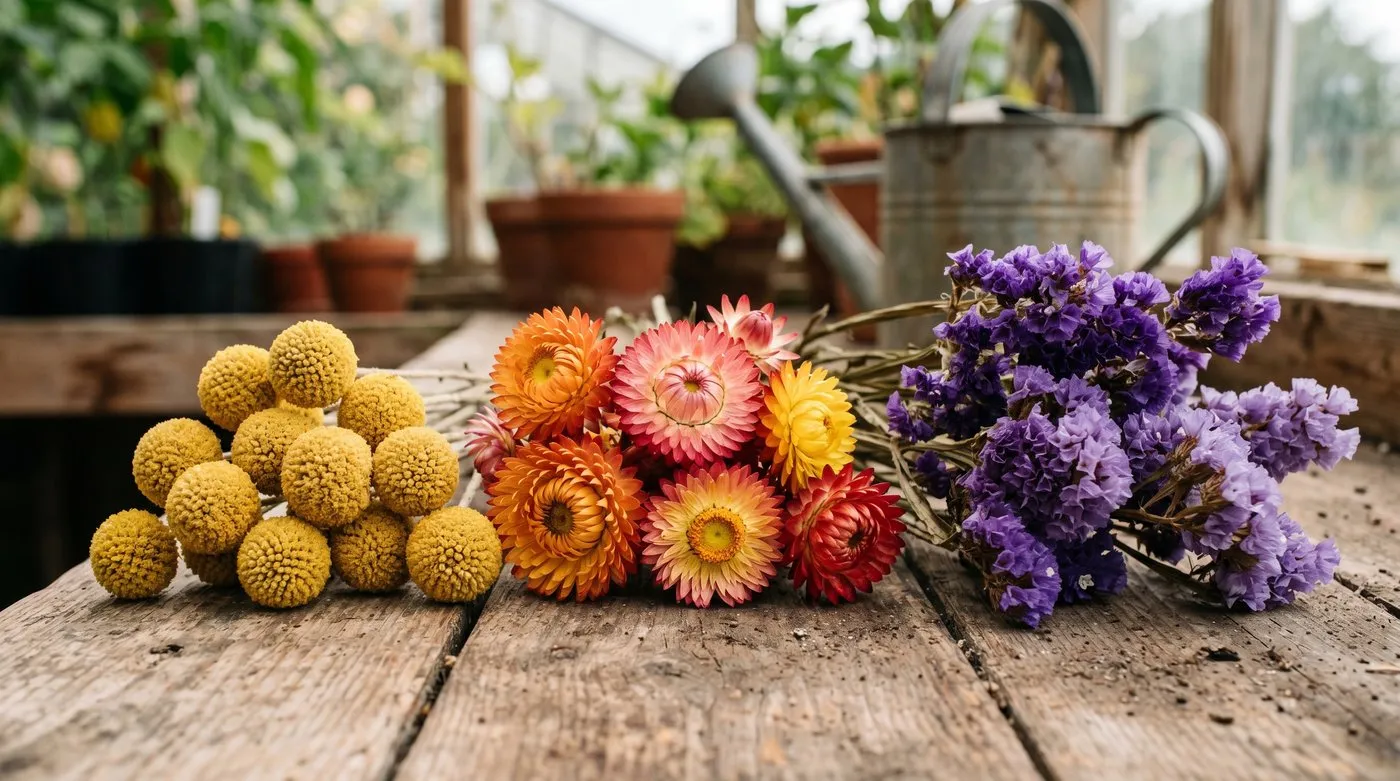 Craspedia holds colour longer than most everlastings. Strawflower and statice dry well too, but billy buttons keep their shape for years.
Ranking the ways to grow Craspedia by reliability
Sowing indoors in late winter is the gold standard, because it gives flowering-size plants by midsummer. Not every method works equally well in the UK climate, so rank them before you commit a season to one approach.
Indoor sowing at 18-20C is the reliable route. Direct sowing outdoors waits for warm soil and flowers late, often only catching the tail of the season. Overwintering plants as tender perennials works only in mild, dry, free-draining gardens, and even then it is a gamble. Buying plug plants in spring is the fastest but the most expensive per plant.
| Method | Reliability | Role | Notes |
|---|---|---|---|
| Surface sow indoors, Feb-Mar at 18-20C | 78% germination | Primary | Gold standard; flowers June onward |
| Buy spring plug plants | Very high | Shortcut | Reliable but costs far more per plant |
| Direct sow outdoors, May | 30-40% | Supplementary | Late, patchy; only on warm free-draining soil |
| Overwinter as tender perennial | Low | Gamble | Only mild, dry, sharp-drained gardens; H3 rated |
The gold standard is indoor surface sowing. It controls the two things that decide success: temperature and light. Direct sowing throws both to chance, and overwintering depends on a dry winter the UK rarely delivers.
Craspedia month by month in the UK
Billy buttons follow a tight annual rhythm, so matching each job to the right month keeps the crop on track. The work front-loads into late winter and spring, then eases into a long cutting and drying season.
| Month | Task |
|---|---|
| January | Order fresh seed. Old seed germinates poorly |
| February | Surface sow indoors at 18-20C in trays or modules |
| March | Continue sowing. Prick out the first seedlings into 7cm pots |
| April | Grow on cool and bright. Pot up strong plants |
| May | Harden off over 10-14 days. Plant out after the last frost, late May |
| June | First flowers open. Begin cutting for fresh vases |
| July | Peak flowering. Cut and hang the firmest heads to dry |
| August | Keep cutting. Heads cut now dry fastest in warm air |
| September | Final flowers. Lift any plants you hope to overwinter under cover |
| October-February | Store dried bunches dry and out of direct sun. Plan next year’s sowing |
Cutting and drying Craspedia for lasting colour
Cut Craspedia when the heads are fully coloured and firm, but before they start to soften. This timing is the single biggest factor in how well they dry. Cut too early and the colour is pale. Cut too late and the heads loosen and shed as they dry.
For fresh use, cut in the cool of the morning, condition the stems in deep water for a few hours, then arrange. Expect two to three weeks in a vase. For drying, cut firm heads, strip every leaf from the stem, and tie them into small bunches of 8 to 10 stems. Hang them upside down in a dark, airy, dry place such as a shed or spare room. Drying takes two to three weeks.
Gardener’s tip: Strip the leaves before you hang the bunches, not after. Leaves left on trap moisture against the stems, slow the drying, and can spot the heads with mould in a damp shed.
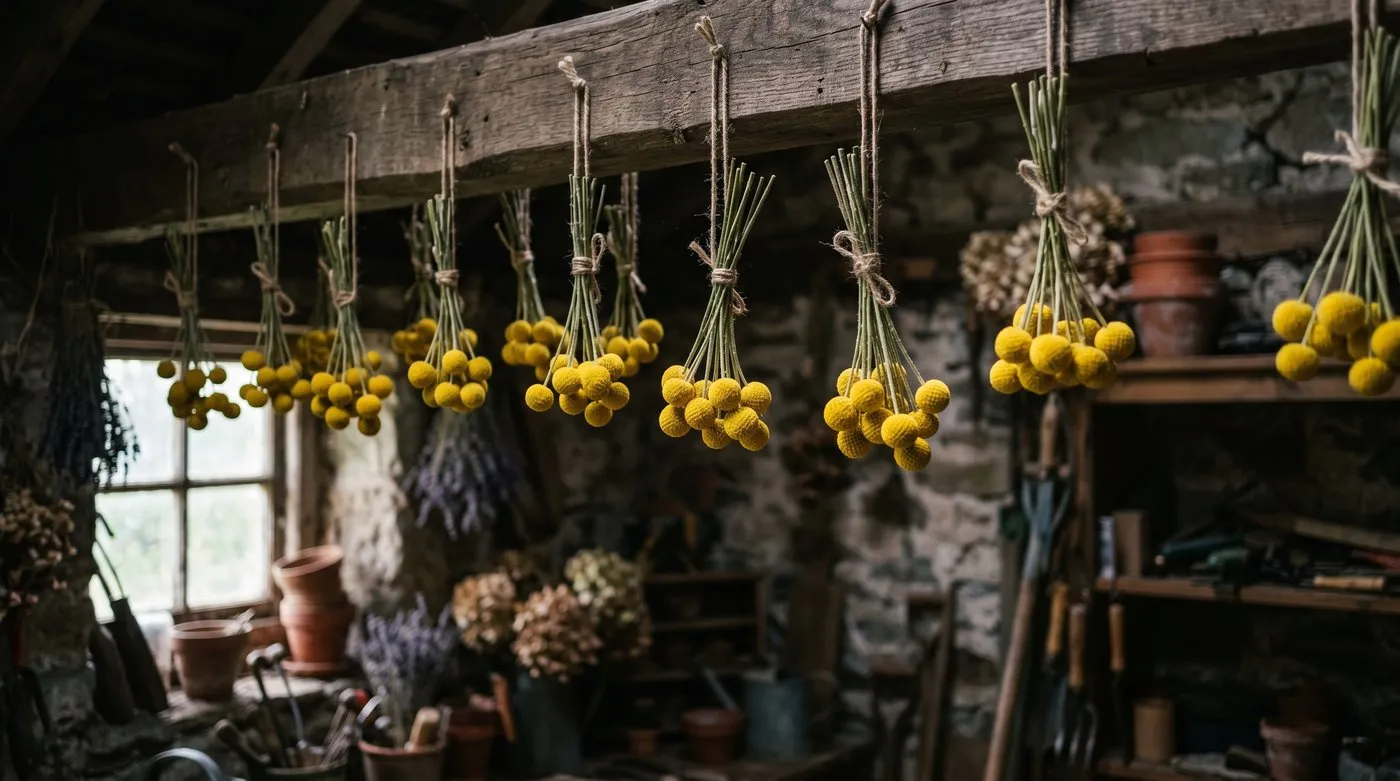 Hang stripped bunches upside down in a dark, airy space. Two to three weeks sets the colour for years.
How long Craspedia lasts cut and dried
A drumstick head holds its shape because it has no fragile petals to drop, just a tight dome of tiny florets. Knowing the structure explains the long vase and dried life. There is nothing to wilt and fall.
Fresh, the stems draw water steadily and the heads stay firm for two to three weeks, longer than most cut flowers. The wiry stem resists bending, so arrangements hold their form. Dried, the heads keep their bright gold for years because the colour sits in the florets themselves, not in any soft petal that browns. Keep dried bunches out of direct sunlight, which is the one thing that slowly bleaches them.
This durability is why florists pair billy buttons with other long-lasting flowers. They suit a cutting garden layout where the aim is repeat harvests through the season, and they reward the work long after the bed is cleared.
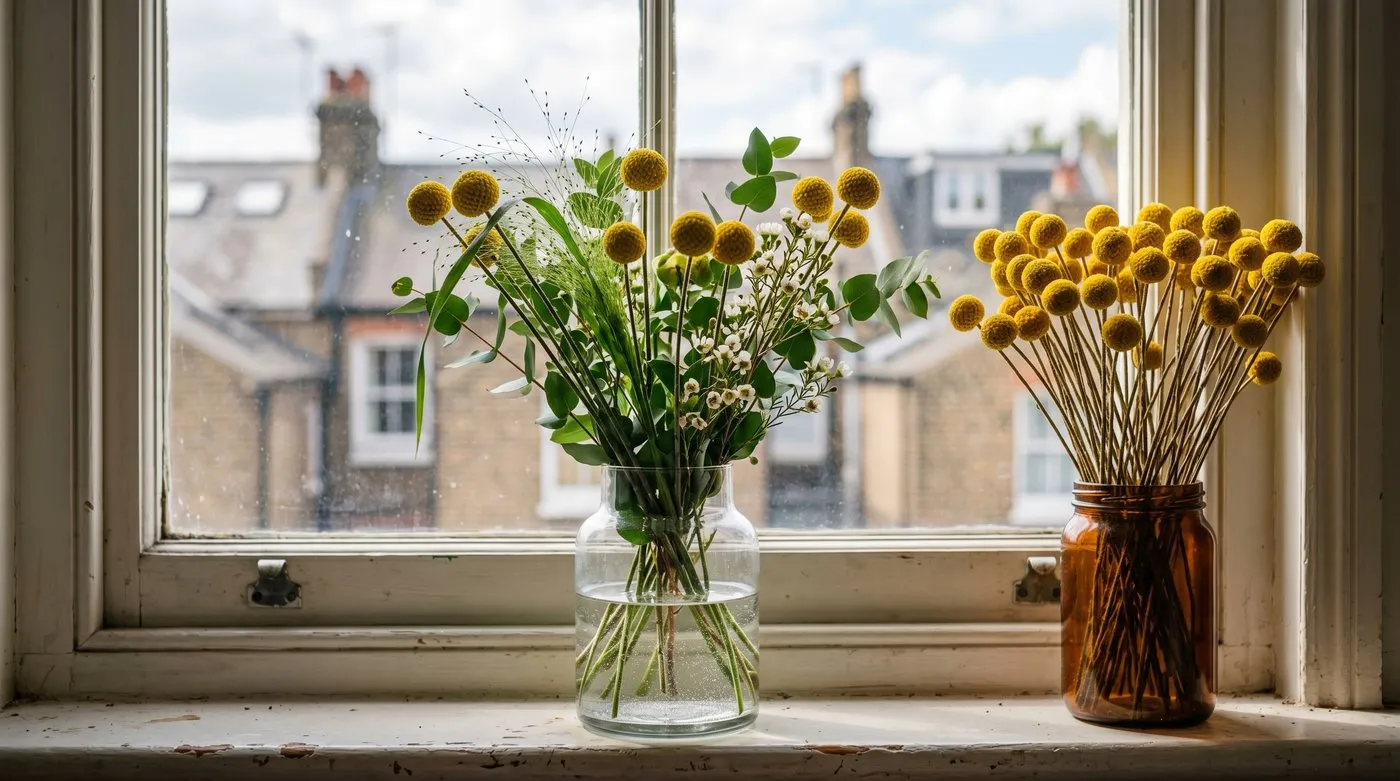 Fresh in a vase or dried in a jar, billy buttons hold their golden colour far longer than most cut flowers.
Pinching, supporting, and getting more stems
Pinch out the growing tip of young Craspedia plants to double the number of flowering stems. A single unpinched plant tends to send up one strong central stem. Pinching forces side shoots and lifts the harvest.
The wiry stems are mostly self-supporting in a sheltered spot. In an exposed or windy garden they can lean once the heads form. Grow them through a low grid of jute netting or among sturdier plants in a cutting garden so neighbours hold them upright. Avoid heavy feeding, which produces soft, floppy growth that needs more support.
The root cause of most Craspedia failures
The real reason billy buttons fail in UK gardens is wet, not cold, combined with seed sown too deep. Most guides treat the symptoms, a bare seed tray or a rotted plant, without naming the cause. Fix the two underlying problems and the plant is straightforward.
Cause one is burying the seed. Craspedia needs light to germinate, so any covering of compost stops it before it starts. The permanent fix is to surface sow every time and never cover the seed. Cause two is winter wet on heavy soil. The plant is rated H3, meaning it survives only mild, dry winters. On cold, waterlogged clay the roots rot long before frost is an issue. For the official hardiness rating and species notes, see the RHS Craspedia entry.
The lasting prevention is to stop fighting the climate. Grow Craspedia as a fresh annual from a February surface sowing each year, and plant it only into sharp, free-draining soil or a gravel bed in full sun. Do not try to overwinter it on clay. Treat it as an annual and it rarely disappoints.
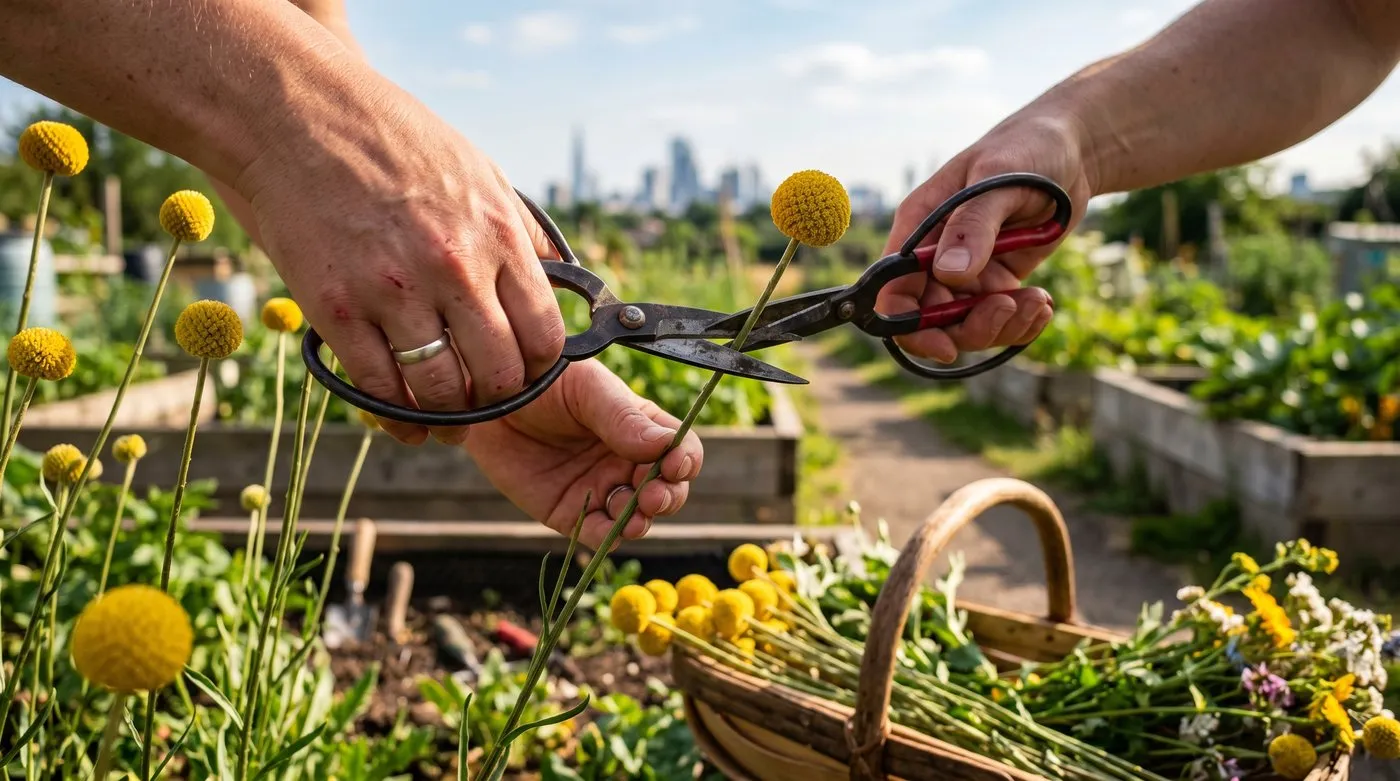 Cut firm, fully gold heads at the base. An allotment bed gives the sun and drainage billy buttons need.
Common mistakes when growing Craspedia
Covering the seed
The most common error is treating the seed like any other and covering it. Craspedia needs light to germinate, so buried seed sits dormant and rots. Surface sow, press in, and leave it uncovered.
Sowing on a cold windowsill
Seed sown below 15C germinates slowly and patchily, if at all. The light trigger and root emergence both need a steady 18-20C. Use a heated propagator or the warmest bright sill you have, not a cold porch.
Planting into wet, rich soil
Billy buttons rot in damp, heavy ground. Rich borders push soft growth that flops. Plant into lean, gritty, free-draining soil in full sun, and add horticultural grit on clay.
Cutting the heads too late
A head left until it softens loosens and sheds as it dries. Cut when the head is fully coloured but still firm to the touch. This is the window that gives years of dried colour.
Skipping the pinch
Leaving the plant unpinched halves the harvest. One central stem looks sparse in a vase. Pinch the tip at 20cm to force side shoots and lift the count to 7 to 9 stems.
Frequently asked questions
Is Craspedia a perennial or an annual in the UK?
It is a tender perennial grown as a half-hardy annual in most UK gardens. Craspedia is rated RHS H3, so it survives only mild, dry winters. On cold wet clay the roots rot, so most gardeners sow fresh each February. In a sheltered free-draining spot it can return for a second or third year.
Why won’t my Craspedia seeds germinate?
Craspedia seed needs light, so buried seed rarely sprouts. Surface sow onto moist compost and press it in without covering. Keep the temperature at 18-20C and the surface damp. Germination takes 10 to 21 days. Sowing too deep is the single most common reason for failure in UK propagation.
When do you sow Craspedia seeds in the UK?
Sow indoors in February or March at 18-20C. This gives the plants time to reach flowering size in their first summer. Surface sow into modules or trays, prick out, then harden off before planting out after the last frost in late May. A direct outdoor sowing in May flowers later and less reliably.
How do you dry Craspedia flowers?
Cut the stems when the heads are fully coloured and firm. Strip the leaves and hang small bunches upside down in a dark, airy place. Drying takes two to three weeks. Dried heads keep their golden colour for years, which makes Craspedia one of the best everlasting flowers for winter arrangements.
How tall does Craspedia grow?
Craspedia grows to about 60cm tall on leafless stems. Each stem carries one spherical golden-yellow head around 2 to 3cm across. The stems are wiry and self-supporting in a sheltered spot. In an exposed garden they can lean, so grow them through a low support or among sturdier neighbours.
Does Craspedia come back every year?
Only in mild, dry gardens with sharp drainage. Craspedia is a tender perennial rated H3, so it dies in cold, waterlogged soil. On free-draining sandy or gravelly ground in a sheltered southern garden it may return for two or three years. Most UK gardeners treat it as an annual and resow each spring.
What is the difference between Craspedia and strawflower?
They are different everlastings: Craspedia has round golden buttons, strawflower has papery daisy petals. Craspedia globosa, also called Pycnosorus globosus, makes one spherical head per leafless stem. Strawflower (Helichrysum) makes flat, multi-coloured papery blooms on leafy stems. Both dry well, but Craspedia holds a single bold shape that suits modern bunches.
Our team produces practical UK gardening guidance from source research, contributor records and established horticultural practice. Editorial standards are overseen by Matt W.