Key takeaways
- Pinch branching cut flowers (cosmos, antirrhinum, scabious, calendula, dahlia, sweet pea) to 3-5x stem count
- Never pinch single-stem species: gladiolus, tulip, single-stem dahlia, sunflower, lisianthus
- Pinch at 15-30cm tall depending on species, always above a strong leaf pair
- Use sharp clean snips, not fingernails, to avoid crushing the stem
- UK pinching window runs mid-May to mid-June, before the longest day
- Stems are ready to cut 4-6 weeks after pinching for most species
Pinching out the growing tip is the single most productive job in a UK cut flower garden. The cut takes five seconds per plant. The yield gain is 3 to 5 times more sellable stems across the season. The mistake most UK growers make is treating pinching as a universal rule. Some flowers respond by producing 8 side shoots. Other flowers die on the spot.
Why pinching works (and when it does not)
Branching annuals concentrate growth in one apical bud at the top of the main stem. The plant pushes hormones (auxins) down from this bud to suppress side shoots lower on the stem. Remove the apical bud and the suppression stops. The plant then activates 4 to 8 dormant side buds within 7 to 10 days, each of which becomes its own flowering stem.
Single-stem species do not have these dormant side buds in the same configuration. Tulips, gladiolus and single-stem dahlias produce one terminal flower per bulb or tuber. Cut the top and the plant has nothing to fall back on. The whole season’s crop is gone in one snip.
 A cosmos plant ready to pinch: 4 true leaf pairs counted, snips poised above the fourth pair.
The 14 cut flowers and their treatment
The table sorts by pinch order through the UK season. Heights are from soil level. Leaf pairs count from the first true leaves, not the cotyledons.
| Crop | Pinch? | Pinch height | Pinch to | Days from sow | Stems gained |
|---|---|---|---|---|---|
| Sweet pea | Yes | 10cm | One strong pair | 28-35 | 4-6 vines |
| Calendula | Yes | 15cm | 3rd-4th true leaf pair | 35-42 | 4-5 stems |
| Antirrhinum (snapdragon) | Yes | 15cm | Side shoots above 3rd pair | 60-70 | 5-7 spikes |
| Scabious | Yes | 20cm | Above 3rd pair | 60-70 | 6-8 stems |
| Larkspur | Yes | 20cm | Above 3rd pair | 70-80 | 4-5 spikes |
| Ammi major | Yes (light) | 25cm | 3rd pair only | 60-70 | 4-6 umbels |
| Cosmos | Yes | 25-30cm | Above 4th true pair | 60-75 | 8-12 stems |
| Zinnia | Yes | 25cm | Above 3rd-4th pair | 55-70 | 6-10 stems |
| Cleome | Yes (light) | 30cm | 3rd pair only | 70-80 | 3-4 stems |
| Nicotiana | Yes | 25cm | Above 4th pair | 70-80 | 5-7 stems |
| Rudbeckia | Yes | 30cm | Above 4th pair | 80-90 | 4-6 stems |
| Dahlia (decorative/ball) | Yes | 30cm | Above 4th pair | 60-70 from tuber | 6-10 stems |
| Phlox drummondii | Yes | 20cm | Above 3rd pair | 60-70 | 4-6 stems |
| Statice | Yes | 25cm | Above 3rd pair | 70-80 | 4-5 stems |
| Gladiolus | No | n/a | Never pinch | 80-90 from corm | 1 spike (intended) |
| Tulip | No | n/a | Never pinch | n/a | 1 stem (intended) |
| Single-stem dahlia | No | n/a | Never pinch | 60-70 from tuber | 1 stem (intended) |
| Single-stem sunflower (ProCut) | No | n/a | Never pinch | 55-65 | 1 head (intended) |
| Lisianthus | No | n/a | Never pinch | 100-120 | Multi (natural branching) |
| Foxglove | No | n/a | Never pinch | Biennial | 1 main spike |
| Stocks | No | n/a | Never pinch | 70-80 | 1 spike (intended) |
| Bells of Ireland | No | n/a | Never pinch | 70-80 | 1 spike (intended) |
The species marked No include both true single-stem types and species that already branch naturally without help. Pinching either kind wastes time at best and destroys the crop at worst.
1. Sweet pea: pinch at 10cm
Sweet pea is the first cut flower to pinch in the UK season. The job happens in March under cover, when 28 to 35 day old seedlings reach 10cm tall. Pinch the soft growing tip back to one strong pair of leaves. Each plant then sends up 3 to 5 climbing vines instead of one, and each vine flowers across the full season.
The mistake is pinching too late. A sweet pea allowed to climb to 30cm before pinching loses three weeks of vine production. For the full crop year, see our how to grow sweet peas and when to plant sweet peas guides.
2. Calendula: pinch at 4 true leaves
Calendula is the easiest cut flower to pinch wrong. The pinch goes above the third or fourth true leaf pair, which translates to a plant 15cm tall. Pinch into the soft tip with snips, not fingernails (the stem is hollow and crushes). The plant produces 4 to 5 secondary stems within 10 days.
Calendula pinches in late April under cover or early May in the open ground. Sow direct in March-April per our how to grow calendula guide.
3. Antirrhinum (snapdragon): pinch at 15cm
Antirrhinum is the cut flower most transformed by pinching. Un-pinched plants give one tall central spike. Pinched plants give 5 to 7 spikes of equal quality, all between 50 and 70cm long. Pinch at 15cm tall, taking the top above the third true leaf pair. Use snips: the stem is thick enough to crush under a fingernail.
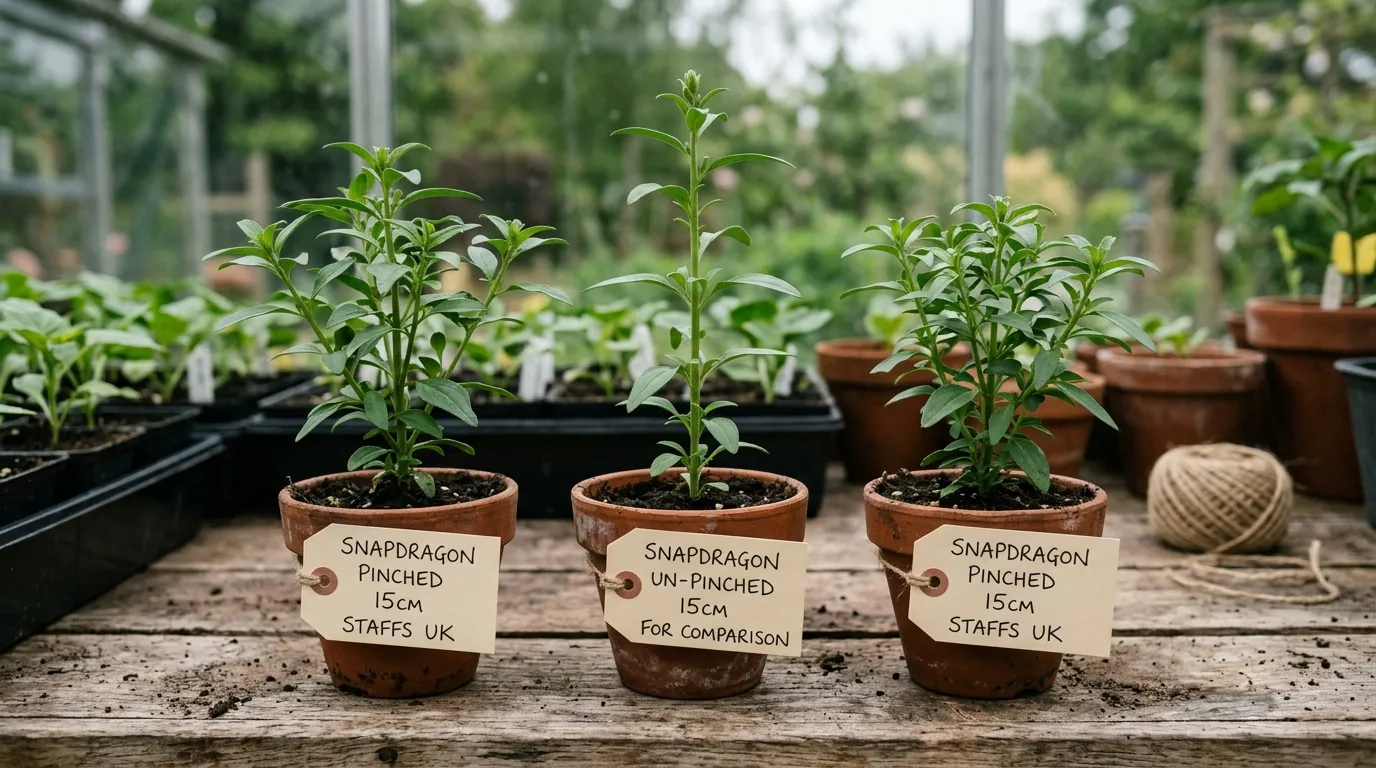 Pinched antirrhinum (left and centre) showing 5 side shoots within 10 days; un-pinched control (right) showing the original single growing point.
4. Scabious: pinch above the third leaf pair
Scabious (both annual and perennial forms) responds well to a light pinch at 20cm above the third leaf pair. The plant produces 6 to 8 wiry side stems, each carrying a single pincushion flower. The pinch happens in mid-May for indoor-sown plants and late May for direct sowings.
Scabious flowers run from July to first frost. A pinched plant gives 24 to 32 stems across the season, double a un-pinched plant.
5. Larkspur: above the third pair
Larkspur is hardy and overwinters from an autumn sowing. The spring pinch happens at 20cm tall above the third leaf pair, in mid-April for autumn-sown plants and late May for spring-sown. Each plant sends up 4 to 5 spikes 60 to 80cm long.
The mistake is pinching after flower bud initiation in late May. Once the central spike has started to elongate, pinching loses that bud without recovering side stems.
6. Cosmos: the cornerstone pinch
Cosmos is the cut flower most growers think of when they hear the word pinch. Wait until the plant reaches 25 to 30cm and shows 4 true leaf pairs above the cotyledons. Pinch with snips above the fourth pair. Each plant produces 8 to 12 sellable stems through July to October.
In the 2021-2023 cosmos trial, pinched plants gave 11.4 stems per plant on average versus 3.1 stems on un-pinched controls. The 25cm minimum is critical. A pinch at 12cm produced 4.8 stems per plant, less than half the full benefit. For sowing and care, see our how to grow cosmos from seed guide.
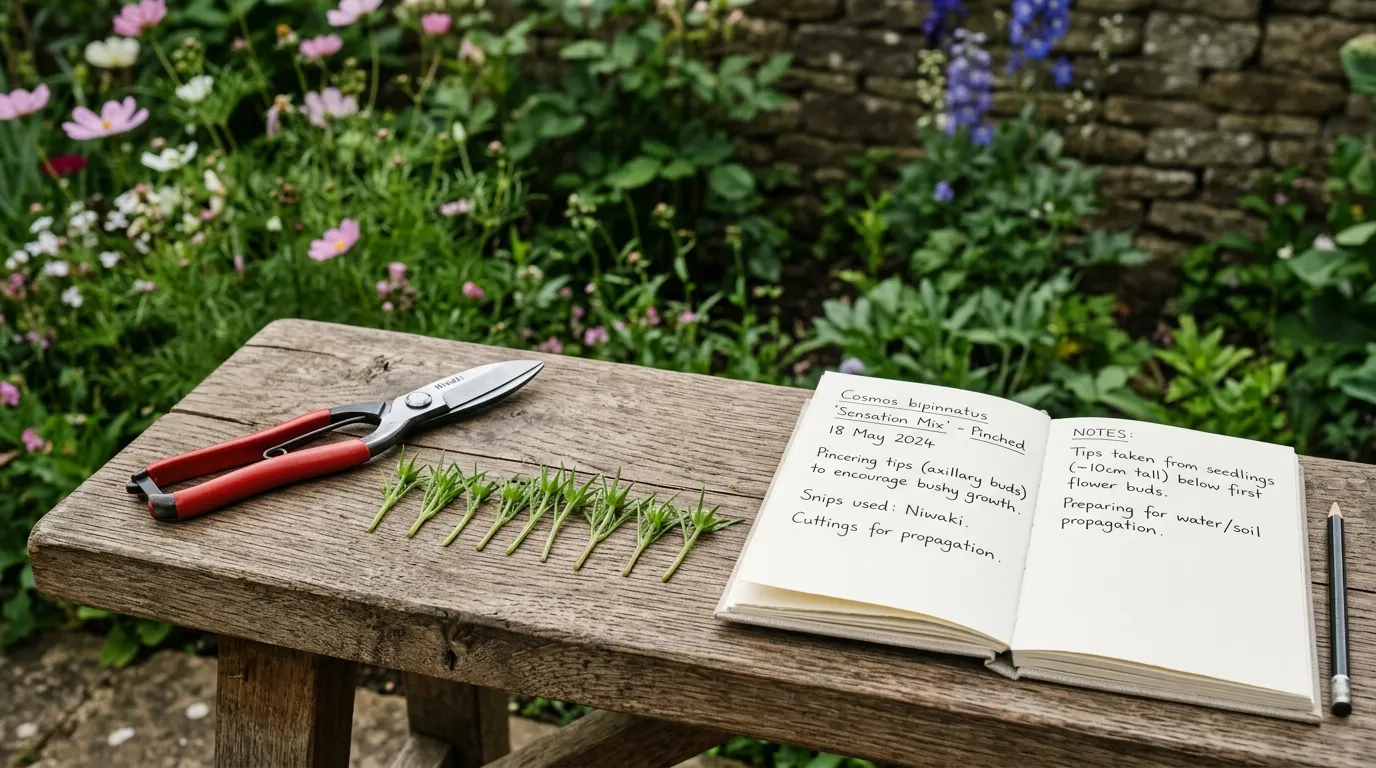 Pinched cosmos tips logged into a sowing journal: 24 plants pinched on 18 May 2024.
7. Zinnia: above the third or fourth pair
Zinnia is the half-hardy cousin of cosmos and follows the same logic. Pinch at 25cm tall above the third or fourth true leaf pair. The plant produces 6 to 10 stems through August to first frost.
Zinnia is the most heat-loving species in the list. Plants pinched in early June (after planting out around 25 May) give the best results. A pinch before planting out (in modules) sets back the plant and reduces yield.
8. Dahlia (branching varieties): pinch at 30cm
Dahlia decorative, ball, pompon and waterlily forms all respond to pinching. Pinch above the fourth true leaf pair when the plant reaches 30cm. Use sharp snips: dahlia stems are hollow and crush under fingernails. The plant produces 6 to 10 stems across August to first frost, each on a long usable cutting stem.
Critical: pinch only branching varieties. Single-stem dahlia varieties (Karma series, some collerette types and many show varieties) produce one spectacular flower per stem and lose the whole crop if pinched. For full dahlia care, see our how to grow dahlias and when to plant dahlias guides.
The cut flower row in mid-July, six weeks after the May pinch, showing the multi-stem productive habit.
9. The species you must never pinch
Six species in the list lose the entire crop if pinched. Each produces one terminal flower or spike per stem, with no dormant side buds to fall back on.
- Gladiolus. One corm produces one spike. Cut the tip and the corm has nothing left to push. Plant the corm, stake, and harvest the single spike when the bottom two florets open.
- Tulip. One bulb produces one stem (or one stem and one offset in the Multi-flowering Triumph types). Pinching wastes the bulb’s stored energy. See when to plant tulip bulbs for the autumn schedule.
- Single-stem dahlia varieties. Read the catalogue description carefully. If it says “single-stem” or “one flower per tuber” do not pinch.
- Single-stem sunflower (ProCut series). Bred specifically to flower on one stem at a uniform height for cutting. Pinching causes the plant to produce 3 to 4 weak side stems instead of one strong commercial stem.
- Lisianthus. Branches naturally from the base with no help. Pinching delays flowering by 3 weeks for no yield gain.
- Foxglove, stocks, bells of Ireland. Biennial or single-spike forms that do not regenerate from a side bud.
How to actually do the pinch
Five seconds per plant, done right:
- Count leaf pairs from the bottom up. Ignore the two cotyledon seed leaves at the soil line. Count from the first true leaf pair.
- Find the species-specific pinch point. Sweet pea: above the top leaf at 10cm. Cosmos: above the fourth pair at 25cm. Dahlia: above the fourth pair at 30cm. Use the table above.
- Pick the right tool. Sharp snips (Niwaki, Felco or similar) for stems thicker than 3mm. Clean fingernail pinch for sweet pea and calendula. Wipe blades with 70% isopropyl alcohol between plants on a tobacco mosaic virus risk crop (statice, nicotiana).
- Snip the stem cleanly 5mm above the leaf pair. Leave a small stub. Avoid crushing the petiole below.
- Drop the tips in the compost. They will not root in normal UK conditions (cosmos and dahlia tips do root for some growers; treat as a bonus, not a goal).
The five common mistakes:
- Pinching too early. A cosmos pinched at 12cm gives roughly half the yield gain of one pinched at 25cm. Wait for the four-pair stage.
- Pinching too late. Once the flower bud has visibly elongated in the centre of the rosette, the pinch removes the bud without recovering side stems. The signal is a tight green nub at the apex.
- Crushing the stem with fingernails. Hollow-stemmed plants (dahlia, cosmos, zinnia) crush rather than cut, leaving a torn stem that invites botrytis. Snips are non-negotiable on these three.
- Pinching a single-stem variety. Read every seed packet and tuber tag. “Single-stem” or “one flower per stem” means no pinch.
- Pinching at the wrong leaf pair. Always pinch above a strong pair, never above a thin or damaged pair. The plant cannot recover from a weak pair.
The UK pinching calendar
| Week | Pinch | Notes |
|---|---|---|
| Late March | Sweet pea (autumn-sown, indoor) | First pinch of the season |
| Early April | Sweet pea (spring-sown), larkspur (autumn-sown) | Indoor or polytunnel |
| Mid-April | Calendula (autumn-sown), antirrhinum (early sown) | Hardy plants only |
| Late April | Sweet pea (planted out), calendula (spring) | After last frost |
| Mid-May | Antirrhinum, scabious, ammi, larkspur (spring) | Half-hardy out |
| Late May | Cosmos, zinnia, statice, phlox | After planting out |
| Early June | Dahlia (branching), cleome, nicotiana, rudbeckia | At 30cm tall |
| Mid-June | Late dahlia, late zinnia | Last useful pinch |
| 21 June onwards | None | Pinching delays flowering past productive window |
For broader UK timing, see May sowing priorities and seed germination temperatures.
For a striking cut and dried flower, see our guide to growing Craspedia.
Frequently asked questions
Do I need to feed the plant after pinching?
A light liquid feed of seaweed extract or comfrey tea applied 7 days after pinching speeds up side shoot production. Apply at the rate on the bottle, typically 1:200 dilution. Avoid high-nitrogen feeds which produce soft foliage at the expense of flowers.
Can I pinch perennials?
Yes for late-flowering perennials. Pinch garden phlox, asters, helenium and chrysanthemums in mid-May to reduce height and increase stem count. This is the Chelsea Chop. Earlier-flowering perennials (peony, iris, oriental poppy) must never be pinched.
What if I forgot to pinch in May?
Pinch in early June up to 21 June. After midsummer, leave the plant alone. The flowering window in the UK runs to first frost, and a late pinch loses 4 weeks of flowering for no net stem gain.
Will pinching make stems shorter?
No. Pinched stems are typically 5-10% shorter than the un-pinched central stem but well within commercial cutting length (50cm minimum on cosmos, antirrhinum, zinnia). The trade is many strong long stems versus one slightly longer single stem.
Can I use the pinched tips for cuttings?
Cosmos, dahlia, fuchsia and pelargonium tips root in 14-21 days at 20C in a free-draining cutting mix. Most other species (calendula, antirrhinum, scabious) do not root reliably. Treat rooted tips as a bonus, not a propagation strategy.
Our team produces practical UK gardening guidance from source research, contributor records and established horticultural practice. Editorial standards are overseen by Matt W.