Key takeaways
- Mandevilla is a tender twining climber, grown as container plant in UK
- Plant out after last frost in 30-40cm container
- Position in full sun, sheltered from wind
- Move indoors at 12-15C for winter survival
- Cut back hard in spring; flowers on new growth
- Best varieties: Alice du Pont, Sundaville Red, Diamantina Mix
Mandevilla (also called Dipladenia) is the tropical climbing plant with trumpet-shaped flowers in pink, red, white and apricot. UK gardeners grow it as a tender container climber for summer patios and conservatories. This guide covers UK varieties, container care, the spring cut-back that triples flower production, and winter survival. If tender pot climbers suit your space, bougainvillea thrives under exactly the same regime.
Best UK Mandevilla Varieties
UK garden centres stock 5-8 Mandevilla varieties from May through September.
| Variety | Flower colour | Plant size | Flowering | Notes |
|---|---|---|---|---|
| Alice du Pont | Deep pink, large (100mm) | 1.5-2.5m | Jun-Oct | The classic, since 1950s |
| Sundaville Red | Bright red | 1.5-2m | May-Oct | Most floriferous |
| Sundaville Pink | Pink, medium | 1.5-2m | May-Oct | Reliable colour |
| Apricot Sundaville | Peach-apricot | 1.5-2m | Jun-Oct | Sought-after recent |
| Diamantina Mix | Pink-white-red blend | 1.2-1.8m | Jun-Oct | Compact, multiple colours per plant |
| Cosmos White | Pure white | 1.5-2m | Jun-Oct | Cottage white |
| Bolivian Sunset | Coral-pink | 1.2-1.5m | Jul-Oct | Different species, similar care |
Sundaville Red is the safe choice for UK first-time growers. Most floriferous, most reliable, available at most garden centres at £15-£25 per established plant.
Container Selection and Planting
Container size: 30-40cm diameter minimum, 30cm deep. Smaller containers limit growth to 1m height. Larger containers (45cm+) support 2.5m climbing.
Compost: Multipurpose peat-free compost with 25% added grit for drainage. Mandevilla hates waterlogged roots. Never grow in pure compost without grit.
Support: Provide a 1.5-2m obelisk, trellis or tripod at planting. Mandevilla twines clockwise and needs something to grip from day 1.
Planting:
- Plant outdoors after last frost (mid-May to early June in UK)
- Place support before planting
- Water in deeply
- Position in full sun, sheltered from prevailing wind
- Gently train initial stems onto the support
Watering and Feeding
Watering:
- Daily water in peak summer (35cm container dries fast in full sun)
- Twice daily in heatwaves over 28C
- Reduce to every 3-4 days in cool weather
- Stop fully wet feet; ensure drainage holes clear
Feeding:
- Half-strength tomato feed weekly from June to September
- Stop feeding completely from October onwards
- Resume feeding in April when growth restarts
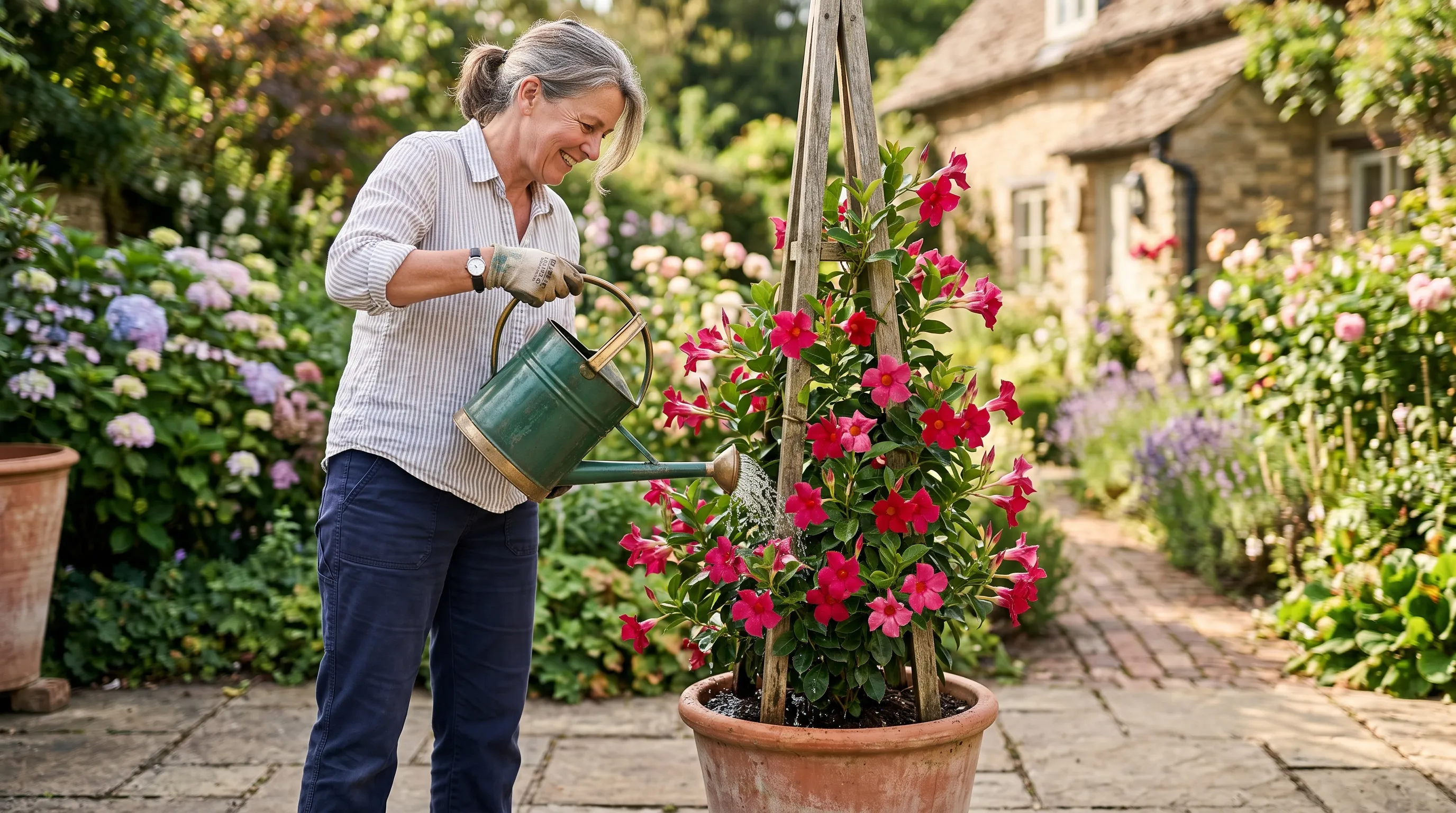 Daily watering routine on the Staffordshire patio. Mandevilla in a 35cm container dries fast in full sun and needs daily watering through July and August. Stop water if drainage holes are blocked.
The Spring Cut-Back
The single highest-impact action in UK Mandevilla growing.
Timing: Early March, before moving the plant outside.
Method:
- Cut all stems back to 200-300mm from the base
- Cut just above a leaf node
- Remove all weak or thin stems entirely
- Repot if rootbound (only every 2-3 years)
- Resume feeding and water as growth restarts
Most UK gardeners shy away from hard pruning because the plant looks devastated. Within 4-6 weeks of pruning, the new growth covers the support entirely.
Winter Survival
Mandevilla is tender. UK overwintering is the key skill.
Indoor minimum: 12-15C overnight. Below 10C and leaves drop; below 5C and the plant typically dies.
Locations that work:
- Heated conservatory (any temperature 12C+)
- Centrally-heated kitchen or living room windowsill (sunny aspect)
- Heated greenhouse running 12C minimum
- Cool sheltered porch (if temperature stays above 12C)
Locations that fail:
- Unheated greenhouse (drops below 5C in UK winter)
- Cold porch or garage
- Outdoor with fleece (UK winters too cold)
Winter care:
- Reduce watering by 60-70% (water once every 14-21 days)
- No feeding
- Allow leaves to drop naturally if temperature is borderline
- Watch for spider mite in dry indoor air; mist occasionally
In March, prune and gradually acclimate to outdoor conditions over 14 days before placing on the patio.
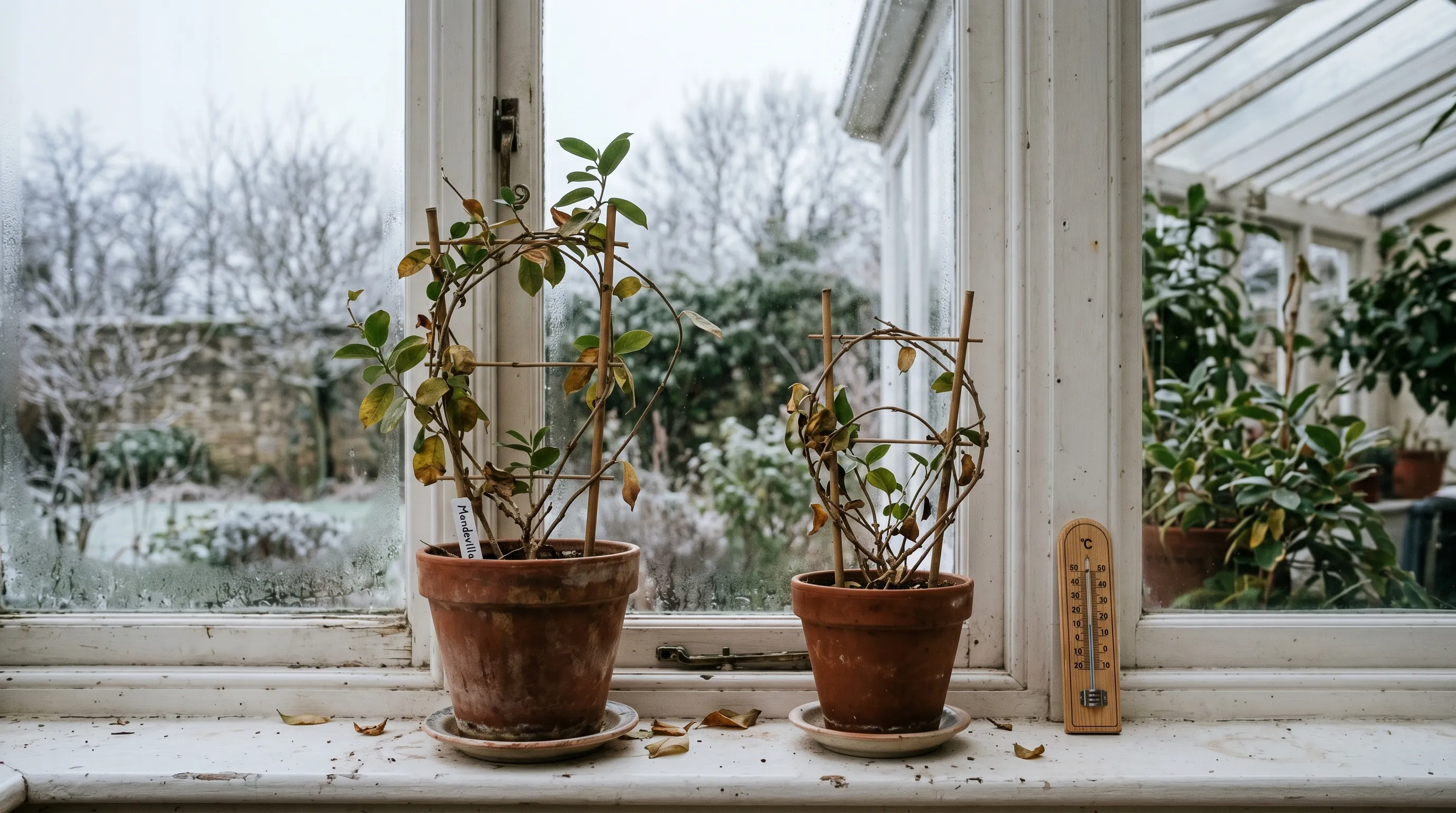 The Staffordshire conservatory overwintering setup. Two Mandevilla plants on a windowsill at 14C, partly defoliated, on reduced winter watering. Bring back outside in late May after spring cut-back.
Common Mistakes With UK Mandevilla
Mistake 1: planting in cold ground. Below 12C soil temperature, growth stalls and flowering delays. Plant after late May.
Mistake 2: skipping spring pruning. Unpruned plants produce 50-70% fewer flowers. Always cut hard in March.
Mistake 3: overwintering in cold greenhouse. Below 10C the plant dies. Indoor heated only.
Mistake 4: heavy clay-soil compost. Roots rot. Always add grit for drainage.
Mistake 5: ignoring sap toxicity. Wear gloves when pruning. Sap irritates skin and is toxic to pets.
For the wider container climber selection, our climbing plants guide covers UK options.
Mandevilla Calendar UK Month-by-Month
| Month | Mandevilla task |
|---|---|
| January | Indoor rest. Water once every 21 days |
| February | Continue indoor rest |
| March | Spring cut-back to 200-300mm |
| April | Gradual outdoor acclimatisation over 14 days |
| May | Plant out after last frost. Begin weekly feeding |
| June | First flowers. Continue feeding |
| July | Peak flowering. Twice-daily water if needed |
| August | Continued flowering. Watch for spider mite |
| September | Reduce feeding. Continue flowering |
| October | Bring indoors before first frost. Reduce water |
| November | Indoor rest. Reduce water further |
| December | Indoor rest. Water once every 21 days |
Frequently asked questions
Can I grow Mandevilla outdoors in the UK?
Yes from late May to early October. Mandevilla is tender and frost-kills below 5C. Grow in containers that can move indoors for winter. Plant out after last frost, position in full sun sheltered from wind, and bring indoors before October frosts arrive.
How do I overwinter Mandevilla in the UK?
Move indoors before October to a heated conservatory, frost-free greenhouse, or warm windowsill at 12-15C minimum. Reduce watering by 60-70% in winter. Plant goes semi-dormant. Resume normal watering and feeding when new growth starts in March.
When should I prune Mandevilla?
Cut back hard in early March before bringing the plant outside. Reduce all stems to 200-300mm. Flowers appear on new growth, so spring pruning concentrates the season’s flowering on fresh strong shoots. Light dead-heading through summer extends the display.
What is the best Mandevilla variety for UK gardens?
Alice du Pont is the classic large-flowered pink variety (100mm trumpets). Sundaville Red is the most floriferous compact red. Diamantina Mix gives a range of colours from one plant. Cosmos White and Apricot Sundaville provide softer cottage-garden colours. All available from UK garden centres May to September.
Is Mandevilla toxic to pets?
Yes. Mandevilla sap contains glycosides that are toxic to dogs, cats, and humans if eaten. Wear gloves when pruning. Keep cuttings out of reach of pets. Symptoms include drooling, vomiting and diarrhoea if ingested.
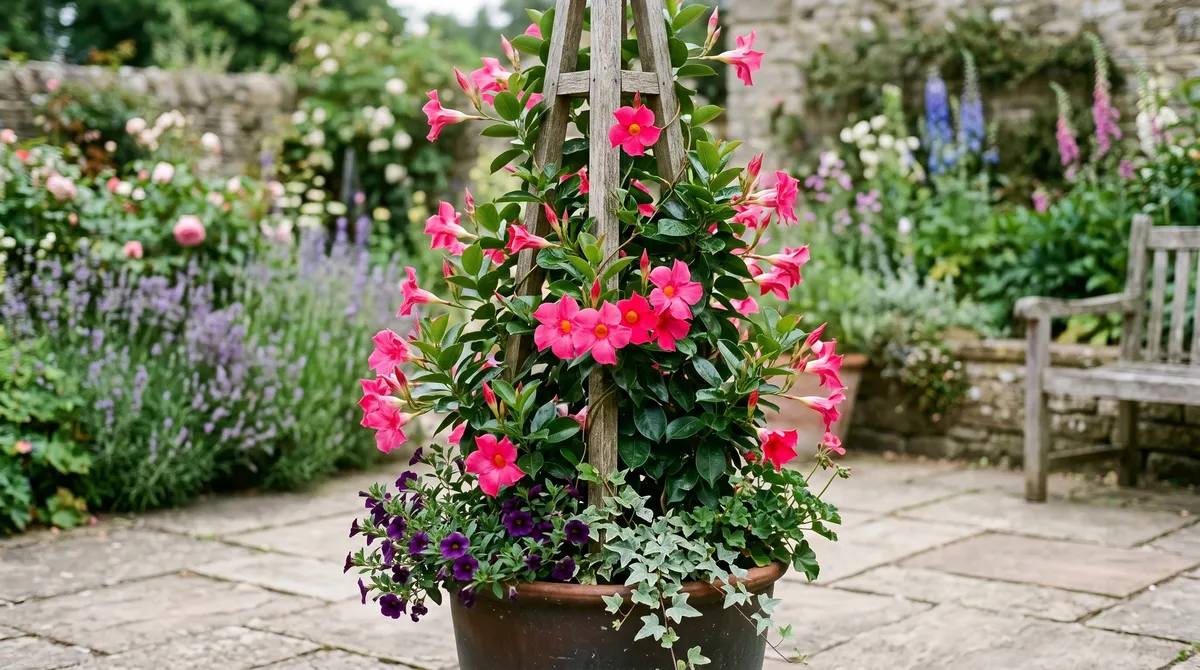
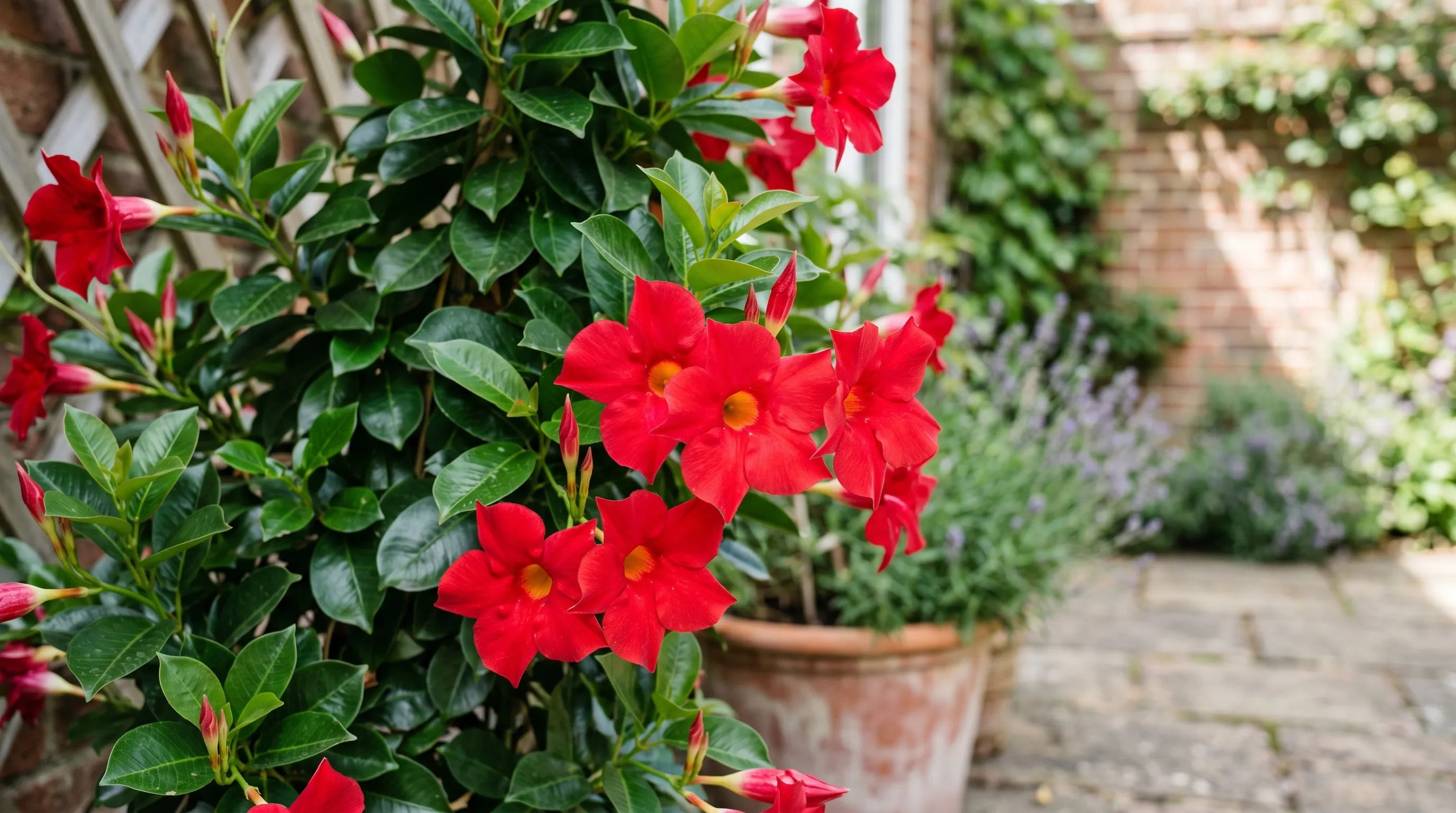 Sundaville Red in peak flowering on the Staffordshire patio. Most floriferous UK-available Mandevilla variety. Bright red trumpets attract hummingbird hawkmoths and large butterflies.
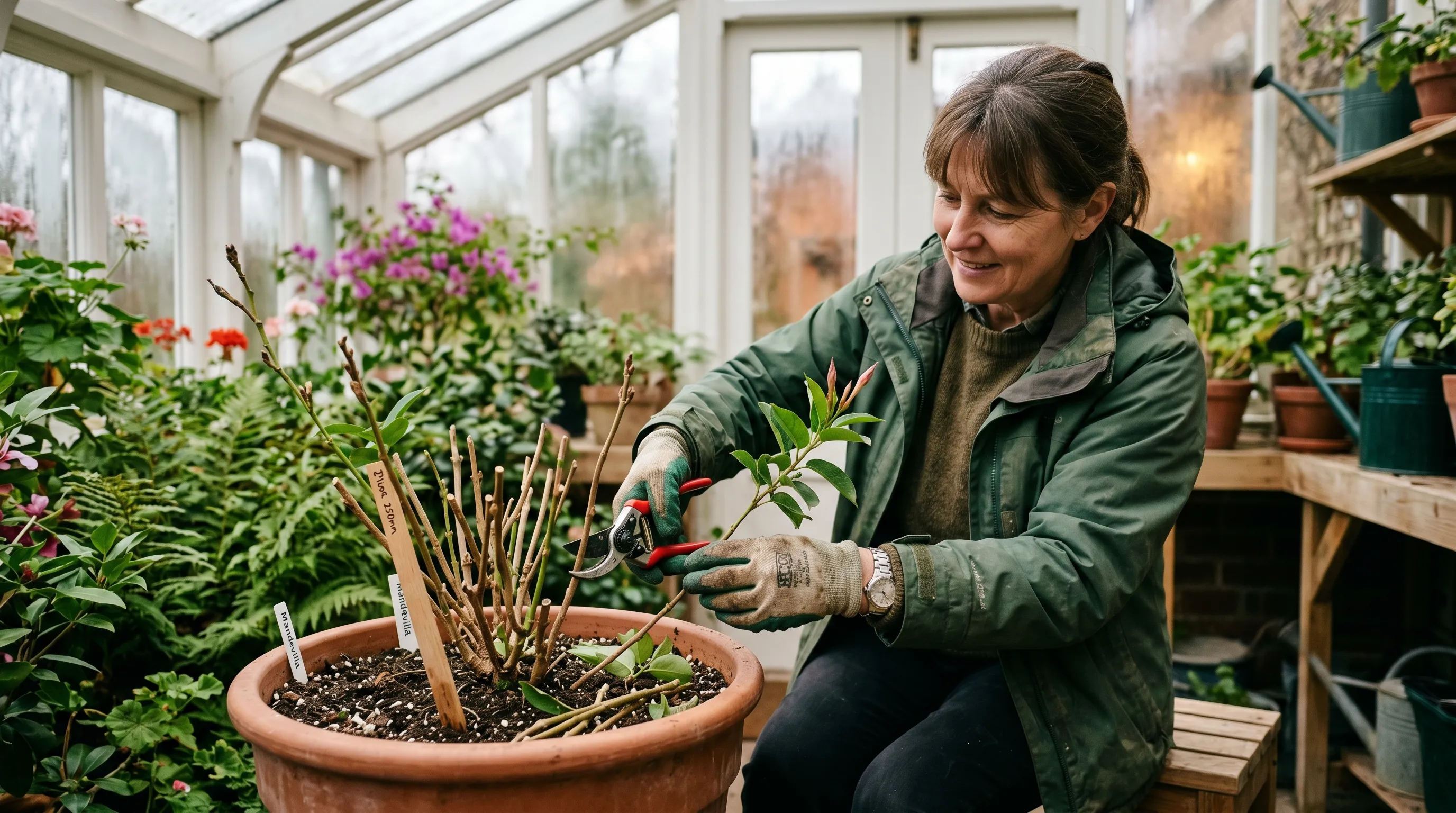 The critical March cut-back. All stems reduced to 200-300mm. Vigorous new growth from this cut produces 3-4x more flowers than unpruned plants across the following summer.
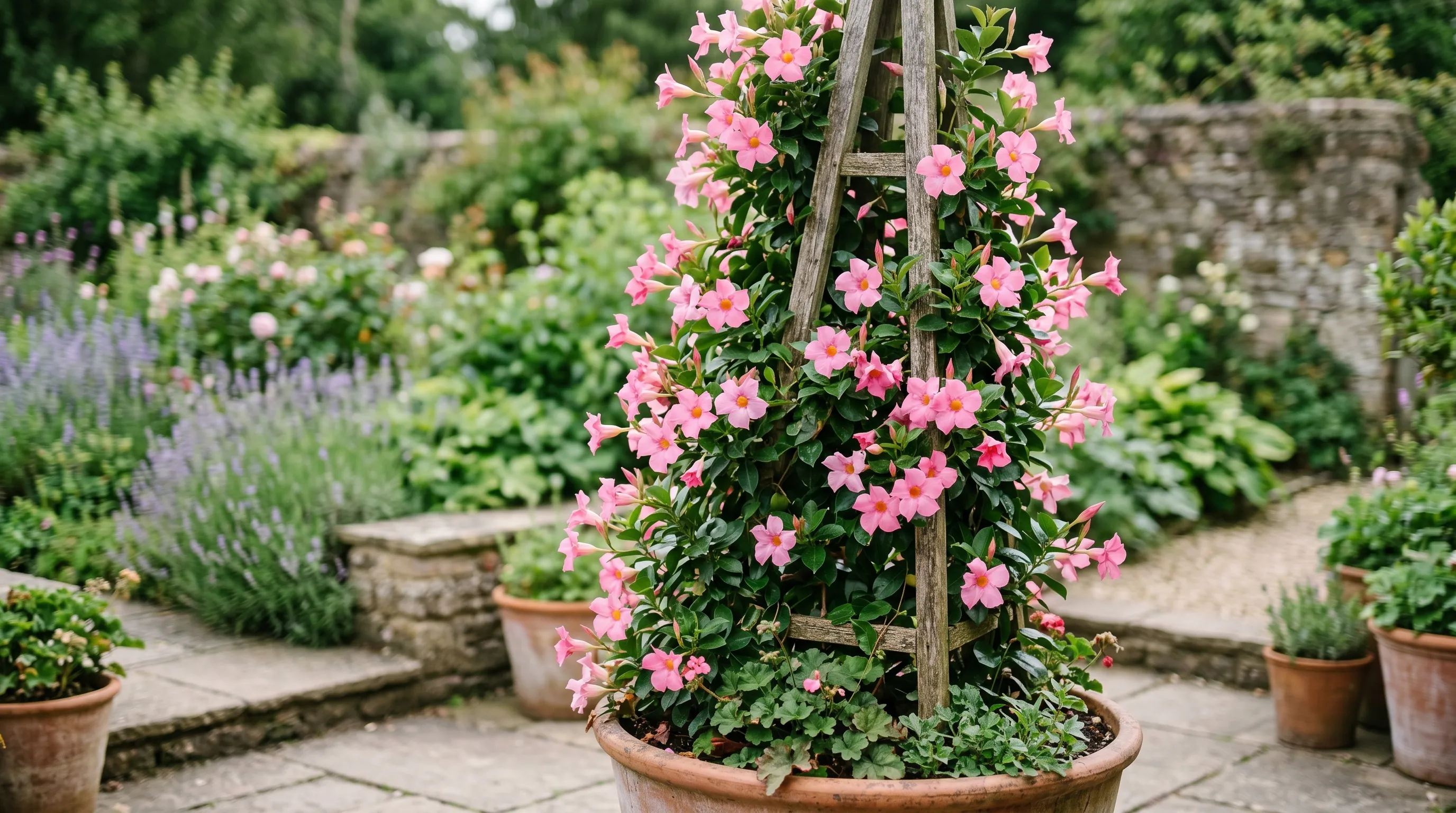 Alice du Pont trained on a 1.8m wooden obelisk on the Staffordshire patio. Twining stems work clockwise around the support. Provide structure from day 1 at planting.
Now plan the wider conservatory and patio palette
Mandevilla is one of several UK conservatory and patio climbers. Our best climbing plants UK guide covers hardy and tender options. For drought-tolerant patio companions, our drought guide covers low-water summer plants. To extend the conservatory interest into winter, our best winter flowering plants UK guide covers cool-season options. And for the wider tender plant overwintering across UK gardens, our hardening off bedding plants guide covers spring-out and autumn-in protocols.
Our team produces practical UK gardening guidance from source research, contributor records and established horticultural practice. Editorial standards are overseen by Matt W.