Key takeaways
- Jade plant is Crassula ovata, an evergreen succulent that can live 50+ years
- Give it 4 to 6 hours of direct sun on a south or west windowsill
- Water only when the compost has dried right out; overwatering is the number one killer
- Cut watering to once every 5 to 6 weeks in winter when the plant is near-dormant
- Not frost hardy: keep it above 10C and use a heavy terracotta pot so it cannot topple
Jade plant care is simpler than most people think, once you learn to water it far less than feels natural. The jade plant, or Crassula ovata, is an evergreen succulent that stores water in its thick glossy leaves. That water store makes it forgiving of neglect but quick to rot if it sits wet. Get the light and the watering right and this is a plant that lives for decades, growing slowly into a small tree.
What is a jade plant? Crassula ovata explained
Crassula ovata is a succulent shrub from the dry regions of South Africa and Mozambique. In the wild it grows into a rounded bush up to 2.5m tall. As a houseplant it stays smaller, usually 30cm to 1m, forming a thick trunk and a tree-like crown. It belongs to the genus Crassula, a large group of southern African succulents.
The plant goes by many names in the UK. You will see it sold as the money plant, money tree, lucky plant, friendship tree or dollar plant. The leaves are the giveaway: oval, smooth, jade-green and 30 to 50mm long, held on stubby branches. In strong light the leaf edges flush red, which is normal and healthy.
A jade plant is a slow but long-lived thing. Given the right care it can pass 50 years and become a family heirloom. Ours started as an 8cm cutting in 2011 and now stands 46cm tall. It is the kind of plant you grow once and keep for life. For a botanical cross-check on hardiness and size, the RHS entry for Crassula ovata is a useful reference.
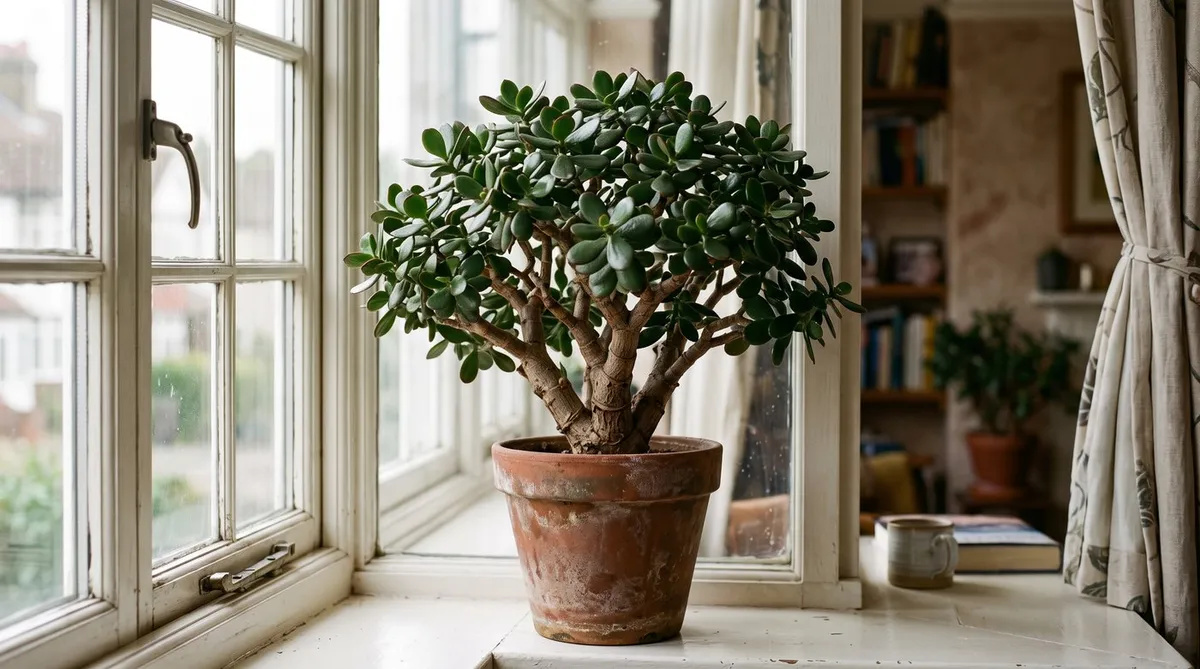
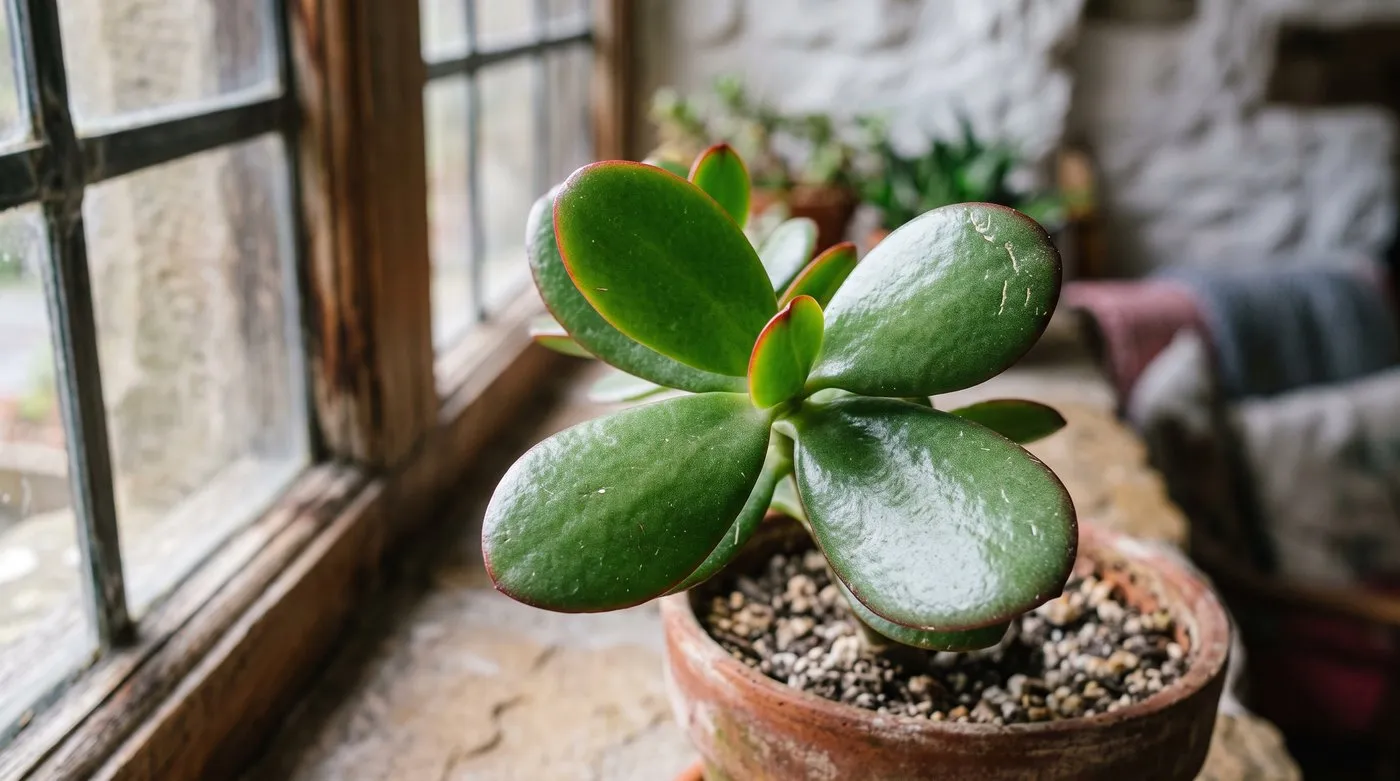 The thick, glossy oval leaves of Crassula ovata store water. The red edges show the plant is getting plenty of light, not that it is stressed.
Light and position for a healthy jade plant
A jade plant wants bright light with some direct sun. Aim for 4 to 6 hours of direct sun a day. In the UK a south or west-facing windowsill is the best spot. East-facing works if it gets a few hours of morning sun. A north window is too dark and the plant will suffer.
Light drives the whole look of the plant. In good light the stems stay short and thick, the leaves sit close together, and the edges take on a red tint. In poor light the opposite happens. The stems stretch, the gaps between leaves widen, and the whole plant grows pale and leans toward the glass.
Turn the pot a quarter turn every couple of weeks so it grows evenly. A plant left facing one way soon leans hard toward the light. If you only have a dim spot, a jade plant is the wrong choice. For darker rooms, look instead at our picks for the best low-light houseplants for UK homes.
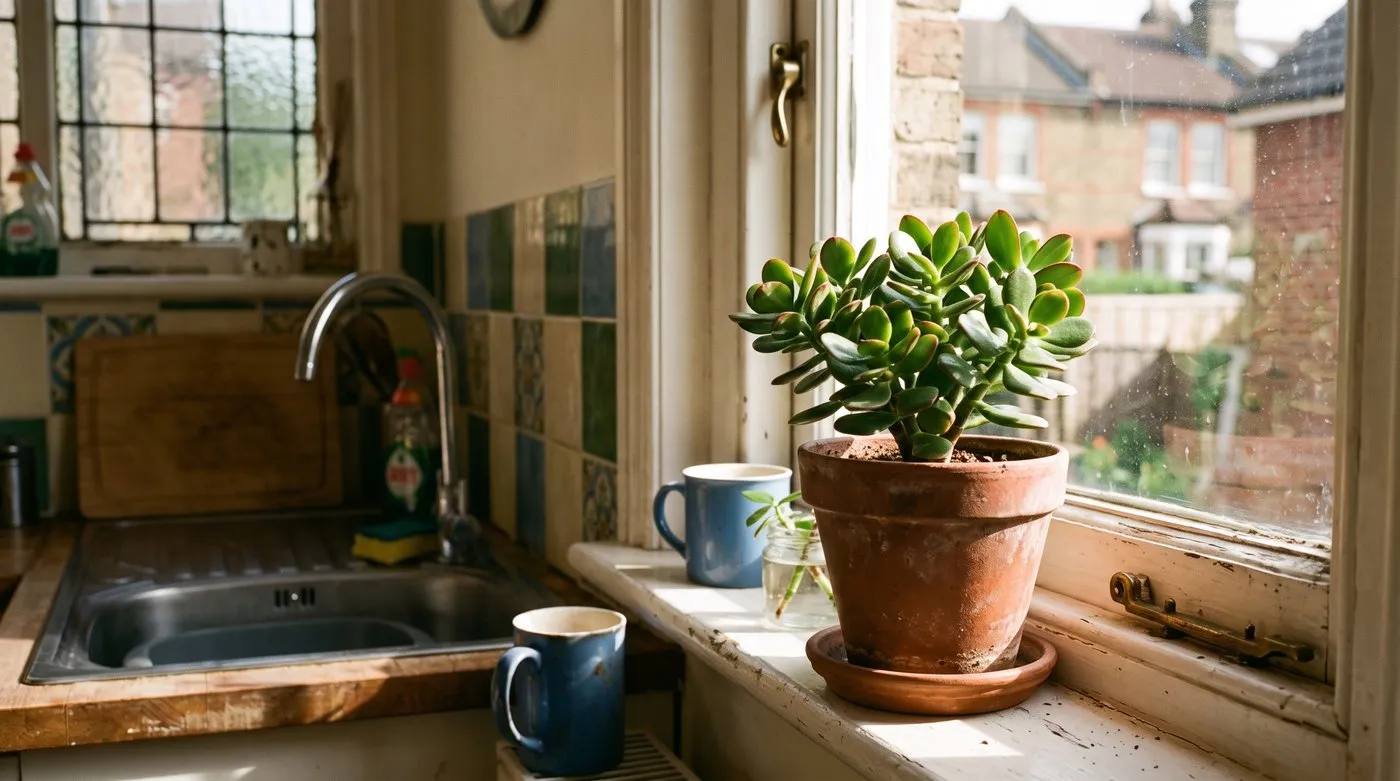 A jade plant on a south-facing kitchen windowsill in a Victorian terrace. Four to six hours of direct sun keeps the growth tight and the leaves richly coloured.
How to water a jade plant without killing it
Watering is where nearly every jade plant dies. The rule is simple: water only when the compost has dried right out. Then soak it thoroughly, let the pot drain fully, and wait until it is bone dry again. This soak-and-dry cycle mimics the plant’s native climate of brief rains and long droughts.
In practice, that means watering roughly every 10 to 14 days in summer and far less in winter. Push a finger 3cm into the compost. If you feel any moisture, wait. A jade plant would far rather be too dry than too wet. The leaves are its reservoir, so it copes with drought with ease.
The killer is winter watering. From November to February the plant is near-dormant and barely drinks. Cut watering right back to once every 5 to 6 weeks, and only a little each time. Cold, wet compost around dormant roots is the fast route to root rot. Never leave the pot standing in a saucer of water.
Warning: The most common way to kill a jade plant is overwatering in winter. Soft, yellowing, translucent leaves and a mushy stem base mean root rot has set in. By the time you see it, the roots are often already gone. When in doubt, do not water.
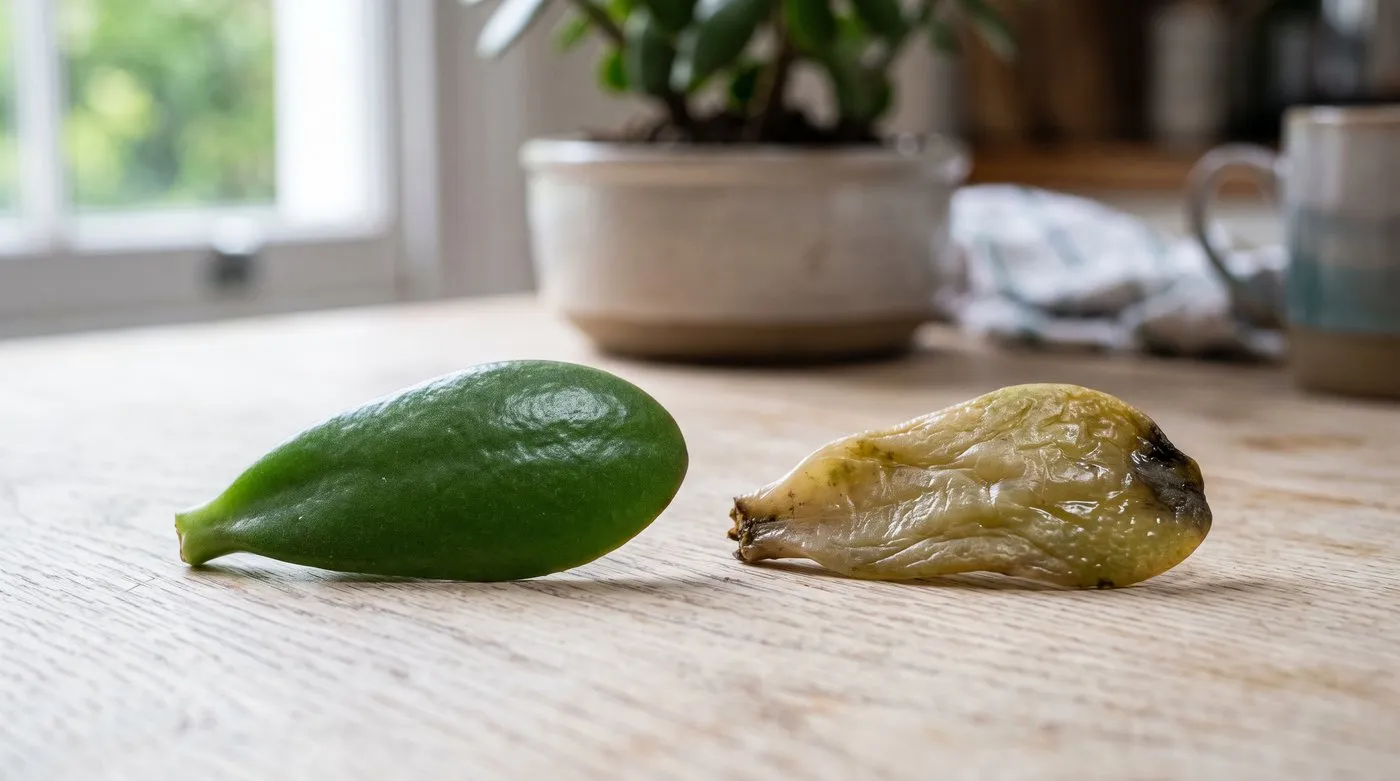 Left, a firm healthy leaf. Right, the soft, yellow, translucent look of overwatering and the start of root rot. Learn to tell them apart before you reach for the watering can.
The best compost and pot for Crassula ovata
A jade plant needs sharp drainage above all else. Standard multipurpose compost holds far too much water and stays soggy, which rots the roots. Use a gritty, free-draining mix. A shop-bought cactus and succulent compost works well, or make your own by mixing 2 parts multipurpose compost with 1 part horticultural grit or perlite.
The pot matters as much as the compost. A jade plant grows top-heavy, with a thick crown on a slim trunk. A light plastic pot tips over easily. Use a heavy terracotta pot instead. Terracotta is porous, so it wicks moisture from the compost and dries it faster, which suits this plant perfectly. Always pick a pot with drainage holes.
Do not rush to repot into a bigger pot. A jade plant likes to be slightly pot-bound and flowers better when its roots are snug. The same principles apply across most succulent houseplants, covered in our guide to caring for succulents indoors.
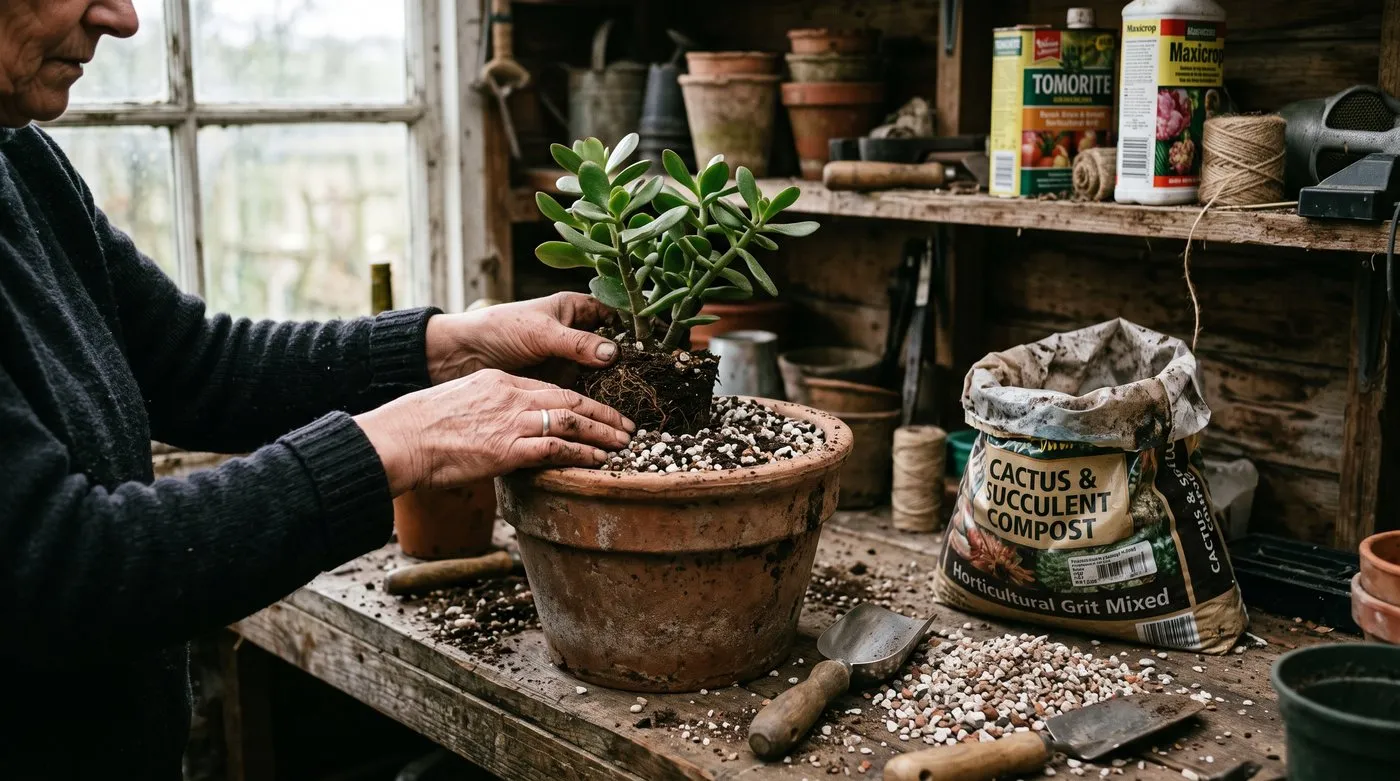 Potting a jade plant into a 2:1 gritty mix and a heavy terracotta pot. Sharp drainage and a stable pot are the two things that keep this plant alive for decades.
Diagnosing common jade plant problems
Most jade plant troubles show in the leaves, and each symptom points to a specific cause. The table below is the quickest way to read your plant. Match the symptom, act on the cause, and most issues reverse within a week or two.
| Symptom | Likely cause | Fix |
|---|---|---|
| Wrinkled, shrivelled leaves | Underwatered | Give a full soak; leaves replump in 2 to 4 days |
| Soft, yellow, translucent leaves + mushy stem | Overwatered, root rot | Stop watering; cut off rotted parts; take healthy cuttings |
| Leaves dropping off | Watering stress or a cold draught | Steady the watering; move away from cold windows and doors |
| Leggy, stretched stems, wide gaps | Too little light | Move to a south or west window with direct sun |
| Red edges on the leaves | Strong light | None needed; this is normal and healthy |
| Brown, dry, sunken spots | Sunburn after a sudden move | Acclimatise gradually to strong sun over 2 weeks |
The one that catches people out is leaf drop. A jade plant near a cold pane or a draughty door will shed leaves in winter even when watering is spot on. Move it 30cm back from the glass on frosty nights. If rot has already taken hold, do not try to save the roots. Snap off firm, healthy leaves and start again, which is how many old plants are rescued.
How to propagate a jade plant from a leaf or cutting
Few plants propagate as easily as a jade plant. You can grow a whole new plant from a single leaf, or a faster one from a stem cutting. The key step everyone skips is letting the cut end dry first. A fresh cut pushed straight into damp compost usually rots.
Take a healthy leaf or snip a stem 5 to 8cm long. Leave it on a windowsill for 3 to 7 days until the cut end forms a dry, hardened callus. This seals the wound and stops rot. Then lay the leaf on, or push the stem into, gritty compost. Water very sparingly, just a mist every few days, until roots form after a few weeks.
Gardener’s tip: Propagate in late spring or early summer when light and warmth are on your side. Callus the cuttings on a saucer, not in soil. Then pot them into barely-moist gritty mix and resist watering for a week. Damp compost on a fresh cut is the one reliable way to rot a cutting that would otherwise have rooted.
Getting a jade plant to flower
Most jade plants never flower, and the reason is comfort. Kept warm and watered all winter, the plant has no trigger to bloom. To get flowers you have to give it a proper cool, dry, bright winter rest. Do that, and a mature plant rewards you with clusters of small white or pink star-shaped flowers.
From late autumn, move the plant somewhere cool and bright at 10 to 13C. An unheated but frost-free room, a porch or a conservatory is ideal. Keep it in good light but water it only rarely, every 5 to 6 weeks. The cool nights and near-drought mimic the plant’s native winter and signal it to set flower buds.
Age matters too. A young plant rarely blooms. A plant of several years, snug in its pot, is far more likely to flower. Ours first bloomed in its seventh year after a cold conservatory winter. The parallel is the same trick used to flower a Christmas cactus: a cool, dry autumn rest is what sets the buds.
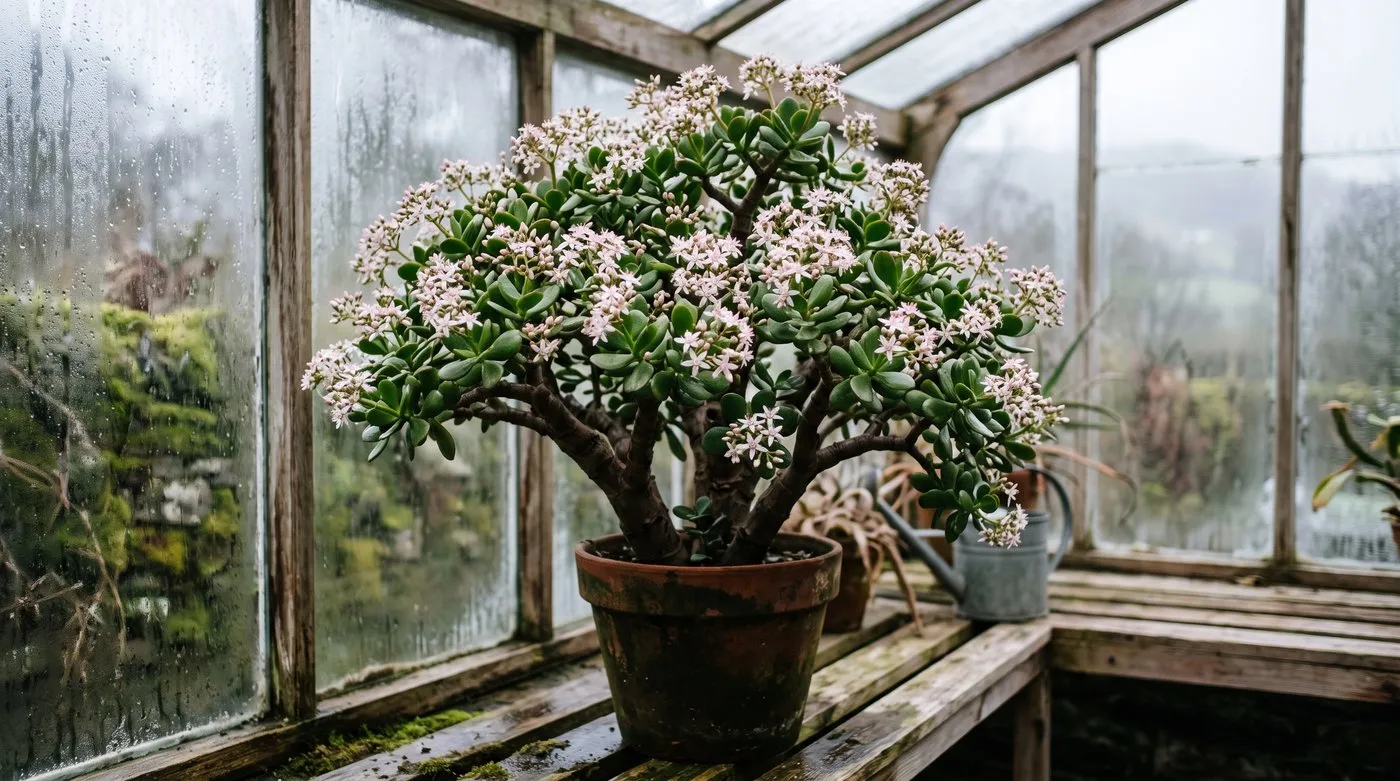 Clusters of small white star flowers on a mature jade plant. A cool, dry winter rest at 10 to 13C is what triggers this rare and welcome show.
Month-by-month jade plant care calendar
A jade plant’s year splits cleanly into a growing half and a resting half. Watering is the thing that changes most between them. This calendar sets out what to do and, just as often, what to leave well alone.
| Month | Task |
|---|---|
| January | Rest period. Water once, sparingly, only if leaves start to wrinkle. Keep cool and bright. |
| February | Still resting. Watch for flower buds if the plant has had a cool winter. Water very lightly. |
| March | Growth restarts. Increase watering slowly as the compost dries faster. Move back to a sunny window. |
| April | Repot now if needed, every 2 to 3 years only. Resume normal soak-and-dry watering. |
| May | Active growth. Feed monthly with a diluted cactus feed. Take cuttings as new stems firm up. |
| June | Peak growing season. Stand the plant outside in a sheltered, sunny spot if you wish. Best month to propagate. |
| July | Water every 10 to 14 days when the compost dries out. Watch for red leaf edges in strong sun. |
| August | Keep feeding monthly. Turn the pot for even growth. Enjoy the strong summer colour. |
| September | Bring outdoor plants back in before the nights cool. Reduce feeding. |
| October | Slow watering right down as growth stops. Last feed of the year early in the month. |
| November | Begin the winter rest. Move to a cool, bright 10 to 13C spot. Water every 5 to 6 weeks only. |
| December | Full dormancy. Barely water. Keep away from cold panes and radiators alike. |
Feeding is light work. A jade plant needs little, so a monthly diluted cactus feed from May to early October is plenty. Do not feed at all in winter. If you move the plant outside for summer, our guide to putting houseplants outdoors for summer covers acclimatising it to stronger light without scorch.
Repotting and keeping a top-heavy jade stable
A jade plant needs repotting only every 2 to 3 years, and it grows better slightly pot-bound. Repot in spring, as growth restarts, so the roots recover quickly. Move up just one pot size, no more. A pot that is too big holds a reservoir of wet compost the roots cannot use, which invites rot.
The real repotting challenge is balance. A mature plant carries a heavy crown on a slender trunk, so it is prone to toppling. This is why a heavy terracotta or stone pot earns its place. For very top-heavy specimens, sit a layer of gravel or a flat stone in the base to add ballast before you add compost.
Handle the plant gently, as the leaves and stems snap off easily. Any that break become free cuttings, so keep them. After repotting, wait a week before watering to let any damaged roots seal over. The same care over pot size and root disturbance applies to most houseplants, as set out in our guide to repotting houseplants.
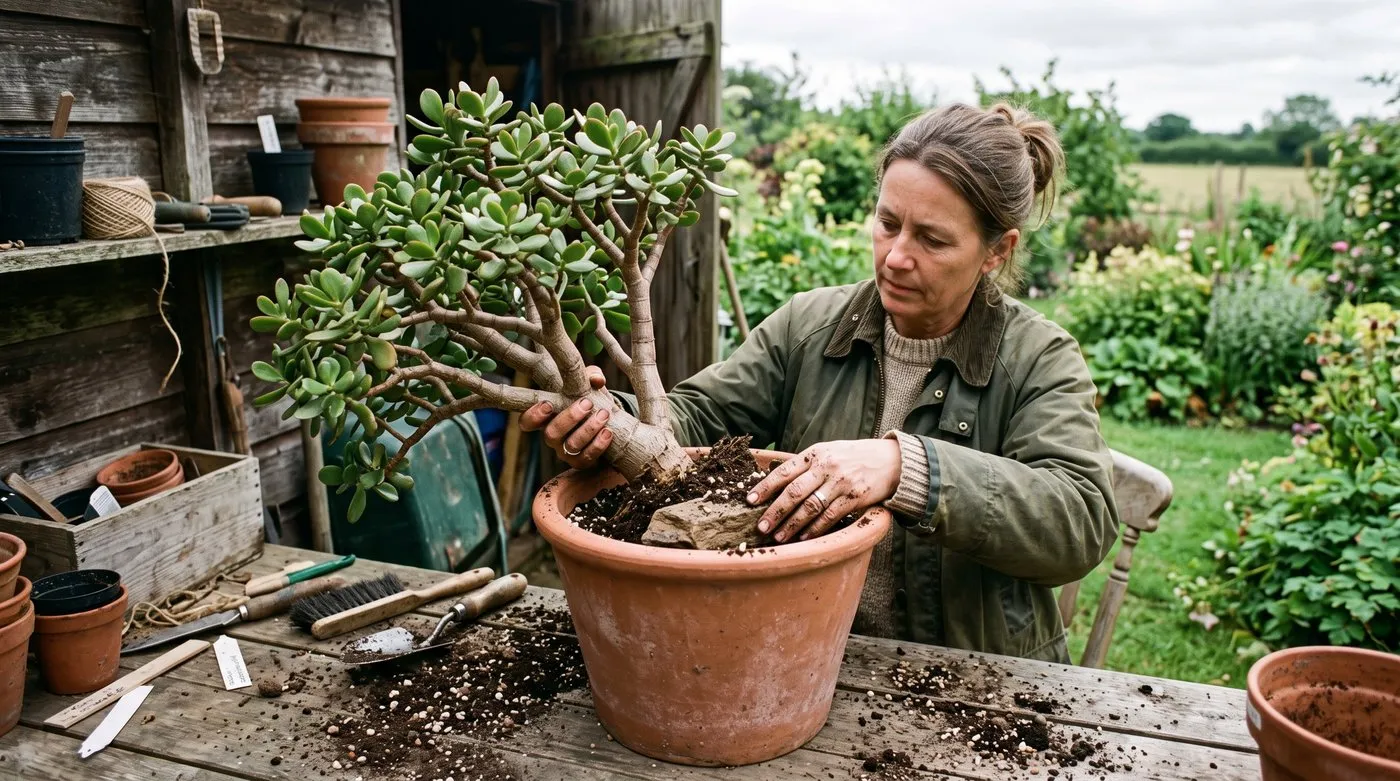 Repotting a top-heavy jade plant. A heavy terracotta pot and a stone in the base stop a mature specimen tipping over as the crown fills out.
Common mistakes with jade plants
- Overwatering, especially in winter. This kills more jade plants than everything else combined. The plant stores its own water and needs very little. Water only when the compost is fully dry, and cut right back to once every 5 to 6 weeks from November to February.
- Growing it in low light. A dim corner makes the plant stretch, pale and lean. It needs 4 to 6 hours of direct sun. If your brightest window still feels dark, this is not the plant for that spot.
- Using standard compost. Multipurpose compost holds too much water and stays soggy around the roots. Use a gritty cactus mix or add one part grit to two parts compost for the drainage this plant demands.
- Leaving it in a light plastic pot. A top-heavy jade tips over and the crown snaps. A heavy terracotta pot keeps it upright and dries the compost faster, which the plant prefers.
- Letting it sit in a cold draught. A plant pressed against a frosty window or by a draughty door sheds leaves. Keep it above 10C and move it 30cm back from cold glass on frosty nights.
Is a jade plant toxic to pets?
A jade plant is mildly toxic to cats and dogs. If a pet chews the leaves it can suffer vomiting, drooling and lethargy. The reaction is rarely life-threatening, but it is unpleasant, and some pets react more than others. Keep the plant out of reach of any cat or dog that nibbles houseplants.
Site the plant on a high windowsill or shelf where pets cannot browse it. If a pet does eat a good amount, or seems unwell afterwards, ring your vet for advice. For a fuller list, see our guides to plants toxic to cats and the wider risks across a home. It is worth checking every houseplant you bring in against that list.
The good news is that a jade plant is easy to place out of harm’s way. It is happiest up high in a bright window anyway, which is exactly where curious pets cannot reach it. For more ideas on safe, easy-care choices, browse our full range of houseplant and indoor plant guides.
Now you know how to keep a jade plant thriving for decades, read our guide to propagating houseplants for the next step in turning one plant into a whole windowsill collection.
Frequently asked questions
How often should I water a jade plant?
Water only when the compost has dried right out. In summer that is roughly every 10 to 14 days, and in winter every 5 to 6 weeks. Soak the pot, let it drain fully, then wait. Never leave the pot standing in a saucer of water, as cold wet compost causes root rot.
Why are my jade plant leaves going soft and wrinkly?
Wrinkled, shrivelled leaves mean the plant is underwatered. The leaves store water and deflate when the reserve runs low. Give it a thorough soak and they plump up within a few days. If the leaves are soft, yellow and translucent instead, that is overwatering and root rot, a very different problem.
How much light does a jade plant need in the UK?
A jade plant needs 4 to 6 hours of direct sun a day. A south or west-facing windowsill is ideal in the UK. In low light the stems stretch, grow pale and lean toward the glass. Some red colour on the leaf edges is normal in strong light and shows the plant is happy, not stressed.
Can a jade plant survive outside in the UK?
Only in summer, and never through a UK winter. Crassula ovata is not frost hardy and needs to stay above about 10C. Stand it outside in a sheltered, sunny spot from June to early September, then bring it back indoors before the nights turn cold. A single frost can turn the leaves to mush.
How do you propagate a jade plant?
Why won’t my jade plant flower?
Most jade plants never flower because they are kept too warm and watered in winter. To trigger flowering, give the plant a cool, bright, dry rest at 10 to 13C from late autumn. Clusters of small white or pink star flowers can then appear in late winter. A mature plant of several years is far more likely to bloom.
Is a jade plant poisonous to cats and dogs?
Yes, the jade plant is mildly toxic to cats and dogs. Eating the leaves can cause vomiting, drooling and lethargy. It is not usually life-threatening, but keep the plant out of reach of pets that chew houseplants. Contact a vet if a pet eats a large amount or seems unwell.
How long do jade plants live?
A well-kept jade plant can live for 50 years or more. Many become family heirlooms passed down through generations. The plant grows slowly into a small tree with a thick woody trunk. Ours has run since 2011 from a single cutting and shows no sign of slowing down.
Our team produces practical UK gardening guidance from source research, contributor records and established horticultural practice. Editorial standards are overseen by Matt W.