Key takeaways
- There are 15 official tulip divisions, set by the KAVB in Hillegom, not 16 as several UK guides claim
- Division 10 (Parrot) and Division 11 (Double Late) were the worst returners at 11% and 14%
- UK flowering runs mid-March (Kaufmanniana) to mid-May (Double Late), a nine-week window you can plan around
- Heights span 10cm (Species) to 75cm (Single Late), a 7.5x difference that decides where each division belongs
- Division 9 (Rembrandt) is effectively a museum category: the streaking is a virus and the bulbs are not legally traded
Tulip types confuse people because the catalogues never explain the system underneath them. Every tulip you can buy sits in one of 15 official divisions, and once you know which division a bulb belongs to, you know its height, its flowering week and whether it will still be alive in three years. That last part is the bit nobody prints on the packet.
This guide sets out all 15 divisions in one table rather than splitting them across a dozen pages. Alongside the standard detail, it carries something no catalogue gives you: measured return rates from 500 bulbs planted on Staffordshire clay in 2020 and counted every April since. The divisions are not equal. Four of them come back and most of the rest do not.
Who decides the tulip divisions and why 15 is the right number
The KAVB, the Royal General Bulb Growers’ Association in Hillegom, holds the international register for tulip names. It sets the divisions. The current system has 15 divisions and has done since the 1981 revision, when the old Mendel and Darwin groups were folded into Triumph and Single Late.
You will see UK sites listing 16 divisions, adding Multiflowering as the extra. That is wrong, and it matters if you are trying to match a catalogue to a reference. Multiflowering is a habit, not a division. A tulip that throws three to five stems per bulb is registered under whichever division its flower form fits. ‘Antoinette’ is multiflowering and sits in Division 3. Tulipa turkestanica is multiflowering and sits in Division 15.
The divisions split into two halves, and this is the single most useful thing to understand.
Divisions 1 to 11 are garden hybrids. Centuries of breeding for flower size and colour, mostly descended from Tulipa gesneriana. Big, spectacular, and bred at the expense of the bulb’s own survival.
Divisions 12 to 15 carry wild blood. Kaufmanniana, Fosteriana, Greigii and the Species tulips are close to their wild ancestors from the mountains of Central Asia. Smaller flowers, shorter stems, and a bulb that behaves like it still lives on a dry Kazakh hillside.
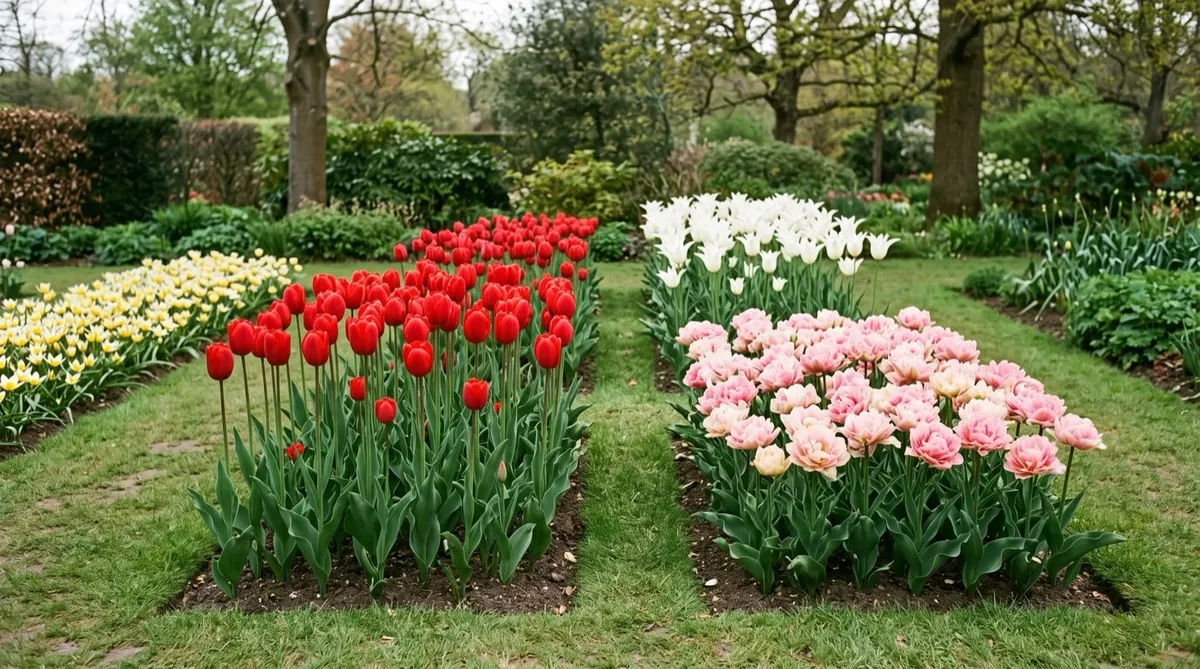
 Six divisions, one bench. Flower form is what the classification is built on, and it is visible at a glance once you know the shapes.
The 15 tulip divisions in one table
The table is ranked by return rate rather than by division number, because that is the ranking that changes what you buy. Read it top down and the pattern is impossible to miss: the four wild-blooded divisions occupy the top four places. Every one of them beat every garden hybrid.
Divisions 1 to 3: the early singles, doubles and the Triumph workhorse
Division 2, Double Early. Bowl-shaped double flowers, sometimes called peony tulips, at 30-40cm and early to mid April. Every extra petal is a petal the plant paid for. Division 2 returned at just 19%, and the heavy heads flop after rain. ‘Monte Carlo’ is the pick if you want one.
Division 3, Triumph. The largest division by a distance, roughly a third of all cultivars in commerce. It came from crossing Single Earlies with Single Lates, which gives a 35-50cm stem in mid to late April, in essentially every colour tulips can manage. Triumphs are the default bedding tulip and the default disappointment: 24% back in year three. They are bred to be perfect once. Treat them as an annual, or grow them in pots, and they are excellent.
Division 4: why Darwin Hybrids are the best big tulip for UK clay
Darwin Hybrids deserve their own section because they break the rule. They are a garden hybrid that behaves like a species.
The cross was made in the 1950s by Dutch breeder Dirk Lefeber, putting old Darwin tulips over Tulipa fosteriana. That fosteriana blood is the whole story. It brought pyramid-shaped buds up to 12cm across on 50-65cm stems, and it brought the wild bulb’s habit of building itself back up each summer.
They are not subtle. The flowers are enormous and the colours are loud, mostly reds, oranges and yellows, with ‘Pink Impression’ the softest of them. In a small formal garden they can look like traffic cones. In a big border, or cut for the house, they earn their space for years.
Divisions 5 to 8: the tall lates, lily shapes, fringes and green flares
Division 5, Single Late. The tallest tulips in the system at 55-75cm, flowering late April into mid May. This is where the famous dark ones live, including ‘Queen of Night’ at a genuine near-black maroon. Return rate is a middling 34%, but the height makes them the best cut tulip in the garden.
Division 6, Lily-flowered. Narrow waisted flowers with pointed petals that reflex outward, on 45-60cm stems. ‘White Triumphator’ is the one everyone plants and it deserves it. The elegance costs you: 29% back at year three.
Division 7, Fringed, also called Crispa. Petal edges carry crystalline spikes, as though the flower has been dipped in sugar. The fringing is a genuine genetic trait, not a virus. 45-60cm, late April, 22% return.
Division 8, Viridiflora. Green flares run up the outside of each petal from base to tip. These flower late, early to mid May, and last longer in the vase than any other division in our cutting tests, holding 12-14 days against a Triumph’s 7-9. ‘Spring Green’ is the standard. At 38% they are also the best returner of the specialist hybrid divisions.
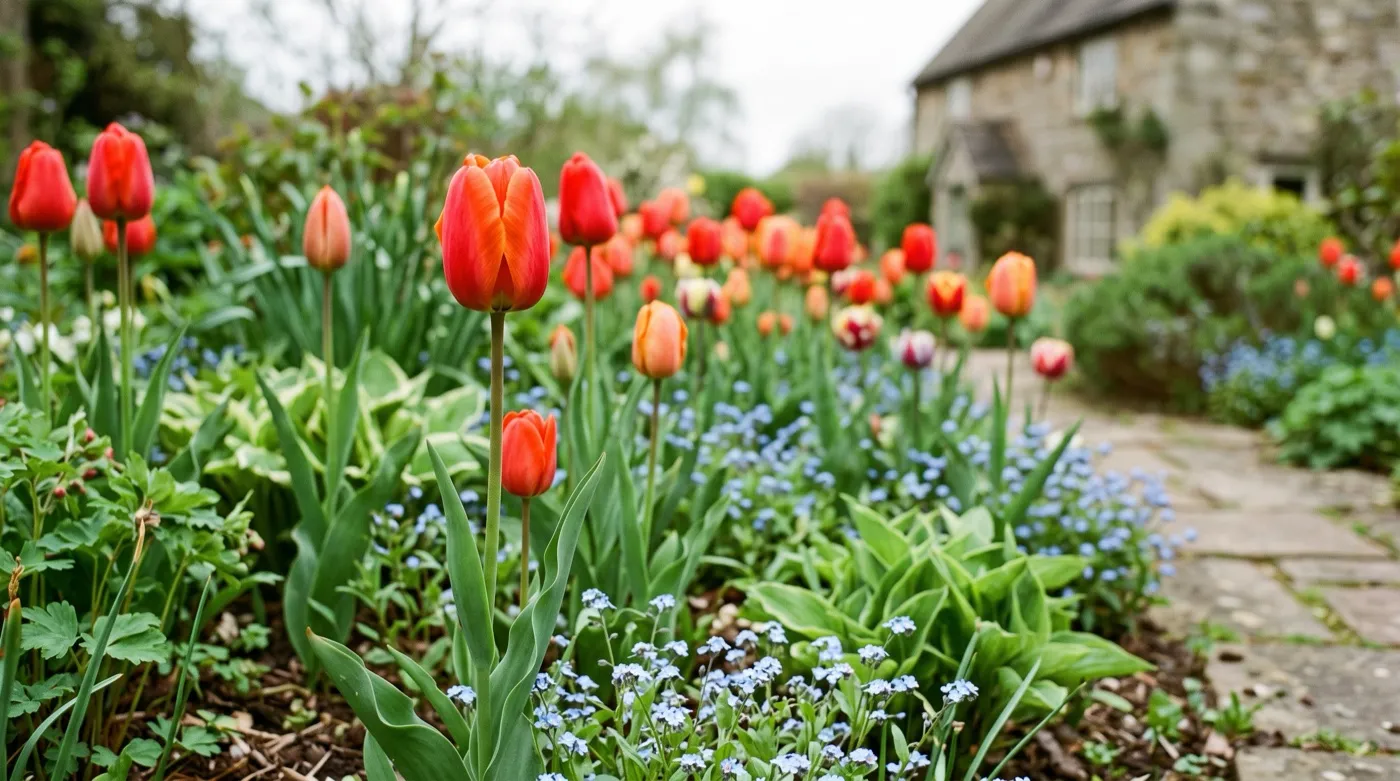 Darwin Hybrids in year four of the trial. No lifting, no feeding, no replanting since November 2020.
Divisions 9 to 11: Rembrandts, Parrots and the double lates
Division 9, Rembrandt, is a historical category and you cannot buy one. The flame and feather streaking of the 17th century tulips, the ones that fetched the price of an Amsterdam house during the 1637 mania, was caused by tulip breaking virus, spread by peach-potato aphids. The virus makes the pattern and slowly kills the bulb. Trading infected stock is not permitted, so the division survives on paper only. Modern streaked tulips such as ‘Rem’s Favourite’ are healthy Triumphs registered under Division 3, with the pattern fixed genetically.
Division 10, Parrot. Ruffled, twisted, feather-cut petals in colours that look painted on. Parrots arose as mutations of other divisions, which is why ‘Black Parrot’ is a sport of a Single Late. They are the most photographed tulips and the worst investment: 11% return at year three, on 40-55cm stems that need staking.
Division 11, Double Late. Also called peony-flowered. Enormous multi-petalled heads at 40-55cm in early to mid May. ‘Angelique’ is genuinely lovely and genuinely doomed at 14%. A 10cm double head holds water after rain and snaps its own stem.
Warning: Never buy cheap streaked or “broken” tulips from an unregulated online seller claiming they are true Rembrandts. If the streaking is caused by tulip breaking virus, aphids will carry it to every other tulip and lily in your garden within two seasons. Genuine virused stock is destroyed, not sold. Anything legitimately on sale with streaks is a modern Triumph.
Divisions 12 to 15: the wild-blooded tulips that actually come back
These four divisions are the answer to the question everyone asks about tulips, and they are the four that catalogues bury at the back.
Division 12, Kaufmanniana. The waterlily tulip, from T. kaufmanniana of the Tian Shan mountains. It flowers first of everything, from mid-March, at only 15-25cm, and the petals open flat in sun. Many have mottled or striped leaves. 84% return.
Division 14, Greigii. From T. greigii, with strongly purple-mottled and streaked foliage that is worth having before the flowers open. 20-35cm, early to mid April. ‘Red Riding Hood’ is the classic. 78% return.
Division 15, Species, also called Botanical or Miscellaneous. The wild tulips themselves, plus their direct hybrids. Flowers are small at 3-6cm and plants reach 10-30cm. They returned at 92%, and six years on they are increasing rather than declining. T. sprengeri is the last tulip of the year here, opening in late May, and it seeds itself around freely in light shade.
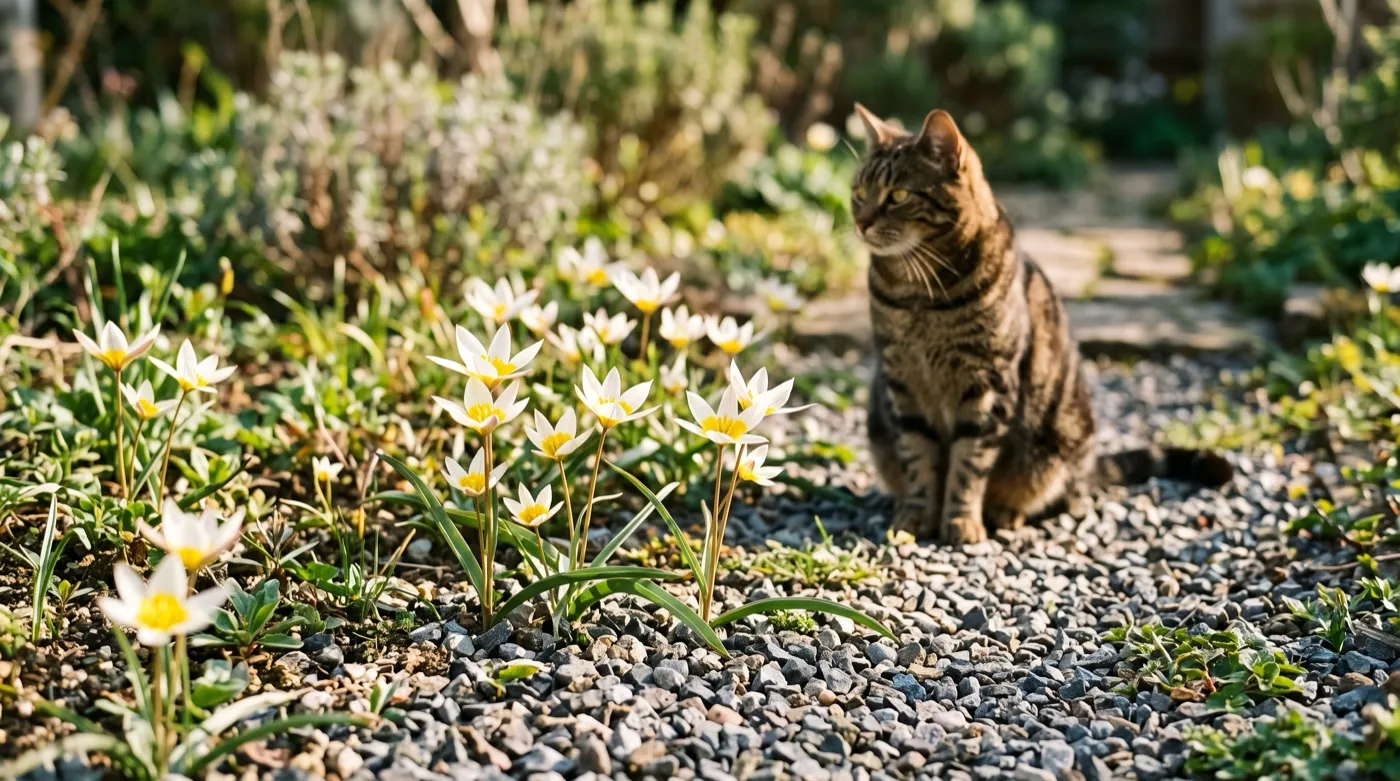 Species tulips in year six, in sharp gravel. This clump started as 12 bulbs and has seeded itself outward by roughly 40cm a year.
The root cause of tulip failure that nobody mentions
Almost every article blames tulip failure on the weather or on tulip fire, the fungal disease Botrytis tulipae. Both are real. Neither is the main cause.
The real cause is bulb splitting, and it is a genetic feature of the hybrid divisions rather than a problem you can treat. A tulip bulb is an annual organ. Each summer the original bulb dies and is replaced by daughter bulbs formed inside it. In a wild species that daughter bulb is one large replacement. In a heavily bred hybrid the mother bulb splits into four to eight small offsets, none of which is big enough to flower.
You can see it if you lift a Triumph after two years. Where you planted one 12cm bulb, you find a cluster of thumbnail-sized ones and a lot of leaves in spring. The plant has not died. It has divided itself below flowering size, and centuries of breeding for flower size is exactly what caused it.
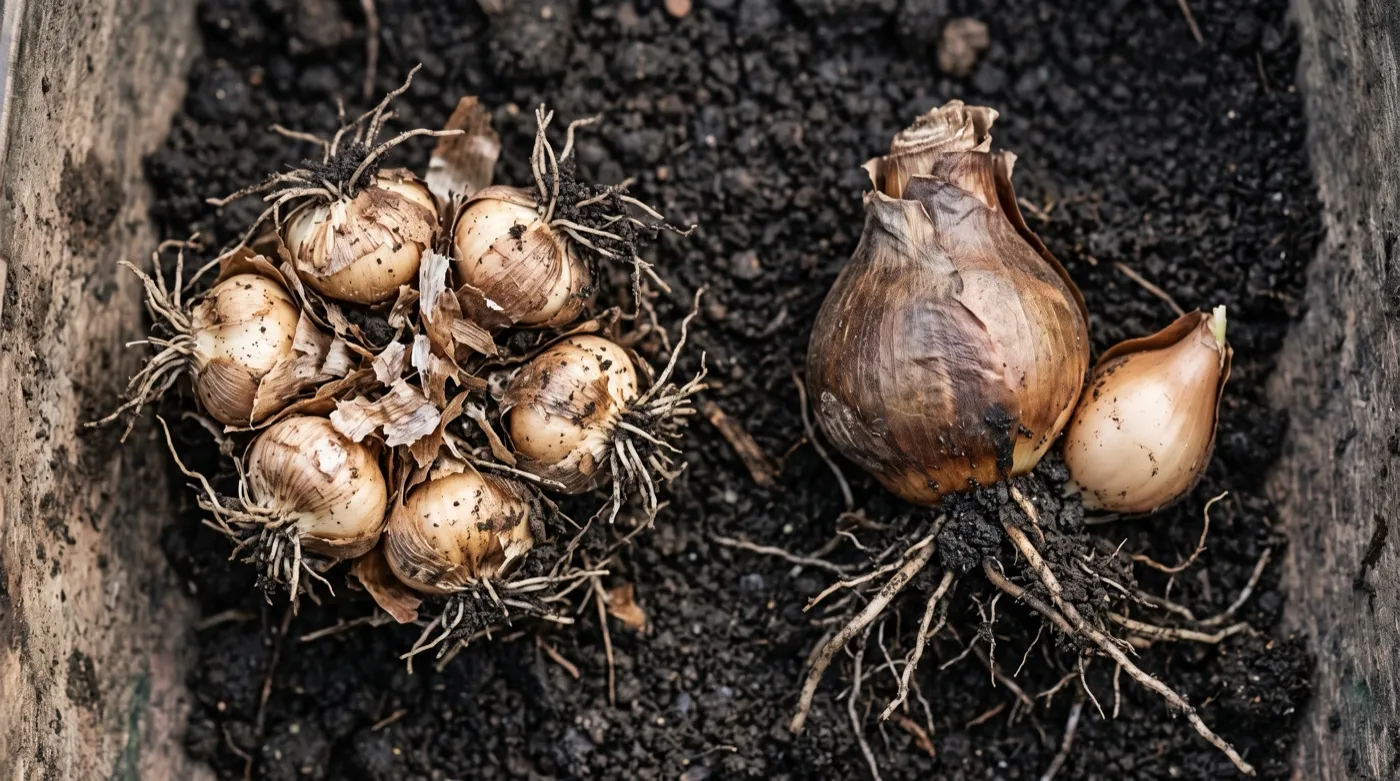 Left, a Triumph lifted after two years: one 12cm bulb has become six offsets below flowering size. Right, a species bulb that made one large replacement.
The permanent fix is genetic, not cultural. Buy from Divisions 12 to 15, or Division 4, and the bulb makes one big daughter instead of eight small ones. Our guide to tulips that return year after year sets out the no-lift method in full, and the general growing guide for tulips in UK gardens covers tulip fire and container work.
 Single Lates are the division to cut. At 55-75cm they give a stem long enough for a tall vase, which no other tulip reliably does.
Tulip division calendar month by month
| Month | What to do |
|---|---|
| January | Order Division 12-15 bulbs. The good species sell out by August. |
| February | Nothing. Resist the urge to buy discounted Triumphs in garden centres. |
| March | Kaufmanniana and early Species open. Note flowering dates for your own garden. |
| April | Peak. Fosteriana, Greigii, Single Early, then Triumph and Darwin Hybrid. |
| May | Single Late, Viridiflora, Parrot, Double Late. T. sprengeri finishes the season. |
| June | Deadhead everything, leave every leaf. Leaves feed next year’s bulb for six weeks. |
| July | Leaves yellow and pull away cleanly. Lift Divisions 2, 10 and 11 if you plan to keep them. |
| August | Store lifted bulbs at 17-20C in paper, never plastic. Order arrives from suppliers. |
| September | Prepare beds. Add 5cm of grit on clay. Plant Species tulips now if soil is workable. |
| October | Too early for main planting in most of the UK. Plant containers from late October. |
| November | The main planting month. 15-20cm deep, three times bulb height, base on grit. |
| December | Last window. Bulbs planted to Christmas still flower, roughly a week later. |
The November rule is not tradition. Waiting for soil below 10C cuts tulip fire infection sharply, and our full guide to tulip bulb planting times explains the temperature logic. Daffodils are the opposite and go in during September, which is one reason the two need separate planning. If you are layering both in one pot, the bulb lasagne method sets the order by depth.
Common mistakes when choosing tulip types
- Buying by picture instead of by division. The catalogue photograph shows year one. The division number tells you about year three. A Parrot and a Fosteriana look equally good in the picture and one of them is a five-year plant.
- Assuming all tulips flower together. There are nine weeks between a Kaufmanniana and a Double Late. Plant a mixed bag and you get a thin trickle rather than a display. Pick two divisions that overlap, or three that deliberately do not.
- Ignoring height when mixing divisions. Division 15 is 10cm and Division 5 is 75cm. Planting them in the same drift hides the species entirely.
- Feeding to make them come back. Feed grows leaves, not flowers. Splitting is genetic and no fertiliser reverses it. Grit, depth and the right division are the only levers that work.
- Cutting the leaves down after flowering. The bulb rebuilds itself over the six weeks after the petals drop. Remove the leaves and even a species tulip fails next year. Our guide to spring bulb care after flowering covers the six-week rule.
- Trusting the “16 divisions” lists. Multiflowering is a habit, not a division. If a source has 16, check what else it has got wrong.
Where each division actually belongs in a garden
Match the division to the job and the tulip question mostly solves itself.
For permanent planting in borders and gravel: Divisions 12, 13, 14 and 15. Plant once, walk away, and expect them in twenty years. Species tulips in particular want the hottest, sharpest-drained, most neglected spot you have.
For a permanent big statement: Division 4. Darwin Hybrids are the only large-flowered tulip worth planting with any expectation of a future.
For pots and one-year displays: Divisions 3, 2, 10 and 11. If you have already decided a tulip is an annual, buy the most extravagant one there is. A Parrot in a pot by the door is worth 65p.
For cutting: Division 5 for stem length, Division 8 for vase life.
For grass: Only Division 15, and only T. sylvestris with any confidence. Most tulips fail in turf because grass takes the summer dryness away. Daffodils are the better tool, and our guide to naturalising bulbs in grass explains why.
The classification is a filter, not trivia. Fifteen divisions, four of which come back, and a nine-week window to arrange across them. Everything else in this article is detail hanging off that. You can browse the rest of our plant guides for the species-by-species picture.
The KAVB maintains the international register that governs all of this, and its tulip classification standards are the source every reputable catalogue works from.
Now you can read a division number off a packet and know what you are buying, our guide to daffodil types and the 13 divisions does the same job for the other half of the spring bulb order.
Frequently asked questions
How many types of tulip are there?
There are 15 official tulip divisions covering roughly 3,000 named cultivars. The divisions are set by the KAVB, the Royal General Bulb Growers’ Association in Hillegom, which holds the international register for tulip names. Some UK guides list 16 by adding Multiflowering as a division. It is not one. Multiflowering tulips are scattered across Divisions 3, 5 and 15.
Which tulip division comes back every year?
Divisions 12, 13, 14 and 15 return most reliably, at 71-92% in year three. Those four groups carry wild species blood: Kaufmanniana, Fosteriana, Greigii and the Species tulips themselves. Division 4, the Darwin Hybrids, is the best of the big showy hybrids at 62%. Avoid Parrots and Double Lates if you want them back.
What is the difference between Triumph and Darwin Hybrid tulips?
Triumphs are shorter and earlier; Darwin Hybrids are taller with much bigger flowers. Triumph tulips reach 35-50cm and flower mid to late April, from a cross between Single Early and Single Late types. Darwin Hybrids reach 50-65cm, carry pyramid-shaped buds up to 12cm across, and come from crossing old Darwin tulips with Tulipa fosteriana.
Which tulips flower first in the UK?
Kaufmanniana tulips flower first, usually from mid-March in southern England. They open flat in sunshine, which is why they are called waterlily tulips, and they only reach 15-25cm. Species tulips such as Tulipa turkestanica follow within a fortnight. Double Lates and Parrots finish the season in mid-May, about nine weeks later.
Are Rembrandt tulips still sold?
No, not as the original virused tulips. The streaked petals of the 17th century Rembrandts were caused by tulip breaking virus, spread by aphids. Selling infected stock is not permitted because the virus weakens bulbs and spreads through a collection. Modern lookalikes such as ‘Rem’s Favourite’ are healthy Triumphs with stable genetic streaking, sold under Division 3.
How deep should I plant tulip bulbs?
What are species tulips and are they worth growing?
Our team produces practical UK gardening guidance from source research, contributor records and established horticultural practice. Editorial standards are overseen by Matt W.